Open Access
Validation of the 8th AJCC Cancer Staging System for Pancreas Neuroendocrine Tumors Using Korean Nationwide Surgery Database
Original Article
Purpose
The 8th edition of the American Joint Committee on Cancer (AJCC) staging system for pan- creatic neuroendocrine tumor (PNET) included several significant changes. We aim to eval- uate this staging system compared to the 7th edition AJCC staging system and European Neuroendocrine Tumors Society (ENETS) system.
Materials and Methods
We used Korean nationwide surgery database (2000-2014). Of 972 patients who had undergone surgery for PNET, excluding patients diagnosed with ENETS/World Health Orga- nization 2010 grade 3 (G3), only 472 patients with accurate stage were included.
Results
Poor discrimination in overall survival rate (OSR) was noted between AJCC 8th stage III and IV (p=0.180). The disease-free survival (DFS) curves of 8th AJCC classification were well separated between all stages. Compared with stage I, the hazard ratio of II, III, and IV was 3.808, 13.928, and 30.618, respectively (p=0.007, p < 0.001, and p < 0.001). The curves of OSR and DFS of certain prognostic group in AJCC 7th and ENETS overlapped. In ENETS staging system, no significant difference in DFS between stage IIB versus IIIA (p=0.909) and IIIA versus IIIB (p=0.291). In multivariable analysis, lymphovascular invasion (p=0.002), perineural invasion (p=0.003), and grade (p < 0.001) were identified as independent prog- nostic factors for DFS.
Conclusion
This is the first large-scale validation of the AJCC 8th edition staging system for PNET. The revised 8th system provides better discrimination compared to that of the 7th edition and ENETS TNM system. This supports the clinical use of the system.
Key words
Validation, Neoplasm staging, Pancreatic neuroendocrine tumor
Yunghun You,
MD1,aJin-Young Jang,
MD, PhD2Song Cheol Kim,
MD, PhD3Yoo-Seok Yoon,
MD, PhD4Joon Seong Park,
MD, PhD5Chol Kyoon Cho,
MD, PhD6Sang-Jae Park,
MD, PhD7Jae Do Yang,
MD, PhD8Woo Jung Lee,
MD, PhD9Tae Ho Hong,
MD, PhD10Keun Soo Ahn,
MD, PhD11Chi-Young Jeong,
MD, PhD12Hyeon Kook Lee,
MD, PhD13Seung Eun Lee,
MD, PhD14Young Hoon Roh,
MD, PhD15Hee Joon Kim,
MD16Hongbeom Kim,
MD2,17In Woong Han,
MD, PhD18*A list of author’s aliations appears at the end of the paper.
+ + + + + + + + + + + + + + + + + + + + + + + + + + + + + + + + + + + + + + + + + + + + + + + + + + + + + + + + + + + + + + + + + + + + + + + + + + + + + + + + + + + + + + + + + + + + + + + + + + + + + + + + + + + + + + + + + + + + + + + + + + + + + + + + + + + + + + + + + + + + + + + + + + + + + + + + + + + + + + + + + + + + + + + + + + + + + + + + + + + + + + + + + + + + + + + + + + + + + + + + + + + + + + + + + + + + + + + + + + + + + + + + + + + + + + + + + + + + + + + + + + + + + + + + + + + + + + + + + + + + + + + + + + + + + + + + + + + + + + + + + + + + + + + + + + + + + + + + + + + + + + + + + + + + + + + + + + + + + + + + + + + + + + + + + + + + + + + + + + + + + + + + + + + + + + + + + + + + + + + + + + + + + + + + + + + + + + + + + + + + + + + + + + + + + + + + + + + + + + + + + + + + + + + + + + + + + + + + + + + + + + + + + + + + + + + + + + + + + + + +
Correspondence: In Woong Han, MD, PhD Department of Surgery, Samsung Medical Center, Sungkyunkwan University School of Medicine, 81 Irwon-ro, Gangnam-gu, Seoul 06351, Korea
Tel: 82-2-3410-0772 Fax: 82-2-3410-6980
E-mail: [email protected]
Received January 10, 2019 Accepted April 17, 2019 Published Online April 19, 2019
*Yunghun You and Jin-Young Jang contributed equally to this work.
aPresent address: Department of Surgery, Samsung Medical Center, Sungkyunkwan University School of Medicine, Seoul, Korea
Introduction
Pancreatic neuroendocrine tumors (PNET) account for less than 2% of total pancreatic cancer [1] and about 10% of tumor arising from pancreas [2]. Rare incidence and indolent bio- logic behavior have made it difficult to understand disease entity and establish staging tools for this disease [3,4]. How- ever, the development of imaging technology in recent deca- des has led to sharp increase in incidence and prevalence [5].
In fact, a proposal for a TNM classification to help stratify the prognosis was not made until 2006 by Rindi et al. [6]. This proposal was ultimately adopted by European Neuroen- docrine Tumors Society (ENETS) and has been validated in the subsequent studies [7-12]. Meanwhile, the American Joint Committee on Cancer (AJCC) staging system for PNET was first isolated from exocrine pancreatic adenocarcinoma stag- ing system in 2010 based on studies by Bilimoria et al. [13].
The same classification criteria as in exocrine pancreatic ade- nocarcinoma were applied to PNET in this study. After that, numerous studies have evaluated the suitability of the AJCC 7th classification [12,14-16]. Of these, two large cohort studies [7,14] have shown that the proportion of patients in stage III of the AJCC 7th edition, which is classified as unresectable case, is relatively small. In particular, poor discrimination between stage II and III was reported by Rindi et al.’s inves- tigation [7]. Furthermore, many studies have raised ques- tions about whether it is appropriate to apply pancreatic adenocarcinoma staging to PNET with other biological char- acteristics [7,11,14,17,18]. These findings support the need for revision of the AJCC 7th system for PNET.
As a result, the newly revised AJCC 8th staging system introduces the classification criteria asserted by ENETS and shows several significant changes (Tables 1-3). At first, PNET staging system has come out separate system and applied to the only G1 (ENETS/World Health Organization [WHO]
2010 grade 1), G2 (ENETS/WHO 2010 grade 2), and well-dif- ferentiated G3 tumors (ENETS/WHO 2010 grade 3) [19]. The remaining poorly differentiated G3 (ENETS/WHO 2010 grade 3) neuroendocrine carcinoma follows staging of exo- crine pancreatic cancer. Second, the size of the tumor has become an important criterion to distinguish the T category and invasion of soft tissue around the pancreas was excluded from staging criteria. Third, adjacent organs invasion has been categorized as T4 category, together with unresectable cases such as major vascular invasion. Fourth, M1 category has been subsided according to metastatic sites.
However, several studies have been published that ques- tion whether the ENETS system should be accepted as a new staging system [7,10,11]. In particular, stage IIIB (any T N1 M0) has a relatively better prognosis than IIIA (T4 N0 M0) in these studies. In fact, the AJCC 8th manual does not distin-
guish between specific substages (IIA vs. IIB and IIIA vs. IIIB) unlike ENETS system. In addition, defining adjacent organ invasion and major vascular invasion as the same T4 has an unnatural aspect in that it may confuse the concept of “resec- table” or “unresectable.”
Given these, we aim to validate the AJCC 8th staging sys- tem in the present study. For this purpose, survival curves were compared according to AJCC 7th, AJCC 8th system, and ENETS system. In addition, multivariate analysis was performed to determine the effect of each system on progno- sis.
Materials and Methods
1. Patients and data collection
Using Korean Tumor Registry System–Biliary Pancreas (KOTUS-BP) and Korean Pancreas Surgery Club (KPSC) database, 972 patients who underwent surgery for PNET during 2000-2014 were identified. Seventeen Korean cancer centers provided data on PNET. Data from following centers was prospectively collected from electronic medical records and retrospectively reviewed: Seoul National University Col- lege of Medicine (n=302), Asan Medical Center (n=228), Sam- sung Medical Center (n=175), Seoul National University Bundang Hospital (n=82), Yonsei University College of Med- icine (n=65), Gangnam Severance Hospital (n=33), Chonnam National University Hwasun Hospital (n=23), Seoul St. Mary's Hospital (n=17), Keimyung University Dongsan Medical Center (n=12), National Cancer Center (n=9), Chung-Ang University Hospital (n=5), Ewha Womans University Mok- dong Hospital (n=5), Gyeongsang National University Hos- pital (n=5), Chonbuk National University Medical School (n=4), Chonnam National University Medical School (n=3), Dong-A University Hospital (n=3), and Dongguk University Ilsan Hospital (n=1). Of these patients, 500 (51.4%) were excluded, including 409 (42.1%) with no acquired lymph nodes, 36 (3.7%) with insufficient information to define T cat- egory and M category according to AJCC and ENETS classi- fications, 14 (1.4%) whose tumor grade was not analyzed, one (0.1%) without follow-up data and 40 (4.1%) with G3 tumor grade. The remaining 472 patients (214 males and 258 females) with a median age of 54.7 years were enrolled in this study.
Variables collected for the database included age at diag- nosis, gender, type of surgery, tumor size, location, adjacent organs invasion, margin status, lymphovascular invasion (LVI), perineural invasion (PNI), ENETS-WHO 2010 tumor grading [19], mitotic count, Ki67 index, and tumor stage by
Table 1. The definition of AJCC 7th, 8th staging and the ENETS staging for pancreatic neuroendocrine tumor
AJCC, American Joint Committee on Cancer; ENETS, European Neuroendocrine Tumors Society. a)Adjacent structures include stomach, spleen, colon, adrenal gland, or the wall of large vessels (celiac axis or the superior mesenteric artery),
b)Extrahepatic sites include lung, ovary, nonregional lymph node, peritoneum, and bone).
AJCC 7th staging classification AJCC 8th staging classification
T1 Limited to the pancreas, Tumor limited to the pancreas, < 2 cm
2 cm in greatest dimension
T2 Limited to the pancreas, Tumor limited to the pancreas, 2-4 cm
> 2 cm in greatest dimension
T3 Beyond the pancreas but without involvement Tumor limited to the pancreas, > 4 cm,
of the superior mesenteric artery or invading the duodenum or common bile duct T4 Involvement of the celiac axis or Tumor invades adjacent structuresa)
uperior mesenteric artery (unresectable tumor)
N0 No regional lymph node metastasis No regional lymph node metastasis
N1 Regional lymph node metastasis Regional lymph node metastasis
M0 No distant metastasis No distant metastasis
M1 Distant metastasis Distant metastasis
M1a Metastasis confined to liver
M1b Metastasis in at least one extrahepatic siteb)
M1c Both hepatic and extrahepatic metastases
AJCC 7th prognostic stage groups AJCC 8th and ENETS prognostic stage groups
Stage T N M Stage T N M
IA T1 N0 M0 I T1 N0 M0
IB T2 N0 M0 II (A)a) T2 N0 M0
IIA T3 N0 M0 II (B)a) T3 N0 M0
IIB T1-3 N1 M0 III (A)a) T4 N0 M0
III T4 Any N M0 III (B)a) Any T N1 M0
IV Any T Any N M1 IV Any T Any N M1
AJCC, American Joint Committee on Cancer; ENETS, European Neuroendocrine Tumors Society. a)Stage II (A/B) and III (A/B) are only used in ENETS system.
Table 2. Prognostic stage groups based on AJCC 7th, 8th staging and the ENETS staging
Table 3. Cross-tabulation presenting cancer staging distributions
AJCC, American Joint Committee on Cancer.
AJCC 8th I AJCC 8th II AJCC 8th III AJCC 8th IV
AJCC 7th I 167 141 0 0
AJCC 7th II 0 69 73 0
AJCC 7th III 0 0 3 0
AJCC 7th IV 0 0 0 19
7th AJCC classification [20]. In order to validation of 8th AJCC and ENETS classification, restaging was performed.
To achieve this, data on tumor size and adjacent organs involved were used. Special attention has been given to the registration of pathologic reports analyzed in our database according to ENETS/WHO 2010 grading. If information on the tumor grade is missing, each center is requested to sup- plement and achieve it as much as possible. The overall sur- vival time was defined as the time from the first diagnostic date to the date of death or last known follow-up. Recur- rence-free survival time was measured from the date of ini- tial diagnosis until recurrence.
2. Statistical analysis
Overall survival rate (OSR) and disease-free survival rate (DFS) analyses were conducted using Kaplan-Meier curves.
In order to access staging classification, log-rank tests were used. To identify independent prognostic factors, Cox pro- portional hazards regression was performed in multivariable analysis. The p-value less than 0.05 indicate statistical signif- icance. Statistical analyses were conducted using the PASW Statistics ver. 23.0 (IBM Corp., Armonk, NY).
Table 4. Clinical and pathological features of PNET
(Continued)
Variable No. (%) (n=472)
Age (yr) 55.5 (15.0-78.0)
Sex
Male 214 (45.4)
Female 258 (54.6)
Operation
Pancreaticoduodenectomy 210 (44.4)
Distal pancreatectomy 179 (37.9)
Central pancreatectomy 15 (3.1)
Enucleation 44 (9.3)
Othersa) 24 (5.3)
Type of operation
Open 328 (69.5)
Laparoscopic 137 (29.0)
Robotic 7 (1.5)
Tumor size (cm) 3.0±2.1
Tumor location 469b)
Head only 257 (54.8)
Body-tail only 207 (44.1)
Head and body-tail or diffuse 5 (1.1) Resection margin status
R0 443 (93.8)
R1 10 (2.1)
R2 19 (4.1)
Lymphovascular invasion 92 (19.5)
Perineural invasion 83 (17.6)
Grade (ENETS/WHO 2010)
G1 319 (67.6)
G2 153 (32.4)
AJCC 7th T category
T1 177 (37.5)
T2 157 (33.3)
T3 134 (28.4)
T4 4 (0.8)
AJCC 8th T category
T1 177 (37.5)
T2 149 (31.6)
T3 130 (27.5)
T4 16 (3.4)
AJCC 7th & 8th N category
N0 392 (83.1)
N1 80 (16.9)
AJCC 7th M category
M0 453 (96.0)
M1 19 (4.0)
AJCC 8th M category 466b)
M0 453 (97.3)
M1a 10 (2.1)
M1b 0 (
M1c 3 (0.6)
Table 4. Continued
PNET, pancreatic neuroendocrine tumor; ENETS, Euro- pean Neuroendocrine Tumors Society; WHO, World Health Organization; AJCC, American Joint Committee on Cancer. a)Twelve cases with total pancreatectomy, 10 cases with open pancreatic biopsy and 2 cases of hepatopancre- atoduodenectomy, b)No. of valid PNETs, c)Stage II (A/B) and III (A/B) are only used in ENET system.
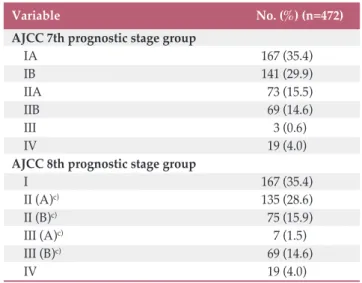
Variable No. (%) (n=472)
AJCC 7th prognostic stage group
IA 167 (35.4)
IB 141 (29.9)
IIA 73 (15.5)
IIB 69 (14.6)
III 3 (0.6)
IV 19 (4.0)
AJCC 8th prognostic stage group
I 167 (35.4)
II (A)c) 135 (28.6)
II (B)c) 75 (15.9)
III (A)c) 7 (1.5)
III (B)c) 69 (14.6)
IV 19 (4.0)
3. Ethical statement
This study was approved by Institutional Review Board of Samsung Medical Center, Seoul, Republic of Korea (approval number: 2017-12-107). Because the study was based on ret- rospective analysis using existing medical records, informed consent was not required.
Results
1. Patient characteristics
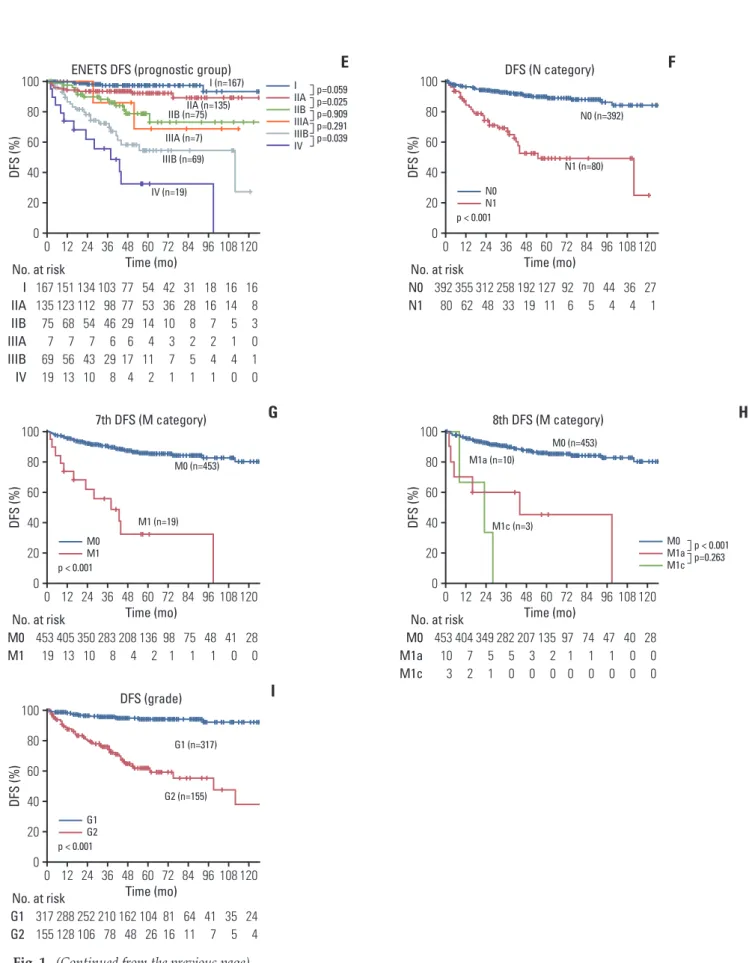
Patient characteristics of the 472 patients are summarized in Table 4. Pancreaticoduodenctomy and distal pancreatec- tomy were performed in 210 (44.4%) and 179 (37.9%), respec- tively. Minimally invasive surgery, including laparoscopic and robotic surgery was conducted in 144 (30.5%). More than Fig. 1. Kaplan-Meier survival analysis of disease-free survival (DFS) according to T category of American Joint Committee on Cancer (AJCC) 7th edition (A), T category of AJCC 8th edition (B), 7th AJCC prognostic group (C), 8th AJCC prognostic group (D), European Neuroendocrine Tumors Society (ENETS) prognostic group (E), N category (F), 7th M category (G), 8th M category (H), and Grade (ENETS/World Health Organization [WHO] 2010) (I). (Continued to the next page)
A
T1T2 T3T4
p=0.002 p < 0.001 p=0.071
T4 (n=4) T3 (n=134)
T2 (n=157) T1 (n=177)
DFS (%)
100
0 20 40 60
0 12 24 36 48Time (mo)60 72 84 96108120 80
177 157 134 4
158 142 112 3
108 110 69 2
80 83 45 1
54 56 25 1 140
130 86 2
42 39 16 0
31 32 12 0
18 19 11 0
16 17 7 0
16 10 2 0 T1
T2 T3 T4 No. at risk
7th DFS (T category) 8th DFS (T category)
B
T1T2 T3T4
p=0.007 p < 0.001 p=0.037
T4 (n=16) T3 (n=130)
T2 (n=149)
DFS (%)
100
0 20 40 60
0 12 24 36 48Time (mo)60 72 84 96108120 80
177 149 130 16
158 136 109 12
108 105 66 9
75 81 41 7
54 55 22 5 140
124 83 11
42 38 13 4
31 31 10 3
18 18 9 3
16 16 7 1
16 9 3 0 T1
T2 T3 T4 No. at risk
T1 (n=177)
C
IAIB IIAIIB III IV
p=0.018 p=0.204 p=0.005 p=0.276 p=0.896
IV (n=19) III (n=3)
IIB (n=69) IIA (n=73)
IA (n=167)
DFS (%)
100
0 20 40 60
0 12 24 36 48Time (mo)60 72 84 96108120 80
167 141 73 69 3 19
151 126 67 56 2 13
104 102 46 30 1 8
77 78 32 20 1 4
54 53 16 12 1 2 132
116 54 44 2 10
42 36 12 8 0 1
31 28 9 6 0 1
18 16 8 5 0 1
16 14 5 5 0
0 16 8 2 2 0 0 IA
IB IIA IIB III IV No. at risk
7th DFS (prognostic group) 8th DFS (prognostic group)
D
III IIIIV
p=0.003 p < 0.001 p=0.020
IV (n=19) III (n=76)
II (n=210)
DFS (%)
100
0 20 40 60
0 12 24 36 48Time (mo)60 72 84 96108120 80
167 210 76 19
151 191 63 13
104 144 35 8
77 106 25 4
54 67 15 2 134
166 50 10
69 46 10 2
31 36 7 1
17 23 6 1
16 19 5 0
16 11 0 0 I
II III IV No. at risk
I (n=167) IB (n=141)
Fig. 1. (Continued from the previous page)
DFS (N category)
F
N0N1 p < 0.001
N1 (n=80)
DFS (%)
100
0 20 40 60
0 12 24 36 48Time (mo)60 72 84 96108120 80
392 80
355 62
258 33
192 19
127 11 312
48
92 6
70 5
44 4
36 4
27 1 N0
N1 No. at risk
N0 (n=392)
E
IIIA IIBIIIA IIIBIV
p=0.059 p=0.025 p=0.909 p=0.291 p=0.039
IV (n=19) IIIB (n=69)
IIIA (n=7)
DFS (%)
100
0 20 40 60
0 12 24 36 48Time (mo)60 72 84 96108120 80
167 135 75 7 69 19
151 123 68 7 56 13
103 98 46 6 29 8
77 77 29 6 17 4
54 53 14 4 11 2 134
112 54 7 43 10
42 36 10 3 7 1
31 28 8 2 5 1
18 16 7 2 4 1
16 14 5 1 4
0 16 8 3 0 1 0 I
IIA IIB IIIA IIIB IV No. at risk
ENETS DFS (prognostic group)
IIA (n=135) I (n=167) IIB (n=75)
7th DFS (M category)
G
M0M1 p < 0.001
M1 (n=19)
DFS (%)
100
0 20 40 60
0 12 24 36 48Time (mo)60 72 84 96108120 80
453 19
405 13
283 8
208 4
136 2 350
10
98 1
75 1
48 1
41 0
28 0 M0
M1 No. at risk
M0 (n=453)
DFS (grade)
I
G1G2 p < 0.001
G2 (n=155)
DFS (%)
100
0 20 40 60
0 12 24 36 48Time (mo)60 72 84 96108120 80
317 155
288 128
210 78
162 48
104 26 252
106
81 16
64 11
41 7
35 5
24 4 G1
G2 No. at risk
G1 (n=317)
8th DFS (M category)
H
M0M1a M1c
p < 0.001 p=0.263 M1c (n=3)
M1a (n=10)
DFS (%)
100
0 20 40 60
0 12 24 36 48Time (mo)60 72 84 96108120 80
453 10 3
404 7 2
282 5 0
207 3 0
135 2 0 349
5 1
97 1 0
74 1 0
47 1 0
40 0 0
28 0 0 M0
M1a M1c
No. at risk
M0 (n=453)
half of the patients had tumors located in the pancreatic head. The mean value of tumor size was 3.0±2.1 cm. Curative resection was achieved in 443 (93.8%). The proportion of LVI and PNI were 19.5% and 17.6%, respectively. The number of patients with G1 (n=319) nearly doubled compared to G2 (n=153). The median or mean number of lymph nodes dis- sected were 2 (0-65) and 5.1±8.4, respectively. Lymph node involvement was developed in 80 (16.9%). According to the 7th AJCC staging classification, only 4 (0.8%) was T4 cate- gory and 3 (0.6%) had prognostic stage group III. In 8th AJCC
edition, the number of patients with T4 and prognostic stage group of III increased to 16 (3.4%) and 76 (16.1%), respec- tively. Among 472, the median time of follow-up was 54 months (25th to 75th percentiles, 39-147). The cumulative OSR at 5 years and 10 years was 92.4% and 79.4%, respec- tively. The cumulative DFS was 83.5% at 5 years and 76.4%
at 10 years.
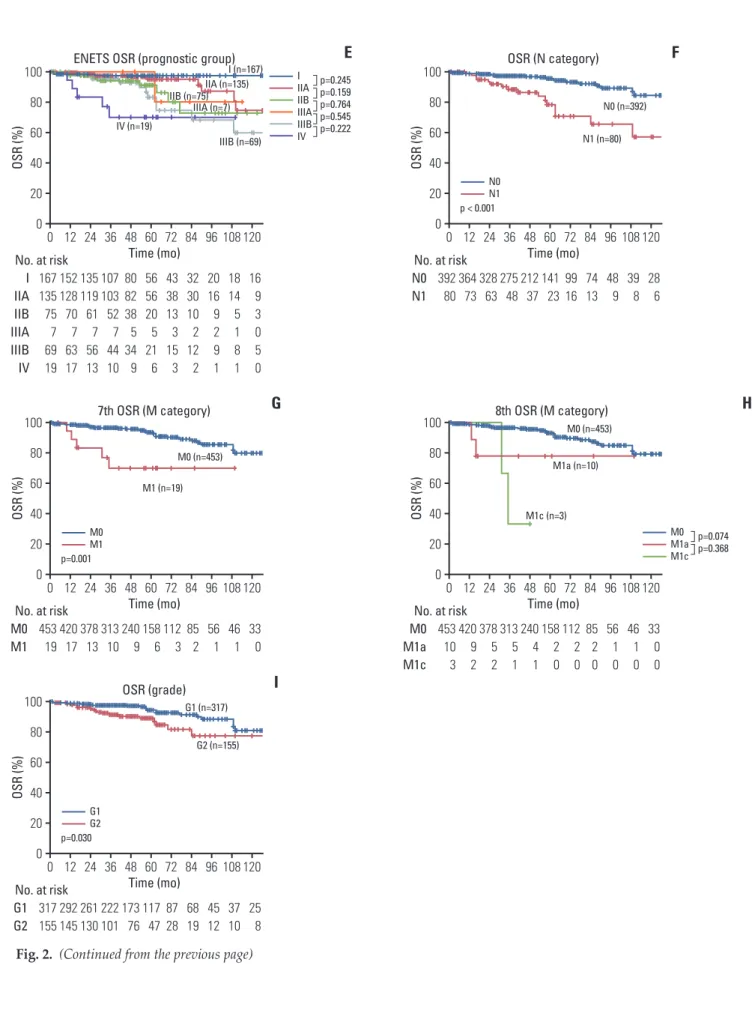
Fig. 2. Kaplan-Meier survival analysis of overall survival rate (OSR) according to T category of American Joint Committee on Cancer (AJCC) 7th edition (A), T category of AJCC 8th edition (B), 7th AJCC prognostic group (C), 8th AJCC prognostic group (D), European Neuroendocrine Tumors Society (ENETS) prognostic group (E), N category (F), 7th M category (G), 8th M category (H), and grade (ENETS/World Health Organization [WHO] 2010) (I). (Continued to the next page)
A
T1T2 T3T4
p=0.128 p=0.012 p=0.718
T4 (n=4) T3 (n=134)
T2 (n=157)
OSR (%)
100
0 20 40 60
0 12 24 36 48Time (mo)60 72 84 96108120 80
177 157 134 4
160 149 124 4
112 120 87 4
84 94 68 3
57 63 42 2 142
139 106 4
44 44 26 1
32 35 20 0
20 21 16 0
18 17 12 0
16 11 6 0 T1
T2 T3 T4 No. at risk
7th OSR (T category) 8th OSR (T category)
B
T1T2 T3T4
p=0.095 p=0.046 p=0.568 T3 (n=130)
T2 (n=149)
OSR (%)
100
0 20 40 60
0 12 24 36 48Time (mo)60 72 84 96108120 80
177 149 130 16
160 142 119 15
112 114 85 12
84 90 64 11
57 60 38 9 142
133 102 14
44 41 25 5
32 32 20 3
20 18 16 2
18 16 11 2
16 10 7 0 T1
T2 T3 T4 No. at risk
C
IAIB IIAIIB III IV
p=0.276 p=0.124 p=0.536 p=0.365 p=0.983 IV (n=19)
III (n=3)
IIB (n=69) IIA (n=73)
IA (n=167) IB (n=141)
OSR (%)
100
0 20 40 60
0 12 24 36 48Time (mo)60 72 84 96108120 80
167 141 73 69 3 19
152 134 68 63 3 17
107 108 51 44 3 11
80 58 21 34 2 9
56 40 21 22 1 6 135
124 60 56 3 13
43 36 13 16 0 3
32 28 9 13 0 2
20 16 8 10 0 1
18 14 5 9 0 1
16 8 2 6 0 0 IA
IB IIA IIB III IV No. at risk
7th OSR (prognostic group) 8th OSR (prognostic group)
D
III IIIIV
p=0.069 p=0.071 p=0.180 IV (n=19)
III (n=76) II (n=210)
OSR (%)
100
0 20 40 60
0 12 24 36 48Time (mo)60 72 84 96108120 80
167 210 76 19
152 198 70 17
107 155 51 10
78 120 40 9
56 76 26 6 135
180 63 13
43 51 18 3
32 39 14 2
20 25 11 1
18 19 9 1
16 12 5 0 I
II III IV No. at risk
T1 (n=177)
T4 (n=16)
T1 (n=177)
I (n=167)
Fig. 2. (Continued from the previous page)
F
N0N1 p < 0.001
N1 (n=80)
OSR (%)
100
0 20 40 60
0 12 24 36 48Time (mo)60 72 84 96108120 80
392 80
364 73
275 48
212 37
141 23 328
63
99 16
74 13
48 9
39 8
28 6 N0
N1 No. at risk
E
IIIA IIBIIIA IIIBIV
p=0.245 p=0.159 p=0.764 p=0.545 p=0.222 IV (n=19)
IIIB (n=69)
OSR (%)
100
0 20 40 60
0 12 24 36 48Time (mo)60 72 84 96108120 80
167 135 75 7 69 19
152 128 70 7 63 17
107 103 52 7 44 10
80 82 38 5 34 9
56 56 20 5 21 6 135
119 61 7 56 13
43 38 13 3 15 3
32 30 10 2 12 2
20 16 9 2 9 1
18 14 5 1 8
1 16 9 3 0 5 0 I
IIA IIB IIIA IIIB IV No. at risk
ENETS OSR (prognostic group)
IIA (n=135) I (n=167)
7th OSR (M category)
G
M0M1 p=0.001
M1 (n=19)
OSR (%)
100
0 20 40 60
0 12 24 36 48Time (mo)60 72 84 96108120 80
453 19
420 17
313 10
240 9
158 6 378
13
112 3
85 2
56 1
46 1
33 0 M0
M1 No. at risk
M0 (n=453)
OSR (grade)
I
G1G2 p=0.030
G2 (n=155)
OSR (%)
100
0 20 40 60
0 12 24 36 48Time (mo)60 72 84 96108120 80
317 155
292 145
222 101
173 76
117 47 261
130
87 28
68 19
45 12
37 10
25 8 G1
G2 No. at risk
G1 (n=317)
8th OSR (M category)
H
M0M1a M1c
p=0.074 p=0.368 M1c (n=3)
M1a (n=10)
OSR (%)
100
0 20 40 60
0 12 24 36 48Time (mo)60 72 84 96108120 80
453 10 3
420 9 2
313 5 1
240 4 1
158 2 0 378
5 2
112 2 0
85 2 0
56 1 0
46 1 0
33 0 0 M0
M1a M1c
No. at risk
M0 (n=453) IIIA (n=7)
IIB (n=75)
OSR (N category)
N0 (n=392)
2. DFS according to each staging system and tumor grade
As shown in Fig. 1A, there is no significant difference in DFS between AJCC 7th T3 versus T4 (p=0.071). By contrast, regarding AJCC 8th T category, significant difference was shown between all T categories (Fig. 1B). Regarding prog- nostic stage groups, some of the DFS curves of 7th AJCC clas- sification overlapped (IB vs. IIA, p=0.204; IIB vs. III, p=0.276;
and III vs. IV, p=0.896) (Fig. 1C). By contrast, DFS curves of 8th AJCC classification were well separated between all stages (Fig. 1D). Compared with stage I, the hazard ratio (HR) of II, III, and IV was 3.808, 13.928 and 30.618, respec- tively (p=0.007, p < 0.001, and p < 0.001). In ENETS staging system, there was no significant difference in DFS between stage IIB versus IIIA (p=0.909) and IIIA versus IIIB (p=0.291), respectively (Fig. 1D). Significant difference in DFS according to N category, AJCC 7th M category, and grade was obser-
ved (p < 0.001, p < 0.001, and p < 0.001) (Fig. 1F, G, and I).
No significant difference between AJCC 8th M1a versus M1c was found in DFS curves (p=0.268) (Fig. 1H).
3. OSR according to each staging system and tumor grade
Fig. 2A shows that OSR curves according to 7th AJCC T category are not well separated. In 8th AJCC edition, there was no significant difference in OSR curves between T3 and T4 (p=0.568) (Fig. 2B). As shown in Fig. 2C and E, all OSR curves of AJCC 7th prognostic groups and ENETS over- lapped. The 5-year and 10-year cumulative OSR according to AJCC 8th prognostic stage groups were as follows (Fig. 2D): IA (97.4% and 97.4%), IB (95.1% and 75.2%), IIA (90.0% and 72.7%), IIB (83.2% and 61.5%), III (100% and 0%), and IV (69.9% and 69.9%). Poor discrimination of curves was shown between III versus IV (p=0.180). Fig. IF, 2F, and G rep-
Univariable analysis AJCC 7th AJCC 8th
multivariable analysis multivariable analysis
HR p-value HR 95% CI p-value HR 95% CI p-value
Sex
Male 1 1 1
Female 0.541 0.020 0.850 0.474-1.522 0.584 0.854 0.478-1.524 0.592
Resection margin status
R0 1 1 1
R1/R2 4.223 0.001 1.299 0.444-3.798 0.633 1.223 0.421-3.551 0.712
Lymphovascular invasion
No 1 1 1
Yes 6.951 < 0.001 2.885 1.494-5.571 0.002 2.885 1.494-5.571 0.002
Perineural invasion
No 1 1 1
Yes 5.940 0.004 2.474 1.352-4.527 0.003 2.474 1.352-4.527 0.003
Grade (ENETS/WHO 2010)
G1 1 1 1
G2 8.403 < 0.001 5.026 2.516-10.043 < 0.001 5.026 2.516-10.043 < 0.001
AJCC 7th stage < 0.001 0.965
I 1 1
II 4.616 < 0.001a) 0.312b) 0.855 0.376-1.944 0.709
III 8.539 0.004a) 0.354b) 1.058 0.202-5.538 0.947
IV 13.872 < 0.001a) 0.521b) 0.761 0.200-2.898 0.688
AJCC 8th stage < 0.001 0.633
I 1 1
II 3.808 0.007a) 0.006b) 1.717 0.628-4.693 0.292
III 13.928 < 0.001a) < 0.001b) 2.058 0.680-6.227 0.201
IV 30.618 < 0.001a) 0.024b) 2.158 0.541-8.613 0.276
AJCC, American Joint Committee on Cancer; HR, hazard ratio; CI, confidence interval; ENETS, European Neuroendocrine Tumors Society; WHO, World Health Organization. a)p-values with stage I as the reference, b)p-values with the previous stage as the reference.
Table 5. Univariable and multivariable analysis of prognostic factor for disease-free survival
resented that significant difference in OSR according to N category, AJCC 7th M category and grade (p < 0.001, p=0.001, and p=0.030). Regarding 8th M category, OSR curves of all stages overlapped (Fig. 2H).
4. Prognostic factor analyses (risk factor for DFS)
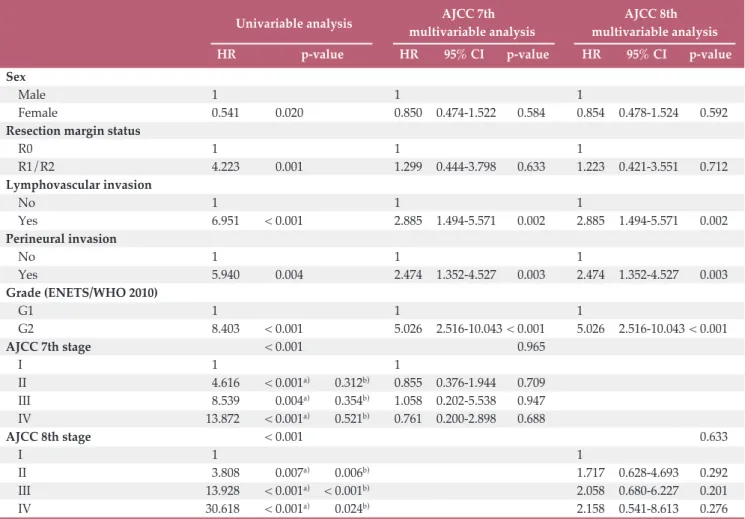
In a univariable analysis of risk factor for DFS, sex (HR, 0.541; 95% confidence interval [CI], 0.320 to 0.913; p=0.020), resection margin status (HR, 4.223; 95% CI, 1.896 to 9.406;
p=0.001), LVI (HR, 6.951; 95% CI, 3.862 to 12.509; p < 0.001), PNI (HR, 5.940; 95% CI, 3.215 to 10.976; p=0.004), grade (HR, 8.403; 95% CI, 4.642 to 15.212; p < 0.001), AJCC 7th staging groups (compared with stage I: HR of II, 4.616; 95% CI, 2.629 to 8.103; p < 0.001; HR of III, 8.539; 95% CI, 1.984 to 36.745;
p=0.004; and HR of IV, 13.872; 95% CI, 6.704 to 28.701; p <
0.001), and AJCC 8th staging groups (compared with stage I: HR of II, 3.808; 95% CI, 1.453 to 9.998; p=0.007; HR of III, 13.928; 95% CI, 5.341 to 36.319; p < 0.001; and HR of IV, 30.618;
95% CI, 10.749 to 87.219; p < 0.001) were revealed as signifi- cant factors. In a multivariable analysis, LVI (HR, 2.885; 95%
CI, 1.494 to 5.571; p=0.002), PNI (HR, 2.474; 95% CI, 1.352 to 4.527; p=0.003), and grade (HR, 5.026; 95% CI, 2.516 to 10.043;
p < 0.001) were identified as independent prognostic factors for DFS. The remaining factors such as sex (HR, 0.854; 95%
CI, 0.478 to 1.524; p=0.592), resection margins status (HR, 1.223; 95% CI, 0.421 to 3.551; p=0.712), AJCC 7th staging groups (compared with stage I: HR of II, 0.855; 95% CI, 0.376 to 1.944; p=0.709; HR of III, 1.058; 95% CI, 0.202 to 5.538;
p=0.947; and HR of IV, 0.761; 95% CI, 0.200 to 2.898; p=0.688), and AJCC 8th staging groups (compared with stage I: HR of II, 1.717; 95% CI, 0.628 to 4.693; p=0.292; HR of III, 2.058; 95%
CI, 0.680 to 6.227; p=0.201; and HR of IV, 2.158; 95% CI, 0.541 to 8.613; p=0.276) were not significant in multivariable analy- sis. These results were summarized in Table 5.
Univariable analysis AJCC 7th AJCC 8th
multivariable analysis multivariable analysis
HR p-value HR 95% CI p-value HR 95% CI p-value
Age (continuous) 1.033 0.078 4.053 1.826-8.998 0.001 1.069 1.028-1.111 0.001
Resection margin status
R0 1 1 1
R1/R2 4.246 0.004 2.228 0.457-10.875 0.322 1.855 0.404-8.517 0.427
Lymphovascular invasion
No 1 1 1
Yes 3.058 0.007 2.235 0.842-5.934 0.106 2.795 1.128-6.925 0.026
Perineural invasion
No 1 1 1
Yes 3.757 0.008 1.549 0.555-4.329 0.404 1.779 0.696-4.549 0.229
Grade (ENETS/WHO 2010)
G1 1 1 1
G2 2.478 0.021 1.250 0.486-3.127 0.644 1.559 0.631-3.852 0.336
AJCC 7th stage 0.001 0.387
I 1 1
II 2.734 0.002a) 0.001b) 2.440 0.848-7.016 0.098
III 3.445 0.230a) 0.792b) 1.362 0.135-13.713 0.793
IV 5.922 < 0.001a) 0.763b) 1.757 0.234-13.176 0.584
AJCC 8th stage 0.001 0.098
I 1 1
II 2.268 0.085a) 0.077b) 4.357 0.981-19.355 0.053
III 4.459 0.003a) 0.077b) 5.310 1.001-28.154 0.050
IV 9.802 < 0.001a) 0.190b) 6.509 0.808-52.472 0.079
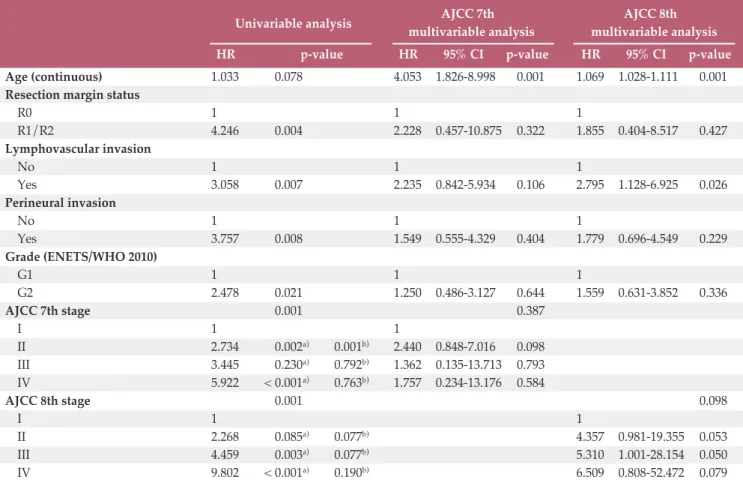
AJCC, American Joint Committee on Cancer; HR, hazard ratio; CI, confidence interval; ENETS, European Neuroendocrine Tumors Society; WHO, World Health Organization. a)p-values with stage I as the reference, b)p-values with the previous stage as the reference.
Table 6. Univariable and multivariable analysis of prognostic risk factor for overall survival rate
5. Analysis of risk factor for OSR
In a univariable analysis of risk factor for OSR, age (HR, 1.033; 95% CI, 0.996 to 1.070; p=0.078), resection margin sta- tus (HR, 4.246; 95% CI, 1.599 to 11.276; p=0.004), LVI (HR, 3.058; 95% CI, 1.349 to 6.931; p=0.007), PNI (HR, 3.757; 95%
CI, 1.410 to 10.011; p=0.008), grade (HR, 2.478; 95% CI, 1.146 to 5.360; p=0.021), AJCC 7th staging groups (compared with stage I: HR of II, 2.734; 95% CI, 1.444 to 5.174; p=0.002; HR of III, 3.445; 95% CI, 0.458 to 25.920; p=0.230; and HR of IV, 5.922; 95% CI, 2.182 to 16.069; p < 0.001), and AJCC 8th stag- ing groups (compared with stage I: HR of II, 2.268; 95% CI, 0.893 to 5.758; p=0.085; HR of III, 4.459; 95% CI, 1.672 to 11.892; p=0.003; and HR of IV, 9.802; 95% CI, 2.967 to 32.386;
p < 0.001) were significant factors. In a multivariable analysis, age was identified as independent risk factor for OSR (HR, 1.609; 95% CI, 1.028 to 1.111; p=0.001) and AJCC 8th staging groups was marginally significant (compared with stage I:
HR of II, 4.357; 95% CI, 0.981 to 19.355; p=0.053; HR of III, 5.310; 95% CI, 1.001 to 28.154; p=0.050; and HR of IV, 6.509;
95% CI, 0.808 to 52.472; p=0.079). However, AJCC 7th staging groups was not significant (compared with stage I: HR of II, 2.440; 95% CI, 0.848 to 7.016; p=0.098; HR of III, 1.362; 95%
CI, 0.135 to 13.713; p=0.793; and HR of IV, 1.757; 95% CI, 0.234 to 13.176; p=0.584) in multivariable analysis. Table 6 summarized these results.
Discussion
To best of our knowledge, this is the first study to validate a new AJCC 8th staging classifications for PNET. In fact, val- idation of the ENETs system, which is the basis for 8th AJCC staging system, has been carried out in several studies [7- 12,21]. Unlike previous studies, the strength of the present study is that it allows accurate assessment of lymph node metastasis. Recent studies have supported lymph node metastasis as a predictor of poor prognosis [22,23]. If accurate assessment of the N category through lymph node sampling or lymphadenectomy is not feasible, accurate TNM staging to predict prognosis becomes difficult. The low lymph node yield rate, including zero percent, is likely to be related to the type of surgery and the individual preference of the operator for PNET. In a single-center study, the rate of no lymph node sampling is higher in patients undergoing enucleation and spleen-preserving distal pancreatectomy compared to pati- ents with other operations [24]. In this regards, previous studies to validate ENETS TNM staging had limitation. In a European multicenter study by Rindi et al. [7] using 1,072 cohorts, the lymph node status could not be assessed in 737
(68.8%) patients. The results of a study conducted by Luo et al. [21] using 2,529 cases from Surveillance, Epidemiology, and End Results data should also be cautious about the proper evaluation of staging system because there is no men- tion of “Nx”. Besides, in the previous two studies mentioning
“Nx”, the ratio of “Nx” in all patients was reported as 51.6%
and 68.8%, respectively [8,9]. In the current study, among the 972 patients who underwent resection with PNET, 409 pati- ents (42.1%) had no lymph node retrieval and contrary to previous studies mentioned above, we excluded samples from the survival analysis that were not correctly evaluated for lymph node status. The inclusion criteria of the current study, which reflects our intent to not ignore the prognostic significance of lymph node status, seems to provide more accurate validation of the AJCC 8th TNM staging system.
An important change in 8th edition of AJCC system is that G3 was not included in the PNET staging system unlike the previous ENETS system. This reflects the results of previous studies showing that exocrine tumors and neuroendocrine tumors have different tumor biology and prognosis [7,11,14, 17,18,25]. In the former ENETS validation study, the propor- tion of G3 ranging from 6.8% to 11.0% was not negligible [7-12,21]. By contrary, we used the cohort excluding G3 in this study. This may have helped to evaluate more elabo- rately the suitability of the new AJCC staging system for PNET.
The present study largely supports that AJCC 8th edition staging system provides better discrimination when com- pared to the AJCC 7th edition and the ENETS staging sys- tem. As for DFS, survival curves of 8th AJCC classification were well separated between all stages. This seems to be rela- ted to some detailed changes in the 8th edition as follows.
First, the definition of T4 category expanded to adjacent organ invasion, which affected the increase of T4 case num- ber (Figs. 1A, B, 2A, and B). As a result, four T4 patients increased to 16 followed by the increases in stage III cases.
Second, T1-3N1M0 (which had been stage IIB in AJCC 7th system) is classified as stage III in the AJCC 8th staging sys- tem, leading to an increase in the proportion of stage III. The two changes described above resulted in an increase in the ratio of stage III in the 8th AJCC and a significant difference in DFS curves between stages (stage II vs. III and stage III vs.
IV in 8th AJCC staging system).
Another remarkable result of this study is that it is more reasonable to combine stage IIIA (T4, N0, M0) and IIIB (any T, N1, M0) into one prognostic group than to divide stage III into two subgroups. In fact, the results that stage IIIB has a better prognosis than IIIA has already been reported in pre- vious studies [7,10,11]. Rindi et al. [7] estimated this to be due to poorer prognosis of the unresectable T4 compared with positive N cases, or different surgical techniques and lymph node sampling methods, or small sample size of T4. In the
current study, there was also no significant difference in sur- vival rate (both OSR and DFS) between the stage IIIA and IIIB using the ENETS system (p=0.291 and p=0.545), respec- tively (Figs. 1D and 2D). Given these, the attempt at the AJCC 8th edition, which classifies the existing ENETS stage into four simple stages, is considered acceptable.
Despite a better distribution of prognosis in different stages based on the new AJCC revision, the low stage IV (Any T Any N M1) ratio of this study, which is only 4%, is worth mentioning. In our opinion, the proportion of stage IV should be related to the definition of the subject being ana- lyzed. For studies reporting high rates of stage IV ranging 35%-60% [8,10,11], patients who have undergone palliative surgery or who have been just diagnosed with biopsy or cytology had been included. In contrast, this rate was repor- ted to be relatively low ranging 9%-21% in studies involving only patients with surgery [9,12]. The present study included only patients who underwent surgical treatment. It is rare to perform radical surgery for PNET with distant metastasis.
Furthermore, the relatively high curative resection rate and exclusion of G3 are also the cause of the low stage IV ratio in the current study. This is consistent with report of a single- center study that patients with G3 accounts for a high per- centage of all patients with ENETS stage IV. Of 53 patients with ENETS stage IV in the study, 27 patients (50.9%) were G3 [26].
Several modalities of adjuvant treatment have been pro- posed that can be used to reduce tumor burden or inhibit cancer progression after recurrence of PNET [27]. In the case of chemotherapy, Ramirez et al. [28] demonstrated that com- bination treatment with capecitabine/temozolomide has the benefit of prolonging the survival of patients with metastasis.
Although all enteropancreatic neuroendocrine tumors were targeted, a randomized controlled study has suggested the effect of long-acting somatostatin analogues [29]. Unfortu- nately, just 67 of the 472 patients (14.2%) enrolled in the cur- rent study were able to confirm whether they received adjuvant treatment. Of these 67 patients, seven had recur- rence, and two of seven patients with recurrence received adjuvant treatment. Two of the patients treated with adju- vant treatment were all diagnosed with G2 and AJCC 8th stage II (T2N0M0), received adjuvant chemotherapy and sur- vived to the last follow-up. The last follow-up point of each patient was 17 months and 4 months after the recurrence. Of the seven patients who had recurred, only one died, and he was one of the five who had not received any adjuvant treat- ment. He was a male patient with LVI, was diagnosed with G2 and AJCC 8th stage III (T3N1MO), and died 41 months after recurrence. Due to the small number of relapses that could be identified, it was not possible to verify statistically the prognostic factor influencing overall survival after recur- rence or metastasis. Therefore, further studies using large
samples that statistically demonstrate the role of adjuvant treatment for PNET is needed.
The present study has several limitations. First, we could not analyze the prognosis between functional tumor and nonfunctional tumor. Previous two studies have reported that functional neuroendocrine tumor is a prognostic factor for survival [7,14]. However, our multicenter database is missing a lot of information about these items. Thus, if this factor was included in the multivariate analysis process, more sophisticated and reliable statistical analysis would have been possible. Second, there is a potential for bias in the retrospective multicenter study design itself. In particular, this is relevant to the difference in the operative methods between various institutes. Considering the importance of lymph node metastasis to prognosis as previously men- tioned in discussion, it is likely that the diversity of operative methods and lymphadenectomy have had some impact on survival.
In summary, this is the first large-scale validation of the AJCC 8th edition staging system for PNET. The revised 8th system provides better discrimination compared to that of the 7th edition system and ENETS staging system. Therefore, using the current system is expected to help stratify the pati- ent's prognosis and provide clinical information.
Conflicts of Interest
Conflict of interest relevant to this article was not reported.
Author Details
1Department of Surgery, Konkuk University Choongju Hospital, Konkuk University School of Medicine, Chungju, 2Department of Surgery, Seoul National University College of Medicine, Seoul,
3Department of Surgery, Asan Medical Center, Ulsan University College of Medicine, Seoul, 4Department of Surgery, Seoul National University Bundang Hospital, Seongnam, 5Department of Surgery, Gangnam Severance Hospital, Yonsei University, Seoul, 6Depart- ment of Surgery, Chonnam National University Hwasun Hospital, Hwasun, 7Department of Surgery and Center for Liver Cancer, National Cancer Center, Goyang, 8Department of Surgery, Chonbuk National University Medical School and Hospital, Jeonju, 9Depart- ment of Surgery, Severance Hospital, Yonsei University College of Medicine, Seoul, 10Department of Hepatobiliary and Pancreas Sur- gery, Seoul St. Mary’s Hospital, College of Medicine, The Catholic University of Korea, Seoul, 11Department of Surgery, Keimyung University Dongsan Medical Center, Daegu, 12Department of Sur- gery, Gyeongsang National University School of Medicine, Jinju,
13Department of Surgery, Ewha Womans University Mokdong Hos- pital, Ewha Womans University School of Medicine, Seoul, 14Depart- ment of Surgery, Chung-Ang University Hospital, Chung-Ang Uni- versity, College of Medicine, Seoul, 15Department of Surgery, Dong-
A University College of Medicine, Busan, 16Department of Surgery, Chonnam National University Hospital, Gwangju, 17Department of Surgery, Dongguk University Ilsan Hospital, Dongguk University
College of Medicine, Goyang, 18Department of Surgery, Samsung Medical Center, Sungkyunkwan University School of Medicine, Seoul, Korea
1. Amin MB, Edge S, Greene F, Byrd DR, Brookland RK, Wash- ington MK, et al. AJCC cancer staging manual. 8th ed. New York: Springer; 2017.
2. Yao JC, Eisner MP, Leary C, Dagohoy C, Phan A, Rashid A, et al. Population-based study of islet cell carcinoma. Ann Surg Oncol. 2007;14:3492-500.
3. Panzuto F, Boninsegna L, Fazio N, Campana D, Pia Brizzi M, Capurso G, et al. Metastatic and locally advanced pancreatic endocrine carcinomas: analysis of factors associated with dis- ease progression. J Clin Oncol. 2011;29:2372-7.
4. Modlin IM, Moss SF, Chung DC, Jensen RT, Snyderwine E.
Priorities for improving the management of gastroenteropan- creatic neuroendocrine tumors. J Natl Cancer Inst. 2008;100:
1282-9.
5. Yao JC, Hassan M, Phan A, Dagohoy C, Leary C, Mares JE, et al. One hundred years after "carcinoid": epidemiology of and prognostic factors for neuroendocrine tumors in 35,825 cases in the United States. J Clin Oncol. 2008;26:3063-72.
6. Rindi G, Kloppel G, Alhman H, Caplin M, Couvelard A, de Herder WW, et al. TNM staging of foregut (neuro)endocrine tumors: a consensus proposal including a grading system. Vir- chows Arch. 2006;449:395-401.
7. Rindi G, Falconi M, Klersy C, Albarello L, Boninsegna L, Buch- ler MW, et al. TNM staging of neoplasms of the endocrine pan- creas: results from a large international cohort study. J Natl Cancer Inst. 2012;104:764-77.
8. Fischer L, Kleeff J, Esposito I, Hinz U, Zimmermann A, Friess H, et al. Clinical outcome and long-term survival in 118 con- secutive patients with neuroendocrine tumours of the pan- creas. Br J Surg. 2008;95:627-35.
9. La Rosa S, Klersy C, Uccella S, Dainese L, Albarello L, Son- zogni A, et al. Improved histologic and clinicopathologic cri- teria for prognostic evaluation of pancreatic endocrine tumors.
Hum Pathol. 2009;40:30-40.
10. Ekeblad S, Skogseid B, Dunder K, Oberg K, Eriksson B. Prog- nostic factors and survival in 324 patients with pancreatic endocrine tumor treated at a single institution. Clin Cancer Res. 2008;14:7798-803.
11. Scarpa A, Mantovani W, Capelli P, Beghelli S, Boninsegna L, Bettini R, et al. Pancreatic endocrine tumors: improved TNM staging and histopathological grading permit a clinically effi- cient prognostic stratification of patients. Mod Pathol. 2010;
23:824-33.
12. Yang M, Zeng L, Zhang Y, Wang WG, Wang L, Ke NW, et al.
TNM staging of pancreatic neuroendocrine tumors: an obser- vational analysis and comparison by both AJCC and ENETS
systems from 1 single institution. Medicine (Baltimore). 2015;
94:e660.
13. Bilimoria KY, Bentrem DJ, Merkow RP, Tomlinson JS, Stewart AK, Ko CY, et al. Application of the pancreatic adenocarci- noma staging system to pancreatic neuroendocrine tumors. J Am Coll Surg. 2007;205:558-63.
14. Strosberg JR, Cheema A, Weber J, Han G, Coppola D, Kvols LK. Prognostic validity of a novel American Joint Committee on Cancer Staging Classification for pancreatic neuroen- docrine tumors. J Clin Oncol. 2011;29:3044-9.
15. Strosberg JR, Cheema A, Weber JM, Ghayouri M, Han G, Hodul PJ, et al. Relapse-free survival in patients with non- metastatic, surgically resected pancreatic neuroendocrine tumors: an analysis of the AJCC and ENETS staging classifi- cations. Ann Surg. 2012;256:321-5.
16. Ellison TA, Wolfgang CL, Shi C, Cameron JL, Murakami P, Mun LJ, et al. A single institution's 26-year experience with nonfunctional pancreatic neuroendocrine tumors: a validation of current staging systems and a new prognostic nomogram.
Ann Surg. 2014;259:204-12.
17. Rindi G. The ENETS guidelines: the new TNM classification system. Tumori. 2010;96:806-9.
18. Martin RC, Kooby DA, Weber SM, Merchant NB, Parikh AA, Cho CS, et al. Analysis of 6,747 pancreatic neuroendocrine tumors for a proposed staging system. J Gastrointest Surg.
2011;15:175-83.
19. Rindi G, Arnold R, Bosman FT. Nomenclature and classifica- tion of neuroendocrine neoplasms of the digestive system. In:
Bosman FT, Carneiro F, Hruban RH, Theise ND, editors.
WHO classification of tumours of the digestive system. 4th ed.
Lyon: IARC; 2010. p. 13-4.
20. Edge SB, Byrd DR, Compton CC, Fritz AG, Greene FL, Trotti A. AJCC cancer staging manual. 7th ed. New York: Springer;
2010.
21. Luo G, Javed A, Strosberg JR, Jin K, Zhang Y, Liu C, et al. Mod- ified staging classification for pancreatic neuroendocrine tumors on the basis of the American Joint Committee on Can- cer and European Neuroendocrine Tumor Society systems. J Clin Oncol. 2017;35:274-80.
22. Hashim YM, Trinkaus KM, Linehan DC, Strasberg SS, Fields RC, Cao D, et al. Regional lymphadenectomy is indicated in the surgical treatment of pancreatic neuroendocrine tumors (PNETs). Ann Surg. 2014;259:197-203.
23. Krampitz GW, Norton JA, Poultsides GA, Visser BC, Sun L, Jensen RT. Lymph nodes and survival in pancreatic neuroen- docrine tumors. Arch Surg. 2012;147:820-7.
References
24. Parekh JR, Wang SC, Bergsland EK, Venook AP, Warren RS, Kim GE, et al. Lymph node sampling rates and predictors of nodal metastasis in pancreatic neuroendocrine tumor resec- tions: the UCSF experience with 149 patients. Pancreas. 2012;
41:840-4.
25. Nakakura EK. Challenges staging neuroendocrine tumors of the pancreas, jejunum and ileum, and appendix. Ann Surg Oncol. 2018;25:591-3.
26. Shiba S, Morizane C, Hiraoka N, Sasaki M, Koga F, Sakamoto Y, et al. Pancreatic neuroendocrine tumors: a single-center 20- year experience with 100 patients. Pancreatology. 2016;16:99- 105.
27. Castellano D, Grande E, Valle J, Capdevila J, Reidy-Lagunes
D, O'Connor JM, et al. Expert consensus for the management of advanced or metastatic pancreatic neuroendocrine and car- cinoid tumors. Cancer Chemother Pharmacol. 2015;75:1099- 114.
28. Ramirez RA, Beyer DT, Chauhan A, Boudreaux JP, Wang YZ, Woltering EA. The role of capecitabine/temozolomide in metastatic neuroendocrine tumors. Oncologist. 2016;21:671-5.
29. Rinke A, Muller HH, Schade-Brittinger C, Klose KJ, Barth P, Wied M, et al. Placebo-controlled, double-blind, prospective, randomized study on the effect of octreotide LAR in the con- trol of tumor growth in patients with metastatic neuroen- docrine midgut tumors: a report from the PROMID Study Group. J Clin Oncol. 2009;27:4656-63.