보 문
말로락틱 발효에 적합한 토착 Lactobacillus plantarum 분리
허준
1
・ 이찬미1
・ 박문국1
・ 정도연2
・ 엄태붕1
*1전북대학교 자연과학대학 생명과학과, 2(재)발효미생물산업진흥원
Isolation of indigenous Lactobacillus plantarum for malolactic fermentation
Jun Heo
1
, Chan-Mi Lee1
, Moon Kook Park1
, Do-Youn Jeong2
, and Tai-Boong Uhm1
*1Department of Biological Sciences, Chonbuk National University, Jeonju 561-756, Republic of Korea
2Microbial Institute for Fermentation Industry (MIFI), Sunchang 595-804, Republic of Korea
(Received June 2, 2015; Accepted June 19, 2015)
ABSTRACT: The malolactic fermentation (MLF), which is widely used in winemaking, is the conversion of malic acid to lactic acid conducted by the malolactic enzyme (Mle) of lactic acid bacteria. In order to select the strains with MLF among 54 lactic acid bacteria isolated from the traditionally fermented foods, we designed a primer set that specifically targets the conserved regions of the mle gene and then selected four strains that harbor the mle gene of Lactobacillus plantarum. All strains were identified as L. plantarum by analyzing the 16S rRNA sequences, biochemical properties, and the PCR products of the recA gene. From comparison of the mle gene sequences consisting of 1,644 bp, the nucleotide and amino acid sequence of strain JBE60 correspond to 96.7% and 99.5% with those of other three strains, respectively. The strain JBE60 showed the highest resistant against 10% (v/v) ethanol among the strains. The strains lowered the concentration of malic acid to average 43%. Considering the ethanol resistance and conversion of malic acid, the strain JBE60 is considered as a potential starter for the malolactic fermentation.
Key words: Lactobacillus plantarum, lactic acid bacteria, malolactic fermentation, mle gene, traditional fermented food
*For correspondence. E-mail: [email protected];
Tel.: +82-63-270-3439; Fax: +82-63-270-3362
와인 제조 과정에서 말로락틱 발효(malolactic fermentation) 는 알코올 발효 후 유산균에 의해 일어나는 이차 발효로서, 말 로락틱 효소(Mle)에 의해 L-malic acid를 L-lactic acid와 CO
2
로 전환하는 대사이다(Davis et al., 1985; Liu, 2002). 말로락틱 발효는 거친 신맛을 내는 L-malic acid를 부드러운 신맛을 내 는 L-lactic acid로 바꿔 산도를 감소시키고, 미생물의 탄소원 으로 이용될 수 있는 malic acid 농도를 줄여 와인의 안정화를 이루며, ethyl lactate, diacetyl, acetoin, butane-2,3-diol 등의 향 기 성분을 생성하게 하는 이점이 있기 때문에, 대부분의 적포 도주와 일부 백포도주 생산에 이 발효 과정을 적용하고 있다 (Jacobson, 2006).
포도 껍질에 부착된 상태로 존재하는 유산균은 와인 제조 시 알코올 발효 동안 감소하였다가 발효 이후 Oenococcus
oeni를 비롯한 알코올 저항성 유산균들이 증식하면서 말로락 틱 발효가 이루어진다(Fleet et al., 1984; Ugliano et al., 2003;
Bauer and Dicks, 2004). 그러나 야생 유산균은 와인의 원료 및 발효물에서 개체수가 적기 때문에 말로락틱 발효 과정이 제대 로 유도되지 않을 수 있으므로 종균의 인위적인 접종이 도움 이 된다. 말로락틱 발효에 적합한 유산균을 선발하여 접종하 면 발효 기간을 단축할 수 있고, 와인의 품질을 균일하게 유지 할 수 있으며, 다른 미생물들에 의한 이상 발효를 막을 수 있다 (Davis et al., 1985; Carrascosa and Muñoz, 2011). 이러한 이유 로 여러 상업용 종균이 개발되어 왔고(Lerm et al., 2010), 현재 유럽의 경우 와인 제조 지역의 토착 균주를 사용한 종균 개발에 초점을 맞추고 있다(Herrero et al., 1999; Cho et al., 2011). 말로 락틱 발효를 진행할 수 있는 균주는 Leuconostoc, Pediococcus, Lactobacillus, Oenococcus 속에 속하는 균주들이 알려져 있 으며 특히 O. oeni가 지금까지 상업 용도의 말로락틱 발효균
으로 가장 널리 사용되어왔다. O. oeni는 에탄올, 낮은 pH, SO
2
에 대한 저항성이 크고, 초산 생성량이 낮아 말로락틱 발 효에 적합하지만 아직 식품의약품안전처(MFDS)의 GRAS 목록에 포함되어 있지 않아 식품 첨가물 재료로 사용할 수가 없다(http://fse.foodnara.go.kr/origin/search_data_list.jsp). 반 면 GRAS에 포함된 많은 Lactobacillus 균주들은 O. oeni를 잇 는 차세대 말로락틱 발효균으로 고려되고 있으며 이들 중 특 히 L. plantarum은 에탄올과 낮은 pH에 O. oeni와 유사한 저항 성을 가지면서도 생육속도가 더 빠르고, 유전체 분석 결과 aroma 형성에 관련된 유전자들을 더 많이 함유하고 있다(Eva et al., 2004; Du Toit et al., 2011; Torriani et al., 2001). 현재까 지 국내에서는 오디(Kim et al., 2008), 흑마늘(Kim et al., 2014), 산머루(Kim et al., 2007) 등 다양한 발효 소재를 이용한 와인제조와 발효용 Saccharomyces cerevisiae 균주의 분리 (Choi et al., 2011)에 대한 연구들이 보고되었으나 말로락틱 발효에 적합한 유산균에 관한 연구는 아직 미흡한 실정이다.국내 연구 중 말로락틱 발효에 상업용 균주를 사용한 연구 (Yoo et al., 2010; Kang et al., 2011)와 감산 관련 미생물 분리 를 수행한 연구(Chang et al., 2011)는 이루어졌으나 말로락틱 발효의 최적화를 위한 균주 선발 연구는 보고된바 없다.
국내 고유의 특색 있는 와인을 개발하기 위해 토종 유산균 주들 가운데 와인 제조에 적합한 유산균주를 선발하는 것이 필요한 실정이다. 이에 우리는 전통 발효식품에서 다양한 유 산균들을 분리해왔고 이들이 말로락틱 발효균으로서 이용될 수 있는지를 조사하였다. 이 연구는 O. oeni와 함께 종균으로 사용되며 GRAS 품목인 Lactobacillus plantarum을 대상으로, 말로락틱 발효에 적합한 균주를 선발하는데 목표를 두었다.
이러한 시도는 나고야 의정서를 대비해 국내 토종 미생물 자 원을 확보하고 국내 와인의 발효기술과 품질을 높이는데 도움 을 줄 수 있을 것이다.
재료 및 방법
유산균주의 분리
균원시료로 순창에서 전통 방식으로 제조한 메주 10종과 시 중에 유통 중인 막걸리 13종을 사용하였다. 균주 분리를 위해 시료 1 g 또는 1 ml을 취해 펩톤액(0.1% peptone + 0.85% NaCl) 으로 희석한 뒤 0.005% bromocresol purple (5',5"-dibromo- o-cresolsulfophthalein)이 첨가된 MRS (de Man, Rogosa and Sharpe) 고체 배지 표면에 도말하여 30°C에서 48시간 배양하 였다. 배양 후 주변에 노란색 환을 형성하는 집락들을 골라 새
MRS 고체배지 표면에 획선 도말 하여 배양 후 단일 집락들을 분 리하였다. 그 결과 메주에서 24종, 막걸리에서 30종이 분리되었 다. 분리한 54종 균주의 genomic DNA를 얻기 위해 Accuprep genomic DNA extraction kit (Bioneer)를 이용하여 각 균주의 DNA를 분리하였고 genomic DNA는 사용하기 전까지 -20°C 에서 보관하였다.
Lactobacillus plantarum 균주 선발
말로락틱 발효에 적합한 균주 분리를 위해 L. plantarum mle 유전자의 염기 서열을 이용한 PCR을 실시하였다. 이를 위해 L.
plantarum WCFS1 (GenBank accession no. AL935263) 균주 를 비롯, NCBI database에 등록된 7종의 L. plantarum mle 유전 자 서열내에서 보존 영역을 주형으로 하여 forward1 (5ʹ-CTT GGT AAC CGG CAC AAG CG-3ʹ) 및 reverse1 (5ʹ-GCA TTG TCR CGA CCG AAA TC-3ʹ) primer를 제작하였다. PCR 조건 은 95°C에서 2분간 초기 변성 후, 95°C에서 30초간 변성, 60°C 에서 30초간 결합, 72°C에서 30초간 증폭 과정을 30회 반복하 고 72°C에서 5분간 마지막 증폭을 실시하였으며 전기영동을 통해 148 bp의 PCR 산물이 나타난 균주들을 선발하였다.
선발 균주의 동정
선발된 균주의 분자 생물학적 동정을 위해 16S rRNA 유전 자 염기서열 분석을 Macrogen에 의뢰하였다. Universal primer 로 27F (5ʹ-AGA GTT TGA TCC TGG CTC AG-3ʹ)와 1,492R (5ʹ-GGT TAC CTT GTT ACG ACT T-3ʹ)을 사용하여 16S rRNA 유전자를 증폭하고, 이 PCR산물을 정제한 후 염기 서열 을 해독하였다. 해독된 염기서열은 chromatogram의 비교를 통해 Mixed base 및 gap을 보정한 후 BLASTN search (Zhang et al., 2000)에서 서열 일치도가 높은 표준 균주의 16S rRNA 유전자 염기서열을 얻었고, 염기 서열간의 상호 비교를 위해 CLUSTAL W (Thompson et al., 1994)를 사용했다. 계통도 분 석을 위해 Tamura-Nei 모델에 기초한 Maximum Likelihood 방법(Tamura and Nei, 1993)을 사용하여 작성하였다. 산출한 계통수에서 각 분지에 대한 통계적 신뢰도를 산출하기 위해 bootstrap 분석을 1,000회 실행하였으며, 계통 분석과 bootstrap 분석은 MEGA6 program (Tamura et al., 2011)을 사용하였다.
생화학적 특성에 따른 동정을 위해 API 50 CHL kit (bioMérieux)를 이용하였다. 균주를 2 ml MRS borth에서 2일 간 배양시켜 정지기에 도달한 배양액을 원심분리로 상등액을 제거하고 0.85% NaCl 용액을 첨가하여 균 현탁액을 얻었으 며 균 현탁액은 API 50 CHL kit의 매뉴얼에 따라 분석했고, 얻
어진 결과들은 on-line bacteria database인 apiwebsoftware (bioMérieux)를 사용하여 생화학적 특성을 비교 계산하여 동 정하였다.
L. plantarum, L. pentosus, L. paraplantarum 종간 구별을 위 해, recA 유전자(Torriani et al., 2001)에 대한 multiplex PCR을 수행하였으며 PCR primer로 paraF (5ʹ-GTC ACA GGC ATT ACG AAA AC-3ʹ), pentF (5ʹ-CAG TGG CGC GGT TGA TAT C-3ʹ), planF (5ʹ-CCG TTT ATG CGG AAC ACC TA-3ʹ), pREV (5ʹ-TCG GGA TTA CCA AAC ATC AC-3ʹ)를 사용하 였다. PCR 조건은 95°C에서 2분간 초기 변성 후 95°C에서 30 초간 변성, 52°C에서 15초간 결합, 72°C에서 30초간 증폭을 30회 반복하였으며, 72°C에서 5분간 마지막 증폭 한 뒤 전기 영동을 통해 PCR 산물 크기를 비교하였다.
선발 균주의 mle 유전자 염기서열 분석
선발 균주들의 전체 mle 염기서열을 읽기 위하여 L.
plantarum WCFS1 mle 유전자의 5ʹ 상류와 3ʹ 하류 쪽에 위치 한 염기 서열을 대상으로 forward2 (5ʹ-TGG TTG GCT CAC ACC GAA TG-3ʹ) 및 reverse2 (5ʹ-CTT GGT AAC CGG CAC AAG CG-3ʹ) primer를 제작하였다. 이 primer들을 mle 유전자 내부 primer들(forward1과 reverse1)과 함께 각 쌍(forward1과 reverse2, forward2와 reverse1)으로 하여 PCR을 수행하였으 며, 이 때 94°C에서 5분간 초기 변성, 30회 반복(94°C에서 45 초간 변성, 59°C에서 30초간 결합, 72°C에서 1분 30초간 증 폭), 72°C에서 5분간 증폭하였다. PCR 산물의 정제 후 염기서 열을 해독(Macrogen)하고 chromatogram과 대조하여 mixed base 및 gap을 보정한 뒤 mle 유전자의 open reading frame을 찾았다. 분리균들 간 mle 염기 서열 및 단백질 서열 차이를 CLUSTAL W (Thompson et al., 1994) program을 이용하여 비 교하였다. MEGA program (Tamura et al., 2011)으로 서열 계 통도 분석은 Tamura-Nei 모델에 기초한 Maximum Likelihood 방법(Tamura and Nei, 1993)을 사용하였고, 산출한 계통수에 서 각 분지에 대한 통계적 신뢰도 산출을 위해 bootstrap 분석 을 1,000회 실행하였다.
선발된 균주 가운데 NCBI에 등록한 mle 유전자 염기 서열 은 다음과 같다: JBE60 균주(accession no. KR153582); JBE171 균주(accession no. KR153583).
에탄올 내성 특성
선발 균주의 종균 활용 가능성을 확인하기 위해 균주의 에 탄올 내성 한계 특성을 확인하였다. 에탄올 농도를 각각 0%,
5%, 8%, 10%, 12%로 달리한 MRS 액체 배양액에 각 균주를 균일하게 접종(10
5
CFU/ml) 한 뒤 30°C에서 48시간 동안 200 rpm으로 진탕 배양시킨 다음 생균수를 측정하였다. 생균수는 배양액을 펩톤액으로 연속 희석하여 0.005% bromocresol purple이 첨가된 plate count agar (PCA, MB Cell) 배지에 도말 한 뒤 30°C에서 48시간 배양하여 형성된 집락을 계수하였다.말로락틱 발효 활성 측정
균주의 말로락틱 발효 활성을 확인하기 위해 HPLC를 이용 한 유기산 분석을 실시하여 malic acid 전환율을 확인하였다.
50 mM의 L-(-)-malic acid (Sigma)를 첨가한 MRS broth (Difco)에 각 균주의 초기 접종 균수가 10
5
CFU/ml이 되도록 접종하여 30°C에서 200 rpm으로 48시간 진탕 배양시킨 다음 15,000 × g에서 10분간 원심 분리하여 상등액 10 μl를 분석에 사용하였다. HPLC는 유기산 분석용 column으로 IOA-1000 (Alltech, 9 μm, 30 cm × 7.6 mm)을 이용하였고 0.005 N sulfuric acid를 이동상으로 하였다. 유속은 0.3 ml/min으로 column을 60°C 항온상태로 유지하면서, 220 nm 파장으로 UV detector 로 검출하였다.통계 분석
모든 측정 실험은 3회 반복하여 실행하였으며 얻어진 값들 은 평균±표준편차로 나타내었다. 실험의 통계처리는 SPSS program (version 20.0, SPSS)을 통해 paired t-test 및 분산 분석 을 실시하였으며 사후 분석으로 Duncan test를 실시하였다. 각 그룹간의 유의적인 차이는 P<0.05 수준에서 검증하였다.
결과 및 고찰
Lactobacillus plantarum 선발
전통 메주 및 막걸리의 세균 군집을 pyrosequencing이나 PCR-DGGE로 분석하였을 때 다양한 종류의 유산균들이 발 견되었으며, 이들 중 일부는 발효 과정 동안 향미를 생성하고 에탄올 저항성이 우수한 것으로 보고되었다(Kim et al., 2011a, 2011b; Yoo, 2013; Heo et al., 2014). 균주 간 대사 과정의 다양 한 차이를 고려할 때, 에탄올 저항성이 큰 토종 유산균들을 말 로락틱 발효에 사용하는 것은 와인에 특색 있는 향미 생성능 을 부여할 수 있을 것이다. 이에 전 유전체 서열이 보고된 L.
plantarum mle 유전자 서열들의 보존 영역을 기반으로 primer 를 제작한 뒤 PCR로 균주를 선발하였다. 분리된 54종의 유산
Fig. 1. Gel electrophoresis of PCR products for the detection of mle gene of L. plantarum. M is a 100 bp DNA ladder. NC, the PCR product of Leuconostoc mesenteroides JBE102 used as negative control
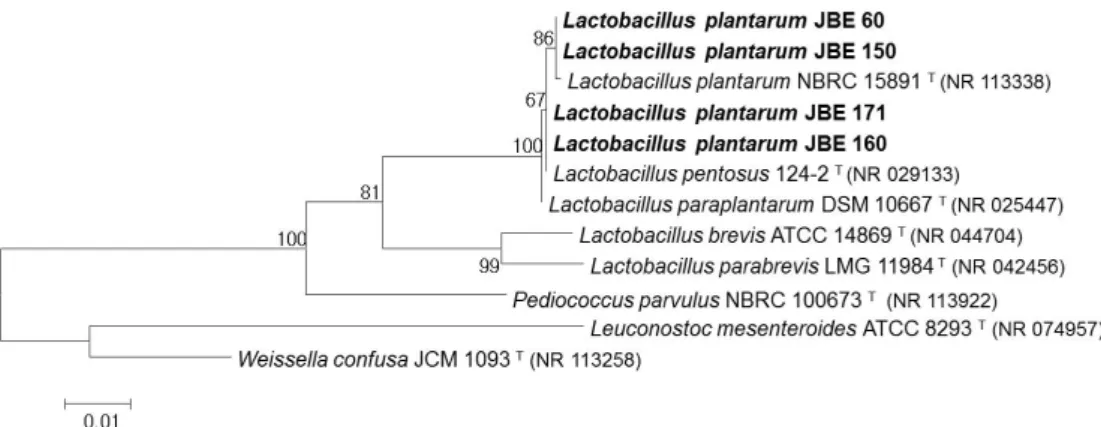
Fig. 2. Phylogenetic tree constructed from comparative analysis of 16S rRNA gene sequences showing the relationships of selected stains with other type strains. Bootstrap values (percentage from 1,000 replicates) are indicated at the nodes. The scale bar indicates the nucleotide change per site.
균 추정 균주에 대해 PCR을 수행한 결과, 서로 다른 균원시료 에서 분리했던 4종의 균주(JBE60, JBE150, JBE160, JBE171) 에서 예상된 크기의 PCR 산물(148 bp)이 관찰되었다(Fig. 1).
이 방법은 신속하고 경제적이므로 말로락틱 발효 균주의 1차 선발에 효과적으로 사용될 수 있을 것으로 보인다. 한편 negative control로 사용한 Leuconostoc mesenteroides JBE102 균주와 다른 분리 균주들에서는 이 PCR 산물이 보이지 않았다.
분리 균주의 동정
선발된 4종 균주들의 16S rRNA 유전자 염기 서열은 표준 균주들과의 서열 비교를 보여주는 계통도 작성을 통해 동정하 였다(Fig. 2). 그 결과 4 균주는 표준 균주들인 L. plantarum NBRC 15891, L. pentosus 124-2, Lactobacillus paraplantarum
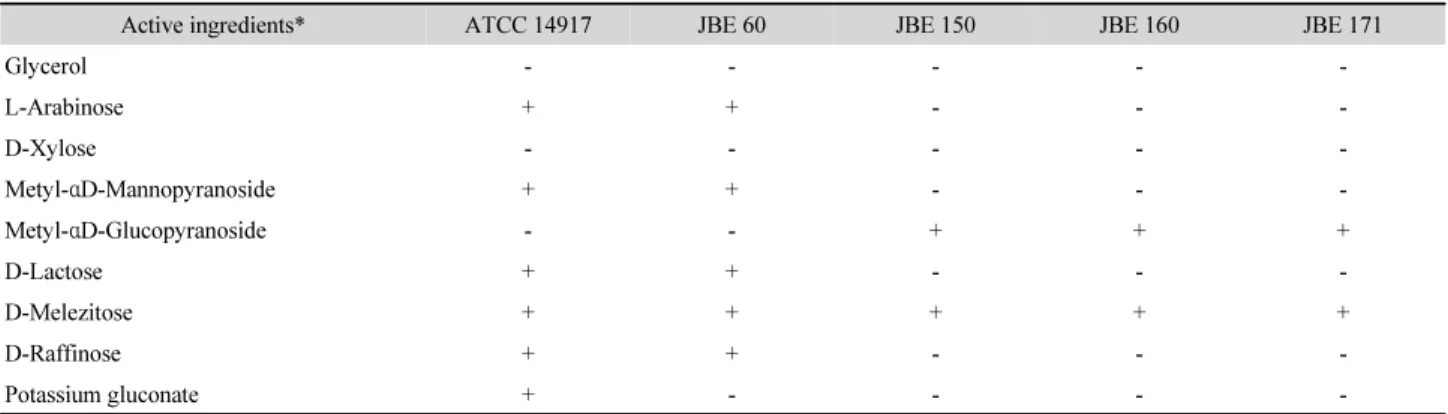
DSM 10667들과 가장 가까운 근연 관계를 보였으며 16S rRNA 염기 서열은 99.5% (1,465–1,466/1,471bp) 이상 상호간 일치하였다. 한편 L. plantarum 및 L. pentosus, L. paraplantarum 사이는 유전학적 상동성이 매우 높은 것으로 보고되었다 (Curk et al., 1996; Zanoni et al., 1987). 16S rRNA를 이용한 동 정으로는 판단이 어려웠으므로, API50 CHL kit를 이용한 생 화학적 분석을 수행하였다(Table 1). 그 결과 JBE 60 균주의 경 우 type strain인 ATCC 14917 균주와 potassium gluconate 이 용성에서 차이가 나타났으나 apiweb에서 L. plantarum 균주 와 생화학적 특성 차이가 없음을 의미하는 99.9% 일치도를 보였으며 JBE 150, JBE 160, JBE 171 균주들의 경우는 99.6%
일치하였다. 이들 세 균주(JBE 150, JBE 160, JBE 171)는 단 지 D-lactose 이용성에서 apiweb에 등록된 L. plantarum 균주 와 특성 차이를 나타냈다. L. plantarum과 L. pentosus 종을 구분하는 생화학적 기준은 glycerol과 D-xylose 이용성에서 차이(Zanoni et al., 1987)를 나타내며, L. plantarum과 L.
paraplantarum간에는 α-methyl-D-mannoside 이용성에서(Curk et al., 1996), L. paraplantarum과 L. pentosus 간에는 glycerol, D-xylose, D-melezitose의 이용성에서 다르다((Curk et al., 1996). 생화학적 기준에 따라 분류하면 JBE60은 L. plantarum, 나머지 세 균주는 L. paraplantarum으로 동정되었다. 결과적 으로 16S rRNA 염기 서열 분석과 생화학적 동정 결과가 상호 일치하지 않아 명확한 동정을 위한 다른 방법이 요구되었다.
Torriani 등(2001)은 DNA 수선과 유지 기능을 담당하는 RecA 유전자 내에 세 종간 명확히 구분되는 가변 영역이 존재하는 것을 밝혔다. 종간 가변 영역에 대한 PCR 수행 결과들에서 L.
paraplantarum의 경우는 107 bp, L. pentosus는 218 bp, L.
plantarum은 318 bp의 크기를 가짐을 보여주었다(Torriani et al., 2001; Bautista-Gallego et al., 2013; Ni et al., 2015). 16S
Table 1. Biochemical properties of the strains
Active ingredients* ATCC 14917 JBE 60 JBE 150 JBE 160 JBE 171
Glycerol - - - - -
L-Arabinose + + - - -
D-Xylose - - - - -
Metyl- αD-Mannopyranoside + + - - -
Metyl- αD-Glucopyranoside - - + + +
D-Lactose + + - - -
D-Melezitose + + + + +
D-Raffinose + + - - -
Potassium gluconate + - - - -
*All strains utilized the following substances: D-Ribose, D-Galactose, D-Glucose, D-Fructose, D-Manose, D-Manitol, D-Sorbitol, N-Acetylglucosamine, Amygdalin, Arbutin, Esculin, Salicin, D-Cellobiose, D-Maltose, D-Melibiose, D-Saccharose, D-Trehalose, Genitobiose, D-Turanose. None of the strains utilized the following substances: erythritol, D-arabinose, L-xylose, D-adonitol, methyl-D-xylopyranoside, L-sorbose, L-rhamnose, dulcitol, inositol, inulin, amidon (starch), glycogen, xylitol, D-lyxose, D-tagatose, D-fucose, L-fucose, D-arabitol, L-arabitol, potassium 2-ketogluconate and potassium 5-ketogluconate (data not shown).
Fig. 3. Gel electrophoresis of the recA gene products by multiplex PCR. M is a 100 bp DNA ladder. Strain ATCC 14917
Twas used as a positive control of L. plantarum for the detection of recA gene.
rRNA 및 생화학 분석과 함께 recA의 가변 영역 길이가 모두 318 bp 위치에 해당되는 밴드를 보인 것으로 보아(Fig. 3), 4종 의 균주 모두를 L. plantarum로 동정하였다.
선발 균주의 mle 유전자 염기서열 분석
L. plantarum로 동정된 4 균주의 mle 유전자 특성을 비교하 였다. 선발 균주 mle 유전자의 전체 염기 서열 크기는 1,644 bp 였고, 이를 유전체 분석이 완료된 균주들 서열과 비교하였다 (Fig. 4A). 그 결과 메주에서 분리했던 JBE60은 막걸리 분리 균인 JBE150, JBE160, JBE171들과 염기서열에서 96.7%
(1,589/1,644 bp)가 같았으나, JBE150, JBE160, JBE171 균주 들 간에는 100% 동일했다. NCBI에 등록된 mle 서열들과 비교 한 결과 JBE60는 Lactobacillus plantarum subsp. plantarum P-8 균주와 서열 일치도가 99% (1,640/1,644 bp)였고 JBE150,
JBE160, JBE171의 경우 Lactobacillus plantarum JDM1 균주 와 99% (1,636/1,644 bp) 일치하였다.
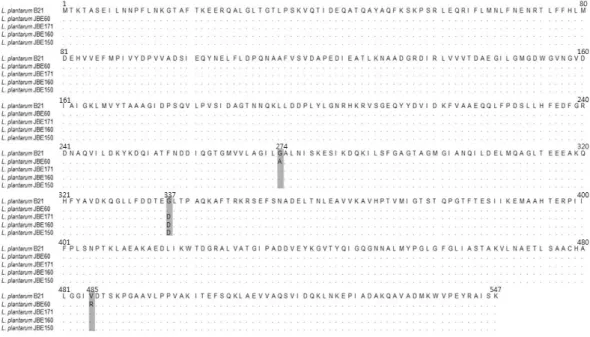
균주들의 염기서열을 547개의 아미노산 서열로 해독한 뒤 유전체 분석이 완료된 균주들의 말로락틱 효소들과 비교하였 다(Fig. 4B). JBE60와 의 세 균주 간 말로락틱 효소의 아미노산 서열을 비교하였을 때 염기서열 간에는 96.7%의 일치도를 보 였으나, 불일치한 서열의 91% (50/55)가 코돈의 3번째 염기서 열에서 나타나 아미노산 서열의 일치도는 99.5% (544/547 aa) 로 상승했다. 말로락틱 효소의 두 영역 중에서 N-terminal domain 영역(아미노산 서열 69-251)은 균주 간 염기 서열에서 는 차이가 있으나 아미노산 서열에서 동일한 반면, Short-chain dehydrogenases/reductases 영역(아미노산 서열 261–540)에 서 아미노산 서열에 차이를 보였다(Fig. 5).
에탄올 내성 특성
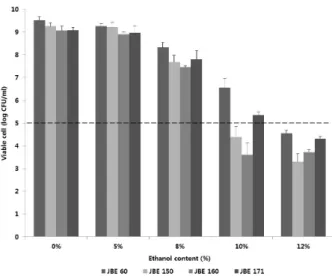
에탄올 내성을 조사하기 위해 에탄올을 첨가한 MRS 배양 액에 배양시킨 후 생균수를 측정한 결과는 Fig. 6과 같다. 5%
농도까지는 첨가하지 않은 대조구와 균수에 차이가 없었으나, 8% 농도부터는 유의적인 차이가 나타났다. JBE60 균주는 10% 에탄올 함유 MRS 배지에서 배양 했을 때 5 log CFU/ml로 부터 48시간 배양 후 6.56±0.40 log CFU/ml까지 증가했으며, 12%농도 배양에서는 초기 접종량과 유의적 차이를 보이지 않 았다(P<0.05). 그러나 다른 세 균주들은 10% 및 12% 농도에 서 초기 접종량과 생균수가 비슷했거나 감소했다. 따라서 JBE60 균주는 10% 에탄올 농도에서도 생육을 지속할 수 있 어, 와인제조 시 말로락틱 발효를 수행할 수 있을 것으로 보인 다(Eva et al., 2004; Torriani et al., 2001).
Fig. 4. Phylogenetic tree constructed from comparative analysis of mle gene sequence (A) and the amino acid sequences (B) showing the relationships of selected stains with other strains. Bootstrap values (percentage from 1,000 replicates) are indicated at the nodes. The scale bar indicates the nucleotide change per site.
Fig. 5. Sequence alignment (residues 1-547) of the malolactic enzymes between the selected strains. Enzyme sequence of L. plantarum B21 (AJO73661) is
used as a control. Gray marks indicate variable sites
Fig. 6. Cell counts of selected strains in the MRS broth with different concentrations of ethanol after 48 h of culture. The viable cell counts represent mean±SD of three replications. Error bars indicate standard error. *Dash bar indicates the initial viable cell counts (10
5CFU/ml).
Table 2. Change of malic acid and lactic acid contents in MRS broth supplement 50 mM L-(-)-malic acid after 2 days of incubation
Strain Malic acid (mM)
Lactic acid (mM)
Rate of change (%)
Viable cell counts (Log
CFU/ml) ATCC14917 3.12±0.29 191.25±43.10 93.76±0.59 9.43±0.04
JBE 60 2.90±0.23 177.13±3.53 94.20±0.45 9.63±0.15 JBE 150 3.74±0.19
*149.93±15.01 92.52±0.38
*9.42±0.13 JBE 160 2.87±0.16 158.95±16.26 94.25±0.32 9.49±0.14 JBE 171 2.80±0.48 153.39±12.39 94.40±0.96 9.41±0.11
*
means significantly different at the 0.05%, according to Duncan multiple range test
말로락틱 발효 활성 측정
말로락틱 발효 활성 수준을 확인하기 위해 50 mM의 L-(-)- malic acid를 첨가한 MRS 배양액에서 정지기에 도달한 48시 간 배양 후 malic acid 감소율을 HPLC를 통해 확인하였다. 생 균수는 평균 9.49 log CFU/ml로 균주들 간 생육은 비슷했다.
균주를 접종하지 않은 대조구는 malic acid의 감소가 없었지 만 표준 균주인 ATCC 14917과 선발 균주들에서는 배양 후 모 두 감소되었다. JBE 150의 경우 접종 전과 비교해 92.5%의 감 소가 있었고, ATCC 14917과 나머지 3종류는 평균 94.2%로 약간 더 높은 감소율을 보였다(Table 2). 말로락틱 효소의 아미 노산 서열 차이에도 불구하고 균주 간 malic acid의 분해율 차 이가 미미한 것으로 볼 때 이 효소의 일부 서열 변이가 활성에 는 큰 영향을 주지 않을 것으로 예상되었다.
적 요
말로락틱 발효(MLF)은 유산균의 말로락틱 효소(Mle)에 의 해 malic acid가 lactic acid로 전환되는 과정으로 와인 제조에 널리 사용된다. 전통 발효 식품으로부터 54개의 유산균을 분리 한 다음 MLF 특성을 가진 균주를 선발하기 위해 Lactobacillus plantarum mle 유전자 서열의 보존 영역에 대한 primer 쌍을 제 작했고, PCR을 통해 이 유전자를 함유한 4 종의 균주를 선발하 였다. 선발된 균주들의 16S rRNA 염기서열과 생화학적 특성, rec gene 영역의 PCR을 수행하여 동정한 결과 Lactobacillus
plantarum으로 모두 동정되었다. 1,644 bp로 구성된 이들 mle 유전자의 분석 결과 JBE60 균주의 염기 서열은 JBE150, JBE160, JBE171 균주들과 96.7%, 아미노산 서열로는 99.5%
가 일치했다. 에탄올 저항성을 확인한 결과 JBE60 균주가 10% 에탄올에 대한 저항성이 가장 높았다. MLF 활성을 확인 한 결과 이들 균주는 평균 43%의 malic acid 감소를 보였으며 균주 간 분해율은 비슷했다. 이러한 결과로부터 JBE60 균주가 와인용 MLF 종균으로 이용 될 수 있을 것으로 보인다.
감사의 말
본 연구는 농림수산식품부 지역 전략 식품산업 육성사업 (과제명: 동부권 고기능 토종발효미생물과 향토자원을 이용 한 발효제품 개발 및 기능성 분석, 과제번호: MIFI 2014-1)의 지원에 의해 이루어진 것임.
References