Copyright ⓒ 2013, The Microbiological Society of Korea
저염 장류에서 증식하는 산막 효모에 길항 작용을 갖는 Bacillus 균주의 분리
전새봄1․류명선1․김용상1․조승화2․정도연2․엄태붕1,3*
1전북대학교 자연과학대학 생명과학과
2순창군 발효미생물관리센터
3전북대학교 방사선 기술연구소
Isolation and Identification of Bacillus Strains with Antagonistic Properties against Film-forming Yeasts Overgrown in Low Salted Soybean Pastes
SaeBom Jeon1, MyeongSeon Ryu1, Yong Sang Kim1, Seung Wha Jo2, Do Yeon Jeong2, and Tai-Boong Uhm1,3*
1Department of Biological Sciences, Chonbuk National University, Jeonju 561-756, Republic of Korea
2Sunchang Research Center for Fermentation Microbes (SRCM), Sunchang 595-804, Republic of Korea
3Institute for Radiation Technology, Chonbuk National University, Jeonju 561-756, Republic of Korea (Received September 9, 2013 / Accepted September 20, 2013)
Soybean pastes with 8% (w/w) salinity were prepared instead of soybean paste with 14% (w/w) salinity to meet the growing demands of Korean’s low sodium diet. After aging, white films had appeared on the surface of all low-salted soybean pastes [8% (w/w) salinity] unlike high-salted soybean pastes [14% (w/w) salinity]. All of eight microbes isolated from the surface film were identified as Pichia kudriavzevii. Eleven Bacillus strains with good characteristics of fermentation were isolated from traditionally fermented soybean pastes in order to preserve their unique flavors and aromas after aging, and as a result of analyzing the biochemical characteristics and 16S rRNA sequences, those were identified as B. subtilis, B. licheniformis, and B. methylotrophicus. All of the Bacillus isolates had antagonistic activities against 8 isolates of the film-forming yeasts and harbored the genes for synthesis of antimicrobial surfactants including lichenysin and/ or surfactin.
Keywords: Bacillus, Pichia, antagonistic property, film-forming yeasts, low-salted soybean paste
*For correspondence. E-mail: [email protected]; Tel.: +82-63-270- 3439; Fax: +82-63-270-3362
장류는 한국인의 식탁에 필수적인 부식으로 식품으로서 안전 성 확보는 무엇보다 중요한 과제이다. 김치, 장류, 젓갈 등의 고 염도 발효식품이 발달한 식문화 습관 때문에 한국인은 식사를 통해 세계적으로 가장 높은 수준의 소금량인 하루 평균 12.2 g (나트륨 함량으로 4.8 g)을 섭취하며 이는 WHO (World Health Organization) 권장량(하루 5 g)의 2.4배에 이른다(Korea Health Statics, 2011, 2012). 소금의 과다 섭취는 심혈관 질환, 위암, 신 장결석 등과 관련(He and MacGregor, 2009) 되어있기 때문에 이의 섭취량을 줄이려는 노력이 범국가적으로 진행되고 있다.
2011년 국민건강영양조사(http://knhanes.cdc.go.kr/)에 따르면, 나트륨 섭취의 주요 급원은 소금으로부터 17.7%, 김치(배추김 치, 총각김치 및 깍두기) 22.1%, 장류(된장, 고추장, 간장 및 쌈 장) 20.6%로서 김치와 장류의 섭취만으로도 하루 소금량의 40%
이상을 섭취하는 것으로 보고되었다. 이에 대한 개선책으로 식품 의약품안전처(Ministry of Food and Drug Safety, MFDS)에서 는 장류 100 g 당 나트륨 함량을 0.4 g 더 줄여줄 것을 장류업체에 권고하였다. 그러나 단백질 및 지방이 풍부한 콩을 저염에서 발효 하는 경우, 소금 때문에 증식이 억제되던 여러 종류의 유해균들이 빠르게 자라면서 부패와 함께 산막이 형성되기 쉽다. 산막은 발효 제품의 상품성을 떨어뜨릴 뿐 아니라, 산소 공급의 차단으로 인해 발효미생물의 군집 특성을 변화시키며 산막의 자가 소화 분해로 여러 부패 균들의 증식을 유발한다. 부패균 증식 억제를 위해 알 코올(Lee et al., 1985)이나 항균 활성을 가진 천연 향신료(Oh et al., 2002, 2005; Lim and Song, 2010) 등을 첨가할 수 있지만 장 류의 고유한 풍미가 사라지는 단점이 있었다. 이의 해결 방안으로 저염에서 증식하는 부패균에 대해 길항 작용하는 발효균을 선발 한 뒤 이를 발효 공정에 사용하는 것이 가장 합당한 전략일 것이 다. 이를 위해 저염 장류 제조 동안 형성되는 산막 형성 균들의 동 정이 필요하지만, 현재까지는 일반적으로 사용하는 고염 숙성 간
Strain Putrescine digestion (%)
Tyramine digestion (%)
B. cereus inhibition
Glutamate (mg/g)
B. cereus toxin genes
Protease activitya
Amylase activityb
SCKB 17 64±2 99±1 ++ 0.96±0.12 none +++ +++
SCKB 18 56±1 95±1 ++ 1.28±0.09 none ++++ +++
SCDB 19 68±2 92±3 ++ 0.96±0.05 none ++++ +++
SCCB 32 88±2 94±2 +++ 4.47±0.08 none +++ +++
SCKB 33 78±3 92±2 ++ 3.84±0.10 none +++ +++
SCDB 34 83±1 91±3 +++ 3.83±0.08 none ++++ +++
SCDB 35 83±3 88±1 ++ 3.21±0.13 none ++++ +++
SCDB 36 84±2 91±2 ++ 2.24±0.15 none ++++ +++
SCCB 37 98±1 90±1 +++ 3.20±0.08 none +++ +++
SCSB 38 90±3 87±1 ++ 3.23±0.07 none ++ +++
SCSB 39 94±2 91±2 ++ 4.79±0.12 none ++++ +++
a ++++, halo radius>10 mm; +++, 7–9 mm; ++, 5–6 mm.
b +++, halo radius 7–9 mm
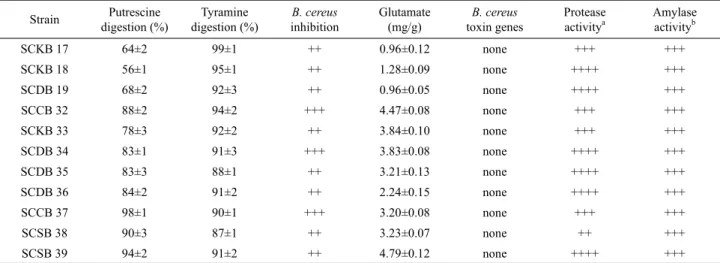
Table 1. Characteristics of isolated Bacillus strains
Fig. 1. A field emission scanning electron micrograph of the film-forming strain SCS FY10. The bar represents 2 µm.
장에서 Zygosaccharomyces 속의 산막효모가 동정되었다는 보고 (Chu et al., 1975) 이외에는 알려진 바가 없었다. 전통 장류에서 Aspergillus 속과 함께 발효에 주 역할을 하는 Bacillus 속은 발효 에 관여하는 많은 세균 군집 가운데 가장 우위를 점하고 있으며 (Kim et al., 2011a, 2011b), 특히 Bacillus의 일부 균주들은 항생 물질 또는 계면 활성제를 분비하여 항세균 및 항진균 작용을 가지 는 것으로 보고되어 왔다(Tagg et al., 1976). 장류의 저염화에 따 른 문제 해결 방안이 필요한 상황에서 본 연구는 저염 된장 제조 동안 증식한 산막 형성 부패균들을 동정하고, 이들 부패균에 대해 길항 능력을 갖는 유익 Bacillus 균들을 분리하여 위생적인 저염 장류를 제조하려는데 목표를 두었다.
된장 제조를 위해 메주용 콩(순창 산) 20 kg을 수세 침지하여 121℃에서 30분 증자하고 냉각하였다. 증자한 콩에 전통 고추장 에서 분리한 A. oryzae SKM7 포자액(~3–7 × 10⁷ CFU/ml)과 B.
licheniformis SCK B11 배양액(~2–10 × 108 CFU/ml)을 각 0.1% (v/w)와 0.05% (v/w) 농도로 동시에 접종하여 30℃에서 48시간 발효시켰고, 이를 60℃에서 24시간 건조한 후 낱알 메주 를 제조하였다. A. oryzae SKM7는 Potato dextrose agar (PDA) 에서 28℃, 14일 배양 후, 10 ml 0.01% Triton X-100를 사용하 여 포자를 수집한 뒤 여과하여 사용하였다. B. licheniformis SCK B11는 37℃에서 18시간 동안 Nutrient broth (NB)에 배양 한후 접종하였다. 각 2 kg 단위의 낱알 메주에 16% (w/v) 및 23% (w/v)의 천일염수 6 L를 각각 첨가한 뒤 총질소량이 1.0%
이상 되는 시점인 약 45일간 침지 발효하였고, 이후 염수를 제거 하여 된장을 분리하였다. 염도계(Takemura, Japan)로 측정 결과, 16% 저염수로 침지한 된장은 8±0.4% (w/w) 소금을, 23% 고염 수에 침지했던 된장은 14±0.5% (w/w)의 소금을 함유하였다.
염수 분리한 된장을 실온에서 다시 6주간 더 숙성하는 동안 14% 염농도 된장들에서는 고유의 된장향미가 있으면서 산막이 없었으나, 8% 저염 된장 시료들 모두에서 표면에 흰 산막이 형 성되었고 부패한 신 냄새가 났다. HPLC (Agilent, USA)에 의한 유기산 분석에서 14% 염을 함유한 된장에서는 kg 당 succinic
acid, lactic acid, acetic acid 함량이 66±4 mg, 221±7 mg, 1238±8 mg이었던 반면, 8% 저염 된장에서는 각각 86±5 mg, 680±9 mg, 2864±13 mg으로, 저염화에 따라 succinic acid 1.3 배, lactic acid는 약 3배, acetic acid의 경우 약 2.3배 증가했다.
산막 형성 미생물을 분리하기 위해 각 시료에서 산막을 분리하여 DW로 희석하고 이를 효모 및 곰팡이 분리용 3 M Petrifilm (3 M, USA)에 접종한 뒤 27℃에서 48시간 배양하였다. 형성된 집 락들을 PDA에 접종하여 배양하고 이를 새 PDA에서 다시 분리 배양하여 8종의 집락을 얻었다. 효모 형태와 크기를 전자현미경 으로 확인한 결과 이들은 타원형으로 약 1.7–2.5 µm × 3.1–5.2 µm의 크기였다(Fig. 1). 동정을 위해 효모용 genomic DNA (gDNA) prep kit (Solgent, Korea)로 gDNA를 추출하고, 이를 주형 DNA로 하여 PCR을 수행하였다. Universal primer로서 ITS1F (5′-TCCGTAGGTGAACCTGCGG-3′)와 ITS4R (5′
-TCCTCCGCTTATTGATATGC-3′)을 사용해 ITS 영역을 증
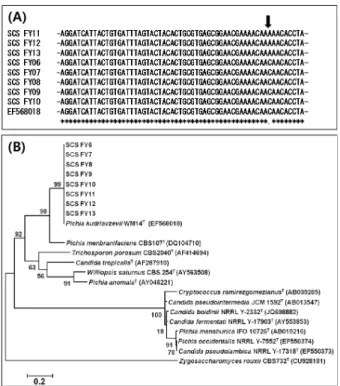
Fig. 2. (A) Close–up view of a single base difference (arrow) between ITS regions of film-forming yeasts. For comparison, sequences of the partial ITS region were aligned for match with that of type strain P. kudriavzevii (EF568018). (B) Phylogenetic tree by Maximum Likelihood method based on ITS sequences (484 bp), showing the relationship between the film-forming yeasts found in soybean pastes with 8% (w/w) salinity and closely related yeast type strains.
The percentage of trees in which the associated taxa clustered together is shown next to the branches. The tree is drawn to scale, with branch lengths measured in the number of substitutions per site.
폭하였으며, PCR은 95℃ 2분 처리, 95℃ 20초, 50℃ 40초, 72℃
1분 반응을 30회 반복, 72℃에서 5분 반응 후 종결하였다. 반응 산물은 1.5% agarose 겔에서 전기영동을 하여 확인하였고 PCR purification kit (Qiagen, Germany)에서 정제한 뒤, Macrogen (Korea)에 염기 서열을 의뢰하였다. 해독한 ITS 영역 염기 서열 (476–723 bp)들을 CLUSTAL W (Thompson et al., 1994)에서 비교한 결과 8종 균주들의 공통 ITS 영역(484 bp)은 하나의 염기 서열 차이를 제외하고 완전히 동일하였으며(Fig. 2A), BLASTN search (Zhang et al., 2000)로 근연 관계들을 비교했을 때 이들 은 모두 Pichia 속 효모에 속했다. 균주 동정을 위해 표준 균주 (type strain)들의 ITS 영역 염기 서열을 StrainInfo의 Advanced Search와 GenBank database를 이용해 찾은 뒤, 표준 균주들과 계통적 유연 관계를 보기 위해 MEGA Program version 5.10 (Tamura et al., 2011)으로 계통도를 작성하였다(Fig. 2B). 계통도 분 석은 균주들의 ITS 영역의 염기 서열들을 정렬하고 chromatogram 의 시각적 관찰과 수작업으로 gap이 최소화되도록 보정한 후 Tamura- Nei model에 기초를 둔 Maximum Likelihood 방법(Tamura and Nei, 1993)을 사용하여 작성하였다. 산출한 각각의 계통수에서 각 분지에 대한 통계학적 신뢰도를 산출하기 위해 bootstrap 분석 을 1,000회 실행하였으며, 계통분석과 bootstrap 분석은 MEGA
program를 사용하였다. 그 결과 8종 효모는 모두 Pichia kudriavzevii (≡Candida krusei ≡Issatchenkia orientalis)로 동정되었는데(Fig.
2B), 저염 된장의 주 산막 형성 효모로서 Pichia 속의 발견은 이 연구 가 처음이었다. 한편 포도주에서 산막을 형성하는 효모로 Candida boidinii, C. intermedia, C. pseudointermedia, C. pseudolambica, C. tropicalis, Issatchenkia occidentalis, I. orientalis, Pichia anomala, P. fluxuum, P. fermentati, P. galeiformis, P. membranifaciens, Brettanomyces 속이 보고되었고(Vollekova et al., 1996), 이들 중 P.
galeiformis와 P. membraniformis가 가장 자주 발견되는 것으로 알 려져 있다
전통 장류의 고유한 풍미를 원래대로 유지하면서 저염 장류 에서 산막을 형성하는 효모의 증식 억제는, 이들 효모에 대해 길 항 능력을 지닌 장류 발효균의 사용이 가장 적절한 방법일 것이 다. 산업적 이용을 위해 산막 효모 억제균은 식품 위생상 안전하 게 사용할 수 있는 장류 주 발효균으로서, 부패 균에 대한 효과적 인 길항 능력과 함께 장류 풍미를 유지해야 한다. 이들 중 Bacillus 는 Aspergillus와 더불어 장류 발효에 가장 중요한 역할을 하는 미생물로서, 전통적으로 사용된 장류 식품에서 식품 안전성이 확립되어 있으며 부패균들에 대해 길항 능력을 가진 항균 물질 들을 생산할 수 있다. 이러한 특성을 고려하여 장류에서 우수 발 효 능력을 지닌 Bacillus를 1차로 선발한 뒤 산막형성 효모에 대 한 길항 능력을 조사했다. 먼저 우수 발효 능력을 지닌 Bacillus 균주의 선발을 위해 장류에서 분리한 균들을 대상으로 (1) B.
cereus 선택배지인 chromogenic B. cereus selective medium (Oxoid, UK)를 이용하여 B. cereus group에 속하는지 유무, (2) 설사, 구토, 호흡 독소를 생산하는 10종의 B. cereus 독소 합성 유전자 존재 유무, (3) pH 지시약 함유 배지에서 biogenic amines 생성 유무, (4) HPLC에 의한 biogenic amines 분해 능력, (5) 세 포 외 glutamate 생성량, (6) protease 및 amylase 생성 능력을 기 준으로 삼아 Kim 등(2012)의 방법에 따라 선발하였다. 이 과정 을 통해 28종의 전통 장류에서 우수발효 능력을 지닌 11종의 Bacillus 균주들을 분리하였다(Table 1).
선발한 11종 Bacillus 균주들의 생화학적 동정을 위해 Nutrient agar (NA)에 접종하고 37℃에서 18시간 배양하였다.
각 집락은 NB에 희석 후 46종의 건조배지와 생화학 반응물로 구성된 BCL ID card (bioMérieux Vitek Inc., USA)에 주입하였 고, 14시간 후 배양 또는 반응 결과를 VITEK 2 Compact software (bioMérieux Vitek)에 저장된 표준 균주의 생화학적 database들 과 비교하여 동정하였다. 그 결과 SCKB17 및 SCDB19는 B.
subtilis 또는 B. amyloliquefaciens나 B. atrophaeus로 추정되었 고, 나머지 9균주들은 94–99%의 높은 확률로 B. licheniformis 로 동정되었다. 16S rRNA 유전자의 염기서열에 의한 균 동정을 위 해 universal primer로서 27F (5′-AGAGTTTGATCCTGGCTCAG- 3′)와 1,492R (5′-GGTTACCTTGTTACGACTT-3′)을 사용하여 16S rRNA 유전자를 증폭 후, 동정에 중요한 가변 염기 영역 (Chakravorty et al., 2007)을 포함하는 1,443 bp를 BigDye terminator v3.1 Cycle Sequencing kit (Applied Biosystems Inc., USA)를 사용하여 해독하였다. 이 염기 서열들을 이용해서 BLASTN search (Zhang et al., 2000)와 Ribosomal Database
Primer pair Sequence Target gene (GenBank accession no) Size (bp) lchAF
lchAR
ACGGCCGATCAGGAGCTTTC TCTCAGCGCCTTCGATCTGC
Lichenysin synthetase, lchAA
(AJ005061) 557
lchBF lchBR
TTTGACCCGGAGCTCGTTGA CTGAGGGCGGAAAGCAGGAT
Lichenysin synthetase, lchAB
(AJ005061) 706
lchCF lchCR
CATGTATACGGGCCGACGGA CTGAAGGCCGGAGATGGCTT
Lichenysin synthetase, lchAC
(AJ005061) 1173
srfAF srfAR
CAGCGGCAGCGGATTAAATG GGCCTTCAAAATCGCCTGCT
Surfactin synthetase AA, srfAA
(NC000964) 1,025
srfBF srfBR
CGGTGTGTCATGGCGGATTT TCGAAAGCGGACGGTTCAAA
Surfactin synthetase AB, srfAB
(NC000964) 696
srfCF srfCR
TTCACTGTCGGAGGCGGAAA ACCGGCAGATAGGCTGCTCC
Surfactin synthetase AC, srfAC
(NC000964) 933
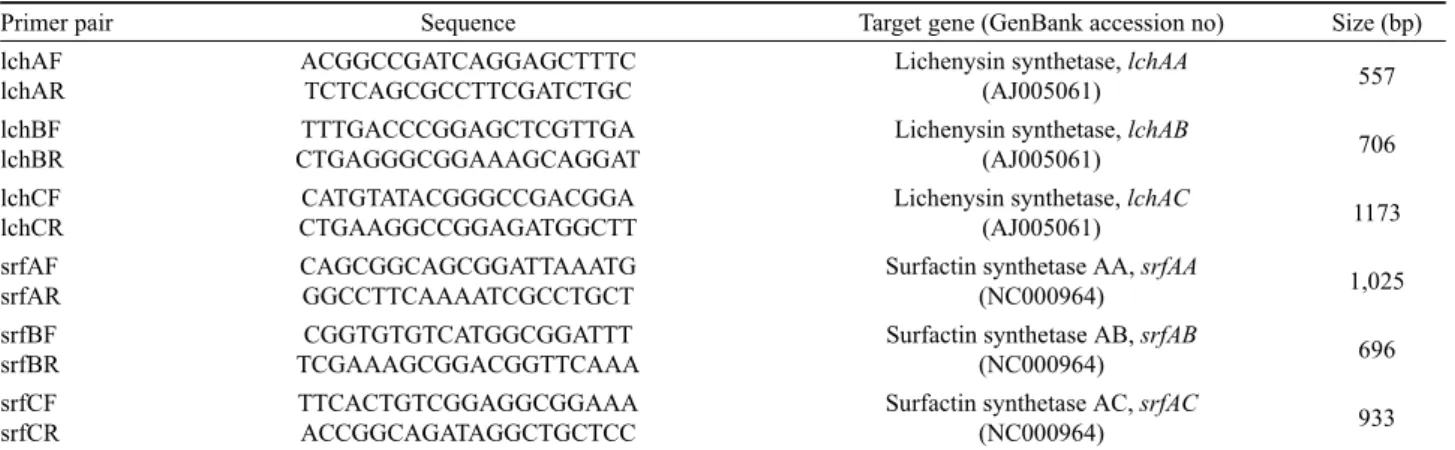
Table 2. PCR primers used in this study
Fig. 3. Phylogenetic tree by Maximum likelihood method based on 16S rRNA gene sequences, showing the phylogenetic position of the strains isolated from traditionally fermented soybean products with respect to species of the genus Bacillus. The percentage of trees in which the associated taxa clustered together is shown next to the branches. The tree is drawn to scale, with branch lengths measured in the number of substitutions per site.
Project (version 10)의 SeqMatch program에서 서열 일치도가 높은 표준 균주들의 16S rRNA 유전자 염기서열들을 얻었고, 이 들 염기 서열간의 상호비교를 위해 CLUSTAL W (Thompson et al., 1994)를 사용하였다. 계통도 분석은 균주들의 16S rRNA 유 전자 염기 서열들을 정렬하고 chromatogram의 시각적 관찰과 수작업으로 gap이 최소화되도록 보정한 후 Tamura-Nei model 에 기초한 Maximum Likelihood 방법(Tamura and Nei, 1993) 을 사용하여 작성하였다(Fig. 3). 산출한 각각의 계통수에서 각 분지에 대한 통계학적 신뢰도를 산출하기 위해 bootstrap 분석을 1,000회 실행하였으며, 계통분석과 bootstrap 분석은 MEGA program (Tamura et al., 2011)를 사용하였다. 선발 균주들은 생
화학적 동정분석 및 16S rRNA 염기 서열의 계통학적 분석으로부 터 Bacillus subtilis와 B. methylotropicus가 각 1종, B. licheniformis 로는 9종이 동정되었다. 발효 능력이 탁월하고 식품 안전성이 확 립된 11종의 선발 발효 균주들 가운데 B. licheniformis가 9종을 차지하는 것으로 보아 B. licheniformis는 전통 장류 발효과정에 서 가장 주요한 역할을 하는 미생물로 보인다. 현재 MFDS에 의 해 장류 발효의 GRAS (generally recognized as safe) 균주로 인 정하는 B. subtilis, B. polyfermenticus, B. natto, B. coagulans (http://fse.foodnara.go.kr/ origin)와 같이, 앞으로는 유전체 분석 으로 안전성이 확립된 B. licheniformis 역시 장류 발효를 위한 GRAS 목록 균주에 지정되어야 할 필요가 있다.
Film yeast
Relative inhibition zonea by antagonistic Bacillus strain
SCKB 17 SCKB 18 SCDB 19 SCCB 32 SCKB 33 SCDB 34 SCDB 35 SCDB 36 SCCB 37 SCSB 38 SCSB 39 SCS FY6 1.3±0.03 1.2±0.03 1.3±0.02 1.4±0.02 1.3±0.02 1.6±0.05 1.6±0.02 1.4±0.02 1.4±0.02 1.5±0.02 1.5±0.02 SCS FY7 1.2±0.02 1.2±0.01 1.3±0.05 1.4±0.03 1.5±0.03 1.2±0.01 1.4±0.03 1.3±0.03 1.3±0.02 1.3±0.02 1.3±0.02 SCS FY8 1.4±0.05 1.3±0.01 1.4±0.01 1.4±0.05 1.2±0.02 1.2±0.01 1.4±0.02 1.5±0.02 1.4±0.02 1.3±0.01 1.3±0.01 SCS FY9 1.2±0.03 1.2±0.02 1.3±0.03 1.2±0.02 1.2±0.02 1.3±0.03 1.3±0.02 1.4±0.01 1.1±0.03 1.3±0.03 1.3±0.03 SCS FY10 1.3±0.05 1.3±0.02 1.3±0.03 1.4±0.01 1.4±0.05 1.6±0.04 1.6±0.01 1.4±0.02 1.4±0.01 1.3±0.01 1.3±0.01 SCS FY11 1.3±0.05 1.4±0.01 1.3±0.05 1.4±0.01 1.5±0.02 1.4±0.02 1.5±0.01 1.4±0.01 1.5±0.03 1.5±0.02 1.5±0.02 SCS FY12 1.3±0.03 1.3±0.03 1.2±0.02 1.2±0.03 1.4±0.05 1.4±0.01 1.5±0.03 1.3±0.03 1.3±0.05 1.3±0.02 1.3±0.02 SCS FY13 1.3±0.05 1.4±0.01 1.2±0.01 1.3±0.05 1.2±0.02 1.5±0.01 1.3±0.01 1.4±0.03 1.2±0.03 1.4±0.05 1.4±0.03
a Halo diameter/paper disc diameter
Table 3. Growth inhibition of film-forming yeasts by antagonistic Bacillus strains isolated from soybean products
Strain Surfactant-synthesizing genea
lchAA lchAB lchAC srfA srfB srfC
Bacillus subtilis SCKB 17 - - - + + +
Bacillus licheniformis SCKB 18 - - - + + +
Bacillus methylotrophicus SCDB 19 - - - - - -
Bacillus licheniformis SCCB 32 + + + + + +
Bacillus licheniformis SCKB 33 + + + - - -
Bacillus licheniformis SCDB 34 + + + - - -
Bacillus licheniformis SCDB 35 + + + - - -
Bacillus licheniformis SCDB 36 + + + - - -
Bacillus licheniformis SCCB 37 + + + - - -
Bacillus licheniformis SCSB 38 + + + - - -
Bacillus licheniformis SCSB 39 + + + - - -
a +, presence; -, absence
Table 4. Presence of surfactant-synthesizing genes of isolated Bacillus strains 선발 Bacillus 균들에 의한 산막 형성 효모 억제능력을 확인하 기 위해, 8종의 산막 형성 균주들을 각각 Potato dextrose broth (PDB)에서 28℃, 18시간 배양 후 200 µl를 취해 PDA 배양 접시 표면에 고르게 펼친 다음 6 mm 직경의 paper disc (Toyo Roshi, Japan)를 얹었다. 선발 Bacillus 균들은 각 NB 배지에 37℃, 48 시간 동안 배양 후 원심분리(13,000 rpm, 3 min)하고 상층액 각 20 µl를 취해 paper disc 위에 분주하였으며, 이를 30℃, 24시간 항온조에서 더 배양 한 후 paper disc 주위에 형성된 투명환 직경 을 측정하였다. Table 3의 결과에서 선발 Bacillus의 균주들은 모두 산막 효모에 대해 길항 능력을 보였으며, 이들 중 B. licheniformis SCDB34 및 SCDB35의 균주는 전체적으로 산막 효모들에 대한 증식 억제 효과가 더 우수했다. 배양한 Bacillus를 원심 분리하여 세포가 제거된 상층액 만을 paper disc에 분주했기 때문에 산막 효모의 증식을 억제하는 물질은 Bacillus의 세포 외 방출물질로 추정되었다. Bacillus 일부 속들은 lipopeptides계 물질인 surfactin family, fengycin family, iturin family, antiadhesin, BamylocinA 등 21종 이상의 다양한 항세균 및 항진균 물질들을 생산하는 것 으로 보고되었다(Roongsawang et al., 2011). B. licheniformis나 B. subtilis의 대표적 항균 계면활성제인 lichenysin (Grangemard
et al., 2001)이나 surfactin (Arima et al., 1968) 유전자를 선발 균주들이 함유하는지 확인하기 위해 B. licheniformis의 lichenysin 합성 효소 유전자인 lchAA, lchAB, lchAC와 B. subtilis의 surfactin 합성효소 유전자 srfAA, srfAB, srfAC를 선택하여 PCR 을 수행하였다. Primer 서열들은 Table 2와 같았고, PCR 조건은 94℃에서 2분간 초기 변성 후, 94℃ 1분간 변성, 56℃ 1분간 결 합, 72℃ 1분간 증폭과정을 30회 반복하고 72℃에서 5분간 마지 막 증폭을 실시하였다. 그 결과 B. subtilis와 B. licheniformis 균 주들은 항균 특성을 지니는 lichenysin과 surfactin 합성 유전자들 을 함유하고 있었으나, 균주에 따라 함유하는 유전자 종류는 차 이를 보였다(Table 4). 또한 타 선발 균주들에 비해 B. licheniformis SCDB34 및 SCDB35의 높은 길항 효과가 여러 항진균 물질들 을 동시에 생산하기 때문일 수도 있기 때문에, 앞으로 이 두 균주가 생산하는 항진균 물질들의 종류와 양들을 분석할 필요가 있다.
장류의 저염화 과정에서 생기는 병원성 균의 증식, 젖산 및 초 산 생성량 증가, 부패취의 증가 문제들은 우수 발효균으로 처리 하는 것이 가장 적절한 해결책일 것이다. 그 동안 연구를 통해 전 통 장류 발효에서 핵심 역할을 하는 B. licheniformis의 일부 균 주가 Aspergillus ochraceus, A. fumigatus, A. flavus, A. parasiticus
와 같은 유해 곰팡이 뿐 아니라, Staphylococcus aureus, Listeria monocytogenesis, Enterobacter faecalis, Pseudomonas aeruginosa, Micrococcus luteus, B. cereus와 같은 유해 세균의 증식을 효과적으로 억제할 수 있음을 발견했다(Kim et al., 2012). 또한 장류에서 우수 균주로 분리했던 B. licheniformis, B.
subtilis, B. amyloliquefaciens들이, 젖산균이나 다른 병원성 부 패균들에 의해 만들어져 부패취를 형성하는 putrescine과 cadaverine을 73–93%까지 분해할 수 있음도 관찰하였다(Kim et al., 2012). 따라서 Bacillus 발효 균주들의 적절하고 지속적인 선발을 통해 우수한 균주들을 분리하고 제조를 위한 실증 실험 을 해 간다면, 저염화 장류 개발 과정에서 생기는 여러 문제점들 에 대해 근본적인 해결책을 마련할 수 있을 것으로 보인다. 현재 발효 특성의 우수성과 산막 억제능력을 검증하기 위해 B.
licheniformis SCDB34와 SCDB35 균주를 주 발효균으로 사용 하여 8% 저염 된장 및 간장을 발효 중에 있다.
적 요
한국인의 저염 섭취 필요성에 부응하기 위해 14% (w/w) 염도 의 된장 대신 8% (w/w) 저염 된장을 제조하였다. 숙성 후 8% 저 염 된장 시료들은 14% 염 된장과 달리 모두 산막을 형성하였고, 이 산막 형성균들을 동정한 결과 8종 모두 효모인 Pichia kudriavzevii 에 속하였다. 장류 고유한 풍미를 유지하기 위해 발효 특성이 우 수한 11종의 Bacillus 균들을 전통 장류에서 분리했고, 이들의 생화학적 특성 및 16S rRNA 염기 서열 분석 결과 B. subtilis, B.
licheniformis, B. methylotrophicus로 동정되었다. 이 균주들은 8 종의 산막 효모에 대해 증식 억제 능력을 보였으며, 항균 계면활 성제인 lichenysin 또는 surfactin 유전자들을 함유하고 있었다.
감사의 말
본 연구는 2013년 농림수산식품부 고부가가치 식품개발사업 (과제번호 311036-3), 2013년 지역 농식품 선도클러스터 육성사 업 및 2013년 전북대학교 자연계열 대학원생 지원 프로그램(전 새봄)에 의해 수행되었습니다.
참고문헌
Arima, K., Kakinuma, A., and Tamura, G. 1968. Surfactin, a crystalline peptidelipid surfactant produced by Bacillus subtillis : isolation, characterization and its inhibition of fibrin clot formation. Biochem.
Biophys. Res. Commun. 31, 488–494.
Chakravorty, S., Helb, D., Burday, M., Connell, N., and Alland, D. 2007.
A detailed analysis of 16S ribosomal RNA gene segments for the diagnosis of pathogenic bacteria. J. Microbiol. Methods 69, 330–339.
Chu, Y-H., Yu, T-J., and Yu, J-H. 1975. Studies on the film forming yeasts isolated from commercial soy sauce. Korean J. Food Sci. Technol.
7, 62–68.
Grangemard, I., Wallach, J., Maget-Dana, R., and Peypoux, F. 2001.
Lichenysin: a more efficient cation chelator than surfactin. Appl.
Biochem. Biotechnol. 90, 199–210.
He, F.J. and MacGregor, G.A. 2009. A comprehensive review on salt and health and current experience of worldwide salt reduction programmes. J. Hum. Hypertens. 23, 363–384.
Kim, Y.S., Cho, S.H., Jeong, D.Y., and Uhm, T.B. 2012. Isolation of biogenic amines-degrading strains of Bacillus subtilis and Bacillus amyloliquefaciens from traditionally fermented soybean products.
Korean J. Microbiol. 48, 220–224.
Kim, Y.S., Jeong, D.Y., Hwang, Y.T., and Uhm, T.B. 2011a. Bacterial community profiling during the manufacturing process of traditional soybean paste by pyrosequencing method. Korean J. Microbiol. 47, 275–280.
Kim, Y.S., Kim, M.C., Kwon, S.W., Kim, S.J., Park, I.C., Ka, J.O., and Weon, H.Y. 2011b. Analyses of bacterial communities in Meju, a Korean traditional fermented soybean bricks, by cultivation-based and pyrosequencing methods. J. Microbiol. 49, 340–348.
Lee, S.W., Shin, S.Y., and Yu, T.J. 1985. Effects of the ethanol contents on the preparation of low salt Doenzang. Korean J. Food Sci.
Technol. 17, 336–339.
Lim, S.I. and Song, S.M. 2010. Fermentation properties of low-salted Doenjang supplemented with licorice, mustard, and chitosan.
Korean J. Food Sci. Technol. 42, 323–328.
Ministry of Health and Welfare. 2012. Korea Health Statics 2011: Korea national health and nutrition examination survey (KNHANES V-2), p. 324, Republic of Korea.
Oh, J.Y., Kim, Y.S., and Shin, D.H. 2002. Changes in physicochemical characteristics of low-salted Kochujang with natural preservatives during fermentation. Korean J. Food Sci. Technol. 34, 835–841.
Oh, J.Y., Kim, Y.S., and Shin, D.H. 2005. Changes in microorganisms and enzyme activities of low-salted Kochujang added with horseradish powder during fermentation. Korean J. Food Sci.
Technol. 37, 463–467.
Roongsawang, N., Washio, K., and Morikawa, M. 2011. Diversity of nonribosomal peptide synthetases involved in the involved in the bionsynthesis of lipopeptide biosurfactants. Int. J. Mol. Sci. 12, 141–172.
Tagg, J.R., Dajani, A.S., and Wannamaker, L.W. 1976. Bacteriocins of Gram-positive bacteria. Bacteriol. Rev. 40, 722–756.
Tamura, K. and Nei, M. 1993. Estimation of the number of nucleotide substitutions in the control region of mitochondrial DNA in humans and chimpanzees. Mol. Biol. Evol. 10, 512–526.
Tamura, K., Peterson, D., Peterson, N., Stecher, G., Nei, M., and Kumar, S. 2011. MEGA5: Molecular evolutionary genetics analysis using Maximum Likelihood, Evolutionary Distance, and Maximum Parsimony methods. Mol. Biol. Evol. 28, 2731–2739.
Thompson, J.D., Higgins, D.G., and Gibson, T.J. 1994. CLUSTAL W:
Improving the sensitivity of progressive multiple sequence alignment through sequence weighting, position-specific gap penalties and weight matrix choice. Nucleic Acids Res. 22, 4673–4680.
Vollekova, A., Malik, F., Vollek, V., and linczenyiova, K. 1996.
Characterization of yeasts isolated from red wine surface film. Folia Microbiol. 41, 347–352.
Zhang, Z., Schwarz, S., Wagner, L., and Miller, W. 2000. A greedy algorithm for aligning DNA sequences. J. Comput. Biol. 7, 203–214.