인공메소코즘에서 동물플랑크톤의 섭식압에 대한 어류의 영향
임지혁ᆞ손세환ᆞ김진영ᆞ오민우ᆞ남귀숙*ᆞ송영희*ᆞ이옥민ᆞ공동수†
경기대학교 생명과학과
*한국농어촌공사
Effects of Fish on the Grazing Pressure of Zooplankton in the Artificial Mesocosms
Ji Hyeok Im⋅Se-Hwan Son⋅Jin Young Kim⋅Min Woo Oh⋅Gui-Sook Nam*⋅ Younghee Song*⋅Ok-Min Lee⋅Dongsoo Kong†
Department of Life Science, Kyonggi University
*Korea Rural Community Corporation
(Received 24 May 2011, Revised 25 October 2011, Accepted 28 October 2011)
Abstract
In a natural water body, a useful ecotechnology to reduce standing crops of phytoplankton is to strengthen the top-down force of zooplankton. However, the predation of fish for zooplankton can make the force weak. This study was conducted to find out the effect of fish on the grazing pressure of zooplankton in the mesocosms established in a eutrophic stream (Kyongan Stream) from October to November in 2010. In the corral with fish, chlorophyll a concentration increased, and a small size cladoceran Bosmina longirostris was dominant. In the corral without fish, chlorophyll a concentration decreased along with the domination of a large cladoceran Daphnia galeata and a large copepod Eudiaptomus japonicus. The size-selective predation of fish appeared to miniaturize the zooplankton community, to narrow their food-size spectrum, and to weaken the top-down force.
keywords : Biomanipulation, Ecotechnology, Kyongan stream, Top-down force
1. 서 론1)
수중생물군집의 영양단계(trophic level)를 조절하여 조류 의 현존량을 감소시키는 생물관리(biomanipulation) 기술에 서 가장 핵심이 되는 사항은 식물플랑크톤에 대한 동물플 랑크톤의 하향조절능(top-down force)을 강화시키는 것이다 (Gophen, 1990; Hansson and Brönmark 2009; Opuszynski, 1978; Shapiro, 1990; Shapiro et al., 1975; Shapiro and Wright, 1984).
지금까지 알려진 조류의 현존량을 감소시키는 방법 중 수중폭기, 전자선과 초음파에 의한 물리적인 방법이 부영양 화된 호수 및 저수지에 적용되어 왔고(나은경 등, 2003;
Ahn et al., 2003), 철이나 알루미늄 첨가를 통해 인을 침전 시켜 불활성화 시키는 화학적인 조류제어 방법도 적용되어 왔다(Stenson et al., 1978). 이와 같은 물리․화학적 방법은 직접적이고 효과가 빠른 반면 비용이 많이 들고 조류를 제 외한 다른 생물에도 영향을 끼쳐 수중생태계의 먹이연쇄를 교란시키는 단점이 있다(Sigee et al., 1999).
그 외에 수체를 완전배수하거나 rotenone과 같은 독성이 적 은 살충제를 살포하여 동물플랑크톤의 포식어(zooplanktivo-
†To whom correspondence should be addressed.
rous fish)를 제거함으로써 초식압을 증가시켜 조류를 제어하 는 생물학적 조류제어 방법도 있다(Shapiro and Wright, 1984;
Sosnovsky and Quirós, 2009; Vijverberg et al., 1993). 생물학 적 방법은 물리화학적 방법에 비해 경제적인 이점은 있으나 아직까지도 실험적 연구 수준에 머물고 있다(이상재 등, 2007).
생물학적 방법 중 자연수체에 동물플랑크톤을 투입하는 시도가 이루어지고 있으나(Boon et al., 1994; Theiss et al., 1990), 어류의 포식압이 큰 경우 동물플랑크톤에 의한 하향 조절효과(top-down effect)가 감소될 수 있다(Gophen, 1990;
Shapiro and Wright, 1984). 따라서 생물관리에서는 어류의 포식압을 감소시켜 동물플랑크톤의 섭식압을 높이는 것이 중요 사안이 된다.
본 연구는 팔당호 내 경안천 수역에 설치된 메소코즘에서 어류의 유무에 따라 동물플랑크톤과 식물플랑크톤 군집의 종조성 및 현존량의 차이를 조사하고 하향조절능에 대한 포식압의 영향을 파악하는데 목적을 두었다.
2. 연구방법
2.1. 조사지점 및 조사기간
조사지점은 팔당호 내 경안천 합류부로서 영양염류 농도가 높고 체류시간이 길기 때문에 조류발생 빈도가 높은 수역이 었으며, Fig. 1의 A지점에 메소코즘을 설치하여 운영하였다.
Fig. 1. The location of mesocosms (A).
2.2. 메소코즘 구성
메소코즘은 2개의 실험조로 구성하였다. 부표와 지지대로 수표면에 부유시켰으며, 차수막의 재질은 타포린으로 각 실 험조는 5 m(L) × 2 m(W) × 1 m(D)의 직육면체 형태였다 (Fig. 2). 대조구(C)에는 어류를 투입하였고, 실험구(E)에는 어류를 투입하지 않았다. 실험기간 중 체류시간을 5일로 하였다(Table 1).
실험에 쓰인 동물플랑크톤은 농어촌연구원에서 경안천 현장에 시설하여 운영하는 동물플랑크톤 배양시설 등에서 네트로 걸러 2회에 걸쳐 실험조에 투입(Spike stocking)하 였다. 동물플랑크톤 배양시설은 현장의 물을 채수하여 식물 플랑크톤과 동물플랑크톤을 분리하고 물고기를 배제한 채 동물플랑크톤을 증가시키는 시설이었다.
실험에 쓰인 어류는 본 지역에서 우점하여 출현하는(국토 해양부, 2010) 피라미(Pale chub, Zacco platypus)였다. 피라 미는 우리나라의 하천과 호수에서 흔하게 출현하며 우점하 는 경향이 많다. 습성은 수서곤충의 유충을 먹기도 하지만 주로 부착조류를 섭식한다(김익수, 1997). 그러나 본 연구의 현장 실험조가 위치한 지역은 수심이 1~2 m로 비교적 깊 고 혼탁하기 때문에 부착조류가 성장하기에 적합하지 않다.
또한 국토해양부(2010)의 조사에 따르면 본 지역에서 채집 된 피라미의 위 내용물 검사에 100 mm 이상의 피라미의 경우 주요 먹이원이 깔따구류, 지각류, 요각류였고, 100 mm 미만의 피라미의 경우 지각류를 다수 섭식한 것으로 나타났다. 따라서 피라미는 동물플랑크톤 및 식물플랑크톤 의 군집변화에 대한 포식 효과를 파악하는데 적절한 것으 로 판단된다. 투입된 피라미의 체장은 7.03 ± 1.12 cm, 개체 당 평균 생체량은 4.37 gWW였으며 밀도는 12 개체/m3였다.
각 실험조에는 인접한 경안천의 팔당호 합류부의 물을 pumping하여 연속적으로 유입시켰으며, 영양물질 공급조에 KH2PO4, NaNO3, NaSiO3・9H2O, NaEDTA・2H2O를 투입하여 유입수의 PO4-P 농도가 0.16 mg/L, NO3-N 농도가 3.6 mg/L 로 유지되도록 하였다.
Fig. 2. Structure of mesocosms.
Table 1. Experimental condition of the mesocosms State Control (C) Experiment (E)
Stocking + Fish - Fish
HRT 19 Oct. ~ 16 Nov. 5days
2.3. 시료 채취
분석에 사용된 시료는 1 m 길이의 Tube형 채수기를 이 용하여 실험조의 물을 수직 채수하고 10 L 용기에 부어 잘 혼합되게 한 다음 5 L는 실험실로 운반하였고, 나머지 5 L는 동물플랑크톤 채집에 사용하였으며 키타하라식(Kitahara) 정량 플랑크톤네트(망구: 23 cm, 망목: 60 m)로 여과하였 다. 채집된 동물플랑크톤 시료는 500 mL 폴리에틸렌 병에 담아 현장에서 중성 포르말린액(20%)을 이용하여 최종농도 5%로 고정하였다.
2.4. 시료 분석
Chlorophyll a (Chl.a)는 수질오염공정시험법에 따라 분석 하였다. 고정된 물 시료를 농축 또는 그대로 Sedgwick- Rafter chamber에 담고 위상차 현미경(Olympus, DX5060)
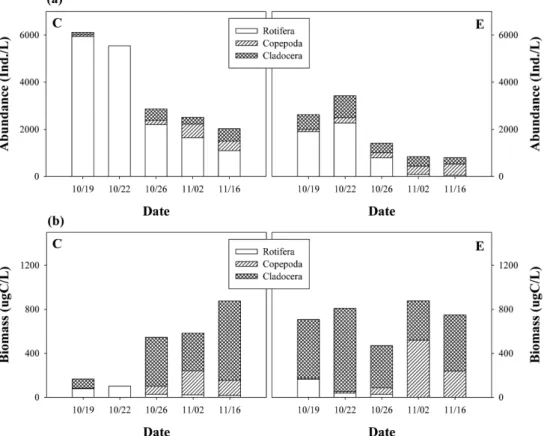
Fig. 3. Variation of abundance (a) and biomass (b) of zooplankton in mesocosms (C) with fish and (E) without fish.
환산하여 식물플랑크톤 개체수를 산출하였다. 규조류의 경 우 세정(Cleaning)과 봉입(Mounting) 과정을 거쳐 영구표본 을 만들어 검경하였으며, Simonsen의 분류체계(Ettle et al., 1986, 1988, 1991a, 1991b)에 따라 동정하였다. 그 외의 분 류군은 Hirose 등(1977)을 참고하여 정리하였으며, 정준 (1993), Patrick and Reimer (1975), Prescott (1962)등의 체 계를 따라 동정하였다.
동물플랑크톤의 정량・정성 분석은 Sedgwick-Rafter 계수 판에 넣고 광학 현미경(Olympus, Japan)하에서 40~200배의 배율로 윤충류, 요각류, 지각류로 구분하여 각 종별로 계수 하였다. 관찰시 출현종에 대한 가로, 세로 길이를 모두 측 정하여 평균값을 생물량 계산에 이용하였다. 동물플랑크톤 의 함수율은 분류군에 따라 차이가 있다. 즉 Asplanchna 의 경우 다른 종에 비해 수분함량이 많기 때문에(Dumont et al., 1975), 분류군간 생물량을 비교하기 위해서는 건중량을 기준으로 하는 것이 바람직하다. 따라서 윤충류 체적은 Downing and Rigler (1984)가 제시한 식에 따라 계산하였 고, 동물플랑크톤의 비중을 1.025로 가정하여 습중량을 구 하고, 습중량의 10%를 건중량으로 계산하였다(Hall et al., 1976; Pace and Orcutt, 1981). 지각류와 요각류의 건중량은 Length-Dry weight 관계식(W=aLb)을 사용하여 계산하였다 (Culver et al., 1985). 동물플랑크톤의 생물량(탄소량: µgC/L) 은 건중량의 48%를 탄소량으로 고려하여(Andersen and Hessen, 1991) 산출하였다.
3.1. 현장반응조 수질 항목
실험기간 중 대조구(C)의 수온, pH, DO, 전기전도도 (Conductivity), 탁도(Turbidity)는 14.1±3.7°C, 9.1±0.2, 10.6±
1.3 mg/L, 263±47 µS/cm, 3.4±0.9 NTU이었고, 실험구(E)는 각각 14.0±3.9°C, 8.7±0.4, 10.1±1.1 mg/L, 273±53 µS/cm, 3.9±2.0 NTU로 큰 차이가 없었다(Table 2).
Table 2. The average value of enviromental parameters in mesocosms
Control (C) Experiment (E) Temperature (°C) 14.1 ± 3.7 14.0 ± 3.9
pH 9.1 ± 0.2 8.7 ± 0.4
DO (mg/L) 10.6 ± 1.3 10.1 ± 1.1
Conductivity (µS/cm) 263 ± 47 273 ± 53 Turbidity (NTU) 3.4 ± 0.9 3.9 ± 2.0
3.2. 동물플랑크톤의 현존량과 군집변화
동물플랑크톤과 어류를 투입하여 실험을 개시한 날(10월 13일)로부터 실험조가 안정을 이룬 6일 이후에 나타난 결 과를 주로 분석하였다.
어류를 투입한 대조구(C)의 동물플랑크톤의 총 개체수는 실험 초반에 5,056 Ind./L에서 실험 후반에 2,029 Ind./L로 시간이 경과할수록 감소하는 것으로 나타났다(Fig. 3). 분류 군별로는 실험 초반에는 주로 소형 윤충류의 개체수가 높
Table 3. Dominants and subdominants of zooplankton based on abundance in mesocosms
Corral Date Dominant species % Ind./L Subdominant species % Ind./L
Inflow
10.18 Keratella cochlearis 42.1 1,216 Bosmina longirostris 19.7 570
10.19 Keratella cochlearis 32.9 900 Bosmina longirostris 23.7 648
10.22 Bosmina longirostris 43.2 2,976 Polyarthra vulgaris 29.3 2,015
10.26 Polyarthra vulgaris 60.3 1,505 Bosmina longirostris 22.4 559
11.02 Bosmina longirostris 74.4 1,354 Copepodid 12.2 222
11.16 Bosmina longirostris 72.2 53 Synchaeta oblonga 11.1 8
C
10.13 Keratella cochlearis var. tecta 42.4 602 Polyarthra sp. 30.3 430
10.15 Keratella cochlearis 46.2 2,336 Polyarthra vulgaris 25.3 1,280
10.18 Keratella cochlearis 58.7 2,812 Polyarthra vulgaris 23.8 1,140
10.19 Keratella cochlearis 65.9 4,026 Polyarthra vulgaris 20.5 1,254
10.22 Keratella cochlearis 53.6 2,970 Polyarthra vulgaris 32.7 1,815
10.26 Polyarthra vulgaris 38.5 1,100 Keratella cochlearis 21.5 616
11.02 Keratella cochlearis 20.4 511 Polyarthra vulgaris 20.4 511
11.16 Keratella cochlearis 29.2 593 Bosmina longirostris 25.8 524
E
10.13 Lepadella acuminata 40.0 630 Polyarthra remata 14.3 225
10.15 Keratella cochlearis 49.6 2,010 Polyarthra vulgaris 18.5 750
10.18 Keratella cochlearis 57.1 1,008 Polyarthra vulgaris 14.3 252
10.19 Keratella cochlearis 42.9 1,122 Bosmina longirostris 13.0 340
10.22 Keratella cochlearis 37.6 1,280 Polyarthra vulgaris 24.3 832
10.26 Polyarthra vulgaris 31.3 440 Bosmina longirostris 28.1 396
11.02 Bosmina longirostris 46.2 392 Nauplius 29.0 244
11.16 Copepodid 45.0 359 Bosmina longirostris 24.3 194
Table 4. Dominants and subdominants of zooplankton based on biomass in mesocosms
Corral Date Dominant species % ugC/L Subdominant species % ugC/L
Inflow
10.18 Bosmina longirostris 83.2 485.6 Bosminopsis deitersi 5.7 33.4
10.19 Bosmina longirostris 79.2 610.1 Bosminopsis deitersi 20.2 160.1 10.22 Bosmina longirostris 82.7 2,407.7 Bosminopsis deitersi 10.6 307.6
10.26 Bosmina longirostris 84.0 526.3 Bosminopsis deitersi 8.1 50.6
11.02 Bosmina longirostris 80.1 995.1 Copepodid 15.5 190.6
11.16 Bosmina longirostris 82.5 51.4 Daphnia galeata 17.2 10.7
C
10.15 Bosminopsis deitersi 51.5 142.0 Asplanchna herriciki 27.1 74.8
10.18 Asplanchna herriciki 60.2 132.9 Polyarthra vulgaris 13.1 28.9
10.19 Bosmina longirostris 39.7 65.8 Asplanchna herriciki 22.5 37.3
10.22 Asplanchna herriciki 50.1 51.4 Polyarthra vulgaris 40.1 41.1
10.26 Bosmina longirostris 64.4 351.2 Bosminopsis deitersi 17.2 93.8
11.02 Bosmina longirostris 53.8 313.5 Copepodid 32.2 187.9
11.16 Bosmina longirostris 82.2 719.8 Copepodid 6.1 52.3
E
10.15 Asplanchna herriciki 29.5 77.7 Bosminopsis deitersi 29.3 77.0
10.18 Bosmina longirostris 74.0 169.3 Bosminopsis deitersi 22.1 50.6
10.19 Bosmina longirostris 44.4 313.9 Bosminopsis deitersi 31.1 220.1 10.22 Bosmina longirostris 71.3 576.7 Bosminopsis deitersi 22.1 178.5
10.26 Bosmina longirostris 81.6 383.9 Nauplius 7.5 35.5
11.02 Eudiaptomus japonicus 45.5 398.7 Bosmina longirostris 38.9 341.3
11.16 Daphnia galeata 55.8 418.1 Eudiaptomus japonicus 24.5 183.6
았으나 실험 후반에는 지각류 및 요각류의 출현도도 높았 다. 이는 실험 후반에 유입수의 소형 지각류인 Bosmina longirostris 가 우점한 것에 이유가 있다고 판단된다(Table 3).
Bosmina longirostris 는 본 연구의 대상지역에서 주로 우점 하여 출현하는 종이다(공동수 등, 1995; 유경아 등, 2010).
어류를 투입하지 않은 실험구(E)의 동물플랑크톤의 총 개
체수는 실험 초반에 대조구(C)에 비하여 적었으나 지각류 와 요각류의 비율이 대조구에 비하여 높았고 실험 후반에 는 대부분 지각류와 요각류가 대부분을 차지하였다.
대조구(C)의 동물플랑크톤의 총 생체량(biomass)은 실험 후반으로 갈수록 증가하는 경향을 보였으며 지각류의 비율 이 높아지는 경향을 보였다(Fig. 3). 주로 우점하는 지각류
Fig. 4. Standing crops of phytoplankton (a) and chlorophyll a concentration (b) in mesocosms.
Table 5. Dominants and subdominants species of phytoplankton in mesocosms
State Date Dominant species % cells/mL Subdominant species % cells/mL
Inflow
10.15 Cryptomonas ovata 26.9 563 Cryptomonas coma 16.7 350
10.18 Cryptomonas ovata 36.8 1,813 Cryptomonas coma 25.9 1,275
10.19 Cryptomonas ovata 30.9 1,850 Cryptomonas coma 25.3 1,513
10.22 Eudorina elegans 21.6 1,860 Microcystis wesebergii 14.0 1,200
10.26 Cryptomonas ovata 21.2 750 Eudorina elegans 15.1 533
11.02 Volvox aeuena 70.7 18,000 Nitzschia palea 9.5 2,425
11.16 Melosira varians 24.4 1,100 Nitzschia acicularis 20.8 938
C
10.13 Nitzschia actinastroides 60.7 26,167 Cyclotella meneghiniana 8.8 3,778 10.15 Nitzschia actinastroides 27.6 1,017 Cyclotella meneghiniana 17.6 650
10.18 Cryptomonas coma 33.0 1,600 Micractinium pusillum 17.5 850
10.19 Micractinium pusillum 39.7 1,788 Cryptomonas coma 26.6 1,200
10.22 Cryptomonas coma 16.3 700 Klebsormidium flaccidum 15.2 650
10.26 Chlorella sp. 46.3 64,380 Ankistrodesmus falcatus 16.4 22,785
11.02 Chlorella sp. 38.6 15,333 Aulacoseira ambigua 21.6 8,600
11.16 Chlorella sp. 70.8 34,000 Klebsormidium flaccidum 23.3 11,167
E
10.13 Nitzschia actinastroides 54.2 48,000 Cyclotella meneghiniana 8.9 7,920
10.15 Cyclotella meneghiniana 25.7 208 Cryptomonas ovata 21.6 175
10.18 Cryptomonas coma 28.4 813 Cryptomonas ovata 20.1 575
10.19 Cryptomonas coma 49.9 1,450 Cryptomonas ovata 13.4 388
10.22 Cryptomonas coma 32.4 1,476 Cyclotella meneghiniana 31.6 1,438
10.26 Volvox aureus 60.1 9,500 Cryptomonas ovata 12.3 1,950
11.02 Cryptomonas coma 54.7 850 Cryptomonas ovata 12.9 200
11.16 Cryptomonas coma 37.4 333 Scenedesmus armatus 14.9 133
수의 생체량 우점종이 Bosmina longirostris 이였기 때문에 나타난 결과이다. 대조구에는 높은 밀도로 피라미가 서식하 고 있었음에도 불구하고 Bosmina longirostris 의 생체량이 매우 높은 것은 이 소형 지각류가 피라미에 효과적으로 포 식되지 않았음을 시사한다.
실험구(E)의 동물플랑크톤 총 생체량은 전반적으로 대조 구(C)에 비하여 많았으나 실험 후반에는 대조구에 비하여 낮았다. 주요 생체량 우점종은 실험초반에는 소형 지각류인 Bosmina longirostris 이였으나 실험 후반에는 대형 요각류인 Eudiaptomus japonicus 와 대형 지각류인 Daphnia galeata 가 우점하였다. 이들은 크기가 커서 섭식능이 높고 먹이 스펙트럼이 넓기 때문에 조류 제어에 매우 효과적이지만 물고기에 의해 선택적으로 쉽게 포식될 수 있는 종들이다.
galeata 가 대조구(C)에서 출현하지 않은 것은 피라미의 선 택적인 포식에 따른 것으로 판단된다.
3.3. 식물플랑크톤의 현존량과 군집변화
메소코즘 내 식물플랑크톤 현존량은 대조구(C)와 실험구 (E)에서 큰 차이를 보였다(Fig. 4). 이는 식물플랑크톤을 섭 식하는 동물플랑크톤의 종조성이 어류의 유무에 따라 달라 지기 때문이다(Schol et al., 1985). 어류를 투입한 대조구 (C)에서 식물플랑크톤의 현존량은 유입수에 비해 실험 후 반으로 갈수록 급격히 증가하고, Chl.a의 농도 또한 유입수 에 비해 급격히 증가하는데 어류의 포식에 의하여 동물플 랑크톤의 섭식압이 줄어들어 식물플랑크톤의 현존량이 증 가하는 것으로 사료된다.
Fig. 5. Variation of chlorophyll a concentration and individual biomass of zooplankton in mesocosms (a) control (C), (b) experiment (E), (c) inflow.
대조구(C)의 식물플랑크톤의 세포수는 실험 중반에 급격 히 증가하였다가 후반에 감소하였으나 Chl.a의 농도는 후 반까지 지속적으로 증가하였다. 이는 식물플랑크톤이 대형 화되었음을 의미한다. 즉 대조구(C)에서는 실험 후반으로 갈수록 세포크기가 크고 사상체를 이루는 Aulacoseira ambigua, Klebsormidium flaccidum 가 증가하였다(Table 5).
이러한 결과는 피라미의 선택적 포식에 의한 동물플랑크톤 의 소형화로 인해 먹이 크기 영역이 좁아짐에 따라 식물플 랑크톤이 대형화되는 연쇄적인 반응이 나타나고 있음을 시 사한다. 식물플랑크톤의 Chl.a의 함량은 종간에도 차이가 있으며 같은 종에서도 환경상태나 생리적 활성도에 따라 달라질 수 있으므로(Jiménez et al., 1987; Odate and Yanada, 1993), Chl.a의 함량 변화로 인해 위와 같은 결과가 나타났 을 수도 있으나 이에 대한 분석은 이루어지지 않았다.
실험구(E)에서는 실험 후반으로 갈수록 갈색편모조류의 Cryptomonas coma 와 Cryptomonas ovata 가 주로 출현하였 으며 실험 중반에는 녹조류의 Volvox aureus 의 출현도가 높았다. 실험구(E)는 포식자인 어류가 없어 대조구(C)에 비 해 동물플랑크톤의 개체수가 많고 단위개체당 생체량이 큰 지각류(Cladocera)가 많았기 때문에 섭식이 용이한 녹조류 의 Chlorella sp., Ankistrodesmus falcatus 의 출현도는 적었 다. 이와 반면 크기가 큰 군체를 이루는 Volvox aureus 는 동물플랑크톤에 섭식되지 않아 일시적으로 우점한 것으로 판단된다. 또한 유입수에서는 크기가 큰 Cryptomonas ovata (30~80 µm)가 작은 Cryptomonas coma (3~10 µm)에 비해 출현비율이 높았던 반면, 실험구(E)에서는 Cryptomonas coma
(3~10 µm)가 주요 우점종으로 나타나 동물플랑크톤에 의 한 선택적인 섭식이 있었던 것으로 판단된다.
3.4. 하향조절능의 주요 요인
초기에 동물플랑크톤이 같은 양으로 투입되었던 두 실험 구(C, E)에서 어류의 유무에 따라 식물플랑크톤의 현존량 은 큰 차이를 보였다(Fig. 5). 대조구(C)에서는 실험 후반기 에 Chl.a 농도가 급격하게 증가한 반면 실험구(E)에서는 매 우 낮은 수준으로 계속하여 감소하였다. 이는 피라미가 없 는 실험구에서 동물플랑크톤의 하향조절능이 계속 유지되 었음을 의미한다.
실험 후반에 대조구(C)의 동물플랑크톤의 총 생체량이 실험구(E)에 비해 많았음에도 불구하고(Fig. 3) Chl.a 농도 가 급격히 증가한 것으로 볼 때 동물플랑크톤의 총 생체량 은 식물플랑크톤에 대한 섭식압과 큰 관계가 없음을 시사 한다. 즉 이 시기에 Bosmina longirostris 가 높은 개체수를 보이고 있음은 이 소형 지각류가 피라미의 포식에 영향을 받지 않음을 의미하며, 또한 같은 시기에 세포크기가 크고 사상체를 이루는 Aulacoseira ambigua, Klebsormidium flacci- dum 는 물론 Chl.a 농도가 급증한 점으로 볼 때 Bosmina longirostris 가 이들 종들을 효과적으로 섭식하지 못함을 시 사한다.
어류를 투입하지 않은 실험구(E)에서 동물플랑크톤에 의 한 식물플랑크톤의 제어 효과가 매우 크게 나타나는 것은 동물플랑크톤의 개체수 증가뿐만 아니라 단위 생체량의 증 가와도 관계가 있다. 동물플랑크톤 포식어는 먹이에 대한
형 동물플랑크톤의 개체군을 억제함에 따라 간접적으로 식 물플랑크톤 개체군을 변화시킨다(Schol et al., 1985).
본 연구에서 실험구(E)에 비하여 대조구(C)의 동물플랑크 톤 단위개체당 생체량은 시간이 경과하면서 큰 차이를 보 이며 줄어들었다. 같은 시기에 유입수의 동물플랑크톤의 단 위개체당 생체량은 증가했음에도 불구하고 대조구에서 단 위개체당 생체량이 감소한 것은 피라미의 대형 동물플랑크 톤에 대한 선택적 포식에 의한 것으로 판단된다. 이와 반 면 실험구(E)에서는 실험 후반기에 대형 요각류인 Eudiap- tomus japonicus 와 지각류인 Daphnia galeata 가 크게 우점 하면서 동물플랑크톤 단위개체당 생체량이 크게 증가하였 다. 섭식능이 크고 먹이에 대한 섭식 스펙트럼이 넓은 대 형 동물플랑크톤이 증가하면서 하향조절능(top-down force) 이 증가하면서 Chl.a 농도가 낮은 수준으로 유지되었음을 알 수 있다.
4. 결 론
본 연구에서는 조류발생빈도가 큰 팔당호 내 경안천 수 역에 메소코즘을 설치하여 피라미의 유무에 따른 동물플랑 크톤 및 식물플랑크톤의 군집변화와 하향조절능의 차이에 대하여 조사하였으며 다음과 같은 결론을 얻을 수 있었다.
1) 피라미는 대형 요각류인 Eudiaptomus japonicus 와 지각 류인 Daphnia galeata 를 선택적으로 포식하는 것으로 보인다.
2) 피라미가 있을 경우 윤충류와 소형 지각류인 Bosmina longirostris 가 우점한 것으로 볼 때 이들이 피라미의 포 식에 영향을 받지 않으며, 세포크기가 크고 사상체를 이 룸으로써 소형 동물플랑크톤이 섭식하기 어려운 Aulaco- seira ambigua, Klebsormidium flaccidum 가 증가하는 경 향을 보였다.
3) 동물플랑크톤의 투입을 통하여 조류발생을 저감하고자 하는 경우, 어류의 포식으로부터 동물플랑크톤이 피난 (refuge)할 수 있는 서식처의 조성이 고려되어야만 그 효과가 유지될 수 있을 것이라 사료된다.
사 사
본 연구는 2010년도 한국농어촌공사 「조류발생 메카니즘 규명 및 조류저감을 위한 수생식물 이용기술 개발」의 지원 을 받아 수행하였습니다.
참고문헌
공동수, 천세억, 정원화, 전선옥, 김종택, 김종민, 류재근 (1995). 호소내 오염하천 유입부의 식물에 의한 정화처 리 연구(Ι), 한강물환경연구소.
국토해양부(2010). 포식성 천적생물을 이용한 녹조방지 기
술개발 최종보고서.
나은경, 신경숙, 장재헌, 강호(2003). 전자선조사를 이용한
부영양화 호수의 조류제어에 관한 연구. 춘계학술연구발
표대회논문집, 대한환경공학회, pp. 504-509.
농어촌공사(2010). 조류발생 메카니즘 규명 및 조류저감을 위한 수생식물 이용기술 개발 결과보고서.
유경아, 박혜경, 공동수, 황순진(2010). 한강 수계 주요 댐호
에서의 동물플랑크톤 군집 구조와 천이. 수질보전 한국
물환경학회지, 26(5), pp. 850-859.
이상재, 이재연, 안광국(2007). 조류제거 효과에 대한 Top- down 어류 조작실험. 한국하천호수학회지, 40(3), pp.
431-438.
정준(1993). 한국담수조류도감, 아카데미출판사.
Ahn, C. Y., Park, M. H., Joung, S. H., Kim, H. S., Jang, K. Y., and Oh, H. M. (2003). Growth inhibition of cyanobacteria by ultrasonic radiation; Labortory and enclosure studies.
Environ. Sci. Technol., 37(13), pp. 3031-3037.
Andersen, A. and Hessen, D. O. (1991). Carbon, nitrogen and phosphorus contents of freshwater zooplankton. Limnol.
Oceanogr., 36, pp. 807-814.
Boon, P. I., Bunn, S. E., Green, J. D., and Shiel, R. J. (1994).
Consumption of cyanobacteria by freshwater zooplankton:
Implications for the success of ‘top-down’ control of cyanobacterial blooms in Australia. Australian Journal of Marine and Freshwater Research, 45(5), pp. 875-887.
Culver, D. A., Boucherle, M. M., Bean, D. J., and Flethcer, J.
W. (1985). Biomass of freshwater crustacean zooplankton from Length-Weight regressions. Can. J. Fish. Aquat. Sci., 42, pp. 1380-1390.
Downing, J. A. and Rigler, F. H. R. (1984). A Manual on Methods for the Assessment of Secondary Productivity in Freshwater, Blackwell Scientific Publications.
Dumont, H. J., Velde, L. V. De., and Dumont, S. (1975). The dry weight estimate of biomass in a selection of Cladocera, Copepoda and Rotifera from the plankton, periphyton and benthos of continental waters. Oecologia, 19(1), pp. 75-97.
Ettl, H., Gerloff, J., Heynig, H., and Mollenhauer, D. (1986).
Süßwasserflora von Mitteleuropa. Band 2/1. Bacillariophy- ceae, Gustav Fischer Verlag, Stuttgart.
Ettl, H., Gerloff, J., Heynig, H., and Mollenhauer, D. (1988).
Süßwasserflora von Mitteleuropa. Band 2/2. Bacillariophy- ceae, Spektrum Akademischer Verlag, Berlin.
Ettl, H., Gerloff, J., Heynig, H., and Mollenhauer, D. (1991a).
Süßwasserflora von Mitteleuropa. Band 2/3. Bacillariophy- ceae, Spektrum Akademischer Verlag, Berlin.
Ettl, H., Gartner, J., Gerloff, J., Heynig, H., and Mollenhauer, D.
(1991b). Süßwasserflora von Mitteleuropa. Band 2/4. Bacill- ariophyceae, Gustav Fischer Verlag, Stuttgart.
Gophen, M. (1990). Biomanipulation: retrospective and future development. Hydrobiologia, 200/201, pp. 1-11.
Hall, D. T., Threlkeld, S. T., Burns, C. W., and Crowley, P. H.
(1976). The size-efficiency hypothesis and the size structure of zooplankton communities, Annual Review of Ecology and Systematics, 7, pp. 177-208.
Hansson, L. A. and Brönmark, C. (2009). Biomanipulation of Aquatic Ecosystems. Encyclopedia of inland waters. pp.
242-248.
Hirose, H. M., Akiyama, T., Imahori, K., Kasaki, H., Kumana,
S., Kobayasi, H., Takahashi, E., Tsumura, T., Hirano, M., and Yamagishi, T. (1977). Illustration of the Japanese freshwater algae. Uchidarokakuho Publishing Co., Ltd., Tokyo, Japan. pp. 932.
Jiménez, F., Rodriguez, J., Bautista, B., and Rodriguez, V.
(1987). Relations between chlorophyll, phytoplankton cell abundance and biobolume during a winter bloom in mediterranean costal water. J. Exp. Mar. Bio. Ecol., 105, pp.
161-173.
O'Brien, W. J. (1979). The predator-prey interaction of plank- tivorous fish and zooplankton. Am. Sci., 67, pp. 572-581.
Odate, T. and Yanada, M. (1993). Phytoplankton carbon biomass estimated from the size-fractionated Chl. concentration and cell density in the northern coastal waters from spring bloom to summer. Bull Plankton Soc. Japan. 39(2), pp. 127-144.
Opuszynski, K. (1978). The influence of the silver carp (Hypophthalmichthys molitrix Val.) on eutrophication of the environment of carp ponds. Roczniki Nauk Rolniczych., 99, pp. 127-151.
Pace, M. L. and Orcutt, J. D. (1981). The relative importance of protozoans, rotifers and crustaceans in a freshwater zoop- lankton community. Limnol. Oceanogr., 26(5), pp. 822-830.
Patrick, R. and Reimer, C. W. (1975). The Diatoms of the United Sates. Exclusive of alaska and Hawaii, Vol. II part 1.
The Academy of Natural Sciences, Philadelphia. pp. 213.
Prescott, G. W. (1962). Algae of the Western Great Lakes Area.
Otto Koeltz Science Publisher, Germany. pp. 976.
Schol, A. T., Soltero, R. A., McKee, K. O., Anderson, E., and Uehara, J. K. (1985). Biomanipulation of a trout fishery and its effect on zooplankton composition, phytoplankton biovolume and water quality of medical lake, Spokane Co.,
Washington, USA. Proc. 4th Annu. Conf. Int. Symp. N. Am.
Lake Manage. Sco., 4, pp. 48-56.
Shapiro, J. (1990). Biomanipulation : the next phase-making it stable. Hydrobiol., 200(201), pp. 13-17.
Shapiro, J., Lamarra, V., and Lynch, M. (1975). Biomanipula- tion: An Ecosystem Approach to Lake Restoration. In: P. L.
Brezonik and J. L. Fox (eds.), Proc. Symp. on Water Quality Management Through Biological Control. University of Florida, pp. 85-96.
Shapiro, J. V. and Wright, D. I. (1984). Lake restoration by biomanipulation: Round Lake, Minnesota, the first two years.
Freshwater. Biol., 14, pp. 371-383.
Sigee, D. C., Glenn, R., Andrews, M. J., Andrews, E. G., Belinger, E. G., Butler, R. D., Epton, H. A. S., and Hendry, R. D. (1999). Biological control of cyanobacteria: principles and possibilities. Hydrobiologia, 395(396), pp. 161-172.
Sosnovsky, A. and Quirós, R. (2009). Effects of fish manipu- lation on the plankton community in small hypertrophic lakes from the pampa plain (Argentina). Limnologica, 39(3), pp.
219-229.
Stenson, J. A. E., Bohlin, T., and Henrikson, L. (1978). Effects of fish removal in a small lake. Verk. Int. Verein. Limnol., 20, pp. 794-801.
Theiss, J., Zielinski, L., and Lang, H. (1990). Biomanipulation by introduction of herbivorous zooplankton. A helpful shock for eutrophic lakes. Hydrobiologia, 200(201), pp. 59-68.
Vijerberg, J., Gulati, R. D., and Mooij, W. M. (1993). Food web studies in shallow eutrophic lakes by the Netherands institute of ecology : Main results, knowledge gaps and new perspec- tives. Netherlands Journal of Aquatic Ecol., 27(1), pp. 35-49.