Printed in the Republic of Korea
http://dx.doi.org/10.5012/jkcs.2011.55.5.882 단신
(Notes)
Synthesis and Biological Screening of Thiazole-5-Carboxamide Derivatives
Pravin C. Mhaske, Kamlesh S. Vadgaonkar†, Rahul P. Jadhav†, and Vivek D. Bobade†,* Department of Chemistry, S. P. College, Pune, India-411 030
†Department of Chemistry, HPT Arts and RYK Science College, Nashik India-422 005.
*E-mail: [email protected]
(Received April 5, 2010; Accepted September 15, 2010)
Key words: Thiazole-5-carboxamide, HOBT, antimicrobial activity, 2-methyl/benzyl-4-(4-aminophenyl) thiazoles, thioamides
Thiazole derivatives have been studied extensively because of their ready accessibility, diverse chemical activity. The chemistry of thiazole continues to draw the attention of synthetic organic chemists due to their varied biological activities,1-5 such as antibacterial, antitubercu- lar, anti-cancer, antifungal and anti-inflammatory activi- ties.6-9 Also 4-(4-aminophenyl)-thiazoles have been reported to exhibit antitubercular activity.10 5-azole carboxamide derivatives show antianoxic activity.11 The aryl imidazolyl carboxamide derivatives were shown to be cannabinoid CB1 receptor antagonist.12,13 Based on these observations, substituted thiazole carboxamides were synthesized and subjected to microbial screening.
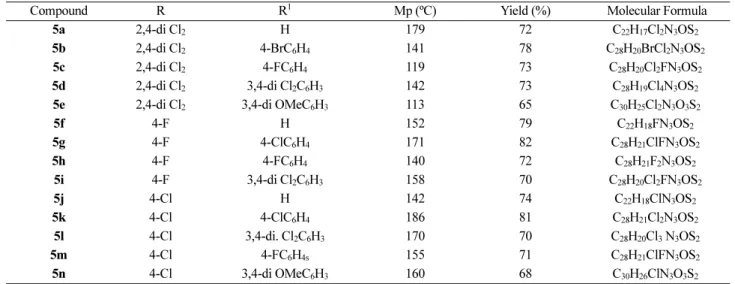
Here in, we report a simple efficient and effective pro- tocol for the synthesis of N-(4-(2-benzylthiazol-4-yl)phe- nyl)-2-benzyl-4-methylthiazole-5-carboxamide derivatives using EDC-HOBt coupling in DMF and their antimicro- bial activities. The target compounds 5a-n were synthe- sized by reaction of 2-benzyl-4-methylthiazole-5-carboxylic acid 3a-c with 2-methyl/substitutedbenzyl-4-(4-aminophe- nyl) thiazoles 2a-f in the presence of EDC- HOBt in DMF in good yields (Scheme 1). The yields, melting points and molecular formula of carboxamide derivatives 5a-n are listed in Table 1. The reaction failed when ethyl 2-benzyl- 4-methylthiazole-5-carboxylate 1a-c was refluxed with 2- methyl/substitutedbenzyl-4-(4-aminophenyl) thiazole 2a- f in absolute ethanol for 24 h. When the same reaction was carried out with acid chloride or mixed anhydride acti- vation of the carboxylic acid, the yields were poor. The amino phenyl thiazole derivatives 2a-f were synthesized using literature protocol.10,14 The target compounds were characterized by IR, 1H NMR, 13C NMR, mass and ele- mental analysis and all the spectral data are in accordance with the assumed structures. In additions to the signals for aromatic protons 1H NMR spectra of the compounds 5a-n reveal singlet at 2.73-2.78 ppm for thiazole-CH3 protons.
Furthermore, the spectra show singlet for methylene pro- tons of benzylic carbon atoms in the range 3.73- 4.41 ppm.
These compounds were found to be effective against the Gram-positive bacteria S. aureu and B. Subtilis and Gram- negative bacteria E. coli and P. aeruginosa. The zones of inhibition in mm, for the bioactive compounds against microorganisms tested are reported in Table 2. N-(4-(2-(4- chlorobenzylthiazol-4-yl)phenyl)-2-(4-chlorobenzyl)-4- methylthiazole-5-carboxamide (5k) is active against both gram positive and gram negative stains but looses activity on adding one chlorine at 3-position as in N-(4-(2-(3,4- dichlorobenzylthiazol-4-yl)phenyl)-2-(4-chlorobenzyl)- 4-methylthiazole-5-carboxamide (5l). When chlorine in the first benzyl ring in 5l, was replaced by fluorine as in N- (4-(2-(3,4-dichlorobenzylthiazol-4-yl)phenyl)-2-(4-fluo- robenzyl)-4-methylthiazole-5-carboxamide (5i), it showed antibacterial activity.
N-(4-(2-(4-fluorobenzylthiazol-4-yl)phenyl)-2-(4-chlo- robenzyl)-4-methylthiazole-5-carboxamide (5m) showed antifungal activity, but when one chlorine atom is added at 2-position as in N-(4-(2-(4-fluorobenzyl)thiazol-4-yl)phe- nyl)-2-(2,4-dichlorobenzyl)-4-methylthiazole-5-carboxa- mide (5c), it showed antibacterial activity with loss of antifungal activity. 2-methyl substituted carboxamide deriv- atives (5a, 5f) showed only antibacterial activity. The dimethoxy derivative 5n was found to be inactive against all stains.
EXPERIMENTAL
Melting points were determined in an open capillary on Veego melting point apparatus and are uncorrected. The purity of the compounds was checked on silica gel-G plates. The compounds 5a-n were purified on silica gel (100-200) column chromatography using ethyl acetate:
hexane as eluent. Infrared spectra (cm-1) were recorded in
Scheme 1.
Table 1. Yields and physical data of compounds 5a-n
Compound R R1 Mp (ºC) Yield (%) Molecular Formula
5a 2,4-di Cl2 H 179 72 C22H17Cl2N3OS2
5b 2,4-di Cl2 4-BrC6H4 141 78 C28H20BrCl2N3OS2
5c 2,4-di Cl2 4-FC6H4 119 73 C28H20Cl2FN3OS2
5d 2,4-di Cl2 3,4-di Cl2C6H3 142 73 C28H19Cl4N3OS2
5e 2,4-di Cl2 3,4-di OMeC6H3 113 65 C30H25Cl2N3O3S2
5f 4-F H 152 79 C22H18FN3OS2
5g 4-F 4-ClC6H4 171 82 C28H21ClFN3OS2
5h 4-F 4-FC6H4 140 72 C28H21F2N3OS2
5i 4-F 3,4-di Cl2C6H3 158 70 C28H20Cl2FN3OS2
5j 4-Cl H 142 74 C22H18ClN3OS2
5k 4-Cl 4-ClC6H4 186 81 C28H21Cl2N3OS2
5l 4-Cl 3,4-di. Cl2C6H3 170 70 C28H20Cl3 N3OS2
5m 4-Cl 4-FC6H4s 155 71 C28H21ClFN3OS2
5n 4-Cl 3,4-di OMeC6H3 160 68 C30H26ClN3O3S2
Table 2. Antimicrobial data of bioactive molecules (Zone diameter of growth inhibition in mm)
Compoundsa Microorganisms
B. subtilis S. aureus E. coli P. aeruginosa C. albicans A. niger
5a 10 9 9 - - -
5b - - 7 8 - -
5c - - 9 9 - -
5f - - 7 8 - -
5i 9 8 - - - -
5k 12 11 9 11 - -
5m - - - - 7 8
Ciprofloxacina 26 28 25 37 NA NA
Nystationa NA NA NA NA 20.5 22.1
aCiprofloxacin (10 µg/disc), Nystatin (100 U/disc) was used as reference; synthesized compounds (100 µg/disc); NA = Not Applica- ble; (-) = Inactive.
KBr on a Shimadzu Model FTIR-435 spectrophotometer.
1H-NMR and 13C NMR spectra were recorded in CDCl3 and DMSO-d6 solution on a Varian Mercury YH-300 spectrometer operating at 300 MHz for 1H and 75 MHz for 13C. Chemical shifts are expressed relative to tetram- ethylsilane (TMS) and were reported as δ (ppm). Carbon, Hydrogen and Nitrogen analysis were performed with Perkin-Elmer 2400 series II instrument. Mass spectral (MS) measurements were made on a Jeol-JMS-DX 303 mass spectrometer. The isotopic peak at M+2 was observed in the mass spectrum of all the compounds due to S, Br and/or Cl.
The in vitro antibacterial activity was performed against Gram-positive bacteria including Staphylococcus aureus (NCIM 2079), Bacillus Subtilis (NCIM 2250) and Gram- negative bacteria including Escherichia coli (NCIM 2109), Pseudomonas aeruginosa (NCIM 2036). Yeast including Candida albicans (NCIM 3471) and fungi Aspergillus niger (NCIM 545) were used to test antifungal activity. Known antibiotics like Ciprofloxacin (the reference anti bacterial drugs) and Nystatin (the reference antifungal drug) were used for comparison.
General procedure for the synthesis of substituted 2- benzyl-4-methylthiazole-5-carboxylic acid. 1a-c. Mix- ture of 2-chloro-3-oxo ethylbutanoate (0.05 mol) and sub- stituted benzyl thioamides (0.055 mol) in 50 mL of methanol was refluxed for 5-6 hours. After completion of the reac- tion, as monitored on TLC, 20 mL of 2N NaOH was added and refluxed further for 4 hours. Methanol was distilled off and the mixture acidified with 4N HCl to pH 2. The precipitated product was filtered, washed with water and recrystallized from aqueous ethanol.
Synthesis of amino phenylthiazole derivatives 2a-f.
These compounds were prepared using the literature pro- tocol.10,14
General procedure for the synthesis of N-(4-(2-methyl/
benzylthiazol-4-yl) phenyl)-2-benzyl-4-methylthiazole- 5-carboxamide 5a-n. A mixture of 2-benzyl-4-methylth- iazole-5-carboxylic acid (1a-c) (1 mmol), DIPEA (0.35 mL, 2 mmol), HOBt (0.14 g, 1 mmol) in DMF (10 mL) was cooled to 0 ºC. To this 2-methyl/benzyl-4-(4-ami- nophenyl) thiazole (2a-f) (1mmol) was added followed by EDC. HCl (0.19 g, 1 mmol) at 0 ºC and stirred overnight at room temperature. The reaction was quenched with water and the product was filtered, washed with water.
The spectral data of the purified compounds are as below:
N-(4-(2-Methylthiazol-4-yl)phenyl)-2-(2,4-dichloroben- zyl)-4-methylthiazole-5-carboxamide (5a). Solid, m.p.
179 ºC, IR(KBr, cm-1) 3440, 3262 (NH); 1646 (CO); 1593
(C=N); 1H NMR (CDCl3): δ 2.74 (s, 3H, CH3), 2.76 (s, 3H, CH3), 4.39 (s, 2H, CH2-Ph), 7.26-7.28 (m, 2H, Ar-H, Thiazole-H), 7.32 (d, J=8.3 Hz, 1H, Ar-H), 7.34 (bs, 1H, NH-CO), 7.45 (d, J=2Hz, 1H, Ar-H), 7.57 (d, J=8.6 Hz, 2H, Ar-H), 7.85 (d, J=8.6 Hz, 2H, Ar-H). LCMS: 474 (M+1).
Anal. Calcd. for C22H17 Cl2N3OS2: C, 55.70; H, 3.61; N, 8.86. Found: C, 55.31; H, 3.50; N, 8.84.
N-(4-(2-(4-Bromobenzyl)thiazol-4-yl)phenyl)-2-(2,4- dichlorobenzyl)-4-methylthiazole-5-carboxamide (5b).
Solid, m.p. 141 ºC, IR(KBr, cm-1) 3448, 3292 (NH); 1652 (CO); 1598 (C=N); 1H NMR (CDCl3): δ 2.75 (s, 3H, CH3), 4.33 (s, 2H, CH2-Ph), 4.41 (s, 2H, CH2-Ph), 7.23- 7.49 (m, 9H, Ar-H, Thiazole-H, NH-CO), 7.59 (d, J=8.5 Hz, 2H, Ar-H), 7.87 (d, J=8.5 Hz, 2H, Ar-H). Anal. Calcd.
for C28H20BrCl2N3OS2: C, 53.43; H, 3.20; N, 6.68. Found:
C, 53.08; H, 3.13; N, 6.33.
N-(4-(2-(4-Fluorobenzyl)thiazol-4-yl)phenyl)-2-(2,4- dichlorobenzyl)-4-methylthiazole-5-carboxamide (5c).
Solid, m.p. 119 ºC, IR(KBr, cm-1) 3462, 3252 (NH); 1641 (CO); 1596 (C=N); 1H NMR (CDCl3): δ 2.75 (s, 3H, CH3), 4.27 (s, 2H, CH2-Ph), 4.32 (s, 2H, CH2-Ph), 7.03- 7.46 (m, 9H, Ar-H, Thiazole-H, NH-CO), 7.58 (d, J=8.5 Hz, 2H, Ar-H), 7.86 (d, J=8.5 Hz, 2H, Ar-H), 13C NMR (CDCl3): δ 17.3 (Thiazole-CH3), 36.9 (CH2-Ar), 38.9 (CH2- Ar), 112.5- 160.2 (24-C, Aromatic-C), 168.3 (CO-NH).
Anal. Calcd. for C28H20Cl2 FN3OS2: C, 59.15; H, 3.55; N, 7.39. Found: C, 59.08; H, 3.33; N, 7.28.
N-(4-(2-(3,4-Dichlorobenzyl)thiazol-4-yl)phenyl)-2- (2,4-dichlorobenzyl)-4-methylthiazole-5-carboxamide (5d).
Solid, m.p. 142 ºC, IR(KBr, cm-1) 3478, 3259 (NH); 1654 (CO); 1603 (C=N); 1H NMR (CDCl3): δ 2.73 (s, 3H, CH3), 4.38 (s, 2H, CH2-Ph), 4.46 (s, 2H, CH2-Ph), 7.21- 7.45 (m, 8H, Ar-H, Thiazole-H, NH-CO) 7.57 (d, J=9 Hz, 2H, Ar-H), 7.85 (d, J=9 Hz, 2H, Ar-H), Anal. Calcd. for C28H19Cl4N3OS2: C, 54.29; H, 3.09; N, 6.38. Found: C, 54.08; H, 3.03; N, 6.35.
N-(4-(2-(3,4-Dimethoxybenzyl)thiazol-4-yl)phenyl)- 2-(2,4-dichlorobenzyl)-4-methylthiazole-5-carboxamide (5e).
Solid, m.p. 113 ºC, IR(KBr, cm-1) 3455, 3248 (NH); 1642 (CO); 1595 (C=N); 1H NMR (CDCl3): δ 2.75 (s, 3H, CH3), 3.87 (s, 3H, OCH3), 3.88 (s, 3H, OCH3), 4.32 (s, 2H, CH2-Ph), 4.41 (s, 2H, CH2-Ph), 6.84-7.47 (m, 8H, Ar-H, Thi- azole-H, NH-CO) 7.68 (d, J=8.7 Hz, 2H, Ar-H), 7.88 (d, J=8.7 Hz, 2H, Ar-H). Anal. Calcd. for C30H25Cl2N3O3S2: C, 59.01; H, 4.13; N, 6.88. Found: C, 58.72; H, 3.94; N, 6.58.
N-(4-(2-Methylthiazol-4-yl)phenyl)-2-(4-fluorobenzyl)- 4-methylthiazole-5-carboxamide (5f). Solid, m.p. 152 ºC, IR(KBr, cm-1) 3444, 3256 (NH); 1660 (CO); 1599 (C=N);
1H NMR (CDCl3): δ 2.74 (s, 3H, CH3), 2.76 (s, 3H, CH3), 4.26 (s, 2H, CH2-Ph), 7.03-7.35 (m, 6H, Ar-H, Thiazole- H, NH-CO), 7.56 (d, J=8.6 Hz, 2H, Ar-H), 7.84 (d, J=8.6 Hz, 2H, Ar-H), LCMS: 423.8 (M+1). Anal. Calcd. for C22H18FN3OS2: C, 62.39; H, 4.28; N, 9.92. Found: C, 61.99; H, 3.95; N, 9.61.
N-(4-(2-(4-Chlorobenzylthiazol-4-yl)phenyl)-2-(4-fluo- robenzyl)-4-methylthiazole-5-carboxamide (5g). Solid, m.p. 171 ºC, IR(KBr, cm-1) 3449, 3232 (NH); 1651 (CO);
1595 (C=N); 1H NMR (CDCl3): δ 2.73 (s, 3H, CH3), 4.25 (s, 2H, CH2-Ph), 4.33 (s, 2H, CH2-Ph), 7.02-7.33 (m, 9H, Ar-H, NH-CO), 7.45 (s, IH, Thiazole-H), 7.57 (d, J=8.7 Hz, 2H, Ar-H), 7.85 (d, J=8.7 Hz, 2H, Ar-H), 13C NMR (CDCl3): δ 17.31 (Thiazole-CH3), 39.01 (2 x CH2-Ar), 112.58-169.64 (24-C, Aromatic-C), 170.69 (CO-NH), LCMS: 423.8 (M+1). Anal. Calcd. for C28H21ClFN3OS2: C, 62.97; H, 3.96; N, 7.87. Found: C, 62.59; H, 3.87; N, 7.53.
N-(4-(2-(4-Fluorobenzylthiazol-4-yl)phenyl)-2-(4-fluo- robenzyl)-4-methylthiazole-5-carboxamide (5h). Solid, m.p. 140 ºC, IR(KBr, cm-1) 3441, 3242 (NH); 1647 (CO);
1601 (C=N); 1H NMR (CDCl3): δ 2.75 (s, 3H, CH3), 3.73 (s, 2H, CH2), 4.34 (s, 2H, CH2), 7.00-7.32 (m, 10H, Ar-H, Thiazole-H, NH-CO), 7.49 (d, J=8.4 Hz, 2H, Ar-H), 7.82 (d, J=8.4 Hz, 2H, Ar-H). Anal. Calcd. for C28H21F2N3OS2: C, 64.97; H, 4.09; N, 8.12. Found: C, 64.69; H, 3.97; N, 8.01.
N-(4-(2-(3,4-Dichlorobenzylthiazol-4-yl)phenyl)-2- (4-fluorobenzyl)-4-methylthiazole-5-carboxamide (5i).
Solid, m.p. 158 ºC, IR(KBr, cm-1) 3472, 3264 (NH); 1641 (CO); 1598 (C=N); 1H NMR (CDCl3): δ 2.74 (s, 3H, CH3), 4.34 (s, 2H, CH2-Ph), 4.40 (s, 2H, CH2-Ph), 7.02- 7.60 (m, 9H, Ar-H, Thiazole-H, NH-CO), 7.58 (d, J=9.0 Hz, 2H, Ar-H), 7.86 (d, J=9.0 Hz, 2H, Ar-H), 13C NMR (CDCl3): δ 17.3 (Thiazole-CH3), 36.9 (CH2-Ar), 38.9 (CH2- Ar), 112.5- 159.7 (24-C, Aromatic-C), 168.4 (CO-NH).
Anal. Calcd. for C28H20Cl2 FN3OS2: C, 59.15; H, 3.55; N, 7.39. Found: C, 58.88; H, 3.38; N, 7.28.
N-(4-(2-Methylthiazol-4-yl)phenyl)-2-(4-chloroben- zyl)-4-methylthiazole-5-carboxamide (5j). Solid, m.p.
142 ºC, IR(KBr, cm-1) 3439, 3255 (NH); 1644 (CO); 1596 (C=N); 1H NMR (CDCl3): δ 2.75 (s, 3H, CH3), 2.77 (s, 3H, CH3), 4.26 (s, 2H, CH2-Ph), 7.25-7.42 (m, 6H, Ar-H, Thiazole-H, NH-CO), 7.58 (d, J=8.7 Hz, 2H, Ar-H), 7.85 (d, J=8.7 Hz, 2H, Ar-H). Anal. Calcd. for C22H18ClN3OS2: C, 60.06; H, 4.12; N, 9.55. Found: C, 59.86; H, 3.92; N, 9.43.
N-(4-(2-(4-Chlorobenzylthiazol-4-yl)phenyl)-2-(4-chlo- robenzyl)-4-methylthiazole-5-carboxamide (5k). Solid, m.p. 186 ºC, IR(KBr, cm-1) 3472, 3222 (NH); 1655 (CO);
1594 (C=N); 1H NMR (CDCl3): δ 2.78 (s, 3H, CH3), 4.30 (s, 2H, CH2-Ph), 4.37 (s, 2H, CH2-Ph), 7.29-7.39 (m, 10H, Ar-H, Thiazole-H, NH-CO), 7.62 (d, J=8.7 Hz, 2H, Ar-H), 7.90 (d, J=8.7 Hz, 2H, Ar-H). Anal. Calcd. for C28H21 Cl2N3OS2: C, 62.97; H, 3.96; N, 7.87. Found: C, 62.65; H, 3.78; N, 7.81.
N-(4-(2-(3,4-Dichlorobenzylthiazol-4-yl)phenyl)-2-(4-chlo- robenzyl)-4-methylthiazole-5-carboxamide (5l). Solid, m.p. 170 ºC, IR(KBr, cm-1) 3471, 3233 (NH); 1649 (CO);
1589 (C=N); 1H NMR (CDCl3): δ 2.75 (s, 3H, CH3), 4.27 (s, 2H, CH2-Ph), 4.47 (s, 2H, CH2-Ph), 7.22-7.46 (m, 9H, Ar-H, Thiazole-H, NH-CO), 7.58 (d, J=8.5 Hz, 2H, Ar- H), 7.86 (d, J=8.5 Hz, 2H, Ar-H). Anal. Calcd. for C28H20Cl3N3OS2: C, 62.97; H, 3.96; N, 7.87. Found: C, 62.59; H, 3.87; N, 7.53.
N-(4-(2-(4-Fluorobenzylthiazol-4-yl)phenyl)-2-(4-chlo- robenzyl)-4-methylthiazole-5-carboxamide (5m). Solid, m.p. 155 ºC, IR(KBr, cm-1) 3449, 3258 (NH); 1651 (CO);
1594 (C=N); 1H NMR (CDCl3): δ 2.75 (s, 3H, CH3), 4.27 (s, 2H, CH2-Ph), 4.35 (s, 2H, CH2-Ph), 7.01-7.38 (m, 10H, Ar-H, Thiazole-H, NH-CO), 7.58 (d, J=8.7 Hz, 2H, Ar- H), 7.87 (d, J=8.7 Hz, 2H, Ar-H). Anal. Calcd. for C28H21ClFN3OS2: C, 62.97; H, 3.96; N, 7.87. Found: C, 62.69; H, 3.84; N, 7.79.
N-(4-(2-(3,4-Dimethoxybenzylthiazol-4-yl)phenyl)-2- (4-chlorobenzyl)-4-methylthiazole-5-carboxamide (5n).
Solid, m.p. 160 ºC, IR(KBr, cm-1) 3448, 3268 (NH); 1647 (CO); 1597 (C=N); 1H NMR (CDCl3): δ 2.76 (s, 3H, CH3), 3.87 (s, 3H, O-CH3), 3.89 (s, 3H, O-CH3) 4.28 (s, 2H, CH2-Ph), 4.32 (s, 2H, CH2-Ph), 6.84-7.37 (m, 9H, Ar- H, Thiazole-H, NH-CO), 7.59 (d, J=8.5 Hz, 2H, Ar-H), 7.88 (d, J=8.5 Hz, 2H, Ar-H), LCMS: 575 (M+), 577 (M+2). Anal. Calcd. for C30H26ClN3O3S2: C, 62.54; H, 4.55; N, 7.29. Found: C, 62.35; H, 4.23; N, 7.33.
Acknowledgement. The authors are thankful to Gar- ware Research Center, University of Pune and IIT Mum- bai, India for providing facilities for spectral studies of compounds. Financial support from UGC, New Delhi is gratefully acknowledged.
REFERENCES
1. Hargrave, K. D.; Hess, F. K.; Oliver, J.T. J. Med. Chem.
1983, 23, 1158.
2. Patt, W. C.; Hammilton, H. W.; Teller, M. D.; Ryan, M.
J.; Taylor, D. G.; Connolly, C. J.; Doherty, A. M.; Klutchko, S. R.; Sircar, I.; Steinbaugh, B. A.; Batley, B. L.; Pain- chaud, C.A.; Rapundalo, S.T.; Michniewicz, B.M.; Olson, S.C. J. Med. Chem. 1992, 35, 2562.
3. Haviv, F.; Ratajczyk, J. D.; DeNet, R. W.; Kerdesky, F.
A.; Waltwers, R. L.; Schmidt, S. P.; Holmes, J. H.; Young, P. R.; Carter, G. W. J. Med. Chem. 1988, 31, 1719.
4. Clemence, F.; Martret, O. L.; Delevallee, F.; Benzoni, J.;
Jouanen, A.; Jouquey, S.; Mouren, M.; Deraedt, R. J.
Med. Chem. 1988, 31, 1453.
5. Jaen, J. C.; Wise, L. D.; Caprathe, B. W.; Tecle, H.; Berg- meier, S.; Humblet, C. C.; Heffner, T. G.; Meltzner, L. T.;
Pugsley, T. A. J. Med. Chem. 1990, 33, 311.
6. Tsuji, K.; Ishikawa, H. Bioorg. Med. Chem. Lett. 1994, 4, 1601.
7. Bell, F. W.; Cantrell, A. S.; Hoberg, M.; Jaskunas, S. R.;
Johansson, N. G.; Jordon, C. L.; Kinnick, M. D.; Lind, P.;
Jr. Morin, J. M.; Noreen, R.; Oberg, B.; Palkowitz, J. A.;
Parrish, C. A.; Pranc, P.; Sahlberg, C.; Ternansky, R. J.;
Vasileff, R. T.; Vrang, L.; West, S. J.; Zhang, H.; Zhou, X.
X. J. Med. Chem. 1995, 38, 4929.
8. Chem. Abstr. 1962, 54, 22576.
9. Manian, A. K.; Khadse, B. G.; Sengupta, S. R. Indian drugs.
1994, 31, 442.
10. Kulkarni, B. S.; Fernandez, B. S.; Patel, M. R.; Bellare, R. A.; Deliwala, C.V. J. Pharm. Sci. 1969, 58, 852.
11. Misturu O.; Atsushi K.; Hiroyoshi S.; Hisashi, T. Chem.
Pharma Bull. 1995, 43, 947.
12. Jong, Y. K.; Hee, J. S.; Sung, H. L.; Myung, E. J.; Kwang- woo, A.; Jeongmin, K. Jinhwa, L. Bioorg. Med. Chem.
Lett. 2009, 19, 142.
13. Sidique, S.; Ardecky, R.; Su, Y.; Narisawa, S.; Brown, B.;
Millan, J. L.; Sergienko, E.; Cosford, N. D. P. Bioorg.
Med. Chem. Lett. 2009, 19, 222.
14. Rindhe, S. S.; Mane, R. A.; Ingle, D. B. J. Indian Chem.
Soc. 1985, 62, 334.