http://dx.doi.org/10.5012/jkcs.2013.57.4.476
One Pot Synthesis of Bioactive Novel Cyanopyridones
Kamlesh Khokhani, Taslimahemad Khatri†,*, and Praful Patel Department of Chemistry, M M Science College, Morbi-363 642, Gujarat, India
†Department of Chemistry, KSKV Kachchh University, Bhuj-Kachchh 370 001, Gujarat, India
*E-mail: [email protected] (Received April 9, 2013; Accepted July 15, 2013)
ABSTRACT. Cyanopyridone was prepared by the condensation of cyanoacetamide, substituted arylaldehydes and malononi- trile in presence of pipyridine. The structure of the synthesized compound CP 1−20 was assigned on the basis of elemental analysis, IR, 1H-NMR and mass spectroscopy. These compounds were also screened for antimicrobial activity. The Minimum Inhibitory Concentration (MIC) of all the synthesized compounds was compared with standard drugs.
Key words: Cyanopyrimidones, Cyanoacetamide, Antimicrobial activity, Malononitrile, Pipyridine
INTRODUCTION
Pyridone and their derivatives play an essential role in several biological processes and have considerable chem- ical and pharmacological importance.1−3 The 2-pyridones represent a unique class of pharmacophore, which are observed in various therapeutic agents4 and antibiotics.5 The 3-cyanopyridin-2-one nucleus is the structural basis of the alkaloid ricinine (I), the first known alkaloid con- taining a cyano-group. Cheney et al. reported 4,6-diaryl- 2-oxo-1,2-dihydropyridine-3-carbonitriles (II), as inhib- itors of the oncogenic serine/threonine kinas PIM-1, which plays a role in cancer cell survival, differentiation and proliferation.6 Wendt et al. showed that several com- pounds with the same general formula as above (II) but with higher lipophilic properties (III) can inhibit surviv- ing which is a member of the inhibitor of apoptosis family (IAP).7
The thienopyridone agonist (IV) showed modest AMPK (adenosine monophosphate-activated protein kinase) activity8 (Fig. 1). These heterocycles attracted attention because of their applications as bioactive compounds for example as a promising class of HIV-1 non-nucleoside reverse tran- scriptase inhibitors (NNRTIs)9 as antibacterial,10 antifungal,11 sedative,12 andcardiotonic agent.13 Moreover, such deriv- atives have recently become important due to their struc- tural similarity to nucleosides.14
They are also versatile precursors for the construction of complex natural products15 pyridines16 and larger pyridone systems such as those found in the nitro guanidine insec- ticide Imidacloprid17 and subtype selective GABA receptor agonists. Consequently, methodologies for the prepara-
tion of pyridones have attracted much attention from both industrial and academic areas.
EXPERIMENTAL
Melting points were determined in open capillary tubes and are uncorrected. Formation of the compounds was routinely checked by TLC on silica gel-G plates of 0.5 mm thickness and spots were located by iodine. IR spectra were recorded Shimadzu FT-IR-8400 instrument using KBr pellet method. Mass spectra were recorded on Shi- madzu GC-MS-QP-2010 model using Direct Injection Probe Figure 1. Some reported potent cynopyridones.
technique. 1H-NMR was determined using DMSO-d6 as asolvent on a Bruker Ac 400 MHz spectrometer. Elemen- tal analysis of the all the synthesized compounds was car- ried out on Elemental Vario EL III Carlo Erba 1108 model and the results are in agreements with the structures assigned.
Preparations of Cyanoacetamide Derivatives
The disubstituted aniline (10 mmol) and ethyl 2-cyanoace- tate (10 mmol) were refluxed on sand bath for 3−4 hours to yield 2-cyano-N-(substituted) acetamides18 (3) in good yields (Scheme 1).
General Procedure for Synthesis of Cyanopyridones (CP 1−20)
A mixture of substituted 10 mmol of cyanoacetamide (3), 10 mmol substituted aldehyde (4) and 10 mmol of malononitrile (5) were dissolve in 30 ml of methanol, cat- alytic amount of pipyridine was added. The reaction mix- ture was heated under reflux on water bath for 20−22 h (under TLC analysis). After completion of the reaction, filtered product was washed with methanol and recrys- talized from ethanol (Scheme 2).
6-Amino-1-(2,5-dichlorophenyl)-2-oxo-4-phenyl-1,2- dihydro pyridine-3,5-dicarbonitrile (CP-1):
MP: 272−274oC; 1H-NMR (400 MHz, DMSO-d6) δ ppm:
7.01−7.11 (t, 1H, Ar−H), 7.10−7.12 (t, 2H, Ar−H, J = 11.6 Hz), 7.52−7.55 (t, 2H, Ar−H, J = 11.6 Hz), 7.68−7.69 (d, 1H, Ar−diCl), 7.75−7.78 (d, 1H, Ar−diCl), 7.85 (s, 1H, Ar−diCl), 8.20 (s, 2H, NH2); IR (KBr, υ/cm−1): 3665 and 3522 (NH2), 3194 (Ar−H), 2218 (C≡N), 1639 (C=O), 774 (C−Cl); MS m/z (%): 380 (M+), 364 (100), 329 (6), 304 (14), 288 (31), 210 (16), 187 (23), 152 (8), 77 (32). Elemental Analysis for C19H10Cl2N4O: Calculated: C, 59.86; H, 2.64;
N, 14.70. Found: C, 59.40; H, 2.30; N, 14.35%.
6-Amino-1-(2,5-dichlorophenyl)-4-(4-methoxyphenyl)- 2-oxo-1,2-dihydro pyridine-3,5-dicarbonitrile (CP-2):
MP: 280−284oC; 1H-NMR (400 MHz, DMSO-d6) δ ppm:
3.85 (s, 3H, OCH3), 7.12−7.15 (d, 2H, 4-OCH3−Ar−H, J
= 11.6 Hz), 7.52−7.55 (d, 2H, 4-OCH3−Ar−H, J = 11.6 Hz), 7.68−7.69 (d, 1H, diCl−Ar−H), 7.75−7.78 (d, 1H, diCl−
Ar−H), 7.85 (s, 1H, diCl−Ar−H), 8.28 (s, 2H, NH2); IR (KBr, υ/cm−1): 3665 and 3522 (NH2), 3194 (Ar−H), 2218 (C≡N), 1639 (C=O), 1173 (C−O−C), 774 (C−Cl); MS m/z (%): 410 (M+), 394 (16), 375 (100), 360 (4), 332 (6), 196 (4), 187 (16), 152 (8), 109 (7), 75 (4). Elemental Analysis for C20H12Cl2N4O2: Calculated: C, 58.41; H, 2.94; N, 13.62.
Found: C, 58.21; H, 2.45; N, 13.33%.
6-Amino-1-(2,5-dichlorophenyl)-4-(2-methoxyphenyl)- 2-oxo-1,2-dihydro pyridine-3,5-dicarbonitrile (CP-3):
MP: 280−284oC; 1H-NMR (400 MHz, DMSO-d6) δ Scheme 1. Synthesis of 2-cyano-N-(substituted) acetamides. Scheme 2. One spot synthesis of CP 1−20.
ppm: 3.87 (s, 3H, OCH3), 7.10−7.13 (d, 2H, 4-OCH3−Ar−H, J = 11.6 Hz), 7.54−7.57 (d, 2H, 4-OCH3−Ar−H, J = 11.6 Hz), 7.22−7.28 (t, 2H, 4-OCH3−Ar−H,), 7.65−7.67 (d, 1H, diCl−Ar−H), 7.71−7.74 (d, 1H, diCl−Ar−H), 7.84 (s, 1H, diCl−Ar−H), 8.28 (s, 2H, NH2); IR (KBr, υ/cm−1): 3665 and 3522 (NH2), 3194 (Ar−C−H), 2218 (C≡N), 1639 (C=O), 1173 (C−O−C), 774 (C−Cl); MS m/z (%): 410 (M+), 394 (45), 375 (100), 360 (6), 332 (9), 196 (8), 187 (21), 152 (6), 109 (11), 75 (8). Elemental Analysis for C20H12Cl2N4O2: Calculated: C, 58.41; H, 2.94; N, 13.62. Found: C, 58.26;
H, 2.54; N, 13.46%.
6-Amino-1-(2,5-dichlorophenyl)-4-(4-nitrophenyl)-2- oxo-1,2-dihydro pyridine-3,5-dicarbonitrile (CP-4):
MP: 245−250oC; 1H-NMR (400 MHz, DMSO-d6) δ ppm:
8.12−8.15 (d, 2H, 4-NO2−Ar−H, J = 11.6 Hz), 7.52−7.55 (d, 2H, 4-NO2−Ar−H, J = 11.6 Hz), 7.68−7.69 (d, 1H, diCl−
Ar−H), 7.75−7.78 (d, 1H, diCl−Ar−H), 7.85 (s, 1H, diCl−Ar−
H), 8.38 (s, 2H, NH2); IR (KBr, υ/cm−1): 3665 and 3522 (NH2), 3194 (Ar−C−H), 2218 (C≡N), 1639 (C=O), 1355−
1315 (NO2), 774 (C−Cl); MS m/z (%): 425 (M+), 304 (25), 288 (100), 237 (15), 210 (12), 187 (5), 152 (7), 126 (13), Elemental Analysis for C19H9Cl2N5O3: Calculated: C, 53.54;
H, 2.13; N, 16.43. Found: C, 53.22; H, 2.04; N, 16.18%.
6-Amino-1-(2,5-dichlorophenyl)-4-(2-nitrophenyl)-2- oxo-1,2-dihydro pyridine-3,5-dicarbonitrile (CP-5):
MP: 234−236oC; 1H-NMR (400 MHz, DMSO-d6) δ ppm:
8.10−8.13 (d, 2H, 2-NO2−Ar−H, J = 11.6 Hz), 7.22−7.25 (d, 2H, 2-NO2−Ar−H, J = 11.6 Hz), 7.54−7.57 (t, 2H, 2- NO2−Ar−H), 7.65−7.67 (d, 1H, diCl−Ar−H), 7.71−7.74 (d, 1H, diCl−Ar−H), 7.84 (s, 1H, diCl−Ar−H), 8.28 (s, 2H, NH2); IR (KBr, υ/cm−1): 3665 and 3522 (NH2), 3194 (Ar−H), 2218 (C≡N), 1639 (C=O), 1355−1315 (NO2), 774 (C−Cl); MS m/z (%): 425(M+), 304 (25), 288 (100), 237 (15), 210 (12), 187 (5), 152 (7), 126 (13). Elemental Anal- ysis for C19H9Cl2N5O3: Calculated: C, 53.54; H, 2.13; N, 16.43. Found: C, 53.20; H, 2.08; N, 16.26%.
6-Amino-1-(2,5-dichlorophenyl)-2-oxo-4-(p-tolyl)-1,2- dihydro pyridine-3,5-dicarbonitrile (CP-6):
MP: 284−286oC; 1H-NMR (400 MHz, DMSO-d6) δ ppm:
2.05 (s, 3H, CH3), 7.10−7.13 (d, 2H, CH3−Ar−H, J = 11.6 Hz), 7.42−7.45 (d, 2H, OCH3−Ar−H, J = 11.6 Hz), 7.68−
7.69 (d, 1H, diCl−Ar−H), 7.75−7.78 (d, 1H, diCl−Ar−H), 7.85 (s, 1H, diCl−Ar−H), 8.28 (s, 2H, NH2); IR (KBr, υ/cm−1):
3665 and 3522 (NH2), 2870 (CH3), 3194 (Ar−C−H), 2218 (C≡N), 1639 (C=O), 774 (C−Cl); MS m/z (%): 394 (M+), 380 (10), 359 (95), 282 (5), 254 (8), 233 (9), 202 (12), 142 (18), 91 (13), 77 (27). Elemental Analysis forC20H12Cl2N4O:
Calculated: C, 60.78; H, 3.06; N, 14.18. Found: C, 60.68;
H, 3.00; N, 14.10%.
6-Amino-1-(2,5-dichlorophenyl)-4-(4-bromophenyl)- 2-oxo-1,2-dihydro pyridine-3,5-dicarbonitrile (CP-7):
MP: 298−300oC; 1H-NMR (400 MHz, DMSO-d6) δ ppm:
7.53−7.56 (d, 2H, 4-Br−Ar−H, J = 11.6 Hz), 7.79−7.82 (d, 2H, 4-Br−Ar−H, J = 11.6 Hz), 7.68−7.69 (d, 1H, diCl−Ar−H), 7.75−7.78 (d, 1H, diCl−Ar−H), 7.85 (s, 1H, diCl−Ar−H), 8.28 (s, 2H, NH2); IR (KBr, υ/cm−1): 3665 and 3522 (NH2), 3194 (Ar−H), 2218 (C≡N), 1639 (C=O), 774 (C−Cl), 642 (C−Br); MS m/z (%): 460 (M+), 425 (95), 401 (23), 323 (18), 293 (10), 205 (12), 218 (8), 164 (9), 77 (65). Elemental Anal- ysis for C19H9BrCl2N4O: Calculated: C, 49.60; H, 1.97; N, 12.18. Found: C, 49.37; H, 1.85; N, 12.07%.
6-Amino-1-(2,5-dichlorophenyl)-4-(3-bromophenyl)- 2-oxo-1,2-dihydro pyridine-3,5-dicarbonitrile (CP-8):
MP: 305−308oC; 1H-NMR (400 MHz, DMSO-d6) δ ppm:
7.38−7.41 (m, 3H, 3-Cl−Ar−H), 7.49 (s, 1H, 3-Cl−Ar−H), 7.68−7.69 (d, 1H, diCl−Ar−H), 7.75−7.78 (d, 1H, diCl−
Ar−H), 7.85 (s, 1H, diCl−Ar−H), 8.28 (s, 2H, NH2); IR (KBr, υ/cm−1): 3665 and 3522 (NH2), 3194 (Ar−C−H), 2218 (C≡N), 1639 (C=O), 774 (C−Cl), 642 (C−Br); MS m/z (%):
460 (M+), 425 (95), 401 (23), 323 (18), 293 (10), 205 (12), 218 (8), 164 (9), 77 (65). Elemental Analysis for C19H9BrCl2N4O:
Calculated: C, 49.60; H, 1.97; N, 12.18. Found: C, 49.27;
H, 1.90; N, 12.11%.
6-Amino-1-(2,5-dichlorophenyl)-4-(4-chlorophenyl)- 2-oxo-1,2-dihydro pyridine-3,5-dicarbonitrile (CP-9):
MP: 278−282oC; 1H-NMR (400 MHz, DMSO-d6) δ ppm:
7.50−7.53 (d, 2H, 4-Cl−Ar−H, J = 11.6 Hz), 7.75−7.78 (d, 2H, 4-Cl−Ar−H, J = 11.6 Hz), 7.68−7.69 (d, 1H, diCl−Ar−H), 7.75−7.78 (d, 1H, diCl−Ar−H), 7.85 (s, 1H, diCl−Ar−H), 8.28 (s, 2H, NH2); IR (KBr, υ/cm−1): 3665 and 3522 (NH2), 3194 (Ar−H), 2218 (C≡N), 1639 (C=O), 774 (C−Cl); MS m/z (%): 414 (M+), 379 (90), 304 (21), 288 (25), 254 (5), 210 (15), 142 (8), 77 (29). Elemental Analysis for C19H9Cl3N4O:
Calculated: C, 54.90; H, 2.18 N, 13.48. Found: C, 54.70;
H, 2.10 N, 13.25%.
6-Amino-1-(2,5-dichlorophenyl)-4-(3-chlorophenyl)- 2-oxo-1,2-dihydro pyridine-3,5-dicarbonitrile (CP-10):
MP: 285−288oC; 1H-NMR (400 MHz, DMSO-d6) δ ppm:
7.28−7.31 (m, 3H, 3-Cl−Ar−H), 7.45 (s, 1H, 3-Cl−Ar−H), 7.68−7.69 (d, 1H, diCl−Ar−H), 7.75−7.78 (d, 1H, diCl−Ar−H), 7.85 (s, 1H, diCl−Ar−H), 8.28 (s, 2H, NH2); IR (KBr, υ/cm−1):
3665 and 3522 (NH2), 3194 (Ar−H), 2218 (C≡N), 1639 (C=O), 774 (C−Cl); MS m/z (%): 414 (M+), 379 (90), 304 (21), 288 (25), 254 (5), 210 (15), 142 (8), 77 (29). Elemental Analysis for C19H9Cl3N4O: Calculated: C, 54.90; H, 2.18 N, 13.48. Found: C, 54.55; H, 2.08N, 13.14%.
6-Amino-1-(2,5-dimethylphenyl)-2-oxo-4-phenyl-1,2- dihydro pyridine-3,5-dicarbonitrile (CP-11):
MP: 283−285oC; 1H-NMR (400 MHz, DMSO-d6) δ ppm:
2.02 (s, 3H, CH3), 2.32 (s, 3H, CH3), 7.55 (s, 5H, Ar−H), 7.25−7.35 (d, 2H, diCH3−Ar−H), 7.12−7.15 (d, 2H, 4- OCH3−Ar−H, J = 11.6 Hz), 7.52−7.55 (d, 2H, 4-OCH3−Ar−
H, J = 11.6 Hz), 7.10 (s, 1H, diCH3−Ar−H), 7.90 (s, 2H, NH2), IR (KBr, υ/cm−1): 3641 and 3447 (N−H), 3206 (Ar−H), 2870 (CH3), 2215 (C≡N), 1631 (C=O), 774 (C−
Cl); MS m/z (%): 340 (M+, 24), 325 (100), 309 (20), 164 (24), 107 (18), 103 (28), 91 (45), 77 (36). Elemental Anal- ysis for C21H16N4O: Calculated: C, 74.10; H, 4.74; N, 16.46. Found: C, 74.06; H, 4.64; N, 16.56%.
6-Amino-1-(2,5-dimethylphenyl)-4-(4-methoxyphenyl)- 2-oxo-1,2-dihydro pyridine-3,5-dicarbonitrile (CP-12):
MP: 255−260oC; 1H-NMR (400 MHz, DMSO-d6) δ ppm:
2.02 (s, 3H, CH3), 2.32 (s, 3H, CH3), 3.85 (s, 3H, OCH3), 7.25−7.35 (d, 2H, diCH3−Ar−H), 7.12−7.15 (d, 2H, 4-OCH3− Ar−H, J = 11.6 Hz), 7.52−7.55 (d, 2H, 4-OCH3−Ar−H, J
= 11.6 Hz), 7.10 (s, 1H, diCH3−Ar−H), 7.90 (s, 2H, NH2);
IR (KBr, υ/cm−1): 3651 and 3457 (N−H), 3206 (Ar−H), 2870 (CH3), 2215 (C≡N), 1631 (C=O), 1172 (C−O−C sym- metrical stretching OCH3 group); MS m/z (%): 370(M+, 20), 355 (95), 324 (17), 205 (20), 164 (17), 107 (15), 103 (24), 91 (40), 77 (30). Elemental Analysis for C22H18N4O2: Calculated: C, 71.34; H, 4.90; N, 15.13.Found: C, 71.30;
H, 4.87; N, 15.08%.
6-Amino-1-(2,5-dimethylphenyl)-4-(2-methoxyphenyl)- 2-oxo-1,2-dihydro pyridine-3,5-dicarbonitrile (CP-13):
MP: 225−228oC; 1H-NMR (400 MHz, DMSO-d6) δ ppm:
2.02 (s, 3H, CH3), 2.32 (s, 3H, CH3), 3.85 (s, 3H, OCH3), 7.10−7.13 (d, 2H, 4-OCH3−Ar−H, J = 11.6 Hz), 7.54−7.57 (d, 2H, 4-OCH3−Ar−H, J = 11.6 Hz), 7.22−7.28 (t, 2H, 4- OCH3−Ar−H), 7.25−7.35 (d, 2H, diCH3−Ar−H), 7.10 (s, 1H, diCH3−Ar−H), 7.90 (s, 2H, NH2); IR (KBr, υ/cm−1): 3650 and 3440 (N−H), 3206 (C−H aromatic), 2870 (CH3), 2215 (C≡N), 1631 (C=O), 1172 (C−O−C symmetrical stretching OCH3 group); MS m/z (%): 370 (M+, 22), 355 (96), 324 (14), 205 (19), 164 (5), 107 (10), 103 (32), 91 (30), 77 (35). Ele- mental Analysis for C22H18N4O2: Calculated: C, 71.34; H, 4.90; N, 15.13. Found: C, 71.31; H, 4.85; N, 15.10%.
6-Amino-1-(2,5-dimethylphenyl)-4-(4-nitrophenyl)- 2-oxo-1,2-dihydro pyridine-3,5-dicarbonitrile (CP-14):
MP: 195−198oC; 1H-NMR (400 MHz, DMSO-d6) δ ppm:
2.02 (s, 3H, CH3), 2.32 (s, 3H, CH3), 7.11 (s, 1H, diCH3−Ar−
H), 7.25−7.35 (d, 2H, diCH3−Ar−H), 7.58−7.61 (d, 2H, 4Br−Ar−H, J = 11.2 Hz), 7.79−7.82 (d, 2H, 4Br−Ar−H, J = 11.6 Hz), 7.91 (s, 2H, NH2); IR (KBr, υ/cm−1): 3644 and 3446 (N−H), 3200 (C−H aromatic), 2855 (CH3), 2250 (C≡N), 1631 (C=O), 1350−1310 (NO2); MS m/z (%): 385 (M+, 31), 370 (100), 339 (28), 205 (15), 164 (8), 122 (30), 103 (30),
77 (30). Elemental Analysis for C21H15N5O3: Calculated:
C, 65.45; H, 3.92; N, 18.17.Found: C, 65.40; H, 3.91; N, 18.15%.
6-Amino-1-(2,5-dimethylphenyl)-4-(2-nitrophenyl)- 2-oxo-1,2-dihydro pyridine-3,5-dicarbonitrile (CP-15):
MP: 228−230oC; 1H-NMR (400 MHz, DMSO-d6) δ ppm:
1.90 (s, 3H, CH3), 2.02 (s, 3H, CH3), 7.25−7.35 (d, 2H, diCH3−Ar−H), 7.10 (s, 1H, diCH3−Ar−H), 7.90 (s, 2H, NH2), 8.10−8.13 (d, 2H, 2-NO2−Ar−H, J = 11.6 Hz), 7.22−7.25 (d, 2H, 2-NO2−Ar−H, J = 11.6 Hz), 7.54−7.57 (t, 2H, 2-NO2−Ar−H); IR (KBr, υ/cm−1): 3351 and 3457 (N− H), 3206 (C−H aromatic), 2870 (CH3), 2215 (C≡N), 1631 (C=O), 1355−1315 (NO2); MS m/z (%): 385 (M+, 29), 370 (98), 339 (30), 205 (14), 164 (6), 122 (21), 91 (8), 77 (45).
Elemental Analysis for C21H15N5O3: Calculated: C, 65.45;
H, 3.92; N, 18.17. Found: C, 65.35; H, 3.88; N, 18.10%.
6-Amino-1-(2,5-dimethylphenyl)-2-oxo-4-(p-tolyl)-1,2- dihydro pyridine-3,5-dicarbonitrile (CP-16):
MP: 220−222oC; 1H-NMR (400 MHz, DMSO-d6) δ ppm:
1.90 (s, 3H, CH3), 2.02 (s, 3H, CH3), 2.32 (s, 3H, CH3), 3.85 (s, 3H, OCH3), 7.25−7.35 (d, 2H, diCH3−Ar−H), 7.12−7.15 (d, 2H, 4-OCH3−Ar−H, J = 11.6 Hz), 7.52−
7.55 (d, 2H, 4-OCH3−Ar−H, J = 11.6 Hz), 7.10 (s, 1H, diCH3−Ar−H), 7.90 (s, 2H, NH2); IR (KBr, υ/cm−1): 3650 and 3450 (N−H), 3205 (C−H aromatic), 2868 (CH3), 2340 (C≡N), 1629 (C=O); MS m/z (%): 354 (M+, 36), 339 (92), 308 (26), 205 (13), 164 (11), 103 (22), 91 (10), 77 (42). Ele- mental Analysis for C22H18N4O: Calculated: C, 74.56; H, 5.12; N, 15.81. Found: C, 74.50; H, 5.11; N, 15.71%.
6-Amino-1-(2,5-dimethylphenyl)-4-(4-bromophenyl)- 2-oxo-1,2-dihydro pyridine-3,5-dicarbonitrile (CP-17):
MP: 275−279oC; 1H-NMR (400 MHz, DMSO-d6) δ ppm:
2.02 (s, 3H, CH3), 2.32 (s, 3H, CH3), 7.11 (s, 1H, diCH3− Ar−H), 7.25−7.35 (d, 2H, diCH3−Ar−H), 7.53−7.56 (d, 2H, 4Br−Ar−H J = 11.2 Hz), 7.79−7.82 (d, 2H, 4Br−Ar−H, J
= 11.6 Hz), 7.93 (s, 2H, NH2); IR (KBr, υ/cm−1): 3640 and 3438 (N−H), 3206 (C−H aromatic), 2870 (CH3), 2215 (C≡N), 1631 (C=O), 642 (C−Br); MS m/z (%): 418 (M+, 61), 403 (100), 323 (18), 309 (10), 205 (12), 164 (14), 103 (32), 91 (20), 77 (65). Elemental Analysis for C21H15BrN4O: Cal- culated: C, 60.16; H, 3.61; N, 13.36. Found: C, 60.11; H, 3.51; N, 13.31%.
6-Amino-1-(2,5-dimethylphenyl)-4-(3-bromophenyl)- 2-oxo-1,2-dihydro pyridine-3,5-dicarbonitrile (CP-18):
MP: 290−292oC; 1H-NMR (400 MHz, DMSO-d6) δ ppm:
2.02 (s, 3H, CH3), 2.32 (s, 3H, CH3), 7.11 (s, 1H, diCH3− Ar−H), 7.25−7.35 (d, 2H, diCH3−Ar−H), 7.42−7.55 (m, 4H, 3Br−Ar−H), 7.93 (s, 2H, NH2); IR (KBr, υ/cm−1): 3635 and 3420 (N−H), 3206 (C−H aromatic), 2872 (CH3), 2215
(C≡N), 1631 (C=O), 642 (C−Br); MS m/z (%): 418 (M+, 57), 403 (100), 323 (20), 309 (10), 205 (9), 164 (14), 103 (30), 91 (18), 77 (65). Elemental Analysis for C21H15BrN4O:
Calculated: C, 60.16; H, 3.61; N, 13.36. Found: C, 60.13;
H, 3.57; N, 13.31%.
6-Amino-1-(2,5-dimethylphenyl)-4-(4-chlorophenyl)- 2-oxo-1,2-dihydro pyridine-3,5-dicarbonitrile (CP-19):
MP: 235−238oC; 1H-NMR (400 MHz, DMSO-d6) δ ppm:
2.02 (s, 3H, CH3), 2.32 (s, 3H, CH3), 7.11 (s, 1H, diCH3− Ar−H), 7.25−7.35 (d, 2H, diCH3−Ar−H), 7.50−7.53 (d, 2H, 4Br−Ar−H, J = 11.2Hz), 7.77−7.80 (d, 2H, 4Br−Ar−H, J
= 11.6Hz), 7.91 (s, 2H, NH2); IR (KBr, υ/cm−1): 3635 and 3440 (N−H), 3202 (C−H aromatic), 2870 (CH3), 2211 (C≡N), 1641 (C=O), 772 (C−Cl); MS m/z (%): 374 (M+, 52), 359 (100), 276 (21), 309 (8), 205 (11), 164 (15), 103 (25), 91 (15), 77 (60). Elemental Analysis for C21H15ClN4O: Calculated:
C, 67.29; H, 4.03; N, 14.95. Found: C, 67.25; H, 3.95; N, 14.89%.
6-Amino-1-(2,5-dimethylphenyl)-4-(3-chlorophenyl)- 2-oxo-1,2-dihydro pyridine-3,5-dicarbonitrile (CP-20):
MP: 258−260oC; 1H-NMR (400 MHz, DMSO-d6) δ ppm:
2.02 (s, 3H, CH3), 2.32 (s, 3H, CH3), 7.11 (s, 1H, diCH3−Ar−
H), 7.25−7.35 (d, 2H, diCH3−Ar−H), 7.42−7.55 (m, 4H, 3Br−Ar−H), 7.93 (s, 2H, NH2); IR (KBr, υ/cm−1): 3590 and 3457 (N−H), 3200 (C−H aromatic), 2860 (CH3), 2210 (C≡N), 1621 (C=O), 774 (C−Cl); MS m/z (%): 374 (M+, 55), 359 (98), 276 (16), 309 (6), 205 (10), 164 (12), 103 (28), 91 (18), 77 (58). Elemental Analysis for C21H15ClN4O: Calcu- lated: C, 67.29; H, 4.03; N, 14.95. Found: C, 67.25; H, 4.00; N, 14.92%.
Antimicrobial Screening
The synthesized compound were tested for their anti- bacterial and antifungal activity (MIC) in vitro by broth dilution method19−21 with two Gram-positive bacteria Sta- phylococcus aureus (S.a.) MTCC 96, Streptococcus pyogenes (S.p.) MTCC 443, two Gram-negative bacteria Escheri- chia coli (E.c.) MTCC 442, Pseudomonas aeruginosa (P.a.) MTCC 441 and three fungal strains Candida albicans (C.a.) MTCC 227, Aspergillus niger (A.n.) MTCC 282, Aspergillus clavatus (A.c.) MTCC 1323 taking ampicillin, chloram- phenicol, ciprofloxacin, norfloxacin, nystatin, and griseoful- vin as standard drugs.
Serial dilutions of the test compounds and reference drugs were prepared in Muellere-Hinton agar. Drugs (10 mg) were dissolved in dimethylsulfoxide (DMSO, 1 mL). Fur- ther progressive dilutions with melted Muellere-Hinton agar were performed to obtain the required concentra- tions of 1.56, 3.12, 6.25, 10, 12.5, 25, 50, 62.5, 100, 125,
250, 500 and 1000 µg mL−1. The tubes were inoculated with 108 cfu mL−1 (colony forming unit mL−1) and incubated at 37 ºC for 24 h. The MIC was the lowest concentration of the tested compound that yields no visible growth (tur- bidity) on the plate. To ensure that the solvent had no effect on the bacterial growth, a control was performed with the test medium supplemented with DMSO at the same dilu- tions as used in the experiments and it was observed that DMSO had no effect on the microorganisms in the con- centrations studied.
RESULTS AND DISCUSSION
The compound 1 and 2 reacted in a solvent free con- dition to provide the starting materials (3) in good yields for the synthesis of desired product (CP 1−20).
As shown in the reaction (Scheme 2) the synthesis of the target molecules CP 1−20 was carried out. The compound 3 was reacted with the various substituted 4 and 5 com- pounds to give different target molecules. All the molecules have been synthesized under the conventional method using methanol as a solvent and pipyridine as a catalyst.
The physical data like molecular formula, molecular weight, melting point, and percentage of yield of all the synthesized target molecules are shown in Table 1.
The purity of all the synthesized compound was checked by TLC (8:2:n-hexane:ethylacetate). The target molecules were conformed on the basis of 1H-NMR, IR, Mass Spec- trometry. The 1H-NMR spectra showed the broad peak in between 7.5−8.0 ppm which showed the presence of an
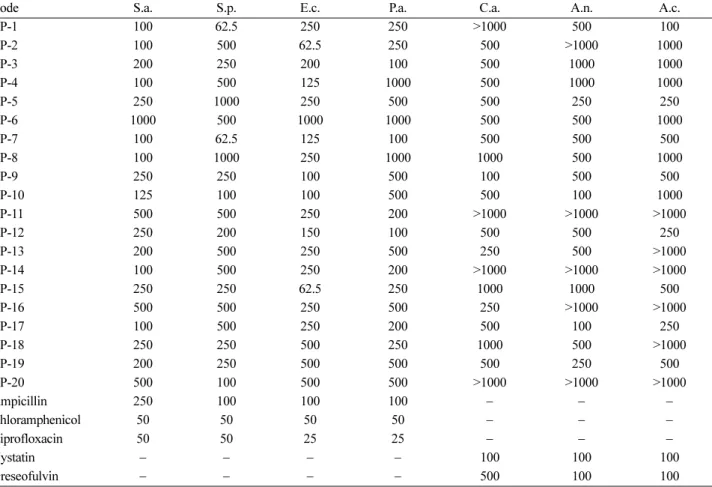
−NH2 functional group. The aromatic ring protons and J values were found to be in accordance with substitution pattern on phenyl ring. The sharp band near 2250 cm−1 in IR spectra indicates the presence of −CN group. System- atic fragmentation pattern was observed in mass spectral analysis for all the synthesized compounds. Molecular ion peak was observed in agreement with molecular weight of respective compound. All the synthesized target molecules showed screening in vitro studies on the selected micro- organism and fungal species. Among the tested compounds CP-1, CP-2, CP-7 and CP-15 exhibited more antimicro- bial activity against gram positive and gram negative bac- teria and CP-9, CP-10 and CP-17 exhibited comparatively moderate anti fungal activity (Table 2).
CONCLUSION
In summary we have developed a simple, one pot method for the preparation of a series of 6-amino-1-(2,5-disub-
Table 2. Minimal inhibitory concentration (MIC) of all synthesized compounds
Code S.a. S.p. E.c. P.a. C.a. A.n. A.c.
CP-1 100 62.5 250 250 >1000 500 100
CP-2 100 500 62.5 250 500 >1000 1000
CP-3 200 250 200 100 500 1000 1000
CP-4 100 500 125 1000 500 1000 1000
CP-5 250 1000 250 500 500 250 250
CP-6 1000 500 1000 1000 500 500 1000
CP-7 100 62.5 125 100 500 500 500
CP-8 100 1000 250 1000 1000 500 1000
CP-9 250 250 100 500 100 500 500
CP-10 125 100 100 500 500 100 1000
CP-11 500 500 250 200 >1000 >1000 >1000
CP-12 250 200 150 100 500 500 250
CP-13 200 500 250 500 250 500 >1000
CP-14 100 500 250 200 >1000 >1000 >1000
CP-15 250 250 62.5 250 1000 1000 500
CP-16 500 500 250 500 250 >1000 >1000
CP-17 100 500 250 200 500 100 250
CP-18 250 250 500 250 1000 500 >1000
CP-19 200 250 500 500 500 250 500
CP-20 500 100 500 500 >1000 >1000 >1000
Ampicillin 250 100 100 100 − − −
Chloramphenicol 50 50 50 50 − − −
Ciprofloxacin 50 50 25 25 − − −
Nystatin − − − − 100 100 100
Greseofulvin − − − − 500 100 100
Table 1. Physical data of all the synthesized compounds
Code R1, R2 R3 M.F. M.W. (gm/mole) M.P. (oC) % of yield
CP-1 Cl H C19H10Cl2N4O 380 272−274 71
CP-2 Cl 4-OCH3 C20H12Cl2N4O2 410 280−284 66
CP-3 Cl 2-OCH3 C20H12Cl2N4O2 410 254−258 75
CP-4 Cl 4-NO2 C19H9Cl2N5O3 425 245−250 74
CP-5 Cl 2-NO2 C19H9Cl2N5O3 425 234−236 78
CP-6 Cl 4-CH3 C20H12Cl2N4O 394 284−286 72
CP-7 Cl 4-Br C19H9BrCl2N4O 458 298−300 65
CP-8 Cl 3-Br C19H9BrCl2N4O 458 305−308 61
CP-9 Cl 4-Cl C19H9Cl3N4O 414 278−282 70
CP-10 Cl 3-Cl C19H9Cl3N4O 414 285−288 72
CP-11 CH3 H C21H16N4O 340 283−285 68
CP-12 CH3 4-OCH3 C22H18N4O2 370 255−260 71
CP-13 CH3 2-OCH3 C22H18N4O2 370 225−228 74
CP-14 CH3 4-NO2 C21H15N5O3 385 195−198 65
CP-15 CH3 2-NO2 C21H15N5O3 385 228−230 69
CP-16 CH3 4-CH3 C22H18N4O 354 220−222 74
CP-17 CH3 4-Br C21H15BrN4O 418 275−279 70
CP-18 CH3 3-Br C21H15BrN4O 418 290−292 75
CP-19 CH3 4-Cl C21H15ClN4O 374 235−238 68
CP-20 CH3 3-Cl C21H15ClN4O 374 258−260 72
stituted phenyl)-2-oxo-4-substituted phenyl-1,2-dihydro- pyridine-3,5-dicarbonitrile. All the synthesized compounds were characterized by FT-IR, 1H-NMR, mass spectros- copy and elemental analysis. The compounds were subjected for different biological activities and all the synthesized compounds showed good to moderate antimicrobial activity, results of other activities are awaiting. Further efforts toward this end will be reported in due course.
Acknowledgments. Authors are thankful to KSKV Kachchh University and M M Science College to providing research support and facility. Authurs are also thankful to Dr V R Ram and Dr G A Baxi for their help in spectral analysis. And the publication cost of this paper was sup- ported by the Korean Chemical Society.
REFERENCES
1. Choi, W.; Houpis, I. N.; Charchil, H. R. O.; Molina, A.;
Lynch, J. E.; Volante, R. P.; Reider, P. J.; King, A. O. Tet- rahedron 1995, 36, 4571.
2. Bhupathy, M.; Conlon, D. A.; Wells, K. M.; Wells, M.;
Nolson, J. R.; Reider, P. J.; Rossen, K.; Sager, J. W.; Volante, R. P. Cyanoacetanilides Intermediates in Heterocyclic Synthe- sis. Part 1: A Facile Synthesis of Polysubstituted and Con- densed Pyridones J. Heterocyclic Chem. 1995, 32, 1283.
3. Kappe, O. C.; Kappe, T. Synthesis of substituted 3-pyridine carbo nitriles with potential biological activity Monatshefte fur Chemie 1989, 120, 1095.
4. Saiki, A. Y. C.; Shen, L. L.; Chen, C. M.; Baranowski, J.;
Lerner, C. G. DNA Cleavage Activities of Staphylococcus aureus Gyrase and Topoisomerase IV Stimulated by Qui- nolones and 2-Pyridones Antimicrob. Agents Chemother.
1999, 43, 1574.
5. Brickner, S. Regio and Selective Synthesis of 4,6-Disub- stituted-2-pyridones. Chem. Ind. 1997, 131.
6. Cheney, I. W.; Yan, S.; Appleby, T.; Walker, H.; Vo, T.;
Yao, N.; Hamatake, R.; Hong, Z.; Wu, J. Z. Bioorg. Med.
Chem. Lett. 2007, 17, 1679.
7. Wendt, M. D.; et al. Bioorg. Med. Chem. Lett. 2007, 17, 3122.
8. (a) Hardie, D. G. Endocrinology 2003, 144, 5179. (b) Har- die, D. G.; Scott, J. W.; Pan, D. A.; Hudson, E. R. FEBS Lett.
2003, 546, 113. (c) Kahn, B. B.; Alquier, T.; Carling, D.;
Hardie, D. G. Cell Metab. 2005, 1, 15. (d) Hawley, S. A.;
Boudeau, J.; Reid, J. L.; Mustard, K. J.; Udd, L.; Makela, T. P.; Alessi, D. R.; Hardie, D. G. J. Biol. 2003, 2, 28.
9. Li, Q.; Mitscher, L. A.; Shen, L. L. The 2-Pyridone Anti- bacterial Agents: Bacterial Topoisomerase Inhibitors Med.
Res. Rev. 2000, 20, 231.
10. Gupta, A, K.; Plott, T. Ciclopirox: A Broad-Spectrum Antifungal with Antibacterial and Anti-inflammatory Prop- erties. Int. J. Dermatol. 2004, 43, 3.
11. Collins, I.; et al. 3-Heteroaryl-2-pyridones: Benzodiazepine Site Ligands with Functional Selectivity for α2/α3-Sub- types of Human GABAA Receptor-Ion Channels J. Med.
Chem. 2002, 45, 1887.
12. Robert, N.; Verrier, C.; Hoarau, C.; Celanire, S.; Mar- sais, F. Solid-phase Synthesis of 3-Hydroxy-2-methyle- nealkanenitriles Using Polymer-Supported α-Selenopropionitrile.
ARKIVOC 2008, 7, 92.
13. Sollogoub, M.; Fox, K. R.; Powers, V. E. C.; Brown, T.
First Synthesis of 1-Deazacytidine, the C-nucleoside Ana- logue of Cytidine Tetrahedron Lett. 2002, 43, 3121.
14. Parsons, S.; Winpenny, R. E. P. Structural Chemistry of Pyridonate Complexes of Late 3d-Metals Acc. Chem. Res.
1997, 30, 89.
15. Murray, T.; Zimmerman, S. 7-Amido-1,8-naphthyridines as Hydrogen Bonding Units for the Complexation of Guanine Derivatives: The Role of 2-Alkoxyl Groups in Decreasing Binding Affinity Tetrahedron Lett. 1995, 36, 7627.
16. Werbitzky, O.; Studer, P. Process for the Production of 2- Chloro-5-chloromethyl-pyridine. U.S. Patent 6,022,974, Feb 8, 2008.
17. Murata, T.; Shimizu, K.; Narita, M.; Manganiello, V.; Tagawa, T. Characterization of Phosphodiesterase 3 in Human Malig- nant Melanoma Cell Line Anticancer Res. 2000, 22, 3171.
18. Ahmed Ali, F.; Samir, B.; Ramy, R.; Hassan Ali, E.
Cyanoacetamide Derivatives as Synthons in Heterocyclic Synthesis Turk. J. Chem. 2008, 32, 259.
19. National Committee for Clinical and Laboratory Stan- dards (NCCLS). Method for Dilution Antimicrobial Sus- ceptibility Tests for Bacteria that Grow Aerobically Approved Standard, 4th ed. NCCLS, Villanova, Italy. 1997, Docu- ment M 100-S7. S100-S157.
20. Isenberg, D. H. Essential Procedure for Clinical Micro- biology; American Society for Microbiology: Washing- ton, 1998.
21. Zgoda, J. R.; Porter, J. R. Pharm. Biol. 2001, 39, 221−25.