Management of Ventilatory Insufficiency in Neuromuscular Patients Using Mechanical Ventilator Supported by the Korean Government
Since 2001, financial support has been provided for all patients with neuromuscular disease (NMD) who require ventilatory support due to the paralysis of respiratory muscles in Korea. The purpose of this study was to identify ventilator usage status and
appropriateness in these patients. We included 992 subjects with rare and incurable NMD registered for ventilator rental fee support. From 21 February 2011 to 17 January 2013, ventilator usage information, regular follow-up observation, and symptoms of chronic hypoventilation were surveyed by phone. Home visits were conducted for patients judged by an expert medical team to require medical examination. Abnormal ventilatory status was assessed by respiratory evaluation. Chronic respiratory insufficiency symptoms were reported by 169 of 992 subjects (17%), while 565 subjects (57%) did not receive regular respiratory evaluation. Ventilatory status was abnormal in 102 of 343 home-visit subjects (29.7%). Although 556 subjects (56%) reported 24-hour ventilator use, only 458 (46%) had an oxygen saturation monitoring device, and 305 (31%) performed an airstacking exercise. A management system that integrates ventilator usage monitoring, counselling and advice, and home visits for patients who receive ventilator support could improve the efficiency of the ventilator support project.
Keywords: Mechanical Ventilator, Respiratory Insufficiency, Neuromuscular Disease;
Home Care Seong-Woong Kang, Won Ah Choi,
Han Eol Cho, Jang Woo Lee, and Jung Hyun Park
Department of Rehabilitation Medicine, Pulmonary Rehabilitation Center, Gangnam Severance Hospital, Rehabilitation Institute of Neuromuscular Disease, Yonsei University College of Medicine, Seoul, Korea Received: 28 July 2015
Accepted: 17 March 2016 Address for Correspondence:
Seong-Woong Kang, MD
Department of Rehabilitation Medicine, Pulmonary Rehabilitation Center, Gangnam Severance Hospital, Rehabilitation Institute of Neuromuscular Disease, Yonsei University College of Medicine, 211 Eonju-ro, Gangnam-gu, Seoul 06273, Korea
E-mail: [email protected]
Funding: This work was supported by the Research Program funded by the Korean Centers for Disease Control and Prevention (Fund code 2011E6300100 and 2012E6300700).
http://dx.doi.org/10.3346/jkms.2016.31.6.976 • J Korean Med Sci 2016; 31: 976-982
INTRODUCTION
In cases of rare and incurable neuromuscular disease (NMD) showing progressive muscular weakness, hypercapnia occurs due to hypoventilation arising from respiratory muscle weak- ening as the disease progresses (1-5). This ventilatory failure is accompanied by respiratory complications such as pneumonia and atelectasis, which deteriorate patients’ quality of life and ultimately lead to death (6,7). Applying appropriate ventilatory support using a ventilator and managing the ventilatory failure status of NMD patients through regular respiratory function evaluation and ventilatory status analysis can prevent respira- tory complications and resultant death and contribute to im- proving quality of life (6,8-12).
To reduce the economic burden for patients with rare and incurable NMD due to medical expense in Korea, the govern- ment has provided a ventilator rental fee for patients who re- quire a ventilator due to paralysis of respiratory muscles from progressive muscular weakness since 2001. However, there is no management system to provide patients with professional advice and counselling on the appropriate use of ventilators and respiratory failure symptoms other than regular inspection
of the devices by ventilator rental companies, and thus the ne- cessity of improving the management of the ventilator support project has been suggested (13).
As part of the Korean government’s medical expense support project for patients with rare and incurable disease, this study examined the appropriateness of ventilator usage and respira- tory care for patients with NMD who receive a ventilator rental fee based on phone interviews and in-person surveys.
MATERIALS AND METHODS Study subjects
In Korea, the following NMD are designated as ‘rare incurable diseases requiring support for respiratory care’: amyotrophic lateral sclerosis (ALS), spinal muscular atrophy (SMA), muscu- lar dystrophy, myotonic dystrophy, congenital myopathy, mito- chondrial myopathy, and other muscular disorders (hereditary ataxia, myasthenia gravis, multiple sclerosis, Charcot-Marie- Tooth disease, Guillain-Barre syndrome, mucopolysaccharido- sis, Pompe disease, and Creutzfeldt-Jakob disease). These pa- tients can request ventilatory support (financial support for the rental cost of a portable ventilator and mechanical insufflation-
exsufflation device) when they have more than two symptoms of chronic hypoventilation (fatigue, sleep disorder, nightmare, morning headache, anxiety, and dyspnoea) and their end-tidal CO2 exceeds 40 mmHg or partial pressure of carbon dioxide (pCO2) exceeds 45 mmHg on 2 serial examinations. The research subjects were 1,251 patients with rare and incurable NMD who had registered for ventilator rental fee support from the govern- ment between February 2011 and April 2012. Among them, 259 subjects (68 subjects who returned the ventilator or died, 5 who did not use the ventilator, 62 with incorrect contact information, 19 who refused to take the survey, and 105 who could not be contacted despite more than three phone call attempts) were excluded, and 992 subjects were finally included. Except who actually did not use home mechanical ventilator (who did not use the ventilator and who returned the ventilator or died), a survey response rate was 84% (992 of 1,178).
Methods
This study involved two phone surveys and home visit surveys from February 21, 2011 to January 17, 2013 (first survey period:
February 21, 2011 to December 20, 2011; second survey period:
April 18, 2012 to January 17, 2013).
Organization of the research team
For the care and management of patients using a ventilator, a respiratory rehabilitation expert team, consisting of a rehabili- tation medicine specialist, social worker, and research assistant nurse, was established by the Korea Centers for Disease Control and Prevention. The rehabilitation medicine specialist was re- sponsible for medical consulting and advice for patients during phone counselling and home visits and for educating the social worker and nurse on the methods of respiratory failure patient care and evaluation. The social worker performed phone coun- selling and surveys. The nurse performed phone counselling, home visits, and visit surveys.
Phone survey
Ventilator usage information, regular follow-up observation, and chronic respiratory insufficiency symptoms were surveyed by phone (Appendix 1, visible online). Ventilator usage infor- mation included the ventilator usage period, method and the presence of oxygen saturation monitoring. For patients receiv- ing home-based care at the time of survey, whether regular fol- low-up observation was conducted through hospital visits, and whether respiratory evaluation was conducted at follow-ups was examined. For patients receiving inpatient treatment, whe- ther regular respiratory evaluation was conducted was exam- ined. For patients receiving home-based care who did not re- ceive follow-up observation, the reason for this absence of fol- low-up was also questioned. To assess the appropriateness of ventilator usage, the presence of fatigue, sleep disorder, night-
mares, morning headache, anxiety, and dyspnoea, which are symptoms of chronic respiratory insufficiency, was examined, with patients able to list multiple symptoms.
Home visit
After the phone survey, a home visit was conducted for 343 sub- jects who required a medical assessment based on the judgment of the expert medical team (e.g., patients who had not received treatment for a long time and patients who had a limitation in prompt hospital treatment due to distance or difficulty in trans- portation, regardless of economic condition). During the home visit, the presence of abnormal ventilatory status was checked by conducting a respiratory evaluation, and a home visit survey record was made (Appendix 2, visible online).
Statistical analysis
Statistical analysis was performed by using of SPSS ver. 20.0 (SPSS, Chicago, IL, USA). The χ2 test or the Fisher exact tests depend- ing on individual cell size was used to compare daily use time, type of ventilation of each disease, as well as abnormal ventila- tion status according to ventilator type or using time. P values
< 0.05 were considered statistically significant.
Ethics statement
The study protocol was reviewed and approved by the institutio- nal review board of the Gangnam Severance Hospital (IRB num- ber 3-2015-0337). Informed consent was waived by the board.
RESULTS
Basic characteristics of subjects
Among total 992 subjects, 436 had ALS, 260 had muscular dys- trophy, 161 had SMA, 34 had myotonic dystrophy, 34 had con- genital myopathy, 23 had mitochondrial myopathy, 3 had un- specified primary muscular disorders, and 41 had other mus- cular disorders (hereditary ataxia, myasthenia gravis, multiple sclerosis, Charcot-Marie-Tooth disease, Guillain-Barre syndrome, mucopolysaccharidosis, Pompe disease, or Creutzfeldt-Jakob disease). There were 658 male subjects and 334 female subjects.
Their mean age was 41.48 ± 21.83 years. Stratified according to disease diagnosis, subjects with ALS had the highest mean age (56.62 ± 11.29 years), and subjects with congenital myopathy had the lowest mean age (14.88 ± 13.83 years) (Table 1).
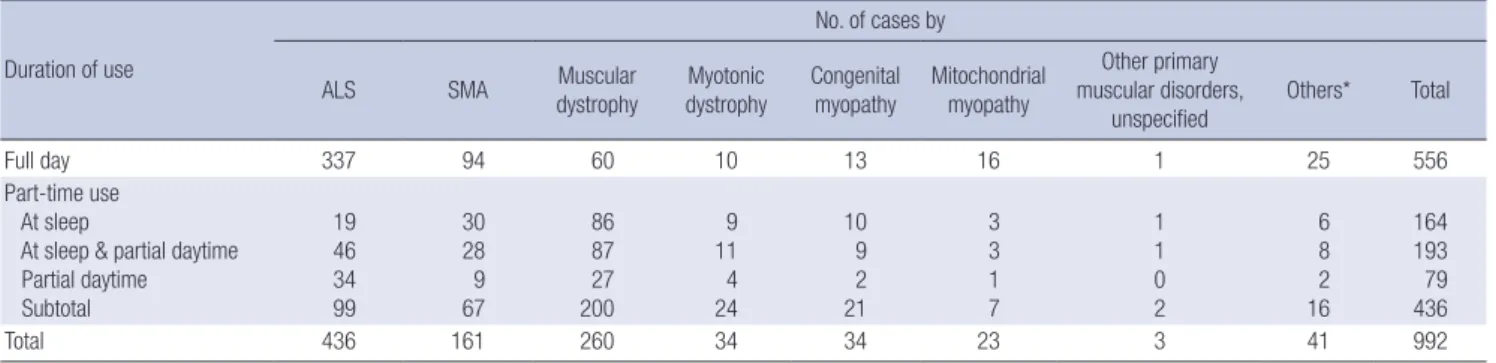
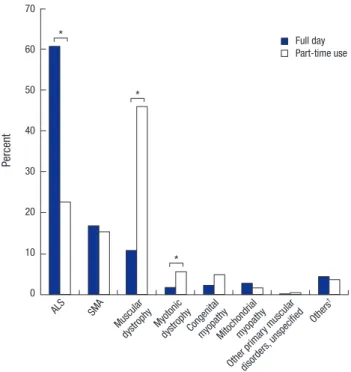
Ventilator usage period and daily average usage time The duration of ventilator usage is shown in Table 2. Five hun- dred fifty-five subjects used a ventilator for 24 hours, 194 sub- jects used it during their entire sleep and “partial daytime” (for a short time when necessary, less than 15 hours), 164 subjects used it only during sleep, and 79 subjects used it only during partial daytime. The proportion of full-day application was high-
er than that of part-time application in subjects with ALS, SMA, and mitochondrial myopathy; in contrast, the proportion of part- time application was higher in subjects with muscular dystro- phy, myotonic dystrophy, and congenital myopathy. The pro- portion of full-day application was significantly high in ALS group (P < 0.001), while the proportion of part-time application was significantly high in muscular dystrophy and congenital myop- athy group (muscular dystrophy P < 0.001, congenital myopa- thy P = 0.014). The proportional difference of full-time applying patients to part-time applying patients was not significant in other diseases (Table 3, Fig. 1).
Type of ventilator usage
Invasive respiratory support (invasive positive pressure ventila- tion, IPPV) via tracheostomy was implemented in 530 subjects (53.4%), and noninvasive respiratory support (NIPPV, noninva- sive intermittent positive pressure ventilation) through a mask was implemented in 462 subjects (46.6%). ALS group and other group had significantly higher tendency of using IPPV (P < 0.001), whereas muscular dystrophy group had higher tendency of us- ing NIPPV (P < 0.001) (Table 4, Fig. 2).
Table 1. Gender and age index for each disease
No. of cases by diseases
ALS SMA Muscular
dystrophy Myotonic
dystrophy Congenital
myopathy Mitochondrial myopathy
Other primary muscular disorders,
unspecified Others* Total
Sex Male
Female Total
257 179 436
108 53 161
216 44 260
22 12 34
19 15 34
13 10 23
2 1 3
21 20 41
658 334 992
Age Mean
SD
56.62 11.29
27.49 19.51
26.40 12.12
37.03 17.86
14.88 13.83
19.78 19.72
32.00 28.16
39.20 22.59
41.48 21.83 ALS, amyotrophic lateral sclerosis; SMA, spinal muscular atrophy.
*This group includes hereditary ataxia, myasthenia gravis, multiple sclerosis, Charcot-Marie-Tooth disease, Guillain-Barre syndrome, mucopolysaccharidosis, Pompe disease, and Creutzfeldt-Jakob disease.
Table 2. Duration of ventilator use for each disease
Duration, yr
No. of cases by
ALS SMA Muscular
dystrophy
Myotonic dystrophy
Congenital myopathy
Mitochondrial myopathy
Other primary muscular disorders,
unspecified
Others* Total
> 1 157 14 39 8 3 5 3 10 239
1-3 158 31 98 12 15 9 0 16 339
3-5 67 27 54 10 10 7 0 8 183
5-7 31 28 43 3 0 2 0 4 111
7-10 20 40 19 1 5 0 0 0 85
10 < 3 21 7 0 1 0 0 3 35
Total 436 161 260 34 34 23 3 41 992
ALS, amyotrophic lateral sclerosis; SMA, spinal muscular atrophy.
*This group includes hereditary ataxia, myasthenia gravis, multiple sclerosis, Charcot-Marie-Tooth disease, Guillain-Barre syndrome, mucopolysaccharidosis, Pompe disease, and Creutzfeldt-Jakob disease.
Table 3. Average time of the daily ventilator use for each disease
Duration of use
No. of cases by
ALS SMA Muscular
dystrophy Myotonic
dystrophy Congenital
myopathy Mitochondrial myopathy
Other primary muscular disorders,
unspecified Others* Total
Full day 337 94 60 10 13 16 1 25 556
Part-time use At sleep
At sleep & partial daytime Partial daytime Subtotal
19 46 34 99
30 28 9 67
86 87 27 200
9 11 4 24
10 9 2 21
3 3 1 7
1 1 0 2
6 8 2 16
164 193 79 436
Total 436 161 260 34 34 23 3 41 992
ALS, amyotrophic lateral sclerosis; SMA, spinal muscular atrophy.
*This group includes hereditary ataxia, myasthenia gravis, multiple sclerosis, Charcot-Marie-Tooth disease, Guillain-Barre syndrome, mucopolysaccharidosis, Pompe disease, and Creutzfeldt-Jakob disease.
Fig. 1. Percentage of time of the daily ventilator use for each disease.
ALS, amyotrophic lateral sclerosis; SMA, spinal muscular atrophy.
*Statistically significant P value < 0.05; †This group includes hereditary ataxia, myas- thenia gravis, multiple sclerosis, Charcot-Marie-Tooth disease, Guillain-Barre syn- drome, mucopolysaccharidosis, Pompe disease, and Creutzfeldt-Jakob disease.
Percent
ALS SMA
Muscular dystrophy Myotonic
dystrophyCongenital myopa thy Mitochondrial myopa
thy
Other primar y muscular disorders,
unspecified Others
†
70 60
50 40
30
20 10
0
*
*
*
Full day Part-time use
Table 4. Ventilator usage type for each disease
Type of ventilator
No. of cases by
ALS SMA Muscular
dystrophy
Myotonic dystrophy
Congenital myopathy
Mitochondrial myopathy
Other primary muscular disorders,
unspecified
Others* Total
IPPV 321 88 43 13 18 16 1 30 530
NIPPV 113 77 216 21 15 7 2 11 462
Total 436 161 260 34 34 23 3 41 992
ALS, amyotrophic lateral sclerosis; SMA, spinal muscular atrophy; IPPV, invasive positive pressure ventilation; NIPPV, non-invasive intermittent positive pressure ventilator.
*This group includes hereditary ataxia, myasthenia gravis, multiple sclerosis, Charcot-Marie-Tooth disease, Guillain-Barre syndrome, mucopolysaccharidosis, Pompe disease, and Creutzfeldt-Jakob disease.
Percent
ALS SMA
Muscular dystrophy Myotonic
dystrophyCongenital myopa thy Mitochondrial myopa
thy
Other primar y muscular disorders,
unspecified Others
†
70 60
50 40
30
20 10
0
*
*
* IPPV NIPPV
Fig. 2. Percentage of type of ventilator use for each disease.
IPPV, invasive positive pressure ventilation; NIPPV, non-invasive intermittent positive pressure ventilator; ALS, amyotrophic lateral sclerosis; SMA, spinal muscular atrophy.
*Statistically significant P value < 0.05; †This group includes hereditary ataxia, myas- thenia gravis, multiple sclerosis, Charcot-Marie-Tooth disease, Guillain-Barre syndrome, mucopolysaccharidosis, Pompe disease, and Creutzfeldt-Jakob disease.
Possession of oxygen saturation monitor and implementation of air stacking exercise
Four hundred fifty-eight of 992 subjects (46.2%) had an oxygen saturation monitor, and 30.7% of subjects (n = 305) performed air stacking exercise. Seventy nine of 531 (14.9%) patients using IPPV via tracheostomy and 225 of 461 (48.8%) patients using NIPPV carried out air stacking exercise.
Implementation of regular follow-up observation and respiratory evaluation
Among the 992 subjects, 605 subjects (61.0%) received follow- up in outpatients, 161 subjects (16.2%) received treatment in a hospital and 226 subjects did not receive follow-up observation.
Among the 605 subjects underwent follow-up observation as outpatients, 375 subjects received regular respiratory evalua-
tion during follow-up observation and 230 did not. Among the subjects receiving inpatient treatment, regular respiratory eval- uation was implemented in only 52 of 161. In summary, 427 (43.0%) underwent respiratory evaluation during hospital visits and 565 patients (57.0%) did not (Fig. 3).
Reason for the omission of follow-up observation
For the 226 subjects who did not receive follow-up observation, the reason for the absence of follow-up was also questioned.
The most common reason was difficulty in travel (172 subjects, 76.1%), followed by distance (12 subjects, 5.3%), economic dif- ficulty (11 subjects, 4.9%), absence of a caregiver (1 subject, 0.4%), and other reasons (30 subjects, 13.3%) such as not feeling the necessity of visiting a hospital due to lack of knowledge of the disease.
Presence of chronic hypoventilation symptoms
In the phone survey of 992 subjects, 169 subjects complained of chronic hypoventilation symptoms and reported a total of 229 symptoms. The symptoms include fatigue (n = 7), sleep disor- der (n = 126), nightmare (n = 2), morning headache (n = 58), anxiety (n = 1), and dyspnoea (n = 35).
Abnormal ventilatory status
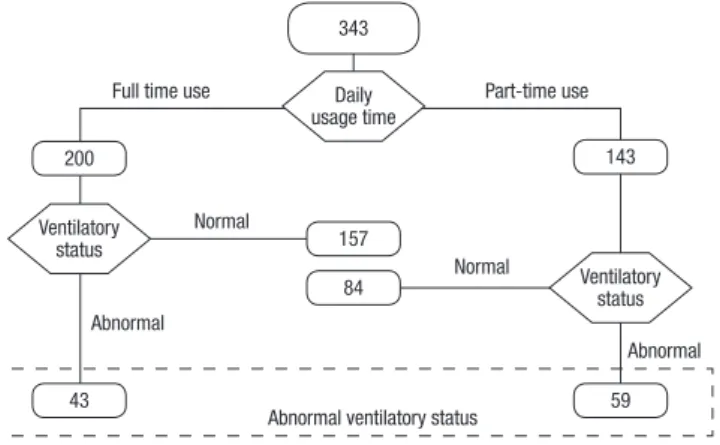
Among the 343 subjects with home visit, 102 (29.7%) demon- strated abnormal respiratory status (end-tidal CO2 partial pres- sure over 40 mmHg or oxygen saturation under 94% with venti- lator using). Among these 102 subjects, 43 demonstrated ab- normal status of ventilation in spite of using a ventilator for 24 hours (Fig. 4).
In the first survey period (February 21, 2011 to December 20, 2011), we found 54 patients with abnormal ventilator status.
Follow up observation of 47 subjects who could be contacted (excluding six subjects who passed away and one who could not be contacted) was done in the second survey period (April 18, 2012 to January 17, 2013). Thirty nine patients (83%) changed their type of ventilator usage by visiting a hospital upon the rec- ommendation of the research nurse following the home visit.
Among the 343 patients, 3 patients were not evaluated due to ventilator malfunction. Out of 207 patients on pressure-preset mode, 55 patients (26.6%) were presented with respiratory fail- ure. Out of 133 patients on volume-preset mode, 47 patients (35.3%) showed respiratory failure. Respiratory failure did not show significant difference among different ventilator preset mode (P = 0.091). Out of 206 patients under IPPV, 50 patients were presented with respiratory failure (24.3%). Meanwhile, out of 137 patients under NIPPV, 52 patients (38.0%) showed respi- ratory failure. Respiratory failure was noticed significantly more in patients under non-invasive mode compared to those under invasive method (P = 0.007).
DISCUSSION
The present study reveals high rates of chronic respiratory in- sufficiency symptoms, abnormal ventilator status, and low rates of regular follow-up, indicating that financial support does not help achieve sufficient ventilator care for NMD patients. These findings suggest that a new method such as the establishment of a home visit service is needed for the continuous care of pa- tients for whom hospital treatment is difficult.
In our study, overall follow-up rate of total patients was 77.2%.
This was similar to the follow up rate of Canada National survey which studied whole population under home mechanical ven- tilator use (CaNuVENT Group) (14). However, the survey results showed that 339 (44.3%) of the 766 subjects who received fol- low-up observation did not receive respiratory evaluation. In- cluding the subjects who did not receive follow-up observation, more than half of all subjects (n = 565, 57.0%) did not receive regular respiratory evaluation. Overall, 38.0% of the subjects who received home-based care and implemented follow-up observation as outpatients (230 of 605 subjects) and 32.3% of hospitalized subjects (52 of 161 subjects) did not receive regular respiratory evaluation. Thus, a high proportion of subjects did not receive respiratory evaluation regardless of home-based care or hospitalization.
Ventilatory status of NMD patients undergoes sustained chan- ges due to progressive weakness of respiratory muscles. Notably in the case of young patients, ventilation status also changes due to growth. The survey of home-visit subjects indicated a high rate of abnormal ventilatory status (29.7%). This rate is consis- tent with previous study showing home mechanical ventilator failure in 30%. However, this was due to incorrect use rather than equipment failure. If the setting of a ventilator is based on a single evaluation, effective ventilatory support would be diffi- cult and get worse as time passes. Therefore, continuous and regular respiratory evaluation and relevant care (e.g., changing the ventilator setting and usage time) are essential and the sys- tem that checks and manages appropriate ventilator use through Fig. 3. A number of patients with regular follow-up observation and respiratory evalu-
ation.
f/u, follow-up; +, yes; -, no.
Total 992 Outpatient f/u
Respiratory
evaluation Respiratory
evaluation
Respiratory evaluation 427 patients
No f/u Inpatient f/u
605 +
- -
+ 161
230 109 226
No respiratory evaluation 565 patients
375 52
Fig. 4. Ventilatory status of the subjects visited at home.
343
Ventilatory status
Ventilatory status Daily
usage time Full time use
Normal
Abnormal
Abnormal Normal
Part-time use
200 143
43 59
Abnormal ventilatory status 157
84
regular respiratory evaluation, rather than simply prescribing a ventilator, is needed.
Survey results indicated that 556 of the total 992 subjects (56%) used a ventilator for 24 hours, indicating high dependence. Ox- ygen saturation monitoring, which can detect symptoms of a ventilator problem, is especially important when ventilator de- pendence is high. However, only 458 subjects (46%) had an ox- ygen saturation monitoring device. In addition, air stacking ex- ercise is known to reduce respiratory complications by signifi- cantly increasing maximal insufflation capacity and assisted peak cough flow (15,16). It also improves the quality of life of terminal NMD patients who use a noninvasive ventilator by de- laying the time to conversion to an invasive ventilator through tracheostomy or intubation. However, this exercise was imple- mented by only 305 subjects (31%). Thus, it appears that educa- tion on the importance of oxygen saturation monitoring and air stacking exercise and additional care for patients were insuffi- cient, suggesting that a management system that can provide advice and counselling on respiratory failure symptoms as well as the use and management of a ventilator is required.
Among the 992 subjects who participated in this study, 831 (83.8%) received home-based care, and 231 (23.3%) had used a ventilator for more than 5 years. This finding was similar to pre- vious reports on long term use of ventilator among patients with neuromuscular diseases (17,18). For most NMD patients who require long-term respiratory support, ventilator support can improve the quality of life of patients and caregivers and reduce unnecessary medical expense, because patients need not re- ceive inpatient treatment simply for the use of a ventilator. How- ever, the results of this study indicate that sufficient respiratory care was not achieved simply through the voluntary hospital visits of patients. We recommended the subjects with abnormal ventilatory status to take a proper care for appropriate use of the ventilator when we found them through the home visit in the first survey period. In the second period, we checked them again. Consequently, 83% of them changed their ventilator set- ting appropriately by visiting a hospital. In other words, simply providing economic support for ventilator usage was insufficient for achieving appropriate respiration in patients, while a com- prehensive management system could ensure that more patients receive proper treatment.
The percentage of patients under IPPV varied among differ- ent countries. The percentage of patients under IPPV in Eurovent study was 24% and was only 18% in Sweden, whereas in Ger- many it was 50%, and 35% in Denmark (18). In Australia and New Zealand, the percentage was only 3% (19). In this study, the percentage of patients under IPPV was 53.4%, higher than in any other previous studies. Eurovent study explains that these differences most likely reflect local and national practices. Add- ing to this, we suggest that the different proportion of neuromus- cular diseases among countries may affect the different percent-
age of patients under IPPV. Patients with ALS showed higher proportion of those under IPPV, consistent with findings in the study from CaNuVENT group (14). Unlike other neuromuscu- lar diseases, bulbar dysfunction develops in ALS as the disease progresses. Once reaching the critical level, tracheostomy is in- evitable for non-invasive muscle aids become inadequate (20, 21). On the other hand, patients with muscular dystrophy re- vealed higher proportion of those under NIPPV. This is also con- sistent with previous studies, which have already shown that tracheostomy is unnecessary in these patients (22,23). Since our study shows higher proportion of ALS than other neuro- muscular diseases, we could guess that the proportion of pa- tients under IPPV is high as well.
We would also like to stress on importance of frequent pul- monary evaluation. Higher tendency of respiratory failure was noticed among patients under NIPPV compared to those under IPPV in this study. Ironically, NIPPV is known to enable oral diet, speech, and improve quality of life (24,25). Thus we recommend getting more frequent monitoring when maintaining NIPPV.
The major limitation of this study is that not all patients were evaluated at home. However, survey response rate was 84%, sim- ilar to that of previous studies. It was 79% in Eurovent survey (18), 89% in CaNuVENT survey (14), and in 82% in Australia and New Zealand (19). Unlike previous studies, however, this study is uni- que in that 1/3 of the patients were visited and evaluated by med- ical team.
In the future, the effects of the operation of the central man- agement centre on patient status should be surveyed based on the currently established cohort. An efficient method for improv- ing patients’ hospital access also requires further study.
In conclusion, the efficiency of the ventilator support project could be maximized, and the social and medical cost reduced, by the implementation of a management system that can link monitoring of the appropriateness of ventilator usage, counsel- ling and advice, and home visits for patients who receive venti- lator support to establish proper treatment.
DISCLOSURE
The authors have no potential conflicts of interest to disclose.
AUTHOR CONTRIBUTION
Study design and conception: Kang SW, Choi WA. Data acqui- sition, analysis, interpretation: Choi WA. Writing: Cho HE. Revi- sion of manuscript: Lee JW, Park JH. Final approval of submis- sion: all authors.
ORCID
Seong-Woong Kang http://orcid.org/0000-0002-7279-3893
Won Ah Choi http://orcid.org/0000-0003-0403-8869 Han Eol Cho http://orcid.org/0000-0001-5625-3013 Jang Woo Lee http://orcid.org/0000-0002-2634-0375 Jung Hyun Park http://orcid.org/0000-0003-3262-7476
REFERENCES
1. Gibson GJ, Pride NB, Davis JN, Loh LC. Pulmonary mechanics in patients with respiratory muscle weakness. Am Rev Respir Dis 1977; 115: 389-95.
2. Griggs RC, Donohoe KM, Utell MJ, Goldblatt D, Moxley RT 3rd. Evaluation of pulmonary function in neuromuscular disease. Arch Neurol 1981; 38:
9-12.
3. Lynn DJ, Woda RP, Mendell JR. Respiratory dysfunction in muscular dys- trophy and other myopathies. Clin Chest Med 1994; 15: 661-74.
4. Schramm CM. Current concepts of respiratory complications of neuro- muscular disease in children. Curr Opin Pediatr 2000; 12: 203-7.
5. Smith PE, Calverley PM, Edwards RH, Evans GA, Campbell EJ. Practical problems in the respiratory care of patients with muscular dystrophy. N Engl J Med 1987; 316: 1197-205.
6. Kang SW, Park JH, Ryu HH, Kang YS, Moon JH. Non-invasive mechanical ventilator care for the patients with advanced neuromuscular disease. J Korean Acad Rehabil Med 2004; 28: 71-7.
7. Misuri G, Lanini B, Gigliotti F, Iandelli I, Pizzi A, Bertolini MG, Scano G.
Mechanism of CO2 retention in patients with neuromuscular disease.
Chest 2000; 117: 447-53.
8. Kim DH, Kang SW, Kim W, Lee SC, Yoo TW, Moon JH. Follow up Survey of Non-invasive intermittent positive pressure ventilatory support in pa- tients with neuromuscular diseases. J Korean Acad Rehabil Med 2007;
31: 427-33.
9. Kim DH, Kang SW, Choi W, Moon JH, Baek JH, Choi SH, Park JH, Shin YB, Seo JH. A research on the management of ventilatory insufficiency in patients with neuromuscular diseases. J Korean Acad Rehabil Med 2010;
34: 347-54.
10. Simonds AK, Muntoni F, Heather S, Fielding S. Impact of nasal ventilation on survival in hypercapnic Duchenne muscular dystrophy. Thorax 1998;
53: 949-52.
11. Bach JR, Alba AS. Management of chronic alveolar hypoventilation by na- sal ventilation. Chest 1990; 97: 52-7.
12. Bach JR. Amyotrophic lateral sclerosis: predictors for prolongation of life by noninvasive respiratory aids. Arch Phys Med Rehabil 1995; 76: 828-32.
13. Kim JY, Min Y, Kim MS, Kim JS, Kim HL, Shin HI. A survey of respiratory care in amyotrophic lateral sclerosis patients using non-invasive ventila- tory support. J Korean Acad Rehabil Med 2010; 34: 49-53.
14. Rose L, McKim DA, Katz SL, Leasa D, Nonoyama M, Pedersen C, Gold- stein RS, Road JD, Amin R, Avendano M, et al. Home mechanical ventila- tion in Canada: a national survey. Respir Care 2015; 60: 695-704.
15. Kang SW, Bach JR. Maximum insufflation capacity. Chest 2000; 118: 61-5.
16. Kang SW, Cho DH, Lee SC, Moon JH, Park YG, Song NK, Lee SH. Clinical implication of air stacking exercise in patients with neuromuscular dis- eases. J Korean Acad Rehabil Med 2007; 31: 346-50.
17. Simonds AK, Elliott MW. Outcome of domiciliary nasal intermittent posi- tive pressure ventilation in restrictive and obstructive disorders. Thorax 1995; 50: 604-9.
18. Lloyd-Owen SJ, Donaldson GC, Ambrosino N, Escarabill J, Farre R, Fau- roux B, Robert D, Schoenhofer B, Simonds AK, Wedzicha JA. Patterns of home mechanical ventilation use in Europe: results from the Eurovent survey. Eur Respir J 2005; 25: 1025-31.
19. Garner DJ, Berlowitz DJ, Douglas J, Harkness N, Howard M, McArdle N, Naughton MT, Neill A, Piper A, Yeo A, et al. Home mechanical ventilation in Australia and New Zealand. Eur Respir J 2013; 41: 39-45.
20. Bach JR, Bianchi C, Aufiero E. Oximetry and indications for tracheotomy for amyotrophic lateral sclerosis. Chest 2004; 126: 1502-7.
21. Sancho J, Servera E, Díaz J, Marín J. Efficacy of mechanical insufflation- exsufflation in medically stable patients with amyotrophic lateral sclero- sis. Chest 2004; 125: 1400-5.
22. Cheng G, Bach JR. Avoidance of tracheostomy in patients with neuromus- cular disease. Chron Respir Dis 2008; 5: 243.
23. Soudon P, Steens M, Toussaint M. A comparison of invasive versus non- invasive full-time mechanical ventilation in Duchenne muscular dystro- phy. Chron Respir Dis 2008; 5: 87-93.
24. Nauffal D, Doménech R, Martínez García MA, Compte L, Macián V, Per- piñá M. Noninvasive positive pressure home ventilation in restrictive dis- orders: outcome and impact on health-related quality of life. Respir Med 2002; 96: 777-83.
25. Radunovic A, Annane D, Rafiq MK, Mustfa N. Mechanical ventilation for amyotrophic lateral sclerosis/motor neuron disease. Cochrane Database Syst Rev 2013; 3: CD004427.