Two-year Clinical Outcomes of Patients with Long Segments Drug-Eluting Stents: Comparison of Sirolimus-Eluting Stent with Paclitaxel-Eluting Stent
Limited data are available on the long-term clinical efficacy of drug-eluting stent (DES) in diffuse long lesions. From May 2006 to May 2007, a total of 335 consecutive patients (374 lesions) were underwent percutaneous coronary intervention with implantation of long DES ( ≥ 30 mm) in real world practice. Eight-month angiographic outcomes and 2-yr clinical outcomes were compared between SES (n = 218) and PES (n = 117). Study endpoints were major adverse cardiac events including cardiac death, myocardial infarction, target-lesion revascularization, target-vessel revascularization and stent thrombosis. Baseline characteristics were similar in the two groups as were mean stent length (44.9 ± 15.2 mm in SES and 47.4 ± 15.9 in PES, P = 0.121). Late loss at 8 months follow-up was significantly lower in SES than in PES group (0.4 ± 0.6 mm in SES vs 0.7 ± 0.8 mm in PES, P = 0.007). Mean follow-up duration was 849 ± 256 days, and 2-yr cumulative major adverse cardiac events were significantly lower in the SES than in the PES group (5.5% in SES vs 15.4% in PES, P = 0.003). In conclusion, long-term DES use in diffuse long coronary lesions is associated with favorable results, with SES being more effective and safer than PES in this real-world clinical experience.
Key Words: Drug-Eluting Stents; Long Lesion; Long-Term, Outcomes Ung Kim1, Sang-Hee Lee1, Geu-Ru Hong1,
Jong-Seon Park1, Dong-Gu Shin1, Young-Jo Kim1, Jae-Sik Jang2, Tae-Hyun Yang2, Dae-Kyeong Kim2, Dong-Soo Kim2, Dong-Kie Kim3, Sang-Hoon Seol3, Doo-Il Kim3, Yoon-Kyung Cho4, Hyung-Seop Kim4, Chang-Wook Nam4, Seung-Ho Hur4 and Kwon-Bae Kim4
1Division of Cardiology, Department of Internal Medicine, Yeungnam University Medical Center, Daegu; 2Division of Cardiology, Department of Internal Medicine, Inje University Busan Paik Hospital, Busan; 3Division of Cardiology, Department of Internal Medicine, Inje University Haeundae Paik Hospital, Busan; 4Division of Cardiology, Department of Internal Medicine, Keimyung University Dongsan Hospital, Daegu, Korea
Received: 28 March 2011 Accepted: 2 August 2011 Address for Correspondence:
Jong-Seon Park, MD
Division of Cardiology, Department of Internal Medicine, Yeungnam University Medical Center, 170 Hyeonchung-ro, Nam-gu, Daegu 705-717, Korea
Tel: +82.53-620-3313, Fax: +82.53-621-3310 E-mail: [email protected]
http://dx.doi.org/10.3346/jkms.2011.26.10.1299 • J Korean Med Sci 2011; 26: 1299-1304
INTRODUCTION
Although drug-eluting stent (DES) use has remarkably reduced in-stent restenosis (ISR) and neointimal hyperplasia, percuta- neous coronary intervention (PCI) of diffuse long coronary ar- tery lesions remains challenging (1, 2); these lesions are com- monly encountered in routine clinical practice and often lead to use long stented segments with stent overlap. Because stent- ed segment length was a known independent predictor of ISR in the bare-metal stent (BMS) era and limited data are available on the long-term efficacy and safety of DES in diffuse long cor- onary artery lesions, we investigated the long-term efficacy and safety of DES in diffuse long lesions (3-5).
MATERIALS AND METHODS Study population
From May 2006 to May 2007, a total of 335 consecutive patients
(374 lesions) underwent PCI with implantation of long DES ( ≥ 30 mm) in de novo long coronary artery lesions at 3 cardiac cen- ters (Inje University Busan Paik Hospital in Busan, Yeungnam University Medical Center in Daegu and Keimyung University Dongsan Hospital in Daegu) in Korea. Patients were divided into sirolimus-eluting stent (SES, Cypher, Cordis, Johnson & Johnson, Roden, The Netherlands, n = 218) and paclitaxel-eluting stent (PES, Taxus, Boston Scientific Corp, Natick, MA, USA, n = 117) recipient groups, and 8-month angiographic 2-yr clinical out- comes were compared.
Procedures and medications
All interventions were performed using standard techniques.
DES selection, Glycoprotein IIb/IIIa inhibitors and intravascu- lar ultrasound (IVUS) were used at the discretion of the opera- tor. All patients received a loading dose of 300 mg clopidogrel followed by a daily dosage of 75 mg for 12 months, in addition to life-long aspirin therapy.
Follow-up
Angiographic follow-up was recommended for all living patients at 8 months after index procedure. Clinical follow-up was per- formed for all patients at 1, 3, 6, 9 and 12 months, and every 3 months thereafter either during out-patient department visits or by direct telephone calls to patients.
Study outcomes and definitions
Study outcome was a composite of major adverse cardiac events (MACE) including cardiac death, myocardial infarction (MI), target-lesion revascularization (TLR), target-vessel revascular- ization (TVR) and stent thrombosis (ST).
Procedural success was defined as residual diameter stenosis
≤ 30% and the absence of any-in hospital MACE. MI was diag- nosed when cardiac enzyme (creatine kinase MB fraction) levels were elevated more than threefold the normal level, with chest pain lasting ≥ 30 min, or with the appearance of new electrocar- diographic changes, or with imaging evidence of new regional wall motion abnormality or loss of viable myocardium. TLR was defined as either surgical or percutaneous reintervention driven by significant ( > 50%) luminal diameter narrowing within the stent or the 5 mm borders proximal and distal to the stent and undertaken in the presence of either anginal symptoms or ob- jective evidence of ischemia. TVR was defined as revasculariza- tion within the target vessel encompassing the target lesion. Stent thrombosis (ST) was classified by the Academic Research Con- sortium definition as definite, probable, or possible and as acute (0 to 24 hr), subacute ( > 24 hr to 30 days), late ( > 30 days to 1 yr) or very late ( > 1 yr). ST was defined as 1) definite: an acute cor- onary syndrome with angiographic documentation of either ves- sel occlusion or thrombus within or adjacent to a previously suc- cessfully stented vessel or autopsy evidence of stent thrombosis, 2) probable: acute MI in the distribution of the treated vessel or unexplained death < 30 days after the index PCI and 3) possible:
unexplained death > 30 days after the index PCI (6, 7).
Angiographic restenosis was defined as ≥ 50% of a diameter stenosis. Cumulative rates of event-free survival and MACE were analyzed over a two-year follow-up period.
Quantitative coronary angiographic analysis
The percentage of diameter stenosis, minimal lumen diameter, lesion length and reference diameter were analyzed with an au- tomated edge-detection system (CASS II, Pie Medical, Maas- tricht, The Netherlands) before the procedure, after the proce- dure, and at follow-up. Lesion morphology was defined accord- ing to the guidelines of the American College of Cardiology and the American Heart Association (8).
Statistical analysis
Data are expressed as mean ± SD for continuous variables, and as frequencies for categorical variables. A two tailed Student’s t
test was used to assess differences between continuous variables.
The chi-square (χ2) test was used for comparison of categorical variables. Multivariate logistic regression analysis was carried out using the baseline clinical and angiographic characteristics to identify the independent predictors of MACEs. The following variables were tested; pre-lesion length, overlapping, number of stents in long lesion, multi-vessel disease and used stent type.
Major adverse cardiac event-free survival distributions were es- timated according to the Kaplan-Meier method. The log-rank test was used to compare MACE-free survival between two groups.
Probability values < 0.05 were considered significant. Data were analyzed with SAS 9.1.3. (SAS Institute Inc., Cary, NC, USA).
Ethics statement
This study was reviewed and approved by the institutional review board (DCR-10-14) and is in accordance with the Declaration of Helsinki. Informed consent was obtained from all patients.
RESULTS
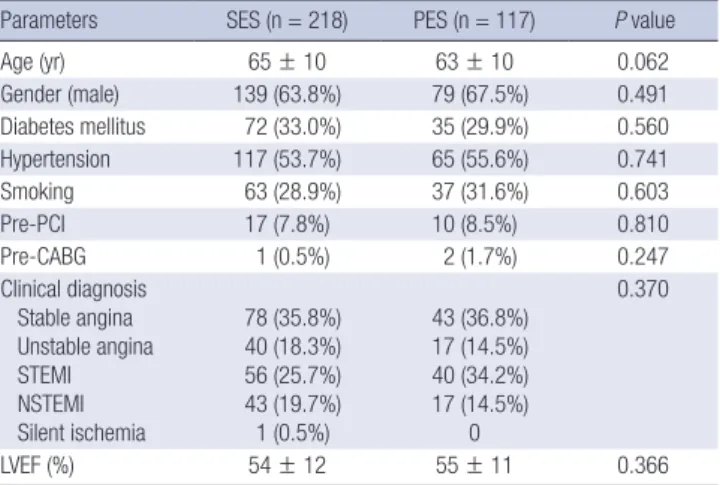
Baseline characteristics of the patients are presented in Table 1 and there were no significant differences between groups. An- giographic and procedural data are shown in Table 2; most le- sions were type C according to the American College of Cardi- ology and American Heart Association and guidelines (8). Mean lesion length (40.4 ± 14.3 mm in SES and 43.6 ± 15.2 mm in PES, P = 0.063) and mean stent length (44.9 ± 15.2 mm in SES and 47.4 ± 15.9 mm in PES, P = 0.121) did not differ significantly be- tween groups. Post-procedural diameter stenosis was greater in the PES than that in SES group (6.1% ± 4.2% in SES vs 7.9% ± 5.0% in PES, P = 0.001). Angiographic follow-up at 8 months was performed in 47.3% and binary restenosis rate was 2.1% in the SES and 5.3% in the PES group (P = 0.094). Late loss was signif-
Table 1. Baseline characteristics of the patients
Parameters SES (n = 218) PES (n = 117) P value
Age (yr) 65 ± 10 63 ± 10 0.062
Gender (male) 139 (63.8%) 79 (67.5%) 0.491
Diabetes mellitus 72 (33.0%) 35 (29.9%) 0.560
Hypertension 117 (53.7%) 65 (55.6%) 0.741
Smoking 63 (28.9%) 37 (31.6%) 0.603
Pre-PCI 17 (7.8%) 10 (8.5%) 0.810
Pre-CABG 1 (0.5%) 2 (1.7%) 0.247
Clinical diagnosis Stable angina Unstable angina STEMI NSTEMI Silent ischemia
78 (35.8%) 40 (18.3%) 56 (25.7%) 43 (19.7%) 1 (0.5%)
43 (36.8%) 17 (14.5%) 40 (34.2%) 17 (14.5%)
0
0.370
LVEF (%) 54 ± 12 55 ± 11 0.366
SES, sirolimus-eluting stent; PES, paclitaxel-eluting stent; PCI, percutaneous coronary intervention; CABG, coronary artery bypass graft; STEMI, ST-segment elevation myo- cardial infarction; NSTEMI, non-ST-segment elevation myocardial infarction; LVEF, left ventricular ejection fraction.
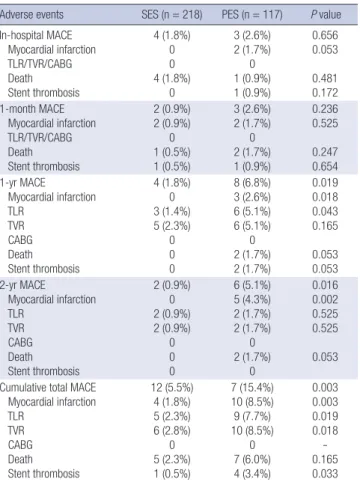
icantly lower in the SES than in the PES (0.4 ± 0.6 mm in SES vs 0.7 ± 0.8 mm in PES, P = 0.007, Table 3). Mean clinical follow-up duration was 849 ± 256 days. In-hospital MACE rates were not statistically different between groups (1.8% in SES vs 2.6% in PES, P = 0.656, Table 4). During hospitalization, 4 patients in the SES group died; 2 with cardiogenic shock, 1 with cardiogenic shock and acute stent thrombosis, and one with cardiac tamponade, while two patients in the PES group died of cardiogenic shock after acute myocardial infarction (Table 4). At one-month follow- up, one additional patient died after subacute stent thrombosis in the SES group, and likewise in the PES group (Table 4). At one year follow-up, two additional deaths occurred in the PES group related to late stent thrombosis, while there were no deaths in the SES group. At two-year follow-up, two additional deaths were found in the PES group related to heart failure; however, there were no additional cases of stent thrombosis (Table 4). Cumu- lative total MACE showed SES yielded superior results than PES (5.5% in SES vs 15.4% in PES, P = 0.003). MACE-free survival rates are presented in Figs. 1, 2 shows TVR-free survival and Fig.
3 shows myocardial infarction, death and stent thrombosis free survival.
From test variables with pre-lesion length, overlapping, num- ber of stents in long lesion, multi-vessel disease and used stent type, the independent risk factors of MACE for diffuse long cor- onary artery lesions were used stent (P = 0.003, odds ratio 3.181, C.I. 1.492-6.779) and overlapping stent (P = 0.025, odds ratio 1.790, C.I. 0.814-3.937).
Table 2. Angiographic and procedural findings
Procedures or variables SES (n = 241) PES (n = 133) P value Lesion type*
B2 C
12 (5.0%) 223 (92.5%)
6 (4.5%) 124 (93.2%)
0.894
Modified lesion type† B2
C
109 (45.2%) 66 (27.4%)
51 (38.3%) 42 (31.6%)
0.610
Disease vessel number 1 vessel
2 vessels 3 vessels
101 (41.9%) 66 (27.4%) 74 (30.7%)
40 (30.1%) 44 (33.1%) 49 (36.8%)
0.078
Target artery LAD LCX RCA
126 (52.3%) 28 (11.6%) 87 (36.1%)
58 (43.6%) 25 (18.8%) 50 (37.6%)
0.106
Bifurcation lesion 50 (20.7%) 30 (22.6%) 0.683 Infarct-related artery 87 (36.1%) 51 (38.3%) 0.666 Stent
Size (mm)
Length (mm) 3.0 ± 0.2
44.9 ± 15.2 3.0 ± 0.3
47.4 ± 15.9 0.157 0.121 Maximal pressure (atm) 15.9 ± 2.0 15.8 ± 2.0 0.863
Post-dilatation 45 (18.7%) 34 (25.6%) 0.118
Overlapping stent 112 (46.5%) 74 (55.6%) 0.090 Stent number at target lesion 1.7 ± 0.5 1.8 ± 0.6 0.089 Lesion length (mm) 40.4 ± 14.3 43.6 ± 15.2 0.063 Pre-PCI
RD (mm) MLD (mm) DS (%)
2.8 ± 0.4 0.3 ± 0.2 88.6 ± 9.1
2.8 ± 0.4 0.3 ± 0.2 87.8 ± 10.3
0.842 0.491 0.428 Post-PCI
MLD (mm)
DS (%) 2.7 ± 0.3
6.1 ± 4.2 2.7 ± 0.3
7.9 ± 5.0 0.100 0.001
Acute gain 2.4 ± 0.3 2.4 ± 0.4 0.543
*According to the ACC/AHA guidelines (8); †Modified lesion classification excluding lesion length. SES, sirolimus-eluting stent; PES, paclitaxel-eluting stent; LAD, left an- terior descending artery; LCX, left circumflex artery; RCA, right coronary artery; PCI, percutaneous coronary intervention; RD, reference diameter; MLD, minimal lumen diameter; DS, diameter stenosis.
Table 3. Follow-up angiographic results
Parameters SES (n = 241) PES (n = 133) P value
Follow-up CAG 109 (45.2%) 68 (51.1%) 0.274
Restenosis 5 (2.1%) 7 (5.3%) 0.094
Restenosis type Body Edge Diffuse Total
1 (0.4%) 1 (0.4%) 1 (0.4%) 2 (0.8%)
0 5 (3.8%)
0 2 (1.5%)
0.110
RD (mm) 2.9 ± 0.4 3.0 ± 0.4 0.178
MLD (mm) 2.3 ± 0.7 2.0 ± 0.8 0.034
DS (%) 21.6 ± 21.5 31.4 ± 22.5 0.007
Late loss (mm) 0.4 ± 0.6 0.7 ± 0.8 0.007
SES, sirolimus-eluting stent; PES, paclitaxel-eluting stent; CAG, coronary angiogra- phy; RD, reference diameter; MLD, minimal lumen diameter; DS, diameter stenosis.
Table 4. Major adverse cardiac events (MACE) at 2 yr
Adverse events SES (n = 218) PES (n = 117) P value In-hospital MACE
Myocardial infarction TLR/TVR/CABG Death Stent thrombosis
4 (1.8%) 0 0 4 (1.8%)
0
3 (2.6%) 2 (1.7%)
0 1 (0.9%) 1 (0.9%)
0.656 0.053 0.481 0.172 1-month MACE
Myocardial infarction TLR/TVR/CABG Death Stent thrombosis
2 (0.9%) 2 (0.9%)
0 1 (0.5%) 1 (0.5%)
3 (2.6%) 2 (1.7%)
0 2 (1.7%) 1 (0.9%)
0.236 0.525 0.247 0.654 1-yr MACE
Myocardial infarction TLR
TVR CABG Death Stent thrombosis
4 (1.8%) 0 3 (1.4%) 5 (2.3%)
0 0 0
8 (6.8%) 3 (2.6%) 6 (5.1%) 6 (5.1%)
0 2 (1.7%) 2 (1.7%)
0.019 0.018 0.043 0.165 0.053 0.053 2-yr MACE
Myocardial infarction TLR
TVR CABG Death Stent thrombosis
2 (0.9%) 0 2 (0.9%) 2 (0.9%)
0 0 0
6 (5.1%) 5 (4.3%) 2 (1.7%) 2 (1.7%)
0 2 (1.7%)
0
0.016 0.002 0.525 0.525 0.053 Cumulative total MACE
Myocardial infarction TLR
TVR CABG Death Stent thrombosis
12 (5.5%) 4 (1.8%) 5 (2.3%) 6 (2.8%)
0 5 (2.3%) 1 (0.5%)
7 (15.4%) 10 (8.5%) 9 (7.7%) 10 (8.5%)
0 7 (6.0%) 4 (3.4%)
0.003 0.003 0.019 0.018 - 0.165 0.033 SES, sirolimus-eluting stent; PES, paclitaxel-eluting stent; MACE, major adverse car- diac events; TLR, target-lesion revascularization; TVR, target-vessel revascularization;
CABG, coronary artery bypass graft.
DISCUSSION
The major finding of this study is that long-term follow-up of DES implantation in diffuse long coronary lesions showed acceptable low rates of clinical events, with SES being more effective and safer than PES in this real-world clinical experience.
Restenosis remains a major problem in treating with DES use, particularly in off-label usage such as in diffuse long lesions.
Stent type can affect the risk of restenosis and SES is superior in terms of late loss and restenosis (9, 10).
Lee et al. (11) reported that the full metal jacket DES method was safe and effective in the treatment of diffuse long coronary artery disease with restenosis rates of 11.1% and 22.2% for SES
and PES, respectively, suggesting that the risk of restenosis is in- fluenced by the type of DES used. Kim et al. (12) also reported that for patients with long coronary artery disease, SES implan- tation was associated with a reduced incidence of angiographic restenosis and a reduced need for TLR compared with PES im- plantation, although incidence of death or myocardial infarction at 9-month follow-up was not significantly different. Our study yielded similar results with SES use being associated with better outcomes than PES use, which might be due to significantly lower late loss (0.4 ± 0.6 mm in SES vs 0.7 ± 0.8 mm in PES, P = 0.007) and TVR rates (2.8% in SES vs 8.5% in PES, P = 0.018). The out- come rates in this study were more favorable than those in the study by Lee et al. (11), which may be secondary to differences in lesion length (mean stent length 71.9 ± 13.7 mm in Lee et al.
report (11) vs 45.8 ± 15.5 mm in the present study), because ISR occurrence increases with increased stented length. However, this study was not focused on full lesion coverage such as with full metal jackets, but on the treatment of long lesions more com- monly seen in the real-world clinical practice.
Our study showed that MACE of patients with SES had better results in not only efficacy (TLR/TVR) but also myocardial infarc- tion and cardiac death. Compared with the previous reports, our study represented different results in hard endpoints because our data reflected real world clinical practice and long term fol- low-up for 2 yr in diffuse long coronary artery lesion (13).
From our study, small differences already uncovered before one year follow-up, however the results came to clearer towards two years. This represents short-term follow-up is necessary but also long-term follow-up is important in patients treated with DES, especially PES, in diffuse long lesions.
Stent thrombosis is another important complication in pa- tients treated with DES, especially in diffuse long lesions. One
MACE-free survival rate (%)
Days after stent implantation
93%
85%
P=0.013 SES PES
218 211 205 198 175
117 106 101 100 86
SESPES Number at risk
0 200 400 600 800
100
90
80
70
60
Fig. 1. Cumulative major adverse cardiac event (MACE) free survival is represented.
Follow-up duration was 849 ± 256 days. The outcomes associated with sirolimus- eluting stent (SES) use were better than those of paclitaxel-eluting stent (PES) use (93% in SES vs 85% in PES, P = 0.013).
TVR-free survival rate (%)
Days after stent implantation
97%
91%
P=0.014 SES PES
215 212 211 206 205 201 198 175
115 110 106 103 101 101 99 89
SESPES Number at risk
0 100 200 300 400 500 600 700 800
1.00
0.95
0.90
0.85
0.80
Fig. 2. Target vessel revascularization-free survival rate is represented. The outcomes of sirolimus-eluting stent were better than those of paclitaxel-eluting stent (97% in SES vs 91% in PES, P = 0.014).
MI/Death/ST-free survival rate (%)
Days after stent implantation
97%
89%
P=0.002 SES PES
218 212 209 206 204 201 198 175
117 110 105 103 101 101 100 89 SESPES
Number at risk
0 100 200 300 400 500 600 700 800
1.0
0.9
0.8
0.7
Fig. 3. Myocardial infarction, death and stent thrombosis free survival rate is repre- sented. The outcomes of sirolimus-eluting stent were better than those of paclitaxel- eluting stent (97% in SES vs 89% in PES, P = 0.002).
study reported a 9-month late stent thrombosis rate of 1.25% (4/
318) for a mean stent length ≥ 55 mm (14). In the present study, 4 stent thrombosis (one acute, two sub-acute and one late) events developed in the PES group (3.4%), while only one subacute stent thrombosis occurred in the SES group (0.5%, P = 0.033).
The reasons for this significant difference are unknown and might include multiple factors such as different environmental or individual factors.
There are several limitations in this study. First, angiographic follow-up was performed only in 47.3% of patients, which might underestimate restenosis rates. This could be another major source of selection bias. So we compared between the patients with and without angiographic follow-up. However, there were no differences in baseline characteristics and angiographic, pro- cedural findings. Second, the total number of patients was rela- tively small to fully assess the safety and efficacy of DES. Third, this study is a retrospective analysis and stent selection was not randomized and could be biased. So we used multivariate re- gression analysis. From this analysis, used stent and overlapping proved independent risk factors for MACE in patients with dif- fuse long coronary artery disease as described early. Fourth, an- other type DES like zotarolimus-eluting stent and second gen- eration DES such as everolimus-eluting stent were not included in this study and further investigation will be warranted.
In conclusion, long-term DES use in diffuse long coronary lesions is associated with favorable results, with SES being more effective and safer than PES in this real-world clinical experience.
REFERENCES
1. Morice MC, Serruys PW, Sousa JE, Fajadet J, Ban Hayashi E, Perin M, Colombo A, Schuler G, Barragan P, Guagliumi G, Molnàr F, Falotico R;
RAVEL Study Group. Randomized Study with the Sirolimus-Coated Bx Velocity Balloon-Expandable Stent in the Treatment of Patients of Pa- tients with de Novo Native Coronary Artery Lesions. A randomized com- parison of a sirolimus-eluting stent with a standard stent for coronary revascularization. N Engl J Med 2002; 346: 1773-80.
2. Degertekin M, Serruys PW, Foley DP, Tanabe K, Regar E, Vos J, Smits PC, van der Giessen WJ, van den Brand M, de Feyter P, Popma JJ. Per- sistent inhibition of neointimal hyperplasia after sirolimus-eluting stent implantation: long-term (up to 2 years) clinical, angiographic, and in- travascular ultrasound follow-up. Circulation 2002; 106: 1610-3.
3. Kobayashi Y, De Gregorio J, Kobayashi N, Akiyama T, Reimers B, Finci L, Di Mario C, Colombo A. Stented segment length as an independent pre- dictor of restenosis. J Am Coll Cardiol 1999; 34: 651-9.
4. Foley DP, Pieper M, Wijns W, Suryapranata H, Grollier G, Legrand V, de Scheerder I, Hanet C, Puel J, Mudra H, Bonnier HJ, Colombo A, Thom- as M, Probst P, Morice M, Kleijne J, Serruys PW; MAGIC 5L Investiga- tors. The influence of stent length on clinical and angiographic outcome in patients undergoing elective stenting for native coronary artery lesions:
final results of the Magic 5L Study. Eur Heart J 2001; 22: 1585-93.
5. de Feyter PJ, Kay P, Disco C, Serruys PW. Reference chart derived from post-stent-implantation intravascular ultrasound predictors of 6-month expected restenosis on quantitative coronary angiography. Circulation 1999; 100: 1777-83.
6. Cutlip DE, Windecker S, Mehran R, Boam A, Cohen DJ, van Es GA, Steg PG, Morel MA, Mauri L, Vranckx P, McFadden E, Lansky A, Hamon M, Krucoff MW, Serruys PW; Academic Research Consortium. Clinical end points in coronary stent trials: a case for standardized definitions. Circu- lation 2007; 115: 2344-51.
7. Cook S, Wenaweser P, Togni M, Billinger M, Morger C, Seiler C, Vogel R, Hess O, Meier B, Windecker S. Incomplete stent apposition and very late stent thrombosis after drug-eluting stent implantation. Circulation 2007;
115: 2426-34.
8. Ellis SG, Vandormael MG, Cowley MJ, DiSciascio G, Deligonul U, Topol EJ, Bulle TM. Coronary morphologic and clinical determinants of proce- dural outcome with angioplasty for multivessel coronary disease. Impli- cations for patient selection. Multivessel Angioplasty Prognosis Study Group. Circulation 1990; 82: 1193-202.
9. Wessely R, Kastrati A, Schömig A. Late restenosis in patients receiving a polymer-coated sirolimus-eluting stent. Ann Intern Med 2005; 143: 392-4.
10. Windecker S, Remondino A, Eberli FR, Juni P, Räber L, Wenaweser P, Togni M, Billinger M, Tuller D, Seiler C, Roffi M, Corti R, Sütsch G, Mai- er W, Lüscher T, Hess OM, Egger M, Meier B. Sirolimus-eluting and pa- clitaxel-eluting stents for coronary revascularization. N Engl J Med 2005;
353: 653-62.
11. Lee CW, Park KH, Kim YH, Hong MK, Kim JJ, Park SW, Park SJ. Clinical and angiographic outcomes after placement of multiple overlapping drug- eluting stents in diffuse coronary lesions. Am J Cardiol 2006; 98: 918-22.
12. Kim YH, Park SW, Lee SW, Park DW, Yun SC, Lee CW, Hong MK, Kim HS, Ko JK, Park JH, Lee JH, Choi SW, Seong IW, Cho YH, Lee NH, Kim JH, Chun KJ, Park SJ; Long-DES-II Study Investigators. Sirolimus-elut- ing stent versus paclitaxel-eluting stent for patients with long coronary artery disease. Circulation 2006; 114: 2148-53.
13. Chu WW, Kuchulakanti PK, Torguson R, Wang B, Clavijo LC, Suddath WO, Pichard AD, Satler LF, Kent KM, Waksman R. Impact of overlap- ping drug-eluting stents in patients undergoing percutaneous coronary intervention. Catheter Cardiovasc Interv 2006; 67: 595-9.
14. Ruchin PE, Trabattoni D, Fabbiocchi F, Montorsi P, Lualdi A, Ravagnani P, Grancini L, Galli S, Teruzzi G, Calligaris G, De Martini S, Bartorelli AL.
Use of multiple overlapping sirolimus-eluting stents for treatment of long coronary artery lesions: results from a single-center registry in 318 con- secutive patients. Int J Cardiol 2009; 134: 231-7.
AUTHOR SUMMARY
Two-year Clinical Outcomes of Patients with Long Segments Drug-Eluting Stents:
Comparison of Sirolimus-Eluting Stent with Paclitaxel-Eluting Stent
Ung Kim, Sang-Hee Lee, Geu-Ru Hong, Jong-Seon Park, Dong-Gu Shin, Young-Jo Kim, Jae-Sik Jang, Tae-Hyun Yang, Dae-Kyeong Kim, Dong-Soo Kim, Dong-Kie Kim, Sang-Hoon Seol, Doo-Il Kim, Yoon-Kyung Cho, Hyung-Seop Kim, Chang-Wook Nam, Seung-Ho Hur and Kwon-Bae Kim
Long-term clinical efficacy and safety of drug-eluting stent (DES) in diffuse long lesions are not well-known. We analyzed 335 consecutive patients underwent percutaneous coronary intervention with implantation of long DES. Clinical outcomes were compared between Sirolimus-eluting stent (SES, n = 218) and Paclitaxel-eluting stent (PES, n = 117). Two-yr cumulative major adverse cardiac event was significantly lower in the SES than in the PES group. DES use in diffuse long coronary lesions was associated with acceptable low rates of clinical events with SES being more effective and safer than PES.