• 검색 결과가 없습니다.

3. p. 33 Study on the Establishment of Standard for Mukeunji Product through Characteristic Analysis of Commercial Mukeunji Products

N/A
N/A
Protected

Academic year: 2021

Share "3. p. 33 Study on the Establishment of Standard for Mukeunji Product through Characteristic Analysis of Commercial Mukeunji Products"

Copied!
19
0
0

로드 중.... (전체 텍스트 보기)

전체 글

(1)

This work was supported by Korea Institute of Planning and Evaluation for Technology in Food, Agriculture and Forestry(IPET) through High Value-added Food Technology Development Program, funded by Ministry of Agriculture, Food and Rural Affairs(MAFRA)(117065-02)

Received: 8 November, 2018 Revised: 15 January, 2019 Accepted: 1 February, 2019

Corresponding Author: Hae Choon Chang Tel: +82-62-230-7345 E-mail: [email protected]

This is an Open-Access article distributed under the terms of the Creative Commons Attribution Non-Commercial License (http://creativecommons.org/licenses/by-nc/3.0) which permits unrestricted non-commercial use, distribution, and reproduction in any medium, provided the original work is properly cited.

ISSN 1229-8565 (print) 한국지역사회생활과학회지

Korean J Community Living Sci

ISSN 2287-5190 (on-line) 30(1): 33~51, 2019 30(1): 33~51, 2019 http://doi.org/10.7856/kjcls.2019.30.1.33

묵은지의 특성 분석을 통한 묵은지 상품기준 설정에 대한 연구

문 송 희ㆍ김 초 롱 1) ㆍ이 팔 우 1) ㆍ장 해 춘

조선대학교 식품영양학과 김치연구센터ㆍ이바돔㈜ 발효식품연구소 1)

Study on the Establishment of Standard for Mukeunji Product through Characteristic Analysis of Commercial Mukeunji Products

Song Hee MoonㆍCho Rong Kim 1) ㆍPal Woo Lee 1) ㆍHae Choon Chang Dept. of Food and Nutrition, Kimchi Research Center, Chosun University, Gwangju, Korea

Fermented Foods Research Institute, Ebadom, Jeollanam-do, Korea 1)

1)
ABSTRACT

Thirty mukeunji products were collected and their characteristics, including pH, acidity, salinity, sugar, organic acids, free amino acids, and flavor compounds, were examined along with their sensory properties. The average values of pH, acidity, sugar, and salinity were pH 3.79 ± 0.25, 1.28 ± 0.24%, 9.70 ± 1.78 brix, and 2.56 ± 0.46%, respectively. Seven types of organic acids were detected at various amounts depending on the mukeunji products.

Lactic acid and acetic acid were detected in all of the mukeunji products examined, with lactic acid present in the highest quantity (10,205.15 ± 3,309.35 mg/L) followed by acetic acid (2,850.18

± 981.87 mg/L). The level of free amino acids was 1,347.94 ± 458.46 mg/100 g(average), and there were 21~34 types of free amino acids. Glutamic acid was detected in the highest quantity. Leucine, asparagine, GABA, serine, lysine, and aspartic acid were also detected in high quantities. A total of 209 volatile compounds were detected from 30 mukeunjis and 22~78 compounds were detected from each mukeunji sample. Thirteen samples with typical mukeunji flavor and taste with a reduced off-flavor were selected from the 30 products through a sensory evaluation and were subjected to an analysis of volatile compounds, which showed that allyl methyl disulfide, dimethyl trisulfide, 2-propenyl methyl trisulfide, and 5-cyano-1-pentene were typical volatile compounds. Mukeunji and over-fermented sour kimchi are often sold as mukeunji because there is no mukeunji standard. Accordingly, a standard for mukeunji should be established to advance the industry. The results of the present study can be used as basic data to establish such a standard.

Key words: mukeunji , chemical properties, sensory property, volatile compound, standards for

mukeunji

(2)

I. 서론

국내 시장에서 묵은지는 2003년부터 상품화되어 본격적인 생산 및 유통이 이루어지고 있다(The Korean Farmers and Fishermen Times 2007). 최근 10년간 묵은지찜, 묵은지 감자탕과 같은 묵은지를 활용한 외 식산업 시장의 급속한 발전에 따라 묵은지 수요량이 증가하자, 묵은지와 신김치가 구분 없이 유통되는 경 우가 있다. 묵은지와 신김치는 그 맛과 향미에 있어 차이가 확연하다. 일반적으로 묵은지 제조 시에는 일 반김치에 비해 배추를 더 짜게 절인 후 양념을 덜 사 용한다(Hur et al. 2015). 묵은지는 저온에서(10℃이 하) 6개월에서 3년간 저장하여 숙성되므로 강한 신맛 과 짠맛과 더불어 깊은 특유의 묵은지 향미를 내는 별미김치이다(Yoo et al. 2001; Nam et al. 2007). 이 와 같은 묵은지의 특징 때문에 묵은지는 그대로 밑반 찬으로 활용되기도 하지만 볶음이나 찜 등으로 활용 시 묵은지 특유의 향미와 식감을 더욱 잘 살릴 수 있 어 기호도가 높다. 이에 반하여 신김치는 김치 발효 및 저장기간이 3개월 이하로서 묵은지와 달리 풍미 가 떨어지고 단순 신맛만 강하다.

현재까지 수행된 묵은지 관련 연구로는 묵은지 특 성 분석(Yoo et al. 2001; Nam et al. 2007; Hur et al. 2015; Ko et al. 2015), 묵은지 발효 숙성(Ji et al.

2009; Ko et al. 2015), 묵은지 향미성분(Kim et al.

2006; Moon et al. 2015), 묵은지 제조 기술(Kim et al. 2013; Moon et al. 2015), 묵은지를 활용한 제품 개발(Jung et al. 2006; Lee et al. 2012), 묵은지의 미 생물상(Park et al. 2010; Hong et al. 2015) 등의 연 구가 보고되고 있다. 다양하고 수많은 김치 관련 연 구에 비해 묵은지 관련 연구는 크게 미진한 실정이 다. 묵은지 특성 연구에서도 소수(1종~6종)의 시료가 연구에 사용되어 그 연구결과가 시료로 사용된 소수 묵은지의 특정된 특징인지 전반적인 묵은지 특징인 지 규정하기 어려운 점이 있다(Yoo et al. 2001; Kim et al. 2006; Ji et al. 2009; Park et al. 2010; Hong et al. 2015; Hur et al. 2015; Ko et al. 2015; Moon

et al 2015). 국내 김치 시장 규모에 비해 묵은지 시 장은 미미하고 묵은지 수급에 관련된 통계도 자료화 되지 않고 있다. 다만 소비자 및 외식업체를 대상으 로 김치소비 현황과 그 중 묵은지가 차지하는 비중을 간접적으로 추산한 연구정도를 찾을 수 있다(Yoo 2016). 김치시장의 약 10%를 차지하는 것으로(Yoo 2016) 추정되는 묵은지 산업이 보다 경쟁력 있는 산 업으로 발전하기 위해서는 우선 묵은지 표준에 대한 정확하고 과학적인 기준 정립이 요구된다.

이에 본 연구에서는 국내에서 유통되고 있는 묵은 지 30종을 수집하여 pH, 산도, 염도, 당도, 유기산, 유리아미노산, 향기성분 분석 등의 특성을 규명하고 자 하였다. 묵은지와 신김치가 혼재되어 형성되어 있 는 국내 묵은지 시장 현황에서 묵은지 표준 기준 정 립을 위한 묵은지의 총체적인 품질 특성 분석을 통하 여 묵은지 표준에 대한 정의 및 상품기준 마련의 기 초자료를 제공하고자 한다.

II. 연구방법

1. 묵은지 시료의 수집

국내 묵은지 제조업체로부터 묵은지 김치를 0.1~

5.0 kg 단위로 구입하여 분석시료로 사용하였다. 묵

은지 제조시 지역적 특징에 따라 묵은지 품질 특성이

달라질 수 있으므로 전국에 분포된 묵은지 전문 제조

사로부터 묵은지를 구입하였다. 국내 묵은지 시장에

서는 저온에서 6개월 이상 숙성된 묵은지와 상대적

으로 보다 고온에서 3개월 이내의 단기간에 익힌 신

김치가 혼재되어 유통되고 있는 경우가 있었다. 이에

6개월 이상 숙성됨이 확인된 묵은지를 지역별 적어

도 1곳 이상씩 구입하여 총 30종의 묵은지 시료를 실

험에 사용하였다(Table 1). 묵은지 시료는 냉장보관

형태로 배송되었으며 구입된 묵은지 시료는 배송 즉

시 -1~-2℃(Dimchae, Winia-Mando, Asan, Korea)에 보

관하면서 실험에 사용하였다.

(3)

묵은지의 특성 분석을 통한 묵은지 상품기준 설정에 대한 연구 35

2. 산도, pH, 염도, 당도의 측정

묵은지는 hand blender(Hanil, Seoul, Korea)로 마쇄 후 멸균거즈로 여과하여 김치여액을 준비 후 이 를 다음 실험에 사용하였다. pH 측정은 준비된 김치 여액을 pH meter(Denver, Arvada, LO, USA)를 사용 하여 측정하였다. 산도는 김치여액 10 mL에 0.1 N NaOH 용액을 적정하여 pH 8.3에 도달할 때까지 소 요된 0.1 N NaOH 소비량(mL)를 측정 후, 총 산도 (total acidity, %(w/w))를 구하였다(Moon et al.

2015). 염도는 염도계(Atago, Tokyo, Japan)를 당도 는 당도계(Misco, Cleveland, OH, USA)를 사용하여 측정하였다(Chang et al. 2011; Moon et al. 2015)

3. 묵은지의 관능적 특성 분석

묵은지 관능검사에는 묵은지 전문 제조사 근로자 12명과 훈련된 식품영양학과 대학원생 10명으로 구 성된 총 22명이 참여하였다. 관능검사 항목 중 신맛, 짠맛, 군내(불쾌취)는 강함, 보통, 약함으로 평가하였 고, 조직감과 묵은지의 전반적 특징 항목은 묘사적 기술로 평가하였다.

4. 유기산 및 유리아미노산 분석

묵은지의 유기산 분석은 이온크로마토그래피 (Prominence HPLC, Shimadzu Co., Kyoto, Japan) 를 사용하여 시행하였다. 컬럼은 Two Shim-pack SCR-102H(300 mm×8.0 mm, Shimadzu)를 사용하였 고 검출기는 Electroconductivity(Shimadzu)을 사용 하였으며 오븐온도는 40℃였다. 이동상은 4 mM ρ -toluenesulfonic acid를 사용하여 0.8 mL/min 유속 하에서 전개하였다(Moon et al. 2018a).

묵은지의 유리아미노산 분석은 아미노산 자동분석 기(S436, Sykam GmbH, Munich, Germany)를 사용 하여 시행하였다(Moon et al. 2018a). 컬럼은 SunFire C18(4.6×150 mm, Waters, Milford, MA, USA)을 사 용하였으며 column 오븐 온도는 46℃로 하였다. 검 출기는 variable wavelength detector(Hitachi)를 사

용하여 254 nm에서 분석하였다. 아미노산 분석시 이 동상은 용매 A(1.4 mM NaHAc, 0.1% TEA, 6%

CH 3 CN, pH 6.1)와 용매 B(60% CH 3 CN)를 사용하였 으며 용매 A에서 B의 직선구배(0~100%) 조건하에서 1.0 mL/min 유속으로 총 분석시간은 50분으로 시행 하였다.

5. 향기성분의 분석

묵은지의 향기성분은 연속증류 추출장치(V-SDE;

Vacuum-Simultaneous Distillation Extraction, Kontes, Vineland, NJ, USA)를 이용하여 다음과 같이 추출하였다(Moon et al. 2015). 김치 여액 1 L를 증류된 diethyl ether 100 mL를 용매로 사용하여 600 mmHg 감압조건에 서 60~65℃를 유지하면서 2시간동안 향기성분을 추 출하였다. 추출액은 암소에서 하룻밤동안 무수 황산 나트륨을(3 g) 넣고 정치시켜 수분을 완전히 제거한 후 여과지를(Whatman No.1, Whatman, Maidstone, UK) 사용하여 여과하였다. 여과액은 30~40℃에서 Vigreux 컬럼(10 mm×25 cm)을 사용하여 농축시키 고, 질소 가스 하에서 재농축하여 최종 1 mL로 맞추 었다.

추출된 묵은지의 향기성분은 Agilent 6890/5873 mass selective detector(MSD)(Agilent, Santa Clara, CA, USA)를 이용하여 분석하였으며, 컬럼은 DB-5MS (30 m×0.25 mm×0.25 μm film thickness; Agilent) 를 사용하였다. GC/MS 분석조건은 오븐온도 30℃에 서 5분간 유지한 후 280℃까지 5℃/min 속도로 올린 다음 에서 280℃에서 30분간 유지하였다. 운반기체 는 헬륨을 사용하여 항속 1 mL/min을 유지하였다.

GC/MS를 사용하여 얻은 mass spectrum은 NIST (National Institute of Standards and Technology;

Washington DC, USA)로 분석한 결과를 이용하여 분

석하였다(Moon et al. 2015; Moon et al. 2018b)

(4)

III. 결과 및 고찰

1. 묵은지 시료의 일반 특성

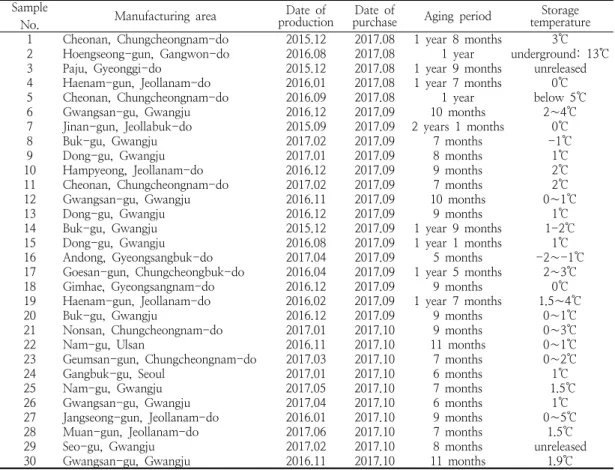
본 연구에서는 전국 묵은지 전문 생산 업체 30곳 으로부터 2017년 8월부터 10월까지 약 2개월 동안 30종의 묵은지를 구입하여 시료로 사용하였다. 시료 구입 시 묵은지 제조사와의 유선상 질의를 통하여 묵 은지 제조일과 묵은지 숙성 온도에 대한 정보를 수집 하였다(Table 1). 일반적으로 묵은지라 함은 6개월 이상 저장한 김치라고 한다(Nam et al. 2007; Moon et al. 2015). 묵은지 시료 구입 시 묵은지 제조사와 유선상 질의에서 묵은지 숙성기간이 6개월에 미치지 못하는 시료는 연구대상에서 제외하였다. 본 연구에 사용된 묵은지 시료의 숙성온도는 주로 1~2℃ 범위 였으며, 숙성기간은 6개월부터 2년 1개월 등 다양하

게 나타났다(Table 1).

2. pH, 산도, 염도, 당도

묵은지 시료들의 pH는 pH 3.56~pH 4.56, 산도는 0.70~1.61%, 염도는 1.96~4.20%, 당도는 7.0~13.8 brix에 분포하였으며, 30종 묵은지시료의 평균 pH, 산도, 염도, 당도는 pH 3.79 ± 0.25, 1.28 ± 0.24%, 2.56 ± 0.46%, 9.70 ± 1.78 brix로 각각 나타났다 (Table 2).

Hur 등은 시판 묵은지 6종의 특성 조사에서 묵은 지의 평균 산도는 2.21%로 나타났다고 하였다(Hur et al. 2015). 본 연구에서의 30종 묵은지의 산도 측 정값과 비교시 Hur 등의 연구에서 훨씬 높은 값을 나 타내었다. 염도는 Hur 등의 연구에서는 1.76~2.45%

(평균값 2.22%)로 나타나, 본 연구에서 30종의 묵은

Sample

No. Manufacturing area Date of

production Date of

purchase Aging period Storage temperature 1 Cheonan, Chungcheongnam-do 2015.12 2017.08 1 year 8 months 3℃

2 Hoengseong-gun, Gangwon-do 2016.08 2017.08 1 year underground: 13℃

3 Paju, Gyeonggi-do 2015.12 2017.08 1 year 9 months unreleased

4 Haenam-gun, Jeollanam-do 2016.01 2017.08 1 year 7 months 0℃

5 Cheonan, Chungcheongnam-do 2016.09 2017.08 1 year below 5℃

6 Gwangsan-gu, Gwangju 2016.12 2017.09 10 months 2∼4℃

7 Jinan-gun, Jeollabuk-do 2015.09 2017.09 2 years 1 months 0℃

8 Buk-gu, Gwangju 2017.02 2017.09 7 months -1℃

9 Dong-gu, Gwangju 2017.01 2017.09 8 months 1℃

10 Hampyeong, Jeollanam-do 2016.12 2017.09 9 months 2℃

11 Cheonan, Chungcheongnam-do 2017.02 2017.09 7 months 2℃

12 Gwangsan-gu, Gwangju 2016.11 2017.09 10 months 0∼1℃

13 Dong-gu, Gwangju 2016.12 2017.09 9 months 1℃

14 Buk-gu, Gwangju 2015.12 2017.09 1 year 9 months 1-2℃

15 Dong-gu, Gwangju 2016.08 2017.09 1 year 1 months 1℃

16 Andong, Gyeongsangbuk-do 2017.04 2017.09 5 months -2∼-1℃

17 Goesan-gun, Chungcheongbuk-do 2016.04 2017.09 1 year 5 months 2∼3℃

18 Gimhae, Gyeongsangnam-do 2016.12 2017.09 9 months 0℃

19 Haenam-gun, Jeollanam-do 2016.02 2017.09 1 year 7 months 1.5∼4℃

20 Buk-gu, Gwangju 2016.12 2017.09 9 months 0∼1℃

21 Nonsan, Chungcheongnam-do 2017.01 2017.10 9 months 0∼3℃

22 Nam-gu, Ulsan 2016.11 2017.10 11 months 0∼1℃

23 Geumsan-gun, Chungcheongnam-do 2017.03 2017.10 7 months 0∼2℃

24 Gangbuk-gu, Seoul 2017.01 2017.10 6 months 1℃

25 Nam-gu, Gwangju 2017.05 2017.10 7 months 1.5℃

26 Gwangsan-gu, Gwangju 2017.04 2017.10 6 months 1℃

27 Jangseong-gun, Jeollanam-do 2016.01 2017.10 9 months 0∼5℃

28 Muan-gun, Jeollanam-do 2017.06 2017.10 7 months 1.5℃

29 Seo-gu, Gwangju 2017.02 2017.10 8 months unreleased

30 Gwangsan-gu, Gwangju 2016.11 2017.10 11 months 1.9℃

Table 1. mukeunji products used in this study

(5)

묵은지의 특성 분석을 통한 묵은지 상품기준 설정에 대한 연구 37

지의 염도보다 낮게 보고되었다. 김치 발효를 주도하 는 김치 유산균은 염 농도가 낮을수록 더 높은 증식 을 나타내며 이에 따라 김치 발효시 더 낮은 염 농도 에서 발효가 더 빨리 일어나므로 결국은 더 높은 산 도를 나타내게 된다(Ko et al. 2015; Moon et al.

2015). 즉 Hur et al.의 연구에서는 묵은지의 평균 염 도가 더 낮게 나타났으므로 이에 따라 더 높은 산도 를 나타내게 된 것으로 여겨진다. 묵은지의 당도에 관한 타 연구 보고는 찾을 수 없었으나 일반 김치의 당도는 12~15 brix로 나타나(Chang et al. 2011) 묵 은지가 일반 김치보다 더 낮은 당도를 나타냄을 알 수 있었다.

본 연구보다 10년 이상 이전에 수행된 묵은지 염 도 조사에 따르면(Yoo et al. 2001; Nam et al. 2007) 묵은지 평균 염도는 2.0~4.0%로 나타났다. 최근 고

나트륨 식이의 유해성과 더불어 김치가 소금섭취의 주원인으로 지목되고 있다. 이에 김치의 저염화가 요 구되고 있으며 일반김치(일반김치 염도 2.0~2.5%)보 다는 묵은지의 염도가 더 높지만(Nam et al. 2007), 묵은지에서도 종래의 염도보다는 더 낮게 제조가 이 루어지고 있음을 알 수 있었다.

3. 관능검사

묵은지 제조에 직접 참여하여 1년 이상 경력을 지닌 근로자 12명과 1년 이상 김치 관능검사에 반복적으로 참 여하여 훈련된 대학원생 10명(여학생 9명, 남학생 1명)이 30종의 묵은지에 대해 묘사적 관능검사를 수행하였다 (Table 3). 대부분의 묵은지 시료가 짜고 신맛이 강했으며 시료 중에는 부분적으로 물러지고 군내가 강한 시료들이 있었다. 수집된 30종의 시료 중 관능검사 참가자 90% 이

Sample No. pH Acidity (%) Salinity (%) Sugar content (brix°)

1 3.56 1.61 4.20 13.8

2 3.70 1.34 2.38 9.3

3 4.05 1.09 2.51 8.3

4 3.61 1.59 2.60 12.1

5 3.75 1.31 2.26 7.0

6 3.71 1.50 2.05 8.8

7 3.86 1.23 2.30 10.0

8 4.14 1.04 2.34 9.2

9 3.61 1.51 2.75 10.2

10 3.72 1.43 2.47 10.8

11 3.78 1.37 2.22 9.3

12 3.76 1.29 2.19 9.2

13 3.67 1.31 2.40 11.2

14 3.72 1.31 2.49 8.0

15 3.62 1.57 2.30 9.4

16 4.56 0.70 2.19 12.4

17 4.21 0.86 2.24 8.0

18 4.16 1.01 3.50 10.4

19 3.90 1.16 2.64 8.1

20 3.75 1.35 2.81 12.1

21 3.80 1.30 2.91 8.4

22 3.82 1.31 2.83 8.2

23 4.06 1.08 2.70 7.0

24 4.11 0.99 2.25 7.3

25 3.60 1.50 2.14 9.2

26 3.73 1.39 2.92 10.0

27 3.54 1.60 2.39 9.7

28 3.72 1.30 1.96 9.3

29 3.76 1.27 2.78 11.0

30 3.65 1.32 2.98 13.4

Average ± S.D. 3.82 ± 0.23 1.29 ± 0.22 2.56 ± 0.46 9.70 ± 1.78

Table 2. Chemical properties of mukeunji products

(6)

상(총 참가자 22명중 20명)이 군내와 같은 불쾌취가 적고 묵은지 특유의 향과 맛이 잘나고 기호도가 높다고 평가한 시료는 시료번호 14번, 15번, 20번, 21번, 25번, 26번, 28 번이었고 관능검사 참가자 70% 이상이 3번, 9번, 13번, 참가자 50% 이상이 4번, 10번, 18번이라고 평가하였다.

이와 같은 평가 결과에 따라 30종의 묵은지 중 불쾌취는 적으면서도 묵은지 특유의 향미가 잘 나는 시료로 총 13 종의 시료를 선정할 수 있었다. 선정된 13종의 묵은지 시 료는 이후의 묵은지 향기 성분 정량 분석실험에서 시료로 사용하였다.

4. 유기산

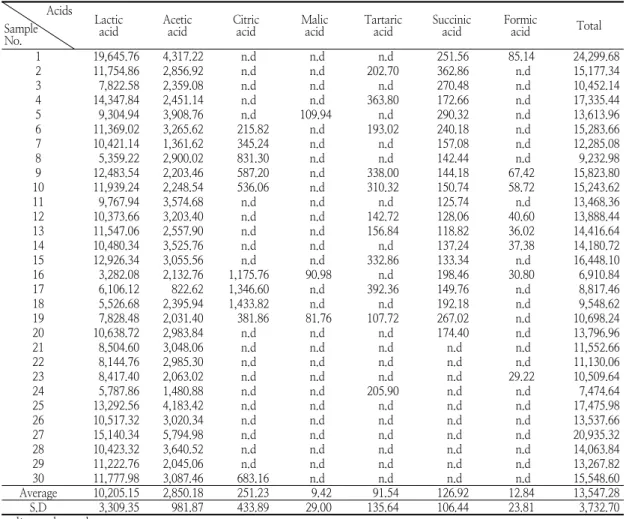
수집된 30종의 묵은지로부터 lactic acid, acetic acid, citric acid, malic acid, tartaric acid, succinic acid, formic acid 등 총 7종의 유기산이 검출되었다 (Table 4). 수집된 30종의 묵은지 시료 중 7종의 유 기산이 모두 검출된 시료는 1종도 없었으며, 6종의 유기산 검출 시료가 4종, 5종의 유기산 검출 시료가 4종, 4종의 유기산 검출 시료가 9종, 3종의 유기산 검 출 시료가 6종, 2종의 유기산 검출 시료가 7종으로 나타났다. 검출된 7종의 유기산 중 모든 시료에서 lactic acid와 acetic acid가 검출되었으며 이중 lactic acid(평균값 10,205.15 ± 3,309.35 mg/L)가 가장 높

Sample

No. Overall features Sourness Saltness Texture Moldy flavor

off-flavor 1 Traditional soy sauce(Ganjang) flavor, Spicy flavor Strong Strong Partially softness Strong 2 Pickle flavor and taste, Alcohol and spicy flavor Strong Normal Partially softness Normal

3 Typical mukeunji flavor and taste Normal Normal Normal None

4 Typical mukeunji flavor and taste, Sesame oil flavor Strong Normal Normal None 5 Moldy and off-flavor, Fecal odor Normal Strong Softness Very strong 6 A little mukeunji flavor and taste Alcohol flavor Strong Normal Partially softness None 7 Very strong moldy and off-flavor Weakness Normal Partially softness Very strong 8 Salted fish sauce flavor, Fermented milk(yogurt) flavor Strong Strong Normal None 9 Typical mukeunji flavor and taste, Spicy taste Normal Normal Partially softness A little 10 Typical mukeunji flavor and taste Strong Normal Normal A little 11 Pickle flavor and taste, A little mukeunji flavor and taste Normal Strong Normal A little 12 A little mukeunji flavor and taste Normal Normal Partially tough Normal 13 Typical mukeunji flavor and taste, Spicy taste Normal Normal Normal A little 14 Typical mukeunji flavor and taste Normal Strong Partially tough Normal 15 Typical mukeunji flavor and taste Strong Normal Partially softness None 16 Fermented kimchi, A little mukeunji flavor and taste Normal Normal Normal None 17 Traditional soy sauce(Ganjang) flavor, Pickle flavor and taste Normal Strong Very softness Strong 18 Typical mukeunji flavor and taste, Bitter taste Normal Strong Partially softness Normal 19 Rancid(over-ripened) kimchi Strong Normal Partially softness A little 20 Typical mukeunji flavor and taste, Salted fish sauce flavor Normal Strong Normal None

21 Typical mukeunji flavor and taste Normal Normal Normal None

22 Traditional soy sauce(Ganjang) flavor, Fermented skate odor Normal Normal Partially softness Normal 23 Rotten vegetable odor, Food waste odor Weakness Normal Partially softness Strong 24 Traditional soy sauce(Ganjang) flavor, Alcohol flavor, Bitter taste Normal Normal Partially softness Normal

25 Typical mukeunji flavor and taste Normal Normal Normal None

26 Typical mukeunji flavor and taste, Salted fish sauce, Traditional soy

sauce(Ganjang) flavor Normal Strong Partially tough None

27 Traditional soy sauce(Ganjang) flavor, Spicy flavor, A little

mukeunji flavor and taste Normal Strong Normal A little

28 Typical mukeunji flavor and taste, Spicy taste Normal Normal Normal None

29 A little mukeunji flavor and taste, Alcohol flavor Normal Normal Partially softness A little

30 Traditional soy sauce(Ganjang) flavor, Pickle flavor and taste Normal Strong Normal None

Table 3. Sensory characteristics of mukeunji products

(7)

묵은지의 특성 분석을 통한 묵은지 상품기준 설정에 대한 연구 39

은 함량으로 그 다음 acetic acid(평균값 2,850.15 ± 981.87 mg/L)가 높은 함량으로 검출되었다. 이외 succinic acid가 20종의 묵은지 시료에서, tartaric acid는 11종의 시료에서, citric acid는 10종, formic acid는 8종의 시료에서 검출되었으며 malic acid가 가장 적은 수의 시료(3종)에서 검출되었다. 검출된 유기산의 총량은 묵은지 시료에 따라 6,910~24,299 mg/L 분포로 검출되었고 30종의 묵은지로부터 검출 된 유기산의 평균값은 13,547.28 ± 3,732.70 mg/L으 로 나타났다(Table 4). 검출된 유기산 7종을 평균 검 출량 순으로 정리하면 lactic acid > acetic acid >

citric acid > succinic acid > tartaric acid > formic

acid > malic acid 순으로 나타났다. 검출된 유기산의 총량은 Table 2의 산도 결과와 거의 일치하는 것으로 나타났다. Kim et al.(2013)은 1년 이상 숙성된 묵은 지의 총 유기산 함량은 1,464.65 mg%이며, 검출된 유기산은 lactic acid, acetic acid, citric acid라고 하 였다. Hur et al.(2015)은 6개월 이상 숙성된 묵은지 6종의 유기산 분석에서 6종의 묵은지 모두에서 lactic acid, acetic acid, succinic acid 3종의 유기산이 검출 되었다고 하였다. Ji et al.(2009)은 46주 숙성된 묵은 지에서 lactic acid와 acetic acid 2종의 유기산이 검 출되었다고 하였다. Yoo et al.(2001)은 30주 동안의 묵은지 발효과정 동안 유기산 함량의 변화를 조사하

Acids Sample No.

Lactic

acid Acetic

acid Citric

acid Malic

acid Tartaric

acid Succinic

acid Formic

acid Total

1 19,645.76 4,317.22 n.d n.d n.d 251.56 85.14 24,299.68 2 11,754.86 2,856.92 n.d n.d 202.70 362.86 n.d 15,177.34 3 7,822.58 2,359.08 n.d n.d n.d 270.48 n.d 10,452.14 4 14,347.84 2,451.14 n.d n.d 363.80 172.66 n.d 17,335.44 5 9,304.94 3,908.76 n.d 109.94 n.d 290.32 n.d 13,613.96 6 11,369.02 3,265.62 215.82 n.d 193.02 240.18 n.d 15,283.66 7 10,421.14 1,361.62 345.24 n.d n.d 157.08 n.d 12,285.08 8 5,359.22 2,900.02 831.30 n.d n.d 142.44 n.d 9,232.98 9 12,483.54 2,203.46 587.20 n.d 338.00 144.18 67.42 15,823.80 10 11,939.24 2,248.54 536.06 n.d 310.32 150.74 58.72 15,243.62 11 9,767.94 3,574.68 n.d n.d n.d 125.74 n.d 13,468.36 12 10,373.66 3,203.40 n.d n.d 142.72 128.06 40.60 13,888.44 13 11,547.06 2,557.90 n.d n.d 156.84 118.82 36.02 14,416.64 14 10,480.34 3,525.76 n.d n.d n.d 137.24 37.38 14,180.72 15 12,926.34 3,055.56 n.d n.d 332.86 133.34 n.d 16,448.10 16 3,282.08 2,132.76 1,175.76 90.98 n.d 198.46 30.80 6,910.84 17 6,106.12 822.62 1,346.60 n.d 392.36 149.76 n.d 8,817.46 18 5,526.68 2,395.94 1,433.82 n.d n.d 192.18 n.d 9,548.62 19 7,828.48 2,031.40 381.86 81.76 107.72 267.02 n.d 10,698.24 20 10,638.72 2,983.84 n.d n.d n.d 174.40 n.d 13,796.96

21 8,504.60 3,048.06 n.d n.d n.d n.d n.d 11,552.66

22 8,144.76 2,985.30 n.d n.d n.d n.d n.d 11,130.06

23 8,417.40 2,063.02 n.d n.d n.d n.d 29.22 10,509.64

24 5,787.86 1,480.88 n.d n.d 205.90 n.d n.d 7,474.64

25 13,292.56 4,183.42 n.d n.d n.d n.d n.d 17,475.98

26 10,517.32 3,020.34 n.d n.d n.d n.d n.d 13,537.66 27 15,140.34 5,794.98 n.d n.d n.d n.d n.d 20,935.32 28 10,423.32 3,640.52 n.d n.d n.d n.d n.d 14,063.84 29 11,222.76 2,045.06 n.d n.d n.d n.d n.d 13,267.82 30 11,777.98 3,087.46 683.16 n.d n.d n.d n.d 15,548.60 Average 10,205.15 2,850.18 251.23 9.42 91.54 126.92 12.84 13,547.28

S.D 3,309.35 981.87 433.89 29.00 135.64 106.44 23.81 3,732.70

n.d: not detected

Table 4. Analysis of organic acids in mukeunji products

unit: mg/L

(8)

였을 때 lactic acid, citric acid, acetic acid는 숙성기 간이 증가함에 따라 가장 많이 증가하고 malic acid 는 발효 초기부터 서서히 감소하였고 succinic acid는 lactic acid, acetic acid, citric acid 보다는 낮은 함량 이지만 발효ㆍ숙성 중 서서히 증가한다고 하였다.

Park et al.(1993)은 김치 발효 중 lactic acid가 가장 많이 증가하고 malic acid, citric acid, tartaric acid, pyroglutamic acid, succinic acid 등은 적숙기에 최 고치를 보이다가 이후 감소한다고 하였다.

이상의 결과를 종합하여 보면 묵은지는 발효ㆍ숙성 중 lactic acid가 가장 높은 함량으로 검출된다는 것 을 알 수 있다. 이는 김치발효 말기에는 homofermentative 유산균이 우점 미생물이 되기 때문으로(Park et al.

2010; Hong et al. 2015) 사료된다. 이와 더불어 acetic acid, citric acid, succinic acid가 검출될 수 있고 그 함량은 묵은지의 발효ㆍ숙성 온도, 사용된 원ㆍ부재 료 등에 따라 다르게 나타나는 것으로 여겨진다.

5. 유리아미노산

묵은지 30종의 유리아미노산 분석시 21~34종의 유리아미노산이 검출되었다(Table 5). 검출된 유리아 미노산 총 함량은 묵은지에 따라 465~2,370 mg/100 g 분포로 다르게 검출되었고 평균 함량은 1,347.94 ± 458.46 mg/100 g으로 분석되었다. 묵은지 시료에 따 라 유리아미노산의 함량과 종류는 다소 다르게 나타 났으며 phosphoserine, taurine, aspartic acid, threonine, serine, asparagine, proline, glycine, alanine, valine, isoleucine, leucine, tyrosine, phenylalanine, γ -amino-n- butyric acid(GABA), histidine, ornithine, lysine 등 18종의 아미노산은 30종의 묵은지 시료에 서 모두 검출되었다. 검출된 유리아미노산 중 평균적 으로 glutamic acid와 alanine이 가장 높은 함량으로 검출되었다. 이외 leucine, valine, asparagine, GABA, serine, lysine, aspartic acid 등이 높게 검출되었다 (Table 5). Ji et al.(2009)은 5℃에서 46주간 발효된 묵은지의 유리아미노산 분석에서 총 유리아미노산 함량은 1,018 mg/100 g이였으며 glutamic acid와

alanine이 주요한 아미노산으로 검출되었다고 보고 하였다. 그리고 김치 중 유리아미노산은 김치 원ㆍ부 재료 중의 단백질이 가수분해 되면서 형성되지만, lysine과 leucine은 발효과정 중 미생물 대사에 의하 여 생성된다고 보고하였다(Ji et al. 2009). 이와 같은 결과는 본 연구에서의 결과와도 일치하는 결과이다.

묵은지의 유리아미노산 분석에서 기능성 아미노산 인 GABA(69.45 ± 40.53 mg/100 g), aspartic acid (58.73 ± 47.23 mg/100 g), ornithine(44.90 ± 40.48 mg/100 g) 등이 30종의 묵은지에서 검출되었다.

GABA는 포유류 중추신경계에서 신경전달물질로서

역할과 더불어 뇌기능 촉진, 정신 안정 작용, 혈압 저

하 작용, 간기능 개선, 비만방지, 알코올 대사 촉진

작용 등 다양한 생리기능을 지닌다고 알려지고 있다

(Cho et al. 2007). Aspartic acid는 스테미나를 증진

시키고 세포 에너지 대사 촉진에 의한 만성 피로증후

군 개선, 암모니아 대사 촉진에 의한 간 해독, 면역력

강화 등의 생리기능을 지닌다고 보고되었다(Praveen

Kumar et al. 2017). Ornithine은 단백질 대사의 부

산물인 암모니아 제거에 필요하고 체내에서 기초대

사를 증진시켜 비만을 예방하는 기능을 나타내어 일

본과 미국 등에서는 식이보존제로 활용되고 있다

(Park et al. 2012). 본 연구에서는 이와 같은 기능성

아미노산이 시료로 사용된 30종의 모든 묵은지에서

풍부하게 검출됨을 확인할 수 있었다. 이와 같은 연

구결과는 묵은지가 일반 김치에 비해 영양학적 가치

는 거의 없고 단지 오래 묵힌 별미김치정도라는 인식

에서 더 나아가 건강 웰빙 식품으로서의 거듭날 수

있는 과학적 근거를 제시함에 의의가 있다. 이에 묵

은지를 활용하여, 영양학적 가치와 더불어 그 생리기

능성을 높여줄 수 있는 다양한 조리제품 개발이 이루

어진다면, 김치시장의 또 다른 한 축으로서 김치 산

업 및 외식산업 발전에 기여할 수 있으리라 평가된

다.

(9)

묵은지 의 특성 분석을 통한 묵 은지 상 품기준 설정에 대한 연 구 41

(10)

제 30 권 1 호 20 19

(11)

묵은지의 특성 분석을 통한 묵은지 상품기준 설정에 대한 연구 43

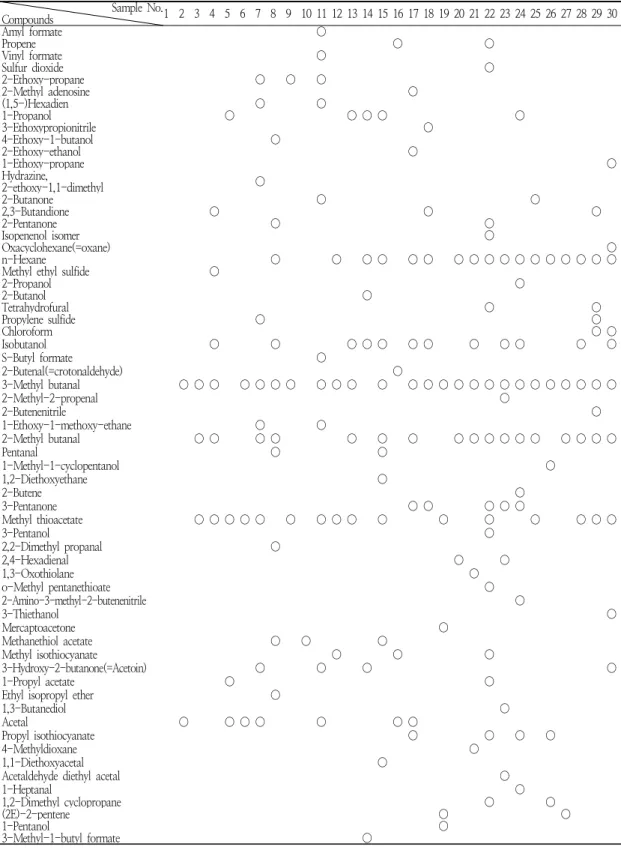
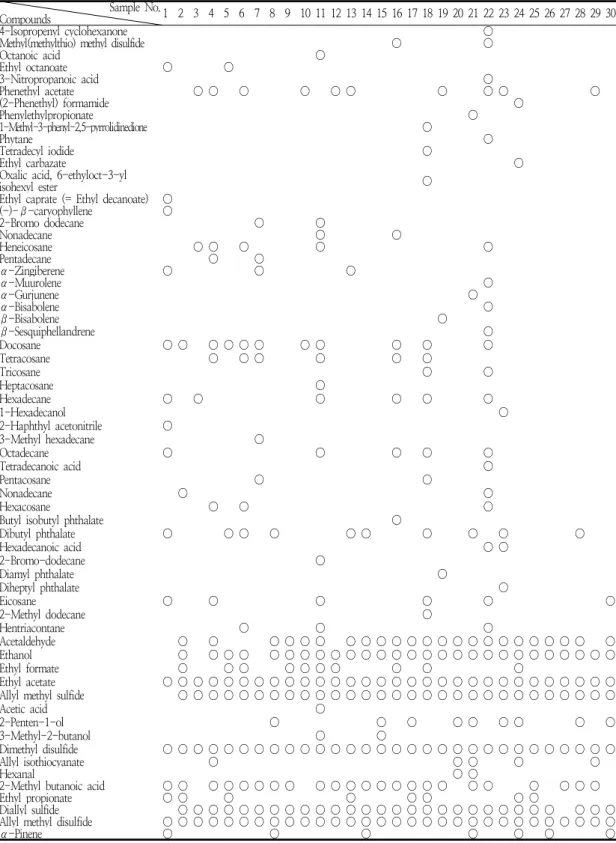
6. 향기성분의 분석과 묵은지 향기 지표 물질 설정 묵은지 30종의 향기성분 분석에서 총 209종의 향 기 물질이 검출되었으며 시료에 사용된 묵은지에 따 라 22~78종의 향기물질이 검출되었다(Table 6). 검출 된 향기물질 중 30종의 모든 묵은지 시료에서 공통적 으로 검출된 물질은 ethyl acetate, dimethyl disulfide, dimethyl trisulfide, allyl methyl disulfide, 2-propenyl methyl trisulfide였으며, 29종의 묵은지 시료에서 allyl methyl sulfide가, 28종의 시료에서 diallyl sulfide, diallyl disulfide, camphene, 27종의 시료에서 ethanol, 26종의 시료에서 1,8-cineol, 25종의 시료에서 3- methyl butanal, 5-cyano-1-pentene, methyl propenyl disulfide, 23종의 시료에서 ethyl butyrate, acetaldehyde, 2-methyl butanoic acid, 22종의 D-2-propenyl trisulfide, 21종의 시료에서 trans-propenyl disulfide, (E)-1-propenyl methyl disulfide가 검출되었다(Table 6).

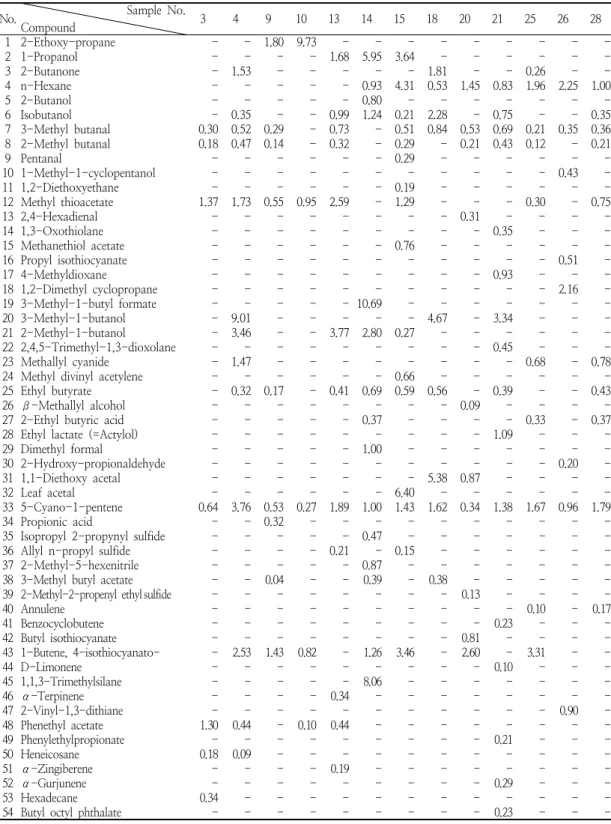
수집된 30종의 묵은지 중 Table 3의 관능검사에서 군내와 같은 불쾌취는 적으면서도, 맛있다고 느껴지 는 특유의 묵은지 향과 맛이 잘 난다고 평가된 시료 는 총 13종의 시료였다. 관능검사를 통하여 선발된 13종 묵은지 시료의 향기성분 분석 결과를 정량적으 로 나타내었다(Table 7). 향기성분추출 및 분석에 사 용된 international standard인 butyl benzene(1 ppm) 의 피크면적은 총 검출 피크 면적의 1.02~5.63%였다.

전반적으로 맛있는 묵은지 맛과 향을 잘 나타내는 13 종의 묵은지 시료의 향기성분 분석에서 총 101종의 향기 물질이 검출되었다. 분석된 13종의 묵은지에서 정성적으로 모든 시료에서 검출되면서, 동시에 정량 적으로도 총 검출피크면적의 30.44~83.62% 이상을 차지하는 것으로 분석된 물질은 5-cyano1-1-pentene, ethyl acetate, allyl methyl sulfide, dimethyl disulfide, diallyl sulfide, allyl methyl disulfide, dimethyl trisulfide, diallyl disulfide, 2-propenyl methyl trisulfide 9개 화합 물로 나타났다.

Jeong & Ko(2010)의 연구에 의하면 비숙성 김치 시료에서 ethanol, allyl mercaptan, methyl allyl

sulfide, dimethyl disulfide, methyl propyl disulfide, diallyl disulfide의 6개 성분이 검출되었으며 이를 2 0℃에서 1일 숙성 후에는 diallyl sulfide와 methyl trisulfide가 추가로 더 검출되었으며, 이들 휘발성 냄 새 성분 8종 중 methyl trisulfide는 생강에서 유래되 었고 나머지 7종은 마늘에서 유래된 것이라고 보고하 였다(Jeong & Ko 2010). 또한 methyl allyl sulfide, diallyl sulfide, methyl trisulfide는 숙성기간 중 계속 증가하고 diallyl disulfide는 숙성기간 중 감소 후 다 시 증가하는 경향을 보인다고 하였다. Jang et al.

(1999)도 배추김치의 휘발성 성분 분석에서 김치 부 재료인 마늘, 파, 부추 유래의 함황화물류가 김치 휘 발성 물질에 지배적이며, 특히 dimethyl disulfide, allyl sulfide, methyl allyl disulfide, dimethyl trisulfide, diallyl disulfide isomer(2종), methyl allyl trisulfide, diallyl trisulfide 등 8종의 화합물이 전체 검출 성분 함량의 약 85%를 차지한다고 하였다. Jeong & Ko(2012) 는 김치의 휘발성 냄새 성분과 관능적 특성과의 상관 관계에서 dimethyl disulfide와 methyl propyl disulfide 가 김치의 기호성에 가장 큰 영향을 미치는 화합물이 라 하였다.

Jang et al.(1999)의 연구에서는 배추김치의 단기

숙성(20일) 중 지배적 휘발성 냄새 성분으로 규명한

12종의 화합물 중 dimethyl disulfide와 diallyl disulfide

는 본 연구에서 묵은지 향과 맛을 잘 내는 13종의 묵

은지에서도 모두 검출되었다(Table 7). Moon et

al.(2015)은 2년 숙성 묵은지와 2개월 숙성 신김치의

향기성분 비교 분석에서 2개월 숙성 신김치와 2년 숙

성 묵은지 모두에서 검출되는 물질로 ethyl acetate,

allyl methyl sulfide, ethanol, 1,8-cineol, acetaldehyde 등

31개 화합물이라고 하였다. 또한 2개월 숙성 신김치

에서는 검출되지 않고 2년 이상 묵은지에서 검출되는

물질로는 dimethyl disulfide, diallyl sulfide, allyl methyl

disulfide, dimethyl trisulfide, diallyl disulfide, 2-propenyl

methyl trisulfide 등 15개 화합물을 보고하였다.

(12)

Table 6. Volatile compounds identified from mukeunji products Sample No.

Compounds 1 2 3 4 5 6 7 8 9 10 11 12 13 14 15 16 17 18 19 20 21 22 23 24 25 26 27 28 29 30

Amyl formate ○

Propene ○ ○

Vinyl formate ○

Sulfur dioxide ○

2-Ethoxy-propane ○ ○ ○

2-Methyl adenosine ○

(1,5-)Hexadien ○ ○

1-Propanol ○ ○ ○ ○ ○

3-Ethoxypropionitrile ○

4-Ethoxy-1-butanol ○

2-Ethoxy-ethanol ○

1-Ethoxy-propane ○

Hydrazine,

2-ethoxy-1,1-dimethyl ○

2-Butanone ○ ○

2,3-Butandione ○ ○ ○

2-Pentanone ○ ○

Isopenenol isomer ○

Oxacyclohexane(=oxane) ○

n-Hexane ○ ○ ○ ○ ○ ○ ○ ○ ○ ○ ○ ○ ○ ○ ○ ○ ○

Methyl ethyl sulfide ○

2-Propanol ○

2-Butanol ○

Tetrahydrofural ○ ○

Propylene sulfide ○ ○

Chloroform ○ ○

Isobutanol ○ ○ ○ ○ ○ ○ ○ ○ ○ ○ ○ ○

S-Butyl formate ○

2-Butenal(=crotonaldehyde) ○

3-Methyl butanal ○ ○ ○ ○ ○ ○ ○ ○ ○ ○ ○ ○ ○ ○ ○ ○ ○ ○ ○ ○ ○ ○ ○ ○ ○

2-Methyl-2-propenal ○

2-Butenenitrile ○

1-Ethoxy-1-methoxy-ethane ○ ○

2-Methyl butanal ○ ○ ○ ○ ○ ○ ○ ○ ○ ○ ○ ○ ○ ○ ○ ○ ○

Pentanal ○ ○

1-Methyl-1-cyclopentanol ○

1,2-Diethoxyethane ○

2-Butene ○

3-Pentanone ○ ○ ○ ○ ○

Methyl thioacetate ○ ○ ○ ○ ○ ○ ○ ○ ○ ○ ○ ○ ○ ○ ○ ○

3-Pentanol ○

2,2-Dimethyl propanal ○

2,4-Hexadienal ○ ○

1,3-Oxothiolane ○

o-Methyl pentanethioate ○

2-Amino-3-methyl-2-butenenitrile ○

3-Thiethanol ○

Mercaptoacetone ○

Methanethiol acetate ○ ○ ○

Methyl isothiocyanate ○ ○ ○

3-Hydroxy-2-butanone(=Acetoin) ○ ○ ○ ○

1-Propyl acetate ○ ○

Ethyl isopropyl ether ○

1,3-Butanediol ○

Acetal ○ ○ ○ ○ ○ ○ ○

Propyl isothiocyanate ○ ○ ○ ○

4-Methyldioxane ○

1,1-Diethoxyacetal ○

Acetaldehyde diethyl acetal ○

1-Heptanal ○

1,2-Dimethyl cyclopropane ○ ○

(2E)-2-pentene ○ ○

1-Pentanol ○

3-Methyl-1-butyl formate ○

(13)

묵은지의 특성 분석을 통한 묵은지 상품기준 설정에 대한 연구 45

Table 6. Continued Sample No.

Compounds 1 2 3 4 5 6 7 8 9 10 11 12 13 14 15 16 17 18 19 20 21 22 23 24 25 26 27 28 29 30

3-Methyl-1-butanol ○ ○ ○

2-Methyl-1-butanol ○ ○ ○ ○ ○ ○ ○

2,4,5-Trimethyl-1,3-dioxolane ○ ○ ○ ○ ○ ○ ○ ○ ○

Methallyl cyanide ○ ○ ○ ○ ○ ○ ○ ○ ○ ○ ○

Methyl divinyl acetylene ○

β-Methyl propyl ethanoate ○

Allyl ethyl sulfide ○

3-Methylthiolane ○

Tetrahydro-3-methyl-thiophene ○

2-Ethoxy propane ○ ○

Ethyl butyrate ○ ○ ○ ○ ○ ○ ○ ○ ○ ○ ○ ○ ○ ○ ○ ○ ○ ○ ○ ○ ○ ○ ○

β-Methallyl alcohol ○

2,4-Pentanediol ○

2-Ethyl butyric acid ○ ○ ○

Ethyl methoxy isopropoxy acetate ○

1-Propoxy-2-propanol ○ ○

Ethyl lactate (=Actylol) ○ ○

Propylene glycol ○ ○

1,3-Dimethoxy-2-propanol ○

Dimethyl formal ○

2-Hydroxy-propionaldehyde ○

1,1-Diethoxy acetal ○ ○

Leaf acetal ○

2-Pentanol ○ ○ ○

Methyl ethyl disulfide ○ ○

cis-Ethyl crotonate ○ ○

Ethyl-2-methyl butyrate ○ ○

5-Cyano-1-pentene ○ ○ ○ ○ ○ ○ ○ ○ ○ ○ ○ ○ ○ ○ ○ ○ ○ ○ ○ ○ ○ ○ ○ ○ ○

Propionic acid ○

Allyl mercaptan ○

S-Cyclopropyl thioacetate ○ ○

Isopropyl 2-propenyl sulfide ○

Propyl thioacetate ○

2-Allylcyclohexanone ○

Allyl n-propyl sulfide ○ ○ ○ ○ ○ ○ ○

2-Methyl-5-hexenitrile ○

3-(1-Ethoxyethoxy)-2-methyl

-1-butanol ○

3-Methyl butyl acetate ○ ○ ○ ○ ○ ○ ○ ○ ○ ○ ○

2-Methyl butyl acetate ○ ○ ○

2-Methyl-2-propenyl ethyl sulfide ○

Annulene ○ ○ ○

Benzocyclobutene ○

Cyclooctatetraene ○

Dimethyl sulfone ○

Butyl isothiocyanate ○

γ-Pentalactone ○

Benzaldehyde ○

1-Butene, 4-isothiocyanato- ○ ○ ○ ○ ○ ○ ○ ○ ○ ○ ○ ○ ○ ○ ○ ○

Succinanil ○

1,2-Propanediol ○ ○

4-Methyl-1,3-dithiane ○ ○

2-Methyl-2-(methylthio)-propane ○

Propylene glycol ○ ○

D-Limonene ○ ○

Thioacetonitrile ○

Dodecane ○ ○

3-Bromo-1-propene ○

Methyl methanethisulfonate ○

Dimethoxysulfone ○ ○

1,1,3-Trimethylsilane ○

1,5-Dithiocane ○ ○

3,7-Diemthyldecane ○

α-Terpinene ○ ○

2-Vinyl-1,3-dithiane ○

(14)

Table 6. Continued Sample No.

Compounds 1 2 3 4 5 6 7 8 9 10 11 12 13 14 15 16 17 18 19 20 21 22 23 24 25 26 27 28 29 30

4-Isopropenyl cyclohexanone ○

Methyl(methylthio) methyl disulfide ○ ○

Octanoic acid ○

Ethyl octanoate ○ ○

3-Nitropropanoic acid ○

Phenethyl acetate ○ ○ ○ ○ ○ ○ ○ ○ ○ ○

(2-Phenethyl) formamide ○

Phenylethylpropionate ○

1-Methyl-3-phenyl-2,5-pyrrolidinedione ○

Phytane ○

Tetradecyl iodide ○

Ethyl carbazate ○

Oxalic acid, 6-ethyloct-3-yl

isohexyl ester ○

Ethyl caprate (= Ethyl decanoate) ○ (-)-β-caryophyllene ○

2-Bromo dodecane ○ ○

Nonadecane ○ ○

Heneicosane ○ ○ ○ ○ ○

Pentadecane ○ ○

α-Zingiberene ○ ○ ○

α-Muurolene ○

α-Gurjunene ○

α-Bisabolene ○

β-Bisabolene ○

β-Sesquiphellandrene ○

Docosane ○ ○ ○ ○ ○ ○ ○ ○ ○ ○ ○

Tetracosane ○ ○ ○ ○ ○ ○

Tricosane ○ ○

Heptacosane ○

Hexadecane ○ ○ ○ ○ ○ ○

1-Hexadecanol ○

2-Haphthyl acetonitrile ○

3-Methyl hexadecane ○

Octadecane ○ ○ ○ ○ ○

Tetradecanoic acid ○

Pentacosane ○ ○

Nonadecane ○ ○

Hexacosane ○ ○ ○

Butyl isobutyl phthalate ○

Dibutyl phthalate ○ ○ ○ ○ ○ ○ ○ ○ ○ ○

Hexadecanoic acid ○ ○

2-Bromo-dodecane ○

Diamyl phthalate ○

Diheptyl phthalate ○

Eicosane ○ ○ ○ ○ ○ ○

2-Methyl dodecane ○

Hentriacontane ○ ○ ○

Acetaldehyde ○ ○ ○ ○ ○ ○ ○ ○ ○ ○ ○ ○ ○ ○ ○ ○ ○ ○ ○ ○ ○ ○ ○

Ethanol ○ ○ ○ ○ ○ ○ ○ ○ ○ ○ ○ ○ ○ ○ ○ ○ ○ ○ ○ ○ ○ ○ ○ ○ ○ ○ ○

Ethyl formate ○ ○ ○ ○ ○ ○ ○ ○ ○ ○

Ethyl acetate ○ ○ ○ ○ ○ ○ ○ ○ ○ ○ ○ ○ ○ ○ ○ ○ ○ ○ ○ ○ ○ ○ ○ ○ ○ ○ ○ ○ ○ ○

Allyl methyl sulfide ○ ○ ○ ○ ○ ○ ○ ○ ○ ○ ○ ○ ○ ○ ○ ○ ○ ○ ○ ○ ○ ○ ○ ○ ○ ○ ○ ○ ○

Acetic acid ○

2-Penten-1-ol ○ ○ ○ ○ ○ ○ ○ ○ ○

3-Methyl-2-butanol ○ ○

Dimethyl disulfide ○ ○ ○ ○ ○ ○ ○ ○ ○ ○ ○ ○ ○ ○ ○ ○ ○ ○ ○ ○ ○ ○ ○ ○ ○ ○ ○ ○ ○ ○

Allyl isothiocyanate ○ ○ ○ ○ ○

Hexanal ○ ○

2-Methyl butanoic acid ○ ○ ○ ○ ○ ○ ○ ○ ○ ○ ○ ○ ○ ○ ○ ○ ○ ○ ○ ○ ○ ○ ○

Ethyl propionate ○ ○ ○ ○ ○ ○ ○ ○

Diallyl sulfide ○ ○ ○ ○ ○ ○ ○ ○ ○ ○ ○ ○ ○ ○ ○ ○ ○ ○ ○ ○ ○ ○ ○ ○ ○ ○ ○ ○

Allyl methyl disulfide ○ ○ ○ ○ ○ ○ ○ ○ ○ ○ ○ ○ ○ ○ ○ ○ ○ ○ ○ ○ ○ ○ ○ ○ ○ ○ ○ ○ ○ ○

α-Pinene ○ ○ ○ ○ ○ ○ ○

(15)

묵은지의 특성 분석을 통한 묵은지 상품기준 설정에 대한 연구 47

이와 같은 타 연구자들의 연구결과들(Jang et al.

1999; Jeong & Ko 2010; Moon et al. 2015)과 본 연 구에서의 묵은지 향기성분 분석 결과들로부터 다음과 같은 내용을 알 수 있었다.

첫째, 김치 담금 후 숙성기간이 길어질수록 더 많 은 향기성분이 검출된다. 둘째, 김치 부재료(마늘, 파, 부추 등)에서부터 유래된 향기성분물질은 김치의 발 효 과정 중에 그 양이 줄어들었다가 오랜 숙성과정 중 다시 증가할 수 있다. 즉 마늘, 파 등의 김치 부재 료에서 유래된 향기물질인 allyl methyl disulfide, dimethyl trisulfide는 막 담근 김치에서는 다량 검출 되지만 단기 숙성 김치에서는 거의 검출되지 않다가 장기 숙성과정 중 다시 검출되는 것을 알 수 있다. 셋 째, 단기 발효(2개월 이내)에 의해 얻어진 신김치에서는 검출되지 않고 장기 발효ㆍ숙성(6개월~2년)된 맛있는 묵은지에서만 검출 될 수 있는 물질은 allyl methyl disulfide, dimethyl trisulfide, 2-propenyl methyl trisulfide, 5-cyano-1- pentene이다. 이와 더불어 신김치나 막 담 근 김치에서도 검출되기는 하지만 묵은지의 맛과 향 에도 중요한 역할을 하는 물질로는 ethyl acetate, allyl methyl sulfide, dimethyl disulfide, diallyl sulfide, diallyl disulfide 등으로 분석된다.

기존의 연구를 살펴보면 김치의 원ㆍ부재료나 단 기숙성(2개월 이내) 김치의 휘발성 성분 규명에 관련 된 연구는 다수 보고되고 있으나 (Jang et al. 1999;

Kang et al. 2003; Choi et al. 2009; Song et al.

2009; Jeong & Ko 2010) 6개월 이상 장기숙성된 묵 은지의 휘발성 성분에 관한보고는 몇 건에 불과하다 (Kim et al. 2006; Moon et al. 2015). 그러므로 6개 월 이상 장기 숙성된 묵은지의 휘발성 냄새성분과 2 개월 이내 단기발효숙성 김치의 휘발성 성분 차이에 대한 보다 많은 연구가 요구된다. 본 연구에서는 30 종에 달하는 묵은지의 휘발성 성분 분석 자료를 제공 함으로써 기존의 김치 원ㆍ부재료, 단기발효에서의 휘발성 냄새 성분과 구별되는 묵은지를 특정할 수 있 는 휘발성 냄새 성분을 규명하였다.

Table 6. Continued Sample No.

Compounds 1 2 3 4 5 6 7 8 9 10 11 12 13 14 15 16 17 18 19 20 21 22 23 24 25 26 27 28 29 30 Methyl propyl disulfide ○ ○ ○ ○ ○ ○ ○ ○ ○ ○ ○ ○ ○ ○ ○ ○ ○ ○ ○ ○ ○ ○ ○ ○ ○ (E)-1-Propenyl methyl disulfide ○ ○ ○ ○ ○ ○ ○ ○ ○ ○ ○ ○ ○ ○ ○ ○ ○ ○ ○ ○ ○

Camphene ○ ○ ○ ○ ○ ○ ○ ○ ○ ○ ○ ○ ○ ○ ○ ○ ○ ○ ○ ○ ○ ○ ○ ○ ○ ○ ○ ○

Dimethyl trisulfide ○ ○ ○ ○ ○ ○ ○ ○ ○ ○ ○ ○ ○ ○ ○ ○ ○ ○ ○ ○ ○ ○ ○ ○ ○ ○ ○ ○ ○ ○

Dimethylthiazole ○ ○ ○ ○ ○ ○ ○ ○ ○ ○ ○ ○ ○ ○ ○ ○ ○ ○ ○

β-Phellandrene ○ ○ ○ ○ ○ ○ ○ ○ ○ ○ ○ ○ ○ ○ ○

1,8-Cineol ○ ○ ○ ○ ○ ○ ○ ○ ○ ○ ○ ○ ○ ○ ○ ○ ○ ○ ○ ○ ○ ○ ○ ○ ○ ○

Dimethyl tetrasulfide ○ ○ ○ ○

Diallyl disulfide ○ ○ ○ ○ ○ ○ ○ ○ ○ ○ ○ ○ ○ ○ ○ ○ ○ ○ ○ ○ ○ ○ ○ ○ ○ ○ ○ ○

β-Linalool ○ ○ ○ ○

Trans-Propenyl propyl disulfide ○ ○ ○ ○ ○ ○ ○ ○ ○ ○ ○ ○ ○ ○ ○ ○ ○ ○ ○ ○ ○

Dipropyl disulfide ○ ○ ○ ○ ○ ○ ○ ○ ○ ○

3-Phenyl propionic acid ○ ○ ○ ○ ○ ○ ○

2-Propenyl methyl trisulfide ○ ○ ○ ○ ○ ○ ○ ○ ○ ○ ○ ○ ○ ○ ○ ○ ○ ○ ○ ○ ○ ○ ○ ○ ○ ○ ○ ○ ○ ○

Terpineol ○

3-Vinyl-[4H]-1,2-dithiin ○ ○ ○ ○ ○

Benzenepropanenitrile ○ ○ ○ ○ ○

Di-2-propenyl trisulfide ○ ○ ○ ○ ○ ○ ○ ○ ○ ○ ○ ○ ○ ○ ○ ○ ○ ○ ○ ○ ○ ○

Phenethyl isothiocyanate ○ ○ ○ ○ ○ ○ ○ ○ ○

(16)

No. Sample No.

Compound 3 4 9 10 13 14 15 18 20 21 25 26 28

1 2-Ethoxy-propane - - 1.80 9.73 - - - - - - - - -

2 1-Propanol - - - - 1.68 5.95 3.64 - - - - - -

3 2-Butanone - 1.53 - - - - - 1.81 - - 0.26 - -

4 n-Hexane - - - - - 0.93 4.31 0.53 1.45 0.83 1.96 2.25 1.00

5 2-Butanol - - - - - 0.80 - - - - - - -

6 Isobutanol - 0.35 - - 0.99 1.24 0.21 2.28 - 0.75 - - 0.35

7 3-Methyl butanal 0.30 0.52 0.29 - 0.73 - 0.51 0.84 0.53 0.69 0.21 0.35 0.36 8 2-Methyl butanal 0.18 0.47 0.14 - 0.32 - 0.29 - 0.21 0.43 0.12 - 0.21

9 Pentanal - - - - - - 0.29 - - - - - -

10 1-Methyl-1-cyclopentanol - - - - - - - - - - - 0.43 -

11 1,2-Diethoxyethane - - - - - - 0.19 - - - - - -

12 Methyl thioacetate 1.37 1.73 0.55 0.95 2.59 - 1.29 - - - 0.30 - 0.75

13 2,4-Hexadienal - - - - - - - - 0.31 - - - -

14 1,3-Oxothiolane - - - - - - - - - 0.35 - - -

15 Methanethiol acetate - - - - - - 0.76 - - - - - -

16 Propyl isothiocyanate - - - - - - - - - - - 0.51 -

17 4-Methyldioxane - - - - - - - - - 0.93 - - -

18 1,2-Dimethyl cyclopropane - - - - - - - - - - - 2.16 -

19 3-Methyl-1-butyl formate - - - - - 10.69 - - - - - - -

20 3-Methyl-1-butanol - 9.01 - - - - - 4.67 - 3.34 - - -

21 2-Methyl-1-butanol - 3.46 - - 3.77 2.80 0.27 - - - - - -

22 2,4,5-Trimethyl-1,3-dioxolane - - - - - - - - - 0.45 - - -

23 Methallyl cyanide - 1.47 - - - - - - - - 0.68 - 0.78

24 Methyl divinyl acetylene - - - - - - 0.66 - - - - - -

25 Ethyl butyrate - 0.32 0.17 - 0.41 0.69 0.59 0.56 - 0.39 - - 0.43

26 β-Methallyl alcohol - - - - - - - - 0.09 - - - -

27 2-Ethyl butyric acid - - - - - 0.37 - - - - 0.33 - 0.37

28 Ethyl lactate (=Actylol) - - - - - - - - - 1.09 - - -

29 Dimethyl formal - - - - - 1.00 - - - - - - -

30 2-Hydroxy-propionaldehyde - - - - - - - - - - - 0.20 -

31 1,1-Diethoxy acetal - - - - - - - 5.38 0.87 - - - -

32 Leaf acetal - - - - - - 6.40 - - - - - -

33 5-Cyano-1-pentene 0.64 3.76 0.53 0.27 1.89 1.00 1.43 1.62 0.34 1.38 1.67 0.96 1.79

34 Propionic acid - - 0.32 - - - - - - - - - -

35 Isopropyl 2-propynyl sulfide - - - - - 0.47 - - - - - - -

36 Allyl n-propyl sulfide - - - - 0.21 - 0.15 - - - - - -

37 2-Methyl-5-hexenitrile - - - - - 0.87 - - - - - - -

38 3-Methyl butyl acetate - - 0.04 - - 0.39 - 0.38 - - - - -

39 2-Methyl-2-propenyl ethyl sulfide - - - - - - - - 0.13 - - - -

40 Annulene - - - - - - - - - - 0.10 - 0.17

41 Benzocyclobutene - - - - - - - - - 0.23 - - -

42 Butyl isothiocyanate - - - - - - - - 0.81 - - - -

43 1-Butene, 4-isothiocyanato- - 2.53 1.43 0.82 - 1.26 3.46 - 2.60 - 3.31 - -

44 D-Limonene - - - - - - - - - 0.10 - - -

45 1,1,3-Trimethylsilane - - - - - 8.06 - - - - - - -

46 α-Terpinene - - - - 0.34 - - - - - - - -

47 2-Vinyl-1,3-dithiane - - - - - - - - - - - 0.90 -

48 Phenethyl acetate 1.30 0.44 - 0.10 0.44 - - - - - - - -

49 Phenylethylpropionate - - - - - - - - - 0.21 - - -

50 Heneicosane 0.18 0.09 - - - - - - - - - - -

51 α-Zingiberene - - - - 0.19 - - - - - - - -

52 α-Gurjunene - - - - - - - - - 0.29 - - -

53 Hexadecane 0.34 - - - - - - - - - - - -

54 Butyl octyl phthalate - - - - - - - - - 0.23 - - -

Table 7. Quantitative analysis of volatile compounds from mukeunji represented typical mukeunji flavor through a sensory evaluation

Unit: Relative area(%)

(17)

묵은지의 특성 분석을 통한 묵은지 상품기준 설정에 대한 연구 49

Ⅳ. 요약 및 결론

본 연구에서는 6개월 이상 숙성된 묵은지 시료 30 종을 수집하고 그 pH, 산도, 당도, 염도, 유기산, 유 리아미노산, 향기성분 분석을 통하여 묵은지 품질특 성 규명을 하고자 하였다. 수집된 묵은지의 평균 pH 는 3.79 ± 0.25, 평균 산도는 1.28 ± 0.24%, 평균 당 도는 9.70 ± 1.78 brix, 평균 염도는 2.56 ± 0.46%로 나타났다. 유기산 분석에서 30종의 lactic acid가 가 장 높은 함량(평균값 10,205.15 ± 3,309.35 mg/L)으 로 검출되었으며, 그 다음 acetic acid(2,850,18 ± 981.87 mg/L)가 높은 함량으로 검출되었다. 유리아

미노산 분석에서 21~34종의 유리 아미노산이 평균 1,347.94 ± 458.46 mg/100 g으로 검출되었으며 그 조성 및 함량은 묵은지 시료에 따라 조금씩 다르게 나타났다. 검출된 유리아미노산은 glutamic acid와 alanine이 가장 높은 함량으로 검출되었고, 이외 leucine, valine, asparagine, GABA, serine, lysine, aspartic acid 등이 높게 검출되었다. 묵은지 30종의 향기성분 분석 시 총 209종의 휘발성 물질이 검출되 었으며 묵은지 종류에 따라 22~78종의 물질이 검출 되었다. 묵은지 시료 30종 모두에 검출된 물질은 ethyl acetate, dimethyl disulfide, dimethyl trisulfide, allyl methyl disulfide, 2-propenyl methyl trisulfide로

No. Sample No.

Compound 3 4 9 10 13 14 15 18 20 21 25 26 28

55 Dibutyl phthalate - - - - 0.21 0.96 - - - 0.67 - - 0.17

56 Acetaldehyde - 2.99 2.21 5.25 1.09 1.07 0.55 0.46 0.25 0.83 0.19 0.50 0.17 57 Ethanol - 8.59 11.85 18.19 14.56 16.48 12.66 8.40 1.43 16.41 4.80 11.28 2.51

58 Ethyl formate - - 12.34 32.70 - - - 4.90 - - - - -

59 Ethyl acetate 13.20 11.46 4.65 11.61 10.96 11.87 8.13 8.12 2.93 9.24 2.91 5.20 2.40 60 Allyl methyl sulfide 7.24 1.03 3.54 0.90 5.43 1.04 6.18 1.96 6.43 2.63 7.54 3.73 5.75

61 2-Penten-1-ol - - - - - - 0.19 - 0.21 4.06 - - 0.16

62 3-Methyl-2-butanol - - - - - - 0.41 - - - - - 0.16

63 Dimethyl disulfide 17.58 15.31 14.44 8.05 22.76 2.71 15.25 20.95 25.54 6.94 34.23 15.34 37.24

64 Allyl isothiocyanate - 0.34 - - - - - - 0.66 0.18 - - -

65 Hexanal - - - - - - - - 0.25 0.14 - - -

66 2-Methyl butanoic acid - - - - - - - - - - 0.17 - -

67 Ethyl propionate - - - - 0.18 - - 0.94 - - 0.14 - -

68 Diallyl sulfide 6.47 1.11 1.19 0.47 1.97 0.53 1.37 1.65 2.10 2.16 0.86 1.88 1.20 69 Allyl methyl disulfide 15.91 8.75 8.17 4.73 7.97 2.72 7.84 10.18 5.75 9.86 7.90 14.68 9.10

70 α-Pinene - - - - - 0.19 - - - 0.24 - 0.30 -

71 Methyl propyl disulfide 0.76 0.55 0.46 0.29 0.62 - 0.72 - 1.91 1.11 0.81 0.70 0.70 72 (E)-1-Propenyl methyl disulfide 0.29 0.09 - - 0.16 - 0.25 0.39 1.44 0.40 0.27 0.37 0.12 73 Camphene 0.19 0.10 0.36 0.09 0.66 0.75 0.33 0.17 0.34 0.87 - 0.80 - 74 Dimethyl trisulfide 4.57 8.88 6.00 2.12 5.41 1.64 6.44 5.04 14.62 2.95 10.68 11.01 10.40 75 Dimethylthiazole - - - - 2.53 0.97 2.89 0.48 2.38 1.27 3.56 0.78 3.26

76 β-Phellandrene - - - - 0.38 0.51 0.23 0.12 0.09 0.41 - - -

77 1,8-Cineol 0.63 0.24 - 0.25 1.01 1.07 0.73 0.79 0.25 1.56 - 0.76 -

78 Dimethyl tetrasulfide - - - - - - - - 0.63 - - - 0.15

79 Diallyl disulfide 13.25 3.84 16.19 1.41 2.83 8.91 2.23 10.80 12.84 13.10 10.17 13.96 13.77

80 β-Linalool - - - - - - 0.50 0.92 - - - - 0.11

81 Trans-Propenyl propyl

disulfide 0.68 0.23 2.85 0.13 0.44 - 0.44 - 1.27 0.63 0.28 0.74 0.27

82 Dipropyl disulfide - - - - - - 0.18 - 0.46 0.09 0.13 - -

83 3-Phenyl propionic acid - - - - 0.83 - 0.47 - - 0.47 - - 0.23

84 2-Propenyl methyl trisulfide 3.61 2.35 1.10 0.88 2.86 0.94 2.18 2.75 5.24 3.52 1.63 4.23 1.97

85 Terpineol 0.47 - - - 0.43 - - - - - - - -

86 3-Vinyl-[4H]-1,2-dithiin - - - - - - - 0.18 - 0.54 - - -

87 Benzenepropanenitrile - - - - - - - 0.27 0.19 - 0.16 - -

88 Di-2-propenyl trisulfide 0.50 0.19 - 0.04 0.31 - 0.16 0.49 1.16 1.14 0.28 0.71 0.24

89 Phenethyl isothiocyanate - - - - - 0.49 - - - 0.40 0.33 - 0.41

Total identified 89.66 91.73 90.62 98.98 97.16 89.37 94.78 98.03 95.71 93.51 95.98 94.73 96.70 -: not detected

Table 7. Continued

(18)

나타났다. 맛있는 묵은지 특유의 향기물질은 allyl methyl disulfide, dimethyl trisulfide, 2-propenyl methyl trisulfide, 5-cyano-1-pentene 4가지 성분임을 알 수 있 었다. 이와 더불어 ethyl acetate, allyl methyl sulfide, dimethyl disulfide, diallyl sulfide, diallyl disulfide 등의 성분은 신김치나 막 담금 김치에서 검출되기도 하지 만 묵은지 맛과 향에도 중요한 역할을 하는 것으로 분석되었다.

유기산이나 유리아미노산은 김치 맛에 중요한 역 할을 할 수 있으므로 묵은지만의 특정 지표 물질이 될 수 있는 유기산 또는 유리아미노산을 기대하였으 나 본 연구결과로부터 묵은지의 특정 지표물질이 될 수 있는 유기산과 유리아미노산은 도출하기 어려웠 다. 그러나 묵은지의 향과 맛을 결정하는 지표물질은 향기성분 분석에서 도출할 수 있었다. 현재까지도 묵 은지의 표준 품질 기준이나 관련 규격이 없다(The Korean Farmers and Fishermen Times 2007). 본 연 구결과로부터 묵은지 규격에 적용될 수 있는 pH, 산 도, 염도, 유기산, 유리아미노산 기준 값 및 묵은지의 맛 과 향을 결정하는 지표물질을 제시할 수 있을 것이다.

현재 CODEX(Codex Alimentarius Commission) 의 김치 규격에 따르면 산도는 1.0% 이하라고 정하 고 있다(CODEX 2001). 본 연구결과에서 나타난 바 와 같이 묵은지의 평균 산도는 1.29 ± 0.22%로서 CODEX의 김치 규격을 벗어난다. 국내 묵은지 산업 을 보다 경쟁력 있는 산업으로 거듭나게 하기 위해서 는 김치 규격 중 묵은지 규격 설정이 요구된다. 우선 국내 김치 규격부터 재정립하고 이를 바탕으로 국제 식품규격인 CODEX에 묵은지 규격을 설정함이 요구 된다. 이와 같은 규격설정은 우수한 묵은지 상품 생 산과 직결될 수 있으며, 더 나아가 김치산업의 발전 및 김치의 세계화에도 기여할 수 있을 것이다.

References

Chang JY, Choi YR, Chang HC(2011) Changes in the microbial profiles of commercial Kimchi during

fermentation. Korean J Food Preserv 18, 786-794 Cho YR, Chang JY, Chang HC(2007) Production of γ

-amino butyric acid(GABA) by Lactobacillus buchneri isolated form Kimchi and its Neuroprotective Effect on Neuronal Cells. J Microbiol Biotechnol 17, 104-109 Choi AR, Park DI, Yoo G, Kim S, Jang JB, Chae HJ(2009)

Effect of soaking of sub-ingredients on odor and fermentation characteristics of Kimchi. J Korean Soc Food Sci Nutr 38, 1564-1570. doi:10.3746/jkfn.2 009.38.11.1564

Codex Alimentarius Commission (Codex) (2001) Codex standard for Kimchi. Codex Stan 223. Rome, Italy:

Food and Agriculture Organization for the United Nations

Hong Y, Li L, Qin P, Lee SY, Kim HY(2015) Predominant Lactic acid bacteria in Mukeunji , a Long-term-aged Kimchi, for Different Periods. Food Sci Biotechnol 24, 545-550. doi:10.1007/s10068 -015-0071-6

Hur SW, Ko MS, Kim MR, Lee HR, Chung SJ, Cho MS(2015) Physicochemical characteristics and sensory properties of commercial Mukeunji products. J Korean Soc Nutr 44, 702-708. doi:10.3746/jkfn.2015.44. 5.702 Jang DJ, Chung KR, Yang HJ, Kim KS, Kwon DY(2015)

Discussion on the origin of Kimchi, representative of Korean unique fermented vegetables. J Ethnic Foods 2, 126-136. doi: 10.1016/j.jef.2015.08. 005 Jang SM, Kim H, Park JY, Yun SS, Park SY, Cha YJ(1999)

Study of major volatile odor components of Chinese cabbage Kimchi during ripening by AEDA method.

Abstract of Poster Session 1999. Annual Meeting of Korean Soc Food Sci Technol Seoul, p289 Jeong HS, Ko YT(2010) Major odor components of raw

Kimchi materials and changes in odor components and sensory properties of Kimchi during ripening.

Korean J Food Cult 25, 607-614

Ji SH, Han WC, Lee JC Cheong C, Kang SA, Lee JH, Jang KH(2009) Effect of low temperature on the qualities of long-term fermented Kimchi (Korean pickled cabbage). Korean J Food Preserv 16, 804-809 Jung HO, Ki YH, Kim BH, Lee JJ, Lee MY(2006) A study

on sensory characteristics of ripened Kimchi with herbs. The Korean J Culin Res 12, 184-194 Kang JH, Lee JH, Min DB(2003) Changes of volatile

compounds, lactic acid bacteria, pH, and headspace gases in Kimchi, a traditional Korean fermented vegetable product. J Food Sci 68, 849-854. doi:10.1 111/j.1365-2621.2003.tb08 254.x

Kim JY, Park EY, Kim YS(2006) Characterization of volatile compounds in low-temperature and long-term fermented Baechu Kimchi. Korean J Food Culture 21, 319-324

Kim HJ, Shin HK, Yang EJ(2013) Production and fermentation characteristics of Mukeunji with a mixed starter. J Korean Soc Food Sci Nutr 42, 1467-1474.

doi:10.3746/jkfn.2013.42.9.1467

(19)

묵은지의 특성 분석을 통한 묵은지 상품기준 설정에 대한 연구 51

Ko MS, Hur SW, Kim MR, Jung SJ, Lee H, Cho MS(2015) The quality properties of rapidly fermented Mukeunji (long-term fermented) Kimchi with different salinity and fermented temperature. Korean J Food Nutr 28, 335-342. doi:10.9799/ksfan.2015.28.3.335

Lee JJ, Jung HO, Lee MY, Chang HC(2012) Characteristics of Mandu with ripened Korean cabbage Kimchi.

Korean J Food Preserv 19, 209-215. doi:10.1100 2/kjfp.2012.19.2.209

Moon SH, Kim IC, Chang HC(2018a) Soy sauce production using Bacterial-koji mixed with seed-soy sauce starter and the effects of salts on the characteristics of the soy sauce. The Korean J Community Living Sci 29, 169-183. doi:10.7856/kjcls.2018.29.3.333

Moon SH, Moon JS, Chang HC(2015) Rapid manufacture and quality evaluation of long-term fermented Kimchi( Mukeunji ) using a Lactobacillus sakei SC1.

Food Sci Biotechnol 24, 1797-1804. doi:10.1007/s10 068-015-0234-5

Moon SH, Park YJ, Kim IC, Chang HC(2018b) Isolation and characterization of Bacillus velezensis SS360-1 form seed soy sauce. Korean J Community Living Sci 29, 49-58. doi:10.7856/kjcls.2018. 29.1.49

Nam MH, Kong CS, Bak SS, Lee YB, Rhee SH, Park KY(2007) Physicochemical properties of long-term fermented Kimchi. J Food Sci Nutr 12, 46-50.

doi:10.3746/jfn.2007.12.1.046

Park YS, Ko CY, Ha DM(1993) Effect of temperature on the production of free organic acids during Kimchi fermentation. J Microbial Biotech 3, 266-269

Park JM, Shin JH, Lee DW, Song JC, Suh HJ, Chang UJ, Kim JM(2010) Identification of the lactic acid bacteria in Kimchi according to initial and over-ripened fermentation using PCR and 16S rRNA gene sequence analysis. Food Sci Biotechnol 19, 541-546. doi:10.10 07/s10068-010-0075-1

Park JA, Tirupathi Pichiah PB, Yu JJ, Oh SH, Daily 3rd JW, Cha YS(2012) Anti-obesity effect of Kimchi fermented with Weissella koreensis OK1-6 as starter in high-fat diet-induced obese C57BL/6J mice. J Appl Microbiol 113, 1507-1516. doi:10.1111/ jam.12017 Praveen Kumar P, Mounika B, Sarvamangala D(2017)

Production of aspartic Acid-A short review. Int J Engineer Trends Technol 45, 254-257. doi:10.14445 /22315381/IJETT-V45P253

Song HP, Shin SL, Jung IS, Kim DH, Kim KS(2009) Analysis of Volatile Organosulfur Compounds in Korean Allium Species. Korean J Food Preserv 16, 929-937 The Korean Farmers and Fishermen Times(2007) ‘Development

Direction of Kimchi Industry’ Symposium. Available from http://www.agrinet.co.kr/news/articleView.htm l?idxno=69921 [cited 2007 September 07]

Yoo DI(2016) A study on storage service for Mukeunji : focus on estimating consumption market size and evaluating validity of storage service for Mukeunji . Korean J Agri Manag Policy 43, 443-473

Yoo MJ, Kim HR, Chung HJ(2001) Changes in

physicochemical and microbiological properties in

low-temperature and long-term fermented Kimchi

during fermentation. Korean J Dietary Culture 16,

431-441

수치

Table  1.  mukeunji   products  used  in  this  study
Table  4.  Analysis  of  organic  acids  in  mukeunji  products
Table  6.  Volatile  compounds  identified  from   mukeunji  products Sample  No. Compounds 1 2 3 4 5 6 7 8 9 10 11 12 13 14 15 16 17 18 19 20 21 22 23 24 25 26 27 28 29 30 Amyl  formate ○ Propene ○ ○ Vinyl  formate ○ Sulfur  dioxide ○ 2-Ethoxy-propane ○ ○
Table  6.  Continued Sample  No.
+2

참조

관련 문서

Consider a cross section of large flow through which all streamlines are precisely straight and parallel. i) Forces, normal to the streamlines, on the element of fluid

In this study, the expression profiles of miRNAs were compared and analyzed for establishment of miRNAs related cancer cell growth inhibition in normal human oral

Second, insurance sales experts showed extremely strong goal-pursuing behavior, acting as a driving force behind development of expert through goal setting

Probiotic properties of lactic acid bacteria isolated from mukeunji, a long-term ripened kimchi. Journal of Food

QDA showed that darkness, dry grass odor, salty flavor, bitter flavor, astringency flavor, acridity flavor, dry chewiness, hardness, roughness, aftertaste

http://blog.naver.com/op2330

n 성문수준에서 기류를 멈춤으로써 흉곽을 고정시켜 팔로 무거운 물체를 들어 올리는 것과 같은 상당히 많은 힘이 필요한 일을 가능하게

• The directions for human life becomes ambiguous.. The value of human was defined as a human identity,