Endocrinol Metab 2015;30:288-296
http://dx.doi.org/10.3803/EnM.2015.30.3.288 pISSN 2093-596X · eISSN 2093-5978
Original Article
Incidence and Prevalence of Overt Hypothyroidism and Causative Diseases in Korea as Determined Using Claims Data Provided by the Health Insurance Review and
Assessment Service
Gi Hyeon Seo1, Jae Hoon Chung2
1Health Insurance Review and Assessment Service; 2Division of Endocrinology and Metabolism, Department of Medicine, Thyroid Center, Samsung Medical Center, Sungkyunkwan University School of Medicine, Seoul, Korea
Background: The incidence and prevalence of overt hypothyroidism have been reported to be 2 to 4/1,000 population/year and 8 to 13/1,000 population, respectively, in foreign countries. As there has been no nationwide survey to obtain data in Korea, the present study investigated the incidence and prevalence of overt hypothyroidism in Korea using claims data provided by the Health Insurance Review and Assessment Service. The proportions of causative diseases for hypothyroidism were also analyzed.
Methods: This study was retrospectively performed with 541,969 Korean patients (92,832 men and 449,137 women), with overt hypothyroidism, treated with thyroid hormone between 2008 and 2012.
Results: The incidence of overt hypothyroidism in Korea was 2.26/1,000 population/year (0.78 in men and 3.72 in women), and the prevalence was 14.28/1,000 population (4.40 in men and 24.03 in women). When patients with thyroid cancer were excluded, the incidence was 1.56/1,000 population/year (0.54 in men and 2.57 in women). The incidence increased with age, with peaks in and after the late 60s in men and in the early 50s in women. The prevalence peaked in the early 70s in men and in the late 50s in women.
Conclusion: This is a report of the first nationwide investigation of the incidence and prevalence of overt hypothyroidism in Ko- rea, although it is limited to patients treated with thyroid hormone.
Keywords: Hypothyroidism; Incidence; Prevalence; Korea
INTRODUCTION
A prospective cohort study of the community population is re- quired to determine the incidence and prevalence of hypothy- roidism. However, such large-scale epidemiological studies
face time and cost constraints. Therefore, investigations of in- cidence and prevalence are mainly conducted in limited com- munity cohorts including middle-aged women, elderly pa- tients, health examinees visiting clinics, or patients admitted to hospital. It is difficult to determine the exact incidence and
Received: 8 August 2014, Revised: 26 September 2014, Accepted: 6 October 2014
Corresponding author: Jae Hoon Chung
Division of Endocrinology and Metabolism, Department of Medicine, Thyroid Center, Samsung Medical Center, Sungkyunkwan University School of Medicine, 81 Irwon-ro, Gangnam-gu, Seoul 06351, Korea
Tel: +82-2-3410-3434, Fax: +82-2-3410-3849, E-mail: [email protected]
Copyright © 2015 Korean Endocrine Society
This is an Open Access article distributed under the terms of the Creative Com- mons Attribution Non-Commercial License (http://creativecommons.org/
licenses/by-nc/3.0/) which permits unrestricted non-commercial use, distribu- tion, and reproduction in any medium, provided the original work is properly cited.
prevalence of overt hypothyroidism because they differ ac- cording to the screening test for hypothyroidism or the study subjects. From reports from foreign countries, the prevalence of overt hypothyroidism that was not previously diagnosed is 0.2% to 0.4%, and the rate is about 1% to 2% when previously diagnosed cases and cases that develop after thyroidectomy or radioactive iodine (RAI) treatment are included. When sub- clinical hypothyroidism is also included, the overall incidence increases to about 5% to 6% [1-5]. According to reports on health examinees or limited community cohorts, the incidence is 0.2% to 6.2% for overt hypothyroidism and 1.8% to 14.3%
for subclinical hypothyroidism in Korea. Recently, an investi- gation was conducted on 3,491 community dwellers over 40 years old in the city of Ansung, Korea. The incidence of overt hypothyroidism was 0.3% in women and the incidence of sub- clinical hypothyroidism was 11.7% (6.3% in men and 16.1%
in women) [6-13]. All the reported studies in Korea are for limited cohorts; there has been no study on the whole popula- tion. Therefore, we investigated the incidence and prevalence of hypothyroidism in patients who have been prescribed thy- roid hormone using claims data provided by the Health Insur- ance Review and Assessment Service (HIRA). The incidence and prevalence of hypothyroidism according to the causative diseases were also evaluated.
METHODS
In this study, claims data for the prescription of thyroid hor- mone (levothyroxine) from HIRA for 2008 to 2012 were eval- uated. The principal diagnosis and first subdiagnosis in the year before and year of thyroid hormone prescription were an- alyzed to evaluate the causative diseases that were treated with thyroid hormone. Hypothyroidism was defined in this study as overt hypothyroidism with long-term prescription of thyroid hormone. Subjects with short-term prescription of thyroid hor- mone (less than 60 days) were excluded to avoid inclusion of transient hypothyroidism. Patients who underwent total/partial thyroidectomies or RAI treatment with more than 5 mCi of 131I sodium iodide were included.
Patients with thyroid cancer were defined as those who un- derwent thyroidectomy or RAI treatment for thyroid cancer (C73) as a principal diagnosis or first subdiagnosis in the year before or year of thyroid hormone prescription. Patients with hyperthyroidism were defined as those who underwent thy- roidectomy or RAI treatment for hyperthyroidism (E05) as a principal diagnosis or first subdiagnosis in the year before or
year of thyroid hormone prescription. Patients with other thy- roid diseases were defined as those treated for other thyroid diseases (E06, D34, E01, E04, and other codes) as a principal diagnosis or first subdiagnosis in the year before or year of thyroid hormone prescription. Causative diseases for thyroid hormone prescription were classified into seven categories: (1) thyroid cancer (C73); (2) hyperthyroidism (E05) following surgery or RAI treatment; (3) diseases other than C73 and E05 following surgery or RAI treatment; (4) Hashimoto’s thyroid- itis (E06.3); (5) other thyroiditis (E06 excluding E06.3); (6) benign thyroid tumors or goitrous diseases (D34, E01, and E04); and (7) diseases with prescription of thyroid hormone not covered by criteria (1) to (6).
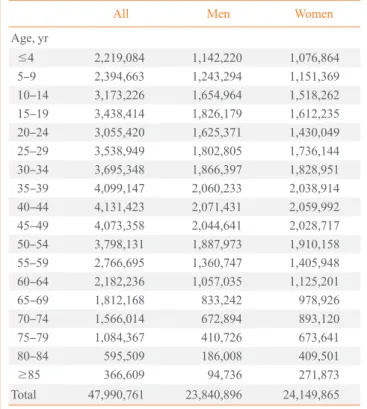
The incidence of hypothyroidism was determined by defin- ing new patients as those who did not have any prescription in 2007, but who were prescribed thyroid hormone for longer than 60 days after 2008. Age in the year of prescription was classified into 5-year groups. The population per gender and 5-year age group was determined using census data for 2010 from Statistics Korea (http://kosis.kr) and set as the population (Table 1). The prevalence of hypothyroidism and its incidence according to the causative disease were determined using the same method as for the incidence rate.
Table 1. The Number of Korean Population according to Age in 2010
All Men Women
Age, yr
≤4 2,219,084 1,142,220 1,076,864
5–9 2,394,663 1,243,294 1,151,369
10–14 3,173,226 1,654,964 1,518,262
15–19 3,438,414 1,826,179 1,612,235
20–24 3,055,420 1,625,371 1,430,049
25–29 3,538,949 1,802,805 1,736,144
30–34 3,695,348 1,866,397 1,828,951
35–39 4,099,147 2,060,233 2,038,914
40–44 4,131,423 2,071,431 2,059,992
45–49 4,073,358 2,044,641 2,028,717
50–54 3,798,131 1,887,973 1,910,158
55–59 2,766,695 1,360,747 1,405,948
60–64 2,182,236 1,057,035 1,125,201
65–69 1,812,168 833,242 978,926
70–74 1,566,014 672,894 893,120
75–79 1,084,367 410,726 673,641
80–84 595,509 186,008 409,501
≥85 366,609 94,736 271,873
Total 47,990,761 23,840,896 24,149,865
Table 2. Annual Mean Incidence of Patients with Hypothyroidism Taking Levothyroxine from 2008 to 2012
Men Women All
Incidencea Number Incidencea Number Incidencea Number
Age, yr
≤4 0.30 1,718 0.27 1,459 0.29 3,177
5–9 0.06 362 0.19 1,102 0.12 1,464
10–14 0.07 579 0.32 2,466 0.19 3,045
15–19 0.09 807 0.48 3,843 0.27 4,650
20–24 0.14 1,115 1.10 7,881 0.59 8,996
25–29 0.30 2,718 2.81 24,330 1.53 27,048
30–34 0.54 5,016 4.43 40,499 2.46 45,515
35–39 0.78 7,993 4.39 44,770 2.57 52,763
40–44 0.92 9,518 4.81 49,514 2.86 59,032
45–49 1.08 11,034 6.14 62,297 3.60 73,331
50–54 1.34 12,650 7.19 68,676 4.28 81,326
55–59 1.54 10,476 6.96 48,894 4.29 59,370
60–64 1.72 9,091 6.26 35,203 4.06 44,294
65–69 1.91 7,971 5.44 26,641 3.82 34,612
70–74 1.65 5,546 3.77 16,818 2.86 22,364
75–79 1.58 3,251 2.59 8,735 2.21 11,986
80–84 1.56 1,448 1.79 3,675 1.72 5,123
≥85 3.25 1,539 1.72 2,334 2.11 3,873
Total 0.78 92,832 3.72 449,137 2.26 541,969
aIncidence, per population 1,000/year, adjusted by the number of population with same age.
RESULTS
The incidence and prevalence of hypothyroidism treated with thyroid hormone in Korea
A total of 541,969 hypothyroidism patients (92,832 men and 449,137 women) were prescribed thyroid hormone between 2008 and 2012. Their mean age was 48.7±14.8 years. The number of new hypothyroidism patients who were prescribed thyroid hormone was 106,543 in 2008, 104,290 in 2009, 110,698 in 2010, 113,930 in 2011, and 106,508 in 2012. The annual incidence in 2008 to 2012 was 2.26 per 1,000 popula- tion (0.78 in men and 3.72 in women). It increased with age in men, with two peaks: a minor peak at 65 to 69 years (1.91 per 1,000) and a major peak at >85 years (3.25 per 1,000). It also increased with age in women, with a peak at 50 to 54 years (7.19 per 1,000) (Table 2). There was no statistically signifi- cant difference in incidence between years: the incidence was 2.22, 2.17, 2.31, 2.37, and 2.22 per 1,000 in 2008, 2009, 2010, 2011, and 2012, respectively. The number of patients pre- scribed thyroid hormone for longer than 60 days in 2012 was 685,101 (104,799 men and 580,302 women), with a preva- lence of 14.28 per 1,000 population (4.40 in men and 24.03 in
women). When the prevalence was analyzed according to age, it started to increase after the 20s in men, reaching a peak of 12.15 per 1,000 in the early 70s, but did not increase thereaf- ter. In women, it also started to increase from the 20s, reaching a peak of 55.85 per 1,000 in the late 50s, and declining there- after (Table 3).
The prevalence of hypothyroidism treated with thyroid hormone in Korea according to the causative diseases We classified 541,969 hypothyroidism patients prescribed thy- roid hormone between 2008 and 2012 into seven categories ac- cording to the causative disease: (1) 167,335 patients (30.9%) with thyroid cancer (C73); (2) 4,811 patients (0.9%) with hyper- thyroidism (E05); (3) 12,775 patients (2.4%) with diseases other than C73 and E05 following surgery or RAI treatment; (4) 37,841 patients (7.0%) with Hashimoto’s thyroiditis (E06.3); (5) 22,175 patients (4.1%) with other thyroiditis (E06 excluding E06.3); (6) 90,688 patients (16.7%) with benign thyroid tumors or goitrous diseases (D34, E01, and E04); and (7) 206,344 pa- tients (38.1%) with diseases with prescription of thyroid hor- mone not covered by criteria (1) to (6) (Tables 4-10). The annu- al incidence per 1,000 population was 0.70, 0.02, 0.05, 0.16,
Table 3. Prevalence of Patients with Hypothyroidism Taking Levothyroxine in 2012
Men Women All
Prevalencea Number Prevalencea Number Prevalencea Number
Age, yr
≤4 1.42 1,618 1.37 1,470 1.39 3,088
5–9 0.65 805 0.87 998 0.75 1,803
10–14 0.50 832 1.40 2,121 0.93 2,953
15–19 0.47 853 1.92 3,098 1.15 3,951
20–24 0.66 1,071 3.73 5,334 2.10 6,405
25–29 1.12 2,027 8.48 14,715 4.73 16,742
30–34 2.34 4,371 19.56 35,769 10.86 40,140
35–39 3.46 7,136 22.95 46,786 13.15 53,922
40–44 4.90 10,140 28.82 59,362 16.82 69,502
45–49 5.50 11,248 33.48 67,930 19.44 79,178
50–54 7.65 14,442 47.85 91,406 27.87 105,848
55–59 9.69 13,180 55.85 78,521 33.14 91,701
60–64 10.33 10,921 52.85 59,469 32.26 70,390
65–69 11.83 9,854 46.63 45,650 30.63 55,504
70–74 12.15 8,178 39.51 35,291 27.76 43,469
75–79 11.71 4,810 29.76 20,050 22.93 24,860
80–84 11.77 2,190 21.54 8,821 18.49 11,011
≥85 11.85 1,123 12.91 3,511 12.64 4,634
Total 4.40 104,799 24.03 580,302 14.28 685,101
aPrevalence, per population 1,000/year, adjusted by the number of population with same age.
Table 4. Annual Mean Incidence of Patients with Thyroid Cancer Taking Levothyroxine from 2008 to 2012
Men Women All
Incidence Number Incidence Number Incidence Number
Age, yr
≤4 0 0 0 1 0 1
5–9 0 7 0 14 0 21
10–14 0 26 0.01 101 0.01 127
15–19 0.01 112 0.07 525 0.04 637
20–24 0.04 336 0.25 1,773 0.14 2,109
25–29 0.12 1,099 0.64 5,524 0.37 6,623
30–34 0.24 2,283 1.14 10,442 0.69 12,725
35–39 0.36 3,707 1.54 15,677 0.95 19,384
40–44 0.4 4,194 1.89 19,489 1.15 23,683
45–49 0.42 4,295 2.26 22,931 1.34 27,226
50–54 0.45 4,275 2.47 23,611 1.47 27,886
55–59 0.43 2,914 2.26 15,872 1.36 18,786
60–64 0.39 2,060 1.89 10,641 1.16 12,701
65–69 0.37 1,528 1.44 7,057 0.95 8,585
70–74 0.23 781 0.86 3,829 0.59 4,610
75–79 0.15 315 0.42 1,399 0.32 1,714
80–84 0.08 77 0.17 345 0.14 422
≥85 0.05 22 0.05 73 0.05 95
Total 0.24 28,031 1.15 139,304 0.7 167,335
Table 6. Annual Mean Incidence of Patients with Other Thyroid Disease Taking Levothyroxine after Thyroidectomy or Radioiodine Ablation from 2008 to 2012
Men Women All
Incidence Number Incidence Number Incidence Number
Age, yr
≤4 0 0 0 0 0 0
5–9 0 0 0 3 0 3
10–14 0 3 0 12 0 15
15–19 0 18 0.01 74 0.01 92
20–24 0 18 0.02 130 0.01 148
25–29 0 28 0.03 276 0.02 304
30–34 0.01 74 0.05 489 0.03 563
35–39 0.01 127 0.08 846 0.05 973
40–44 0.02 179 0.10 1,076 0.06 1,255
45–49 0.02 233 0.17 1,674 0.09 1,907
50–54 0.04 348 0.20 1,888 0.12 2,236
55–59 0.05 324 0.21 1,472 0.13 1,796
60–64 0.05 273 0.21 1,175 0.13 1,448
65–69 0.05 223 0.19 906 0.12 1,129
70–74 0.03 115 0.11 495 0.08 610
75–79 0.03 52 0.05 182 0.04 234
80–84 0.02 15 0.02 38 0.02 53
≥85 0 1 0.01 8 0 9
Total 0.02 2,031 0.09 10,744 0.05 12,775
Table 5. Annual Mean Incidence of Patients with Hyperthyroidism Taking Levothyroxine after Thyroidectomy or Radioiodine Abla- tion from 2008 to 2012
Men Women All
Incidence Number Incidence Number Incidence Number
Age, yr
≤4 0 0 0 0 0 0
5–9 0 0 0 0 0 0
10–14 0 1 0 7 0 8
15–19 0 26 0.01 107 0.01 133
20–24 0.01 62 0.03 211 0.02 273
25–29 0.01 132 0.04 351 0.03 483
30–34 0.02 165 0.04 355 0.03 520
35–39 0.02 231 0.04 432 0.03 663
40–44 0.02 213 0.04 438 0.03 651
45–49 0.02 202 0.04 421 0.03 623
50–54 0.02 165 0.04 383 0.03 548
55–59 0.02 109 0.04 254 0.03 363
60–64 0.01 71 0.03 180 0.02 251
65–69 0.01 48 0.03 133 0.02 181
70–74 0 14 0.01 57 0.01 71
75–79 0 3 0.01 31 0.01 34
80–84 0 0 0 8 0 8
≥85 0 1 0 0 0 1
Total 0.01 1,443 0.03 3,368 0.02 4,811
Table 7. Annual Mean Incidence of Patients with Hashimoto’s Thyroiditis Taking Levothyroxine from 2008 to 2012
Men Women All
Incidence Number Incidence Number Incidence Number
Age, yr
≤4 0 6 0 9 0 15
5–9 0.01 34 0.05 286 0.03 320
10–14 0.01 55 0.09 650 0.04 705
15–19 0 43 0.06 492 0.03 535
20–24 0 38 0.13 924 0.06 962
25–29 0.01 96 0.33 2,891 0.17 2,987
30–34 0.02 209 0.50 4,601 0.26 4,810
35–39 0.03 327 0.38 3,853 0.20 4,180
40–44 0.04 376 0.35 3,578 0.19 3,954
45–49 0.05 466 0.43 4,406 0.24 4,872
50–54 0.05 510 0.51 4,868 0.28 5,378
55–59 0.07 463 0.47 3,298 0.27 3,761
60–64 0.07 395 0.36 2,016 0.22 2,411
65–69 0.07 307 0.26 1,278 0.17 1,585
70–74 0.05 177 0.14 628 0.10 805
75–79 0.04 91 0.09 307 0.07 398
80–84 0.05 44 0.04 86 0.04 130
≥85 0.03 12 0.02 21 0.02 33
Total 0.03 3,649 0.28 34,192 0.16 37,841
Table 8. Annual Mean Incidence of Patients with Other Thyroiditis Taking Levothyroxine from 2008 to 2012
Men Women All
Incidence Number Incidence Number Incidence Number
Age, yr
≤4 0 14 0 12 0 26
5–9 0 9 0.01 65 0.01 74
10–14 0 24 0.03 192 0.01 216
15–19 0.01 48 0.03 277 0.02 325
20–24 0 38 0.07 513 0.04 551
25–29 0.01 68 0.21 1,825 0.11 1,893
30–34 0.01 131 0.30 2,780 0.16 2,911
35–39 0.02 208 0.23 2,385 0.13 2,593
40–44 0.03 275 0.22 2,231 0.12 2,506
45–49 0.03 276 0.27 2,703 0.15 2,979
50–54 0.03 321 0.29 2,817 0.17 3,138
55–59 0.04 258 0.24 1,702 0.14 1,960
60–64 0.04 221 0.18 1,011 0.11 1,232
65–69 0.04 180 0.15 720 0.10 900
70–74 0.03 113 0.09 404 0.07 517
75–79 0.03 66 0.05 178 0.05 244
80–84 0.03 25 0.02 51 0.03 76
≥85 0.02 9 0.02 25 0.02 34
Total 0.02 2,284 0.16 19,891 0.09 22,175
Table 10. Annual Mean Incidence of Patients with Other Hypothyroidism Taking Levothyroxine from 2008 to 2012
Men Women All
Incidence Number Incidence Number Incidence Number
Age, yr
≤4 0.30 1,691 0.26 1,425 0.28 3,116
5–9 0.05 292 0.10 592 0.07 884
10–14 0.05 404 0.14 1,087 0.09 1,491
15–19 0.05 498 0.21 1,690 0.13 2,188
20–24 0.07 538 0.43 3,094 0.24 3,632
25–29 0.12 1,080 1.18 10,247 0.64 11,327
30–34 0.19 1,777 1.81 16,538 0.99 18,315
35–39 0.26 2,723 1.46 14,871 0.86 17,594
40–44 0.33 3,403 1.39 14,318 0.86 17,721
45–49 0.42 4,326 1.79 18,201 1.11 22,527
50–54 0.58 5,431 2.19 20,961 1.39 26,392
55–59 0.72 4,925 2.23 15,647 1.49 20,572
60–64 0.92 4,837 2.23 12,565 1.59 17,402
65–69 1.11 4,633 2.25 10,995 1.72 15,628
70–74 1.10 3,711 1.89 8,459 1.55 12,170
75–79 1.21 2,475 1.59 5,372 1.45 7,847
80–84 1.31 1,217 1.34 2,751 1.33 3,968
≥85 3.10 1,467 1.55 2,103 1.95 3,570
Total 0.38 45,428 1.33 160,916 0.86 206,344
Table 9. Annual Mean Incidence of Patients with Benign Thyroid Tumor or Goiter Taking Levothyroxine from 2008 to 2012
Men Women All
Incidence Number Incidence Number Incidence Number
Age, yr
≤4 0 7 0 12 0 19
5–9 0 20 0.02 142 0.01 162
10–14 0.01 66 0.05 417 0.03 483
15–19 0.01 62 0.08 678 0.04 740
20–24 0.01 85 0.17 1,236 0.09 1,321
25–29 0.02 215 0.37 3,216 0.19 3,431
30–34 0.04 377 0.58 5,294 0.31 5,671
35–39 0.07 670 0.66 6,706 0.36 7,376
40–44 0.08 878 0.81 8,384 0.45 9,262
45–49 0.12 1,236 1.18 11,961 0.65 13,197
50–54 0.17 1,600 1.48 14,148 0.83 15,748
55–59 0.22 1,483 1.51 10,649 0.88 12,132
60–64 0.23 1,234 1.35 7,615 0.81 8,849
65–69 0.25 1,052 1.13 5,552 0.73 6,604
70–74 0.19 635 0.66 2,946 0.46 3,581
75–79 0.12 249 0.38 1,266 0.28 1,515
80–84 0.08 70 0.19 396 0.16 466
≥85 0.06 27 0.08 104 0.07 131
Total 0.08 9,966 0.67 80,722 0.38 90,688
0.09, 0.38, and 0.86 for thyroid cancer, hyperthyroidism, other diseases following surgery or RAI treatment, Hashimoto’s thy- roiditis, other thyroiditis, benign thyroid tumors or goitrous dis- eases, and diseases with prescription of thyroid hormone not covered by criteria (1) to (6), respectively. When 167,335 pa- tients with thyroid cancer were excluded, there were 374,634 hypothyroidism patients, and the annual incidence of hyperthy- roidism was 1.56 per 1,000 population (1.68 in 2008, 1.52 in 2009, 1.61 in 2010, 1.58 in 2011, and 1.41 in 2012).
For thyroid cancer, the incidence was highest in the 50s in both men and women; for Hashimoto’s thyroiditis and other thyroiditis, the incidence was highest in the 60s in men and the early 30s and early 50s in women. For benign thyroid tumors or goitrous diseases, the incidence was highest in the 60s in men and the 50s in women.
DISCUSSION
This study was the first investigation of the entire population of Korea. Although the study used nationwide claims data pro- vided by HIRA, the data are reliable considering that most of the Korean population has medical insurance provided by the government. The incidence and prevalence of hypothyroidism reported previously in Korea were limited to health examin- ees, middle-aged women, or elderly patients; hence, the sub- jects were not a representative sample of the entire population.
In this study, hypothyroidism was defined as prescription of thyroid hormone for more than 60 days, rather than by assess- ing thyroid hormone profiles; hence, the results may differ from other studies. Patients prescribed thyroid hormone for reasons other than treatment of hypothyroidism may have been included. Such patients may have included thyroid can- cer patients who did not undergo surgery, patients with large thyroid tumors or goiters, and patients with other diseases such as obesity. By contrast, patients with euthyroid Hashimo- to’s thyroiditis, thyroiditis with transient hypothyroidism, sub- clinical hypothyroidism, and undiagnosed overt hypothyroid- ism may have been excluded from this investigation because they were not prescribed thyroid hormone.
The number of new patients with hypothyroidism between 2008 and 2012 was 108,394 per year (18,566 men and 89,827 women), and the mean annual incidence was 2.26/1,000 popu- lation (0.78 in men and 3.72 in women). When patients with thyroid cancer (C73) were excluded, the annual incidence de- creased to 1.56/1,000 population (0.54 in men and 2.57 in women). The incidence was similar to that reported by Chung
et al. [6] in 1999 (1.6/1,000 population; 0.6 in men and 2.8 in women). When patients with thyroid cancer were added, the rate rose by 40% [6]. The annual incidence of hypothyroidism in other countries was approximately 2.0 to 4.0/1,000 popula- tion, not very different from that in Korea [1]. In this study, the incidence of hypothyroidism increased with age in both men and women, peaking in the late 60s and at >85 years in men and in the early 50s in women. The annual incidence did not change significantly between 2008 and 2012, but it de- creased if thyroid cancer was excluded.
The number of hypothyroidism patients in 2012 was 685,101 (104,799 men and 580,302 women), with a prevalence of 14.28 per 1,000 population (4.40 in men and 24.03 in women). The prevalence started to increase after the 20s in both men and women, but peaked in the early 70s in men and in the late 50s in women. In the 1999 report by Chung et al. [6], the preva- lence of overt hypothyroidism was 2.8 per 1,000 population (1.1 in men and in 4.9 women). It increased substantially in both men and women between 1999 and 2012. This may be because of the rapid increase in the number of thyroid cancer patients, as well as a natural increase. In reports from foreign countries, the incidence of overt hypothyroidism was approxi- mately 7.9 to 13 per 1,000 population [1,14,15].
When we classified overt hypothyroidism into seven catego- ries according to the causative disease, Hashimoto’s thyroiditis accounted for only 7.0% of cases; miscellaneous causes of hy- pothyroidism, which presumably included a significant number of cases of Hashimoto’s thyroiditis, accounted for 38.1% of cases. In 2013 Seo et al. [16] reported that every year an aver- age of 2,896 hyperthyroidism patients were treated with RAI and an average of 316 patients underwent thyroidectomy.
Therefore, an annual average of 3,212 hyperthyroidism patients were treated with RAI therapy or surgery. The present study found an annual average of 962 patients (4,811 patients over 5 years) were prescribed thyroid hormone after RAI therapy or surgery for hyperthyroidism, accounting for –30% of cases.
Hypothyroidism after RAI therapy or surgery for hyperthyroid- ism was most frequent in the 50s in both men and women.
In conclusion, this study was the first investigation of the en- tire Korean population. We investigated the incidence and prevalence of hypothyroidism in patients prescribed thyroid hormone using claims data provided by HIRA. A total of 541,969 patients (92,832 men and 449,137 women) who were prescribed thyroid hormone for longer than 60 days between 2008 and 2012 were analyzed. The incidence and prevalence of hypothyroidism were 2.26 per 1,000 population (0.78 in men
and 3.72 in women) and 14.28 per 1,000 population (4.40 in men and 24.03 in women), respectively. The annual incidence per 1,000 population was 0.70, 0.02, 0.05, 0.16, 0.09, 0.38, and 0.86 for thyroid cancer, hyperthyroidism, other diseases follow- ing surgery or RAI treatment, Hashimoto’s thyroiditis, other thyroiditis, benign thyroid tumors or goitrous diseases, and oth- er diseases with prescription of thyroid hormone, respectively.
The annual incidence of hypothyroidism when thyroid cancer was excluded was 1.56 per 1,000 population.
CONFLICTS OF INTEREST
No potential conflict of interest relevant to this article was re- ported.
ACKNOWLEDGMENTS
This study was supported by the Korean Endocrine Society.
REFERENCES
1. Bilous RW, Tunbridge WM. The epidemiology of hypo- thyroidism: an update. Baillieres Clin Endocrinol Metab 1988;2:531-40.
2. Wiersinga WM. Subclinical hypothyroidism and hyperthy- roidism. I. Prevalence and clinical relevance. Neth J Med 1995;46:197-204.
3. Canaris GJ, Manowitz NR, Mayor G, Ridgway EC. The Colorado thyroid disease prevalence study. Arch Intern Med 2000;160:526-34.
4. Vanderpump MP, Tunbridge WM. Epidemiology and pre- vention of clinical and subclinical hypothyroidism. Thy- roid 2002;12:839-47.
5. Hollowell JG, Staehling NW, Flanders WD, Hannon WH, Gunter EW, Spencer CA, et al. Serum TSH, T(4), and thy- roid antibodies in the United States population (1988 to 1994): National Health and Nutrition Examination Survey (NHANES III). J Clin Endocrinol Metab 2002;87:489-99.
6. Chung JH, Kim BJ, Choi YH, Shin MH, Kim SH, Min YK, et al. Prevalence of thyrotoxicosis and hypothyroid-
ism in the subjects for health check-up. J Korean Soc En- docrinol 1999;14:301-13.
7. Oh MK, Cheon KS, Jung SM, Ryu DS, Park MS, Cheong SS, et al. Prevalence of thyroid diseases among adult for health check-up in a Youngdong area of Kwangwon prov- ince. J Korean Acad Fam Med 2001;22:1363-74.
8. Choi JK, Kim JS, Hwang CH, Kim DH, Hwang SW, Cho B, et al. Subclinical hypothyroidism and coronary risk fac- tors in women above 55 years. J Korean Acad Fam Med 2002;23:96-103.
9. Jung CH, Sung KC, Shin HS, Rhee EJ, Lee WY, Kim BS, et al. Thyroid dysfunction and their relation to cardiovas- cular risk factors such as lipid profile, hsCRP, and waist hip ratio in Korea. Korean J Intern Med 2003;18:146-53.
10. Lee WY, Oh KW, Rhee EJ, Jung CH, Kim SW, Yun EJ, et al. Relationship between subclinical thyroid dysfunction and femoral neck bone mineral density in women. Arch Med Res 2006;37:511-6.
11. Choi HS, Park YJ, Kim HK, Choi SH, Lim S, Park DJ, et al. Prevalence of subclinical hypothyroidism in two popu- lation based-cohort: Ansung and KLoSHA cohort in Korea.
J Korean Thyroid Assoc 2010; 3:32-40.
12. Kim TH, Kim KW, Ahn HY, Choi HS, Won H, Choi Y, et al. Effect of seasonal changes on the transition between subclinical hypothyroid and euthyroid status. J Clin Endo- crinol Metab 2013;98:3420-9.
13. Kim YA, Park YJ. Prevalence and risk factors of subclinical thyroid disease. Endocrinol Metab (Seoul) 2014;29:20-9.
14. Tunbridge WM, Evered DC, Hall R, Appleton D, Brewis M, Clark F, et al. The spectrum of thyroid disease in a commu- nity: the Whickham survey. Clin Endocrinol (Oxf) 1977;7:
481-93.
15. Vanderpump MP, Tunbridge WM, French JM, Appleton D, Bates D, Clark F, et al. The incidence of thyroid disorders in the community: a twenty-year follow-up of the Whick- ham Survey. Clin Endocrinol (Oxf) 1995;43:55-68.
16. Seo GH, Kim SW, Chung JH. Incidence & prevalence of hyperthyroidism and preference for therapeutic modalities in Korea. J Korean Thyroid Assoc 2013;6:56-63.