유도 AmpC β-lactamase를 생산하는 장내세균 혈액분리균에서의 extended-spectrum β-lactamase 생성균의 빈도
정혜숙
1·고관수
2·강철인
3·정두련
3·백경란
3·송재훈
3건국대학교병원 감염내과1, 성균관대학교 의과대학 분자생물학과2, 성균관대학교 의과대학 삼성서울병원 감염내과3
Submitted: January 4, 2010 Revised: September 20, 2010 Accepted: September 24, 2010
Correspondence to Kyong Ran Peck, M.D.
Division of Infectious Diseases, Samsung Medical Center, Sungkyunkwan University School of Medicine, 50 Ilwon- dong, Gangnam-gu, Seoul 135-710, Republic of Korea Tel : +82-2-3410-0329, Fax : +82-2-3410-0041 E-mail : [email protected]
Copyright © 2010 by The Korean Society of Infectious Diseases | Korean Society for Chemotherapy
Infect Chemother 2010;42(5):280-284
www.icjournal.org
Prevalence of Extended-spectrum β-lactamase among Enterobacteriacae Blood Isolates with Inducible AmpC β -lactamase
Background: Among the inducible AmpC β-lactamase-producing members of the family Enterobacteriaceae such as Enterobacter spp., Citrobacter spp., Serratia spp., and Morganella morganii (ECSM), the prevalence of ESBL-producing isolates are increasing. However, there have been only a limited number of studies that have investigated the prevalence for ESBL-production in blood isolates of these organisms.
Materials and Methods: We performed a prospective observational study to evaluate the prevalence for ESBL production among ECSM blood isolates. All consecutive blood isolates in the Samsung Medical Center were included from Oct 2006 to Mar 2008. Antimicrobial susceptibility test was performed by broth microdilution method. ESBLs were confirmed by double-disk synergy test and ESBL phenotypes were determined by PCR.
Results: The 124 isolates (94 Enterobacter spp., 18 Citrobacter spp., 8 Serratia spp.
and 4 Morganella spp.) were investigated. Among 124 ESCM isolates, 30 isolates (24.2%) showed ESBL-producing activity. Derepressed or partially derepressed AmpC mutants and derepressed AmpC mutants with ESBL production accounted for 36.3% (45/124) and 16.9% (21/124), respectively. Of ESBL producers, the most prevalent ESBL was SHV-12 (5/24, 20.8%).
Conclusions: The prevalence of ESBL-producing isolates is high in Enterobacter spp., Serratia marcescens and Citrobacter spp. clinical isolates. It suggested that routine screening test for ESBLs among Enterobacteriacae blood isolates with inducible AmpC β-lactamase should be needed.
Key Words: Enterobacter spp., Extended-spectrum β-lactamase, AmpC β-lactamase
Hae Suk Cheong1, Kwan Soo Ko2, Cheol-In Kang3, Doo Ryeon Chung3, Kyong Ran Peck3, and Jae-Hoon Song3
Division of Infectious Diseases, Konkuk University Hospi- tal, Konkuk University School of Medicine1; Department of Molecular Cell Biology2 and Division of Infectious Disease3, Samsung Medical Center, Sungkyunkwan Uni- versity School of Medicine, Seoul, Korea
This study was received a research award in the Annual Meeting of the Korean Society of Infectious Diseases and the Korean Society for Chemotherapy, 2008.
서론
Enterobacter spp., Citrobacter spp., Serratia spp., Morganella morganii (ECSM) 는 AmpC β-lactamase를 코딩하는 염색체 서열을 지닌 세균으로 원내감염의 중요 한 원인균으로 알려져 있으며, 베타락탐계 항생제에 노출되면 AmpC β-lactamase가
유도된다. AmpC 효소의 조절 유전자에 변이가 발생하면 유도 없이도 AmpC β-lactamase를 연속적으로 생산하는 변이균 (derepressed mutant)이 생기고 3세대 세파계 항생제에 내성을 보인다. 따라서 3세 대 세파계 항생제를 사용하면 변이균이 선택적으로 증식된다[1, 2].
최근 연구에 따르면, ECSM 균의 extended-spectrum β-lac- tamase (ESBL) 생성률은 상당히 높아 10-43% 정도로 알려져 있다 [3-6]. 그러나, ECSM 균의 경우, AmpC β-lactamase와 ESBL을 동시 에 생성하는 경우에는 clavulanic acid 억제 검사상 위음성이 많으며 일반 검사실에서는 ESCM균의 ESBL을 검출하는 표준화된 검사법이 없다. 한편, ESCM균의 ESBL생성여부에 대한 대부분의 연구는 실제 감 염증을 일으킨 균을 대상으로 하는 연구는 아니고 병원내 분리균 모두 를 대상으로 한 연구가 많았고, 혈액배양균을 대상으로 이루어진 연구 는 있었지만 소아에서 분리된 균을 대상으로 하는 연구였다[3-6]. 따 라서, 본 연구에서는 유도 AmpC β-lactamase 생성하는 ECSM 균을 대상으로 ESBL을 생산하는 균의 분포를 보고 임상적으로 이를 어떻게 적용할 수 있을지 알아보고자 한다.
재료 및 방법
1. 대상 균주
2006년 10월부터 2008년 3월까지 삼성서울병원의 균혈증 환자 에서 분리한 Enterobacter spp., Citrobacter spp., Serratia spp., Morganella morganii (ECSM) 균주 총 124균주를 대상으로 하였다.
동일 환자에서 반복하여 분리된 균주는 제외하였다.
2. 항생제 감수성 검사
항생제 감수성 검사는 Mueller-Hinton broth (Becton Dickinson, Sparks, MD)로 microdilution 방법으로 시행하였고, Clinical and Laboratory Standards Institute (CLSI) (CLSI 2007)에 의해 감수 성 여부를 판정하였다[7]. 시험 항균제는 ampicillin, gemtamicin, ciprofloxacin, cefotaxime, ceftazidime, aztreonam, imipenem,
cefepime, cefoxitin, piperacillin-tazobactam이었다. 감수성 시험 의 정도관리를 위해서 E. coli ATCC 25922, K. pneumoniae ATCC 700603을 사용하였다.
3. Extended-spectrum β-lactamase (ESBL) 균의 검출 세균을 생리 식염수에 0.5 McFarland 농도로 부유시킨 후 Mueller- Hinton 한천에 고르게 접종하였다. Cefotaxime (30 μg), ceftazidime (30 μg) disk와 각각 항균제(cefotaxime,ceftazidime)에 clavulalate 10 μg 이 같이 포함된 disk를 2cm 간격으로 놓아두고, 35℃에서 하룻 밤 배양한 후 디스크 사이의 억제대의 지름이 5 mm 이상 차이가 나면 양성으로 해석하였다[8]. 동시에 cefepime (30 μg)과 amoxicillin (20 μg)-clavulanate (10 μg)를 2 cm 간격으로 놓아두고 double-disk synergy test를 시행하였다[9]. 여기에 사용된 항균제 disk는 BD BBL Sensi-Disk (Beckton Dickinson,USA) 이다.
4. ESBL의 유전자형
ESBL유전자형을 알아보기 위해 중합효소연쇄반응법과 유전자서열 분석을 시행하였다. 유전자형을 알기 위한 PCR의 primer는 Kim 등의 연구에서 사용한 서열과 환경을 적용하여 국내에서 가장 흔한 TEM, SHV, CTX-M형에 대한 PCR 검사만을 시행하였다. 유전자가 확인된 경 우 DNA를 추출하여 염기서열을 분석 하였다[4].
5. 유도 AmpC β-lactamase 생성균의 검출
유도 AmpC β-lactamase 생성균을 검출하기 위해서는 cefoxitin- cefotaxime antagonist test를 시행하여 D-모양의 억제대 유무를 관찰하였다. Derepressed AmpC β-lactamase 생성균은 cefoxitin MIC≥32 μg/mL, cefotaxime MIC≥16 μg/mL 이면서 cefoxitin- cefotaxime antagonist test상 음성인 경우로 하였고, partially depressed AmpC β-lactamase 생성균의 경우 derepressed AmpC β-lactamase과 같은 특징을 지니지만 cefotixin-cefotaxime antagonist test상 양성인 경우로 정의하였다[5, 10].
Table 1. MICs of antibiotics for Enterobacter spp., Citrobacter spp., Serratia spp., and Morganella morganii (ECSM) Clinical Isolates
MIC (μg/mL) Susceptibility (% of isolates)
50% 90% Range S I R
Ampicillin >64 >64 ≤0.06 ~ >64 4.0 4.8 91.2
Gentamicin 0.5 32 0.12 ~ 64 86.3 0.8 12.9
Ciprofloxacin ≤0.06 0.12 ≤0.06 ~ >64 89.5 1.6 8.9
Ceftazidime 2 >64 ≤0.06 ~ >64 59.7 2.4 37.9
Cefotaxime 2 >128 ≤0.12 ~ >128 55.6 12.1 32.3
Aztreonam 0.5 64 ≤0.06 ~ >64 59.7 3.2 37.1
Imipenem 0.5 2 0.12 ~ 16 97.6 0.8 1.6
Trimethoprim-sulfamethoxazole 0.25 >32 0.03 ~ >32 82.3 17.7
Piperacillin-tazobactam 4 256 0.5 ~ >256 67.7 12.9 21.0
Cefepime 0.12 16 ≤0.06 ~ >64 92.7 4.8 7.3
Cefoxitin >64 >64 1 ~ >64 10.5 3.2 86.3
MIC, minimal inhibitory concentration; S, susceptible; I, intermediate; R, resistant
결과
1. 대상균주 분포와 항생제 내성률
본 연구에 사용된 대상균주의 분포를 보면, Enterobacter cloacae 66균주 (53.2%), Enterobacter aerogenes 25균주(20.2%), Citrobacter freundii 12균주(9.7%), Serratia marcescens 7균주 (5.6%), Morganella morganii 4균주(3.2%), Citrobacter koseri 3균주 (2.4%), Citrobacter brakii 3균주(2.4%), Enterobacter asburiae 2균 주(1.6%) 그리고 Enterobacter cancerogenus와 Serratia fonticola 는 각각 1균주(0.8%)이었다. 대상 균주들의 ceftazidime, ceftriaxone, cefotaxime에 대한 내성률은 50%가 넘었고, cefepime과 piperacillin-tazobactam에는 각각 7.3%와 21.0% 내성율을 보였다.
그리고, imipenem에 내성인, Enterobacter cloacae, Enterobacter aerogenes, Citrobacter freundii 각각 1균주씩이 있었다(Table 1).
2. Derepressed AmpC mutant와 ESBL 생성균의 비율
전체 ECSM 124 균주 중에서 derepressed mutant는 36균주, partially derepressed mutant는 총 9균주로, 모두 36.3% (45/124) 균 주가 derepressed 혹은 partially derepressed mutant에 해당하였다.
그리고, 전체 균주 중에서 ESBL 생성균은 총 24.2% (30/124)이었다.
Double-disk시험으로 본 결과 전체 124균주 중에서 30균주(24.2
%) 에서 ESBL이 생성됨을 관찰할 수 있었다. Cefoxitin-cefotaxime antagonist test상 유도 AmpC β-lactamase생성균은 총 59균주 (47.6%) 였다. 그리고, derepressed AmpC와 ESBL생성을 동시에 보 이는 균도 21균주(16.9%)가 있었다. 균종별로 내성유전자의 분포비율
을 보면, 가장 많은 비율을 차지하는 Enterobacter spp.의 경우 24 균 주(25.5%, 24/94), Citrobacter spp.는 3균주(20.0%, 3/15)가 ESBL이 였으나, Serracia spp.의 경우 약 60% 정도가 ESBL 균주였다(62.5%, 5/8) (Table 2).
3. ESBL 균주의 유전자형 분석
본 연구에서는 5 가지형의 ESBL 유전자를 검출하였다(TEM 3 종류, SHV 1 종류, CTX 1 종류). 총 30균주 중에 실제 14 균주는 PCR상 ESBL 이 검출되지 않았으며, 2가지의 유전자를 지닌 2균주를 포함하여 총 16균주에서 유전자형을 분석하였다(Table 3). ESBL이 아닌 TEM-1을 제외하고는 SHV-12가 가장 많은 비율을 차지하였다.
고찰
현재 국내 대부분의 병원에서 ESBL 생성여부를 보고하게 되어 있는 균주는 Escherichia coli, Klebsiella spp., Proteus mirabilis로 한정 되어 있다[7]. 다른 Enterobacteriacae에 대해서는 표준화된 ESBL 검 출 방법이 없는 상태이다. 그러나 최근 연구에서 AmpC β-lactamase 를 코딩하는 염색체 서열을 지닌 Enterobacter spp., Citrobacter spp., Serratia spp., Morganella morganii (ECSM)에서 ESBL 생성균의 비 율이 높아지고 있다고 보고되고 있다[3-6]. 이들 세균은 실제 검사실 에는 일반적으로 ESBL생성여부에 대한 보고를 하지 않는 것이므로 주 로 임상에서 항균제 선택에 있어 더욱 신중해 지지 않을 수 없다. 그러 나 지금까지 이상의 세균에 대한 연구 대부분은 감염증의 직접적인 원
Table 2. Antimicrobial Susceptibilities, Cefoxitin-cefotaxime Antagonism Test, and Confirmatory Test for ESBL Production among 124 ECSM Isolates
Groupa (No. of strains) Cefoxitin-Cefotaxime
Antagonist test b ESBL testb MIC50, MIC range (μg/mL)
cefoxitin cefotaxime ceftazidime cefepime
Derepressed or partially derepressed mutants (n=24) - 18, +6 -, 15 >64, 32~>64 64, 16~>128 >64, 8~>64 1,0.06~8 Derepressed mutants with ESBL production (n=21) - 21 +21 >64, 32~>64 >128, 128~>128 >64, 16~>64 8, 0.5~>64 Strains with ESBL production (n=9) - 7, +2 +9 >64, 16~>64 32, <0.12~>128 >64, 1~>64 0.5, 0.06~>64 Inducible strains without ESBL production (n=59) +59 - 59 >64, 2~>64 0.25, <0.12~8 0.5, <0.06~>64 0.06, <0.06~32 ECSM, Enterobacter spp., Citrobacter spp., Serratia spp., Morganella morganii
aRemaining 11 strains do not belong in any groups. Explanation for this is in discussion part.
bThe numbers of isolates with negative(-) and positive(+) results are shown.
Table 3. Distribution of ESBLs among Enterobacteriacae isolates
Species (No. of isolated tested) TEM CTX SHV
No PCR detection Multiple detection
TEM-1a TEM-17 TEM-52 TEM-128 CTX-M12 SHV-12
Enterobacter cloacae (16) 4 1 1 3 8 1
Enterobacter aerogenes (5) 1 1 2 1 1 1
Citrobacter freundii (2) 2
Serratia marcescens (4) 1 1 1 1
Citrobacter brakii (1) 1
Enterobacter cancerogenus (1) 1 0
Serratia fonticola (1) 1
Total 6 1 4 1 1 5 14 2
a TEM-1 is not ESBL enzyme No, Negative
인이 되는 임상검체를 대상으로 시행한 것이 아니고 상재균을 포함한 병원에서 분리된 모든 균을 대상으로 시행된 것이었다[4, 6, 11]. Pai 등 에 의해 Enterobacter spp. 혈액배양균을 대상으로 ESBL 생성여부 를 본 연구가 있으나 이 연구는 소아에서 동정된 균을 대상으로 하였으 며, 전체 균주 중 43%가 ESBL을 생성한 것으로 보고하였다[5]. Israel 에서 발표된 결과에서는 Enterobacter spp.는 22%, Citrobacter spp.
는 10.9%, 그리고 S. marcescens의 경우 15.5%에서 ESBL을 생성한 다고 한 반면[12], 아시아 국가를 대상으로 한 SENTRY 연구에 따르면 China, Philippines, Singapore 등 국가에서는 여타 다른 아시아 국가 들에 비해서 Enterobacter cloacae의 ESBL생성률이 높아 대략 35- 40%로 보고하였다[13]. 본 연구는 성인을 대상으로 혈액검체를 전향 적으로 수집하여 임상적 의미가 있는 ECSM 균의 실제 내성률을 정확 히 보고자 하였으며, 본 연구결과가 ECSM 균의 귀중한 항생제 내성자 료가 될 것으로 기대한다. 본 연구에서는 전체 124균주 중에서 30균주 (24.2%)가 ESBL을 생성함을 알 수 있었다. 그러나, 이들 30균주 중 분 자유전학적방법인 PCR 검사로는 16균주에서만 ESBL 생성을 확인할 수 있었는데 그 중 6균주는 ESBL로 분류되지 않는 TEM-1이었다. 위 와 같은 결과는 다른 ESBL아형에 대한 PCR이 이루어지지 않았거나, TEM, SHV, CTX-M 유전자와는 다른 ESBL 관련유전자의 표현형이 ESBL 양성으로 나타난 것으로 추측되나 아직 이에 대한 정확한 정보 는 없는 상태이다. 하지만, 본 연구의 결과는 우리나라에서 시행된 이전 연구의 ECSM 균의 ESBL 생성률에 비해서 다소 낮았다.
원칙적으로 모든 AmpC β-lactamase생성 균주는 derepressed mutant, partially derepressed, inducible strains 중 하나에 속하 여야 하는데, 본 실험에서는 정의상 어디에도 속하지 않는 11균주 가 있었다. 이들은 cefoxitin과 cefotaxime에 감수성이 있으며 실제 cefotixin-cefotazime antagonist test에서는 음성소견을 보였다. 이 에 대해서 설명을 하자면, 이들 11균주의 경우 AmpC enzyme이 특 정수준까지 발현되지 않아 cefoxitin에 감수성이 있는 균주들로 나왔 고, 실제 cefotixin-cefotaxime antagonist test시 억제대 부분이 겹쳐 blungting 되는 부분을 제대로 인지하지 못한 경우였다[10, 14].
ESBL과 derepressed AmpC β-lactamase 의 경우 각각 염색체와 플라스미드를 이용한 내성전달과 같이 내성기전에서의 차이는 있지 만, 본 연구에서는 전체 ESBL 생성균의 70%가 derepressed AmpC β-lactamase도 동시에 생성하는 것을 볼 수 있었다. 다른 연구결과에 서도 비슷한 비율로 전체 ESBL과 derepressed AmpC β-lactamase 변이를 동시에 보이는 것으로 보고하였다[3, 5]. ECSM 균 감염 치료 에서 AmpC β-lactamase (derepressed 변이균 포함하여) 생성균일 지라도 cefepime으로 비교적 안전하게 사용될 수 있다고 알려져 있 다. ECSM 균에서 AmpC β-lactamase를 유도한다고 알려진 3세대 cepha계 항생제에 비해서 cefepime으로 내성 유전자를 유도하지 않 으면서 사용될 수 있다고 알려져 있다[1]. 그러나 ESBL 을 동시에 가지 는 derepressed AmpC β-lactamase생성균의 경우 cefepime의 MIC 가 올라가는 경우를 볼 수 있다[15]. ESBL 생성균에서 실제 cefepime 의 치료에 대한 임상보고는 거의 없는 상태이지만 심각한 감염증 환 자에서 치료실패를 유도할 가능성이 있다[16]. 그러므로 임상에서
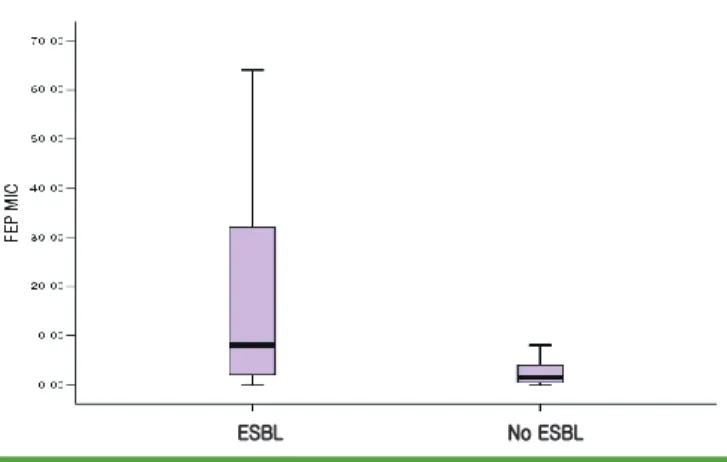
ESCM균의 ESBL 생성여부를 볼 필요성이 있으며, 가장 유용한 방법 으로 cefepime MIC을 기준으로 하는 것이다. 그리하여, cefepime MIC가 1 μg/mL 이상일 때를 ESBL 생성균으로 간주할 수 있다는 연 구가 있다[3, 6]. 본 연구에서도 ECSM 균에서의 derepressed AmpC β-lactamase 변이균과 ESBL과 derepressed AmpC β-lactamase 를 동시에 보이는 균주의 cefepime MIC를 비교하여 보았고, MIC를 Student t-test를 해본 결과 통계상 유의하게 MIC에서 차이를 보였다 (P=0.003, 3.9±5.6 vs. 17.2±21.2) (Fig. 1). 그러나, 두 군 사이의 분포 를 보면 평균값은 차이가 나지만 MIC로 기준을 세울 수 없다는 것을 알 수 있다. ECSM 균에서의 ESBL 생성의 치료결과와 사망률에 미치는 영 향에 대한 보고는 현재까지는 거의 없는 상태이므로 앞으로 더 연구 하 여야 할 분야이다.
결론적으로 E. coli와 Klebsiella spp.와 마찬가지로 Enterobacter spp., Citrobacter spp., 그리고 Serratia spp. 균에서도 ESBL 생성률은 이미 상당히 높아진 상태로 가능한 방법을 동원하여 실제 임상에서도 이들 균에서의 ESBL 생성여부에 대한 보고가 필요하다.
References
1. Paterson DL. Resistance in gram-negative bacteria: entero- bacteriaceae. Am J Med 2006;119(6 Suppl 1):S20-8.
2. Pfaller MA, Segreti J. Overview of the epidemiological profile and laboratory detection of extended-spectrum beta-lacta- mases. Clin Infect Dis 2006;42(Suppl 4):S153-63.
3. Choi SH, Lee JE, Park SJ, Kim MN, Choo EJ, Kwak YG, Jeong JY, Woo JH, Kim NJ, Kim YS. Prevalence, microbiology, and clinical characteristics of extended-spectrum beta-lactamase-produc- ing Enterobacter spp., Serratia marcescens , Citrobacter freundii, and Morganella morganii in Korea. Eur J Clin Micro- biol Infect Dis 2007;26:557-61.
4. Kim J, Lim YM. Prevalence of derepressed ampC mutants and
ESBL No ESBL
Figure 1. Difference of cefepime MICs between derepressed AmpC β-lactamase producing isolates and derepressed AmpC β-lactamase with ESBL producing isolates.
FEP, cefepime.
extended-spectrum beta-lactamase producers among clinical isolates of Citrobacter freundii, Enterobacter spp., and Serratia marcescens in Korea: dissemination of CTX-M-3, TEM-52, and SHV-12. J Clin Microbiol 2005;43:2452-5.
5. Pai H, Hong JY, Byeon JH, Kim YK, Lee HJ. High prevalence of extended-spectrum beta-lactamase-producing strains among blood isolates of Enterobacter spp. collected in a tertiary hospi- tal during an 8-year period and their antimicrobial suscepti- bility patterns. Antimicrob Agents Chemother 2004;48:3159-61.
6. Park YJ, Park SY, Oh EJ, Park JJ, Lee KY, Woo GJ, Lee K. Occur- rence of extended-spectrum beta-lactamases among chromo- somal AmpC-producing Enterobacter cloacae, Citro bac ter freundii, and Serratia marcescens in Korea and investi gation of screening criteria. Diagn Microbiol Infect Dis 2005;51: 265-9.
7. Chow JW, Yu VL. Combination antibiotic therapy versus mono- therapy for gram-negative bacteraemia: a commentary. Int J Antimicrob Agents 1999;11:7-12.
8. Jacoby GA, Han P. Detection of extended-spectrum beta- lactamases in clinical isolates of Klebsiella pneumoniae and Escherichia coli. J Clin Microbiol 1996;34:908-11.
9. Tzelepi E, Giakkoupi P, Sofianou D, Loukova V, Kemeroglou A, Tsakris A. Detection of extended-spectrum beta-lactamases in clinical isolates of Enterobacter cloacae and Enterobacter aerogenes. J Clin Microbiol 2000;38:542-6.
10. Livermore DM, Brown DF. Detection of beta-lactamase- mediated resistance. J Antimicrob Chemother 2001;48(Suppl 1):59-64.
11. Ko KS, Lee MY, Song JH, Lee H, Jung DS, Jung SI, Kim SW,
Chang HH, Yeom JS, Kim YS, Ki HK, Chung DR, Kwon KT, Peck KR, Lee NY. Prevalence and characterization of extended- spectrum beta-lactamase-producing Enterobacteriaceae isolated in Korean hospitals. Diagn Microbiol Infect Dis 2008;
61:453-9.
12. Navon-Venezia S, Hammer-Munz O, Schwartz D, Turner D, Kuzmenko B, Carmeli Y. Occurrence and phenotypic charac- teristics of extended-spectrum beta-lactamases among mem- bers of the family Enterobacteriaceae at the Tel-Aviv Medical Center (Israel) and evaluation of diagnostic tests. J Clin Micro- biol 2003;41:155-8.
13. Bell JM, Turnidge JD, Jones RN; SENTRY Asia-Pacific Partici- pants. Prevalence of extended-spectrum beta-lactamase- producing Enterobacter cloacae in the Asia-Pacific region:
results from the SENTRY Antimicrobial Surveillance Program, 1998 to 2001. Antimicrob Agents Chemother 2003;47:3989-93.
14. Moritz VA, Carson PB. Cefoxitin sensitivity as a marker for inducible beta-lactamases. J Med Microbiol 1986;21:203-7.
15. Szabó D, Bonomo RA, Silveira F, Pasculle AW, Baxter C, Linden PK, Hujer AM, Hujer KM, Deeley K, Paterson DL. SHV-type extended-spectrum beta-lactamase production is associated with reduced cefepime susceptibility in Enterobacter cloacae. J Clin Microbiol 2005;43:5058-64.
16. Wi YM, Kang CI, Cheong HS, Chung DR, Jung CW, Ko KS, Song JH, Peck KR. Failure of cefepime therapy in neutropenic pa- tients with extended-spectrum beta-lactamase-producing Gram-negative bacteraemia. Int J Antimicrob Agents 2009;33:
384-6.