Patients with Arthritis Undergoing Surgery: How Should We Manage Tumour Necrosis Factor Blocking Agents
Perioperatively?-A Systematic Literature Review
Herwig Pieringer,
1,2Kathrin Danninger,
1Nikolay Tzaribachev,
3Nikolaus Böhler,
4Erich Pohanka,
1,5and Manfred Herold
61Section of Rheumatology, 2nd Department of Medicine, General Hospital Linz, Linz;
2Paracelsus Medical University, Salzburg, Austria.
3Department of Pediatric Rheumatology, Klinikum Bad Bramstedt, Bad Bramstedt, Germany.
4Department of Orthopedics and Orthopedic Surgery, General Hospital Linz, Linz;
5Internal Medicine III, Medical University Vienna, Vienna;
6Rheumatology Unit, Clinical Department of General Internal Medicine, Innsbruck Medical University, Innsbruck, Austria.
Received: January 12, 2012 Revised: February 20, 2012 Accepted: February 21, 2012
Corresponding author: Dr. Herwig Pieringer, General Hospital Linz, Austria and Paracelsus Medical University, Salzburg, Krankenhausstr.
94020 Linz, Austria.
Tel: 43-732-7806-0, Fax: 43-732-7806-6135 E-mail: [email protected]
∙ The authors have no financial conflicts of interest.
© Copyright:
Yonsei University College of Medicine 2013 This is an Open Access article distributed under the terms of the Creative Commons Attribution Non- Commercial License (http://creativecommons.org/
licenses/by-nc/3.0) which permits unrestricted non- commercial use, distribution, and reproduction in any medium, provided the original work is properly cited.
We systematically reviewed the literature on the infectious risk in patients treated with tumour necrosis factor blocking agents (TNF-BA) undergoing surgery: we searched the Medline (PubMed) and the online archive from the Annual European Congress of Rheumatology and the Annual Scientific Meeting of the American College of Rheumatology. Of total 1259 reports, 14 were finally analysed. With one exception all were retrospective. Four of 6 studies compared patients on TNF- BA with those not receiving TNF-BA, and found an increased risk of infection with the use of TNF-BA. None of the other studies which compared continued with discontinued treatment at surgery found an increased risk of infection, when the medication was continued perioperatively. In conclusion, while in theory there is an increased risk of infections when TNF-BA are administered perioperatively, the available literature does not necessarily support this. It rather appears that pa- tients receiving TNF-BA are a priori at a higher risk of postoperative infections.
Scheduling surgery at the end of the drug interval and adding one “safety” week prior to surgery should be an acceptable plan in daily clinical practice.
Key Words: Surgery, arthritis, tumour necrosis factor blocking agents, infection
The introduction of tumour necrosis factor blocking agents (TNF-BA) into the care of patients with arthritis substantially improved treatment options. While these drugs reduce disease activity and joint damage, they can also pose a general- ly increased risk of infection.1 Despite modern medical therapies surgery is still common in patients with rheumatoid arthritis (RA).2 Thus, when patients treated with TNF-BA elect surgery, the challenging question arises of how best to manage this medication perioperatively: on the one hand, continuing treatment might in-
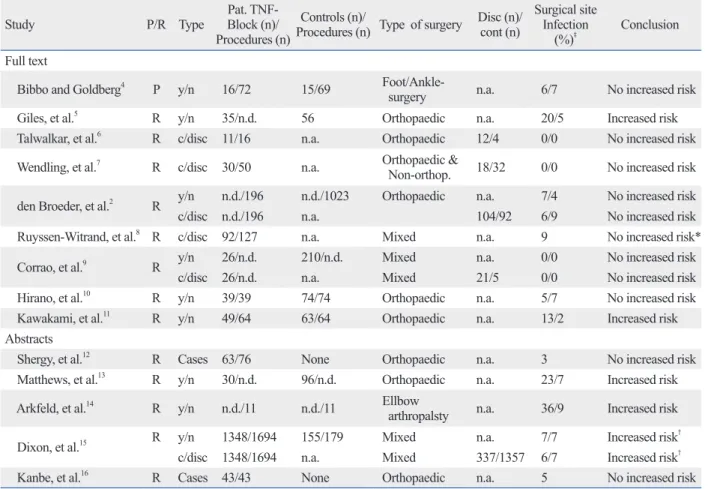
There were 6 y/n studies, 3 c/disc studies, and 3 papers that presented data both in a y/n and c/disc form. Two abstracts presented large case series. Nearly all participants in the studies had RA. Most procedures performed were ortho- paedic surgeries. Four studies (all of them of the y/n type) found an increased risk of infection with the use of TNF- BA whereas none of the other studies did find the increased risk. None of the c/disc studies found an increased risk of infection, when the medication was continued periopera- tively. All data are summarized in Table 1.
In sum, the results of the studies would indicate that the perioperative continuation of TNF-BA does not add sub- stantial risk of infection. However, patients on TNF-BA ap- pear in 4 of the y/n studies to be at higher risk of postopera- tive infectious complications than patients not receiving such treatment. The question arises whether such patients are a priori at higher infectious risk than patients not requir- ing TNF-BA.
There are a number of stumbling blocks to the clear inter- pretation of these studies. First and most obviously, only one of the studies is prospective. There are large differences in the percentages of infections in the studies, and this might be related to that (both Talwalkar, et al.6 and Wendling, et al.7 found 0%, while Arkfeld, et al.14 reported an infection rate of 36%). Thus, the definition of infection might differ among the studies, and retrospective assessment could be difficult. Furthermore, one could argue that different lengths of time are required for a patient to be considered off treat- ment, depending on the TNF-BA used. For instance, Dix- on, et al.15 had a 28 day threshold. Hirano, et al.10 stopped infliximab for 3-4 weeks and etanercept for 1-2 weeks prior to surgery. While one would agree that discontinuing etan- ercept for 4 weeks is an effective interruption, this would not be the case for infliximab, which is usually given every 8 weeks. In addition, it is not always the case that patients were “on drug” at the time of surgery in the y/n studies. For example, Matthews, et al.13 discontinued treatment in the TNF group for 2 weeks before and after surgery. One would, therefore, have to conclude that the increased risk found in this study was due to other factors. Furthermore, many of the studies included only a small number of pa- tients, making it difficult to detect differences between the groups. Finally, the type of surgery could well be of rele- vance to the rate of infectious complications.
The largest study included in the analysis was presented as an abstract.15 This study included a total of 5 groups [“on” and “off” drug during 28 days presurgery, “on” and crease the risk of perioperative infections. On the other
hand, discontinuation could lead to a disease flare that can limit postoperative rehabilitation and to the need for cortico- steroids, which in turn have unfavourable side effects on wound healing. We have previously presented a review on the perioperative management of anti-rheumatic medica- tion.3 Controversy on how TNF-BA can best be managed is ongoing, therefore, we decided to systematically review the literature on the infectious risk in patients treated with TNF- BA and summarized available data herein.
We performed a Medline (PubMed) search of the Eng- lish-language literature from the earliest entries to 2010.
The following index keywords were used: “arthritis” and (“surgery” or “perioperative”) and (“infliximab” or “adali- mumab” or “etanercept” or “certolizumab” or “golimum- ab” or “tumour necrosis factor”). In addition, we searched the online archive from the Annual European Congress of Rheumatology and the Annual Scientific Meeting of the American College of Rheumatology (ACR). References in retrieved articles were searched for further relevant studies.
If both a full text and an abstract were available, only the full text was used for analysis.
For the analysis, we accepted all relevant studies, wheth- er prospective or retrospective. In addition, we included case series with ≥10 patients. Those series with fewer than 10 patients were excluded, as we considered such reports not to provide sufficient information. Not included in the analysis were reviews, commentaries, editorials, letters to the editor (except for such with original data) or case re- ports. Fig. 1 shows the flow chart of article selection.
In general, the studies were of two types: the one type compared patients on TNF-BA with patients not receiving this treatment [“yes/no” studies; (y/n)]. In the second study type, all patients received TNF-BA: in these studies one group of patients continued treatment during surgery, while patients in the other group discontinued treatment [“contin- ued/discontinued” studies; (c/disc)]. Three of the studies looked at 3 groups; one group discontinuing treatment with TNF-BA at surgery, one continuing this treatment and a third group that did not receive these agents. For these stud- ies we present the data in both forms, as a y/n study and as a c/disc study; for the y/n presentation, all the patients on TNF-BA were grouped together, regardless of whether treatment was stopped at surgery or not.
Fourteen reports were analyzed. With one exception4 all were retrospective.2,5-16 Nine reports were published as stud- ies,2,4-11 and five reports were published only as abstracts.12-16
“off” drug at time of surgery, “DMARD” (disease-modify- ing anti-rheumatic drug) group]. For our presentation, the groups “on” and “off” drug at the time of surgery were ana- lyzed. It is of relevance to note that when Dixon, et al.15 compared the DMARD group with the group on drug, they stated that “after allowing for other risk factors” there “ap- pears” to be an increased risk for infections in patients ex- posed to TNF-BA. However, the data presented also show that there is no statistically significant difference in the rate of infections between those on or off drug. The confidence interval found is wide [OR 1.07 (0.58, 1.96)]. The interpre- tation of these results is, therefore, somewhat difficult: giv- en the confidence interval, the real risk may be lower in the TNF-BA group, but could also be twice as high as in the control group. However, given the data presented, an ap- propriate interpretation would be that the results do not nec- Table 1. Summary of the Results of All Included Studies
Study P/R Type Pat. TNF-
Block (n)/
Procedures (n)
Controls (n)/
Procedures (n) Type of surgery Disc (n)/
cont (n)
Surgical site Infection
(%)‡ Conclusion Full text
Bibbo and Goldberg4 P y/n 16/72 15/69 Foot/Ankle-
surgery n.a. 6/7 No increased risk
Giles, et al.5 R y/n 35/n.d. 56 Orthopaedic n.a. 20/5 Increased risk
Talwalkar, et al.6 R c/disc 11/16 n.a. Orthopaedic 12/4 0/0 No increased risk
Wendling, et al.7 R c/disc 30/50 n.a. Orthopaedic &
Non-orthop. 18/32 0/0 No increased risk den Broeder, et al.2 R y/n n.d./196 n.d./1023 Orthopaedic n.a. 7/4 No increased risk
c/disc n.d./196 n.a. 104/92 6/9 No increased risk
Ruyssen-Witrand, et al.8 R c/disc 92/127 n.a. Mixed n.a. 9 No increased risk*
Corrao, et al.9 R y/n 26/n.d. 210/n.d. Mixed n.a. 0/0 No increased risk
c/disc 26/n.d. n.a. Mixed 21/5 0/0 No increased risk
Hirano, et al.10 R y/n 39/39 74/74 Orthopaedic n.a. 5/7 No increased risk
Kawakami, et al.11 R y/n 49/64 63/64 Orthopaedic n.a. 13/2 Increased risk
Abstracts
Shergy, et al.12 R Cases 63/76 None Orthopaedic n.a. 3 No increased risk
Matthews, et al.13 R y/n 30/n.d. 96/n.d. Orthopaedic n.a. 23/7 Increased risk
Arkfeld, et al.14 R y/n n.d./11 n.d./11 Ellbow
arthropalsty n.a. 36/9 Increased risk
Dixon, et al.15 R y/n 1348/1694 155/179 Mixed n.a. 7/7 Increased risk†
c/disc 1348/1694 n.a. Mixed 337/1357 6/7 Increased risk†
Kanbe, et al.16 R Cases 43/43 None Orthopaedic n.a. 5 No increased risk
P, prospective; R, retrospective; y/n, “yes/no-studies”-comparison of patients with and without TNF-blockers; c/disc, “continued/discontinued”-studies - comparison of patients who continued or discontinued treatment with TNF-blocking agents; n.d., not determined; n.a., not applicable; TNF-BA, tumour necrosis factor blocking agents.
*c/disc is stratified in 3 groups (depending on duration of discontinuation), infections are mentioned only for the total group, the total complication rate was not influenced by time of discontinuing the drug.
†The authors of the mentioned abstract [15] conclude that there “appears” to be “a higher risk of infection”. Please also see main text.
‡Infections: in c/disc studies percentages for infections are given as: “discontinued/continued”. In y/n studies percentages for infections are given as: “with TNF-BA/without TNF-BA”.
Fig. 1. Literature review flow chart. TNF-BA, tumour necrosis factor block- ing agents.
1259 potentially relevant reports identified and screened for retrieval
83 reports retrieved for more detailed evaluation
14 articles reporting on perioperative risk of TNF-BA included in the analysis
1176 reports excluded on basis of title and/or review of the abstract [reviews, commentaries, letters to editor
(not in the form of a study), editorials]
69 reports excluded from analysis on basis of exclusion criteria [case reports, and case series n<10 (absence of control group); not reporting on perioperative complications;
infections in general during treatment with TNF-BA;
presented twice (as full text and abstract)]
a higher risk of postoperative infections than are patients not receiving this treatment. However, it should be emphasized that the quality of most trials published is rather poor. Given the-limited-published evidence, we believe that a pragmatic approach, scheduling surgery at the end of the drug interval and adding one “safety” week prior to surgery is an accept- able plan in daily clinical practice.
REFERENCES
1. Listing J, Strangfeld A, Kary S, Rau R, von Hinueber U, Stoyano- va-Scholz M, et al. Infections in patients with rheumatoid arthritis treated with biologic agents. Arthritis Rheum 2005;52:3403-12.
2. den Broeder AA, Creemers MC, Fransen J, de Jong E, de Rooij DJ, Wymenga A, et al. Risk factors for surgical site infections and other complications in elective surgery in patients with rheumatoid arthritis with special attention for anti-tumor necrosis factor: a large retrospective study. J Rheumatol 2007;34:689-95.
3. Pieringer H, Stuby U, Biesenbach G. Patients with rheumatoid ar- thritis undergoing surgery: how should we deal with antirheumatic treatment? Semin Arthritis Rheum 2007;36:278-86.
4. Bibbo C, Goldberg JW. Infectious and healing complications after elective orthopaedic foot and ankle surgery during tumor necrosis factor-alpha inhibition therapy. Foot Ankle Int 2004;25:331-5.
5. Giles JT, Bartlett SJ, Gelber AC, Nanda S, Fontaine K, Ruffing V, et al. Tumor necrosis factor inhibitor therapy and risk of serious postoperative orthopedic infection in rheumatoid arthritis. Arthritis Rheum 2006;55:333-7.
6. Talwalkar SC, Grennan DM, Gray J, Johnson P, Hayton MJ. Tu- mour necrosis factor alpha antagonists and early postoperative complications in patients with inflammatory joint disease undergo- ing elective orthopaedic surgery. Ann Rheum Dis 2005;64:650-1.
7. Wendling D, Balblanc JC, Brousse A, Lohse A, Lehuede G, Gar- buio P, et al. Surgery in patients receiving anti-tumour necrosis factor alpha treatment in rheumatoid arthritis: an observational study on 50 surgical procedures. Ann Rheum Dis 2005;64:1378-9.
8. Ruyssen-Witrand A, Gossec L, Salliot C, Luc M, Duclos M, Guignard S, et al. Complication rates of 127 surgical procedures performed in rheumatic patients receiving tumor necrosis factor alpha blockers. Clin Exp Rheumatol 2007;25:430-6.
9. Corrao S, Pistone G, Arnone S, Calvo L, Scaglione R, Licata G.
Surgery during etanercept therapy in patients with rheumatoid ar- thritis: is it time to follow patient preferences? Intern Emerg Med 2008;3:73-5.
10. Hirano Y, Kojima T, Kanayama Y, Shioura T, Hayashi M, Kida D, et al. Influences of anti-tumour necrosis factor agents on postoper- ative recovery in patients with rheumatoid arthritis. Clin Rheuma- tol 2010;29:495-500.
11. Kawakami K, Ikari K, Kawamura K, Tsukahara S, Iwamoto T, Yano K, et al. Complications and features after joint surgery in rheumatoid arthritis patients treated with tumour necrosis factor- alpha blockers: perioperative interruption of tumour necrosis fac- tor-alpha blockers decreases complications? Rheumatology (Ox- ford) 2010;49:341-7.
12. Shergy WJ, Phillips RM, Hunt RE, Hernandez J. Infliximab and its impact on surgical outcomes in patients with rheumatoid arthri-
essarily support the assumption of an increased infectious risk during treatment with TNF-BA.
A number of national specialist societies issued recom- mendations. The British Society for Rheumatology, for in- stance, recommends balancing the risks of postoperative in- fections against the risk of a peri-operative flare. If treatment is stopped, consideration should be given to stopping at a point before surgery that is 3 to 5 times the half-life of the drug (for infliximab that would be 8-9.5 days, etanercept 100 h, adalimumab 15-19 days). Treatment should not be restarted after surgery until there is “good wound healing and no evidence of infection”.17 The ACR advises that bio- logic agents (not restricted to TNF-BA) not be administered during the perioperative period: for at least 1 week prior to and 1 week after surgery. The “pharmacokinetic properties”
of the drug used and the “type of surgery” should be taken into account.18 The German Association of Rheumatology recommends to withhold the drug for a duration of twice the drug half-life before surgery.19
Given the data on TNF-BA presented in the reviewed studies, we could not find conclusive evidence that perioper- atively continued treatment with TNF-BA is associated with an increased number of infectious complications, compared to discontinued treatment. This is similar to the experience with methotrexate.20 We believe that it is important to pre- vent situations that make corticosteroids necessary postoper- atively, as these are associated with an increased risk of in- fections. The data available from these studies are not sufficient to allow final recommendations. The published literature does not necessarily support an increased risk for infection. However, the available evidence does not neces- sarily deny an increased risk for infection when TNF-BA are continued perioperatively. Large prospective trials are needed to finally clarify the risk of infection. Until such data are available our own pragmatic approach would be to schedule surgery at the end of a medication interval and probably add one extra “safety” week prior to surgery. This approach would be supported by the fact that most patients start to flare at that time point, indicating that the effects of the drug are wearing off. Treatment should be restarted when wound closure is more or less complete. For exam- ple, when suture material has been removed. This approach is similar to that proposed by the ACR.18
In summary, while in theory there is an increased risk of infections when TNF-BA are administered perioperatively, the available literature does not necessarily support this. It rather appears that patients receiving TNF-BA are a priori at
anti-TNF therapies. Rheumatology (Oxford) 2010;49:2217-9.
18. Saag KG, Teng GG, Patkar NM, Anuntiyo J, Finney C, Curtis JR, et al. American College of Rheumatology 2008 recommendations for the use of nonbiologic and biologic disease-modifying anti- rheumatic drugs in rheumatoid arthritis. Arthritis Rheum 2008;
59:762-84.
19. Neufassung der Empfehlungen der Deutschen Gesellschaft für Rheumatologie zur Therapie mit Tumornekrosefaktor-hemmen- den Wirkstoffen bei entzündlichrheumatischen Erkrankungen (Stand März 2006). http://dgrh.de/fileadmin/media/Praxis___
Klinik/Therapie-Empfehlungen/TNF-Blocker_06.pdf.
20. Grennan DM, Gray J, Loudon J, Fear S. Methotrexate and early postoperative complications in patients with rheumatoid arthritis undergoing elective orthopaedic surgery. Ann Rheum Dis 2001;
60:214-7.
tis. Ann Rheum Dis 2005;64(Suppl 3):1511.
13. Matthews JLK, Martin L, Hu R. Postoperative complications in rheumatoid arthritis patients on anti-TNF therapies undergoing or- thopaedic procedures. Ann Rheum Dis 2006;65(Suppl 2):331.
14. Arkfeld DG, Kasraeian S, Metyas S, Itomura J. Use of anti-TNF agents in 15 rheumatoid arthritis patients undergoing total elbow arthroplasty. Ann Rheum Dis 2007;66(Suppl 2):534.
15. Dixon WG, Lunt M, Watson KD, Hyrich KL. Anti-TNF therapy and the risk of serious post-operative infection: results from the BSR biologics register (BSRBR). Ann Rheum Dis 2007;66(Suppl 2):118.
16. Kanbe K, Inoue K, Chiba J. Risk factors of infection after ortho- paedic surgery with infliximab for rheumatoid arthritis. Ann Rheum Dis 2007;66(Suppl 2):174.
17. Ding T, Ledingham J, Luqmani R, Westlake S, Hyrich K, Lunt M, et al. BSR and BHPR rheumatoid arthritis guidelines on safety of