대한감각통합치료학회지 제19권 1호
The Journal of Korean Academy of Sensory Integration 2021 Vol. 19. No. 1
http://dx.doi.org/10.18064/JKASI.2021.19.1.69
국내의 발달성협응장애(DCD) 연구에 관한 체계적 고찰 : 평가와 중재접근 중심으로
김민주*, 최정실**
*경희대학교 공과대학 기계공학과 학술연구교수
**충북보건과학대학교 작업치료과 교수
국문초록
목적 : 본 연구는 발달성협응장애(Developmental Coordination Disorder; DCD)에 관한 국내 연구동향 및 DCD의 선별이나 중재에 관한 연구결과를 고찰하여 향후 관련 종사자들이 연구를 설계하거나 중재결과 를 효과적으로 제시할 수 있도록 기본정보를 제공하고자 한다.
연구방법 : 체계적 고찰방법을 사용하여 1990년 1월부터 2020년 12월까지 국내에서 발행된 논문들 중 발 달성협응장애와 관련된 논문을 검색하였다. 검색어는 국내의 연구현황을 확인하기 위해 ‘발달성협응장애’,
‘발달협응’, ‘발달적 협응’으로 선정하였다. 검색원은 한국교육학술정보원과 한국학술정보, 구글학술검색을 사용하였다. 검색된 4,878개의 논문 중 중복되어 검색된 논문과 배제기준에 해당되는 논문을 제외한 총 17편의 논문이 분석에 사용되었다. 선정된 논문은 DCD연구 중 평가와 중재접근을 분석하기 위하여 Wilson(2005)이 제시한 개념적 모델을 이용하였다.
결과 : 선정된 연구의 질적수준을 분석한 결과에 따르면 두 집단간의 비무작위 연구인 level Ⅱ가 70%를 차지하였다. 연구설계 시대상 아동의 DCD 유무를 판별하기 위해 Movement Assessment Battery for Children test(MABC)와 MABC Second Edition(MABC-2)(72%)가 운동발달 평가도구로 주로 사용 되었다. 중재연구 중 역동체계접근을 적용한 논문은 47%으로 가장 높았으며, 정상발달기술접근의 논문 과 인지적 신경과학을 적용한 논문은 각각 18%이었고, 신경발달이론을 적용한 논문은 11%이었다. 정상 발달기술접근과 일반적 능력접근을 병행한 논문은 6%로 가장 낮은 사용을 보였다. 이들 논문은 주로 DCD아동들의 운동특성이나 운동(체육)프로그램의 중재효과에 관한 것이었다.
결론 : 국내에서 진행된 DCD관련 연구는 대부분 DCD의 움직임 특성을 설명하거나 운동 중재프로그램의 효과성을 설명한 연구가 주류를 이루었다. 향후 DCD 연구에서는 국내 실정에 적합한 평가도구들의 타당 성에 관한 연구와 재활 분야에서 사용하고 있는 다양한 중재접근의 효과를 입증하여 DCD 아동의 운동 협응을 향상시키기 위한 시도가 필요하다.
주제어 : 발달성협응장애, 운동기술평가도구, 운동협응
교신저자: 최정실([email protected])
∥*이 논문은 2017년도, 2019년도 정부(교육부)의 재원으로 한국연구재단의 지원을 받아 수행된 기초연구사업임 (NRF-2017S1A5B5A01023531, No. 2019R1I1A1A01058996)
접수일: 2021.02.24. ∥심사일: 2021.03.11. ∥게재확정일: 2021.06.14.
Ⅰ. 서 론
유아 및 아동기는 인지 및 정서뿐 아니라 운동 기술이 급격히 변화하는 매우 중요한 시기이다. 특히 이 시기는 운동, 인지, 정서가 맞물려 변화하는 시기이며 어느 한 영역에서 발달의 문제가 발생하면 다른 발달영역에도 부 정적인 영향을 주게 된다. 이미 임상에서는 인지나 정서 발달의 선별과 조기 중재가 활발하게 이루어지고 있지만 운동발달 영역은 상대적으로 선별과 조기 중재에 대한 인식이 저조한 편이다. 또한 운동장애에 대한 의료적, 교 육적, 사회 복지적 지원 혜택을 받으려면 신체적 장애나 신경학적 결손이 확실한 운동장애를 가진 경우만 가능하 므로 그렇지 못한 일부 아동, 즉 운동의 어눌함(motor clumsiness)이 있는 경우는 사각지대에 놓여있다.
운동의 어눌함을 보이는 대표적인 질환으로 발달성협 응장애(Developmental Coordination Disorder; DCD) 가 알려져 있다. 일반적으로 정상아동의 5∼15%에서 운동 의 어눌함을 보인다고 보고되고 있다(American Psychiatric Association, 2013; Geuze, Jongmans, Schoemaker,
& Smits-Engelsman, 2001). 국내에서도 학령기 아동 의 약 5% 정도가 운동의 어눌함을 보이는 위험군으로 보 고된 바 있다(Kim, 2016a). 정신장애진단 및 통계편람 5판(Diagnostic and Statistical Manual of Mental Disorder-5; DSM-5)에서는 DCD의 주요특징으로 운동 의 어눌함을 설명하고 있다. DCD는 지적장애나 시각손 상으로 설명되지 않으며 뇌성마비, 근육퇴행위축, 퇴행 성 질환 같은 신경학적 손상이 없음에도 불구하고 운동 기술이 또래보다 현저하게 낮다. 이러한 운동의 어눌함 이 일상생활 활동, 학교생활, 놀이 등에 영향을 미칠 때 아동은 DCD로 진단될 수 있다. 이러한 발달성협응장애 의 증상은 발달 초기부터 운동발달의 지연을 보이며, 또 래 아동들에 비하여 비교적 부정확하고, 느리며, 운동의 가변성이 큰 특징을 보인다(Bair, Barela, Whitall, Jeka,
& Clark, 2011; Zwicker, Missiuna, Harris, & Boyd, 2012). 그러나, 전형적으로 발달성협응장애는 5세 이전 에는 진단되지 않는다. 이는 아동마다 운동기술을 습득 하는 연령에 상당한 편차가 있고, 아동기 초기에는 측정 방법의 진단 지속성이 부족하거나 운동지연을 야기하는 기타장애가 완전히 발현되지 않았기 때문이다(American Psychiatric Association, 2013).
국내에서 발달성협응장애에 대한 진단체계나 이들을 위한 지원이 부족한 이유는 운동발달 지연은 대수롭지 않게 여기는 사회적 분위기가 영향을 주고 있다. 이로 인 하여 대부분의 부모들은 스스로 수저질하기, 옷 갈아입 기, 공 던지기 같은 과제를 습득해야 할 시기가 되어야 자녀의 운동기술 발달이 어눌한 특성을 알아채거나 운동 협응의 문제를 인식하기 시작한다. 학령기가 되면 좀 더 확연하게 대근육 혹은 소근육 운동기술이 필요한 놀이나 체육 수업에 참여하는데 어려움을 보이며, 글씨 쓰기, 그 림 그리기, 소지품 정리하기 등에서 문제를 경험하게 된 다. DCD로 진단받은 아동의 50%에서 나타나는 이러한 운동의 어눌함과 협응의 문제는 청소년 및 성인 시기까지 지속된다고 보고된 바 있다(Kirby, Sugden, Beveridge,
& Edwards, 2008). 또한 이들은 성인이 되어도 일상생활 에서도 불편함을 갖고 살면서 신체활동을 즐겨하지 않는 비활동적 생활습관을 보인다(Cairney, Hay, Veldhuizen,
& Faught, 2010; Rasmussen & Gillberg, 2000). 인지 적 처리과정 측면에서도 느린 정보처리 능력을 보이며 (Nam et al., 2017), 낮은 학업성취도(Dewey, Kaplan, Crawford, & Wilson, 2002)를 보이거나 사회성이나 정서발달이 지연된다(Piek, Barrett, Allen, Jones, &
Louise, 2005). 따라서 이러한 아동을 조기에 선별하는 것은 전인적인 발달을 위하여 반드시 필요하다.
DCD를 판별하는 평가에 있어서 영국, 캐나다, 미국의 작업치료사들은 DCD의 진단에 필요한 정보 즉 운동기술 평가 결과와 운동기술의 결함으로 인하여 영향을 받는 작업(occupation)과의 관계를 설명하는 역할을 수행하 고 있다(Kennedy, Brown, & Stagnitti, 2013). 또한 임 상에서 주로 다루는 주의력 결핍 및 과잉행동장애, 난독 증, 자폐성장애도 운동협응의 문제가 있음을 인식하고 있다. 그러나 이러한 증상이 DCD의 증상과 직접적인 관 계가 있는지는 아직도 많은 논의가 되고 있는 주제이다.
이러한 운동의 어눌함이나 발달지연을 선별 혹은 확인하 기 위하여 Movement Assessment Battery for Children test/checklist(MABC/MABC checklist), Bruininks- Oseretsky Test of Motor Proficiency(BOTMP), Developmental Coordination Disorder Questionnaire (DCDQ)등의 평가도구가 가장 널리 사용되고 있다. 캐나 다의 경우, 작업치료분야에서 DCD를 판별하는데 감각프 로파일(Sensory Profile)을 사용하고 있었다(Karkling,
Paul, & Zwicker, 2017). 그러나 감각프로파일은 일반 적으로 감각처리능력이 일상생활을 방해하는 요인으로 의심되는 원인을 확인하기 위하여 사용할 수 있는 2차 평 가도구이지 DCD의 진단기준을 확인하기 위한 선별도구 로 사용하는 것은 바람직하지 못하다(Karkling, Paul, &
Zwicker, 2017). 현재 작업치료분야에서는 운동의 어눌 함을 감각프로파일과 BOTMP 혹은 Bruininks-Oseretsky Test of Motor Proficiency-2(BOT-2)의 검사결과를 근거로 설명하고 있을 뿐 DCD같은 진단을 내릴 수 있는 근거는 부족한 편이다. 그 이유는 아직 국내에서는 DCD 를 진단하기 위한 표준화된 도구가 없고 사회문화적 환 경에 적합한 DCD 진단체계 및 분류에 관한 관련 전문가 들 간의 합의가 이루어지지 않은 상태이기 때문이다 (Choi, 2018). 최근에 부모나 선생님에게 설문을 통해 DCD를 확인할 수 있는 DCDQ라는 설문지가 국내용으로 번안되었으나(Ko, Lee, Woon, & Kim, 2020), 이는 아 동의 운동기술을 직접 평가하지 않는다는 점에서 Movement Assessment Battery for Children Second Edition (MABC-2)와 대비되는 특징을 보인다.
국내외적으로 이러한 평가도구들을 사용하여 운동기 술의 현저한 지연을 보이는 DCD를 대상으로 한 중재 연구가 다양하게 진행되어왔다. DCD 관련 중재법에 대한 연구는 국외의 경우 1970년부터 1996년까지는 감 각통합(sensory integration), 고유감각훈련(kinaesthetic training), 지각훈련(perceptual training) 중 두 가지 방법을 결합한 중재법을 사용하였다. 그 결과 감각통합기 능, 고유감각 기능, 근력, 체간의 안정성, 시운동지각 등 더 나은 운동기술을 수행하는데 효과를 다양하게 규명해 왔다(Sugden, 2007). 1996년 이후부터는 클라이언트 중 심, 운동조절 혹은 운동학습, 생태학적 관점(ecological principles)에 초점을 둔 신경운동훈련(neuromotor task training)과 인지기반 작업수행모델(cognitive orientation to daily occupational performance)의 연구가 진행되 고 있다. 최근에는 과제중심 접근인 신경운동훈련, 인지 기반 작업수행 모델, 상상훈련(imagery training)을 새롭 게 적용하는 시도가 많아지고 있다(Smits-Englesman et al., 2013; Sugden & Dunford, 2007). 이러한 국외 의 추세에 맞추어 국내에서도 비슷한 중재 설계의 연구 가 진행되고 있다. 국내에서는 2000년대 초부터 DCD에 대한 관심을 갖기 시작하였고 감각통합, 고유감각훈련,
지각훈련 등의 중재효과에 대한 사례연구가 중심이 되어 오다가 최근에 과제중심의 중재방법에 관한 연구결과가 발표되기 시작하였다.
운동의 어눌함에 대한 국내에서의 관심은 주로 의학, 보건학, 체육학 분야에서 증가하고 있다. 그러나 여전히 국내에서 DCD를 조기진단하기 위한 적절한 평가도구에 관한 연구가 부족한 게 현실이다(Choi, 2018). 이는 아 직 진단체계가 구체적으로 제시되어 있지 않고, 치료 분 야에서도 다소 생소한 증상으로 여겨지는 DCD의 특성 때문에 나타난 현상으로 볼 수 있다. 따라서 본 연구의 목적은 DCD에 관한 평가 혹은 이들을 위한 중재한 연구 결과를 체계적으로 고찰하여 향후 작업치료사뿐만 아니 라 관련 종사자들에게 DCD에 관한 이해를 높이고 이들 을 위한 연구를 설계하거나 중재연구를 고려할 때 활용 할 수 있는 기본정보를 제공하는데 있다.
Ⅱ. 본 론
1. 자료 수집 방법 및 연구 대상본 연구는 1990년 1월부터 2020년 12월까지 국내에 서 발행된 논문들 중 DCD 평가와 중재와 관련된 국내 연구동향을 분석하기 위하여 학회지에 게재된 논문 을 검색하였다. 검색원은 한국교육학술정보원(Research Information Sharing Service; RISS)과 한국학술정보 (Korean Studies Information Service System; KISS), 구글 학술검색(Google Scholar)을 사용하였다. 검색어는
‘발달성협응장애(developmental coordination disorder)’,
‘발달협응(development coordination)’, ‘발달적 협응 (developmental coordination)’으로 검색하였다. 본 연 구의 제1저자가 검색된 총 4,878편의 논문의 제목과 초 록을 검토하여 한 검색원에서 중복되어 검색된 논문이나 다른 검색원에서도 동일한 논문이 검색된 경우를 제외하 는 1차 분석을 실시하였다. 2차 분석은 본 연구의 저자 간 충분한 토론을 걸쳐서 정해진 포함기준과 배제기준에 따라 논문의 원문을 확인하여 최종적으로 선정된 분석대 상 연구는 총 17편을 사용하였다(Figure 1). 본 연구에 참여한 저자는 작업치료학과 교수 1인과 운동발달 분야 의 연구교수 1인이며, 해당 DCD에 관한 국가과제 및 다 수의 연구를 진행한 DCD 분야의 전문가로 구성되었다.
1) 포함기준
(1) 5세 이상의 아동이 DCD 진단을 받았거나 선별을 포함한 경우
(2) DCD 관련 평가와 중재에 관한 논문
2) 배제기준
(1) 대상자의 운동발달지연이 DCD가 원인이 아닌 경우 (주의력 결핍 및 과잉행동장애, 난독증, 자폐성장 애 등 기타 발달장애로 인한 협응 문제)
(2) 학위논문과 고찰논문인 경우 (3) DCD의 유병률 연구인 경우
2. 분석내용
분석 대상 논문의 질적 수준을 평가하기 위해 연구의
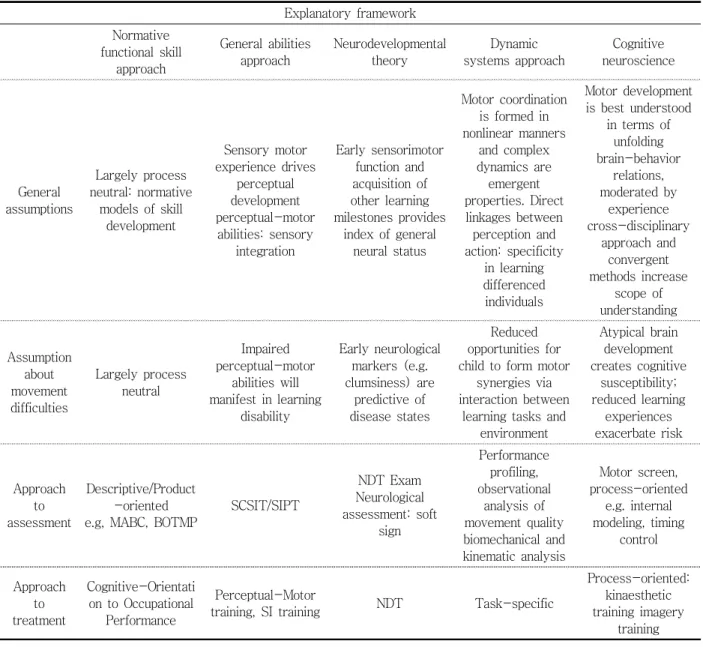
근거기반 수준(hierarchy of levels of evidence-based practice)을 사용하였다(Arbesman, Scheer, & Lieberman, 2008). 이 모델에서 level Ⅰ은 무작위 대조연구, 두 집단 간의 비무작위 연구는 level Ⅱ, 단일집단의 비무작위 연 구는 level Ⅲ, 개별실험연구와 조사연구는 level Ⅳ, 사례 연구는 level Ⅴ로 분류되어있으며, 단위가 낮을수록 근거 수준이 높음을 의미한다. 그리고 DCD관련 평가와 중재에 대한 고찰을 위하여 Wilson(2005)이 제시한 개념적 모델 을 사용하여 분석하였다. Wilson(2005)은 운동장애 (movement disorder)의 다양한 설명적 모델을 5개로 나 누었다. 정상발달기술 접근(normative functional skill approach), 일반적 능력 접근(general abilities approach), 신경발달이론(neurodevelopmental theory), 역동체계 접근(dynamical systems approach), 인지적 신경과학 (cognitive neuroscience)이다. 이 개념적 모델은 각각의 4,878 of records through three database were identified.
All search terms were in Korean
RISS (
n
=203) KISS (n
=30) Google Scholar (n
=4,645)Developmental coordination disorder (
n
=11)Developmental coordination disorder (
n
=3)Developmental coordination disorder (
n
=110)Development coordination (
n
=175) Development coordination (n
=17) Development coordination (n
=3,870) Developmental coordination (n
=17) Developmental coordination (n
=10) Developmental coordination (n
=665)
98 studies assessed for eligibility based on title and abstract
RISS KISS Google Scholar
(
n
=33) (n
=13) (n
=52)
Articles excluded after sorting duplicate publications
74 articles reserved for full text screening from each database
RISS KISS Google Scholar
(
n
=30) (n
=16) (n
=28)
Combining the lists from each database after screening duplicate publication
38 of full-text articles included for analysis Studies excluded (
n
=21)1) DCD with comorbidity (
n
=6) 2) Dissertation (n
=8)3) Review articles (
n
=7)
Total 17 articles included for analysis Figure 1. Search process
RISS: Research Information Sharing Service, KISS: Korean Studies Information Service System, DCD: Developmental Coordination Disorder
모델에서 운동장애에 대한 가정과 평가도구, 치료접근에 대하여 개념적으로 틀을 마련하였다(Table 1).
Ⅲ. 연구결과
1. 분석 대상 연구의 특성과 근거수준
분석에 사용한 연구는 총 17편으로 1990∼2020년까 지 발행된 논문 중 만 5세 이상 DCD 증상을 보인 아동을
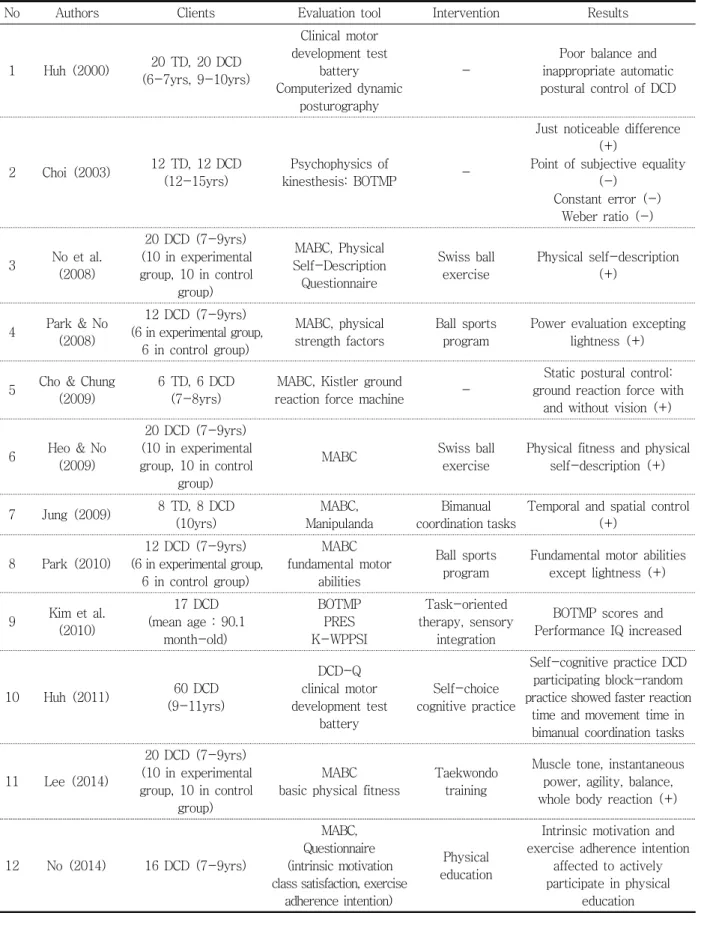
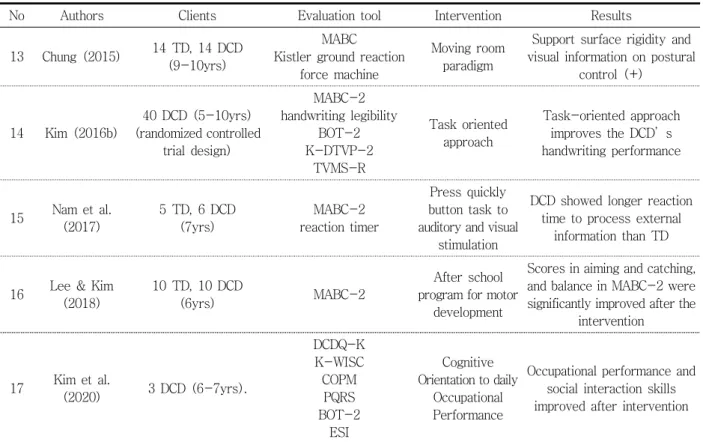
대상으로 일반 아동과의 차이를 평가하거나 중재를 제공 하여 그 효과를 규명하였다. 구체적인 연구대상자, DCD 평가도구 및 중재, 이에 따른 연구결과에 관한 구체적인 내용은 Table 2와 같다. 구체적으로 분석대상의 논문의 근거기반 수준은 두 집단 간의 비무작위 연구인 수준Ⅱ 가 12편으로 70%의 높은 빈도를 보였으며, 근거수준 Ⅲ 이 3편이고, 근거수준Ⅰ과 Ⅴ는 각각 1편씩으로 낮은 빈 도를 보였다(Table 3).
Table 1. Summary of explanatory frameworks informing different approaches to assessment and treatment of DCD Explanatory framework
Normative functional skill
approach
General abilities approach
Neurodevelopmental theory
Dynamic systems approach
Cognitive neuroscience
General assumptions
Largely process neutral: normative
models of skill development
Sensory motor experience drives
perceptual development perceptual-motor
abilities: sensory integration
Early sensorimotor function and acquisition of other learning milestones provides
index of general neural status
Motor coordination is formed in nonlinear manners
and complex dynamics are emergent properties. Direct linkages between perception and action: specificity
in learning differenced individuals
Motor development is best understood
in terms of unfolding brain-behavior
relations, moderated by
experience cross-disciplinary
approach and convergent methods increase
scope of understanding
Assumption about movement difficulties
Largely process neutral
Impaired perceptual-motor
abilities will manifest in learning
disability
Early neurological markers (e.g.
clumsiness) are predictive of disease states
Reduced opportunities for child to form motor
synergies via interaction between
learning tasks and environment
Atypical brain development creates cognitive
susceptibility;
reduced learning experiences exacerbate risk
Approach to assessment
Descriptive/Product -oriented e.g, MABC, BOTMP
SCSIT/SIPT
NDT Exam Neurological assessment: soft
sign
Performance profiling, observational
analysis of movement quality biomechanical and kinematic analysis
Motor screen, process-oriented
e.g. internal modeling, timing
control
Approach to treatment
Cognitive-Orientati on to Occupational
Performance
Perceptual-Motor
training, SI training NDT Task-specific
Process-oriented:
kinaesthetic training imagery
training BOTMP: Bruininks-Oseretsky Test of Motor Proficiency, MABC: Movement Assessment Battery for Children, NDT:
Neurodevelopmental Treatment, SCSIT/SIPT: Southern California Sensory Integration/Sensory Integration and Praxis Tests
Table 2. Summary of reviewed studies
No Authors Clients Evaluation tool Intervention Results
1 Huh (2000) 20 TD, 20 DCD (6-7yrs, 9-10yrs)
Clinical motor development test
battery Computerized dynamic
posturography
-
Poor balance and inappropriate automatic postural control of DCD
2 Choi (2003) 12 TD, 12 DCD (12-15yrs)
Psychophysics of
kinesthesis: BOTMP -
Just noticeable difference (+)
Point of subjective equality (-)
Constant error (-) Weber ratio (-)
3 No et al.
(2008)
20 DCD (7-9yrs) (10 in experimental group, 10 in control
group)
MABC, Physical Self-Description Questionnaire
Swiss ball exercise
Physical self-description (+)
4 Park & No (2008)
12 DCD (7-9yrs) (6 in experimental group,
6 in control group)
MABC, physical strength factors
Ball sports program
Power evaluation excepting lightness (+)
5 Cho & Chung (2009)
6 TD, 6 DCD (7-8yrs)
MABC, Kistler ground
reaction force machine -
Static postural control:
ground reaction force with and without vision (+)
6 Heo & No (2009)
20 DCD (7-9yrs) (10 in experimental group, 10 in control
group)
MABC Swiss ball
exercise
Physical fitness and physical self-description (+)
7 Jung (2009) 8 TD, 8 DCD (10yrs)
MABC, Manipulanda
Bimanual coordination tasks
Temporal and spatial control (+)
8 Park (2010)
12 DCD (7-9yrs) (6 in experimental group,
6 in control group)
MABC fundamental motor
abilities
Ball sports program
Fundamental motor abilities except lightness (+)
9 Kim et al.
(2010)
17 DCD (mean age : 90.1
month-old)
BOTMP PRES K-WPPSI
Task-oriented therapy, sensory
integration
BOTMP scores and Performance IQ increased
10 Huh (2011) 60 DCD
(9-11yrs)
DCD-Q clinical motor development test
battery
Self-choice cognitive practice
Self-cognitive practice DCD participating block-random practice showed faster reaction
time and movement time in bimanual coordination tasks
11 Lee (2014)
20 DCD (7-9yrs) (10 in experimental group, 10 in control
group)
MABC basic physical fitness
Taekwondo training
Muscle tone, instantaneous power, agility, balance, whole body reaction (+)
12 No (2014) 16 DCD (7-9yrs)
MABC, Questionnaire (intrinsic motivation class satisfaction, exercise
adherence intention)
Physical education
Intrinsic motivation and exercise adherence intention
affected to actively participate in physical
education
2. 국내의 DCD 관련 연구동향
1) DCD 고찰연구 관련 설명의 틀
DCD와 관련한 평가와 중재에 대한 연구를 고찰하기 위하여 Wilson(2005)이 제시한 개념적 모델을 사용하였
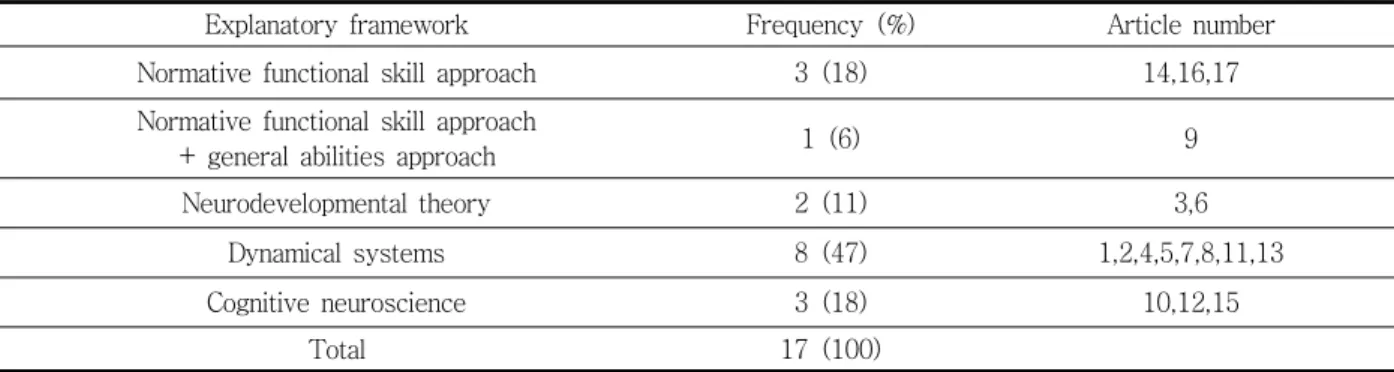
다. 그 결과 정상발달기술 접근을 사용한 논문은 3편, 정 상발달기술 접근과 일반적 능력 접근을 병행한 논문은 1 편, 신경발달이론을 적용한 논문은 2편, 역동체계접근을 적용한 논문은 8편, 인지적 신경과학을 적용한 논문은 3 편이었다(Table 4). 국내에서는 DCD와 관련하여 DCD 여부를 판단하는 평가와 운동기술 향상을 위한 중재에 Table 2. Summary of reviewed studies (Cont.)
No Authors Clients Evaluation tool Intervention Results
13 Chung (2015) 14 TD, 14 DCD (9-10yrs)
MABC
Kistler ground reaction force machine
Moving room paradigm
Support surface rigidity and visual information on postural
control (+)
14 Kim (2016b)
40 DCD (5-10yrs) (randomized controlled
trial design)
MABC-2 handwriting legibility
BOT-2 K-DTVP-2
TVMS-R
Task oriented approach
Task-oriented approach improves the DCD’s handwriting performance
15 Nam et al.
(2017)
5 TD, 6 DCD (7yrs)
MABC-2 reaction timer
Press quickly button task to auditory and visual
stimulation
DCD showed longer reaction time to process external
information than TD
16 Lee & Kim (2018)
10 TD, 10 DCD
(6yrs) MABC-2
After school program for motor
development
Scores in aiming and catching, and balance in MABC-2 were significantly improved after the
intervention
17 Kim et al.
(2020) 3 DCD (6-7yrs).
DCDQ-K K-WISC COPM PQRS BOT-2
ESI
Cognitive Orientation to daily
Occupational Performance
Occupational performance and social interaction skills improved after intervention
BOTMP: Bruininks-Oseretsky Test of Motor Proficiency, COPM: Canadian Occupational Performance Measure, DCD:
Developmental Coordination Disorder, DCD-Q/DCDQ-K: Developmental Coordination Disorder Questionnaire /Developmental Coordination Disorder Questionnaire Korean, ESI: Evaluation of Social Interaction, K-DTVP-2: Korean Developmental Test of Visual Perception-2, K-WISC: Korean Wechsler Intelligence Scale for Children, K-WPPSI: Koean Wechsler Preschool and Primary Scles of Intelligence, MABC/MABC-2: Movement Assessment Battery for Children/Movement Assessment Battery for Children-2, PQRS: Performance Quality Rating Scale, TVMS-R: Test of Visual Motor Skills- Revised
Table 3. Level of evidence
Evidence level Definition Frequency (%) Article number
Ⅰ Randomized controlled trials 1 (6) 14
Ⅱ Two group, non-randomized studies 12 (70) 1,2,3,4,5,6,7,8,11,13,15,16
Ⅲ One group, non-randomized studies 3 (18) 9,10,12
Ⅳ Single-subject designs 1 (6) 17
Ⅴ Case reports 0 (0) -
Total 17 (100)
대한 개념적 설명모델로 역동체계접근을 주로 사용한 연 구가 많았다.
2) DCD 선별에 사용한 평가도구
국내 연구자들이 DCD의 유무를 선별하기 위하여 사 용한 평가도구로 MABC/MABC-2를 가장 많이 사용해 왔다. 그 밖에 BOTMP와 DCD-Q, 임상적 운동발달 검 사를 사용하여 DCD를 평가하였다(Table 5).
3) 연구에 활용한 중재방법
17편의 논문 중 중재에 관한 논문은 14편이다(Table 6).
14편의 논문에서 주로 특정한 운동 과제를 반복 훈련하 는 방식으로 중재가 제공되었다. 주로 공이나 태권도 등 을 활용한 스포츠 프로그램, 양측협응 과제 등이 중재방 법으로 사용되었다. 나머지 연구에서는 각각 인지기반 작업수행중재와 운동감각훈련/상상훈련을 주로 사용하 였다. 인지기반 작업수행중재에서는 주로 글씨쓰기 과제 를 사용하였고, 운동감각훈련/상상훈련에서는 빠르게 버튼을 누르는 과제, 운동과제, 청각이나 시각을 활용한 과제로 반응시간을 촉진하는 훈련을 주로 하였다.
Table 4. Summary of explanatory frameworks informing different approaches to assessment and treatment of DCD
Explanatory framework Frequency (%) Article number
Normative functional skill approach 3 (18) 14,16,17
Normative functional skill approach
+ general abilities approach 1 (6) 9
Neurodevelopmental theory 2 (11) 3,6
Dynamical systems 8 (47) 1,2,4,5,7,8,11,13
Cognitive neuroscience 3 (18) 10,12,15
Total 17 (100)
Table 5. DCD Screening tools
Evaluation tool Frequency (%) Article number
MABC/MABC-2 13 (72) 3,4,5,6,7,8,11,12,13,14,15,16,
BOTMP 2 (11) 2,9
DCD-Q/DCDQ-K 2 (11) 10,17
Clinical motor development test battery 1 (6) 1
Total 17 (100)
MABC/MABC-2: Movement Assessment Battery for Children/Movement Assessment Battery for Children-2, BOTMP:
Bruininks-Oseretsky Test of Motor Proficiency DCD-Q/DCDQ-K: Developmental Coordination Disorder Questionnaire/
Developmental Coordination Disorder Questionnaire Korean Table 6. Intervention types
Intervention Frequency (%) Article number
CO-OP 3 (21) 14,16,17,(9)*
Perceptual-motor training/SI 1 (7) 9
NDT 2 (15) 3,6
Task-specific 5 (36) 4,7,8,11,13,
Kinaesthetic training/imagery training 3 (21) 10,12,15
Total 14 (100)
CO-OP: Cognitive Orientation to Daily Occupational Performance, NDT: Neurodevelopmental Treatment, SI: Sensory Integration
*Article number 9 includes cases of CO-OP and SI.
Ⅳ. 고 찰
본 연구는 국내에서 아직 개념이 생소하여 널리 알려 지지 않은 DCD에 관한 평가 혹은 이들을 위한 중재한 연 구결과를 체계적으로 고찰하여 추후에 DCD 관련 연구설 계 및 중재결과를 효과적으로 제시할 수 있는 방법을 모 색하는 데 있다. 이를 위하여 최근 30년 동안 국내에서 수행된 DCD 관련 연구들 중에서 평가와 중재에 초점을 둔 논문들을 선정하였으며, 체계적 고찰방법을 사용하여 선정된 논문의 특성을 분석하였다.
본 연구에서 선정된 17편의 논문의 분석결과, 질적 수 준이 level Ⅱ인 두 집단 간의 비무작위 연구논문이 70%
를 차지하였으며 국내에서 진행된 연구들이 대부분 비교 적 높은 수준의 근거수준을 보이는 것으로 확인되었다.
또한, Wilson(2005)이 제시한 DCD 관련 개념적 모델로 분석한 결과 역동체계접근의 설명적 틀을 사용한 빈도가 가장 높았다. 이들 연구에서 대부분 평가영역에서는 DCD 아동의 운동발달 특성이 정상아동과 차이가 있는 변인에 초점을 두었고, 중재 영역에서는 공을 활용하거 나 태권도와 같은 특정한 운동프로그램을 적용한 스포츠 를 활용한 중재가 운동협응능력이 향상되는 중재의 효과 성을 입증하였다.
본 연구결과에 따르면 국내에서도 DCD관련 연구가 활발히 진행되고 있는 캐나다와 마찬가지로 DCD를 판별 하기 위해 MABC/MABC-2를 사용하였다. 이는 MABC/
MABC-2이 DSM-5에서 제시한 진단기준에 부합한 근 거를 제시하기 위해 사용하는 전형적인 운동성 평가도 구이기 때문에 이를 근거로 국내에서도 가장 널리 쓰 이고 있다고 판단된다(Blank et al., 2019). 본 연구결과 MABC/MABC-2 이외에 운동성평가도구로 BOTMP/
BOT-2를 사용하는 것으로 나타났다. 이러한 도구들은 MABC/MABC-2와 달리 DCD판별의 목적이 아닌 DCD 아동의 중재 후 운동성 변화를 보여줄 수 있는 결과치를 측정하기 위하여 사용되었다.
국외에서는 DCD의 판별과 중재효과성을 보여주기 위 하여 주로 MABC/MABC-2를 사용하고 있다(Civetta &
Hillier, 2008; Schoemaker, Niemeijer, Flapper, &
Smits-Englesman, 2012). 그러나 국내에서는 아직까 지 MABC/MABC-2에 대한 임상의 인식이 낮고 주로 연 구 분야에서 사용하고 있기 때문에 중재효과를 관찰하는
데 BOTMP/BOT-2를 더 익숙하고 선호하는 경향이 있 다(Kim, 2015). 최근에 발간된 연구에서 작업치료사들 을 대상으로 MABC-2를 교육하였는데 단시간 내에 MABC-2를 훈련한 작업치료사들의 평가역량이 향상됨 을 입증한 바 있었다(Choi & Kim, 2020). 따라서, 국내 에서도 작업치료 임상 분야에서 정상발달과 발달지연 경 계에 있거나 신경학적 정형외과적 손상이 없어도 운동장 애가 있는 아동에게 BOTMP/BOT-2보다 쉽게 적용할 수 있는 MABC-2의 사용을 고려할 필요가 있겠다.
본 연구의 DCD관련 중재연구의 고찰 결과는 Lee와 Kim(2019)이 고찰한 결과와 비슷하다. 다만 Lee와 Kim(2019)의 연구는 본 연구와 달리 학위논문을 포함하 고 있어서, 공과 태권도 같은 운동프로그램 이외에 변형 된 형태의 골프나 탁구와 같은 운동중재를 추가적으로 언급하고 있었다. 그럼에도 아직까지 국내의 DCD관련 운동중재의 연구의 수는 매우 적고 연령대도 아동기까지 로 제한적이다. 이러한 DCD 증상을 방치할 경우, 성인 기까지 운동장애를 경험할 수 있다는 연구결과를 고려한 다면 단순히 유아 및 아동기에 그치지 않고 전생애적으 로 관리되어야 함을 이해해야 할 것이다(Kirby et al., 2008). 또한 DCD아동을 위한 운동프로그램이 현재보다 는 다양한 운동기술의 종류와 수준을 적절하게 구성한 프로그램개발이 필요할 것으로 보인다(Lee & Kim, 2019). 그 밖에 DCD관련 중재로 인지기반 작업수행 중 재와 운동감각훈련/상상훈련을 주로 사용하였다. 인지 기반 작업수행 중재에서는 주로 글씨쓰기 과제를 사용하 였고, 운동감각훈련/상상훈련에서는 빠르게 버튼을 누 르는 과제, 운동 과제, 청각이나 시각을 활용한 과제로 반응시간을 촉진하는 훈련을 주로 하였다. 오히려 오랫 동안 작업치료와 같은 재활현장에서는 운동발달에 지연 을 보이는 아동을 위하여 감각운동기능을 향상시키는 감 각통합치료와 신경발달치료를 제공해왔으나 DCD관련 해서는 근거가 부족한 게 사실이다. 본 연구의 고찰 결과 로 살펴보면 국내에서 감각통합 중재는 보조치료로 사용 하는 수단으로 사용되었고 신경발달치료도 특별한 운동 기술을 학습하는 데 초점을 두는 게 전부였다. 최근에 외 국 문헌에서는 DCD아동의 운동발달과 지적발달에 감각 통합 중재의 효과가 미비하다는 것이 임상적 근거로 취 급되고 있다(Wilson, 2005). 따라서 향후 연구에서는 이 러한 부분을 확인하는 과정이 필요하다.
DCD는 신체적, 신경학적 장애가 없지만 운동기술 발 달에 있어 현저한 지연을 보이는 특성이 있다. 국제적으 로 DSM-5에서 제시한 진단기준에 맞추어 DCD와 관련 된 국제적인 임상 권고사항이 마련될 만큼 관심받고 있 는 진단임에도 불구하고 아직 국내에서는 이 부분에 대 한 인식이 부족한 게 현실이다. 향후 본 고찰 논문의 결 과를 기초로 하여 국내에서 DCD 선별하거나 임상가, 작 업치료사, 체육 교사 등이 중재프로그램을 계획 시 평가 도구를 선택하고 효과적인 중재프로그램을 개발하는데 필요한 기초자료로 활용될 것으로 보인다.
Ⅴ. 결 론
본 연구는 향후 DCD 관련 종사자들이 연구를 설계하 고 중재 결과를 효과적으로 제시할 수 있도록 기본정보 를 제공하고자 DCD 평가와 중재에 관한 17편의 논문을 선정하여 체계적으로 고찰하였다. 분석결과 국내에서 진 행된 DCD 관련 연구는 대체로 DCD의 운동특성을 설명 하기 위한 평가 관련 논문이나 체육 및 스포츠 분야에서 제공된 운동 중재프로그램의 효과성을 설명한 연구들이 대부분이었다. 향후 DCD 연구에서는 국내 실정에 맞는 평가도구들의 타당성에 관한 연구와 재활 분야에서 사용 하고 있는 다양한 중재접근의 효과를 입증하는 시도가 필요할 것으로 보인다. 본 연구는 DCD 관련 종사자들이 DCD를 선별하거나 중재프로그램 계획할 때 평가도구를 선택하고 효과적인 중재프로그램을 개발하는데 필요한 기초자료로 활용될 것으로 보인다.
참고 문헌
American Psychiatric Association. (2013). Diagnostic and statistical manual of mental disorders (DSM-5®). American Psychiatric Publishing.
Arbesman, M., Scheer, J., & Lieberman, D. (2008).
Using AOTA's critically appraised topic(CAT) and critically appraised paper(CAP) series to link evidence to practice. OT Practice, 13(12), 18-22.
Bair, W. N., Barela, J. A., Whitall, J., Jeka, J. J.,
& Clark, J. E. (2011). Children with developmental coordination disorder benefit from using vision in combination with touch information for quiet standing. Gait and Posture, 34(2), 183-190.
https://doi.org/papers2://publication/doi/10.1 016/j.gaitpost.2011.04.007
Blank, R., Barnett, A. L., Cairney, J, Green, D., Kirby, A., Polatajko, H., et al. (2019). International clinical practice recommendations on the definition, diagnosis, assessment, intervention, and psychosocial aspects of developmental coordination disorder. Developmental Medicine Child Neurology, 61(3), 242-285. https://doi.org/
10.1111/dmcn.14132
Cairney, J., Hay, J., Veldhuizen, S., & Faught, B.
E. (2011). Trajectories of cardiorespiratory fitness in children with and without developmental coordination disorder: A longitudinal analysis.
British Journal of Sports Medicine, 45(15), 1196-1201. https://doi.org/10.1136/bjsm.2009.
069880
Cho, Y. J., & Chung, H. C. (2009). Static postural control of 7- and 8- year old children with developmental coordination disorder in conditions with and without vision. Journal of Sport and Leisure Studies, 37(2), 1324-1332.
Choi, J. S. (2018). Reliability and validity of the movement assessment battery for children-2 checklist. Chungnam National University, Daejeon.
Choi, J. S., & Kim, M. J. (2020). The effect of education on motor skill assessment tool for occupational therapist. Journal of Korean Society of Community Based Occupational Therapy, 10(2), 63-72.
https://doi.org/10.18598/kcbot.2020.10.2.06 Choi, S. O. (2003). Psychophysical analysis of
kinesthesis in individuals with developmental coordination disorder. Journal of Adapted Physical Activity & Exercise, 11(1), 157-168.
Chung, H. (2015). The influence of support surface
rigidity and visual information on postural control in children with developmental coordination disorder. Journal of Sport and Leisure Studies, 59(1), 635-644.
Civetta, L. R., & Hillier, S. L. (2008). The developmental coordination disorder questionnaire and movement assessment battery for children as a diagnostic method in Australian children.
Pediatric Physical Therapy, 20(1), 39-46.
https://doi.org/10.1097/PEP.0b013e31815ccaeb Dewey, D., Kaplan, B. J., Crawford, S. G., & Wilson,
B. N. (2002). Developmental coordination disorder: Associated problems in attention, learning, and psychosocial adjustment. Human Movement Science, 21(5-6), 905-918. https://doi.
org/10.1016/s0167-9457(02)00163-x
Geuze, R. H., Jongmans, M. J., Schoemaker, M. M.,
& Smits-Engelsman, B. C. (2001). Clinical and research diagnostic criteria for developmental coordination disorder: A review and discussion.
Human Movement Science, 20(1), 7-47.
https://doi.org/10.1016/s0167-9457(01)00027-6 Heo, J. S., & No, J. K. (2009). The effects of Swiss
ball exercise on developmental coordination disorder children's of fitness and physical self-description. Korea Journal of Sport Psychology, 20(1), 15-34.
Huh, J. (2000). Automatic postural response of children with developmental coordination disorders. Korea Journal of Sport Psychology, 11(1), 3-18.
Huh, J. (2011). Effects of contextual interference based on self-choice cognitive practice on motor skill in children with developmental coordination disorders. Korean Journal of Adapted Physical Activity, 19(2), 1-14.
Jung, H. (2009). Bimanual coordination dynamics in children with developmental coordination disorder:
Dynamical theory of motor control. Korea Journal of Physical Education, 48(2), 149-158.
Karkling, M., Paul, A., & Zwicker, J. G. (2017).
Occupational therapists' awareness of guidelines for assessment and diagnosis of developmental coordination disorder. Canadian Journal of Occupational Therapy, 84(3), 148-157. https://doi.
org/10.1177/0008417417700915
Kennedy, J., Brown, T., & Stagnitti, K. (2013).
Top-down and bottom-up approaches to motor skill assessment of children: Are child-report and parent-report perceptions predictive of children's performance-based assessment results?
Scandinavian Journal of Occupational Therapy, 20(1), 45-53. https://doi.org/10.3109/11038128.
2012.693944
Kim, I. S. (2015). A survey on status of sensory integration therapy in Korea. Journal of Korean Academy of Sensory Integration, 13(2), 1-19.
Kim, K. W., Yoo, E. Y., Park, J. H., & Han A. R.
(2020). The effect of group cognitive orientation to daily occupational performance intervention to increase occupational performance and social interaction skills with developmental coordination disorder. Korean Journal of Occupational Therapy, 28(1), 15-31.
Kim, M. (2016). The effects of upper limb coordinated movement based task oriented approach on improving handwriting performance in children with developmental coordination disorder.
Therapeutic Science for Neurorehabilitation, 5(1), 81-91.
Kim, M. J. (2016). A basic study of prevalence and characteristics of motor coordination among children with developmental coordination disorder in Korea. Korean Journal of the Elementary Physical Education, 21(4), 1-9.
Kim, S. W., Shin, J. B., You, S., Song, S. H., Chung, H. J., & Kim, Y. K. (2010). Clinical features and effects of occupational therapy in children with developmental coordination disorder. Korean Academy of Rehabilitation Medicine, 34(1),
85-90.
Kirby, A., Sugden, D., Beveridge, S., & Edwards, L.
(2008). Developmental co-ordination disorder(DCD) in adolescents and adults in further and higher education. Journal of Research in Special Educational Needs, 8(3), 120-131. https://doi.
org/10.1111/j.1471-3802.2008.00111.x
Ko, J., Lee, W., Woon, J., & Kim, Y. (2020).
Development of Korean the version of the developmental coordination disorder questionnaire (DCDQ-K). Journal of Korean Physical Therapy, 32(1), 44-51. https://doi.org/10.18857/jkpt.2020.
32.1.44
Lee, K., & Kim, M. J. (2018). Case study: Changes of motor skill development in children with developmental coordination disorder after 12- week after-school program. Korean Journal of Sport Psychology, 29(3), 209-217. http://dx.doi.
org/10.14385/KSSP.29.3.209
Lee, K., & Kim, M. J. (2019). A systematic review of intervention research for Korean children with developmental coordination disorder. Korean Journal of Elementary Physical Education, 25(3), 119-131. https://doi.org/10.26844/ksepe.2019.
25.3.119
Lee, P. W. (2014). A study on improvement of basic fitness of children with developmental coordination disorder through Taekwondo training. Taekwondo Journal of Kukkiwon, 5(1), 139-158.
Nam, S., Lee, K., Kim, S., Lee, Y., Park, J., Kwon, Y., et al. (2017). A preliminary study of reaction time in Korean children with developmental coordination. Korean Journal of the Elementary Physical Education, 22(4), 47-58.
No, J. K. (2014). The effects of physical education in intrinsic motivation, class satisfaction and intention to continuance of developmental coordination disorders children's. Korea Journal of Sport, 12(2), 17-31.
No, J. K., Jo, S. C., Kim, K. K., An, D. S., & Kim,
J. S. (2008). The effects of Swiss ball exercise on developmental coordination disorders children's physical self description. Korean Society of Growth and Development, 16(4), 303-312.
Park, Y. H. (2010). The effects of developmental coordination disorder children's on ball sports program in fundamental motor ability. Journal of Coaching Development, 12(2), 185-195.
Park, Y. Y., & No, J. K. (2008). The effects of ball sports program exercise on developmental coordination disorders children's fitness. Korean Journal of the Elementary Physical Education, 14(2), 97-107.
Piek, J. P., Barrett, N. C., Allen, L. S., Jones, A.,
& Louise, M. (2005). The relationship between bullying and self-worth in children with movement coordination problems. British Journal of Educational Psychology, 75(3), 453-463. https://doi.org/10.1348/000709904X2 4573
Rasmussen, P., & Gillberg, C. (2000). Natural outcome of ADHD with developmental coordination disorder at age 22 years: A controlled longitudinal, community-based study. Journal of the American Academy of Child and Adolescent Psychiatry, 39(11), 1424-1431. https://doi.org/10.1 097/00004583-200011000-00017
Schoemaker, M. M., Niemeijer, A. S., Flapper, B.
C., & Smits-Engelsman, B. C. (2012). Validity and reliability of the movement assessment battery for children-2 Checklist for children with and without motor impairments. Developmental Medicine and Child Neurology, 54(4), 368-375.
https://doi.org/10.1111/j.1469-8749.2012.0422 6.x
Smits-Engelsman, B. C., Blank, R., Van der Kaay, A. C., Mosterd-Van der Meijs, R., Vlugt-Van den Brand, E., Polatajko, H. J., et al. (2013).
Efficacy of interventions to improve motor performance in children with developmental
coordination disorder: A combined systematic review and meta-analysis. Developmental Medicine and Child Neurology, 55(3), 229-237.
https://doi.org/10.1111/dmcn.12008
Sugden, D. (2007). Current approaches to intervention in children with developmental coordination disorder. Developmental Medicine Child Neurology, 49(6), 467-471. https://doi.org/10.1111/j.1469-8749.
2007.00467.x
Sugden, D., & Dunford, C. (2007). Intervention and the role of theory, empiricism and experience in children with motor impairment. Disability and Rehabilitation, 29(1), 3-11. https://doi.org/10.
1080/09638280600947542
Wilson, P. H. (2005). Practitioner review: Approaches to assessment and treatment of children with DCD: An evaluative review. Journal of Child Psychology and Psychiatry, and Allied Disciplines, 46(8), 806-823. https://doi.org/10.1111/j.1469-7610.
2005.01409.x
Zwicker, J. G., Missiuna, C., Harris, S. R., & Boyd, L. A. (2012). Developmental coordination disorder: A review and update. European Journal of Paediatric Neurology, 16(6), 573-581.
https://doi.org/10.1016/j.ejpn.2012.05.005
A Systematic Review of Developmental Coordination Disorders in South Korea: Evaluation and Intervention
Kim, Min Joo*, Ph.D., Choi, Jeong-Sil**, Ph.D., O.T.
*Department of Mechanical Engineering, Kyung Hee University,
**Department of Occupational Therapy, Chungbuk Health & Science University
Objective : This recent work intended to provide basic information for researchers and practitioners related to occupational therapy about Developmental Coordination Disorder (DCD) in South Korea.
The previous research of screening DCD and the effects of intervention programs were reviewed.
Methods : Peer-reviewed papers relating to DCD and published in Korea from January 1990 to December 2020 were systematically reviewed. The search terms “developmental coordination disorder,” “development coordination,” and “developmental coordination” were used to identify previous Korean research in this area from three representation database, the Research Information Sharing Service, Korean Studies Information Service System, and Google Scholar. We found a total of 4,878 articles identified through the three search engines and selected seventeen articles for analysis after removing those that corresponded to the overlapping or exclusion criteria. We adopted
“the conceptual model” to analyze the selected articles about DCD assessment and intervention.
Results : We found that twelve of the 17 studies showed the qualitative level of Level 2 using non-randomized approach between the two groups. The Movement Assessment Battery for Children and its second edition were the most frequently used tools in assessing children for DCD. Among the intervention studies, the eight articles (47%) were adopted a dynamic systems approach; a normative functional skill framework and cognitive neuroscience were each used in 18% of the pieces; and 11% of the articles were applied neurodevelopmental theory. Only one article was used a combination approach of normative functional skill and general abilities. These papers were mainly focused on the movement characteristics of children with DCD and the intervention effect of exercise or sports programs.
Conclusion : Most of the reviewed studies investigated the movement characteristics of DCD or explore the effectiveness of particular intervention programs. In the future, it would be useful to investigate the feasibility of different assessment tools and to establish the effectiveness of various interventions used in rehabilitation for better motor performance in children with DCD.
Key words : Developmental Coordination Disorder, Motor Coordination, Motor Skill Assessment Tool