INTRODUCTION
It is imperative to investigate the psychopathology of culture-specific syndromes using
a multi-faceted approach, considering their uneven distribution and region-specific
concentration.
1,2Because culture-bound syndromes are closely related to cultural factors,
understanding and management from a cultural perspective are warranted. Culture-bound
syndromes cannot easily be conceptualized from the viewpoint of the pre-existing psychiatric
classification system, which is mainly based on Western psychiatry. Thus, non-Western
syndromes need to be described with proper characterization.
3The Diagnostic and Statistical
Manual of Mental Disorders (DSM) has been the most prestigious taxonomic and diagnostic
tool published by American Psychiatric Association (APA). The culture-bound syndromes
have been changed into the cultural conceptualizations of distress—which include cultural
syndromes, idioms of distress, and explanatory models—along with the revision of
DSM-IV to DSM-5, because DSM-5 emphasizes cultural formulation.
4,5In terms of cultural
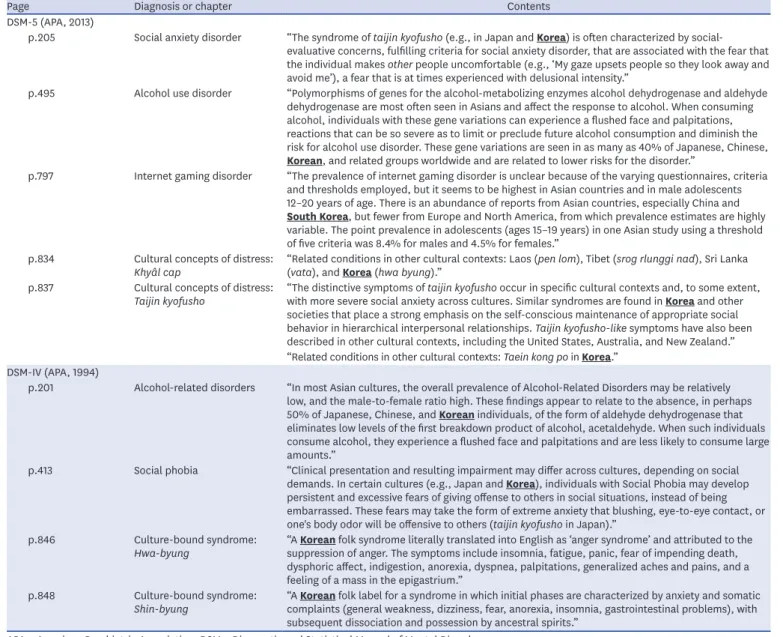
formulation, as shown in Table 1, South Korea has been mentioned four and five times in
DSM-IV and DSM-5, respectively. In DSM-5,
hwa-byung (anger syndrome) and taein-kong-po
(fear of interpersonal relations) were introduced in the section of cultural concept of distress.
Furthermore, it is described that both internet gaming disorder and alcohol-metabolizing
enzyme gene polymorphisms are highly prevalent in Koreans.
5HWA-BYUNG (ANGER SYNDROME)
In DSM-5,
hwa-byung is predominantly regarded as one of the khyâl cap (wind attack)-related
conditions in other cultural contexts, and the clinical characteristics of
hwa-byung have
not been described at all.
5Hwa-byung is prevalent among older married women and is
etiologically associated with anger repression that arises from familial conflicts attributed
to the patriarchal Korean social system.
6A diagnosis of
hwa-byung can be provisionally
made on the basis of the symptom criteria including feelings of unfairness, subjective anger,
expression of anger, sensation of heat, pushing up in chest, dry mouth, and sighing.
7The
lower activity of the anterior cingulate gyrus (the neural substrate of anger) in response to
neutral stimuli was observed in patients with
hwa-byung.
8However,
hwa-byung has merely
been used as a folk term to describe “consequences of repressed anger or accumulated rage
Opinion
Received: Sep 16, 2019 Accepted: Nov 10, 2019 Address for Correspondence: Seon-Cheol Park, MD, PhD
Department of Psychiatry, Inje University Haeundae Paik Hospital, 875 Haeun-daero, Haeundae-gu, Busan 48108,
Republic of Korea.
E-mail: [email protected] © 2020 The Korean Academy of Medical Sciences.
This is an Open Access article distributed under the terms of the Creative Commons Attribution Non-Commercial License (https:// creativecommons.org/licenses/by-nc/4.0/) which permits unrestricted non-commercial use, distribution, and reproduction in any medium, provided the original work is properly cited.
ORCID iDs Seon-Cheol Park
https://orcid.org/0000-0003-3691-4624 Yong Chon Park
https://orcid.org/0000-0002-3019-5748 Funding
This work was supported by the National Research Foundation of Korea (NRF) grant funded by the Korea government (MSIT) (2019R1A2C1090146).
Disclosure
The authors have no potential conflicts of interest to disclose.
Seon-Cheol Park
1and Yong Chon Park
21Department of Psychiatry, Inje University Haeundae Paik Hospital, Busan, Korea 2Department of Neuropsychiatry, Hanyang University Guri Hospital, Guri, Korea
Korea in the Diagnostic and Statistical
Manual of Mental Disorders, Fifth
Edition
Psychiatry & Psychology
Conceptualization: Park SC. Formal analysis: Park SC, Park YC. Investigation: Park SC. Methodology: Park SC. Validation: Park SC, Park YC. Writing - original draft: Park SC. Writing - review & editing: Park SC, Park YC.
culture-bound syndrome specific to Korean culture.” Therefore, considering the perspective
of cultural psychopathology and the established clinical practices specific to South Korea, the
term
hwa-byung could be used to improve psychiatrist-patient communication.
9Thus, a more
detailed description for
hwa-byung may be discussed in the further revision of the DSM.
Although
shin-byung (divine illness) has been listed as a culture-bound syndrome in the
DSM-IV, it has been excluded from the DSM-5. Furthermore, few Korean patients present with
“dissociation and possession by ancestral spirits,” or
shin-byung.
10Table 1. Korea in DSM-IV and DSM-5
Page Diagnosis or chapter Contents
DSM-5 (APA, 2013)
p.205 Social anxiety disorder “The syndrome of taijin kyofusho (e.g., in Japan and Korea) is often characterized by social-evaluative concerns, fulfilling criteria for social anxiety disorder, that are associated with the fear that the individual makes other people uncomfortable (e.g., ‘My gaze upsets people so they look away and avoid me’), a fear that is at times experienced with delusional intensity.”
p.495 Alcohol use disorder “Polymorphisms of genes for the alcohol-metabolizing enzymes alcohol dehydrogenase and aldehyde dehydrogenase are most often seen in Asians and affect the response to alcohol. When consuming alcohol, individuals with these gene variations can experience a flushed face and palpitations, reactions that can be so severe as to limit or preclude future alcohol consumption and diminish the risk for alcohol use disorder. These gene variations are seen in as many as 40% of Japanese, Chinese,
Korean, and related groups worldwide and are related to lower risks for the disorder.”
p.797 Internet gaming disorder “The prevalence of internet gaming disorder is unclear because of the varying questionnaires, criteria and thresholds employed, but it seems to be highest in Asian countries and in male adolescents 12–20 years of age. There is an abundance of reports from Asian countries, especially China and
South Korea, but fewer from Europe and North America, from which prevalence estimates are highly
variable. The point prevalence in adolescents (ages 15–19 years) in one Asian study using a threshold of five criteria was 8.4% for males and 4.5% for females.”
p.834 Cultural concepts of distress:
Khyâl cap “Related conditions in other cultural contexts: Laos (pen lom), Tibet (srog rlunggi nad), Sri Lanka (vata), and Korea (hwa byung).” p.837 Cultural concepts of distress:
Taijin kyofusho “The distinctive symptoms of taijin kyofusho occur in specific cultural contexts and, to some extent, with more severe social anxiety across cultures. Similar syndromes are found in Korea and other societies that place a strong emphasis on the self-conscious maintenance of appropriate social behavior in hierarchical interpersonal relationships. Taijin kyofusho-like symptoms have also been described in other cultural contexts, including the United States, Australia, and New Zealand.” “Related conditions in other cultural contexts: Taein kong po in Korea.”
DSM-IV (APA, 1994)
p.201 Alcohol-related disorders “In most Asian cultures, the overall prevalence of Alcohol-Related Disorders may be relatively low, and the male-to-female ratio high. These findings appear to relate to the absence, in perhaps 50% of Japanese, Chinese, and Korean individuals, of the form of aldehyde dehydrogenase that eliminates low levels of the first breakdown product of alcohol, acetaldehyde. When such individuals consume alcohol, they experience a flushed face and palpitations and are less likely to consume large amounts.”
p.413 Social phobia “Clinical presentation and resulting impairment may differ across cultures, depending on social demands. In certain cultures (e.g., Japan and Korea), individuals with Social Phobia may develop persistent and excessive fears of giving offense to others in social situations, instead of being embarrassed. These fears may take the form of extreme anxiety that blushing, eye-to-eye contact, or one's body odor will be offensive to others (taijin kyofusho in Japan).”
p.846 Culture-bound syndrome:
Hwa-byung “A Korean folk syndrome literally translated into English as ‘anger syndrome’ and attributed to the suppression of anger. The symptoms include insomnia, fatigue, panic, fear of impending death, dysphoric affect, indigestion, anorexia, dyspnea, palpitations, generalized aches and pains, and a feeling of a mass in the epigastrium.”
p.848 Culture-bound syndrome:
Shin-byung “A Korean folk label for a syndrome in which initial phases are characterized by anxiety and somatic complaints (general weakness, dizziness, fear, anorexia, insomnia, gastrointestinal problems), with subsequent dissociation and possession by ancestral spirits.”
TAEIN-KONG-PO (FEAR OF INTERPERSONAL
RELATIONS)
The translated Chinese term for fear of interpersonal relations is pronounced differently in
Korean (
taein-kong-po) and Japanese (taijin-kyofusho).
5An offensive subtype of
taein-kong-po
(
taijin-kyofusho) had initially been conceptualized as a “Japanese culture-specific diagnostic
label,” and was clinically characterized by the fear of offending others or making them
uncomfortable by staring inappropriately, making rude and improper facial expressions,
etc. The offensive subtype is also noted in individuals from New York, Switzerland, and
Indonesia along with East Asian countries including Korea and Japan. It is possible that
the offensive version of
taein-kong-po may be not a culture-bound syndrome, but a clinically
relevant syndrome associated with interdependent or independent self-construals.
11,12It has
previously been reported that 80% of patients in Korea that are suffering from
taein-kong-po
are primarily treated with pharmacotherapy (antianxiety, propranolol, antidepressant, and
antipsychotic) and supportive group-psychotherapy.
13INTERNET GAMING ADDICTION
Internet addiction is regarded as one of most serious public mental health problems
in Korea, because of its high prevalence and association with pharmacotherapy and/
or hospitalization among the Korean children aged 6–19 years.
14An epidemiological
study reported that patients categorized in the internet gaming addiction group were
characterized by greater proportions of individuals who were unmarried and unemployed,
with high frequencies of suicidal ideation, planning, and attempts than those in the
non-internet game addiction group in Korea. Herein, “escape from negative emotions”
was considered as the primary reason to indulge in internet games among Korean adults
diagnosed with internet gaming addiction and depression.
15A meta-analysis of empirical
studies reported that internet addiction was associated with “escape from self ” and
“self-identity” in terms of self-related variables; “attention problem,” “self-control,” and
“emotional regulation” in terms of control and regulation-related factors; “addiction and
absorption traits” in terms of temperamental variables; “anger” and “aggression” in terms of
emotion- and mood-related factors; and “negative stress coping” in terms of coping-related
factors in Korea.
16Moreover, a national study reported that, among Korean adolescents,
internet addiction was more predominantly present in female students in girls' schools
rather than in those in coeducational schools.
17OTHER IMPORTANT PSYCHOPATHOLOGICAL ISSUES IN
KOREA
Finally, the following psychopathological issues in Korean neuropsychiatry may need
to be considered during the revision of DSM-5: First, to reduce the stigma attached to
schizophrenia in Korea, the corresponding Korean term for schizophrenia has been
changed from
jungshinbunyeolbyung (精神分裂病 in Chinese characters; mind-splitting
disorder) to
johyeonbyung (調絃病; attunement disorder) in 2011 after collecting diverse
opinions.
18Additionally, the Korean term for epilepsy has been revised from
gan-jil (癎疾;
convulsive disease) to
noi-jeon-jeung (腦電症; cerebroelectric disorder).
19Second, due to
the cultural deviation between South and North Koreans, the latter have reported a unique
symptomatology in comparison with South Koreans.
20CONCLUSION
In conclusion, a detailed description of
hwa-byung, taein-kong-po, internet gaming disorder,
and others in South Korea may contribute to enrich the cultural conceptualizations of
distress in DSM-5.
REFERENCES
1. Bhugra D. Textbook of Cultural Psychiatry. Cambridge: Cambridge University Press; 2007.
2. Park SC, Shinfuku N, Maramis MM, Lee MS, Park YC. Adjunctive antipsychotic prescription patterns for outpatients with depressive disorders in Asia: The Research on Asian Psychotropic Prescription Patterns for Antidepressants (REAP-AD) study. Am J Psychiatry 2015;172(7):684-5.
PUBMED | CROSSREF
3. Tseng WS. Culture and psychopathology: general view. In: Bhugra D, Bhui K, editors. Textbook of Cultural Psychiatry. Cambridge: Cambridge University Press; 2007, 95-112.
4. American Psychiatric Association. Diagnostic and Statistical Manual of Mental Disorders (4th ed). Washington, D.C.: American Psychiatric Association; 1994.
5. American Psychiatric Association. Diagnostic and Statistical Manual of Mental Disorders (5th ed). Washington, D.C.: American Psychiatric Association; 2013.
6. Park YC. Hwabyung: symptom and diagnosis. Psychiatry Investig 2004;1(1):25-8.
7. Min SK, Suh SY, Song KJ. Symptoms to use for diagnostic criteria of hwa-byung, an anger syndrome. Psychiatry Investig 2009;6(1):7-12.
PUBMED | CROSSREF
8. Lee BT, Paik JW, Kang RH, Chung SY, Kwon HI, Khang HS, et al. The neural substrates of affective face recognition in patients with hwa-byung and healthy individuals in Korea. World J Biol Psychiatry 2009;10(4 Pt 2):552-9.
PUBMED | CROSSREF
9. Rhi BY. Hwabyung: an overview. Psychiatry Investig 2004;1(1):21-4.
10. Yongmi Yi K. Shin-byung (divine illness) in a Korean woman. Cult Med Psychiatry 2000;24(4):471-86.
PUBMED | CROSSREF
11. Clarvit SR, Schneier FR, Liebowitz MR. The offensive subtype of Taijin-kyofu-sho in New York City: the phenomenology and treatment of a social anxiety disorder. J Clin Psychiatry 1996;57(11):523-7.
PUBMED | CROSSREF
12. Vriends N, Pfaltz MC, Novianti P, Hadiyono J. Taijin kyofusho and social anxiety and their clinical relevance in Indonesia and Switzerland. Front Psychol 2013;4(3):3.
PUBMED | CROSSREF
13. Lee SH, Park YB, Oh KS. Comparative study of social phobic symptoms between early 80's and 90's. J Korean Neuropsychiatr Assoc 1996;35(1):107-13.
14. Block JJ. Issues for DSM-V: internet addiction. Am J Psychiatry 2008;165(3):306-7.
PUBMED | CROSSREF
15. Kim DJ, Kim K, Lee HW, Hong JP, Cho MJ, Fava M, et al. Internet game addiction, depression, and escape from negative emotions in adulthood: a nationwide community sample of Korea. J Nerv Ment Dis 2017;205(7):568-73.
PUBMED | CROSSREF
16. Koo HJ, Kwon JH. Risk and protective factors of internet addiction: a meta-analysis of empirical studies in Korea. Yonsei Med J 2014;55(6):1691-711.
PUBMED | CROSSREF
17. Heo J, Oh J, Subramanian SV, Kim Y, Kawachi I. Addictive internet use among Korean adolescents: a national survey. PLoS One 2014;9(2):e87819.
18. Lee YS, Kim JJ, Kwon JS. Renaming schizophrenia in South Korea. Lancet 2013;382(9893):683-4.
PUBMED | CROSSREF
19. Kim HD, Kang HC, Lee SA, Huh K, Lee BI. Changing name of epilepsy in Korea; cerebroelectric disorder (noi-jeon-jeung): my epilepsy story. Epilepsia 2014;55(3):384-6.
PUBMED | CROSSREF
20. Park SC, Choi J, Lee DW, Park YC. Psychiatric research in North Korea in the 21st century. Am J Psychiatry 2019;176(2):96-7.