대한감각통합치료학회지 제13권 제2호
The Journal Korean Academy of Sensory Integration 2015 Vol. 13, No. 2
http://dx.doi.org/10.18064/JKASI.2015.13.2.053
아동의 전정-고유감각 중심의 감각통합중재 효과에 대한 체계적 고찰:
국내연구를 중심으로
박영주*, 공인주*
*인제대학교 대학원 재활과학과
국문초록
목적 : 아동을 대상으로 국내에서 실시하는 전정-고유감각 중심의 감각통합중재의 효과를 알아보기 위해 체계적 고찰을 사용하여 근거를 제시하고자 하였다.
연구방법 : 본 연구는 2015년 8∼9월 동안 한국학술정보(KISS), 학술연구정보서비스(RISS), 누리미디어(DBpia)의 데이터베이스에서‘감각통합중재’, ‘감각통합치료’, ‘전정-고유감각’을 키워드로 검색하여 최종적으로 7개의 연구 를 선정하였다. 각 연구는 근거의 질적 수준과 방법론적 질적 수준으로 분석하였고 그 결과는 연구 설계와 대상자, 중재, 결과측정, 결과에 따라 분석하였다.
결과 : 분석에 포함된 연구의 근거수준은 수준 Ⅲ이 5개, 수준 Ⅳ가 1개, 그리고 수준 Ⅴ가 1개이었다. Down과 Black의 기준에 따라 대상 연구의 방법론적 질을 살펴보면,‘완벽’과 ‘우수’는 0개, ‘보통’은 2개, ‘나쁨’은 5개이었 다. 발달지연을 대상으로 한 단일대상연구가 가장 많았고 결과측정은 운동영역에 대한 평가요소 빈도가 가장 높았으며 결과는 평가영역에 대한 긍정적인 향상이나 긍정적인 감소를 보였다.
결론 : 국내 전정-고유감각 중심의 감각통합중재의 특징을 제시하여 관련 분야 전문가들이 이에 대한 정보를 활용 할 수 있도록 도움을 주고자 하였다. 앞으로 감각통합 중재에 대해 높은 근거 수준과 다양한 실험설계를 바탕으로 한 연구가 필요하다.
주제어 : 감각통합, 전정-고유감각, 중재, 체계적 고찰
교신저자: 공인주([email protected])
Ⅰ. 서 론
감각통합은 적응반응을 만들어내기 위해 뇌에서 감각 정보를 조직화하는 과정으로, 신체 내부와 신체 외부에 서 받아들이는 감각을 환경 속에서 효과적으로 사용하는 능력이다(Ayres, 1979; Kimball, 1988). 감각통합 중재 에 사용되는 감각에는 전정감각, 고유감각, 촉각, 시각, 청각 등이 있다(Ayres, 1979). 이런 다양한 감각들은 독
립적으로 작용하는 것이 아니라 주요 기본 감각인 고유 감각, 전정감각, 촉각의 통합을 바탕으로 여러 가지 감각 이 동시에 적용이 된다(Kim & Kim, 2007; Kim & Lee, 2005). 특히 감각통합에서는 전정-고유 중심의 통합이 중요하다(Ayres, 1979).
전정감각은 균형을 유지하고 안구운동을 조절하며 자 세를 바로잡을 뿐만 아니라 근긴장도를 조절하여 신체상 을 형성하는 등 양측협응에 중요한 영향을 미친다(Lee,
Son, Jeon, & Lee, 2007). 고유감각은 전반적인 각성 상태와 감정에 영향을 미치고 과반응 조절에 도움을 제 공한다. 전정감각과 고유감각의 통합은 아동이 일상생활 에서 다양한 활동을 할 때 머리위치에서 받아들이는 감 각과 신체위치에서 받아들이는 감각을 동시에 뇌로 전달 한다(Kranowitz, 1998). 따라서 전정감각과 고유감각은 올바른 자세조절을 형성하여 운동능력에 영향을 미치게 되므로 감각통합이 잘 이루어지면 적절한 근긴장도가 유 지되고 자세조절이 향상된다(Hong & Kim 2007). 또한 발달학적으로 전정감각과 고유감각이 통합되어야 자세, 균형 및 근 긴장도가 완성되고 더 나아가 신체지각, 양측 협응, 운동계획 및 주의집중이 형성되기 때문에(Ayres, 1979), 아동을 대상으로 감각통합중재를 실시할 때 전정 감각과 고유감각의 통합은 매우 중요하다.
감각통합 중재의 효과는 연구대상자, 연구방법, 중재, 그리고 결과측정도구에 따라 다양한 차이가 있어 그 결 과를 객관적인 근거로 제시하기에 어려움이 있다(Kim, 2009). 중재효과를 제시하는 것은 그 영역에서 치료의 효과와 질을 향상시키고 치료의 필요성을 정당화하며 치 료사의 신뢰를 높이기 위해 필요하다(Jung, Choi, &
Kim, 2013). 중재효과를 제시하는 연구방법으로 체계적 고찰이 있다. 체계적 고찰은 문헌검색을 통해 관련 자료 를 취합하고 그 결과를 다시 분석하여 근거 있는 결론을 제시하는 과정으로(Back, Park, & Kang, 2002) 작업치 료사는 효율적인 중재를 제공하기 위해 작업치료에 대한 체계적 고찰연구를 광범위하게 살펴보아야 한다 (Bennett, Hoffmann, McCluskey, Coghlan, & Tooth, 2013).
국내에서 실시된 감각통합중재에 대한 여러 체계적 고 찰연구가 있다(Hong & Kim, 2013; Kwag, Sim, &
Roh, 2014; Lee & Kim, 2014). 그러나 기존의 고찰 연 구는 평가도구 분석에 대한 연구, 특정 진단군을 대상으 로 중재효과를 분석한 연구, 특정 실험설계를 대상으로 분석한 연구 또는 연구의 특정 게재기간을 제한한 연구 를 실시하여 국내 감각통합중재 효과를 제시하기에 부족 하였다. 따라서 본 연구에서는 국내 감각통합중재에서 가장 빈번하게 사용하는(Park, Lee, Kim, & Chang, 2013) 전정-고유감각 중심의 감각통합중재의 효과를 체 계적으로 고찰하여 근거를 제시하고자 한다.
Ⅱ. 연구 방법 1. 자료 수집 및 과정
1) 포함기준
(1) 전정-고유감각 중심의 감각통합 중재를 사용한 연구 (2) 아동을 대상으로 한 연구
(3) 원문보기가 가능한 연구
2) 배제기준
(1) 전정-고유감각 이외의 감각을 중재한 연구 (2) 평가도구의 신뢰도와 타당도에 대한 연구 (3) 프로그램 개발에 대한 연구
(4) 고찰 및 메타분석에 대한 연구
(5) 인간 이외의 동물을 대상으로 실시한 연구
3) 검색과정 및 선정
본 연구는 2015년 9월∼10월 동안 한국학술정보 (KISS), 학술연구정보서비스(RISS), 디비피아(DBpia) 의 데이터베이스에서 ‘전정-고유감각’, ‘감각통합중재’,
‘감각통합치료’의 키워드로 검색하였다. 검색된 연구는 본 연구의 제 1 저자와 제 2 저자가 독립적으로 제목과 초록을 검토하였고 필요에 따라 원문확인을 실시하였다.
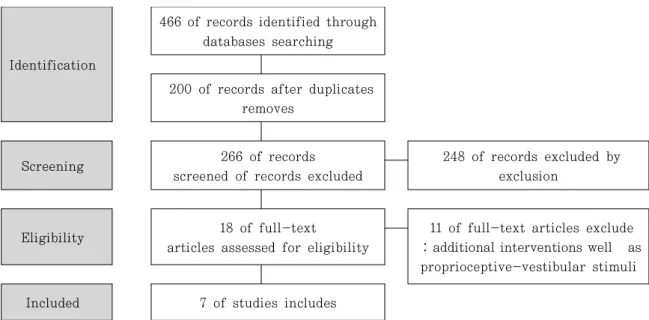
대상연구 선정과정에서 저자 간 이견이 있을 경우 충분 한 토의를 통해 대상연구를 선정하였다. 포함과 배제기 준에 따라 본 연구 분석에 사용된 연구는 총 7개로 연구 의 흐름은 Preferred Reporting Items for Systematic Reviews and Meta-Analyses(PLISMA)에 따라 제시하 였다(Moher, Liberati, Tetzlaff, & Altman, 2010) (Figure 1).
2. 분석방법
1) 근거의 질적 수준
두 명의 저자는 포함연구의 근거의 질적 수준을 평가 하기 위해 Arbesman, Scheer와 Lieberman(2008)이 개발한 근거기반 실습(evidence-based practice)의 근 거를 기반으로 한 연구의 수준을 사용하였다.
Identification
466 of records identified through databases searching
200 of records after duplicates removes
Screening 266 of records screened of records excluded
248 of records excluded by exclusion
Eligibility 18 of full-text articles assessed for eligibility
11 of full-text articles exclude : additional interventions well as
proprioceptive-vestibular stimuli Included 7 of studies includes
Figure 1. Diagram on process about searching process
2) 방법론적 수준
포함연구의 방법론적 측정은 Downs와 Black (1998) 이 개발하고 Strong, Jutai, Elizabeth와 Evans(2008) 이 수정한 Downs & Black Criteria(D&B)를 사용하였 다. D&B는 무작위 실험설계와 비무작위 실험설계를 포 함한 모든 양적 연구의 방법론적 수준을 점수화하여 측 정하는 것이다. 총 27개의 항목으로 보고, 외적 타당도, 내적 타당도, 그리고 파워의 하위척도로 구성되어 있다.
각 항목은 ‘예’ 일 때 1점을 ‘아니오’ 일 때는 0점으로 측정 되고 총 합의 점수에 따라 대상연구의 방법론적 수준이 결정된다. 결과는 총점이 26점 이상일 때 ‘완벽’, 20∼25 점은 ‘우수’, 15점∼19점은 ‘보통’, 그리고 0∼14점은 ‘나 쁨’으로(Strong et al., 2008) 분류된다.
Ⅲ. 연구 결과
1. 연구근거의 질적 수준
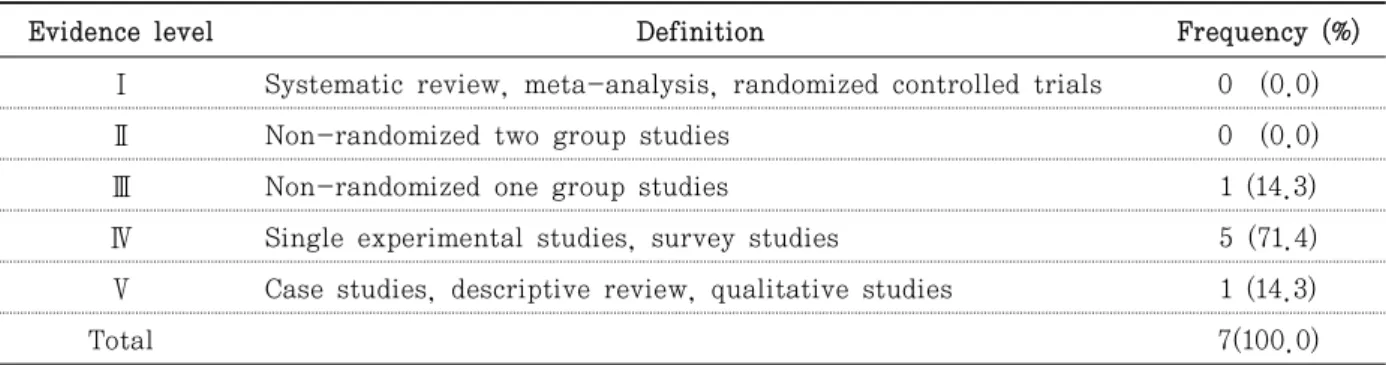
본 연구에 분석된 연구근거의 질적 수준은 7개의 연구 중 수준 Ⅲ이 1개, 수준 Ⅳ가 5개, 그리고 수준 Ⅴ가 1개 이었다. 연구 설계는 단일대상연구가 약 71.4%로 가장
높았고 그룹 전후 비교연구와 사례연구가 각각 약 14.3%
이었다(Table 1).
2. 연구근거의 질적 수준 및 방법론적 질
대상연구의 근거수준은 2010년 이전에는 수준 Ⅳ의 연구가 주로 이루어졌고 2010년 이후에는 수준 Ⅲ, Ⅳ,
Ⅴ의 연구가 이루어졌다. 대상연구를 D&B의 기준에 따 라 방법론적 질을 분석한 결과는 다음과 같다. ‘완벽’과
‘우수’ 연구는 0개, ‘보통’ 연구는 2개, 그리고 ‘나쁨’ 연구 가 5개이었다(Table 2).
3. 전정-고유감각 중심의 감각통합 중재 대 상 진단군
연구 분석은 연구 설계와 대상자, 중재, 결과측정, 결 과 순으로 제시하였다. 연구 설계는 단일대상연구(5개) 가 가장 많았고, 단일집단 전·후 비교연구(1개)와 사례 연구(1개) 순이었다. 대상자의 진단군은 발달지연(4개) 이 가장 많았고, 아스퍼거 증후군(1개), 감각처리에 문제 가 의심되지만 진단을 받지 않은 아동(2개)이 포함되었 다(Table 3).
Table 1. Hierarchy of levels of evidence for evidence-based practice
Evidence level Definition Frequency (%)
Ⅰ Systematic review, meta-analysis, randomized controlled trials 0 (0.0)
Ⅱ Non-randomized two group studies 0 (0.0)
Ⅲ Non-randomized one group studies 1 (14.3)
Ⅳ Single experimental studies, survey studies 5 (71.4)
Ⅴ Case studies, descriptive review, qualitative studies 1 (14.3)
Total 7(100.0)
Table 2. Evidence level and methodological quality of included studies
Author (year) Evidence level Methodological quality
1 Park, Lee, Kim, Chang (2013) Ⅳ 14a
2 Kim, Hwangbo, Yoo, Kim (2011) Ⅲ 11a
3 Park, Kim (2011) Ⅴ 17a
4 Hong (2009) Ⅳ 16a
5 Kim, Kim (2008) Ⅳ 14a
6 Hong, Kim (2007) Ⅳ 14a
7 Lee, Park (2007) Ⅳ 13a
aDawn & Black's criteria
Table 3. Summary of included studies Author (year) Study design/
participants Intervention Outcome measure Results
Park, Lee, Kim,
& Chang (2013)
Single-subject(N=1)/
DD (Male, 3 yr.)
Proprioceptive-vestib ular based SI (15 sessions/30 min.
per session/8 wks.)
Electronic scale (Drooling)
Amount of drooling was decreased in 1.50g±0.46g.
Nintendo wii fit balance board (Balance)
Postural control was improved in 16.12±4.87%.
Kim, HwangBo, Yoo, & Kim (2011)
One group
non-randomized(N=23)/
DD (Male=19, Female=4)
Vestibule-oriented SI (60 sessions/45 min.
per session/12 wks.)
SCPNT(Nystagmus) Nystagmus's data is improved from 2.02±0.44sec to 3.13±0.57sec.
DTVP-2
(Visual perception)
Vision showed a statistically significant increase.
P-CTSIB(Balance) Balance showed a statistically significant increase.
SCSIT(Balance) Balance showed a statistically significant increase.
BOTMP (Motor) Motor showed a statistically
significant increase.
Park & Kim (2011)
Case study(N=1)/
DD
(Male, 6yr. 5mon.)
Focus on the proprioceptive-vestib ular sensory (4 sessions/50 min.
per session/4 wks.)
Clinical observation Participated in activities without over-arousal.
Improved social interaction skills. Play was qualitatively extended.
Hong (2009) Single-subject(N=1)/
Not specific Diagnosis (Male, 5.7yr.)
Proprioceptive-vestib ular based SI (20 sessions/40 min.
per session/12 wks.)
From to chair to heel distance(Motor)
C-h distance is decreased in 17.13cm±4.57cm.
K-DTVP-2 (Visual perception)
Eye-hand coordination's inclination is increased from 125.67 to 145.3.
Visuo-motor speed is improved from 4 to 30.4.
Kim & Kim (2008)
Single-subject(N=1)/
Asperger Syndrome (Male, 11yr. 2mon.)
Proprioceptive-vestib ular based SI (7 sessions/40 min.
per session/7 wks.)
From Chair to Heel distance(Motor)
Chair to heel distance is decreased from 27.33cm to 11.69cm.
Hip joint angle (Motor)
Hip joint angle is decreased from 43.3° to 20°.
COMPS (Motor) Prone extension posture's data is improved from 13.15sec to 24.84sec.
Hong & Kim (2007)
Single-subject(N=1)/
Not specific Diagnosis (Male, 6yr.)
Focus on the proprioceptive-vestib ular sensory
(8 sessions/40 min per session/6 wks.)
COMPS (Motor) Prone extension posture's data is improved from 11±0.10sec to 14.99sec.
BOTMP (Motor) Eye-hand coordination's data is improved from 17.33±0.58 to 19.12.
Lee & Park (2007)
Single-subject(N=3)/
DD
(Male, Preschool)
Proprioceptive-Vestib ular based SI, 3 type programs
(39 sessions/50 min.
per session/12 wks.)
Clinical observation (Frequency recording)
Stereotypic behavior disappeared or dicreased.
BOTMP: Bruininks-Oseretsky test of motor proficiency, COPM: Canadian occupational performance measure, DD: Developmental disorders, DTVP-2: Developmental test of visual perception-2, K-DTVP-2: Korean version developmental test of visual perception-2, min.: minute, mon.:
month, P-CTSIB: Pediatric-clinical test of sensory interaction balance, SCPNT: Southern california postrotary nystagmus test, SCSIT: South California sensory integration test, SI: Sensory integration, SP: Sensory profile, SSP: Short sensory profile, wks.: weeks
4. 전정-고유감각 중심의 감각통합 중재 및 결과 측정
연구 대상자들은 중재로 모두 전정-고유감각 중심의 감각통합치료를 받았다. 중재회기는 4∼60회기까지 다 양하였고 각 회기 당 중재 시간은 30∼50분이었다. 중재 가 이루어진 기간은 4∼12주로, 이 중에서 12주(3개)가 가장 많았다. 분석연구 7개의 결과측정은 총 16가지로
시지각(2개), 균형을 포함한 운동능력(10개), 안구진탕(1 개), 상동행동(1개), 침흘리기(1개), 임상관찰(1개)로 평 가가 이루어졌으며, 이 중 운동요소에 대한 평가빈도가 가장 높았다. 결과는 모든 연구에서 측정영역에 대해 긍 정적인 향상이나 긍정적인 감소가 나타났다. 특히 단일 그룹 전·후 비교 연구에서는 시지각, 운동영역에서 통 계학적으로 유의한 차이가 나타났다(Table 3).
Ⅳ. 고 찰
본 연구에서는 전정-고유감각 중심의 감각통합중재 의 적용 및 효과를 체계적으로 고찰하였다. 연구에 사용 된 데이터베이스는 국내 감각통합에 대한 체계적 고찰연 구에서 사용한 데이터베이스를 이용하였다(Jung et al., 2013; Kwag et al., 2014).
본 연구에서는 분석에 사용된 총 7개 연구를 대상으로 연구의 질적 수준을 측정하였다. 대상연구에서 무작위 대조군 실험과 비 무작위 대조군 실험이 포함되지 않아 근거수준의 질이 비교적 낮았다. 근거중심 실행에서 높 은 수준의 연구를 수행하는 것은 필요하다. 그러나 사례 연구와 같은 근거수준이 낮은 연구라도 감각통합치료의 실제적용에 대한 근거를 제시하기 때문에 다양한 실험설 계를 바탕으로 한 연구는 필요하다(Jung & Chang, 2015). 또한 본 연구에서는 양적 연구 측정방법인 D&B 를 적용하여 방법론에 따른 질적 수준을 제시하고자 하 였다. D&B는 다양한 실험설계를 대상으로 한 연구에서 방법론에 대해 질적인 평가를 실시하는데 사용되고 있다 (Jung & Chang, 2014).
본 연구에서 전정-고유감각 중심의 감각통합 중재를 American Occupational Therapy Association(2014) 에서 제시한 체계적 고찰 작성의 틀에 따라 분석하였다.
분석결과는 연구 설계와 대상자, 중재, 결과측정, 결과 순으로 제시하였다. 연구 설계는 단일대상연구가 71.4%
로 가장 높았다. 국외연구에서는 감각통합 중재효과에 대한 연구 중 45.5%가 단일대상연구 설계(Kim, 2009) 인 것에 비해 다소 높은 비율이다. 이와 같은 이유는 장 애아동의 다양한 특성과 중복장애로 인해 동일한 집단을 구성하기 어렵고(Kwag et al., 2014), 국내에서 아동을 집단으로 연구하기에 어려운 임상적 현실과 개별 아동에 따른 중재효과를 밝혀내는데 단일대상연구가 적합한 연 구방법이기(Lee, Park, & Kim, 2000) 때문이다. 단일 대상연구가 근거중심접근을 수행하기에 적합하지만 그 결과를 일반화하기에는 어려움이 따르므로(Han &
Nam, 2005) 다양한 실험 설계를 바탕으로 한 연구가 필 요하다.
본 연구에서 전정-고유감각 중심의 감각통합 중재 대 상 진단군은 발달지연이 가장 많았고 평가영역은 운동요
소에 대한 측정이 가장 많이 이루어졌다. Jung과 Chang (2015)의 연구에서 감각통합치료학회지에 게재된 연구 의 대상자가 전반적 발달장애 다음으로 발달 지연이 많 아 발달지연의 비중이 높은 측면에서 그 결과가 일치한 다. 발달지연 아동은 일상생활활동을 수행하기 위해 전 정감각을 비롯한 균형능력이 필요하다(Park & Kim, 2011). 전정-고유감각 중심의 감각통합중재는 발달지연 아동의 다양한 문제행동을 감소시키고 중추신경계의 발 달시스템에 긍정적인 영향을 미친다(Lee & Park, 2007). 국내에서 실시된 감각통합 중재는 전정-고유감 각 중심의 감각통합중재를 사용하여 자세조절을 비롯한 운동능력 향상에 대한 연구가 대부분으로(Park et al., 2013) 중재의 평가영역에서 운동요소가 많은 비중을 차 지하는 본 연구와 그 결과가 일치한다.
본 연구의 제한점은 다음과 같다. 전정-고유감각 중 심의 이외의 중재가 사용된 연구는 분석에서 배제하여 분석대상 논문의 수가 부족하였다. 그리고 국내 연구만 을 대상으로 하여 전정-고유중심 감각통합중재의 세계 적인 연구의 흐름을 파악할 수가 없었다. 앞으로 국내에 서 전정-고유중심의 감각통합중재가 지속적으로 연구가 이루어지고, 이에 대한 해외의 연구동향을 제시하는 고 찰연구가 진행되어야 할 것이다.
Ⅴ. 결 론
본 연구는 국내에서 실시하고 있는 전정-고유감각 중 심의 감각통합중재에 대한 연구를 체계적으로 고찰하여 연구의 특징을 분석하고 그 결과를 제시하였다. 국내에 서 진행된 전정-고유감각 중심의 감각통합중재의 근거 수준은 Ⅲ, Ⅳ, Ⅴ로 비교적 낮은 수준의 연구가 진행되 었고 방법론적 질적 수준 또한 ‘보통’과 ‘나쁨’의 연구로 나타났다. 대상자는 발달지연을 대상으로 한 단일대상연 구 실험설계 방법이 가장 많이 사용되었고 중재는 모두 전정-고유 감각 중심의 감각통합중재를 사용하였다. 연 구결과는 운동능력에 대한 평가가 주를 이루었으며 그에 따른 결과는 긍정적인 향상이나 긍정적인 감소를 보였다.
앞으로 다양한 진단명을 가진 대상군을 대상으로 근 거수준이 높은 실험설계를 기초로 한 감각통합중재 연
구가 필요하다. 그리고 다양한 실험설계를 바탕으로 한 감각통합중재에 대한 연구가 지속적으로 이루어져야 할 것이다.
참 고 문 헌
American Occupational Therapy Association. (2014).
Guidelines for systematic review
. American Journal of Occupational Therapy.Arbesman, M., Scheeler, J., & Lieberman, D.
(2008). Using AOTA's critically appraised topic (CAT) and critically appraised paper (CAP) series to link evidence to practice.
OT practice, 13
(5), 18-22.Ayres, A. J. (1979).
Sensory integration and the child
. Los Angeles: Western psychological services.Back, Y. H., Park, D. S., & Kang, S. K. (2002). The review on the evidence-based study of acupuncture.
Journal of Korean Acupuncture and Moxibustion Medicine Society, 19
(3), 138-155.Bennett, S., Hoffmann, T., McCluskey, A., Coghlan, N., & Tooth, L. (2013). Systematic reviews informing occupational therapy.
American Journal of Occupational Therapy, 67
(3), 345-354. http://dx.doi.org/10.5014/ajot.2013.005819
Downs, S. H., & Black, N. (1998). The feasibility of creating a checklist for the assessment of the methodological quality both of randomized and non-randomized studies of health care interventions.
Journal of Epidemiology Community Health, 52
(6), 377-384.Han, S. H., & Nam, Y. S. (2005). A review of single- subject design research in special education.
Korean Journal of Special Education, 40
(2), 103-130.Hong, E. K. (2009). The effects of sensory integration intervention for postural control and visual-motor integration.
Journal of Special Education & Rehabilitation Science, 48
(4), 77-99.Hong, E. K., & Kim, K. M. (2007). The improvement of the postural control by sensory integration intervention: Single-subject research.
Journal of Special Education & Rehabilitation Science, 46
(3), 175-190.Hong, E. K., & Kim, K. M. (2013). Systematic review of assessment tools for praxis ability of sensory integrative function: Provide range of assessment tools in foreign and domestic normal children.
The Journal of Korean Academy of Sensory Integration, 11
(2), 41-56.Jung, H. R., Choi, Y. W., & Kim, K. M. (2013). A systemic review on sensory integration intervention in Korea: Focusing on Ayres sensory integration.
The Journal of Korean Academy of Sensory Integration, 11
(2), 27- 40.Jung, N. H., & Chang, M. (2015). An analytical study on research trends in Journal of Korean Academy of Sensory Integration:
From 2003 to 2014.
The Journal of Korean Academy of Sensory Integration, 13
(1), 45-56. http://dx.doi.org/10.18064/jkasi.2015.13.1.045
Jung, N. H., & Chang, M. Y. (2014). A systematic review on driving ability and measurement method of drivers after a traumatic brain injury.
The Journal of Korean Society of Occupational Therapy, 22
(1), 65-78. http://dx.doi.org/10.14519/jksot.2014.22.1.06 Kim, E. S., & Kim, K. M. (2008). The effects of
sensory integrative therapy on vestibulo- proprioceptive sensory processing of children with Asperger syndrome.
The Journal of
Korean Academy of Sensory Integration,
6
(1), 35-46.Kim, H. H., HwangBo, G., Yoo, B. K., & Kim, M. K.
(2011). Effects of vestibule-oriented sensory integration treatment on the nystagmus, visual perception and balancing ability of children with developmental disability.
Journal of The Korea Contents Society, 11
(4), 290-302. http://dx.doi.org/10.5392/jkca.2011.11.4.290
Kim, J. M., & Kim, K. M. (2007). The review of proprioceptive activities in sensory integration intervention.
The Journal of Korean Academy of Sensory Integration, 5
(1), 1-13.Kim, K. M. (2009). The effectiveness of sensory integrative intervention: A systematic review.
The Journal of Korean Academy of Sensory Integration, 7
(2), 77-90.Kim, T. Y., & Lee, M. H. (2005).
Sensory introduction
. Seoul: Korean Academy of Sensory Integration.Kimball, J. G. (1988). Hypothesis for production of stimulant drug effectiveness utilizing sensory integrative diagnostic methods.
Journal of the American Orthopedic Association, 88
(6), 757-762.Kranowitz, C. S. (1998).
The out of sync child:
Recognizing and coping with sensory integration dysfunction
. New York: The Berkley Publishing Group.Kwag, S. W., Sim, J. M., & Roh, H. L. (2014). Study on the characteristics and quality level of single subject researches in the sensory integration therapy field of korean occupational therapy.
The Journal of Korean Academy of Sensory Integration, 12
(2), 25- 36.Lee, N. H., & Kim, K. M. (2014). The intervention and outcome measurement tools of children with attention deficit hyperactivity disorder:
A systematic review.
The Journal of Korean
Academy of Sensory Integration, 12
(1), 39-50.Lee, N. S., & Park, H. M. (2007). The influence of vestibular-proprioceptive sensory training on stereotypic behaviors in children with developmental disorders.
Korean Journal of Physical and Multiple Disabilities, 50
(1), 89-114.Lee, S. H., Park, E. H., & Kim, Y. T. (2000).
Single subject research in educational and clinical settings.
Seoul: Hakjisa.Lee, S. Y., Son, G. S., Jeon, H. J., & Lee, M. H.
(2007). The effects of therapeutic exercise on the balance and gait in older adults.
The Journal of Korean Society of Physical Therapy, 19
(2), 1-10.Moher, D., Liberati, A., Tetzlaff, J., & Altman, D.
G. (2010). Preferred reporting items for systematic reviews and meta-analyses: The prisma statement.
International Journal of Surgery, 8
(5), 336-341. http://dx.doi.org/10.1016/j.ijsu.2010.02.007
Park, H. S., Lee, N. H., Kim, K. M., & Chang, M.
Y. (2013). The effects of proprioceptive- vestibular based sensory integration intervention on drooling and postural control of the child with developmental delay: Single subject research design.
Journal of Special Education
& Rehabilitation Science, 52
(1), 337-354.Park, J. H., & Kim, I. S. (2011). The effect of sensory integrative intervention focused on proprioceptive-vestibular stimuli on adaptive response of children with sensory defensiveness:
Case study.
The Journal of Korean Academy of Sensory Integration, 9
(2), 35-46.Strong, J. G., Jutai, J. W., Elizabeth, R. M., &
Evans, M. (2008). Driving and low vision: An evidence-based review of rehabilitation.
Journal of Visual Impairment and Blindness,
102
(7), 410-419.Abstract
A Systematic Review of Effects on Sensory Integration Intervention Based on Vestibular-Proprioceptive System for Children in Korea
Park, Youngju*, M.S., O.T., Kong, In-Joo*, Med., O.T.
*Dept. of Rehabilitation Science, Graduate School of Inje University
Objective : The purpose of this study was to investigate the effects on sensory integration interventions for korean children which focused on vestibular - proprioceptive system.
Methods : Authors systematically searched published studies in DBpia, KISS and RISS databases from August to September 2015. Key words in the search were 'sensory integration intervention’, 'sensory integration therapy' and 'vestibular-proprioceptive'. By using the inclusion and exclusion criteria, we selected seven studies for further analyses examining level of evidence and methodological qualities. Information for the analyses were on study designs, participants, interventions, outcome measures and results.
Results : Grade Ⅳ rated evidence was found from five studies, and Grade Ⅲ and Grade Ⅴ rated evidence was found from one for each study. The methodological levels of the quantitative studies were 'fair' (2) and 'poor' (5). Subjects for the studies were developmental delay (5), Asperger Syndrome (1), and not specific diagnosis (2). Single-subject design was most frequently used and motor area were most frequently evaluated. The interventions used the studies showed positive effects on outcome measures.
Conclusion : This study presented the summary of sensory integration intervention based on vestibular-proprioceptive system for Korean children. More studies with high level of evidence and various study designs need to be followed.
Key words : intervention, sensory integration, systematic review, vestibular-proprioceptive