신경재활치료과학 제5 권 제1 호
Therapeutic Science for Neurorehabilitation Vol. 5, No. 1, 2016.
상지 협응 움직임을 기반으로 한 과제중심적 접근 훈련이 발달성 협응 장애아동의 글씨쓰기 능력에 미치는 효과
김미지*
*브레인 감각통합 발달연구소
국문초록
목적 : 상지 협응 움직임을 기반으로 한 과제중심적 접근 훈련이 발달성 협응 장애아동의 한글 글씨쓰기 능력에 미치 는 영향을 알아보며 각 접근이 한글 글씨 쓰기 수행의 질과 글씨쓰기 준비기술에 미치는 영향을 비교하고자 한다.
연구방법 : 본 연구는 5~10세의 발달성 협응장애 아동 40명을 대상으로 무작위 추출을 통해 두 집단으로 나뉘어 사 전-사후 검사로 진행하였다. 두 집단은 과제중심접근 중재군과 과정중심접근 중재군으로 5주 동안 40분씩 주 2회 중재를 받았다. 글씨쓰기 수행은 한글 자모 쓰기 검사로 측정하고, 글씨쓰기 준비요소인 상지 운동 기능, 시 지각 기능과 시 운동기능은 각각 운동 유창성 평가(Bruininks-Oseretsky Test of Motor Proficiency-2: BOT-2)중 미세운동조절의 하위검사 일부, 한국판 시 지각 발달 검사(Korean-Developmental Test of Visual Perception-2: K-DTVP-2), 개정된 시 운동기술 평가(Test of Visual Motor Skills-Revised: TVMS-R)로 평가 하였다.
고찰 : 본 연구는 과제중심접근법을 적용하여 발달성 협응 장애아동의 글씨쓰기 수행도를 향상시킨다는 임상적 근거 를 제공하는데 의의가 있다. 또한 과정중심접근법과 과제중심접근법이 글씨쓰기 준비기술의 향상에 어떠한 영향 을 끼치는 지에 대한 결과를 확인하여 보다 효과적인 글씨쓰기 중재방법을 제시하는 초석이 될 수 있을 것이라 생각한다.
주제어 : 감각통합, 글씨쓰기, 과제중심접근, 발달성 협응 장애아동
교신저자 : 김미지([email protected]) || 접수일: 2015. 11. 30 || 심사일: 2015. 12. 31
|| 게재승인일: 2016. 1. 31
Ⅰ. 서 론
발달성 협응장애 (Developmental Coordination Disorder; DCD)는 운동협응의 어려움이라는 신경발 달학적 특성을 가지는 질환으로, 자신의 움직임을 조 절하고 자세를 바꾸며 복잡한 과제를 실행하는데 어 려움을 가진다(Barnhart, Davenport, Epps, &
Nordquist, 2003). 발달성 협응장애는 유병율이 최
소 5~6%정도로 이 중 5~10%의 학령기아동이 학습 운동기술의 문제와 학교생활 참여에의 어려움을 겪는 다(Niemejjer, Smits-Egelsman, & Schoemaker, 2007; Miller, Polatajko, Missiuna, & Mandich, 2001). 또한 집중력 문제나, 실서증, 학습장애 등 도 연관하여 나타날 수 있다.
글씨쓰기는 수업시간에 주어진 과제를 수행하기 위 해 습득하여야 하는 작업수행이자 학문적 기술로
(Weintraub & Graham, 1998), 학령 기 아동의 수업 시간 내 미세운동 작업수행 중 31-60%를 차지하는 (Mchale & Cermak, 1992) 중요한 기술이다. 글씨쓰 기 수행의 가장 중요한 두 가지 요소는 명료도와 속 도다(Mather & Roberts, 1995). 또한 효율적이고 능 숙한 글씨쓰기를 위해 필요한 글씨쓰기 준비기술에는 시 지각, 눈-손 협응, 시각-운동 통합, 운동지각, 미 세운동 협응, 손의 기민성, 손 안 조작 등의 지각-운 동 기술의 통합된 능력이 있다(Kephart, 1971).
발달성 협응장애아동의 글씨쓰기 특징은 정상 아동 에 비하여 글씨를 크고 급하게 적는 것이다(Jolly &
Gentaz, 2013). 또한 움직임 전략의 반복적 활용이 부족하고, 과제의 규칙에 대한 유연한 적응이 어렵다 (Smits-Engelsman, Niemeijer, & van Galen, 2001).
단어 사이에서 멈춤 시간(pausing)이 긴 ‘멈춤현상 (pausing phenomenon)’도 특징 중 하나이다. 멈춤 현상은 자동적인 글쓰기의 어려움이 있다는 것을 의 미한다. 보고 적기, 기억해서 적기, 이름쓰기 그리고 10분 동안 자유 글쓰기와 같은 과제에서 글자를 적어 나가기가 느리다(Chang & Yu, 2010; Prunty, Barnett, Wilmut, & Plumb, 2013; Rosenblum &
Livneh-Zirinski, 2008).
현재까지 발달성 협응 장애아동을 위한 다양한 치 료프로그램이 개발되어 왔고, 이러한 치료프로그램 은 크게 과정중심접근(process-oriented approach;
bottom up)과 과제중심접근(task-oriented ap- proach; top-down)으로 나눌 수 있다(Erhard &
Meade, 2005; Sugden & Wright, 1998). 과정중심 접근은 실제 손상에 초점을 맞춘 것으로, 계층이론에 따라 수행 요소나 기반 과정을 다루는 접근법이다.
대표적인 중재 방법으로는 감각통합치료와 운동지각 훈련 등이 있다(Mandich, Polatajko, Macnab, &
Miller, 2001). 반면, 과제중심접근은 기능적 제한에 초점을 두고, 체계이론과 학습이론관점으로 운동조 절과 운동기술 획득과정을 설명한다(Choi & Kim, 2008). 과제중심접근에는 운동훈련 측면을 강조한 신경운동과제훈련과 문제해결 측면을 강조한 일상 작 업수행의 인지중심 접근법(CO-OP)이 있다. 글씨쓰
기 중재 시 작업치료사들은 감각운동접근(Feder, Majnemer, & Synnes, 2000)을 많이 사용하고 있고, 많은 선행 연구에서 감각운동접근과 과제중심접근법 을 함께 사용하는 경우, 글씨쓰기 명료도가 향상되는 효과가 나타난다고 하였다(Roberts, Siever, & Mair, 2010; Weintraub, Yinon, Hirsch, & Parush, 2009;
Zwicker & Hadwin, 2007; Denton, Cope, & Moser, 2006).
글자는 각 언어별로 고유한 형태와 특성을 가지고 있다. 때문에 중재를 적용함에 있어 언어 간 특성을 고려해야 한다. 국내에서 실시된 글씨쓰기와 관련한 연구로는 뇌성마비 아동의 글씨 쓰기에 관한 연구 (Kim, Bae, Jun, Jang, & Song, 2015; Kim, Han,
& Jang, 2015)와 학령전기 아동의 글씨쓰기 명료도 와 시 지각 능력의 상관관계에 관한 연구(Min, Jung, Jung, & Kang, 2008)등이 있었으나, 발달성 협응 장애아동의 한글 글씨 쓰기 어려움의 특성과 중재효 과에 대한 연구는 없었다. 때문에 본 연구에서는 첫 째, 상지 협응 움직임을 기반으로 한 과제중심적 접 근 훈련이 발달성 협응 장애아동의 한글 글씨쓰기 과 제수행의 향상을 불러오는지에 대해 알아보고자 한 다. 둘째, 중재 방법에 따른 글씨쓰기 준비기술 향상 의 차이를 비교하여 알아보고자 한다.
본 연구의 가설은 다음과 같다.
첫째, 상지 협응 움직임을 기반으로 한 과제중심적 접근 훈련은 발달성 협응장애아동의 한글글씨쓰기 수 행의 향상을 가져올 것이다.
둘째, 중재 방법에 따른 글씨쓰기 준비기술 향상의 차이가 있을 것이다.
Ⅱ. 연구 방법 1. 연구 설계 및 설정
본 연구는 두 그룹 사전 사후 검사 설계를 사용하
여 진행한다. 무작위 대조(randomized controlled trial), 단일 맹검(single-blind)으로 설계되었다.
2. 표본 크기
특정 질환군을 대상으로 연령기준의 설정하여 표본 을 추출하기 때문에 연구 결과의 일반화를 어렵게 할 것으로 사료된다. 하지만 아동 간 연령에 따른 인지 수준과 신체기능의 차이로 인한 영향이나 집중력 등 에 있어 이질성은 적을 것이다. 본 연구에서 표본크 기는 정규분포를 만족하기 위한 최소 모집단의 크기 가 30(N 30)이라는 점을 감안하여, 그룹 당 20명씩 (Ntotal=40) 배정 후 진행한다.
3. 대상자와 모집
대상자들은 국내에 거주하는 5~10세의 발달성 협 응장애 아동을 대상으로 한다. 연구에 관심을 보이고 참가 의사를 밝힌 사람들을 대상으로 선정기준을 만 족하는 자를 선별한다. 선정된 대상자에 한하여 본 연구의 목적과 내용 그리고 계획된 스케줄을 설명하 고, 자발적으로 참여 동의서를 작성한 후 연구를 진 행한다. 모든 대상자는 연구방법에 관하여 충분한 정 보를 제공받게 될 것이고, 참가 전 동의서에 직접 서 명을 할 것이다. 본 연구는 연세대학교 생명 윤리 심 의 위원회의 승인을 받을 것이다.
1) 대상자 선정기준
연구의 내용과 훈련방법을 적절하게 이해하고 적용하 기 위해서 대상자는 무작위 배정 전 다음의 기준을 만족 해야 한다: 1) 아동용 운동평가 배터리 2(Movement assessment battery for children 2; MABC-2) 점 수가 15% 이하에 속하는 자; 2) 부모 면담 시, 학교나 일상생활에서 적어도 두 가지 이상의 기능적 어려움 이 있는 자.
2) 대상자 제외기준
다음의 기준 중 하나 이상 속하는 대상자는 연구에
서 제외 된다: 1) 발달성 협응장애가 아닌 만성적인 질환이나 기타 발달 장애(예. 뇌성마비, 자폐 스팩트 럼장애 등)가 있는 자; 2) 활동수준이나 성장, 식욕 등에 영향을 주는 약물치료(Steroids 또는 stimu- lants)를 받고 있는 자.
4. 무선할당과 맹검
통계분석의 내적타당도를 높이기 위하여 모든 대상 자는 무선할당을 통해 각 그룹으로 배정될 것이다.
또한 중재 전 후 기능평가는 3년 이상의 임상경력을 가진 숙련된 치료사가 시행하고, 검사자는 연구가 종 료되는 시점까지 정보를 받지 않은 상태(맹검)로 진 행된다. 연구 대상자도 검사자에게 중재에 관하여 언 급하지 않도록 주의를 줄 것이다. 중재를 제공하는 치료사는 기초선 측정 후 중재가 시작하기 전 대상아 동에 대한 정보를 받게 된다.
5. 중재
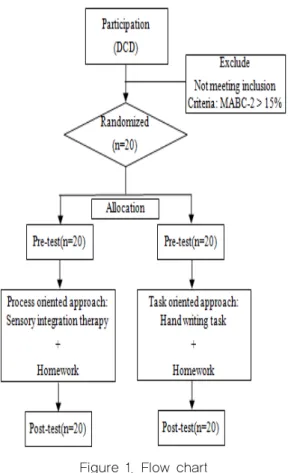
대상자들은 무작위 추출을 통해 과제중심접근과 과 정중심접근으로 나눠 질 것이다. 총 연구회기는 14회 기로, 기초선 A 2회기, 중재기 B 10회기, 기초선 A' 2 회기로 구성된다. 그룹 간 동질성 검사를 시행한 후, 총 5주 동안 40분씩 주 2회 중재를 시행한다. 모든 대 상자들은 중재기 동안 가정에서 수행할 과제를 제공받 을 것이다. 중재기가 끝난 후 다시 기초선을 재 측정한 다. 전반적인 연구과정은 다음과 같다(Figure 1).
1) 과정중심접근
과정중심접근군은 감각통합치료를 받는다. 10회기 동안 진행되는 감각통합 중재는 Rho, Hong &
Kim(2011)의 연구를 참고하여 자세조절과, 시-운동 통합 능력, 소 근육 운동 등 글씨쓰기 준비기술을 향 상시키기 위한 세부 목표 하에 회기 당 40분으로 활 동을 재구성하였다(Table 1).
No Sensory
processing Target Activities
1
Improve vestibular
· proprioceptive
processing
Postural control
Swings Various speed & posture Play ball while taking swings
2 wheel barrow Passing through the obstacles in wheel barrow
position
3 Crawling Crawling to target point by passing through
various space
4 Visuo-motor
integration
Glider swing Throwing ball to target while taking glider swing
5 Fishing Fishing on platform swing
6 Improve tactile processing
Fine motor coordination
Drawing Drawing by glue
7 Small objects Figure out the objects inside box by stereognosis 8
Improve proprioceptive
processing
Sequencing, bilateral integration
Moving things Transfer small objects such as beans and rice by using various tool
9 Shoulder girdle
stability
Weight bearing on shoulder
Organizing things while weight bearing on shoulder
10
Visuospatial processing, motor planning
Mouth soccer Play soccer by blowing ball with strow.
Table 1. Process oriented program: Sensory integration activities
Figure 1. Flow chart
Step Activity Time 1. Think posture and strategies for good hand writing
Daily goal setting 10min
Give guide to a child about posture and basic skills for good hand writing. Encourage a child to think his/her owe posture and strategies for
2. Real-life writing 10min
Teachers may supply actual assignments, or could be generated by the occupational therapist. Activities include: writing a thank-you not. completing an invitation to party, preparing a grocery list, writing in their daily planner, or completing journal entries.
3. Writing for fun 10min
A variety of pens, pencils, papers are provided for students to write anything they wish.
Materials are self-selected from those presented each day. Materials should be varied so students have an opportunity to use all of them.
4. Self-check for implementation of strategies and daily goals 5min
·How well did implement the writing strategies?
·How much did achieve your daily goals?
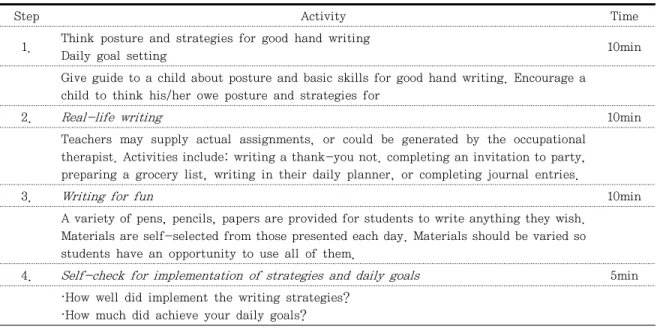
Table 2. Task oriented program: Hand writing activities
2) 과제중심접근과제중심접근군은 글쓰기 활동을 직접 훈련한다.
글씨쓰기 활동은 Denton, Cope & Moser(2006)의 중재방법을 참고하여, 4단계로 구성하였다(Table 2);
1) 자세잡기 및 잘 쓰기 위한 전략 확인과 당일 목표 설정 (5분); 2) 일상생활 쓰기(15분); 3) 재미를 위한 쓰기(15분); 4) 전략의 수행 정도와 당일 목표에 대한 자가 확인(5분). 회기 당 소요 시간은 40분으로 한다.
아동에게 글씨를 잘 쓰기 위해 필요한 자세 및 기본 기술에 대한 가이드를 제공한다. 회기 진행 시 가장 역점을 두는 부분은 아동 스스로 잘 쓰기 위해 필요 한 전략을 설정하고, 적용한 후, 전략의 수행 정도에 대한 자가 확인을 하는 것이다. 치료사는 중재 시 모 든 아동이 40분의 진행시간 동안 쓰기 활동을 지속할 수 있도록 독려해하고, 필요시 언제든 수행에 대한 피드백을 제공할 것이다.
3) 가정활동
모든 대상자에게 치료효과의 연속성과 부모의 참여 를 향상시키기 위하여 직접적인 글씨쓰기가 아닌 선 긋기, 그림그리기, 색칠하기 등의 펜 활동과 패턴 맞 추기, 길 찾기 등의 가정에서 수행할 시 지각 학습지
를 과제로 제공한다.
6. 결과측정
결과는 중재 전(A, 1주차), 중재 후(A', 7주차)에 각각 2회기에 거쳐 측정할 것이다. 평가는 3년 이상 의 임상경력이 있는 숙련된 치료사가 그룹배정에 대 하여 알지 못하는 상태에서 시행한다. 검사자는 누구 도 중재과정에 참여하지 않을 것이다. 연구는 대상 아동의 기능적인 변화를 측정하기 위해 표준화된 점 수기준을 사용할 것이다.
1) 일차결과 측정 (1) 글씨쓰기 능력 측정도구
한글 자모 쓰기 검사
한글 자모쓰기 검사는 기본 자음 14자, 기본 모음 10자로 구성 된 쓰기검사이다. 검사지의 위 칸에 자 모의 예시를 주고 아래 칸에 보조선이 그어진 자모를 주어 덧쓰기를 하게 구성되어 있다. 자모의 글꼴과 크기는 한글 신명조체 48포인트 이고, 네모 칸의 크 기는 2.5cm×2.5cm 이다. 판별기준에 따라 각 자모
에 대하여 정확하게 쓰면 1점으로 채점하고 총점은 24점이다. 한글 자모 쓰기 검사자간 신뢰도는 . 95이 고 검사-재검사 신뢰도는 .65이다(Jeong, 2004).
글씨쓰기 속도
글씨쓰기 속도는 1분(60초)당 쓴 글자 수를 말한다 (Graham, Berninger, Weintraub, & Schafer, 1998).
본 연구에서는 글씨쓰기 속도를 Pollock 등(2009)이 제시한 식을 참고하여, 한글 자모쓰기 평가 시행 시 쓴 총 글자 수를 소요시간으로 나누는 방법으로 계산 할 것이다. 이 때, 총 소요 시간은 연필을 들고 글씨 를 쓰기 시작하는 시점부터 쓰기를 완료하고 연필을 책상에 내려놓는 시점까지의 시간을 의미한다. 산출 식은 아래와 같다.
글씨쓰기 속도 = 총 글자 수 총 소요시간(초)
2) 이차결과 측정 (1) 상지운동기능평가
운동 유창성 평가(Bruininks-Oseretsky Test of Motor Proficiency-2; BOT-2)
BOT-2 검사는 4세에서 21세까지의 개인의 다양한 운동 기술 숙련도를 평가하고, 운동조절 및 운동 협 응에 문제를 가진 개인의 운동기술 손상 정도를 측정 하기 위하여 개발되었다(Bruininks, 2005). 이 평가 도구는 미세운동조절(fine manual control), 조작 협 응(manual coordination), 신체 협응력(body coor- dination), 근력과 민첩성(strength and agility)의 4 개 영역으로 구성되어 있고, 본 연구에서는 손 기능 을 평가하기 위해 미세운동조절의 하위검사인 미세 소근육 운동정확성, 미세 소근육 운동통합과 조작민 첩성 항목을 사용한다(Case-smith, 2002). BOT-2 검사의 검사자간 신뢰도는 근력과 민첩성, 조작 협 응, 신체 협응력에서 .98~.99, 미세운동조절에서 .92이며, 평가-재평가 신뢰도는 .89이다. 연구에서 는 각 항목의 원 점수를 사용할 것이다.
(2) 시 지각 및 시 운동 통합 기능평가
한국판 시 지각 발달 검사(Korean-Developmental Test of Visual Perception-2: K-DTVP-2) 한국판 시 지각 발달 검사는 만 3세 10개월에서 만 9세 아동의 시 지각 및 시 운동장애 수준을 파악하고 시 지각 기관 결함 가능성에 관한 증거를 제공하는 시 지각 발달검사이다. 이 검사의 하위검사항목으로 는 눈-손 협응(eye hand coordination), 공간위치 (position in space), 따라 그리기(copying), 도형- 배경변별(figure-ground), 공간관계(spatial relations), 시각통합(visual closure), 시각-운동속도(visual- motor speed), 형태항상성(form constancy)이 있 다. 이 전체 항목을 일반 시 지각(General Visual Perception; GVP)이라고 하며, GVP는 시각운동통 합(Visual-Motor Integration; VMI)과 운동감소시 지각(Motor-reduced Visual Perception; MRP)으로 나누어진다. 평가-재평가 신뢰도는 8개 하위 검사 항목의 경우 .83 .95, 종합척도의 경우 .94 .95이며 검사자간의 신뢰도는 .93 .99이다(Hammill, Pearson,
& Voress, 1993).
개정된 시 운동기술 평가(Test of Visual Motor Skills Revised; TVMS-R)
TVMS-R은 시 운동 기술과 그 요소를 기하학적인 모양을 따라 그림으로써 평가하는 도구이다. 총 23개 의 디자인으로 구성되어 있고, 8가지 분류기준과 분 류기준에 따른 특징이 있다. 1, 3, 4, 6, 8번 분류기 준은 시각 분석 기술을 평가하고, 2, 5, 7번 분류기준 은 시-공간 기술을 평가한다. 23개 디자인을 따라 그 린 그림에서 발생한 오류(error)를 분류기준 번호에 기반하여 채점한다. 하위 평가 항목 간 신뢰도 .96
.99이다(Brown & Unsworth, 2009).
7. 분석 방법
수집된 자료의 분석은 SPSS version 21.0을 이용 한다. 대상자들의 기초선(A)을 측정한 후 기술통계를 사용하여 두 군간 동질성을 비교한다. 중재 전, 후 그
룹 내 글씨쓰기 수행도를 비교는 대응표본 t검정 (paired t-test)을, 그룹 간 글씨쓰기 수행의 변화 정 도의 비교는 독립표본의 t검정(independent t-test) 을 실시한다. 글씨쓰기 수행도와 전반적인 시 지각, 비운동성 시 지각, 시 운동통합, 상지운동기능(미세 소근육 운동정확성, 미세 소근육 운동통합과 조작민 첩성)의 상관관계는 피어슨 상관관계 분석(Pearson product-moment correlation coefficients)을 통해 알아볼 것이다. 모든 통계분석의 유의수준은 .05로 설정한다.
Ⅲ. 고 찰
글씨쓰기는 학령 기 아동의 중요한 작업수행기술 로, 운동협응의 어려움을 특징으로 하는 발달성 협응 장애 아동이 주로 호소하는 대표적인 어려움이다. 글 씨쓰기능력의 향상을 위한 중재방법인 과정중심접근 법과 과제중심접근법을 발달성 협응 장애아동에게 적 용하여 그 효과를 입증한 연구가 미국, 홍콩과 프랑 스 등 여러 언어권에서 발표되어져 왔다. 글자는 각 언어별로 고유한 형태를 지니므로 언어권 별로 중재 효과에 대한 연구가 필요함에도 국내 발달성 협응 장 애아동을 대상으로 한 연구는 아직 이뤄지지 않았다.
때문에 본 연구는 국내 발달성 협응 장애아동에게 두 가지 중재방법이 아동의 한글 글씨쓰기 수행기술과 글씨쓰기 준비기술의 향상에 어떠한 영향을 미치는지 알아보고자 한다.
글씨쓰기 훈련 없이 운동훈련이나 감각운동만을 실 시한 선행연구에서는 글씨쓰기 명료도가 향상되지 않 았다고 언급해왔다(Denton et al., 2006; Sudsawad, Trombly, Henderson, & Trickle-Degmen, 2002).
Ham, Kim, Lee와 Jeon(2012)은 주의력결핍/과잉행 동장애아동에게 글씨 쓰기 중재로 감각통합치료를 제 공하고, 매 회기 치료 후 글씨쓰기 명료도와 속도를 측정하였다. 연구 결과 아동들의 운동기술과 처리기 술 모두 유의한 향상이 나타났으나 회기 당 반복되었 던 글씨쓰기 측정이 실험결과에 영향을 미칠 수 있다
는 제한점이 있었다. 때문에 본 연구에서는 감각통합 치료군에게 글씨쓰기를 제외한 학습지 활동을 과제로 주어 검사 결과의 내적타당도를 올릴 것이다.
과제중심접근은 강한 학습효과를 지니는 중재방법 이다. 많은 연구에서 과제중심접근 중 인지 중심 작 업 수행(CO-OP)접근을 적용하였을 때, 특정 기능적 기술이 향상되고 그 효과도 지속된다고 하였다(Wilcox
& Polatajko, 1993; Banks, Rodger, & Polatajko, 2008). 발달성 협응 장애아동에게 과제중심 중재를 적용한 8개의 논문을 분석한 Choi와 Kim(2008)의 체계적 고찰에 따르면, 신체기능과 구조 영역에서 22.22%, 활동과 참여 영역에서 40.74%의 중재효과 가 나타났다고 하였다. 이에 따라 본 연구에서 과제 중심접근을 적용할 때, 운동기능 향상을 지지하기 위 해 글씨쓰기 준비기술 중 상지 협응 움직임을 기반으 로 한 가이드를 제공할 것이다. 또한 각 중재접근 별 글씨쓰기 준비기술의 향상 정도가 다를 것으로 예상 하고, 상지운동기능평가와 시 지각 및 시운동 통합 기능평가를 중재 전 후로 시행하여 중재의 영향을 알 아보고자 한다.
기존 글씨쓰기 수행을 중재한 연구에서 시지각 평 가로 한국판 시 지각 발달 검사(K-DTVP-2)를 주로 사용하였다(Min et al., 2008; Kim et al., 2015).
한국판 시 지각 발달 검사는 시각운동통합과 운동감 소 시 지각, 일반 시 지각 수준을 확인할 수 있는 표 준화된 도구이다. 본 연구에서는 기존 선행연구에서 거의 사용하지 않았던 개정된 시 운동기술 평가 (TVMS-R)를 시행할 것이다. 개정된 시 운동기술 평 가는 하위 평가 항목 간 신뢰도 .96 .99(Brown &
Unsworth, 2009)의 표준화된 평가도구로 점수 채점 기준이 본 연구에서 글씨쓰기 명료도 검사를 위해 사 용하는 한글 자모쓰기 검사와 기준과 유사하므로 시 지각 기술과 글씨쓰기 명료도와의 보다 구체적이고 명확한 상관성을 알 수 있을 것으로 기대된다.
본 연구는 과제중심접근법을 적용하여 발달성 협응 장애아동의 글씨쓰기 수행도를 향상시킨다는 임상적 근거를 제공하는데 의의가 있다. 또한 과정중심접근 법과 과제중심접근법이 글씨쓰기 준비기술의 향상에
어떠한 영향을 끼치는 지에 대한 결과를 확인하여 보 다 효과적인 중재방법을 제시하는 초석이 될 수 있을 것이라 생각한다.
References
Banks, R., Rodger, S., & Polatajko, H. J. (2008).
Mastering handwriting: How children with developmental coordination disorder succeed with CO-OP. Occupation, Participation and Health, 28(3), 100-109.
Barnhart, R. C., Davenport, M. J., Epps, S. B.,
& Nordquist, V. M. (2003). Developmental coordination disorder. Physical Therapy, 83, 722-731.
Brown, T., & Unsworth, C. (2009). Construct validity of the Test of Visual-Motor Skills-Revised (TVMS–R): An evaluation using the Rasch Measurement Model. Scandinavian journal of occupational therapy, 16(3), 133-145.
Bruininks, R. H. (2005). Bruininks-Oseretsky Test of Motor Proficiency(BOT-2). Minneapolis, MN: Pearson Assessment.
Case-Smith, J. (2002). Effectiveness of school- based occupational therapy intervention on handwriting. American Journal of Occupational Therapy, 56(1), 17-25.
Chang, S. H., & Yu, N. Y. (2010). Characterization of motor control in handwriting difficulties in children with or without developmental coordination disorder. Developmental Medicine
& Child Neurology, 52(3), 244-250.
Choi, Y. J. & Kim, K. M. (2008). Effectiveness of task-oriented approach for children with develomental coordination disorder: A sys- tematic review of the evidence. The Journal of Korean Society of Occupational Therapy, 16(3), 13-22.
Denton, P. L., Cope, S., & Moser, C. (2006). The effects of sensorimotor-based intervention versus therapeutic practice on improving handwriting performance in 6-to 11-year-old children. American Journal of Occupational Therapy, 60(1), 16-27.
Erhardt, R. P., & Meade, V. (2005). Improving handwriting without teaching handwriting:
The consultative clinical reasoning process.
Australian Occupational Therapy Journal, 52(3), 199-210.
Feder, K., Majnemer, A., & Synnes, A. (2000). Hand- writing: Current trend in occupational therapy practice. Canadian Journal of Occupational Therapy, 67(3), 197-204.
Graham, S., Berninger, V., Weintraub, N., &
Schafer, W. (1998). Development of handwriting speed and legibility in grades 1-9. Journal of Educational Research, 92(1), 42-52.
Ham, B. H., Kim, S. K., Lee, J. S., & Jeon, B.
J.(2012). The effects of sensory integration treatment in handwriting performance in children with attention deficit hyperactivity disorder. The Journal of Korean Society of Occupational Therapy, 20(2), 55-71.
Hammill, D. D., Pearson, N. A. & Voress, J. K. (1993).
Developmental Test of Visual Perception (2nd ed.). Austin, TX: Pro-Ed.
Jeong, H. D. (2004). A Review of the Handwriting Assessment and Characteristics of Children with Cerebral Palsy. The Journal of Special Education : Theory and Practice, 5(2), 115-133.
Jolly, C., & Gentaz, E. (2013). Analysis of cursive letters, syllables, and words handwriting in a French second-grade child with Developmental Coordination Disorder and comparison with typically developing children. Frontiers in psychology, 4. 1-10. doi: 10.3389/fpsyg.2013.01022
Kephart, N. C. (1971). The slow learner in the classroom (2nd ed.). Columbus, OH: Charles E. Merill.
Kim, E. H., Bae, M. J., Jun, H. Y., Jang, C., &
Song, M. O. (2015). The Effects of Visual Perception Training Program on Writing Intelligibility and Visual Perception Ability of Children with Spastic Cerebral Palsy.
Journal of the Korean Society of Integrative Medicine, 3(1), 11-21.
Kim, Y. K., Han, S. S., & Jang, C. (2015). A Study on Factors Influencing Handwriting of Preschool Children. Journal of the Korean Society of Integrative Medicine, 3(1), 1-10.
Mandich, A. D., Polatajko, H. J., Macnab, H. I.,
& Miller, L. T. (2001). Treatment of children with developmental coordination disorder:
What is the evidence?. Physical Occupational Therapy in Pediatric, 20, 51-68.
Mchale K, Cermak SA(1992). Fine motor activities in elementary school: preliminary findings and provisional implications for children with fine motor problems. American Journal of Occupational Therapy, 46(10), 898-903.
Mather N, Roberts R(1995). Informal assessment and instruction in written language: A prac- titioner’s guide for students with learning disabilities. Clinical Psychology Publishing Company.
Miller, L. T., Polatajko, H. J., Missiuna, C., &
Mandich, A. D. (2001). A pilot trial of a cognitive treatment for children with developmental coordination disorder. Human Movement Science, 20, 183-210.
Min, K. C., Jung, M. Y., Jung, B. I., & Kang, D. H.
(2008). Relationships Between Handwriting Legibility and Visual Perception Skills of Preschool Children. The Journal of Korean
Society of Occupational Therapy, 16(3), 1-12.
Niemejjer, A. S., Smits-Egelsman, B. C. M., &
Schoemaker, M. M. (2007). Neuromotor task training for childeren with developmental coordination disorder: A controlled trial.
Developmental Medicine & Child Neurology, 49, 406-411.
Rho, G. Mo., Hong, E. K., Kim, K. M.(2011). The effects of sensory integration intervention on postural control and hand function in child with pervasive developmental disorder. Journal of Special Education & Rehabilitation Science, 50(3), 377-392.
Pollock, N., Lockhart, J., Blowers, B., Semple, K., Webster, M., Farhart, L., et al. (2009).
Handwriting assessment protocol-2nd edition.
Hamilton: McMaster University.
Prunty, M. M., Barnett, A. L., Wilmut, K., &
Plumb, M. S. (2013). Handwriting speed in children with Developmental Coordination Disorder: Are they really slower?. Research in Developmental Disabilities, 34(9), 2927-2936.
Rosenblum, S., & Livneh-Zirinski, M. (2008).
Handwriting process and product characteristics of children diagnosed with developmental coordination disorder. Human Movement Science, 27(2), 200-214.
Roberts, G. I., Siever, J, E., & Mair, J. A.
(2010). Effects of a kinesthetic cursive handwriting intervention for grade 4-6 students. American Journal of Occupational Therapy, 64(5), 745-755
Smits-Engelsman, B. C., Niemeijer, A. S., & van Galen, G. P. (2001). Fine motor deficiencies in children diagnosed as DCD based on poor grapho-motor ability. Human Movement Science, 20(1), 161-182.
Sugden, D. A., & Wright, H. C. (1998). Motor
coordination disorders in children. London, England: Sage Publications.
Sudsawad, P., Trombly, C. A., Henderson, A., &
Tickle-Degnen, L. (2002). Testing the effect of kinesthetic training on handwriting per- formance in first-grade students. American Journal of Occupational Therapy, 56(1), 26-33.
Wilcox AL, & Polatajko HJ. (1993). Verbal self-guidance as a treatment technique for children with Developmental Coordination Disorder (Abstract). Canadian Journal of Occupational Therapy, 60, 83–105.
Weintraub, N., & Graham, S. (1998). Writing legibly and quickly: A study of children’s
ability to adjust their handwriting to meet com- mon classroom demands. Learning Disability Research Practice, 13(3), 146-152.
Weintraub, N., Yinon, M., Hirsch, I., & Parush, s. (2009). Effectiveness of sensorimotor and task-oriented handwriting intervention in elementary achoole-aged students with handwriting difficulties. OTJR: Occupation, Participation and Health, 29(3), 125-134.
Zwicker, J. G., & Hadwin, A. F. (2007). Cognitive versus multisensory approaches to hand- writing intervention: A randomized controlled trial. OTJR: Occupation, Participation and Health, 29(1), 40-48.
Abstract
The Effects of Upper Limb Coordinated Movement Based Task Oriented Approach on Improving
Handwriting Performance in Children With Developmental Coordination Disorder
Kim, Miji, B.H.Sc., O.T.*
*Brain Sensory Integration Developmental Institution
Objective : The purpose of this study is to investigate the impact of task-oriented approach based on upper limb coordinated movement on the ability of the Korean handwriting in children with developmental coordination disorder(DCD).
Methods/Design : This randomized controlled trial designed as a pre-/post- test will compare the effectiveness of task-oriented approach and process-oriented approach on handwriting performance for children with DCD aged 5 to 10. These interventions consist of 10 training sessions and 4 assessment sessions over 7weeks. Children will be measured regard to handwriting legibility, speed and pre-handwriting skills including upper limb movement skills, visual perception and visual motor coordination.
Conclusion : This is the first attempt to investigate effects of a task-oriented approach in children with DCD. The significance of this study is to provide the clinical evidences to apply the task-oriented approach improves the children’s handwriting performance. Furthermore it will also present a more effective intervention for handwriting by figuring out each approach’s impact on the improvement of pre-handwriting skills.
Key words : DCD, Handwriting, Sensory integration, Task-oriented approach