Ewha Med J 2011;34(2):39-46 pISSN 2234-3180 / eISSN 2234-2591
Reliability and Validity of Korean Bowel Disease Questionnaire for Functional Gastrointestinal Disorders
Hyun Joo Song, Hye-Kyung Jung
1Department of Internal Medicine, Jeju National University School of Medicine, Jeju, 1Department of Internal Medicine, Ewha Womans University School of Medicine, Seoul, Korea
Objectives: The Korean version of Bowel disease questionnaire (BDQ-K) was developed to evaluate the symptom items required to meet the definition of functional gastrointestinal disorders (FGIDs). We evaluated the test-retest reliability and validity of the self-reported BDQ-K and prevalence of functional dyspepsia (FD) and irritable bowel syndrome (IBS) according to the Rome-III criteria.
Methods: Sixty-nine patients participated in the test-retest reliability study, with a two week interval, and anoth- er 74 patients were enrolled to assess the self-reported questionnaire versus a doctor’s interview (concurrent validity). A total of 3,325 subjects (mean age, 44±9 yrs; 58.3% male) presenting for an upper endoscopy responded to the BDQ-K at a health promotion center, but 797 subjects with organic diseases were excluded.
Results: In the validity study of the BDQ-K, the median kappa value was 0.74 (0.36∼1.0). The median kappa value for the test-retest was 0.56 (range 0.22∼1.0), including abdominal pain (κ=0.51, P<0.001), pain onset be- fore 6 months (κ=0.51, P<0.001), epigastric pain (κ=0.69, P<0.001), early satiety (κ=0.40, P<0.001), and post- prandial fullness (κ=0.34, P<0.001). The prevalence of FD was 8.3% (209/2,528); epigastric pain more than once a week 4.4%, early satiety 2.5%, and postprandial fullness 6.1%. FD was more prevalent in women (P=0.001).
The prevalence of IBS was 6.1% and IBS also predominated in women (7.1% vs 5.1% in men, P=0.032).
Conclusion: The BDQ-K is a reliable and valid instrument for identifying FGIDs. The prevalence of FD according to the Rome III criteria was 8.3% and that of IBS was 6.1%. (Ewha Med J 2011;34(2):39-46)
Key Words: Dyspepsia; Irritable bowel syndrome; Prevalence; Questionnaire
Corresponding author: Hye-Kyung Jung, Department of Internal Medicine, Ewha Womans University Mokdong Hospital, 911-1 Mok-dong, Yangcheon-gu, Seoul 158-710, Korea Tel: 82-2-2650-2874, Fax: 82-2-2655-2076
E-mail: [email protected]
Introduction
Functional gastrointestinal disorders (FGIDs) are very common diseases [1]. Most gastrointestinal (GI) dis- orders are diagnosed from a physiological abnormality or biomarker, and no defintive pathophysiological fea-
tures characterize FGIDs [2,3]. Therefore, it is necessary to exclude other diseases before a functional GI desig- nation can be made [4].
The Rome III criteria were updated to identify a more homogeneous patient group for pathophysio- logical studies and clinical trials [4,5]. There have been some changes to the definitions of FGIDs according to the ROME III criteria [5,6]. The first is a time-frame change for FGIDs: symptoms must have begun 6 months prior to diagnosis and be active for recent 3 months.
This time frame is less restrictive than that of Rome II criteria (12 weeks of symptoms over a 12 months perioid). The second change in the criteria for functional dyspepsia (FD). FD is divided into the two subcategories of postprandial distress syndrome (PDS) and epigastric pain syndrome (EPS), which are similar to the dysmo- tility-like and ulcer-like dyspepsia, respectively, of the Rome II criteria. The third change is a revision of the irritable bowel syndrome (IBS) subtypes: diarrhea, con- stipation, and the mixed and unspecified subtypes should be based on a simple classification derived from stool consistency.
Talley’s bowel disease questionnaire (BDQ), a self-re- ported structured questionnaire, has been used to meas- ure the symptoms of FGIDs and past medical histories.
It is reliable, with a median kappa value of 0.78 (range, 0.52∼1.00), and adequate content and construct val- idity [7,8]. The BDQ contains 46 GI-related items and an additional 14 questions in drop-down boxes. It in- cludes 26 items about GI symptoms, medical visits, soci- odemographic data, body mass index, family history, and surgical history.
The responses to the questionnaire, including those about GI symptoms, might be influenced by the social and cultural milieux. Therefore, a simple translation of the questionnaire from English to another local lan- guage is insufficient because the cultures and conceptual uses of language will differ.
In the present study, we developed a Korean version of the BDQ (BDQ-K), using a standard translation proc- ess, and validated it. We also investigated whether the symptom criteria distinguished the patients presumed to have IBS (by a positive diagnosis) from healthy sub- jects or patients with other functional or structural disorders.
Methods
Validation of the K-BDQ7 Rome III version We used the modified version of the BDQ. Because the symptom items of the BDQ were tested individually, subsequent questionnaires have used selected questions from the original instrument. A new questionnaire, the BDQ-K, was developed using validated questions from
previous surveys and new questions, incorporating all symptom items required to meet the ROME III criteria for the chief complaint. The BDQ-K contains 31 GI-re- lated items and an additional 14 questions in drop-down boxes. It includes 11 items referring to GI symptoms, medical visits, sociodemographic data, body mass index, family history, and surgical history. The patients were given a diagram of the abdomen and asked to mark the site of any abdominal pain, to facilitate a classi- fication of upper- and lower-abdominal pain. The so- matic symptom checklist consists of 18 non-GI symp- toms or illnesses. The total length of the instrument is 12 pages.
The BDQ-K was reviewed by elementary school teachers to ensure that the terminology was comprehen- sible at a sixth-grade reading level. The questionnaire was translated into Korean by a bilingual nonmedical person. Back-translation was performed by another bi- lingual nonmedical university student. The inves- tigators reviewed the translated and back-translated questionnaires to ensure that the relevant GI symptoms could be properly assessed. For pretesting, the BDQ-K was given to 10 consecutive outpatients in the gastro- enterology outpatient clinic in Ewha Womans University Mokdong Hospital, who were asked to com- plete the survey and comment on any questions that were difficult to understand.
The reliability of the BDQ-K was determined with a test-retest study on 69 independent, consecutive outpatients. The patients completed an identical BDQ-K a second time by mail within 4 weeks of completing an initial questionnaire. The outpatients volunteered to participate as the independent sample in the validity test of the two versions of the BDQ-K, with a sex-strati- fied random order. Two doctors who were blinded to the prior medical histories and responses of the patients interviewed them and subsequently completed the BDQ-K based on the information obtained during the interviews.
Subjects
A total of approximately 5,192 subjects at a Health Promotion Center at Ewha Womans University Mokdong Hospital who were over 18 years of age were
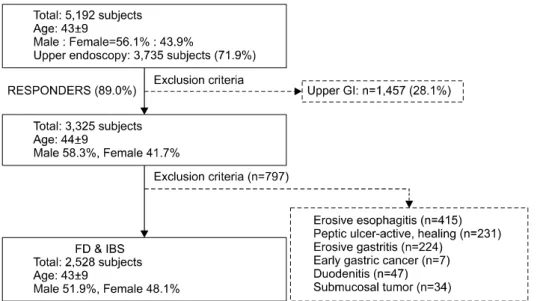
Fig. 1. Patient enrollment of functional gastrointes- tinal disorders.
enrolled from August 2008 to January 2009. Of these, 1,457 subjects (28.1%) were excluded because they had undergone radiologic upper-GI series rather than endos- copy (Fig. 1). In total, 3,325 subjects (mean age, 44±9 years; 58.3% male) presenting for 3,735 endoscopies responded to the BDQ-K, generating an 89.0% response rate. The exclusion criteria were: 1) no upper endoscopy;
2) could not read Korean; 3) could not understand the BDQ-K because of severe alcoholism, dementia, old age, etc.; and 4) refusal to participate. Among the 3,325 subjects, 797 were excluded because of organic diseases, including erosive esophagitis (n=415), active or healing stages of peptic ulcer (n=231), erosive gastritis (n=224), early gastric cancer (n=7), duodenitis (n=47), and sub- mucosal tumor (n=34). Finally, a total of 2,528 subjects who responded to the questionnaire and underwent an upper endoscopy were included in the study. The study protocol was approved by the Institutional Review Board of Ewha Womans University Mokdong Hospital.
Definitions of FD and IBS
FD was defined according to the ROME III criteria [5,6]: (1) PDS, or (2) EPS in the current 3 months and no evidence of structural disease (including on up- per endoscopy). IBS was defined as recurrent abdominal pain or discomfort, with no evidence of structural dis- ease, plus two out of three of the following symptoms [6]; (1) pain relief after defecation, (2) pain onset asso-
ciated with a change in stool frequency, (3) pain onset associated with a change in the stool form (appearance) during the current three months. IBS was classified into four types: constipation predominant, diarrhea pre- dominant, mixed, and unclassified.
Statistics
The statistical analysis was performed using the kappa statistic for reliability and validity. A kappa statistic value of 0.4∼0.7 indicated a good correlation, and a value of >0.7 indicated an excellent correlation [9].
Continuous variables were expressed as means±SD. We performed a χ2 test for the prevalence of sex-based differences. Data analyses were performed with SPSS for Windows (v. 13.0; SPSS Inc., Chicago, IL, USA), and P<0.05 was considered significant.
Results
Reproducibility and concurrent validity of GI symptoms on the BDQ-K
The median kappa value for the test-retest study was 0.56 (range 0.22∼1.0) for the GI symptoms; κ=0.51 for abdominal pain (P<0.001), κ=0.51 for pain onset before six months (P<0.001), κ=0.64 for pain severity (P<0.001), κ=0.69 for epigastric pain (P<0.001), κ=0.40 for early satiety (P<0.001), and κ=0.34 for post- prandial fullness (P<0.001; Table 1).
Table 1. Reproducibility and concurrent validity of gastrointestinal symptoms assessed with the K-BDQ*
Reproducibility (n=69) Concurrent validity (n=74)
Kappa value P value Kappa value P value
Abdominal pain in the last year Pain onset before six months Pain location, epigastric area Periumbilical area
Severity of pain
Loose stool when pain began Hard stool when pain began
Number of bowel movements/week Type of stool form
Presence of hematochezia Constipation before six months Taking medication for constipation None
Fiber Laxatives Loose stools Epigastric pain Early satiety Postprandial fullness Hunger pain
Pain related to eating Bloating
0.509 0.508 0.690 0.740 0.639 0.442 0.419 0.541 - 0.950 0.653
0.910 0.782 0.914 0.505 0.690 0.395 0.342 0.217 0.752 0.335
<0.001
<0.001
<0.001
<0.001
<0.001
<0.001
<0.001
<0.001 -
<0.001
<0.001
<0.001
<0.001
<0.001
<0.001
<0.001
<0.001
<0.001 0.188
<0.001
<0.001
0.910 0.890 0.727 0.576 0.828 0.552 - 0.507 0.608 0.778 0.788
0.915 0.793 1.000 0.431 0.727 0.504 0.567 0.783 - -
<0.001
<0.001 0.001 0.007
<0.001
<0.001 -
<0.001
<0.001
<0.001
<0.001
<0.001
<0.001
<0.001
<0.001 0.001
<0.001
<0.001 0.011
- -
*Korean version of a bowel disease questionnaire.
Table 2. Reproducibility and concurrent validity of nongastrointestinal symptoms assessed with the K-BDQ*
Reproducibility (n=69) Concurrent validity (n=74)
Kappa value P value Kappa value P value
Weight loss Surgical history Appendectomy Pregnancy
Number of normal deliveries Number of cesarean sections Marital status
Education Tobacco history Alcohol history Past medical history Cancer
Diabetes
Active peptic ulcer Frequency of doctor visits History of GI problems
0.657 0.811 0.915 0.800 1.000 0.907 0.968 0.915 0.874 - 0.374 0.621 1.000 0.800 0.746 0.866
<0.001
<0.001
<0.001
<0.001
<0.001
<0.001
<0.001
<0.001
<0.001 - 0.010 0.026 0.001 0.005
<0.001
<0.001
- 0.757 1.000 1.000 1.000 1.000 0.942 0.910 0.941 0.746 0.745 1.000 1.000 0.545 0.656 1.000
-
<0.001
<0.001
<0.001
<0.001
<0.001
<0.001
<0.001
<0.001
<0.001
<0.001 0.005 0.003 0.171
<0.001
<0.001
*Korean version of a bowel disease questionnaire.
In the validity study of the BDQ-K, the median kappa value was 0.74 (0.36∼1.0); κ=0.91 for abdominal pain (P<0.001), κ=0.71 for pain onset before six months (P<0.001), κ=0.83 for pain severity (P<0.001), κ=0.73
for epigastric pain (P<0.001), κ=0.50 for early satiety (P<0.001), and κ=0.57 for postprandial fullness (P<
0.001; Table 1).
Table 3. Prevalence of functional dyspepsia according to sex FD (≥2∼3/month) FD (≥1/week) Total Male
Female Total
189 (14.4%) 268 (22.0%) 457 (18.1%)*
78 (5.9%) 131 (10.8%) 209 (8.3%)*
1,311 1,217 2,528
*P value<0.001.
Fig. 2. The prevalence of functional dyspepsia and subtypes.
Table 4. Prevalence of irritable bowel syndrome according to sex IBS (≥1/month) IBS (≥2∼3/month) Total Male
Female Total
73 (5.6%) 98 (8.1%) 171 (6.8%)*
67 (5.1%) 87 (7.1%) 154 (6.1%)†
1,311 1,217 2,528
*P value=0.013; †P value=0.032.
Fig. 3. The proportions of lower-abdominal symptoms.
Reproducibility and concurrent validity of non- GI symptoms on the BDQ-K
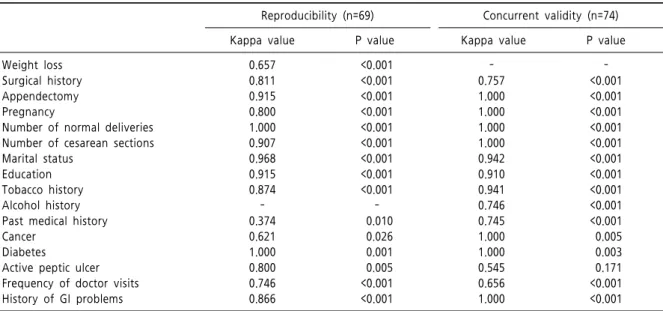
For the non-GI symptoms, the median kappa value of the test-retest study was 0.63 (range 0.27∼1.0), in- cluding κ=0.66 for weight loss (P<0.001), κ=0.81 for surgical history (P<0.001), κ=0.80 for pregnancy his- tory (P<0.001), and κ=0.75 for frequency of visits to doctors (P<0.001). The median kappa value of validity was 0.76 (range 0.36∼1.0; Table 2).
Prevalence of FD according to the Rome III criteria
A total of 2,528 subjects (mean age, 43±9 years; 51.9%
male) were included in the study. The prevalence of FD at least weekly was 8.3% (209/2,528). A female predominance was noted in the subjects with FD (M:F=10.8:5.9, P<0.001; Table 3).
The proportion of patients with EPS was 4.4%
(112/2,528) and with PDS was 6.5% (164/2,528), which consisted of early satiety 2.5% (64/2,528) and post-
prandial fullness 6.1% (155/2,528; Fig. 2).
Prevalence of IBS according to the Rome III criteria
The prevalence of IBS at least 2∼3 times per month was 6.1% (154/2,528) and at least once a month was 6.8% (171/2,528). IBS also predominated in women (7.1% vs 5.1% in men, P=0.032; Table 4). According to the proportion of lower-abdominal symptoms, pain or discomfort improved after a bowel movement at least 2∼3 times per month in 3.8% of patients; the onset of pain or discomfort was associated with more stools at least 2∼3 times per month in 2.7%; fewer stools occurred in 1.3%; looser stools occurred in 3.0%;
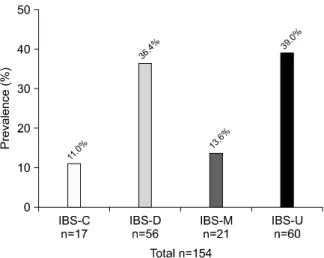
and harder stools occurred in 1.5% (Fig. 3). Among the 154 subjects who had IBS symptoms at least 2∼
times per month, the prevalence of the IBS subtypes were as follows: IBS constipation 11.0% (n=17), IBS diarrhea 36.4% (n=56), IBS mixed 13.6% (n=21), and IBS unspecified 39.0% (n=60; Fig. 4).
Fig. 4. The proportions of irritable bowel syndrome subtypes.
IBS-C, constipation-predominant IBS; IBS-D, diarrhea-predo- minant IBS; IBS-M, mixed pattern of IBS; IBS-U, unclassified pattern of IBS.
Discussion
FGIDs are highly prevalent and potentially disabling conditions that are diagnosed by the patterns of symp- toms presented by the patients to their physicians. For the purpose of research, we need a reliable and standard method to properly select patients to analyze the specific pathophysiological features underlying these symp- toms, and to develop proper treatments for targeted patient groups. However, it is difficult to validate the symptom-based diagnostic criteria for FGIDs because of the lack of gold standard diagnoses. In the absence of a gold standard diagnostic factor or biomarker, inves- tigators have adopted one of the following two strategies. One defines FGIDs by exclusion and the other defines FGIDs by positive symptoms.
Our study is the first to translate into Korean the BDQ, a well-known validated, structured questionnaire for the evaluation of FGIDs, and to validate it with a standardized method. The questionnaire, which is based on self-reported symptoms, can guide diagnoses and treatment approaches. It may also facilitate ob- jective diagnosis and increase their reliability, and re- duce the ordering of unnecessary diagnostic studies for FGIDs. It may also be important in socioeconomic con- text to evaluate different treatment outcomes, and in the establishment of dynamic clinical changes. There-
fore, a well designed verified questionnaire may be help- ful for diagnosing FGIDs.
In Korea, there are several questionnaires for the diagnosis of FGIDs, which have been translated or spe- cifically developed [10,11]. Cho et al [12] translated into Koreans the questionnaire developed by Locke [13]
for gastroesophageal reflux disease (GERD), thus gen- erating the GERD-K. The GERD-K includes a ques- tionnaire about GERD and a medical outcome study, the short form 20 (SF-20), a simplified questionnaire of the patient’s quality of life. Questionnaires about GERD, FD, IBS, and functional constipation defined according to the ROME II criteria [13,14] have also been translated into Korean [15,16]. A few studies [17,18]
of the epidemiology of IBS based on one of these trans- lated questionnaires have also been undertaken, accord- ing to the ROME II criteria [19]. The validity and reli- ability of the questionnaire in assessing the quality of life of IBS patients were also documented [20].
Epidemiological studies in Korea have demonstrated the prevalence of FD and IBS, defined according to the ROME II criteria, to be around 9.5∼12.2% and 6.6∼9.6%, respectively [15-18]. However, information on the prevalence of FD and IBS in Asia is still lacking, especially for Korea. In the past, a factor analysis of the symptoms in a sample of Asian patients with FGID supported the use of the ROME II classification [21].
In subject undergoing a health check-up, the frequency of FD was 13.4% based on the ROME II criteria [22].
Another study showed that the prevalence of IBS, de- fined according to the ROME II criteria, was 16.8%
[23]. Therefore, the results differ among studies and the response rates were two low to represent the Korean population. In our study, the prevalence of FD and IBS, defined according to the Rome III criteria, was 8.3% and 6.1%, respectively.
In the present study, the accuracy of the BDQ-K was excellent, with a median kappa value of 0.74 (0.36∼
1.00). However, its reliability was relatively low (κ=0.56, range 0.22∼1.00). The median follow-up dura- tion was two weeks after the first visit. However, GI symptoms fluctuate within several weeks and some- times disappear after an endoscopy or clinical work-up for GI symptoms. Therefore, a two-week interval for
the test-retest study might have been too long for the evaluation of FGIDs.
The lowest kappa value was observed for upper-GI symptoms, especially early satiety, postprandial fullness, and hunger pains. In the present study, the prevalence of early satiety was relatively low, but was not propor- tionally low as that for postprandial fullness or epigastric pain. It is difficult to say whether this result represents true poor quality of questionnaire or the different so- cio-cultural effects experienced in Korea compared with Western countries.
The subgroup classification of IBS is important for clinical trials, especially pharmacodynamic studies. The Rome III criteria recommend that the classification of IBS subtypes by the Bristol Stool Scale (BSS). However, the response rate to the BSS was very low and Korean subjects did not readily understand it. There are few data available about the duration or frequency of stool form evaluated with the BSS. We used the BSS ques- tionnaire to evaluate the last bowel movement accord- ing to the original BDQ, but, many subjects did not remember it. Consequently, we failed to assess the reli- ability of the BSS. Therefore, the subtypes of IBS were not easily approached. We used this analysis following the specific questionnaire for stool form in the Rome III questionnaire on the homepage of Rome committee [24].
This study has several strong points. First, we enrolled a large sample of study participants who underwent laboratory studies, upper endoscopy, and abdominal ultrasonography. Second, the response rate to the ques- tionnaire in this study was very high, at 89.0%. The response rates have been reported to be <50% in several recent studies [15,18]. The study also has some limitations.
The kappa statistic was relatively low for the reliability of the questionnaire and this was mainly related to the misunderstanding of symptoms that commenced six months earlier. Some kappa statistics could not be measured because of the inconsistency of several differ- ent answers. We enrolled relatively large numbers of subjects in the study, but most of them did not have FGIDs, so the low rate of positive symptoms might have influenced the agreement in the kappa statistics.
A proportion of the subjects who were enrolled at the
Health Promotion Center had different exposures from general population.
In conclusion, the BDQ-K is an accurate and reliable instrument for identifying FGIDs according to the Rome III criteria. The prevalence of FD and IBS according to the Rome III criteria was 8.3% and 6.1%, respectively.
References
1. Locke GR III. The epidemiology of functional gastro- intestinal disorders in North America. Gastroenterol Clin North Am 1991;25:1-19.
2. Thompson WG, Heaton KW. Functional bowel disorders in apparently healthy people. Gastroenterology 1980;79:
282-288.
3. Manning AP, Thomson WG, Heaton KW, Morris AF.
Towards positive diagnosis of the irritable bowel. Br Med J 1978;2:653-654.
4. Talley NJ, McNeil D, Piper DW. Discriminant value of dyspeptic symptoms: a study of the clinical pre- sentation of 221 patients with dyspepsia of unknown cause, peptic ulceration, and cholelithiasis. Gut 1987;
28:40-46.
5. Tack J, Talley NJ, Calmilleri M, Holtmann G, Hu P, Malagelda JR, et al. Functional gastroduodenal disor- ders. Gastroenterology 2006;130:1466-1479.
6. Drossman DA. The functional gastrointestinal dis- orders and the Rome III process. Gastroenterology 2006;130:1377-1390.
7. Talley NJ, Phillips SF, Melton J 3rd, Wiltgen C, Zinsmeister AR. A patient questionnaire to identify bowel disease. Ann Intern Med 1989;111:671-674.
8. Talley NJ, Phillips SF, Wiltgen CM, Zinsmeister AR, Melton LJ 3rd. Assessment of functional gastro- intestinal disease: the bowel disease questionnaire.
Mayo Clin Proc 1990;65:1456-1479.
9. Fleiss JL. Statistical methods for rates and proportions.
2nd ed. New York: John Wiley and Sons; 1981.
10. Kim ES, Lee BJ, Kim YS, Lee SI, Park HJ. Validation to ROME III criteria in the diagnosis of functional gas- trointestinal disorders in Korean patients. Korean J Neurogastroenterol Motil 2008;14:39-44.
11. Lee EH, Hahm KB, Lee JH, Park JJ, Lee DH, Kim SK, et al. Development and validation of a functional dyspepsia-related quality of life (FD-QOL) scale in South Korea. J Gastroenterol Hepatol 2006;21:268-274.
12. Cho YS, Choi MG, Jeong JJ, Chung WC, Lee IS, Kim SW, et al. Prevalence and clinical spectrum of gastro- esophageal reflux: a population-based study in Asan-si, Korea. Am J Gastroenterol 2005;100:747-753.
13. Locke GR, Talley NJ, Weaver AL, Zinsmeister AR. A new questionnaire for gastroesophageal reflux disease.
Mayo Clin Proc 1994;69:539-547.
14. Talley NJ, Stanghellini V, Heading RC, Koch KL, Malagelada JR, Tytgat G. Functional gastroduodenal disorders. Gut 1999;45:1137-1142.
15. Yang SY, Lee OY, Bak YT, Jun DW, Lee SP, Lee SH, et al. Prevalence of gastroesophageal reflux disease symptoms and uninvestigated dyspepsia in Korea: a population-based study. Dig Dis Sci 2008;53:188-193.
16. Lee SY, Lee KJ, Kim SJ, Cho SW. Prevalence and risk factors for overlaps between gastroesophageal reflux disease, dyspepsia, and irritable bowel syndrome: a pop- ulation-based study. Digestion 2009;79:196-201.
17. Hwang SY, Choi CH, Rhie SY, Do MY, Lee SH, Kim HJ, et al. The frequency and related factors of irritable bowel syndrome in health check up subjects. Korean J Neurogastroenterol Motil 2006;12:136-143.
18. Han SH, Lee OY, Bae SC, Lee SH, Chang YK, Yang SY, et al. Prevalence of irritable bowel syndrome in Korea: population-based survey using the Rome II criteria. J Gastroenterol Hepatol 2006;21:1687-1692.
19. Thompson WG, Longstreth GF, Drossman DA, Heaton KW, Irvine EJ, Muller-Lissner SA. Functional bowel disorders and functional abdominal pain. Gut 1999;45:
1143-1147.
20. Park JM, Choi MG, Oh JH, Cho YK, Lee IS, Kim SW, et al. Cross-cultural validation of irritable bowel syn- drome quality of life in Korea. Dig Dis Sci 2006;51:
1478-1484.
21. Kwan AC, Bao TN, Chakkaphak S, Ke MY, Law NM, Leelakusolvong S, et al. Validation of Rome II criteria for functional gastrointestinal disorders by factor analy- sis of symptoms in Asian patient sample. J Gastroenterol Hepatol 2003;18:796-802.
22. Rhie SU, Choi CH, Lee HW, Do MY, Lee SH, Han SP, et al. The frequency of functional dyspepsia and its re- lated factors for health check up subjects. Korean J Neurogastroenterol Motil 2007;13:31-37.
23. Park KS, Ahn SH, Hwang JS, Cho KB, Chung WJ, Jang BK, et al. A survey about irritable bowel syndrome in south Korea: prevalence and observable organic ab- normalities in IBS patients. Dig Dis Sci 2008;53:704-711.
24. http://www.romecriteria.org/pdfs/IBSMode.pdf