• 검색 결과가 없습니다.

회전근개 봉합술 후 재활치료의 최신 지견

N/A
N/A
Protected

Academic year: 2021

Share "회전근개 봉합술 후 재활치료의 최신 지견"

Copied!
7
0
0

로드 중.... (전체 텍스트 보기)

전체 글

(1)

접수일 : 2013 년 8 월 19 일 , 게재승인일 : 2013 년 8 월 30 일 책임저자 : 이인식 , 서울시 광진구 능동로 120-1

󰂕 143-729, 건국대학교 의학전문대학원 재활의학교실

Tel: 02-2030-5347, Fax: 02-2030-5379 E-mail: [email protected]

회전근개 봉합술 후 재활치료의 최신 지견

건국대학교 의학전문대학원 재활의학교실

이 인 식

Recent Update of Rehabilitation after Rotator Cuff Repair

In-Sik Lee, M.D., Ph.D.

Department of Rehabilitation Medicine, Konkuk University Medical Center and School of Medicine, Seoul, Korea The goals of rehabilitation after rotator cuff repair are to achieve healing of the cuff while restoring pain-free motion and function. Patient-related factors, such as prior surgery, smoking, and comorbidities, undoubtedly influence tendon healing, rehabilitation, and ultimate clinical outcomes. Many rehabilitation protocols for rotator cuff repair are based pri- marily on anecdotal clinical observation and empirical clin- ical experience without sufficient scientific evidences. These protocols indicate a specific exercise/activity progression based on healing time lines. An evaluation-based protocol takes into account not only healing time lines but also the attainment of specific clinical goals. Recently, as surgical techniques and materials have been being developed, the tissue quality of the rotator cuff and the structural integrity of the shoulder joint tend to be emphasized in the re- habilitation after rotator cuff repair. So, recent trends and debates of postoperative rehabilitation after rotator cuff re- pair are reviewed as comparing the accelerated re- habilitation protocol with the delayed rehabilitation protocol.

(Clinical Pain 2013;12:59-65)

Key Words: Rotator cuff repair, Postoperative rehabilitation, Shoulder rehabilitation

서 론

견관절 수술에 관절경이 도입된 후 견관절 질환의 진단 및 치료는 많은 발전이 이루어졌으며, 수술적 치료의 건수 도 기하급수적으로 증가하는 추세에 있다. 따라서, 수술 후 재활 프로그램도 점점 중요성이 부각되면서 수술적 치료의

성공여부에 결정적인 역할을 하게 되어 수많은 재활 프로 토콜들이 각 의료기관에서 개발되어 사용되고 있다. 하지 만, 흔히 사용되고 있는 대부분의 견관절 재활 프로그램들 은 과학적 근거가 부족한 임상적 관찰에 의거하여 개발되 었다는 한계를 가지고 있다.

1

최근 들어서는 회전근개 질환 을 중심으로 생역학적 및 조직학적 치유과정에 대한 연구 결과들이 쌓이고, 또한 수술 수기 및 재료의 발달 등으로 수술적 방법이 발전적인 진화를 하면서, 회전근개의 조직 학적 질 및 견관절의 구조적 완전성 등이 수술 후 재활과정 에서 고려해야 할 중요한 초점으로 강조되고 있다.

본고에서는 2000년대에 들어서 널리 사용되고 있는 견 관절 수술 후 재활 프로그램들에 대한 원칙 및 방법에 대해 살펴보고, 특히 최근에 화두가 되고 있는 회전근개 봉합술 후 재활치료의 최신 경향을 중점적으로 살펴보고자 한다.

견관절 수술 후 재활치료의 원칙 및 전통적 방법

우선, 견관절 수술 후 재활치료를 담당하는 전문가들에 게 요구되는 접근 전략 원칙으로는 첫째, 수술적 방법에 대 한 이해, 둘째, 보호되어야 할 해부학적 구조들과 이들의 치유 속도 및 이들에게 적절한 부하를 주는 방법 등에 대한 이해, 셋째, 치유 중인 조직들에게 부하를 주는 적절한 방법 의 선택 및 숙련된 방법 적용 그리고 마지막으로 초기 부동 고정 기간 동안의 적절한 관리 및 관절범위운동 진행 속도 적용 등을 들 수 있다.

2

견관절 수술 후 재활치료는 슬관절 등 다른 스포츠 재활 치료 프로그램과 유사하게 4∼5단계의 시기적 단계로 나눌 수 있으나, 각 시기적 단계의 정확한 기간 및 재활치료방법 은 질환별, 시행기관별, 수술의사마다 조금씩 차이가 있다.

회전근개 수술 후 재활치료의 전통적 방법은 22주에서 26 주간의 재활치료를 필요로 한다(Table 1).

1

특히 회전근개 수술 후 재활치료의 경우 초기 단계인 1, 2단계에서 가속재 활치료와 지연재활치료 중 어느 쪽이 견관절 기능 회복에 더 좋은가에 대한 논란이 2009년 이후에도 한창 벌어지고 있는 중이다.

재활치료의 방법으로는 견갑골 이상운동(Scapular dyki-

nesia)의 주창자인 Kibler가 2001년에 근위부-원위부 운동

사슬 역학 모델과 조절(control) 및 폐쇄사슬운동 개념을 적

(2)

Table 1. The Five Phases of Healing During Rehabilitation Following Rotator Cuff Surgery

Phase Goals Precautions Criteria for progression

Phase 1:

Immediate postoperative period (weeks 0∼6)

Maintain/protect integrity of repair Gradually increase PROM Diminish pain and inflammation Prevent muscular inhibition Become independent with

modified ADLs

Maintain arm in abduction sling/brace, remove only for exercise

No shoulder AROM, lifting of objects, shoulder motion behind back, excessive stretching or sudden movements, supporting of any weight, lifting of body weight by hands

Keep incision clean and dry

Passive forward flexion to ≥125

o

Passive ER in scapular plane to ≥75

o

(if uninvolved shoulder PROM

>80

o

)

Passive IR in scapular plane to ≥75

o

(if uninvolved shoulder PROM

>80

o

)

Passive abduction to ≥90

o

in the scapular plane

Phase 2:

Protection Phase (weeks 6∼12)

Allow healing of soft tissue Do not overstress healing tissue Gradually restore full PROM

(weeks 4∼5)

Decrease pain and inflammation

No lifting

No supporting body weight with hands and arms

No sudden jerking motions No excessive behind the back

movements

Avoid upper extremity bike and ergometer

Full AROM

Phase 3:

Intermediate phase (weeks 10∼16)

Full AROM (weeks 10∼12) Maintain full PROM Dynamic shoulder stability Gradual restoration of shoulder

strength, power, and endurance Optimize neuromuscular control Gradual return to functional

activities

No lifting objects >5 lbs, sudden lifting or pushing activities, sudden jerking motions, overhead lifting

Avoid upper extremity bike and ergometer

Ability to tolerate progression to low-level functional activities Demonstrated return of

strength/dynamic shoulder stability Reestablishment of dynamic shoulder

stability

Demonstrated adequate strength and dynamic stability for progression to more demanding work- and sport-specific activities Phase 4:

Advanced strengthening phase (weeks 16∼22)

Maintain full nonpainful AROM Advanced conditioning exercises

for enhanced functional use Improve muscular strength, power,

and endurance

Gradual return to full functional activities

Phase 5: Return to activity phase (weeks 20∼26)

Gradual return to strenuous work activities

Gradual return to recreational activities

Gradual return to sport activities

용하여 Pelvis control over the planted leg (negative Trendelenburg sign) → Effective hip and trunk extension

→ Scapular control (especially of retraction) → Normal glenohumeral rotation → No substitutions for these func- tions의 진행 순서로 5가지 주요 쟁점을 강조한 재활치료 프로토콜을 제안한 후(Table 2),

3

2002년에는 Rubin과

Kibler

4

가 core-based 기능적 재활치료의 중요성도 강조하

였다. Kibler는 2008년 논문에서는 반드시 폐쇄사슬운동을

고집하지는 않지만, 최적의 운동사슬(kinetic chain)을 적용

한 근육 활성 패턴을 여전히 강조하면서, 수술부위의 부하

(스트레스)를 최소화하는 목적의 운동을 추가로 강조하고

있다.

5

이후 대부분의 재활 프로그램에서는 견갑골 이상운

(3)

Table 2. Rehabilitation Flow Sheet proposed by Kiebler

Stages (estimate)

Weeks (estimate)

Acute

Recovery Functional

1 2 3 4 5 6 7 8 9 10

Guideline

1. Diagnosis X X

2. Proximal segment control

Step up/step down X X X

Lunges X X X X X

Squats X X X X X X

Hip extension/trunk rotation X X X X X X X X

3. Scapular rehabilitation

Pect minor/up trap stretch (X) (X) X X

Posterior joint mobilization (X) (X) X X X

Hip/trunk extension:

Scapular retraction: X X X X X

Diagonal rotation:

Scapular retraction: X X X X X X X

Pinches X X

Scapular clock (X) (X) X X X

Low row (X) (X) X

Shoulder dumps X X X X X X

Punches X X X X X X

Table pushup X X X

Normal pushup plus X X X X

4. Glenohumeral rehabilitation

Weight shifts (X) (X) X

Scapular clock (X) (X) X X X

Wall washes (X) X X X

Rotation diagonal X X X X X

Isolated rotator cuff X X

5. Plyometrics

Lower extremity X X X X X X

Medicine ball X X X X X

Rotation diagonals X X X X X

Dumbbell rotations X X X X X

( ): May be performed if indicated by tissue healing.

동의 교정을 중요시하여 견갑골 안정화 운동을 우선적으로 시행하고 있다(Fig. 1).

6

회전근개 봉합술 후 재활치료의 최신 경향:

가속재활 대 지연재활

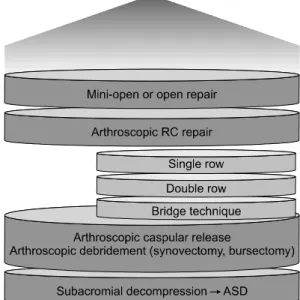
회전근개 질환은 견봉하 충돌증후군부터 회전근개 완전 파열까지 다양한 범주를 보이며, 수술적 적응증 및 수술적 치료 방법의 선택에도 단계적인 접근 전략을 취하게 된다 (Fig. 1). 하지만 많은 수술의들은 회전근개 봉합술을 시행

하면서 견봉하 감압술 등과 같은 여러 술기들을 동시에 시 행하는 경우가 많고, 회전근개 봉합술도 단열(single-row) 봉합과 이열(double-row)봉합 및 교량형(suture bridge)봉합 등과 같이 여러 가지 방법으로 시행되기 때문에 해당 환자 에게 시행된 수술방법에 대한 정확한 이해와 수술의와의 충분한 교감이 요구된다.

회전근개 봉합술 후 재활치료의 목적은 봉합된 회전근개

의 조직학적 치유를 얻으면서, 통증없는 관절운동범위와

견관절 기능을 회복시키는 것이다. 이를 위해서는 수술 후

강직을 최소화하면서 봉합된 회전근개의 조직학적 치유를

(4)

Fig. 2. Hierarchy of surgeries for rotator cuff disorder.

Fig. 1. Treatment algorithm for scapular dysfunction.

이끄는 것이 필요하다. 조직학적 치유가 충분하게 이루어 지지 않으면 재파열이 발생되게 되며, 실제 관절경적 봉합 술 후에도 재파열의 발생률은 25%에서 90%까지 이르는 것으로 보고되고 있으며, 특히 파열 병변의 크기가 클수록 발생률이 높은 것으로 알려져 있다.

7-9

병변 크기 외에도 환

자 나이와 해당 회전근개 근육의 위축 및 지방성 변성의 정도가 중요한 재파열의 예측 인자로 알려져 있다.

10,11

봉합술 방법에 따라서도 재파열 발생률의 차이를 보이는

것으로 알려지고 있는데, 이열봉합이나 교량형봉합이 단열

봉합에 비해 족문피복(footprint coverage)을 넓힘으로써 봉

합부위의 접촉면 압력을 증가시켜 초기 고정력을 증가시키

고 봉합부위의 틈(gap) 형성을 감소시키게 된다.

12

이는 구

조적인 조직의 치유에 더 유리한 것으로 알려져 있으며,

Duquin 등

13

은 1 cm 이상의 파열 병변 크기를 보이는 경우

에는 이열봉합이 단열봉합에 비해 재파열 발생률이 더 낮

으며, 관절경적 수술과 비관절경적 수술간 및 anchor 봉합

과 경골적 봉합간에는 재파열 발생률의 차이가 없었다고

보고하고 있다. 하지만, 2010년에 Saridakis와 Jones의 메타

분석 논문

14

에서는 3 cm 이상의 대형 파열에서만 이열봉합

이 단열봉합보다 기능적 회복우위에 있다고 분석 보고하고

있고, 이열봉합이 봉합된 힘줄의 치유에 더 유리할 수 있다

는 점 외에는 임상적 호전에서 우월성이 없다는 보고들도

많은 실정이다.

15

단열봉합은 22%에서 25% 정도에서 해부

학적 실패율을 보이며,

16,17

이열봉합도 11%에서 17% 정도

의 재파열 발생률을 보이는 것으로 보고되고 있다.

18-20

그리

고 교량형 봉합술을 받은 경우에도 12%에서 재파열이 발

생되었다는 보고부터 최근에는 대형 크기의 파열을 수술한

경우에는 30%까지 재파열이 발생되는 것으로 보고되고 있

(5)

다.

21,22

재파열 발생부위는 단열봉합의 경우에는 족문(footprint) 에서 대부분 발생하며, 교량형봉합의 경우에는 근-힘줄 결합 부위에서 주로 발생하지만, 교량형봉합의 경우에도 회전근 개 근육 위축과 지방 변성이 심할 경우에는 족문에서 재파열 될 수 있는 것으로 보고되고 있다.

23

교량형봉합 후 발생하는 근-힘줄 결합부위에서의 재파열은 정확하게는 이열봉합 중 내측봉합된 부위가 재파열되는 것으로 내측 회전근개 부전 (medial rotator cuff failure)이라고 부르기도 하는데 내측 봉 합부위의 과도한 긴장에 의한 것으로 추정하고 있다.

22

수술 후 재파열과 관련된 재미있는 사실은 재파열이 되 어도 통증 등의 증상이 없는 경우가 많다는 것이다.

23

재파 열은 완전 봉합을 못하고 틈 형성을 남기는 수술의 불완전 성과 제대로 봉합을 하였으나 다시 파열되는 경우 등이 복 합되어 발생하긴 하지만, 재파열 환자의 대다수에게서 유 의한 통증이 없다는 것은 회전근개 파열에서 파열된 회전 근개가 통증의 원인이 아니라는 것을 반증해 준다.

관절경적 봉합술이 널리 사용되기 이전인 개방적(open) 회전근개 봉합술을 시행하던 때에는 수술 후 불응성 강직 (stiffness)이 심각한 수술적 합병으로 흔하게 발생되었기 때문에 수술 후 즉각적인 수동관절운동을 시행함으로써 유 착을 예방하고, 이를 통해 봉합된 조직을 보호하는 것이 일 반적으로 추천되었다.

24

이후 도입된 최소침습 개방적 (mini-open) 수술 후에도 수술 후 강직이 비교적 흔하게 발 생하였는데, 두 수술 방법은 연부조직의 절개로 인해 삼각 근하(subdeltoid) 유착들이 초래되어 수술 후 강직이 발생 하는 것으로 알려져 왔다.

25,26

또한, 최근 기초연구들 중에 서 개방적 봉합술을 받은 환자군에서 혈청 interleukin-6가 관절경적 봉합술을 받은 군에 비해 더 높은 것으로 보고되 었으며,

27

관절경적 봉합술을 받은 후 수술 후 강직이 발생 한 경우에 술후 15개월에 측정한 혈장 substance P가 3배 정도 더 높다는 보고 등을 고려하면,

28

수술 후 조직의 염증 반응이 더 심할수록 수술 후 강직이 더 많이 발생되는 것으 로 추정되며, 결국 수술적 방법이 수술 후 강직 발생에 중요 한 역할을 하는 것으로 추정된다.

수술 후 강직은 최소침습 개방적 수술 후에는 20% 정도 에서 발생하는 것으로 알려져 있는 것에 비해 관절경적 봉 합술에서는 상대적으로 적은 것으로 알려져 있는데, Huberty 등

29

은 489명의 관절경적 회전근개 봉합술을 받은 환자 중 4.8%에서 수술 후 강직이 발생했으며, 유발 위험인자로는 석회성 건염, 유착성 관절낭염, 단일 힘줄 봉합술을 받은 경우, PASTA 병변 봉합술을 받은 경우, 50세 이하의 연령 및 직업적 보상 여부 등을 들고 있다. 이들 중 95.8%에서 봉합된 회전근개는 완전 치유되었다고 하며, 이들 대부분 이 관절경적 관절낭 유리술을 받은 후 정상 운동범위를 확

보하였다고 보고하였다. Denard 등

30

은 재활치료로 호전이 안 되는 수술 후 강직에 대해서는 관절경적 관절낭 유리술 을 권장하며, 이에 대한 구체적인 수술 방법까지 제안하고 있다. 또한, 통상적으로 수술을 하기 전에 우선적으로 풀어 야 한다는 수술 전 강직에 대해서도 중등도의 강직일 경우 관절경적 회전근개 봉합술를 할 때 도수치료를 동반한 관 절경적 관절낭 유리술을 함께 시행하면 수술 후 임상결과 에 영향을 주지 않는다는 보고도 있다.

31

이와 같이 최근에는 관절경적 관절낭 유리술을 통한 수 술 후 강직의 치료가 확보됨으로써 수술의들은 수술 후 6주 기간 동안의 부동 고정을 통한 조직 치유에 중점을 두는 지연재활(delayed rehabilitation)을 선호하는 경향이 우세를 보이고 있는 추세이다. Peltz 등

32

이 쥐 실험을 통해 수술 후 즉각적인 수동관절운동을 한 군에서 수술 후 지속적 부 동 고정을 한 군보다 수술 후 강직이 더 많이 발생했다는 보고와 회전근개 봉합술 후 부동 고정을 통한 수술 후 강직 은 일시적이라는 임상 보고들,

33,34

쥐의 극상근 힘줄들을 봉 합한 후 부동 고정시킨 군에서 힘줄의 생역학적 특성이 더 좋았다는 보고,

35

그리고 영장류를 이용한 회전근개 치유 과정을 고찰한 동물실험에서 봉합된 회전근개의 조직학적 숙성(maturation)이 12주에서 15주를 필요로 한다는 보고

36

등이 수술 후 초기 6주간의 부동 고정을 강조하는 지연재활 치료에 대한 근거들로 제시되고 있다.

전통적 재활프로그램들은 관절경적 봉합술 후에도 초기 6주 동안은 부동 고정을 하면서 수동관절운동만 시행할 것 을 권고하고 있으며,

1,37,38

지연재활 프로그램들은 수술 후 초기 6주간 슬링 보조기를 이용하여 부동 고정만 하고 운동 은 전혀 하지 않는 것을 권고하고 있다.

29,33

한편, Koo 등

39

은 앞서 언급한 Huberty 등

29

이 언급한 수술 후 강직의 위험 인자들이 존재하는 경우에 수술 후 초기 6주 동안 슬링 고 정을 기본으로 하면서 폐쇄사슬의 수동전방굴곡 운동(table slides)을 추가하도록 하는 변형 지연재활 프로그램을 제안 하였으며, 이를 통해 수술 후 불응성 강직이 0%까지 이른 다고 보고하고 있다. 한편, 전통적 방법은 불응성 수술 후 강직의 발생률이 1.5%로 보고되고 있고,

37,38

지연재활 방법 은 이미 언급했듯이 4.5% 및 4.8%의 불응성 강직 발생률이 각각 보고되고 있다.

29,33

반면 조기 가동을 원칙으로 수술 후 강직의 최소화와 일

상생활의 조기복귀를 목표로 하는 가속재활(accerelerated

rehabilitation)의 효용성을 주장하는 논문들도 있다. 회전근

개 봉합술 후 3주 지난 시점에서 능동관절운동을 시작한

13명의 가속재활군에서 6주 지난 시점에서 능동관절운동

을 시작한 16명의 지연재활군에서보다 통증 및 기능적 회

복이 더 우월하였다는 보고가 있었으며,

40

Klintberg 등

41

수술 후 4주까지 하루 3회의 회전근개 활성을 위한 동작과

(6)

수술 4주 지난 시점에서 시작하는 능동보조관절운동을 골 자로 한 진행성 재활치료를 소개하면서, 이러한 방법이 회 전근개를 활성화시켜 교원섬유 조직의 대사활동 및 유산소 능력을 향상시킴으로써 조직 치유에도 더 도움이 된다고 주장하고 있다.

하지만 지연재활 및 가속재활 방법은 수술 후 봉합조직 을 관리하는 방법적 차이는 있지만 둘 다 봉합 조직의 치유- 회복을 최대한 이끌어내고 수술 후 강직은 가능한 한 최소 화하려는 목적은 동일하다고 할 수 있다. 2011년에 들어서 는 봉합된 조직의 치유 회복의 촉진을 위해서 보툴리눔 독 소를 극상근에 주사하여 마비를 통한 부동 고정을 시키는 동물실험연구들도 발표되었고,

42,43

수술과 동시에 자가 혈 소판 풍부 혈장 주사치료를 봉합부위에 주사를 함으로써 임상적 호전이 촉진된다는 보고들

44,45

및 봉합술 후 항유착 제인 Sodium hyaluronate의 견봉하 주사치료가 수술 후 강 직의 감소에 효과가 있었다는 보고까지 있다.

46

참 고 문 헌

1. Millett PJ, Wilcox RB 3rd, O'Holleran JD, Warner JJ.

Rehabilitation of the rotator cuff: an evaluation-based approach. J Am Acad Orthop Surg 2006; 14: 599-609 2. Gaunt BW, Shaffer MA, Sauers EL, Michener LA,

McCluskey GM, Thigpen C; American Society of Shoulder and Elbow Therapists. The American Society of Shoulder and Elbow Therapists' consensus rehabilitation guideline for arthroscopic anterior capsulolabral repair of the shoulder. J Orthop Sports Phys Ther 2010; 40: 155-168 3. Kibler WB, McMullen J, Uhl T. Shoulder rehabilitation

strategies, guidelines, and practice. Orthop Clin North Am 2001; 32: 527-538

4. Rubin BD, Kibler WB. Fundamental principles of shoulder rehabilitation: conservative to postoperative management.

Arthroscopy 2002; 18(9 Suppl 2): 29-39

5. Kibler WB, Sciascia A. Rehabilitation of the athlete's shoulder. Clin Sports Med 2008; 27: 821-831

6. Ellenbecker TS, Cools A. Rehabilitation of shoulder im- pingement syndrome and rotator cuff injuries: an evidence- based review. Br J Sports Med 2010; 44: 319-327 7. Bishop J, Klepps S, Lo IK, Bird J, Gladstone JN, Flatow

EL. Cuff integrity after arthroscopic versus open rotator cuff repair: a prospective study. J Shoulder Elbow Surg 2006; 15: 290-299

8. Galatz LM, Ball CM, Teefey SA, Middleton WD, Yamaguchi K. The outcome and repair integrity of com- pletely arthroscopically repaired large and massive rotator cuff tears. J Bone Joint Surg Am 2004; 86: 219-224 9. Liem D, Lichtenberg S, Magosch P, Habermeyer P.

Magnetic resonance imaging of arthroscopic supraspinatus tendon repair. J Bone Joint Surg Am 2007; 89: 1770-1776 10. Oh JH, Kim SH, Kang JY, Oh CH, Gong HS. Effect of age on functional and structural outcome after rotator cuff repair. Am J Sports Med 2010; 38: 672-678

11. Oh JH, Kim SH, Ji HM, Jo KH, Bin SW, Gong HS.

Prognostic factors affecting anatomic outcome of rotator cuff repair and correlation with functional outcome. Arthro- scopy 2009; 25: 30-39

12. Kim DH, Elattrache NS, Tibone JE, Jun BJ, DeLaMora SN, Kvitne RS, et al. Biomechanical comparison of a sin- gle-row versus double-row suture anchor technique for ro- tator cuff repair. Am J Sports Med 2006; 34: 407-414 13. Duquin TR, Buyea C, Bisson LJ. Which method of rotator

cuff repair leads to the highest rate of structural healing?

A systematic review. Am J Sports Med 2010; 38: 835-841 14. Saridakis P, Jones G. Outcomes of single-row and dou- ble-row arthroscopic rotator cuff repair: a systematic review. J Bone Joint Surg Am 2010; 92: 732-742 15. Nho SJ, Slabaugh MA, Seroyer ST, Grumet RC, Wilson

JB, Verma NN, et al. Does the literature support dou- ble-row suture anchor fixation for arthroscopic rotator cuff repair? A systematic review comparing double-row and sin- gle-row suture anchor configuration. Arthroscopy 2009; 25:

1319-1328

16. Cho NS, Rhee YG. The factors affecting the clinical out- come and integrity of arthroscopically repaired rotator cuff tears of the shoulder. Clin Orthop Surg 2009; 1: 96-104 17. Cole BJ, ElAttrache NS, Anbari A. Arthroscopic rotator

cuff repairs: an anatomic and biomechanical rationale for different suture-anchor repair configurations. Arthroscopy 2007; 23: 662-669

18. Huijsmans PE, Pritchard MP, Berghs BM, van Rooyen KS, Wallace AL, de Beer JF. Arthroscopic rotator cuff repair with double-row fixation. J Bone Joint Surg Am 2007; 89:

1248-1257

19. Lafosse L, Brozska R, Toussaint B, Gobezie R. The out- come and structural integrity of arthroscopic rotator cuff re- pair with use of the double-row suture anchor technique.

J Bone Joint Surg Am 2007; 89: 1533-1541

20. Sugaya H, Maeda K, Matsuki K, Moriishi J. Repair in- tegrity and functional outcome after arthroscopic dou- ble-row rotator cuff repair: a prospective outcome study. J Bone Joint Surg Am 2007; 89: 953-960

21. Frank JB, ElAttrache NS, Dines JS, Blackburn A, Crues J, Tibone JE. Repair site integrity after arthroscopic trans- osseous-equivalent suturebridge rotator cuff repair. Am J Sports Med 2008; 36: 1496-1503

22. Cho NS, Lee BG, Rhee YG. Arthroscopic rotator cuff re-

pair using a suture bridge technique: is the repair integrity

(7)

actually maintained? Am J Sports Med 2011; 39:

2108-2116

23. Cho NS, Yi JW, Lee BG, Rhee YG. Retear patterns after arthroscopic rotator cuff repair: single-row versus suture bridge technique. Am J Sports Med 2010; 38: 664-671 24. Cofield RH. Rotator cuff disease of the shoulder. J Bone

Joint Surg Am 1985; 67: 974-979

25. Mansat P, Cofield RH, Kersten TE, Rowland CM. Compli- cations of rotator cuff repair. Orthop Clin North Am 1997;

28: 205-213

26. Norberg FB, Field LD, Savoie FH 3rd. Repair of the rotator cuff. Miniopen and arthroscopic repairs. Clin Sports Med 2000; 19: 77-99

27. Shinoda T, Shibata Y, Izaki T, Shitama T, Naito M. A com- parative study of surgical invasion in arthroscopic and open rotator cuff repair. J Shoulder Elbow Surg 2009; 18: 596-599 28. Franceschi F, Longo UG, Ruzzini L, Morini S, Battistoni

F, Dicuonzo G, et al. Circulating substance P levels and shoulder joint contracture after arthroscopic repair of the ro- tator cuff. Br J Sports Med 2008; 42: 742-745

29. Huberty DP, Schoolfield JD, Brady PC, Vadala AP, Arrigoni P, Burkhart SS. Incidence and treatment of post- operative stiffness following arthroscopic rotator cuff repair.

Arthroscopy 2009; 25: 880-890

30. Denard PJ, Lädermann A, Burkhart SS. Prevention and management of stiffness after arthroscopic rotator cuff re- pair: systematic review and implications for rotator cuff healing. Arthroscopy 2011; 27: 842-848

31. Oh JH, Kim SH, Lee HK, Jo KH, Bin SW, Gong HS.

Moderate preoperative shoulder stiffness does not alter the clinical outcome of rotator cuff repair with arthroscopic re- lease and manipulation. Arthroscopy 2008; 24: 983-991 32. Peltz CD, Dourte LM, Kuntz AF, Sarver JJ, Kim SY,

Williams GR, et al. The effect of postoperative passive mo- tion on rotator cuff healing in a rat model. J Bone Joint Surg Am 2009; 91: 2421-2429

33. Parsons BO, Gruson KI, Chen DD, Harrison AK, Gladstone J, Flatow EL. Does slower rehabilitation after arthroscopic rotator cuff repair lead to long-term stiffness? J Shoulder Elbow Surg 2010; 19: 1034-1039

34. Sarver JJ, Peltz CD, Dourte L, Reddy S, Williams GR, Soslowsky LJ. After rotator cuff repair, stiffness? But not the loss in range of motion? Increased transiently for immo- bilized shoulders in a rat model. J Shoulder Elbow Surg 2008; 17: 108S-113S

35. Gimbel JA, Van Kleunen JP, Williams GR, Thomopoulos S, Soslowsky LJ. Long durations of immobilization in the

rat result in enhanced mechanical properties of the healing supraspinatus tendon insertion site. J Biomech Eng 2007;

129: 400-404

36. Sonnabend DH, Howlett CR, Young AA. Histological eval- uation of repair of the rotator cuff in a primate model. J Bone Joint Surg Br 2010; 92: 586-594

37. Tauro JC. Stiffness and rotator cuff tears: Incidence, arthro- scopic findings, and treatment results. Arthroscopy 2006;

22: 581-586

38. Brislin KJ, Field LD, Savoie FH 3rd. Complications after arthroscopic rotator cuff repair. Arthroscopy 2007; 23:

124-128

39. Koo SS, Parsley BK, Burkhart SS, Schoolfield JD.

Reduction of postoperative stiffness after arthroscopic rota- tor cuff repair: Results of a customized physical therapy regimen based on risk factors for stiffness. Arthroscopy 2011; 27: 155-160

40. Duzgun I, Baltacı G, Atay OA. Comparison of slow and accelerated rehabilitation protocol after arthroscopic rotator cuff repair: pain and functional activity. Acta Orthop Trau- matol Turc 2011; 45: 23-33

41. Klintberg IH, Gunnarsson AC, Svantesson U, Styf J, Karlsson J. Early loading in physiotherapy treatment after full-thickness rotator cuff repair: a prospective randomized pilot-study with a two-year follow-up. Clin Rehabil 2009;

23: 622-638

42. Hettrich CM, Rodeo SA, Hannafin JA, Ehteshami J, Shubin Stein BE. The effect of muscle paralysis using Botox on the healing of tendon to bone in a rat model. J Shoulder Elbow Surg 2011; 20: 688-697

43. Mannava S, Wiggins WF, Saul KR, Stitzel JD, Smith BP, Koman LA, et al. Contributions of neural tone to in vivo passive muscle--tendon unit biomechanical properties in a rat rotator cuff animal model. Ann Biomed Eng 2011; 39:

1914-1924

44. Barber FA, Hrnack SA, Snyder SJ, Hapa O. Rotator cuff repair healing influenced by platelet-rich plasma construct augmentation. Arthroscopy 2011; 27: 1029-1035

45. Jo CH, Kim JE, Yoon KS, Lee JH, Kang SB, Lee JH, et al. Does Platelet-Rich Plasma Accelerate Recovery After Rotator Cuff Repair? A Prospective Cohort Study. Am J Sports Med 2011; 39: 2082-2090

46. Oh CH, Oh JH, Kim SH, Cho JH, Yoon JP, Kim JY.

Effectiveness of subacromial anti-adhesive agent injection

after arthroscopic rotator cuff repair: prospective random-

ized comparison study. Clin Orthop Surg 2011; 3: 55-61

수치

Table  1.  The  Five  Phases  of  Healing  During  Rehabilitation  Following  Rotator  Cuff  Surgery
Table  2.  Rehabilitation  Flow  Sheet  proposed  by  Kiebler Stages  (estimate) Weeks  (estimate) Acute Recovery Functional 1 2 3 4 5 6 7 8 9 10 Guideline     1
Fig.  1.  Treatment  algorithm  for  scapular  dysfunction.

참조

관련 문서

If both these adjustments are considered, the resulting approach is called a bootstrap-BC a -method (bias- corrected-accelerated). A description of this approach

③ A student who attended Korean course at KNU Korean Language Program and holds TOPIK Level 3 or a student who completed Korean course Level 4 at the KNU Korean Language

· 50% exemption from tuition fee Ⅱ for the student with a TOPIK score of level 3 or higher or completion of level 4 or higher class of the Korean language program at the

웹 표준을 지원하는 플랫폼에서 큰 수정없이 실행 가능함 패키징을 통해 다양한 기기를 위한 앱을 작성할 수 있음 네이티브 앱과

_____ culture appears to be attractive (도시의) to the

이하선의 실질 속에서 하악경의 후내측에서 나와 하악지의 내측면을 따라 앞으로 간다. (귀밑샘 부위에서 갈라져 나와

The key issue is whether HTS can be defined as the 6th generation of violent extremism. That is, whether it will first safely settle as a locally embedded group

The “Asset Allocation” portfolio assumes the following weights: 25% in the S&P 500, 10% in the Russell 2000, 15% in the MSCI EAFE, 5% in the MSCI EME, 25% in the