• 검색 결과가 없습니다.

Effect of Vinyl Group Content of the Functionalized Liquid Butadiene Rubber as a Processing Aid on the Properties of Silica Filled Rubber Compounds

N/A
N/A
Protected

Academic year: 2021

Share "Effect of Vinyl Group Content of the Functionalized Liquid Butadiene Rubber as a Processing Aid on the Properties of Silica Filled Rubber Compounds"

Copied!
12
0
0

로드 중.... (전체 텍스트 보기)

전체 글

(1)

DOI: https://doi.org/10.7473/EC.2021.56.3.152

Effect of Vinyl Group Content of the Functionalized Liquid Butadiene Rubber as a Processing Aid on the Properties of Silica Filled Rubber Compounds

Donghyuk Kim, Byungkyu Ahn, Gyeongchan Ryu, Kiwon Hwang, Sanghoon Song, and Wonho Kim School of Chemical Engineering, Pusan National University, 2, Busandaehak-ro 63beon-gil, Gumjung-Gu,

Busan 46241, Republic of Korea

(Received September 1, 2021, Revised September 13, 2021, Accepted September 15, 2021)

Abstract: Liquid butadiene rubber (LqBR) is used as a processing aid and plays a vital role in the manufacture of high- performance tire tread compounds. In this study, center-functionalized LqBR (C-LqBR) was polymerized with different vinyl content via anionic polymerization. The effects of the vinyl content on the properties of the compounds were inves- tigated by partially replacing the treated distillate aromatic extract (TDAE) oil with C-LqBR in silica-filled rubber com- pounds. C-LqBR compounds showed a low Payne effect and Mooney viscosity regardless of the vinyl content, because of improved silica dispersion due to the ethoxysilyl group. As the vinyl content of C-LqBR increased, the optimum cure time (t

90

) increased owing to a decrease in the number of allylic hydrogen. Moreover, the glass transition temperature (T

g

) of the compound increased, and snow traction and abrasion resistance performance decreased, whereas wet grip improved. The energy loss characteristics revealed that the hysteresis attributed to the free chain ends of C-LqBR was dominant.

Keywords: liquid butadiene rubber, silica-filled compound, anionic polymerization, vulcanizate structure, rubber com- pounding

Introduction

산업적으로 제조된 “liquid butadiene rubber (LqBR)”는 고 무산업에서 plasticizer, cure coagent, 그리고 타이어 트레드의 점탄성을 개선하는 용도로 사용된다. 특히, 타이어 산업에 적 용하려는 연구가 지난 10년간 크게 증가하였는데, 이는 liquid polymer 관련 특허 출원 수의 큰 증가폭으로 확인할 수 있다.

1

1995년부터 유럽의 processing oil 생산업체와 타이어 제조 업체들은 기존에 사용하던 highly aromatic oil (distilled aromatic extract, DAE)이 발암성 물질인 polycyclic aromatic hydrocarbons (PAHs)을 함유하고 있어, 이를 대체하기 위한 가공조제를 개발하기 시작하였다. 실제로 2010년 EU REACH (Registration, Evaluation, Authorization and Restriction of Chemical) 규정에 따라 타이어 제조에서 DAE oils의 사용이 금지되었고, treated distillate aromatic extract (TDAE) oil과 같이 PAHs 함량이 적은 oil이 대체 가공조제로 사용되고 있 다.

2,3

하지만 TDAE oil이 적용된 가류물은 시간이 지남에 따 라 TDAE oil의 migration이 발생하여 컴파운드 물성이 나빠 지는 단점이 있다.

4,5

이러한 문제들은 non-PAHs 이면서 migration 문제가 없는 새로운 가공조제에 대한 필요성을 제 시하였다. 이에 따라 liquid polymer 에 대한 수요와 관심이 점

차 증가하기 시작하였다.

처음 liquid polymer는 레이싱 타이어 트레드 컴파운드의 점탄성을 개선하는 용도로 매우 요긴하게 사용되었다. 높은 vinyl 함량을 갖는 liquid polymer는 base polymer로 사용된 high vinyl styrene-butadiene rubber 와 상용성이 우수하여 컴 파운드 T

g

를 증가시켰으며, 레이싱 타이어의 hysteresis 를 증 가시켜 제동 성능을 극대화하였다.

1

더 나아가 승용차용 타이 어의 제조에서도 LqBR을 가공조제로 적용하려는 다양한 시 도와 함께 적용 기술이 점진적으로 발전하였다. 특히, 일본의 Kuraray Co. Ltd.에서는 non-functionalized LqBR의 vinyl 함 량을 최소화하여 T

g

를 크게 낮추었고, solid polymer와 co- vulcanization 시킴으로써 LqB R의 migration이 감소함을 확 인하였다.

6

Sumitomo Rubber Industries (Japan)와 Continental AG (Germany)는 윈터 타이어 컴파운드에 낮은 vinyl 함량의 LqBR 을 적용하여 저온에서의 viscoelastic performance와 내 마모성을 개선하였다.

7,8

Hirata et al.은 상업화된 non-func- tionalized liquid rubbers를 가공조제로서 carbon black-filled NR 컴파운드에 적용하였고, 가공성 개선 및 migration 문제가 해결됨을 확인하였다.

9

그러나 승용차 타이어 분야 내에서 LqBR의 적용 영역을 넓혀 가기 위해서는 LqBR의 free chain ends로부터 기인하는 hysteresis 문제 해결이 필수적이었다.

Non-DAE plasticizers에 대한 관심과 동시에, 1993년 Michelin 을 필두로 한 타이어 제조업체들은 온실가스 배출 저감을 위

Corresponding author E-mail: [email protected]

(2)

하여 기존의 카본블랙을 대체하여 실리카를 보강제로 사용하 는 연구들을 진행하였다.

10

소수성의 카본블랙과 달리, 실리카 는 친수성의 표면 특성으로 인해 실란 커플링제를 사용하여 타이어 컴파운드의 traction과 rolling resistance를 개선하였으 며, 이러한 filler technology의 전환은 polymer 사슬에 func- tional group을 도입하는 계기가 되었다.

11,13

이러한 기술들을 기반으로 silane-functionalized LqBR은 2017년부터 상용화 되었으며,

14,15

타이어 컴파운드에 적용된 연구들이 보고되었다.

16,18

Kim et al.은 silane-functionalized LqBR의 ethoxysilyl group이 실리카의 silanol group과 반응 할 뿐만 아니라 가교제인 황에 의해 base polymer와 crosslink reaction을 함으로써 컴파운드 내에서 실란 커플링제와 유사 한 역할을 수행할 수 있다고 보고하였다.

19

게다가 silane- functionalized LqBR로 processing oil과 non-functionalized LqBR을 대체할 경우, functional group에 의한 chain mobility 감소와 free chain ends 수의 감소로 hysteresis를 크게 감소시 킬 수 있다. 또한, Hogan et al.은 alkoxy, amino, cyano, sulfonyl, epoxy groups, halogen atoms 등으로 변성된 LqBR이 실리카 표면에 존재하는 silanol group과 화학적 결합을 형성할 수 있 기 때문에 물성이 더욱 향상된다고 보고하였다.

11,13

타이어의 성능이 polymer의 거시구조(분자량, 분자량 분포, 고분자 곁가지 사슬 등)와 미세구조(styrene 함량, vinyl 함량 등)에 크게 의존하므로 타이어에서 요구되는 일련의 성능인 자들을 만족시키기 위한 polymer의 분자특성과의 관계를 이 해하는 것은 대단히 중요하다. 그러나, 앞선 대부분의 연구에 서는 직접 합성한 것이 아닌 상용화된 LqBR을 사용하였고, 이에 따라 분자량, vinyl 함량, functionalization 조절에 있어 서 LqBR의 구조가 매우 한정적이었다. 이로 인해 LqBR이 컴 파운드 내에서 작용하는 메커니즘과 물성 결과에 대한 본질 적인 이유를 설명하지 못하였다. 특히, LqBR에 functional group을 도입하는 합성법은 고도의 기술을 필요로 하며, 이 렇게 합성된 functionalized LqBR (F-LqBR)의 미세구조 (vinyl 함량)에 대한 연구는 여전히 부족한 상황이다.

따라서, 본 연구에서는 음이온 중합법을 이용하여 분자량은 유사하고 vinyl 함량이 서로 다른 center-functionalized LqBR (C-LqBR, modified with ethoxysilyl group)을 합성하였다. 그 리고 이를 TDAE oil을 대체할 가공조제로 적용하여 실리카 충진 고무 컴파운드를 제조하였으며, 타이어 트레드 컴파운 드의 성능에 영향을 미치는 물성들을 평가하여 C-LqB R의 vinyl 함량 효과를 확인하였다. 여기서 분석된 결과는 LqB R 이 적용된 타이어 트레드 컴파운드 제조에 필요한 최적의 LqBR 설계 및 선정의 기반을 마련해줄 것이라 기대된다.

Experimental

1. Materials

1.1. Polymerization

중합 시 사용한 물질들은 모두 질소 치환하였으며 유기용 매로 cyclohexane (99%, Samchun Chemical Co., Seoul, South Korea), 음이온 개시제로서 n-butyl lithium (2.0 mol/L in cyclohexane, Sigma Aldrich Corp., Seoul, South Korea)을 사 용하였다. Monomer로서 1,3-butadiene (Kumho Petrochemical Co., Daejeon, South Korea), vinyl 함량을 조절하기 위해 N,N,N′,N′-tetramethylethylenediamine (TMEDA, 99%, Sigma- Aldrich Corp., Seoul, South Korea)을 polar modifier로 사용 하였다. 그리고 LqB R을 변성시키기 위한 커플링제로서 tetraethyl orthosilicate (TEOS, 98%, Sigma-Aldrich Corp., Seoul, South Korea), 종결제로서 n-octyl alcohol (99%, Yakuri Pure Chemicals Co. Ltd., Kyoto, Japan)을 사용하였다.

1.2. Compounding

Solution styrene butadiene rubber (SSBR)인 SOL-5220M (Kumho Petrochemical Co. Daejeon, South Korea, styrene content: 26.5 wt%, vinyl content: 26 wt%, non-oil extended) 과 high-cis butadiene rubber (CB24, Lanxess Chemical Industry Co., Ltd., Cologne, Germany; cis content: 96 wt%) 이 base polymer로 사용되었고, 실리카(ZEOSIL 195MP, Solvay Silica Korea Co., Ltd., Gunsan, Korea)가 filler로 사용되었으며, X50-S (Evonik Industries AG, Essen, Germany; bis-[3-(tri- ethoxysilyl)propyl]tetrasulfide (TESPT) 50%, carbon black N330 50%)가 실란 커플링제로 사용되었다. 그리고 배합 가 공 조제로서 treated distillate aromatic extracted (TDAE) oil (Kukdong Oil & Chemicals Co., Yangsan, Korea)을 사용하였 다. 활성화제로 ZnO와 스테아르산(both from Sigma-Aldrich Corp., Seoul, Korea), 오존방지제로 N-(1,3-dimethylbutyl)-N′- phenyl-p-phenylenediamine (6PPD, Kumho Petrochemical Co., Daejeon, Korea) 이 컴파운드에 사용되었다. 그리고 가교 제로 황(Daejung Chemicals & Metals Co., Siheung, Korea), 촉진제로 n-cyclohexyl benzothiazyl-2-sulfenamide (CBS, 98%, Tokyo Chemical Industry Co. Ltd., Tokyo, Japan)와 1,3- diphenylguanidine (DPG, 98%, Tokyo Chemical Industry Co.

Ltd., Tokyo, Japan)가 사용되었다.

2. Measurements

2.1. Gel permeation chromatography (GPC)

분자량과 분자량분포는 gel permeation chromatography

(GPC, Shimadzu, Kyoto, Japan)를 이용하여 측정하였으며

GPC는 solvent delivery unit, refractive index detector와 3 종

류의 Styragel column: HT 6E (10 µm, 7.8 mm × 300 mm),

HMW 7 column (15-20 μm, 7.8 mm × 300 mm), HMW 6E

column (15-20 μm 7.8 mm × 300 mm)으로 구성되어 있고,

(3)

polystyrene 표준 sample (EasiCal PS-1 standard, Agilent Technologies, Santa Clara USA)을 사용하여 분자량 보정을 하였다.

2.2. Proton nuclear magnetic resonance (

1

H NMR) spectro- scopy

핵자기 공명기(

1

H NMR; Varian, Unity Plus 300 spectro- meter, Garden State Scientific, Morristown, NJ, USA)를 이용 하여 C-LqB R 내의 vinyl 함량을 확인하였다. C-LqBR은 deuterochloroform (CDCl

3

, Cambridge Isotope Laboratories, Inc., Andover, MA, USA)을 용매로 하여 5 mm NMR tube에 15 mg/mL 농도로 용해시켰다. 측정은 acquisition time 3s, relaxation time 2s, frequency 300 MHz, temperature 25°C 조 건으로 64번 스캔하였다.

2.3. Differential scanning calorimetry (DSC)

C-LqBRs의 유리 전이 온도(T

g

)는 시차 주사 열량계(DSC- Q10, TA Instruments, New Castle, DE, USA)를 사용하여 측 정하였다. 샘플(3-6 mg)에 대한 thermogram은 질소 대기하에 서 분당 10°C의 가열 속도로 샘플을 -120°C에서 -20°C로 가 열하여 얻었다.

2.4. Payne effect

Rubber processing analyzer (RPA2000, Alpha Technologies, Hudson, Ohio, USA)를 이용하여 컴파운드의 filler-filler interaction을 평가하였다. 미가류 컴파운드의 storage modulus (G′)는 strain 0.28%-40% 범위에서 60°C 온도로 측정되었다.

낮은 strain 영역에서는 실리카 agglomerates가 파괴되지 않아 G′ 값이 큰 반면, 높은 strain 영역에서는 agglomerates가 파괴 되어 G′ 값이 작아진다. G′ (G′ at 0.28%-G′ at 40%) 값을 Payne effect 라고 하며, 이는 filler-filler interaction 의 정도를 의미한다.

2.5. Mooney viscosity

Mooney viscometer (Vluchem IND Co., Seoul, Korea)는, ASTM D1646에 따라, 미가황 고무 컴파운드로 채워진 공간 을 로터가 회전할 때의 토크를 측정하여 고무의 가공성을 평 가하는 장치이다. 로터의 회전속도는 2 rpm, 온도는 100

o

C로 설정하고 1분간의 예열 이후 4분간 로터를 회전시켜 토크값 을 측정하였다.

2.6. Cure characteristics

컴파운드의 가황 특성은 moving die rheometer (MDR, Myung Ji Co., Seoul, Korea)을 이용하여 진동 각도 ±1°, 온 도 160°C를 유지한 상태에서 30분 동안 측정하였으며, minimum torque (T

min

)와 maximum torque (T

max

), 스코치 시

간(t

10

) 그리고 최적 가황 시간(t

90

)을 측정하였다.

2.7. Solvent extraction and analysis of the vulcanizate structure

가교밀도는 가류물 내에 가교점의 수로 결정된다. 가교밀도 가 증가하면 가교점 사이의 분자량이 감소하고, 가교점의 수 가 증가한다. 팽윤 시험에서 가교밀도가 높을수록 가교된 고 무 사슬 사이에 용매의 침투가 어려워 상대적으로 팽윤이 적 다. 10 mm × 10 mm × 2 mm 크기의 가류물 시편 무게를 측 정하고 tetrahydrofuran (THF, 99%, Samchun Chemical Co., Seoul, Korea)와 n-hexane (95%, Samchun Chemical Co., Seoul, Korea)에 각각 25

o

C에서 1일간 침지 시켜 시편 내부 의 유기 첨가물을 제거한다. 이어서 시편을 25

o

C에서 1일간 건조시킨 후 중량을 측정하여 추출된 유기 첨가물의 질량분 율을 결정한다. Total crosslink density 를 측정하기 위해 유기 첨가물이 제거된 시편의 중량을 측정한 후 상온에서 1일간 톨 루엔 용매에서 침지 시키고 팽윤된 시편의 무게를 측정한다.

그리고 Flory-Rehner 식 (1)과 Kraus 식 (4)을 이용하여 vulcanizate structure 를 분석하였다.

20,21

(1)

ν : crosslink density (mol/g)

M

c

: average molecular weight between crosslink points (g/

mol)

ν

r

: the volume fraction of rubber in the swollen gel at equilibrium

V

s

: the molar volume of solvent (cm

3

/mol) ρ : the density of the rubber sample (g/cm

3

)

χ : the polymer-solvent interaction parameter in Equation (3)

(2)

w

dry

: the weight of dry sample

w

filler

: the weight of filler in the dry sample w

swollen

: the weight of the swollen sample ρ

rubber

: the density of the rubber

ρ

solvent

: the density of the solvent

(3) ν

0

: the molar volume of solvent

p

: the solubility parameter of polymer v = 1 2M --- = ln 1 v

C

 –

r

 v + +

r

v

r2

2V

s

 v

r1/3

– v

r

/2  --- –

v

r

=

w

dry

– w

filler

rubber

--- w

dry

– w

filler

rubber

--- w

swollen

– w

dry

solvent

--- +

---

 = 0.34 + v RT --- 

0

p

– 

s

2

(4)

s

: the solubility parameter of solvent

(4) v

r0

: the volume fraction of rubber in the swollen unfilled

rubber

v

r

: the volume fraction of rubber in the swollen filled rubber m : the slope which represents the filler-rubber interaction φ : the volume fraction of filler

2.8. Mechanical properties

가류물의 기계적 특성(인장강도, 모듈러스, 파단 시 연신율) 은 universal testing machine (UTM, KSU-05M-C, KSU Co., Ansan, Korea)을 이용하여 ATSM D 412에 따라 제작된 100 mm (길이) × 25 mm (너비)의 아령형 시편을 이용하여 500 mm/min의 속도로 측정하였다.

2.9. Abrasion resistance

내마모성은 Deutsche Industrie Normen (DIN) 마모시험기 를 이용하여 DIN 53516에 따라 측정하였다. 시편은 직경 16 mm, 두께 8 mm인 실린더형으로 제작하였고, 40±1 rpm으로 회전하고 있는 원통형 드럼에 부착된 연마포의 표면에 5 N의 load를 가하여 시편을 40 m 주행 시키고 감소된 질량을 측정 하였다.

2.10. Viscoelastic properties

컴파운드의 동적점탄 특성에서 temperature sweep은 strain- controlled rheometer (ARES-G2, TA Instrument, New Castle, DE, USA)를 이용하여 strain 0.5%, 10 Hz frequency에서 -60ºC 부터 70ºC 까지 storage modulus (G′), loss modulus (G″), tanẟ를 torsion mode로 측정하였다. 그리고 strain sweep 은 dynamic material thermal spectrometer (DMTS, Eplexor 500N, GABO GmbH & Co. KG, Germany)를 이용하여 temperature 60ºC, 10 Hz frequency에서 dynamic strain 0.5%

부터 20%까지 tension mode로 측정하였다.

3. Synthesis and functionalization of liquid butadiene rubbers

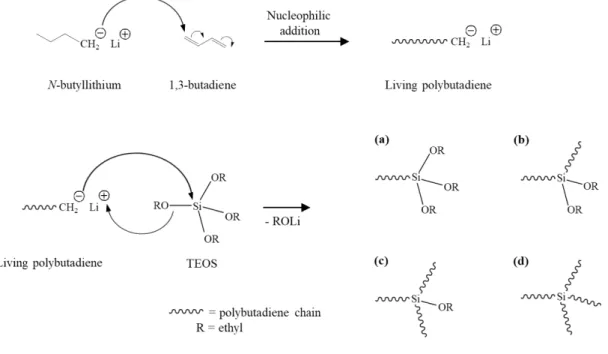
Center-functionalized liquid BR (C-LqBR)의 중합 mechanism 은 Figure 1에 나타내었다. C-LqBR은 질소로 치환된 stainless- steel 반응기(2L)를 이용하여 50°C 조건에서 음이온 중합으로 합성하였다. 이때 vinyl 함량이 서로 다른 C-LqBRs을 합성하 기 위해 TMEDA의 양을 조절하였다.

22

이후 1,3-butadiene을 질소 압력을 이용해 반응기에 투입하였다. 모든 C-LqBRs의 중합은 동일한 반응조건에서 이루어졌으며, 40분 동안 반응 시킨 후 B R 사슬 2개가 coupling된 구조로 합성하기 위해 tetraethyl orthosilicate (TEOS, 0.5 molar ratio)를 투입하여 반 응을 종결시켰다.

23

이후 vacuum evaporator를 이용하여 C- LqBR solution 내 cyclohexane을 증발시켜 C-LqBRs을 수득 하였다. C-LqBRs의 거시구조와 미세구조는 GPC와

1

H NMR 을 이용하여 분석하였다.

v

r0

v

r

--- = 1 m –  1  – ---

 

 

Figure 1. Polymerization of center-functionalized liquid butadiene rubber (C-LqBR); (a) BRSi(OR)

3

, (b) BR

2

Si(OR)

2

, (c) BR

3

Si(OR), and

(d) BR

4

Si.

(5)

4. Manufacture of compounds and vulcanizates

컴파운드는 Table 2에 나타낸 배합표를 바탕으로 밀폐식 혼 합기(300cc, Mirae Scientific Instruments Inc., Gwangju, Korea)를 이용하여 제조하였다. Fill factor는 혼합기 용량의 70%로 설정하였으며, 투입 단위는 parts per hundred rubber (phr)로 고무를 기준으로 투여되었다. 가교구조 분석을 위해 100 phr의 실리카 함량을 갖는 컴파운드도 배합하였으며, 120 phr의 실리카 함량을 갖는 컴파운드의 물성 평가 결과만을 제 시하였다. 배합 절차는 Table 3에 나타내었고, 각 단계의 초 기 온도는 100

o

C와 50

o

C, 최종온도는 150-155

o

C와 80-90

o

C

로 조절하였다. 각 단계의 배합이 끝난 후에는 two-roll mill 을 이용하여 컴파운드를 시트화 하였다. 이렇게 제조한 컴파 운드는 moving die rheometer (MDR)을 이용하여 160

o

C에서 최적 가황시간을 확인한 후 160

o

C의 유압프레스에서 최적 가 황시간동안 가류하여 가류물을 제조하였다.

Results and Discussion

1. Polymerization of LqBR

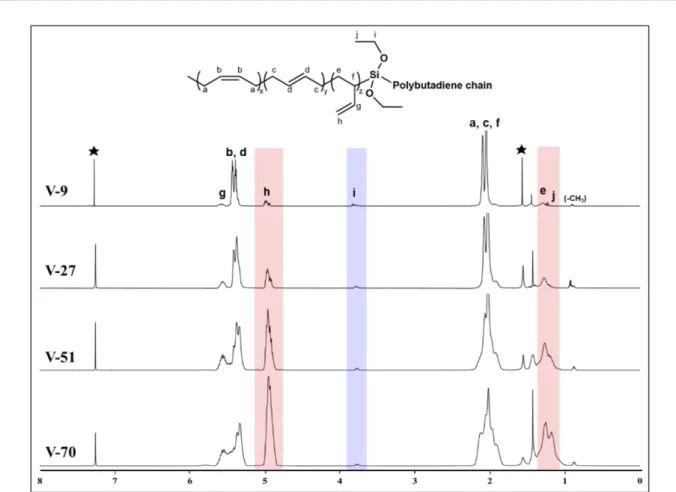
중합된 C-LqBRs의 GPC와

1

H NMR 분석 결과를 Figure 2, 3과 Table 4에 나타내었다. Kim et al. 은 LqBR의 분자량이 25,000 g/mol 이상일 경우, 대부분의 LqBR이 황에 의해 base polymer에 crosslink 될 수 있다고 보고한 바 있다.

19

따라서, 본 연구에서는 C-LqB R의 분자량을 25,000 g/mol과 유사하게 합성하고자 하였다. GPC 측정 결과를 통해 C-LqB Rs이 21,000-25,000 g/mol 범위의 분자량 및 좁은 분자량 분포 (1.12-1.19)를 갖는 것을 확인하였다. 그리고 NMR spectra에 Table 1. Polymerization Recipe for Center-functionalized Liquid

Butadiene Rubbers (C-LqBRs) Polymerization

V-9 V-27 V-51 V-70

Butadiene (g) 70 70 70 70

Cyclohexane (g) 400 400 400 400

n-Butyllithium (mmol) 5.42 6.27 6.61 6.05

TMEDA (mmol) - 1.34 4.02 6.44

TEOS (mmol) 2.763.10 3.32 2.98

n-Octyl alcohol (mmol) 5.79 6.49 7.34 6.49

Table 2. Formulation of the Rubber/silica Compounds using C- LqBRs (unit: parts per hundred rubber, phr)

Sample code TDAE V-9 V-27 V-51 V-70

SSBR 80 80 80 80 80

BR 20 20 20 20 20

Silica 120 120 120 120 120

X50S 20 20 20 20 20

TDAE oil 40 30 30 30 30

C-LqBR 0 10 10 10 10

DPG 2 2 2 2 2

ZnO 3 3 3 3 3

Stearic acid 1 1 1 1 1

6 PPD 2 2 2 2 2

Sulfur 1.3 1.3 1.3 1.3 1.3

CBS 1.61.61.61.61.6

Table 3. Mixing Procedures

Time, min:s Action

stage 1st

0:00-0:40 Rubber (initial temp.: 100

o

C) 0:40″-1:40 Silica 1/2+X50S 1/2+DPG1/2+oil1/2+LqBR1/2   1:40-2:40 Silica 1/2+X50S 1/2+DPG1/2+oil1/2+LqBR1/2

  2:40-5:00 ZnO, St/A, 6PPD

5:00 Ram up

5:00-7:40 Extra mixing and dump (dump temp.: 150

o

C-155

o

C) stage 2nd

0:00-0:20 Master batch from 1st stage (initial temp.: 50

o

C)

0:20-2:00 Curatives and dump (dump temp.: 80

o

C-90

o

C) Figure 2. GPC curves of C-LqBRs; (a) aliquot sample and (b)

final sample.

(6)

서 butadiene의 1,4-addition 구조는 5.37-5.50 ppm, 1,2-addition (vinyl) 구조는 5.50-5.60와 4.79-4.99 ppm에서 resonance peaks 를 나타내는데,

24

면적의 비율을 계산한 결과 C-LqBRs 의 vinyl 함량이 9, 27, 51, 70 wt%로 각각 합성되었다.

Alkoxysilyl goup에 결합된 ethoxy groups의

1

H chemical shift 는 1.19-1.26 ppm (SiO-CH

2

-CH

3

)에서 triplet, 3.75-3.85 ppm (SiO-CH

2

-)에서 quartet을 나타내었다.

25

C-LqBRs의 coupling 된 polybutadiene 사슬의 개수를 나타내는 coupling number (CN)는 coupling reaction 전후의 수 평균 분자량(M

n

) 비율로 계산되었다.

26

Coupling number (CN) =

C-LqBRs의 coupling number가 1.9-2.3 값을 가지는데 이는 polybutadiene 사슬 2개 (Figure 1(b))가 coupling 되는 반응이 지배적임을 나타낸다.

1

H NMR spectra에서 각각의 H에 대한 resonance peak의 면적과 수소 원자 수는 비례한다. 이러한 원리에 따라, C- LqBR 사슬에 존재하는 ethoxy-silyl group의 비율인 function- ality를 vinyl group의 proton과 alkoxysilyl group의 proton peak 면적의 비율로 계산하였다.

27

S

vinyl

-H과 S

Alkoxysilane

-H는 vinyl group과 alkoxysilyl group 의 proton peak 면적을 나타낸다. R

Vinyl

은 vinyl 함량, M

n

은 C- LqBR의 수평균 분자량, M

B

는 1,3-butadiene monomer의 분 자량, n

alkoxysilane

은 alkoxysilane의 수소원자 개수, i.e., -Si- (OCH

2

CH

3

)

2

; “4” 를 나타낸다. F는 변성률(Si/Chain), 다시 말 해서; “1” 은 polybutadiene 사슬 2개가 coupling 되어 중심에

Number average molecular weight after coupling Number average molecular weight before couplint ---

S

Vinyl H–

S

Alkoxysilane H–

--- = 2 R  

Vinyl

   M

n

/M

B

 n

Alkoxysilane

 F --- Table 4. Characteristics of C-LqBRs

Sample code V-9 V-27 V-51 V-70

Aliquot sample

a

M

n

(g/mol) 11,800 11,200 10,600 11,300 Final sample

b

M

n

(g/mol) 24,100 25,400 21,500 24,800 Polydispersity index (PDI) 1.19 1.12 1.15 1.12

Vinyl content (% in BD) 9 27 51 70

T

g

(°C) -98 -87 -65 -50

Coupling number (CN) 2.05 2.28 1.99 2.19 Functionality (Si/Chain) 1.08 1.07 1.15 1.00

a

Aliquot sample; LqBR sample before addition to TEOS

b
Final sample; C-LqBR sample after addition to TEOS

Figure 3.

1

H NMR spectra of C-LqBRs with different vinyl content, ★Resonance peak of CDCl

3

at 1.57 and 7.26 ppm due to solvent

impurities and residual H.

(7)

실리콘 원자 1개가 있음을 나타낸다.

2. Payne effect

Figure 4, Table 5에 제시한 Payne effect는 미가류물의 filler-filler interaction을 나타낸다.

28

그리고 strain amplitude 증가에 따른 storage modulus (G′)의 감소는 filler network가 파괴되어 나타나는 결과이며, △G′ 값이 클수록 강한 filler- filler interaction을 나타낸다.

C-LqBRs은 ethoxy group이 실리카 표면을 개질 시킴에 따 라 실리카 분산이 향상되어 TDAE 컴파운드 대비 낮은 △G′

(G′ at 0.28%-G′ at 40%, MPa) 결과를 나타내었다. 반면, vinyl 함량에 따른 △G′ 값의 차이는 거의 없었기 때문에 실리카 분 산의 경우, C-LqBR의 functional group의 효과가 지배적이라 판단된다.

3. Cure characteristics and Mooney viscosity of the compounds

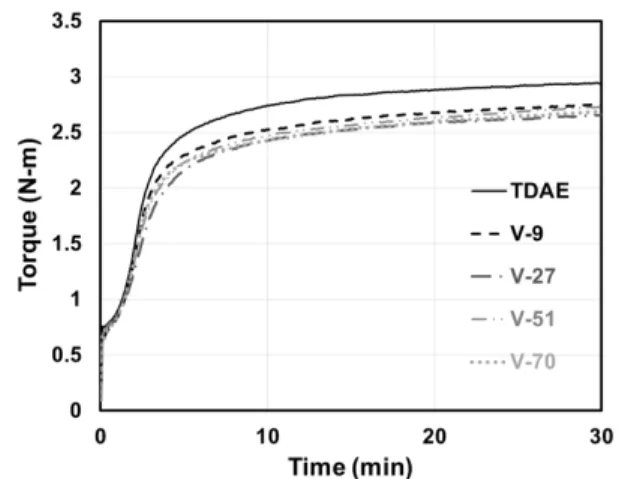
컴파운드의 가공성과 관련이 있는 Mooney viscosity와 moving die rheometer (MDR)를 이용해 얻은 가황 특성 결과 는 Figure 5와 Table 6에 나타내었다. C-LqBRs을 적용한 컴 파운드들의 T

min

값은 TDAE 컴파운드보다 낮은 값을 나타내 었다. 이는 Payne effect 결과에서 확인한 바와 같이 functional group이 silanization reaction을 통해 실리카 표면을 소수화 시

킬 수 있어 실리카의 분산이 개선됨에 따라 나타난 결과라 판 단된다. 그리고 C-LqBRs은 실리카 분산을 개선시킬 뿐만 아 니라 base polymer 사슬 사이에서 윤활유 역할을 하여 사슬 미끄러짐이 잘 일어남에 따라 C-LqBRs를 적용한 컴파운드들 이 TDAE 컴파운드보다 낮은 Mooney viscosity 값을 나타내 었다.

실리카 컴파운드의 경우, MDR curve에서 델타 토크(ΔT;

T

max

–T

min

) 값이 filler의 morphology와 total crosslink density 에 영향을 받는다고 알려져 있다.

29

C-LqBRs은 우수한 실리 카 분산을 유도할 뿐 아니라 base polymer 사이의 가교 결합 에 사용되는 황을 소모하기 때문에 C-LqBRs를 적용한 컴파 운드들의 ΔT 값이 TDAE 컴파운드에 비해 낮은 값을 나타내 었다. 이러한 결과로 부터 total crosslink density 값 또한 TDAE 컴파운드 보다 낮을 것으로 예상된다.

30

고무 컴파운드에 가교제로 황이 사용되었을 때, 가교 중에 황(S

8

)은 고리가 열리면서 고무의 allylic hydrogen 또는 이중 결합과 반응하여 가황 반응이 일어난다.

31

가교 반응의 active site를 생성하는 allylic hydrogen의 수가 많을수록 최적 가황 시간(t

90

)은 짧아지게 된다. BR의 미세구조에 따른 allylic hydrogen atom의 개수를 Figure 6에 나타내었다. 그리고 C- LqBR은 vinyl 함량이 증가함에 따라 C-LqBR 내에 존재하는 total allylic hydrogen 개수가 감소하여 t

90

이 증가하는 경향을 Figure 4. Payne effect of the compounds with different vinyl

content of C-LqBRs.

Table 5. The G′ Values of the Compounds with Different Vinyl Content of C-LqBRs

Compound TDAE V-9 V-27 V-51 V-70

(0.28-40%, MPa) △G′ 5.9 4.74 4.57 4.62 4.84

Figure 5. Cure curves of the compounds according to the applied processing aids.

Table 6. Mooney Viscosity and Cure Characteristics of the Compounds

Compound TDAE V-9 V-27 V-51 V-70

Mooney viscosity

(ML

1+4

@100°C) 134 120 124 126125

T

min

(N·m) 0.75 0.66 0.69 0.69 0.64 T

max

(N·m) 2.95 2.75 2.66 2.73 2.69

ΔT (N·m) 2.2 2.09 1.97 2.04 2.05

t

10

(min:s) 01:13 01:08 01:19 01:02 01:00

t

90

(min:s) 09:37 11:0611:13 12:11 12:18

(8)

나타내었다.

4. Solvent extraction and vulcanizate structures

가류물 내에 존재하는 유기물의 양을 계산하기 위해 2종류 의 유기용매를 이용하여 가류물 시편으로부터 유기물을 추출 하였다. 먼저, 배합 시 투입된 TDAE oil과 저분자량의 물질 이 THF에 의해 추출되었다. 이어서 THF 추출 후 얻어진 시 편으로부터 n-hexane을 이용하여 soluble 한 free LqBR을 추 출하였다. 2종류의 유기용매로부터 추출된 유기물의 총 추출 량을 Figure 7(a)과 Table 7에 나타내었다.

가류물 시편 내에서 TDAE oil 40 phr의 비율은 13.6 wt%

이며, 그 중 10 phr은 3.4 wt%에 해당한다. TDAE 컴파운드 의 유기물 추출량이 16.2 wt% (TDAE oil 40 phr; 13.6 wt%

+ 일부 첨가제; 2.6 wt%)로 가장 높은 값을 나타내었는데, 이 는 oil이 컴파운드 내에서 다른 재료와의 화학 결합을 형성하 지 않아 유기용매에 쉽게 추출되기 때문이다. 반면 분자량이 25,000 g/mol 정도인 C-LqBRs은 13.8 wt% (TDAE oil 30 phr;

10.2 wt% + 일부 C-LqB R; 1 wt% + 일부 첨가제; 2.6 wt%) 가 추출되어 70.6% 정도가 추출되지 않고 잔류하였는데 이는 functional group 이 silanization 반응을 통해 실리카 표면에 고 정될 수 있고, 가류 시 base polymer와의 co-vulcanization을 통해 polymer network에 고정될 수 있어 TDAE 컴파운드 대 비 적은 추출량을 보였다. C-LqBR의 vinyl 함량에 따른 유기 물 추출량은 유사했으며, 이는 vinyl 함량에 관계없이 C- LqBRs이 base polymer에 co-vulcanization 할 수 있도록 각 컴 파운드를 t

90

동안 가류했기 때문이다(즉, C-LqBRs 추출량;

29.4%).

가교구조를 분석하기 위해 가류물의 total crosslink density 를 실리카-실란-고무 구조에 의한 filler-rubber interaction과 황에 의한 chemical crosslink density로 구분하였으며, 그 결 과를 Figure 7(b)와 Table 7에 나타내었다. 일반적으로 컴파 운드 가류 시, 황은 base polymer 가교와 실란 커플링 반응에 각각 사용되어 chemical crosslink density와 filler-rubber interaction을 증가시킨다.

15

변성되지 않은 LqB R은 가류 시, 황을 소모하여 가류물의 chemical crosslink density와 filler- rubber interaction을 동시에 감소시켜 이 둘의 합인 total Figure 6. The number of allylic hydrogen atoms according to BR

microstructure.

Figure 7. (a) Weight loss after the extraction and (b) crosslink density of the vulcanizates.

Table 7. Vulcanizate Structures and Weight Loss of the Vulcanizates After the Extraction

Compound TDAE V-9 V-27 V-51 V-70

Weight loss after the extraction (wt%) 16.2 13.8 13.8 13.8 13.8

Weight loss after the extraction in 10 phr of TDAE oil and C-LqBRs (%) 100 29.4 29.4 29.4 29.4

Total crosslink density (10

-4

mol/g) 1.68 1.55 1.54 1.56 1.56

Filler-rubber interaction (10

-4

mol/g) 1.05 1.03 1.03 1.05 1.04

Chemical crosslink density (10

-4

mol/g) 0.63 0.52 0.51 0.51 0.52

(9)

crosslink density를 감소시킨다. 하지만 C-LqBR은 functional group이 실리카 표면에 고정될 뿐만 아니라 base polymer와 의 crosslink reaction에 의한 화학적 결합을 형성하여 filler- rubber interaction을 증가시킬 수 있다. 그 결과, vinyl 함량에 관계없이 모든 C-LqBR 컴파운드에서 TDAE 컴파운드 대비 chemical crosslink density가 0.1×10

4

mol/g 이상 감소하고, filler-rubber interaction은 유사한 값을 나타내었다.

5. Mechanical properties and DIN abrasion loss

기계적 물성과 DIN abrasion loss 측정 결과는 Figure 8과 Table 8에 나타내었다. Stress-strain curves에서의 modulus at 300% elongation (M

300

) 값은 total crosslink density 결과와 높 은 상관관계를 가진다고 알려져 있다.

21

일반적으로 변성되지 않은 LqBR은 base polymer chain 사이에서 윤활유 역할을 하 여 미끄러짐이 잘 일어나게 하며, 황을 소모함으로 인해 total crosslink density 값이 감소하여 modulus를 감소시킨다.

19

그 러나 C-LqBR 컴파운드는 TDAE 컴파운드 대비 total crosslink density가 낮음에도 유사한 수준의 M

300

값을 나타내었다. 이 는 C-LqB R이 coupling reaction에 의해 TDAE 컴파운드 대 비 유사한 filler-rubber interaction을 가질 뿐만 아니라, C-

LqBR의 chain entanglement 영향으로 인해 modulus 값이 증 가했기 때문이라 판단된다. 그리고 vinyl 함량에 따른 C- LqBR 컴파운드의 경우, 유사한 total crosslink density와 vulcanizate structure를 가지기 때문에 M

300

값 역시 동등한 수 준을 나타내었다.

일반적으로 내마모성은 polymer의 T

g

와 filler-rubber inter- action에 큰 영향을 받는다고 알려져 있다.

32,35

TDAE oil보다 낮은 T

g

를 갖는 C-LqB Rs 은 컴파운드의 T

g

를 소폭 낮추었 으며, C-LqBR의 vinyl 함량이 증가함에 따라 컴파운드의 T

g

역시 증가하는 경향을 나타내었다. 그 결과, V-9 컴파운드의 내마모성이 가장 우수하였고, V-70 컴파운드는 TDAE와 유 사한 내마모성을 나타내었다.

6. Dynamic viscoelastic properties

고무 컴파운드의 점탄성 특성은 타이어의 성능을 예측할 수 있는 실험실적 측정값이며, 둘 사이의 상관관계가 매우 높다.

그 중 -10°C 이하 저온 영역에서의 storage modulus (G′) 값 은 snow traction을 나타내는 지표로서, 값이 낮을수록 snow traction이 향상된다고 알려져 있다.

36,37

이는 저온 조건에서 낮 은 G′ 값을 가질수록 타이어 트레드가 얼음 노면에서 쉽게 변 형되고 adhesion 할 수 있기 때문이다.

38

Loss modulus (G″) at 0°C 값은 타이어의 wet grip 성능을 나타내는 지표이며, 그 값 이 높을수록 wet grip 성능이 우수해진다고 알려져 있다.

39,40

그리고 G″ 값은 effective filler volume fraction이 높을수록 높 게 나타난다.

41

Tanδ at 60°C 값은 타이어의 rolling resistance (RR) 를 나타내는 지표로서, 그 값이 낮을수록 연비 성능이 향 상된다고 알려져 있다.

42

이 온도에서의 main energy dissipation 은 filler-filler network의 파괴 및 재생성에 기인한다고 알려 져 있다.

41

Kitamura는 이 온도 영역에서의 hysteresis 특성이 polymer의 free chain ends에도 기인한다고 보고하였다.

43

그 리고 Salort는 저분자량의 butadiene rubber가 base polymer 에 crosslink 될 경우, dangling ends로 인해 hysteresis가 발생 한다고 보고 하였다.

4

두 연구 결과는 고온 영역에서의 에너 지 손실은 polymer의 free chain ends도 중요인자 임을 잘 보 여준다.

Figure 8. (a) Stress-strain curves and (b) DIN abrasion loss of the vulcanizates according to the applied C-LqBRs.

Table 8. Mechanical Properties and DIN Abrasion Loss of the Vulcanizates

Compound TDAE V-9 V-27 V-51 V-70

M

100

(kgf/cm

2

) 38 39 39 41 40

M

300

(kgf/cm

2

) 143 142 142 145 145

Elongation at break (%) 416378 376383 380

Tensile strength (kgf/cm

2

) 205 184 183 191 189

DIN abrasion loss (mg) 111 94 104 107 111

Processing aid T

g

(ºC) -48 -98 -87 -65 -50

Compound T

g

(ºC) -39.5 -43.1 -41.6-39.5 -38.2

(10)

Figure 9과 Table 9에 TDAE oil과 C-LqBRs이 적용된 컴 파운드의 동적 점탄특성 결과를 나타내었다. 낮은 T

g

를 갖는 C-LqBRs은 컴파운드의 T

g

를 낮추고, 저온에서 컴파운드의 flexibility를 증가시키기 때문에 TDAE 컴파운드보다 낮은 G′

at -30°C 값을 나타내었다. 하지만 C-LqBR의 vinyl 함량이 증 가함에 따라 컴파운드 T

g

역시 증가하여 G′ at -30°C 값이 증 가하는 경향을 나타내었다.

C-LqBR 컴파운드는 앞선 Payne effect 결과에서 확인한 바 와 같이 실리카 분산이 향상됨에 따라 effective filler volume fraction이 낮아져 TDAE 보다 낮은 G″ at 0°C 값을 나타내었 다. 하지만 C-LqBR의 vinyl 함량이 증가함에 따라 컴파운드 T

g

가 점차 증가하여 V-51 컴파운드부터는 TDAE 컴파운드와 유사한 G″ at 0°C 값을 나타내었다.

Figure 9(c)에 나타낸 바와 같이 C-LqB R 컴파운드들은 vinyl 함량에 관계없이 TDAE 컴파운드 대비 높은 tanδ at 60°C 값을 나타내었다. 이는 base polymer에 결합하여 dangling 된 C-LqBRs 사슬이 free chain ends로서 거동하여 hysteresis 를 유발했기 때문이라 판단된다. 그리고 컴파운드의 tanδ at 60°C 값 증가에는 C-LqBR의 vinyl 함량보다 dangling ends 효 과가 지배적이라 판단된다.

7. Evaluation of C-LqBRs

C-LqBR의 vinyl 함량에 따른 컴파운드의 물성 변화의 경 향을 Table 10에 나타내었다. 이러한 C-LqBR의 특성들은 저 온조건에서의 high traction, long term flexibility를 요구하는 윈터 타이어에 적합하다. Dangling chain ends 효과를 제거할 수 있는 양말단 functionalized LqB R을 적용할 경우 tanδ at 60°C의 값은 크게 개선될 것이다. 연구에서 제시된 결과는 LqBR이 적용된 타이어 제조에 필요한 최적의 LqBR 설계 및 Figure 9. (a) G′ at -30ºC, (b) G″ at 0ºC and (c) tanδ at 60ºC of

the vulcanizates according to the applied processing aids.

Table 9. Viscoelastic Properties of the Compounds According to the Applied Processing Aids

Condition Properties TDAE V-9 V-27 V-51 V-70

Temperature sweep

Compound T

g

(ºC) -39.5 -43.1 -41.6-39.5 -38.2

G′ at -30ºC (MPa) 167 141 151 166 172

G″ at 0ºC (MPa) 11.7 10.7 10.9 11.8 11.6

Strain sweep Tan δ at 60ºC at 5% 0.177 0.188 0.190 0.190 0.188

Table 10. Effect of the Vinyl Content of C-LqBR on the Performance of Silica-filled Rubber Compounds Types of

processing aids Payne

Effect Extraction

Resistance Abrasion

Resistance Tan δ

at 60ºC G″

at 0ºC G′

at -30ºC

TDAE oil M B M M M M

9% G E E B W E

27% G E G B B G

51% G E G B M M

70% G E M B M B

E: Excellent, G: Good, M: Moderate, B: Bad. W: Worst.

(11)

선정의 기반을 마련해줄 것이라 기대된다.

Conclusions

본 연구에서는 silica filled rubber compounds에 가공조제로 서 적용한 C-LqBR의 vinyl 함량이 물성에 미치는 영향을 확 인하였다.

• Functional group을 갖는 C-LqBRs은 기계적 물성의 하락 없이 Payne effect를 개선시켰다. C-LqBR은 vinyl 함량이 증가함에 따라 C-LqB R 내에 존재하는 total allylic hydrogen 개수가 감소하여 t

90

이 증가하는 경향을 나타내 었다.

• C-LqB R의 추출량은 TDAE oil 대비 크게 개선되었다. C- LqBR은 가류 시, 황을 소모하여 TDAE 컴파운드보다 낮 은 ΔT, total crosslink density 값을 나타내었다. 하지만 C- LqBRs은 coupling reaction을 통해 실리카와 base polymer 사이에 화학적 결합을 형성함에 따라 TDAE 컴파운드와 유사한 filler-rubber interaction 값을 나타내었다.

• C-LqB R의 vinyl 함량에 따른 컴파운드의 유기물 추출량 과 mechanical properties 는 유사한 결과를 나타내었다. 반 면, 내마모성은 vinyl 함량이 증가함에 따라 컴파운드의 T

g

가 증가하여 하락하였다.

• Dynamic properties는 C-LqBR 의 vinyl 함량이 증가함에 따라 컴파운드의 T

g

가 증가하여 snow traction은 불리해 졌으며 wet grip은 개선되었다. Tanδ at 60°C 값의 경우, C-LqBRs이 base polymer에 crosslink 되면서 형성된 dangling ends 효과가 vinyl 함량보다 지배적임을 확인하 였다.

Acknowledgements

이 논문은 부산대학교 기본연구지원사업(2년)에 의한 연구임.

References

1. F. Salort and S. K. Henning, “Silane-terminated liquid poly (butadienes) in tread formulations: A mechanistic study”, Rubber Chem. Technol., 94, 24 (2020).

2. European Union. Directive 2005/69/EC of the European Par- liament and of the Council of 16 Nov 2005. Off. J. Eur.

Union, dated 12 September (2005).

3. S. Ezzoddin, A. Abbasian, M. Aman-Alikhani, and S. T.

Ganjali, “The influence of non-carcinogenic petroleum-based pprocess oilson tire compounds’ performance”, Iran. Polym.

J., 22, 697 (2013).

4. T. Nakazono and A. Matsumoto, “Mechanical properties and thermal aging behavior of styrene-butadiene rubbers vulca-

nized using liquid diene polymers as the plasticizer”, J. Appl.

Polym. Sci., 118, 2314 (2010).

5. T. Kataoka, P. B. Zetterlund, and B. Yamada, “Effects of stor- age and service on tire performance: oil component content and swelling behavior”, Rubber Chem. Technol., 76, 507 (2003).

6. M. Gruendken, “Liquid rubber for safer and faster tires” In Proceedings of the Tire Technology Expo 2018, Hannover, Germany, 14-16 February (2017).

7. K. Ikeda, “Bio liquid polymer for winter tires” In Proceed- ings of the Tire Technology Expo 2018, Hanover, Germany, 20-22 February (2018).

8. V. P. Sierra, J. Mann, C. Van De Pol, N. Kendziorra, K. Her- zog, C. Recker, and N. Mueller, “Rubber blend with improved rolling resistance behavior” U.S. Patent 9080042 (2015).

9. J. K. Hirata, “Effects of crosslinkable plasticizers”, RFP Rub- ber Fibers Plast. Int., 6, 212 (2011).

10. S. S. Choi, “Improvement of the filler dispersion in silica- filled SBR compounds using low molecular weight polybu- tadiene treated with maleic anhydride”, Elastomers Compos., 41, 10 (2006).

11. T. E. Hogan, W. L. Hergenrother, and M. Tallman, “Amine- containing alkoxysilyl-functionalized polymers”, U.S. Patent 8148486 (2012).

12. W. L. Hsu and A. F. Halasa, “Rubbers having improved inter- action with silica”, U.S. Patent 5652310 (1997).

13. K. Taniguchi, K. Tsukimawashi, N. Kobayashi, and T.

Tadaki, “Conjugated-diolefin (co) polymer rubber and pro- cess for producing the same”, U.S. Patent 7528199 (2009).

14. P. J. Flory, “Statistical mechanics of swelling of network structures”, J. Chem. Phys., 18, 108 (1950).

15. J. Y. Lee, B. Ahn, W. Kim, H. Moon, H. J. Paik, and W. Kim,

“The effect of accelerator contents on the vulcanizates struc- tures of SSBR silica vulcanizates”, Compos. Interfaces, 24, 563 (2016).

16. R. Herpich, T. Fruh, L. Heiliger, and K. Schilling, “Silica gel- containing rubber compounds with organosilicon compounds as compounding agent”, U.S. Patent 6593418 (2003).

17. H. Takuya and M. Tochiro, U.S. Patent 2005146115 (2003).

18. S. Satoyuki and Y. Chikashi, U.S. Patent 2005350603 (2005).

19. D. Kim, B. Ahn, K. Kim, J. Lee, I. J. Kim, and W. Kim,

“Effects of molecular weight of functionalized liquid butadi- ene rubber as a processing aid on the properties of SSBR/Sil- ica compounds”, Polymers, 13, 850 (2021).

20. P. J. Flory, “Principles of polymer chemistry”, p. 576, Cornell University Press, New York, NY, USA, 1953.

21. B. Ahn, N. Park, D. Kim, and W. Kim, “Influence of end-

functionalized solution styrene–butadiene rubber on silica-

filled vulcanizates with various silica–silane systems”, Rub-

(12)

ber Chem. Technol., 92, 364 (2019).

22. T. A. Antkowiak, A. E. Oberster, A. F. Halasa, and D. P. Tate,

“Temperature and concentration effects on polar-modified alkyllithium polymerizations and copolymerizations”, J.

Polym. Sci. Part A-1 Polym. Chem., 10, 1319 (1972).

23. D. Derouet, S. Forgeard, and J. C. Brosse, “Synthesis of alkoxysilyl-terminated polyisoprenes by means of “living”

anionic polymerization, 1. Modeling of the termination step by studying the reaction of butyllithium with various alkox- ysilane reagents”, Macromol. Chem. Phys., 199, 1835 (1998).

24. A. Ventura, T. Chenal, M. Bria, F. Bonnet, P. Zinck, Y.

Ngono-Ravache, and M. Visseaux, “Trans-stereospecific polymerization of butadiene and random copolymerization with styrene using borohydrido neodymium/magnesium dial- kyl catalysts”, Eur. Polym. J., 49, 4130 (2013).

25. D. Derouet, S. Forgeard, and J. C. Brosse, “Synthesis of alkoxysilyl-terminated polyisoprenes by means of ‘living’

anionic Polymerization, 2. Synthesis of trialkoxysilyl-termi- nated 1, 4-polyisoprenes by reaction of polyisoprenyllithium with various functional trialkoxysilanes selected as end-cap- ping reagents”, Macromol. Chem. Phys., 200, 10 (1999).

26. Y. H. Ko and S. W. Cheen, “End-modified styrene-diene block copolymer prepared using polyfunctional coupling agent”, U.S. Patent 6777493 (2004).

27. X. Liu, S. Zhao, X. Zhang, X. Li, and Y. Bai, “Preparation, structure, and properties of solution-polymerized styrene- butadiene rubber with functionalized end-groups and its sil- ica-filled composites”, Polymer, 55, 1964 (2014).

28. A. R. Payne and R. E. Whittaker, “Low strain dynamic prop- erties of filled rubbers”, Rubber Chem. Technol., 44, 440 (1971).

29. C. R. Parks and R. J. Brown, “Crosslink density of elasto- mers. a new gas chromatographic method”, Rubber Chem.

Technol., 49, 233 (1976).

30. A. S. Hashim, B. Azahari, Y. Ikeda, and S. Kohjiya, “The effect of bis (3-triethoxysilylpropyl) tetrasulfide on silica reinforcement of styrene-butadiene rubber”, Rubber Chem.

Technol., 71, 289 (1998).

31. P. J. Nieuwenhuizen, J. Reedijk, M. Van Duin, and W. J.

McGill, “Thiuram-and dithiocarbamate-accelerated sulfur vulcanization from the chemist's perspective; methods, mate-

rials and mechanisms reviewed”, Rubber Chem. Technol., 70, 368 (1997).

32. S. S. Choi, K. H. Chung, and C. Nah, “Improvement of prop- erties of silica-filled styrene-butadiene rubber (SBR) com- pounds using acrylonitrile-styrene butadiene rubber (NSBR)”, Polym. Adv. Technol., 14, 557 (2003).

33. N. Rattanasom, T. Saowapark, and C. Deeprasertkul, “Rein- forcement of natural rubber with silica/carbon black hybrid filler”, Polym. Test., 26, 369 (2007).

34. A. F. Halasa, J. Prentis, B. Hsu, and C. Jasiunas, “High vinyl high styrene solution SBR”, Polymer, 46, 4166 (2005).

35. E. Padenko, P. Berki, B. Wetzel, and J. Karger-Kocsis,

“Mechanical and abrasion wear properties of hydrogenated nitrile butadiene rubber of identical hardness filled with car- bon black and silica”, J. Reinf. Plast. Comp., 35, 1, (2016).

36. C. F. Derham, R. Newell, and P. M. Swift, “The use of silica for improving tread grip in winter tyres”, NR Technol., 19, 81 (1988).

37. H. Dörrie, C. Schröder, and B. Wies, “Winter tires: operating conditions, tire characteristics and vehicle driving behavior”, Tire Sci. Technol., 38, 119 (2010).

38. K. Hirata and M. Moriguchi, “Bio-based liquid rubber for tire application”, Rubber World, 256, 50 (2017).

39. S. Maghami, “Silica-filled tire tread compounds: An investi- gation into the viscoelastic properties of the rubber com- pounds and their relation to tire performance”, Ph.D. Thesis, University of Twente, Enschede, the Netherlands, 2016.

40. K. Suchiva, C. Sirisinha, P. Sae-oui, and P. Thapthong,

“Development of tyre tread compounds for good wet-grip:

effects of rubber type”, IOP Conf. Ser. Mater. Sci. Eng., 526, 012035 (2019).

41. M. J. Wang, “Effect of polymer-filler and filler-filler interac- tions on dynamic properties of filled vulcanizates”, Rubber Chem Technol., 71, 520 (1998).

42. S. Han, W. S. Kim, D. Y. Mun, B. Ahn, and W. Kim, “Effect of coupling agents on the vulcanizate structure of carbon black filled natural rubber”, Compos. Interfaces, 27, 355 (2020).

43. T. Kitamura, D. F. Lawson, K. Morita, and Y. Ozawa,

“Anionic polymerization initiators and reduced hysteresis

products therefom”, U.S. Patent 5393721(1995).

수치

Figure 1. Polymerization of center-functionalized liquid butadiene rubber (C-LqBR); (a) BRSi(OR) 3 , (b) BR 2 Si(OR) 2 , (c) BR 3 Si(OR), and (d)  BR 4 Si.
Table  3.  Mixing  Procedures
Figure 3.  1 H NMR spectra of C-LqBRs with different vinyl content, ★Resonance peak of CDCl 3  at 1.57 and 7.26 ppm due to solvent impurities  and  residual  H.
Table 5. The  G′  Values  of  the  Compounds  with  Different  Vinyl Content  of  C-LqBRs
+4

참조

관련 문서

• 이명의 치료에 대한 매커니즘과 디지털 음향 기술에 대한 상업적으로의 급속한 발전으로 인해 치료 옵션은 증가했 지만, 선택 가이드 라인은 거의 없음.. •

Result: First, as a result of examining the effect of the program on the adaptive behavior of the developmentally disabled, the experimental group

Because of the special rubber (DuPont Dow rubber Viton® - fluorocaoutchouc FPM-F) pad material and the heat resistant felt coating, the pads will not mar material surfaces.

The proposal of the cell theory as the birth of contemporary cell biology Microscopic studies of plant tissues by Schleiden and of animal tissues by Microscopic studies of

웹 표준을 지원하는 플랫폼에서 큰 수정없이 실행 가능함 패키징을 통해 다양한 기기를 위한 앱을 작성할 수 있음 네이티브 앱과

_____ culture appears to be attractive (도시의) to the

1) 필수구성 및 선택구성 그리고 기구 - 러버댐 시트(Rubber Dam Sheet) - 러버댐 프래임(Rubber Dam Frame) - 러버댐 클램프(Rubber Dam Clamp) - 러버댐

 Rubber wheel, rubber point, wheel을