209
Received April 2, 2008
Accepted for publication May 5, 2008
Reprint request to: Hee Young Kang, M.D., Department of Dermatology, Ajou University School of Medicine, 5, Wonchon-dong, Yeongtong-gu, Suwon 443-721, Korea.
Tel: 82-31-219-5190, Fax: 82-31-219-5189, E-mail: hykang
@ajou.ac.kr
Acute Generalized Exanthematous Pustulosis after Ingestion of Lacquer Chicken
Min Young Park, M.D., Hee Young Kang, M.D.
Department of Dermatology, Ajou University School of Medicine, Suwon, Korea Acute generalized exanthematous pustulosis (AGEP) is an acute pustular eruption characterized by multiple small, sterile, non-follicular pustules on an erythematous and edematous base, usually accompanied by fever and neutrophilia. It is attributed to systemic drugs in over 90% of cases, mainly β-lactam and macrolide antimicrobials. Viral infections, mercury exposure, Ginkgo biloba, and spider bites may occasionally cause the condition. We report a rare case of AGEP induced by intake of lacquer chicken in a 40-year-old man.
(Ann Dermatol (Seoul) 20(4) 209∼211, 2008)
Key Words: Acute generalized exanthematous pustulosis, Lacquer chicken
INTRODUCTION
In 1980, Beylot et al1 first described acute gen- eralized exanthematous pustulosis (AGEP) as an acute pustular eruption on an erythematous bed, accompanied by fever and neutrophilia. A wide range of systemic drugs have been suspected of causing these reactions in more than 90% of cases2. Rarely, intake of lacquer chicken can be a cause of AGEP, and Park et al3 reported four such cases. We present a case of AGEP induced by ingestion of lacquer chicken, which contains a known allergen, urushiol.
CASE REPORT
A 40-year-old man was admitted to our depart- ment with a pruritic rash of four days duration. Six days before, he had ingested lacquer chicken as a health food. Physical examination demonstrated
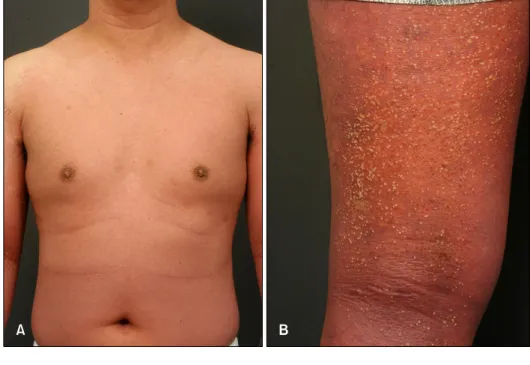
marked generalized, symmetrical erythema with multiple overlying small pustules on the trunk, medial arms, and proximal legs (Fig. 1). The patient also had a fever and complained of severe itching and burning. He had ingested lacquer chicken a couple of times in the past, but this was the first time he had developed a skin eruption. He reported no history of psoriasis, drug ingestion, recent infection, or contact with mercury.
Laboratory studies showed leucocytosis (17·3×109/ L) with neutrophilia and hypocalcaemia (7.9 mg/dl).
The ESR and CRP were elevated (23 mm/h and 5.22 mg/dl). A skin biopsy specimen taken from a pustular lesion on the thigh revealed intracorneal pustules with neutrophils. The papillary dermis was edematous, and a superficial perivascular lympho- cytic infiltrate with scattered interstitial neutrophils and eosinophils was noted (Fig. 2). On the basis of clinical, histopathological, and laboratory findings, a diagnosis of AGEP was made.
The patient was treated with systemic cortico- steroids and antihistamines, along with topical corti- costeroids. The pustules rapidly resolved over three days with desquamation, and the generalized ery- thema completely resolved within ten days.
DISCUSSION
AGEP is an acute pustular eruption characterized
Annals of Dermatology
210 MY Park and HY Kang Vol. 20, No. 4, December 2008
Fig. 1. (A) Generalized, symmetrical erythema with overlying pustules on the trunk. (B) Numerous small pustules were more clearly visualized on the posterior thigh.
Fig. 2. A skin biopsy showed an intracorneal pustule with neutrophils and spongiosis. A mixed interstitial and perivascular infiltrate of neutrophils, lymphocytes, and eosinophils was present in the dermis (H&E, ×200).
by numerous, non-follicular pustules arising on a widespread erythematous base, which usually ap- pears first in the intertriginous areas and then spreads to other body sites. Neutrophilia and high fever are also usually present. The pustules resolve spontaneously within a few days and are followed by pinpoint desquamation. Histologically, AGEP is characterized by spongiform intraepidermal or sub-
corneal pustules, dermal edema, vasculitis, periva- scular neutrophils or eosinophils, and necrotic kera- tinocytes2.
AGEP is induced by systemic drugs in over 90%
of cases, mainly β-lactam and macrolide anti- microbials. Calcium channel blockers, anti-malarials, and terbinafine have also been reported to cause AGEP2,4. In addition, viral infections, mercury ex- posure, Ginkgo biloba, and spider bites may serve as occasional causes5-8.
Lacquer chicken contains a known contact al- lergen, urushiol, the active component of which is pentadecylcatechol (PDC). When a previously sen- sitized person ingests the food, urushiol can reach the skin through the circulation and can cause systemic contact dermatitis. Common skin mani- festations include maculopapular eruption, erythema multiforme, and erythroderma. Purpura, wheals, and blisters have occasionally been reported9. AGEP very rarely occurs secondary to ingestion of lacquer chicken. To date, four cases have been reported by Park et al3. All the patients in their report de- veloped AGEP within one to four days after ingestion of lacquer chicken, and with or without treatment, all the eruptions resolved within ten days.
The mechanism responsible for the induction of AGEP after lacquer chicken ingestion is unknown.
Girardi et al10 demonstrated drug-specific positive
Acute Generalized Exanthematous Pustulosis after Ingestion of Lacquer Chicken 211
patch test responses and in vitro lymphocyte proli- ferative responses in patients with a history of AGEP, a finding that strongly suggests that AGEP occurs via an antigen-specific T-cell-mediated pro- cess. Similar mechanisms may have triggered the appearance of AGEP in our patient. Although we did not challenge him with a patch test, it is possible that ingestion of lacquer chicken induced AGEP in our patient because there is a causal relationship between intake of the food and the skin eruption. There were no other possible causes in our patient.
AGEP should be differentiated from other pustular dermatoses, such as generalized pustular psoriasis and subcorneal pustular dermatosis. Pustular psoriasis also demonstrates similar pustules, but it is usually associated with papillomatosis and acanthosis. Clini- cally, most patients with pustular psoriasis have a past history of psoriasis and show more generalized, longer lasting eruptions than those with AGEP2. Subcorneal pustular dermatosis tends to affect mainly intertriginous areas, and each lesion spreads peripherally and leaves a central polycyclic area.
Histologically, spongiosis and leukocytoclastic vas- culitis are less commonly seen in subcorneal pustular dermatosis11.
The most important aspect of AGEP treatment is the immediate withdrawal of the causative agent.
Because of the self-limited nature of AGEP, other specific treatments are not usually needed, but topical or systemic corticosteroids can be helpful2.
To our knowledge, lacquer chicken-induced AGEP is a rare entity. Our case adds lacquer chicken to the list of etiologies for AGEP and reinforces the idea that lacquer chicken should be avoided be- cause of its severe cutaneous and systemic effects.
REFERENCES
1. Beylot C, Bioulac P, Doutre MS. Acute generalized exanthematic pustuloses (four cases). Ann Der-
matol Venereol 1980;107:37-48.
2. Sidoroff A, Halevy S, Bavinck JN, Vaillant L, Roujeau JC. Acute generalized exanthematous pustulosis (AGEP)--a clinical reaction pattern. J Cutan Pathol 2001;28:113-119.
3. Park YM, Park JG, Kang H, Houh D, Byun DG, Kim JW. Acute generalized exanthematous pu- stulosis induced by ingestion of lacquer chicken.
Br J Dermatol 2000;143:230-232.
4. Beltraminelli HS, Lerch M, Arnold A, Bircher AJ, Haeusermann P. Acute generalized exanthematous pustulosis induced by the antifungal terbinafine:
case report and review of the literature. Br J Dermatol 2005;152:780-783.
5. Ofuji S, Yamamoto O. Acute generalized exanthe- matous pustulosis associated with a human par- vovirus B19 infection. J Dermatol 2007;34:121-123.
6. Roujeau JC, Bioulac-Sage P, Bourseau C, Guillaume JC, Bernard P, Lok C, et al. Acute generalized exanthematous pustulosis. Analysis of 63 cases.
Arch Dermatol 1991;127:1333-1338.
7. Pennisi RS. Acute generalised exanthematous pustulosis induced by the herbal remedy Ginkgo biloba. Med J Aust 2006;184:583-584.
8. Davidovici BB, Pavel D, Cagnano E, Rozenman D, Halevy S. Acute generalized exanthematous pustulosis following a spider bite: report of 3 cases.
J Am Acad Dermatol 2006;55:525-529.
9. Park SD, Lee SW, Chun JH, Cha SH. Clinical features of 31 patients with systemic contact dermatitis due to the ingestion of Rhus (lacquer).
Br J Dermatol 2000;142:937-942.
10. Girardi M, Duncan KO, Tigelaar RE, Imaeda S, Watsky KL, McNiff JM. Cross-comparison of patch test and lymphocyte proliferation responses in patients with a history of acute generalized ex- anthematous pustulosis. Am J Dermatopathol 2005;27:343-346.
11. Sanchez NP, Perry HO, Muller SA, Winkelmann RK. Subcorneal pustular dermatosis and pustular psoriasis. A clinicopathologic correlation. Arch Dermatol 1983;119:715-721.