ISSN 2234-3806 • eISSN 2234-3814
http://dx.doi.org/10.3343/alm.2016.36.3.275 www.annlabmed.org 275
Ann Lab Med 2016;36:275-277
http://dx.doi.org/10.3343/alm.2016.36.3.275
Letter to the Editor
Clinical Microbiology
Septicemia Caused by Neisseria meningitidis With Decreased Ciprofloxacin Susceptibility: The First Case Report in Korea
Ji Yeon Ahn, M.D.1, Joon Ki Min, M.D.1, Myeong Hee Kim, M.D.2, Soo-youn Moon, M.D.1, Ki-Ho Park, M.D.1, Mi Suk Lee, M.D.1, and Jun Seong Son, M.D.1
Division of Infectious Diseases1, Department of Internal Medicine, Kyung Hee University School of Medicine; Department of Laboratory Medicine2, Kyung Hee University School of Medicine, Seoul, Korea
Dear Editor,
Several antibiotics are currently used for meningococcal pro- phylaxis, including ciprofloxacin, rifampin, and ceftriaxone. Cip- rofloxacin, a fluoroquinolone, is often used in adults because of its convenient single-dose regimen. In contrast to an emerging trend worldwide, ciprofloxacin-resistant Neisseria meningitidis has not been reported in Korea [1, 2]. We report the first in- stance of septicemia caused by meningococcus with decreased ciprofloxacin susceptibility in Korea.
A 20-yr-old female was admitted to the hospital with fever, rhi- norrhea, sputum, and myalgia that started 24 hr before admis- sion. The patient’s initial vital signs included a temperature of 38.3°C, a blood pressure of 91/76 mm Hg, a pulse rate of 95 beats/min, and a respiratory rate of 20 breaths/min. Physical ex- amination revealed a pinkish rash on the lower extremities. Labo- ratory testing showed a white blood cell (WBC) count of 7.5 ×10⁹/L (70% neutrophils) and C-reactive protein levels of 10.98 mg/dL. We suspected an infectious disease with severe sepsis, and ceftriaxone was injected intravenously. About six hours later, the rash turned into multiple petechial lesions, sized from 1 mm to 5 mm, and was purpuric and non-blanching; a
meningococcal infection was suspected. She was moved to the intensive care unit (ICU) and quarantined. She complained about a severe headache as well. Cerebrospinal fluid (CSF) anal- ysis for the differential diagnosis of meningitis showed a WBC count of 16 ×106/L (18% polymorphonuclear neutrophils and 70% monocytes), a red blood cell (RBC) count of 3×10⁶/L, and glucose and protein levels of 81 and 43 mg/dL, respectively.
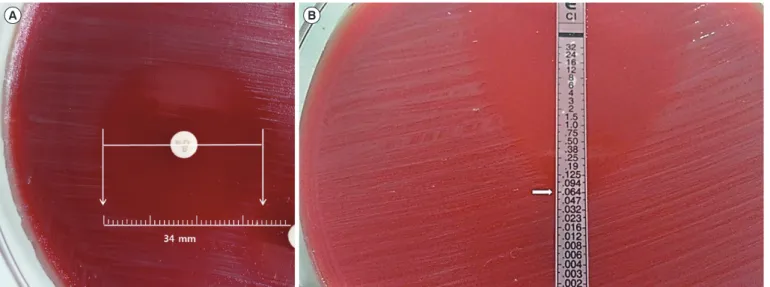
Blood culture showed gram-negative diplococci after two days of incubation. On the fourth day of hospitalization, the isolate was identified as N. meningitidis by using VITEK 2 system (bio- Mérieux, Marcy l’Etoile, France). Ciprofloxacin, ceftriaxone, and trimethoprim-sulfamethoxazole susceptibility testing was per- formed by using the disk diffusion method according to the CLSI guidelines [2]. Test results are shown in Table 1; ciproflox- acin susceptibility was intermediate with a zone diameter of 34 mm (Fig. 1A). We confirmed the minimum inhibitory concentra- tion (MIC) via E-test (AB Biodisk, Solna, Sweden). Our results indicated an intermediate susceptibility of the isolate to cipro- floxacin at 0.06 μg/mL (Fig. 1B). Serogrouping by PCR was per- formed as described previously [3]. The crgA gene was used to identify N. meningitidis, while the orf-2 gene (serogroup A) and
Received: July 31, 2015
Revision received: September 23, 2015 Accepted: December 9, 2015 Corresponding author: Jun Seong Son
Division of Infectious Diseases, Department of Internal Medicine, Kyung Hee University Hospital at Gangdong, 892 Dongnam-ro, Gangdong-gu, Seoul 05278, Korea
Tel: +82-2-440-6129, Fax: +82-2-440-7073 E-mail: [email protected]
© The Korean Society for Laboratory Medicine.
This is an Open Access article distributed under the terms of the Creative Commons Attribution Non-Commercial License (http://creativecommons.org/licenses/by-nc/3.0) which permits unrestricted non-commercial use, distribution, and reproduction in any medium, provided the original work is properly cited.
Ahn JY, et al.
Meningococcus with reduced susceptibility
276 www.annlabmed.org http://dx.doi.org/10.3343/alm.2016.36.3.275 the siaD gene (serogroups B, C, Y, and W135) were used for
serogroup prediction. PCR indicated this isolate belonged to se- rogroup B.
Before the drug susceptibility results were available, the pa- tient’s close contacts received ciprofloxacin chemoprophylaxis.
However, because the results indicated decreased ciprofloxacin susceptibility, chemoprophylaxis was repeated by using a single 250 mg intravenous dose of ceftriaxone.
Clinical guidelines for the management of bacterial meningitis in adults in Korea recommend rifampin, ciprofloxacin, and cef- triaxone for meningococcal chemoprophylaxis of close contacts [4]. Rifampin, ciprofloxacin, and ceftriaxone are 90-95% effec- tive in reducing the nasopharyngeal carriage of N. meningitidis and are considered acceptable antimicrobial drugs for chemo- prophylaxis [5].
However, N. meningitidis has developed a resistance against several penicillin and chloramphenicol agents used in chemo- prophylaxis. Similarly, sulfonamides and tetracycline can no lon- ger be used for this purpose. Rifampin has been licensed for meningococcal chemoprophylaxis, so has been the drug of choice. However, rifampin-resistant N. meningitidis has been
reported, and cases of rifampin-resistant N. meningitidis infec- tion, although rare, have been associated with chemoprophy- laxis failure [6].
Ciprofloxacin is used for prophylaxis treatment of large num- bers of close-contact individuals, such as military personnel or students residing in dormitories. As opposed to rifampin, cipro- floxacin is administered as a single dose and does not interact with oral contraceptives. Ciprofloxacin is also more readily avail- able. In addition, reports of ciprofloxacin-resistant N. meningiti- dis are rare. There has been one report about the antimicrobial susceptibility of N. meningitidis isolates in Korea, and all 11 me- ningococcal isolates from 2002 to 2003 were susceptible to cip- rofloxacin, rifampin, and cefotaxime [1].
However, the use of fluoroquinolones, one of the most com- monly prescribed classes of broad-spectrum antibiotics, proba- bly facilitated the emergence of ciprofloxacin-resistant strains.
Chemoprophylaxis failure is possible even with ciprofloxacin. Re- cently, decreased ciprofloxacin susceptibility has been reported in France, Australia, Spain, India, Hong Kong, and the United States [7]. In those cases, a second chemoprophylaxis treatment other than ciprofloxacin was administered to close contacts. To our knowledge, this is the first reported case of meningococcus having decreased ciprofloxacin susceptibility in Korea.
Authors’ Disclosures of Potential Conflicts of Interest
No potential conflicts of interest relevant to this article were re- ported.
Table 1. Zone diameters of Neisseria meningitidis isolate
Antimicrobial agent Disk content (μg) Zone diameter (mm) Interpretation
Ciprofloxacin 5 34 Intermediate
Ceftriaxone 30 ≥34 Susceptible
Trimethoprim- sulfamethoxazole
1.25/23.75 ≤25 Resistant
Fig. 1. Susceptibility testing on Müller-Hinton agar plates with 5% sheep blood. Susceptibility to ciprofloxacin was intermediate with a zone diameter of 34 mm (A). The minimum inhibitory concentration was 0.06 μg/mL according to the E-test (B).
A B
Ahn JY, et al.
Meningococcus with reduced susceptibility
http://dx.doi.org/10.3343/alm.2016.36.3.275 www.annlabmed.org 277
REFERENCES
1. Bae SM and Kang YH. Serological and genetic characterization of me- ningococcal isolates in Korea. Jpn J Infect Dis 2008;61:434-7.
2. Clinical and Laboratory Standard Institute. Performance standard for antimicrobial susceptibility testing. Twenty-second Informational supple- ment, Document M100-S22. Wayne, PA: Clinical and Laboratory Stan- dards Institute, 2012.
3. Taha MK. Simultaneous approach for nonculture PCR-based identifica- tion and serogroup prediction of Neisseria meningitidis. J Clin Microbiol 2000;38:855-7.
4. The Korean Society of Infectious Diseases, The Korean Society for Che- motherapy, The Korean Neurological Association, The Korean Neuro-
surgical Society, The Korean Society of Clinical Microbiology. Clinical practice guidelines for the management of bacterial meningitis in adults in Korea. Infect Chemother 2012;44:140-63.
5. Gaunt PN and Lambert BE. Single dose ciprofloxacin for the eradication of pharyngeal carriage of Neisseria meningitidis. J Antimicrob Chemoth- er 1988;21:489-96.
6. Mounchetrou Njoya I, Deghmane AE, Taha MK, Isnard H, Parent du Châtelet I. A cluster of meningococcal disease caused by rifampicin-re- sistant C meningococci in France, April 2012. Euro Surveill 2012;17:pii=
20254.
7. Wu HM, Harcourt BH, Hatcher CP, Wei SC, Novak RT, Wang X, et al.
Emergence of ciprofloxacin-resistant Neisseria meningitidis in North America. N Engl J Med 2009;360:886-92.