• 검색 결과가 없습니다.

말초

N/A
N/A
Protected

Academic year: 2021

Share "말초"

Copied!
6
0
0

로드 중.... (전체 텍스트 보기)

전체 글

(1)

大 韓 不 妊 學 會 誌 : 第 32 卷 第 2 號 2005 Kor. J. Fertil. Steril., Vol. 32, No. 2, 2005, 6

말초 혈액 CD56+Natural Killer Cell 증가에 기인한 습관성 유산 환자에서 정맥 내 면역글로블린 치료의

효과에 관한 연구

성균관대학교 의과대학 삼성제일병원 산부인과

1

, 진단검사의학과

2

차선화

1

·박찬우

1

·김해숙

1

·조동희

2

·김진영

1

·강인수

1

·궁미경

1

·양광문

1

Effectiveness of Intravenous Immunoglobulin Therapy in Women with Recurrent Spontaneous Abortions and Elevated Pre-conceptional

Peripheral Blood CD56+ Natural Killer Cell Percentage

Sun Hwa Cha

1

, Chan Woo Park

1

, Hae Suk Kim

1

, Dong Hee Cho

2

, Jin Young Kim

1

, Inn Soo Kang

1

, Mi Kyoung Koong

1

, Kwang Moon Yang

1

1

Department of Ob/Gyn,

2

Department of Laboratory Medicine, Samsung Cheil Hospital, SungKyunkwan University School of Medicine, Seoul, Korea

Objective: The aim of present study was to evaluate the effectiveness of low-dose intravenous immunoglobulin (IVIg) therapy in women with recurrent spontaneous abortions (RSA) and elevated pre-conceptional peripheral blood CD56+Natural Killer (NK) cell percentage.

Study Design: Retrospective case control study.

Materials and Methods: Thirty three women with RSA and elevated pre-conceptional peripheral blood CD56+NK cell percentage who had received low-dose IVIg therapy (400 mg/kg per day, every 4 week, until 20 gestational weeks) were included in this study. Controls were nine women with RSA and elevated pre-conceptional peripheral blood CD56+ Natural Killer (NK) cell percentage who had not received IVIg therapy were included in this study. Medical records of study and control groups were retrospectively analyzed and we compared the successful pregnancy outcomes between two groups.

Successful pregnancy outcome was defined as pregnancy ongoing beyond 25 gestational weeks.

Results: Age, number of previous abortions, pre-conceptional CD56+NK cell percentage and type of RSA were not statistically different between two groups. Otherwise, twenty-five women who received IVIg therapy (25/33, 75.8%) but, only three women who had not received (3/9, 33.3%) had a successful pregnancy outcome and the rate difference between two groups was statistically significant.

Conclusion: Based on our study, low-dose IVIg therapy have a effective role in treatment of RSA patients with elevated pre-conceptional peripheral blood CD56+ Natural Killer (NK) cell percentage, but more larger scaled prospective study is needed for available of conclusive evidence.

Key Words: Natural Killer cells, Intravenous immunoglobulin, Recurrent spontaneous abortion

주관책임자: 양광문, 우) 100-380 서울특별시 중구 묵정동 1-19, 성균관대학교 의과대학 삼성제일병원 산부인과, 의학연구 소 2층. Tel: (02) 2000-7545, Fax: (02) 2000-7790, e-mail: [email protected]

(2)

임상적으로 인지된 임신의 약 10%가 자연 유산 되며 ,

1

이러한 자연 유산의 원인으로 약 43%에서 이수성 (aneuploidy) 태아 염색체 이상이 그 원인으 로 보고되고 있다. 한편 3회 이상 연속적인 자연 유 산이 반복된 경우로 정의되는 습관성 유산은 가임 기 여성에서 약 0.5~1% 빈도를 보인다.

2

이러한 습관성 유산의 원인으로서 여러 다양한 원인인자가 거론 되지만,

3

반복되는 유산의 원인으 로서 동종면역거부반응의 중요성이 점차 증가 하고 있다.

4

이런 동종면역거부반응의 원인기전으로 Na- tural Killer cell (NK) 활성 및 수적 증가가 여러 연 구자 들에 의해 연구되었고 그 결과, 태아 염색체 이상과 상관없는 유산을 경험한 여성에서 NK cells 이 증가 되어 있으며, 한편 NK cell이 증가 되어 있 는 바 임신 여성에서도 향후 임신 시 유산의 가능 성이 매우 높음

5

및 정상 임신에서 말초 혈액의 NK cell의 활성과 숫자가 감소 되는 반면 임신 초기 습관성 유산 환자에서는 증가하며,

6,7

더 나아가 임 신 전 말초 혈액 내의 NK cell의 활성 및 수적 증가 가 있는 습관성 유산 환자에서 다음 임신 시 반복 된 유산과 연관이 있음이 보고 되기도 하였다.

5,8

한편 , 다른 보고에 의하면 성공적인 임신의 유지 를 위해서는 말초 혈액 내에 NK cell의 아형 중 CD56+16-, CD56+16+, CD19+CD5+B-1 아형들이 임 신단백의 일종인 TJ-6 등에 의해 자연괴사 (apopto- sis)과정을 거쳐 말초 혈액 내에서 감소되는 현상을 보이는 반면,

9~11

태아가 유산된 여성의 말초 혈액 내에서는 오히려 증가됨이 관찰 되었으며,

9

유산된 자궁 내에서 CD56+16- 아형이 높은 농도로 검출되 어 이런 세포들의 세포독성의 작용부위가 착상부위 임을 보고 하였다.

12

정맥 내 면역 글로블린 주사 (IVIg)는 면역이상에 기인한 여러 질환의 치료에 이용되어 왔으며,

13

그 작용기전은 활성화된 말초 혈액 림파구의 자연괴사 를 촉진시키는 역할에 있다고 알려져 있다.

14

한편, Intravenous immunoglobulin (IVIg)의 투여가 비 정상 적 면역체계에 그 원인이 있는 습관성 유산의 기왕 력을 가진 환자의 치료에 효과가 있음이 보고 되었

으며 ,

15,16

그 작용기전으로 T-cell 아형의 변화 초래,

세포 매개 성 면역기전의 조절, 단핵구 (monocyte) 의 FcγR 수용체의 차단, NK 세포독작용을 저하시

킴 등이 제기 되었다.

17~21

저자들은 본 연구에서 임신 전 말초 혈액 내 CD56+ NK cell의 증가에 기인한 습관성 유산 환자 에서 저 용량 정맥 내 면역글로블린 주사 (low dose IVIg)의 치료 효과를 보고자 하였으며, 동일 조건하 에서 정맥 내 면역글로블린을 투여하지 않은 대조 군과 비교하여 유산억제력을 알아보고자 하였다.

연구 재료 및 방법

1. 연구 대상군

습관성 유산의 기왕력이 있는 환자 중 그 원인이 단지 CD56+ NK 세포의 증가에 기인하며, 임신 전 말초 혈액의 CD56+ NK 세포 비율이 15% 이상인 환자 중 저 용량 정맥 내 면역글로블린 (low dose IVIg)을 투여 받은 환자 33명을 대상으로 하였다.

습관성 유산은 임신 주수 20주 이전 연속 3회 이상 자연 유산이 반복된 환자로 정의 하였으며, 대조 군 으로 동일 조건하에 면역글로블린을 투여 받지 않 은 9명의 환자를 대상으로 하여 그 임신 지속 정도 를 후향적으로 비교, 분석하였다. 모든 대상군은 면 역학적 원인의 습관성 유산을 진단하기 위해 습관 성 유산의 해부학적, 내분비적, 유전적 그리고 감 염원인에 대한 검사가 시행 되었으며, 해부학적, 유 전적, 감염에 의한 유산의 기왕력이 있는 환자 및 자가항체 증가의 증거가 있는 환자들은 연구 대상 에서 제외하였다. 유산억제력을 측정하기 위해 임 신유지 주수가 조사 되었으며, 성공적인 유산 억제 는 임신 주수 25주 이상 임신이 진행됨으로 정의하 였다 .

2. CD56+ NK cell 백분율의 측정

각각의 환자로부터 말초 혈액 10 ml를 채취하여 F-H gradient solution을 이용하여 림프구나 큰 단핵 세포를 2000 µl 정도로 세척하여 분리하였다. CD56+

NK cell에 간접 형광염색을 하여 FACScan (Becton-

Dickinson Co, mauntainview, U.S.A) 기기를 이용하

여 CD56+NK cell을 분석하여 절대수와 백분율을

구하였다 .

(3)

3. 저 용량 정맥 내 면역글로블린 (low dose IVIg) 사용 방법

말초 혈액의 CD56+ NK 세포가 증가된 환자를 대상으로 Coulam 등

22

이 치료에 사용했던 용량을 참고하여 본 연구의 고유의 치료 용량을 설정하였 다 . 본 연구에서 연구 대상군은 자궁 내 임신을 초 음파로 확인 가능한 임신 주수 5주부터 4주 간격으 로 임신 20주까지 환자 체중 (Kg) 당 400 mg을 정 맥 내 점적 하였다.

4. 통계적 분석

대상군과 대조군 간의 비교를 위해 연속변수의 비교는 Student's t-test를 이용하였고 두 군 간의 임 신유지 능력을 비교하기 위해 Mann-whitney U-test 를 이용하였다. 통계분석 후 p 값이 0.05 이하인 경 우 통계적으로 유의함으로 정의 하였다.

결 과

1. 일반적 특성

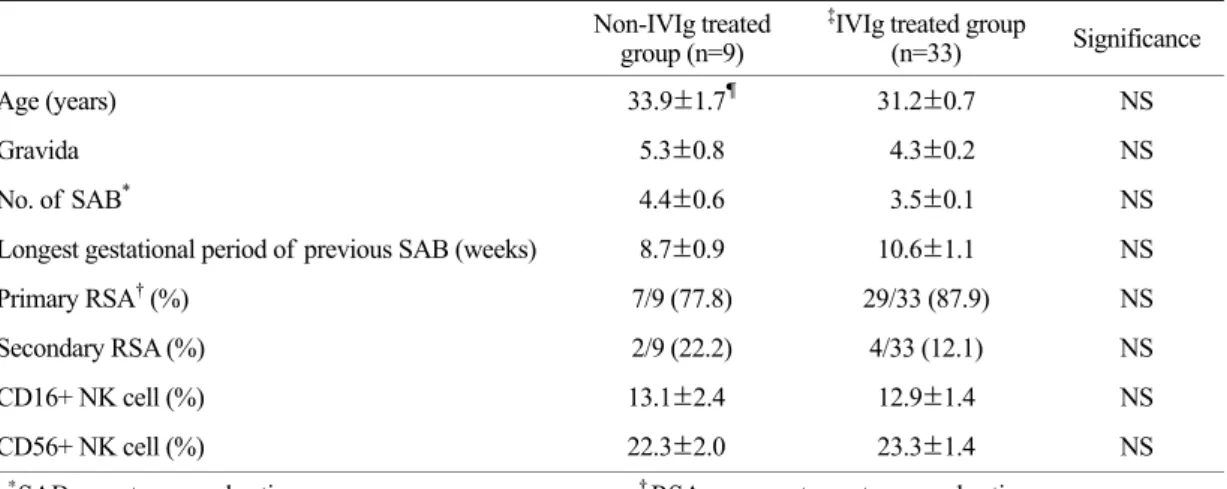
면역글로블린을 투여 받지 않은 대조군 (n=9)과 면역글로블린을 투여 받은 군 (n=33)간의 평균연령, 자연 유산의 평균횟수, 임신력, 유산력 중 가장 오 래 지속된 임신 주수, 1차성과 2차성 습관성 유산의 빈도 , 그리고 말초 혈액의 CD16, 56+NK cell의 백 분율 등에서 두 군 간의 의미 있는 차이가 없었다 (Table 1).

2. 면역글로블린의 치료 효과

면역글로블린을 사용하지 않는 대조군에서는 임 신 25주 이상 임신이 지속된 경우가 전체 9예 중 3예 (3/9, 33.3%)인 반면 면역글로블린을 투여한 군 에서는 전체 33예 중 25예 (25/33, 75.8%)를 보이며,

Table 2. Treatment outcome of IVIG in RSA patients with elevated peripheral CD56+ NK cell, ≥15%

Non-IVIG treated group (n=9)

*

IVIG treated

group (n=33) Significance Ongoing preg. ≥25 weeks 3/9 (33.3%) 25/33 (75.8%) p<0.05

Mean gestational weeks of delivery 38.3±0.3

38.1±0.1

NS Mean gestational weeks of SAB 7.3±0.2

15.8±1.6

p<0.05

*

IVIG 400 mg/kg every 4 weeks, from 5 weeks to 20 weeks,

Values are ± SE Table 1. Patient characteristics of study and control groups

Non-IVIg treated group (n=9)

IVIg treated group

(n=33) Significance

Age (years) 33.9±1.7

31.2±0.7 NS

Gravida 5.3±0.8 4.3±0.2 NS

No. of SAB

*

4.4±0.6 3.5±0.1 NS

Longest gestational period of previous SAB (weeks) 8.7±0.9 10.6±1.1 NS

Primary RSA

(%) 7/9 (77.8) 29/33 (87.9) NS

Secondary RSA (%) 2/9 (22.2) 4/33 (12.1) NS

CD16+ NK cell (%) 13.1±2.4 12.9±1.4 NS

CD56+ NK cell (%) 22.3±2.0 23.3±1.4 NS

*

SAB: spontaneous abortion,

RSA: recurrent spontaneous abortion,

IVIG 400 mg/kg every 4 weeks, from 5 weeks to 20 weeks,

Values are mean ± SE

(4)

임신 지속에 실패한 경우의 평균 유산 줏수도 대조 군에서는 평균 7.3주 지속되나 면역글로블린을 투여 한 군에서는 15.8주를 보여 양 군간의 통계학적으로 의미 있는 차이를 보여 면역글로블린이 임신 지속 능력에 효과가 있음을 보여 주였다. 반면, 양군에서 25주 이상 임신이 지속된 경우의 평균 임신 종결 주수는 각각 38.3주와 38.1주로 두 군 간의 차이를 보이지 않았다 (Table 2).

3. 면역글로블린의 임신유지 능력

말초 혈액의 CD56+NK cell이 증가된 원인에 기 인한 습관성 유산 환자에서 면역글로블린 투여 시 25주 이상 임신을 지속할 수 있는 가능성은 면역글 로블린을 투여하지 않은 군에 비교하여 평균 6.3배 (1.3~30.9, 95% CI)를 보여 면역글로블린의 투여가 유산 방지에 통계적으로 의미 있는 효과가 있는 것 으로 보여진다.

고 찰

자연 유산은 임신의 가장 흔한 합병증이며, 많게 는 임신을 원하는 부부의 약 3~5%가 자연 유산이 반복되는 습관성 유산으로 고통 받고 있다.

3

한편, 이런 습관성 유산의 원인기전으로 동종면역이상에 의한 면역학적 원인이 거론되고 있지만 아직 그 진 단 방법과 치료 효과에 대해서는 의견이 분분하며, 명확한 결론이 없는 상태이다. 그럼에도 불구하고 습관성 유산의 원인으로 일반적으로 받아들여지는 자궁기형 , 유전적 그리고 호르몬이상 등의 원인이 전혀 없는 습관성 유산 환자에 대해 태아에 대한 모체의 면역거부현상을 줄이기 위한 다양한 치료가 시도 되고 있다.

23

많은 연구자들에 의해 습관성 유산의 원인 중 하 나의 기전으로 Natural Killer (NK) 세포의 활성도와 말초 혈액에서의 차지하는 비율에 대한 연구가 진 행 되었으며, 그 결과 성공적인 임신의 수행을 위 해서는 전신의 NK 세포에 대한 적절한 조절이 필 요하며 임신 전 또는 임신 초기의 말초 혈액 내 어 느 특정 NK 세포의 증가는 습관성 유산의 원인이 된다는 연구 결과 및

24

특정 아형의 NK 세포가 증 가된 임신부에서의 해당 임신의 자연 유산의 비율

이 높음을 보고 하기도 하였다.

5

정맥 내 면역글로블린의 사용을 통한 수동면역 치료법은 탁월한 면역억제 효과에 기인하여 다양한 면역질환의 치료에 이용되고 있으며,

25

그 작용기전 으로 전신의 NK 세포의 활성을 저하시키며, 특히 착상부위의 NK 세포의 활성을 억제시켜 유산을 방 지하는 것으로 보고 되고 있다.

23

원인 불명의 습관성 유산에 대한 면역글로블린의 치료 효과를 보고한 여러 연구가 발표 되었지만 그 치료 효과에 대한 결과는 서로 상반되어 습관성 유 산 환자에서 치료 목적을 위한 면역글로블린 투여 의 도입은 아직 논란의 대상이다. Coulam 등

22

은 29명의 원인불명의 습관성 유산 환자에서 면역글로 블린을 사용하여 18명 즉, 62%에서 유산을 방지하 여 33명의 동일 조건하에 면역글로블린을 사용하지 않은 대조군의 유산 방지율 33% (11/33)에 비해 유 산 방지에 대한 의미 있는 차이가 없음을 보고 하 였고, Christiansen 등

2

은 17명의 원인불명의 습관성 유산 환자를 대상으로 면역글로블린의 유산 방지 효과를 동일 조건의 위약을 사용한 군과 비교한 결 과 53% (9/17)로 대조군의 29% (5/17)에 비해 유산 방지에 효과에 의미있는 차이가 없음을 보고 하였다.

반면 Kwak 등

26,27

은 말초 혈액의 CD56+, CD56+/

16+ NK 세포는 정맥 내 면역글로블린 투여 후 효 과적으로 감소하며, 말초 혈액의 NK 세포가 증가 된 73명의 습관성 유산 환자를 대상으로 면역글로 블린을 투여한 결과 NK 세포의 활성이 억제되며 그 결과 임신의 지속능력이 현저히 증가함을 보고 하였다 . 하지만 면역글로블린의 치료 효과를 규명하 기 위한 이전의 연구들은 면역글로블린의 투여 용 량 , 투여 시기 그리고 투여 대상군의 선정 등이 모 두 상이한 문제가 있었으며, 결국 습관성 유산 환 자에서 면역글로블린의 치료 효과는 아직 명확히 규명되지 않았다.

본 연구에서 저자들은 임신 전 말초 혈액의

CD56+ NK 세포가 증가된 습관성 유산 환자를 대

상으로 면역글로블린을 사용한 군과 사용하지 않은

군의 임신 지속능력을 후향적으로 분석하였으며,

그 결과 면역글로블린을 사용한 군에서 임신 지속

능력이 사용하지 않은 군에 비교하여 현저히 증가

된 결과를 보였으며 이 결과는 Coulam 등

22

(5)

Christiansen 등

2

의 연구 등과는 상반된 결과를 보이 는 반면, Kwak 등

26,27

의 연구 결과와 일치하며, 이 러한 상이한 결과의 원인은 치료 대상 군의 선정에 기인한 것으로 사료된다. 결국 습관성 유산 환자에 서 면역글로블린의 사용은 말초 혈액의 NK 세포가 증가된 환자에서 그 효과가 있는 것으로 사료되며, 본 연구에서는 면역글로블린의 투여 용량, 시기 등 이 이전의 다른 연구 등과 차별된 저 용량 면역글 로블린용법을 사용하여 통계적으로 의미 있게 유산 을 방지하는 효과를 볼 수 있었고, 결국 본 연구의 치료 용법은 말초 혈액 CD56+ NK 세포의 증가에 기인한 습관성 유산 환자에게 치료의 효과가 있음 을 알 수 있다.

결론적으로 본 연구에 의하면, 임신 전 말초 혈 액의 CD56+NK 세포의 증가에 기인한 습관성 유 산 환자에서 저 용량 면역글로블린의 투여는 유산 의 방지에 치료 효과가 있는 것으로 사료된다. 하지 만 치료 효과에 대한 보다 명확한 증거를 제시하기 위해서는 더 큰 연구군을 포함한 전향적 연구가 필 요할 것으로 사료된다.

참 고 문 헌

1. Christiansen OB. A fresh look at the causes and treatments of recurrent miscarriage, especially its immunological aspects. Hum Reprod Update 1996;

2: 271-93.

2. Christiansen OB, Mathiesen O, Lauritsen JG. Intra- venous immunoglobulin treatment of women with multiple miscarriages. Hum Reprod 1994; 7: 718 -22.

3. Daya S. Habitual abortion. Text book of Gynecology.

Philadelphia, WB Saunders 1993: 204-30.

4. Daya S. Immunotherapy for unexplained recurrent spontaneous abortion. Infertil Reprod Med Clinics N Am 1997; 8: 65-77.

5. Aoki K, Kajiura S, Matsumoto Y, Ogasawara M, Okada S, Yagami Y, et al. Preconceptual natural killer cell activity as a predictor of miscarriage.

Lancet 1995; 345: 1340-42.

6. Kwak JY, Beaman KD, Gilman-Sachs A, Ruiz JE,

Schewitz D, Beer AE. Up-regulated expression of CD56+, Cd56+/CD56-, and CD19+ cells in peri- pheral blood lymphocytes in pregnant women with recurrent pregnancy losses. Am J Reprod Immunol 1995; 34: 93-9.

7. Higuchi K, Aoki K, Kimbara T, Hosoi N, Yama- moto T, Okada H. Suppression of natural killer cell activity by monocytes following immunotherapy for recurrent spontaneous aborters. Am J Reprod Im- munol 1995; 33: 221-7.

8. Emmer PM, Veerhoek M, Nelson WL, Steegers EA, Joosted I. Natural killer cell reactivity and HLA-G in recurrent spontaneous abortion. Transplant Proc 1999; 31: 1838-40.

9. Ribbing SL, Hoversland RC, Beaman KD. T-cell suppressor factors plays an integral role in preven- ting fetal rejection. J Reprod Immunol 1998; 14:

83-95.

10. Nicols TC, Kang J, Angkachatchai V, Beer AE, Beaman KD. Expression of a membrane form of the pregnancy associated protein TJ6 on lympho- cytes. Cell Immunol 1995; 155: 219-29.

11. Bhat NM, Mithal A, Bieber MM, Herzenberg LA, Teng NNH. Human CD5+ B lymphocytes (B-1 cells) decrease in peripheral blood during pregnancy.

J Reprod Immunol 1995; 28: 53-60.

12. Daya S, Gunby J, Clark DA. Intravenous immuno- globulin therapy for recurrent spontaneous abortion:

A meta analysis. Am J Reprod Immunol 1998; 39:

69-76.

13. Ronda N, Hurez V, Kazatchkine MD. Intravenous immunoglobulin therapy of autoimmune and syste- mic inflammatory disease. Vox Sang 1993; 64: 65 -72.

14. Prasad NK, Papoff G, Zeuner A. Therapeutic pre- parations of normal polyspecific IgG (IVIG) induce apoptosis in human lymphocytes and monocytes: a novel mechanism of action of IVIg involving the Fas apoptopic pathway. J Immunol 1998; 161: 3781 -90.

15. Scott JR, Branch W, Kochenour NK, Ward K. In-

(6)

travenous immunologlobulin treatment of pregnant patients with recurrent pregnancy loss caused by antiphospholipid antibodies and Rh immunization.

Am J Obstet Gynecol 1998; 159: 1055-6.

16. Kwak JY, Quilty EA, Gilman-Sachs A, Beaman KD, Beer AE. Intravenous immunoglobulin G infusion therapy in women with recurrent spontaneous abor- tions of immune etiologies. J Reprod Immunol 1995;

28: 175-88.

17. Caccavo D, Vaccaro F, Ferri GM, Amoroso A, Bo- nomo L. Anti-idiotypes against antiphospholipid anti- bodies are present in normal polyspecific immuno- globulins for therapeutic use. J Autoimmun 1994; 7:

537-48.

18. Tsubakio T, Kurato Y, Katageri S. Alteration of T-cell subset and immunoglobulin synthesis in vitro during high dose gammaglobulin therapy in patients with idiopathic thrombocytopenic purpura. Clin Exp Immunol 1983; 53: 697-702.

19. Klaesson S, Ringden O, Markling L, Remberger M, Lundkvist I. Immune modulatory effects of immu- nologlobulins on cell-mediated immune response in vitro. Scand J Immunol 1993; 38: 477-84.

20. Mannhalter JW, Ahmad R, Wolf HM, Eible MM.

Effect of polymeric IgG on human monocyte func- tions. Int Arch Allergy Appl Immunol 1987; 82:

159-67.

21. Engelhard D, Waner JL, Kapoor N, Good RA. Effect of intravenous immune globulin on natural killer

cell activity: Possible association with autoimmune neutropenia and idiopathic thrombocytopenia. J Pe- diatr 1986; 108: 77-81.

22. Coulam CB, Krysa L, Stern J, Bustillo M. Intra- venous immunoglobulin for treatment of recurrent pregnancy loss. Am J Reprod Immunol 1995; 34:

333-7(7-12).

23. Daya S, Gunby J, Porter F, Scott J, Clark DA. Cri- tical analysis of intravenous immunoglobulin the- rapy for recurrent miscarriage. Hum Reprod Update 1999; 5: 475-82.

24. Yamada H, Morikawa M, Kato EH, Shimada S, Kobashi G, Minakami H, et al. Preconceptional natural killer cell activity and percentage as pre- dictors of biochemical pregnancy and spontaneous abortion with normal chromosome karyotype. Am J Reprod Immunol 2003; 50: 351-4.

25. Dwyer JM. Manipulating the immune system with immune globulin. N Engl J Med 1992; 326: 107-16.

26. Kwak JY, Kwak FM Ainbinder SW, Ruiz AM, Beer AE. Elevated peripheral blood natural killer cells are effectively suppressed by immunoglobulin G in- fusion in women with recurrent spontaneous abor- tions. Am J Reprod Immunol 1996; 35: 363-9.

27. Ruiz JE, Kwak JY, Baum L, Gilmansachs A, Bea-

man KD, Kim YB, et al. Effects of intravenous

immunoglobulin G on natural killer cell cytotoxi-

city in vitro in women with recurrent spontaneous

abortion. J Reprod Immunol 1996; 31: 125-41.

수치

Table 2. Treatment outcome of  IVIG in RSA patients with elevated peripheral CD56+ NK cell, ≥15%

참조

관련 문서

Intravenous immunoglobulin G (IVIG) and aspirin are the standard initial therapy in the treatment of acute KD. The purpose of this study was to investigate drug utilization

Hysteroscopic septum resection of complete septate uterus with cervical duplication, sparing the double cervix in patients with recurrent spontaneous abortions

MG, myasthenia gravis; LEMS, Lambert-Eaton myasthenic syndrome; BM, bone marrow; MAG, myelin-associated glycoprotein; IVIG, intravenous immunoglobulin; MMN,

Intravenous immunoglobulin G (IVIG) and aspirin are the standard initial therapy in the treatment of acute KD. The purpose of this study was to investigate drug utilization

Inhibition of cell adhesion by antibodies to Arg-Gly-Asp (RGD) in normal immunoglobulin for therapeutic use (intravenous immunoglobulin, IVIg). Infusion of Fc gamma fragments

Intravenous immunoglobulin (IVIg) is the treatment of choice for many autoimmune neuropathic disorders such as Guillain-Barre syndrome (GBS), chronic

Background: Intravenous immunoglobulin (IVIg) has been administered for various immune-mediated neurological diseases such as autoimmune neuropathy, inflammatory myopathies,

Abbreviations: ADR, Adverse drug reaction; IVIG, Intravenous immunoglobulin; MIF, Macrophage migration inhibition factor; SCAR, Severe cutaneous adverse reactions; SJS,