• 검색 결과가 없습니다.

Predictive Parameters of Testicular Salvage of Pediatric Testicular Torsion: A 6-Year Experience of a Single Center

N/A
N/A
Protected

Academic year: 2021

Share "Predictive Parameters of Testicular Salvage of Pediatric Testicular Torsion: A 6-Year Experience of a Single Center"

Copied!
5
0
0

로드 중.... (전체 텍스트 보기)

전체 글

(1)

Original Article Urogenit Tract Infect 2016;11(1):25-29

Predictive Parameters of Testicular Salvage of Pediatric Testicular Torsion: A 6-Year Experience of a Single Center

Seungsoo Lee

1,2,*

, Bu Kyung Park

1,*

, Moon Kee Chung

1,2

, Jae Min Chung

1,2

, Sang Don Lee

1,2

1

Department of Urology, Pusan National University School of Medicine, Yangsan,

2

Department of Urology, Pusan National University Yangsan Hospital, Pusan National University School of Medicine, Yangsan, Korea

Purpose: We evaluated parameters associated with testicular salvage in boys with testicular torsion.

Materials and Methods: During 2009-2014, 19 boys younger than 18 years old underwent emergency surgery for testicular torsion in our hospital. Age, chief complaint, laterality of the torsion, physical appearance, ultrasonographic results, duration between the onset of symptoms and hospital visit, duration between the onset of symptoms and start of surgery, intraoperative appearance, surgical method (orchiopexy or orchiectomy), and any postoperative complications were analyzed retrospectively. Cases were categorized according to salvageable testes (n=14) or unsalvageable testes (n=5) groups based on testes viability.

Results: The mean age was not significantly different between the two groups. All patients were diagnosed using color Doppler ultrasonography of the scrotum. Six (42.9%) boys in the salvageable testes group and all five in the unsalvageable testes group were transferred from other clinics or hospitals (p=0.026). The mean duration between the onset of symptoms and hospital visit was 925 minutes in the salvageable testes group and 3,488 minutes in the unsalvageable testes group (p=0.042), and the mean duration between the onset of symptoms and start of surgery was 1,131 minutes in the salvageable testes group and 3,777 minutes in the unsalvageable testes group (p=0.042).

Conclusions: There was a high possibility that orchiectomy was required if surgery was delayed. However, even when a boy is admitted to the hospital more than 24 hours after the onset of symptoms, the testis can still be viable provided the surgery is performed as quickly as possible.

Keywords: Testis; Spermatic cord torsion; Orchiectomy; Orchiopexy

Copyright 2016, Korean Association of Urogenital Tract Infection and Inflammation. All rights reserved.

This is an open access article distributed under the terms of the Creative Commons Attribution Non-Commercial License (http://creativecommons.org/licenses/by-nc/4.0) which permits unrestricted non-commercial use, distribution, and reproduction in any medium, provided the original work is properly cited.

Received: 30 March, 2016 Revised: 8 April, 2016 Accepted: 8 April, 2016

Correspondence to: Sang Don Lee http://orcid.org/0000-0001-9459-3887 Department of Urology, Pusan National University Yangsan Hospital, 20 Geumo-ro, Mulgeum-eup, Yangsan 50612, Korea

Tel: +82-55-360-2134, Fax: +82-55-360-2164 E-mail: [email protected]

*These authors contributed equally to this study and should be considered co-first authors.

INTRODUCTION

The acute scrotum in pediatric patients is a urologic emergency [1,2]. Scrotal pain, swelling, or erythema of acute onset is presented in the acute scrotum, and there are several diseases including testicular torsion, epididymo-orchitis,

testicular appendix torsion, and scrotal injury [3-6]. In

particular, a delay in diagnosis and treatment can lead to

losing the involved testis [7-11], therefore testicular torsion

is a true emergency and must be differentiated from other

etiologies of acute scrotum [12]. Testicular torsion constitutes

approximately 25% of cases of acute scrotum [12]. The

(2)

Table 1. Age distribution of boys with testicular torsion under 18-year-old (n=19)

Age (y) Number (%)

0 1 (5.3)

5 1 (5.3)

7 1 (5.3)

12 3 (15.8)

13 3 (15.8)

14 2 (10.5)

15 2 (10.5)

16 2 (10.5)

17 2 (10.5)

18 2 (10.5)

annual incidence of testicular torsion is 3.8% in males under 18 years old, and approximately 75% of cases of testicular torsion occur in teenagers [13,14].

However, some younger patients have been reported, and diagnosis with only history taking and physical examination is difficult. Doppler ultrasonography is not available in all hospitals, therefore, diagnosis and management are delayed in some patients [15,16].

The aim of this study was to determine the parameters associated with testicular salvage in patients under 18 years old with testicular torsion.

MATERIALS AND METHODS

This is a retrospective study of 19 patients under 18-year- old diagnosed with testicular torsion from a single center (Pusan National University Yangsan Hospital) for six years between 2009 and 2014. All patients underwent emergency surgery. Patients’ age, chief complaints, laterality, results of physical examination, ultrasonographic findings, duration from the occurrence of symptoms to hospital visit and beginning of the operation, surgical findings, surgical methods (orchiopexy or orchiectomy), and postoperative complications were studied.

A salvageable testes group in which the testes could be salvaged and an unsalvageable testes group in which testes could not be salvaged or was atrophied were defined and analyzed according to surgical findings.

Statistical analysis was performed using IBM SPSS Statistics ver. 20.0 (IBM Co., Armonk, NY, USA). Mann-Whitney U tests were applied for comparison of age, duration from the occurrence of symptoms to hospital visit and beginning of the operation of each group and chi-square tests were

applied for comparison of laterality and visiting other clinics or hospitals for each group; p-values <0.05 were considered statistically significant.

RESULTS

The age of patients was 0-year in one (5.3%), 5-year in one (5.3%), 7-year in one (5.3%), 12-year in three (15.8%), 13-year in three (15.8%), 14-year in two (10.5%), 15-year in two (10.5%), 16-year in two (10.5%), 17-year in two (10.5%), and 18-year in two (10.5%) (Table 1). Among 19 patients, the salvageable testes group included 14 (73.7%) and the unsalvageable testes group included five (26.3%).

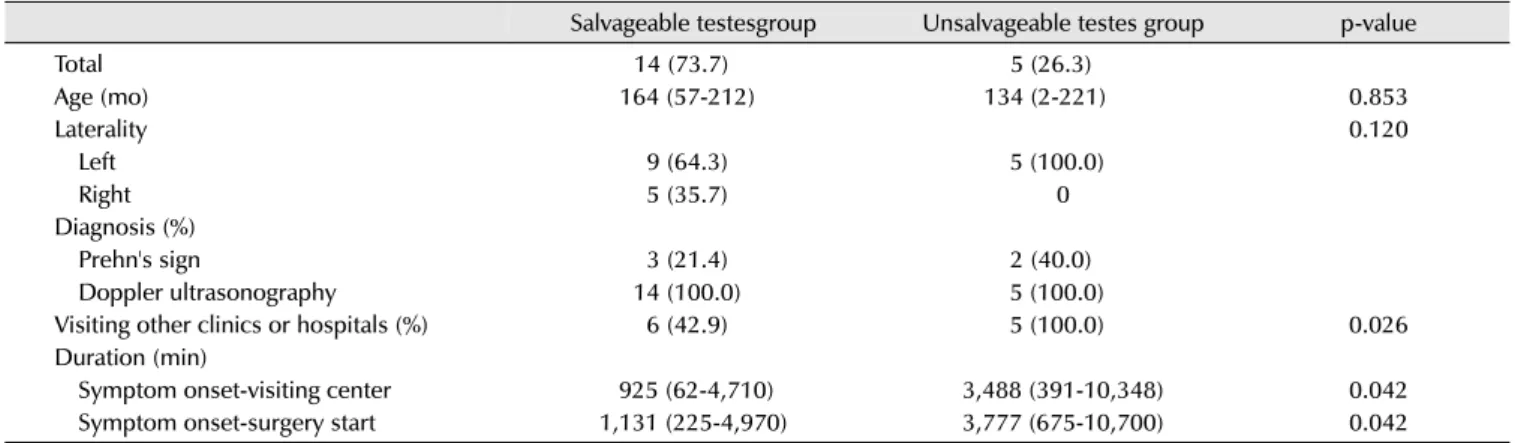
The mean ages were 164 months (57-212) in the salvageable testes group and 134 months (2-221) in the unsalvageable testes group. There was no statistical difference (p=0.853). Nine patients (64.3%) in the salvageable testes group had laterality of involved testes in left, five (35.7%) in right, and in the unsalvageable testes group, all involved testis were in left, with no significant difference (p=0.120).

All children visited the hospital with scrotal pain or swelling. Only three patients (21.4%) in the salvageable testes group and two (40.0%) in the unsalvageable testes group could be diagnosed with physical examination such as Prehn’s sign. All patients were confirmed with Doppler ultrasonography.

In the salvageable testes group, six children (42.9%) visited our hospital via other clinics; however, in the unsalvageable testes group, all five children visited via other clinics, showing a statistical difference (p=0.026).

The mean duration from the occurrence of symptoms to the hospital visit and to beginning of the operation was 925 minutes (62-4,710) and 1,131 minutes (225-4,970) in the salvageable testes group, and 3,488 minutes (391-10,348) and 3,777 minutes (675-10,700) in the unsalvageable testes group, respectively. The duration was significantly different between the two groups (p=0.042 and p=0.042, respec- tively) (Table 2).

In the salvageable testes group, the distribution of

durations between the onset of symptoms and start of

surgery was five (36%) in under 360 minutes, four (29%)

in 360-720 minutes, two (14%) in 720-1,440 minutes, and

three (21%) in >1,440 minutes.

(3)

Table 2. Patient characteristics in the salvageable testes group and unsalvageable testes group

Salvageable testesgroup Unsalvageable testes group p-value

Total 14 (73.7) 5 (26.3)

Age (mo) 164 (57-212) 134 (2-221) 0.853

Laterality 0.120

Left 9 (64.3) 5 (100.0)

Right 5 (35.7) 0

Diagnosis (%)

Prehn's sign 3 (21.4) 2 (40.0)

Doppler ultrasonography 14 (100.0) 5 (100.0)

Visiting other clinics or hospitals (%) 6 (42.9) 5 (100.0) 0.026

Duration (min)

Symptom onset-visiting center 925 (62-4,710) 3,488 (391-10,348) 0.042

Symptom onset-surgery start 1,131 (225-4,970) 3,777 (675-10,700) 0.042

Values are presented as number (%) or number (range).

DISCUSSION

Testicular torsion is a common urologic emergency [17].

Most testes can be salvaged if surgery is performed quickly, although risk of decreased sperm production, fertility, and testicular atrophy is increasing [18,19]. Previous studies concluded that testicular viability is associated with the short time duration between scrotal pain onset and surgery [7-11].

In general, necrosis of testicular tissues starts after about four hours of absent blood flow [20]. The reported salvage rate is 90-100% when detorsed within six hours of the onset of symptoms, and this rate decreases to 20-50% after 12 hours and 0-10% when more than 24 hours [13,21,22].

In our study, we analyzed not only surgery time but also hospital visit time from onset of symptoms. Among 14 testes in the salvageable testes group, nine (64%) patients’

testes could be saved, although surgeries were performed after six hours from pain onset. However, the mean durations between the onset of symptoms and visiting the hospital and between the onset of symptoms and start of surgery were shorter in the salvageable testes group than in the unsalvageable testes group.

Some patients visited other clinics or hospitals before visiting our center, so that the diagnoses and treatments were delayed. All orchiectomy group patients were transferred from other clinics or hospitals. Absolute golden time for testicular salvage is not fixed; however, shorter durations of visiting and surgery are associated with testicular saving.

In this study, history taking and physical examination were not always helpful for diagnosing testicular torsion.

All patients were diagnosed by Doppler ultrasonography

with absent testicular blood flow. Previous studies have reported sensitivity rates varying from 78.6% to 100% and specificity rates varying from 76.9% to 100% [23].

Distinguishing testicular torsion from epididymitis with ultrasonography can be difficult.

Nussbaum Blask and Rushton [24] reported that an enlarged hypovascular and echogenic epididymis was common in pediatric patients with testicular torsion. Kaye et al. [25] reported on 55 boys with scrotal exploration;

37 were heterogeneous on ultrasonography, and all heterogeneous testes were unsalvageable on exploration.

Chmelnik et al. [26] reported that all 16 boys with testicular torsion with focal sonographic heterogeneity had orchiectomy or testicular atrophy. Therefore, examination of testes is useful for exact diagnosis and treatment.

Testicular torsion usually presents in teenagers, however, is uncommon in patients younger than ten years old [7-11].

Most patients in our study were teenagers, but three were under 10 years. Young boys with testicular torsion may not complain of scrotal pain, but may present with abdominal pain or other symptoms. Therefore, physicians should always consider testicular torsion in the case of any male patients complaining of abdominal pain.

Absence of the cremasteric reflex is one of the features highly associated with testicular torsion. However, the presence of the cremasteric reflex cannot always exclude testicular torsion, as the reflex was intact in 8% of young boys with testicular torsion. In previous studies, 29-40%

of patients with testicular torsion showed normal cremasteric reflex [23].

Salvageability of torsed testis is important for the fertility

of the patient. Several studies examining mechanisms that

(4)

show the effect of testicular torsion on male infertility have been reported. Ischemia-reperfusion due to torsion and detorsion leads to an increase in neutrophil migration to the testicular tissue. Inflammation proceeded with recruitment of neutrophils to the testis causing apoptosis of germ cells [27].

A recent study suggested that apoptotic cell death plays an important role in limiting the testicular germ cell population, and this cell regulation probably has an association with male infertility [28]. In addition, damage to the blood-testis barrier leads to initiation of autoimmune activity against sperm cells, followed by appearance of antisperm antibodies in the circulatory system, causing immunogenic infertility by affecting the contralateral testis [29].

This study has some limitations. First, the number of patients was small, with only five patients in the unsalvageable testes group. This was a single center result, therefore, a multi-center study may be useful for establishing parameters affecting testis salvage.

In addition, long-term follow-up results were not investigated. The most important purpose of testis salvage is preserving male fertility. However, because the patients were young examination of fertility like semen analysis was not performed. We just followed up testis size and blood flow with Doppler ultrasonography.

CONCLUSIONS

Most boys with testicular torsion were 12-16 years old, however successful testicular salvage was not associated with age. The laterality of involved testis was not associated with testis viability. Diagnostic choice for testicular torsion was Doppler ultrasonography.

The short duration between symptom onset and hospital visit or between symptom onset and surgery start was important for saving testis. There was a high possibility that orchiectomy was required if surgery was delayed for more than 12 hours. Even when a boy is admitted to the hospital more than 24 hours after the onset of symptoms, the testis can still be viable provided the surgery is performed as quickly as possible.

CONFLICT OF INTEREST

No potential conflict of interest relevant to this article

was reported.

ACKNOWLEDGMENTS

This work was supported by a 2-Year Research Grant of Pusan National University.

REFERENCES

1. McAndrew HF, Pemberton R, Kikiros CS, Gollow I. The incidence and investigation of acute scrotal problems in children. Pediatr Surg Int 2002;18:435-7.

2. Nelson CP, Williams JF, Bloom DA. The cremasteric reflex: a useful but imperfect sign in testicular torsion. J Pediatr Surg 2003;38:1248-9.

3. Sidler D, Brown RA, Millar AJ, Rode H, Cywes S. A 25-year review of the acute scrotum in children. S Afr Med J 1997;87:1696-8.

4. Kadish HA, Bolte RG. A retrospective review of pediatric patients with epididymitis, testicular torsion, and torsion of testicular appendages. Pediatrics 1998;102:73-6.

5. Lewis AG, Bukowski TP, Jarvis PD, Wacksman J, Sheldon CA.

Evaluation of acute scrotum in the emergency department. J Pediatr Surg 1995;30:277-81; discussion 281-2.

6. Bae TH, Jung DY, Kim W, Cho JP. Differential diagnostic method of acute scrotum. J Korean Soc Emerg Med 1997;8:385-9.

7. Mansbach JM, Forbes P, Peters C. Testicular torsion and risk factors for orchiectomy. Arch Pediatr Adolesc Med 2005;159:1167-71.

8. Makela E, Lahdes-Vasama T, Rajakorpi H, Wikstrom S. A 19-year review of paediatric patients with acute scrotum.

Scand J Surg 2007;96:62-6.

9. Saxena AK, Castellani C, Ruttenstock EM, Hollwarth ME.

Testicular torsion: a 15-year single-centre clinical and histological analysis. Acta Paediatr 2012;101:e282-6.

10. Mestrovic J, Biocic M, Pogorelic Z, Furlan D, Druzijanic N, Todoric D, et al. Differentiation of inflammatory from non- inflammatory causes of acute scrotum using relatively simple laboratory tests: prospective study. J Pediatr Urol 2013;9:

313-7.

11. Mellick LB. Torsion of the testicle: it is time to stop tossing the dice. Pediatr Emerg Care 2012;28:80-6.

12. Gunther P, Rubben I. The acute scrotum in childhood and adolescence. Dtsch Arztebl Int 2012;109:449-57; quiz 458.

13. Zhao LC, Lautz TB, Meeks JJ, Maizels M. Pediatric testicular torsion epidemiology using a national database: incidence, risk of orchiectomy and possible measures toward improving the quality of care. J Urol 2011;186:2009-13.

14. Korbel EI. Torsion of the testis. J Urol 1974;111:521-2.

15. Kim HS, Lee SW, Yoo TK, Kang JY. Clinical outcomes of scrotal

exploration for acute scrotum in children less than 13 years old.

(5)

Korean J Pediatr Urol 2009;1:100-4.

16. Boettcher M, Krebs T, Bergholz R, Wenke K, Aronson D, Reinshagen K. Clinical and sonographic features predict testicular torsion in children: a prospective study. BJU Int 2013;112:1201-6.

17. Yazihan N, Ataoglu H, Koku N, Erdemli E, Sargin AK. Protective role of erythropoietin during testicular torsion of the rats.

World J Urol 2007;25:531-6.

18. Horica CA, Hadziselimovic F, Kreutz G, Bandhauer K.

Ultrastructural studies of the contorted and contralateral testicle in unilateral testicular torsion. Eur Urol 1982;8:358-62.

19. Thomas WE, Williamson RC. Diagnosis and outcome of testicular torsion. Br J Surg 1983;70:213-6.

20. Bartsch G, Frank S, Marberger H, Mikuz G. Testicular torsion:

late results with special regard to fertility and endocrine function. J Urol 1980;124:375-8.

21. Cattolica EV, Karol JB, Rankin KN, Klein RS. High testicular salvage rate in torsion of the spermatic cord. J Urol 1982;128:66-8.

22. Ringdahl E, Teague L. Testicular torsion. Am Fam Physician 2006;74:1739-43.

23. Liang T, Metcalfe P, Sevcik W, Noga M. Retrospective review of diagnosis and treatment in children presenting to the pediatric

department with acute scrotum. AJR Am J Roentgenol 2013;200:W444-9.

24. Nussbaum Blask AR, Rushton HG. Sonographic appearance of the epididymis in pediatric testicular torsion. AJR Am J Roentgenol 2006;187:1627-35.

25. Kaye JD, Shapiro EY, Levitt SB, Friedman SC, Gitlin J, Freyle J, et al. Parenchymal echo texture predicts testicular salvage after torsion: potential impact on the need for emergent exploration.

J Urol 2008;180(4 Suppl):1733-6.

26. Chmelnik M, Schenk JP, Hinz U, Holland-Cunz S, Gunther P.

Testicular torsion: sonomorphological appearance as a predictor for testicular viability and outcome in neonates and children. Pediatr Surg Int 2010;26:281-6.

27. Lysiak JJ, Turner SD, Nguyen QA, Singbartl K, Ley K, Turner TT.

Essential role of neutrophils in germ cell-specific apoptosis following ischemia/reperfusion injury of the mouse testis. Biol Reprod 2001;65:718-25.

28. Baccetti B, Collodel G, Piomboni P. Apoptosis in human ejaculated sperm cells (notulae seminologicae 9). J Submicrosc Cytol Pathol 1996;28:587-96.

29. Bohring C, Krause W. Immune infertility: towards a better

understanding of sperm (auto)-immunity. The value of

proteomic analysis. Hum Reprod 2003;18:915-24.

수치

Table 1. Age distribution of boys with testicular torsion under  18-year-old (n=19)
Table 2. Patient characteristics in the salvageable testes group and unsalvageable testes group

참조

관련 문서

웹 표준을 지원하는 플랫폼에서 큰 수정없이 실행 가능함 패키징을 통해 다양한 기기를 위한 앱을 작성할 수 있음 네이티브 앱과

_____ culture appears to be attractive (도시의) to the

이하선의 실질 속에서 하악경의 후내측에서 나와 하악지의 내측면을 따라 앞으로 간다. (귀밑샘 부위에서 갈라져 나와

1 John Owen, Justification by Faith Alone, in The Works of John Owen, ed. John Bolt, trans. Scott Clark, "Do This and Live: Christ's Active Obedience as the

On the contrary, when including U-band, the judgment disposition group(J) and the perception disposition group(P) made a meaningful difference in 6

Data represent the mean ±SD of Three separate experiments; the statistical significance of differences between each treatment group and the control (**P < 0.01, *P

In this study, the dislocation group had a wider width of AEB (p<0.05), and the posterior slope (TR angle) of the AER and the average of AEB were smoother (p<0.05) compared

The Mann-whitney U test was used to compare and analyze the salivary cortisol concentration according to the duration of symptoms in the temporomandibular disorder patient group