* The authors acknowledge the financial support from the National Natural Science Foundation of China for the research conducted (Research Grant No. 40131010).
** Professor, School of Economics, Ocean University of China, Qingdao, 266071, China, [email protected]
*** Researcher, Institute of Geographical Sciences and Natural Resources Research Chinese Academy of Sciences, Beijing, 100101, China, [email protected]
The Role of New Information and Communication Technologies in the Internationalization of Firms: A Case Study of Haier*
기업의 국제화와 신 정보통신기술의 역할: 중국 Haier 기업을 사례로
Shuguang Liu** and Weidong Liu***
Abstract : It is now widely recognized that new Information and Communication Technologies (ICTs) have been changing the way by which firms conduct their businesses. Examples are the application of enterprise resources planning (ERP) and business process reengineering (BPR) to increase the efficiency of internal resources management, adoption of Business-to-Business e-commerce (B2B e-com) to integrate supply chain, and invention of new marketing channels such as Business-to-Customer (B2C) e-com. These new ways of conducting businesses are believed to help firms to reduce transaction costs and increase productivity. As a result, new ICTs have played an important role in recent growth of many small firms into multi-functional and multi-product corporations and in their spatial expansion towards internationalization as well. This paper takes Haierin China as a case to study the role of new ICTs in the growth of firms and reveal how the new technologies have facilitated the expansion of Haier into a transnational corporation (TNC) by examining the internationalization process of the firm in relation to its adoption of new ICTs in the period from 1990 to 2002.
The study reveals that the adoption of new ICTs has helped Haier to integrate its functional units located in dozens of places across the world, which is essential to the internationalization of a firm, and to link closely together its worldwide suppliers and customers to achieve just-in-time (JIT) production and delivery. As such, the authors of the paper argue that, without the facilitation of new ICTs, Haier could not have developed into a TNC in less than ten years.
Key Words : new ICTs, internationalization of firms, Haier
요약: 신 정보통신기술(ICTs)이 기업의 비즈니스 처리방식을 변화시키고 있다는 점은 일반적으로 받아들여지
고 있다. 예를 들어, 기업의 내부자원 관리의 효율성을 제고하기 위한 ERP(enterprise resources planning)와 BPR(business process reengineering) 활용, 공급 연줄망을 통합하기 위한 기업-기업간 e-com의 적용, 그리고 기업- 고객간 e-com과 같이 새로운 마켓팅 통로의 창출 등을 들 수 있다. 기업들은 이러한 새로운 방식의 비즈니스가 기업의 생산성 증대 및 개래비용의 절감 효과를 가져온다고 확신한다. 그 결과, 신 ICTs는 다양한 제품을 생산하 는 많은 소규모 기업들의 최근 성장과 국제화를 통한 공간적 확산에 중요한 역할을 하고 있다. 본 연구는 중국 Haier 기업을 사례로 기업의 성장과정에 신 ICTs가 끼친 역할을 살펴본 것이다. Haier 기업은 1990년부터 2002년 시기에 초국적 기업으로 성장했는데, 그 배경으로 신 ICTs의 채택과 관련하여 기업의 국제화 과정을 연구한 것이 다. 연구결과, Haier 기업의 신 ICTs의 채택은 세계 여러 지역에 위치한 기능체의 통합에 기여했으며, 이는 기업 의 국제화에 필수적인 적기생산과 배달체계를 구축함으로써 세계적으로 광범위한 지역의 공급자와 구매자를 가
깝게 연계시키는 결과를 가져왔다. 결론적으로Haier 기업은 신 ICTs를 활용함으로써 10년 이내에 초국적기업으
로 성장하게 되었다는 점이다.
주요어 : 신 정보통신기술, 기업의 국제화, Haier
1. Introduction
Internationalization and globalization are the major manifestations of the growth and develop- ment of enterprises in recent decades. As Jack Welch (1987), Chairman of General Electric, said: “The win- ners in these global games will be those who can put together the world’s best in design, manufacturing, research, execution, and marketing on the largest scale. Rarely are all of these elements found in one country or on one continent.”These trends have been propelled by the rapid development of infor- mation and communication technologies (ICTs), which makes the global commercial network more and more accessible and flexible, resulting in the rev- olutionary reform of enterprise operation and man- agement (Jiang, Zhang & Shao, 2002). Enterprise resources planning (ERP) and business process reengineering (BPR) are regarded as the necessary means for enterprise managerial and operational innovations (Hammer, 1990; Champy, 1993), and they should be accomplished through the adoption of new ICTs within and out of the enterprises. With the spatial expansion and popularization of new ICT infrastructures, more and more enterprises start to develop new ICTs-based tools of operation and management to improve their capacity of respond- ing to quick market change and to adopt just-in-time (JIT). The new tools include business-to-business (B2B) e-commerce, business-to-customer (B2C) e- commerce, etc.
It is argued that the adoption of new ICTs and new management tools will boost the re-organiza- tion of enterprises toward spatial decentralization and internationalized value chain fragmentation, and also reinforce the globalization of existing transnational corporations (TNCs). Positive contri- butions of the adoption of new ICTs to the internationalization and globalization of enterprises have been studied from such aspects of enterprise
operation as R&D, production and marketing (Dunning, 1993; Gourevitch, Bohn & Mckendrick, 2000; Howells & Wood, 1993; Montgomery &
Hariharan, 1991; Patel & Pavitt, 1997; Zander, 1998;
Dunning & Lundan, 1998). These studies, however, are based on investigations of TNCs and small and medium-sized enterprises (SMEs) in the developed countries, and little has been known about TNCs and SMEs from the developing countries.
With the ongoing reform toward a market econo- my, more and more enterprises in China have been developing very rapidly and started their internatio- nalization processes. Haier is a typical case of such internationalized enterprises. Established in 1984, Haier is a fast-growing and eye-catching manufac- turer of household appliances in China, and in the world as well. In China, Haier has a thirty percent share in the market of refrigerators, air conditioners and washing machines respectively. However, in 1984, Haier was only a small local plant in Qingdao, Shandong Province, making refrigerators with imported technology from Germany. At present, the plant has developed into a TNC with thirteen over- seas plants and sixteen overseas R&D or design cen- ters, and with its products exported to more than 160 countries. The successes of Haier in internation- alizing its business have attracted increasing atten- tion from scholars of different origins, and diversi- fied factors are found to contribute to its success (Sun, 2002; Gao, 2003; Marlom, 2002; Liu and Li, 2002). While corporate culture and management ideas are key to Haier’s success, it is admitted by its top managers that new ICTs have also played an important role in its fast development. The purpose of this paper is to analyze dynamic interactions between the adoption of new ICTs and internation- alization of Haier. We hope that our analysis will help to understand the internationalization of enter- prises in the developing countries in the era of knowledge economy.
2. Analytical Framework
The evolutionary theory was introduced into the studies of economic dynamics by Nelson and Winter (1982). The concepts such as trajectories, path-depen- dence, lock-in and accumulative learning are widely employed to describe organizational economic activ- ities within certain periods and milieus. The interac- tions of factors and the consequences are regarded as the major mechanism for the evolution process of organizations. As for the internationalization of enterprises, recent literature argues that technology innovation and coherence are among the major fac- tors for the internationalization processes of large firms (Patel and Pavitt, 1997; Zander, 1998; Piscitello, 2000). However, not much literature is available in the impacts of the adoption of new ICTs on the internationalization of enterprises. In this paper, we will take the evolutionary approach to analyze the dynamic relationships between new ICTs adoption and business internationalization of Small and Medium-sided Enterprises (SMEs).
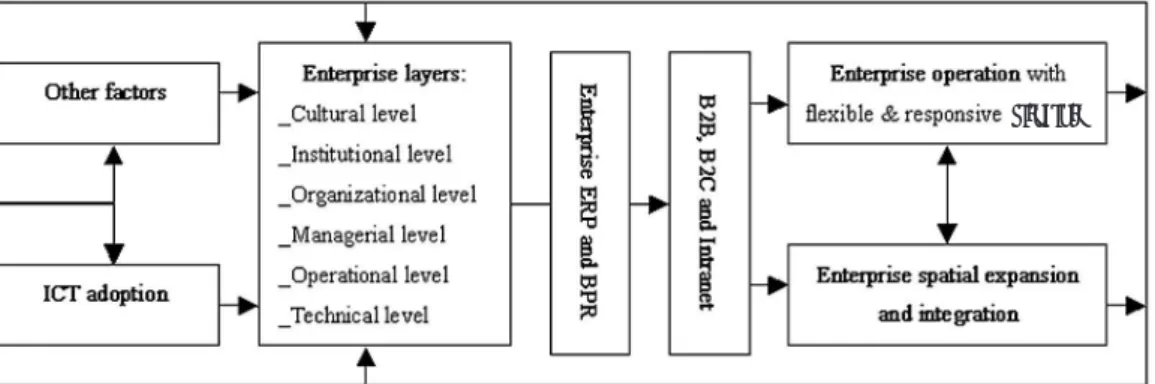
Based on the evolutionary theory, we have devel- oped a theoretical framework as shown in Figure 1.
In the framework, we would like to make the follow- ing arguments and use in-depth analyses of Haier’s evolution to prove them.
(1) The adoption of new ICTs enables enterprises to reorganize businesses through ERP and BPR;
(2) The establishment of ICT-intensive networks like B2C, B2B, and intranet is regarded as the consequence of enterprise reorganization;
(3) The ICT-intensive networks not only help to increase the responsiveness and flexibility of enterprises, but also enable and promote their spatial expansion and integration;
(4) The enterprise functional restructuring and spatial expansion interact with each other;
(5) Positive outcomes of enterprise restructuring and expansion will reinforce the adoption of new ICTs, which is an important force for enterprises to achieve sustained global devel- opment.
3. Trajectory of ICTs Adoption and Internationalization of Haier
Since its establishment in 1984, Haier has regis- tered an average annual increase of sales by seventy- eight percent. At present, Haier produces a wide range of household appliances in eight-six categories and 13,000 specifications. According to a survey by Euromonitor, Haier ranks the fifth in market share among all household-appliance providers in the world, after Whirlpool, Electrolux, GE, Bosch- Siemens, and ranks the first in refrigerator market. In China, Haier is regarded as one of the most success- ful enterprises in both the adoption of new ICTs and
Figure 1. Dynamic interrelations between ICT adoption and internationalization of enterprises structure
the internationalization of businesses. The trajectory of Haier to adopt new ICTs and internationalize its businesses is listed in Table 1 and more details are provided in the Appendix. Table 1 shows that the development of Haier can be divided into three strategic stages; i.e. the OBM (original brand manu- facturing) period (1984-1991), diversified develop- ment period (1992-1998), and internationalization period (1999-2002). From stage to stage, the internationalization of Haier has been accompanied by the adoption of new ICTs and continuous re- organization.
4. Current Situations of Haier ICTs Adoption
1) The ICT-intensive Operation Systems under BPR
In 1998, Haier decided to adopt BPR based on ERP to realize its internationalization strategy, which aimed to change the original multi-division systems into market-oriented horizontal units.
Under the new business model, the roiginal com- modity and international promotion headquarters, the product headquarters and ODM (original design and manufacturing), and the logistics centers of
Haier are restructured into independent units along the intra-enterprise value chains, and these new functional units are simultaneously responsible for the flow of orders derivated from global customer resources. Besides, the whole business system links together global suppliers and customers through supply chains of products and flows of capitals. The new system is supported by a 3T security system, i.e.
total capital management (TCM), total productive maintenance and management (TPM), total quality management (TQM), and also supported by a 3R development system, i.e. research and development (R&D), human resource development (HR), cus- tomer relation development (CR). The foundation of these new business practices is Haier’s management philosophy of OEC (overall; everyone, everything, everyday; clean and control) and its corporate cul- ture (See Figure 2).
2) ICT Infrastructure Networks of Haier
Haier established its public websites by connect- ing to the worldwide website networks in 1996, and began to construct its Intranet in 1998. The core equipment like ATM comes from CISCO, USA. All the networks are centered on the global headquarter of Haier in Qingdao. Functional headquarters, divi- sions and regional branches, trade companies, industrial parks, call centers, and B2C-based cus- Table 1. Dynamics of Haier ICT adoption and internationalization (1984-2002)
1984- OBM From TQM Traditional ICTs Localized expansion Technology and management
1991 to OEC1 introduction from Germany and Japan
1992- Diversified External take- Internal information Establishment of Joint design with international partners 1998 development over center Corporate domestic factories and OEM to USA
Website R&Ds
1999- International- Market-chain- New ICTs adoption Competitive location Global design networking;
2002 ization guided BPR through BPR and all over the country; Global marketing, purchasing and serving;
operation via B2B, Establishment of Globalization in USA and Europe B2C and intranet domestic branches as
the essential parts of global value chains
1OEC: overall; every day, everything, every one; clean and control.
Period Strategy Management ICTs Adoption Domestic Expansion International Expansion
tomers all over the world are closely linked via the Intranet and Internet. Different lines of the networks have different bandwidths as the degrees of inter- connection are diversified (See Figure 3).
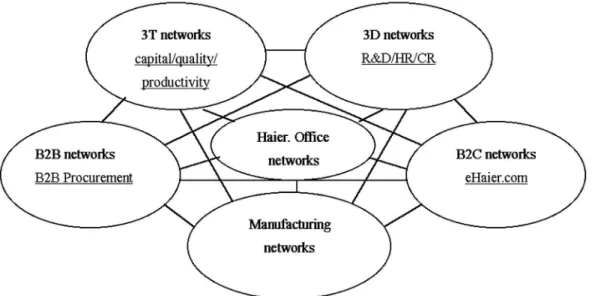
3) ICT Networks as E-business System Haier has established sophisticated ICT networks
based on ERP (See Figure 4). According to their busi- ness functions within and outside of the enterprise, at least three categories of ICT networks can be iden- tified; i.e. B2B networks, B2C networks and Intranet networks. The structure and operation procedures of Haier’s B2B and B2C have been discussed by Liu (2001). The Intranet is an integrated system of differ- Figure 2. Internationalized operation systems of Haier
Figure 3. The topological illustration of worldwide ICT networks of Haier
ent functional networks, including manufacturing management networks, 3T networks, 3R networks, and office automation (OA) system (see previous discussion for the meanings of 3T and 3R), which plays the role of enterprise communication, coordi- nation, and control. All the functional networks are connected with each other while converging on the whole system. Different networks are simultaneous- ly responsible for handling the information flow of orders from the worldwide market.
5. Impacts of the Adoption of New ICTs on Haier’s Internationalization
1) A Brief Introduction to Haier’s Internationalization
After the two strategic stages of OBM and diversi- fied development in the period from 1984 to 1998, Haier developed its new strategy of internationaliza- tion in 1999. By 2002, Haier has established an international business framework with networks of competitive trading, design, production, distribution and after-market services. It now operates eighteen
design institutes, ten industrial complexes (one in South Carolina, USA; one in Pakistan; in China, five in Qingdao, one in Hefei, one in Dalian, and one in Wuhan), fifty factories, fifty-six trade companies, 58,800 sales agents, and 11,976 after-market services centers throughout the world. Overseas businesses have become an essential part of Haier’s global strat- egy (See Figure 5). Meanwhile, Haier’s products have entered twelve of the fifteen European top supermarket chains as well as eight of the ten American top ones, using localized design, produc- tion, and sales in the United States and some European countries. With the development of its internationalization strategy, Haier has attracted a few TNCs, like Sanyo (Japan) and Emerson (USA), to set up specific component supply branches in Qingdao. On March 4, 2002, Haier officially opened American headquarters in New York, which is locat- ed at the landmark neo-classical bank building on Broadway in Manhattan. This new regional head- quarter indicates that Haier has moved into a new stage to globalize its product design, manufacturing and sales, with a strong wish of long-term develop- ment in the United States.
Figure 4. Functional divisions and connections of Haier ICT networks
2) The Adoption of New ICTs in Haier’s International Businesses
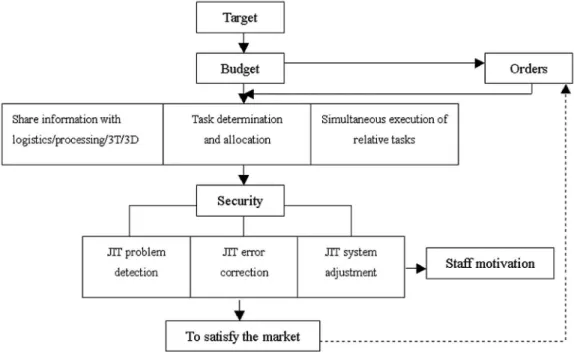
The internationalization strategy of Haier was accompanied by BPR, which was initiated in 1998 and aimed to integrate the market chains. The estab- lishment of overseas promotion headquarters is a result of BPR. These newly established headquarters are responsible for deriving overseas orders and ensuring the satisfaction of orders. The adoption of new ICTs is the premise of Haier’s overseas busi- nesses, while the rapid increase of overseas orders makes the adoption of new ICTs necessary. The process of obtaining and satisfying overseas orders based on new ICT tools is illustrated in Figure 6.
3) New ICT Adoption and Internationalization:
the case of Haier’s R&D
Cantwell and Santangelo (2000) find some evi- dences of a convergence in corporate technological diversification across large firms, facilitated by the common use of new ICTs as an integrator of former- ly separate technological systems. This has enabled small firms to diversify, and large firms to consoli-
date activities around those technologies that have become extremely interrelated. Much literature is now available on the internationalization of Harier with regard to its global marketing, manufacturing, and even global purchasing (Jiang, Zhang, and Shao, 2002; Sun, 2002; Gao, 2003). The importance of ICT adoption in Haier’s global expansion is also dis- cussed by Marlom (2002). Nonetheless, little is known about the interactions of ICT adoption and global R&D activities of Haier. Going global as an enterprise in a developing country, Haier chose to internationalize its R&D activities instead of obtain- ing advanced technologies and management meth- ods from the outside world. The technologies intro- duced from Germany and Japan and the establish- ment of international standard quality identification systems like ISO 9000 in the early days, laid the foundation for Haier to export its products to the US and European countries. Since 1994, Haier has been making great efforts in developing its worldwide R&D networks, which plays an important role in boosting the internationalization of its businesses. By the late 1990s, Haier had established an immense global R&D network based on new ICTs, including Figure 5. Domestic and overseas business units of Haier, 2002
Haier Central Research Institute (in Qingdao), six international design centers (Los Angeles, Amsterdam, Tokyo, Lyons, Montreal, and Silicon Valley), ten international information centers (Hong Kong, New York, Seoul, Sydney, Los Angeles, Amsterdam, Tokyo, Lyons, Taipei, and Montreal), and dozens of technological alliances with world big
names such as Microsoft, Philips, Martz, Panasonic, and Mitsubishi . To some extent, the global competi- tiveness of Haier is mainly supported by its exuber- ant global R&D networks (See Figure 7).
Haier manages to integrate its worldwide design and information centers and other R&D resources via the Intranet and Internet to achieve paralleled Figure 6. Overseas order obtaining & satisfying processes of Haier supported by new ICTs
Figure 7. Haier’s global R&D system
design (Figure 8a). As an important step of world- wide R&D integration, in 1999, Haier developed the PDM (product database management) software run- ning via special R&D networks for synthesizing CAD, CAE and CAM, and established a C3P center to manage it. PDM consists of four subsystems, i.e.
program management, document management, net- work management, and data retrieving. The system now operates well, as demonstrated by Haier Mould Co. Ltd., and is introduced to other divisions of Haier (Jiang, Zhang and Shao, 2002). Besides the par- alleled design activities, Haier has also tried global 24-hour/day successive designs. A case is the 24- hour/day successive design of blue-tooth technolo- gy for network household appliances in Haier’s design center in Qingdao and Ericsson’s R&D center in Sweden. Design staffs of Haier in Qingdao do their research at daytime and send the daily results via the Internet to Ericsson staffs before 9:00 PM (Beijing Time) so that the latter can continue research at Beijing nighttime. Ericsson staffs pass back their results at the end of their working day so as to con- tinue research by Haier’s staff in Qingdao. The research program is therefore accelerated and fin- ished in only two months. The global 24-hour/day
successive R&D model is also being successfully adopted in the development of IC technology between Haier’s staffs in Qingdao and Silicon Valley (Figure 8b).
4) Efficiencies and Effects of ICT Adotion
With the adoption of BPR, Haier has developed a global value chain through its networks of R&D, manufacturing, marketing, and after-market ser- vices. International businesses have contributed a lot to the growth of Haier and the internationalization process of Haier is so far successful (Table 2). The adoption of new ICTs, which includes both ICT infrastructures (hardware) and management solu- tions (software) for BPR, contributes very much to the internationalized development of Haier. The effi- ciencies and effects of Haier’s adoption of new ICTs can be seen from the comparison of enterprise per- formances before and after BPR (See Table 2).
6. Concluding Remarks
Haier’s adoption of new ICTs and its internation- alization process show that: (1) the adoption of new Figure 8. Two time-spatial models of Haier global R&D
Task Result
(a) Parallel design model (b) Succession design model:
ICTs that provides ICT infrastructures and manage- ment solutions has facilitated Haier’s BPR, and BPR makes it possible for Haier to expand internationally through lowering the cost of logistics, manufactur- ing, and marketing via interconnected B2B, B2C, and Intranet networks; (2) the development of Haier’s ICT networks not only innovates the ways of materi- als purchasing and products marketing, but also becomes the major channels of the enterprise’s brand and cultural marketing, which again makes the international process much easier and more powerful; (3) the adoption of new ICTs is of extremely importance for information and technolo- gy intensive enterprises like Haier, and the world- wide sprawling R&D networks linking information- intensive centers of the developed countries is the basis of Haier’s internationalization.
At the same time, we should not over-estimate the first-mover advantages from the adoption of new ICTs. The BPR supported by new ICTs not only brings great costs to enterprise operation, but also needs comprehensive innovations of the enterprise itself and favorable local milieu as well. The experi- ences of Haier can be understood only with concur-
rent studies of its special trajectories and innovative milieu, which help Haier become an internationally recognized enterprise even before its intensive adop- tion of new ICTs. Due to the lack of sufficient field- work, in this paper, we could not figure out the exact contribution of ICT adoption to the international expansion of Hiaer. Further fieldwork and more complete evaluation models are needed for future researches.
References
Cantwell, J. and Santangelo, G. D., 2000, Capitalism, profits and innovation in the new techno- economic paradigm, Journal of Evolutionary Economics, 10(1-2), 131-157.
Dunning, J. H. and Lundan, S. M., 1998, The geo- graphical sources of competitiveness of multinational enterprises: an econometric analysis, International Business Review, 7(2), 115-133.
Dunning, J. H., 1993, Multinational Enterprises and the Global Economy, Addison-Wesley Publishers Table 2. Comparison of Haier’s performances before and after BPR
Before BPR After BPR Improvement
Market responsiveness:
(1) Delivery time of refrigerators 9.5 days 6.5 days -31%
(2) Average delivery time of all products 36 days 10 days -72%
Logistics integration:
(3) Amount of Suppliers 2336 840 -10%1
(4) Percentage of international suppliers <50% >70% >20%
(5) Supplying punctuality 95% 99% 4%
International market expansion:
(6) Export growth US$ 280million(2000) US$ 420million(2001) 175%
(7) Overseas sales agents NA 38000 --
Capital turnover:
(8) Cash turnover period(days) NA NA -84%
(9) Row materials turnover period(days) 32 12 -63%
Direct benefit from BPR: NA US$415 million --
1: -10% refers to annual purchasing cost reduction.
* Source: Haier group statistics, 2002.
Before BPR After BPR Improvement
Ltd., Rockingham, UK.
Egidi, M. and Narduzzo, A., 1997, The emergence of path-dependent behaviors in cooperative contexts, The International Journal of Industrial Organization, 15(6), 677-709.
Gao, Z., 2003, New Models of Haier Logistics Innovation, China Modern Economy Publishing House, Beijing. (in Chinese).
Gourevitch, P., Bohn, R. and Mckendrick, D., 2000, Globalization of production: insights from the hard disk drive industry, World Development, 28(2), 301-317.
Howells, J. and Wood, M., 1993, The Globalization of Production and Technology, Belhaven Press, London/New York.
Jiang, Q., Zhang, R. and Shao, N., 2002, Market Chain and ICTs Adoption of Haier, China Economy Publishing House, Beijing. (in Chinese).
Liu, H. and Li. K., 2002, Strategic Implications of Emerging Chinese Multinationals: The Haier Case Study, Elsevier Science Ltd.
Liu, W., 2002, Firms’ spatial organization under new information & communication technologies:
a case study of Haier, Paper presented to the Annual Residential Conference of The IGU Commission on the Dynamics of Economic Spaces, Johannesburg, South Africa.
Marlom, J., 2002, Business way of Jeck Welch and Ruimin Zhang, Translated by Mu, Q., China Workers Press, Beijing.
Montgomery, C. A. and Hariharan, S., 1991, Diversified expansion by large established firms, Journal of Economic Behavior and
Organization, 15(1), 71-89.
Mueller, D. C., 1997, First-mover advantages and path dependence, International Journal of Industrial Organization, 15(6), 827-850.
Nelson, R. R. and Winter, S. G., 1982, An Evolutionary Theory of Economic Change, Harvard University Press, Cambridge.
Nolan, P. and Zhang, J., 2002, Challenge of global- ization for large chinese firms, World Development, 30(12): 2089-2107.
Patel, P. and Pavitt K. L. R., 1997, The technological competencies of the world’s largest firms:
complex and path-dependent but not much variety, Research Policy, 26(2), 141-156.
Pearce, R. D., 1983, The Growth and Evolution of Multinational Enterprise, Edward Elgar, Aldershot, UK.
Piscitello, L., 2000, Relatedness and coherence in technological and product diversification of the world’s largest firms, Structural Change and Economic Dynamics, 11(3), 295 - 315.
Sun, J., 2002, The Corporation Strategy of Haier, Enterprise Management Press, Beijing. (in Chinese).
Zander, I., 1998, The evolution of technological capa- bilities in the multinational corporation-dis- persion, duplication and potential advan- tages from multinationality, Research Policy, 27(1), 17-35.
Received April 10, 2003 Accepted June 19, 2003
Trajectory of global expansion and ICT adoption of Haier
Year Period ICTs Adoption Domestic Expansion International Expansion
1984
1985
1988
1991
1992
1994
1995
1996
1997
1998
Strategy:
OBM Management:
TQM to OEC1 Spatial perspective:
Local development
Strategy:
Diversified development Management:
External take- over Spatial perspective:
Domestic expansion and international initiative
NA
NA
NA
NA
Internal information center
NA
NA
Corporate Website
Call center
Website upgrading;
Establishment of Intranet;
Internal services &
management system;
Reengineering of AC dept. (ERP)
Establishment of Qingdao Refrigerator Plant
NA
Take-over of Qingdao Electroplating Plant
Establishment of Qindao-Haier Group;
Take-over of Qingdao AC plant & Ice- Box Plant
Take-over of Qingdao Condenser Plant;
Renamed as Haier Group
NA
Establishment of Haier Industrial Park;
Take-over of Red Star Electrical Appliance Plant;
Purchase of Wuhan Refrigerator Plant;
Establishment a Trade Company in Hong Kong
NA
Shunde Haier Electrical Appliance Co.
Ltd.;
Take-over of Qingdao 3rd Pharmaceutical Plant;
Laiyang Haier Electrical Appliance Co.
Ltd.;
Hefei Haier Electrical Appliance Co.
Ltd.
Haier (Pingdu) Refrigerator Export Base Take-over of Zhangqiu Electrical Machinery Plant;
Joint R&D Center with CAS;
Haier Digital Technology Development Co. Ltd.;
Joint Software Co. Ltd. with Beijing Aerospace Univ.
Haier IT Industrial Park in Qingdao;
Haier Central Research Institute
NA
German Liebherr refrigerator technology introduction
NA
Refrigerator technology alliance with Mitsubishi Heavy Industry;
Registered trademark in United Arab Emirates (UAE)
NA
Established international design institute with GD in Tokyo
Hong Kong (Marketing);
Export to US market through OEM
Haier Sah-Polo (Indonesia) Co. Ltd (Manufacturing)
Haier-LKG (Philippines) Co. Ltd. in Philippines
Haier (Asean) Co. Ltd. in Malaysia Haier-Yugoslavia Industrial Alliance Air- conditioner Joint-ventures in Belgrade, Yugoslavia
Strategic Alliance with Philips(R&D);
Haier Silicon Valley Design Center in US (R&D)
Appendix:
Continued
Year Period ICTs Adoption Domestic Expansion International Expansion 1999
2000
2001
2002
Strategy:
Internationalization
Management:
Market-chain- guided Business Process Reengineering (BPR);
Spatial perspective:
To Establish global networks
Internal information infrastructure development;
Reengineering of business flow through Enterprise Resource Planning, ERP)
Total EC solution;
B2B and B2C CRM open BBP open Overseas order management system
Integration of different networks;
Third party logistics information system;
Order execution HQ
C3P Joint Lab with Shanghai Transport Univ.;
New Industrial Park in Qingdao Development Zone
Haier E-commerce Co. Ltd.
Qingdao Haier IT Park Haier International Logistics Center;
Haier (Dalian) Industrial Park;
Expansion of Haier (Qingdao) Information Research Park;
Introduction of international suppliers such as Emerson and Sanyo to Qingdao;
Cooperation with Lucent (on GSM mobile phone);
Cooperation with Microsoft (Venus Plan);
Haier (US) Trade Company New York, US Haier (US) Industrial Park South Carolina, US;
Cooperation with Toshiba (on AC manufacturing)
Haier Middle East branches in Iran and UAE Industrial Park South Carolina, US;
NA
Haier (Pakistan) Industrial Park in Pakistan Cooperation with Ericsson (network appliances);
Haier (Milano) Marketing Center in Italy Haier (Lyon) Design Center in France Haier (Amsterdam) Design Center in The Netherlands
Take-over of a refrigerator plant in Padua, Italy Haier Regional HQ (America) in New York, US
Sanyo establish a branch in Haier (Huangdao) industrial park
Emerson a branch in Haier (Jiaozhou) industrial park
Source: Haier group, 2002.
1: overall; every day, everything; every one; clean, control.