The incidence of total knee arthroplasty (TKA) and revi- sion TKA for treatment failure has been increasing. Infec- tion is one of the most common complications requiring revision after TKA.1) A recent epidemiologic study re-
ported that the incidence and prevalence of periprosthetic joint infection may be increasing over time in the United States.2) The incidence of infection was reported to be 1%–2% in primary TKA and 4%–8% in revision TKA.3)
In patients with a suspected infection, there are cas- es without culture of pathogens despite definite symptoms or signs of infection. Moreover, there are cases in which the culture of pathogens from the specimen during the operation is positive whereas no pathogen was cultured before the operation. Therefore, diagnosis of infection and identification of the pathogens are very important for
Safety of Temporary Use of Recycled Autoclaved Femoral Components in Infected Total Knee
Arthroplasty: Confirming Sterility Using a Sonication Method
Hyung-Jin Park, MD*
,†, Hee-June Kim, MD*
,†, Shukho Kim, PhD
‡, Seong-Min Kim, MD*
,†, Jong-Uk Mun, MD
§, Jungmin Kim, MD
‡, Hee-Soo Kyung, MD*
,†*Department of Orthopaedic Surgery, School of Medicine, Kyungpook National University, Daegu, South Korea,
†Department of Orthopaedic Surgery, Kyungpook National University Hospital, Daegu, South Korea,
‡Department of Microbiology, School of Medicine, Kyungpook National University, Daegu, South Korea,
§Department of Orthopaedic Surgery, Gyeongsang National University Changwon Hospital, Changwon, South Korea
Background: The purpose of this study was to evaluate the usefulness of sonication technique for microbiological diagnosis and the sterility of the recycled autoclaved femoral components from infected total knee arthroplasty (TKA) using a sonication method.
Methods: Nineteen femoral implants explanted from patients with infected TKA were sterilized with a standard autoclave method. Standard culture of the fluid before and after sonication of the sterilized implants was performed to detect pathogenic microorganisms. Additional experiments were performed to evaluate the sterility of the recycled implant by inducing artificial bio- film formation. Methicillin-resistant Staphylococcus aureus (MRSA) was inoculated into 10 implants and sterilization in a standard autoclave was performed, and then the fluid was cultured before and after sonication.
Results: Two of the 19 sterilized implants were positive for growth of bacteria after sonication, whereas no growth was detected in the cultured fluid from the sterilized implants before sonication. The bacteria were Staphylococcus species in all two cases. In one of 10 implants inoculated with MRSA, the culture was positive for growth of bacteria both before and after sonication. How- ever, Staphylococcus epidermidis was cultured from both occasions and thus this implant was thought to be contaminated.
Conclusions: We found sonication for identification of pathogens could be helpful, but this finding should be interpreted carefully because of the possibility of contamination. Sterilization of an infected femoral implant with an autoclave method could be a good method for using the temporary articulating antibiotic spacer in two-stage revision arthroplasty.
Keywords: Infection, Total knee arthroplasty, Sonication, Periprosthetic joint infection
Copyright © 2018 by The Korean Orthopaedic Association
This is an Open Access article distributed under the terms of the Creative Commons Attribution Non-Commercial License (http://creativecommons.org/licenses/by-nc/4.0) which permits unrestricted non-commercial use, distribution, and reproduction in any medium, provided the original work is properly cited.
Clinics in Orthopedic Surgery • pISSN 2005-291X eISSN 2005-4408 Received June 15, 2018; Accepted September 6, 2018
Correspondence to: Hee-Soo Kyung, MD
Department of Orthopaedic Surgery, Kyungpook National University Hospital, 130 Dongdeok-ro, Jung-gu, Daegu 41944, Korea
Tel: +82-53-200-5636, Fax: +82-53-422-6605 E-mail: [email protected]
treatment.
The appropriate antibiotic therapy must be initiated until second-stage revision arthroplasty. Therefore, iden- tification of the pathogens is important for the treatment of infection. Chronic periprosthetic infections are related to tolerance to the antibiotics and defense mechanisms of the host and biofilm formation. In particular, Staphylococ- cus aureus, which is one of the most common pathogens of postoperative infection,4) can attach to the surface of implants and form a biofilm that may not be identified by traditional microbiological techniques.5) The identification of pathogens and appropriate treatment are difficult in this situation.
Therefore, many methods for the identification of pathogens have been attempted. Most surgeons use a cul- ture of the periprosthetic tissue from infected implants for the identification of the pathogen. Peel et al.6) reported a sensitivity of 92% after 1 day with periprosthetic tissues using a blood culture bottle. Recently, sonication of infect- ed implants to remove the biofilm followed by culture has been shown to be a more sensitive and accurate method for the identification of pathogens by several studies.7-9)
In cases of chronic infection after TKA, a two-stage revision arthroplasty has been recommended as a treat- ment. In the first stage of revision arthroplasty, culture of the pathogenic bacteria using the removed implant and periprosthetic tissue is necessary for the identification of the pathogen. An articulating spacer molded by antibiotic- mixed bone cement is used,10,11) or the autoclaved femoral component removed from the patients is reused in this stage. These methods are both widely used and good clinical results have been reported by several authors.12-14) Therefore, the sterility of recycled femoral components is important for successful operation. Lyons et al.14) reported on the sterility of the autoclaved implant and found the autoclaved femoral component could reduce the biofilm burden significantly.
We hypothesized that the reuse of an autoclaved femoral implant from an infected TKA would be safe mi- crobiologically and evaluated the results of culture from a sterilized implant using the autoclave method for patients with an infected TKA before and after sonication. The purpose of this study was to evaluate the usefulness of sonication technique for microbiological diagnosis and the sterility of the recycled autoclaved femoral components from TKA using a sonication method.
METHODS
Experiments to Evaluate the Usefulness of Sonication Technique for Microbiological Diagnosis
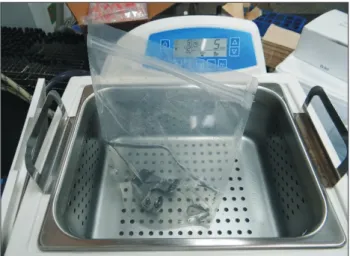
Nineteen infected femoral implants without identified pathogens were prepared. Sterilization of the implants with an autoclave sterilizer (Tomy SX-700; Seiko, Tokyo, Japan) was performed at 121°C for 20 minutes after re- moval of periprosthetic tissues and cleansing were per- formed. The implants were then aseptically transferred into a stomacher bag (20 × 30 cm; BNF Korea, Gimpo, Korea). Four hundred milliliters of sterile saline was added to the stomacher bag with the implant in a laminar airflow biosafety cabinet, and then the stomacher was vortexed for 30 seconds (Fig. 1). Thirty milliliters of sterile saline was taken from the stomacher bag and centrifuged at 6,000 rpm for 5 minutes. All but 1 ml of the supernatant was decanted. The centrifuge tube was vortexed until the precipitate was resuspended completely and 100 µL each was spread onto four different selective agar plates: mac- Conkey agar plate (MAC) for Gram-negative organism, sheep blood agar plate (BAP) for fastidious organism and detecting hemolytic activity, chocolate agar plate (CAP) for fastidious respiratory bacteria, and Centers for Disease Control and Prevention (CDC)-BAP for anaerobes. BAP, CAP, and MAC were incubated aerobically at 37°C for 4 days and CDC was incubated anaerobically at 37°C for 7 days. Bacterial colonies on the agar media were observed phenotypically and identified using an API biochemical kit (Biomerieux, Marcy-l'Etoile, France). A culture was considered positive if one colony per plate (1 colony form-
Fig. 1. The implants were aseptically transferred into a stomacher bag and 400 mL of sterile saline was added to the stomacher bag.
ing unit [CFU]/plate) was counted.
The stomacher bag with the 400 mL of saline and implant was subjected to sonication (Branson 3510; Bran- son Ultrasonic, Danbury, CT, USA) for 5 minutes (40 kHz, 185 W) and vortexed for 30 seconds (Fig. 2). The same process for culture was then repeated as described above.
Confirmation of Safety Using the Femoral Implant with Methicillin-Resistant Staphylococcus aureus Inoculation
The previous pathogens before autoclave sterilization were unknown in the previous experiment. Therefore, an ad- ditional experiment was performed using the implant with direct inoculation of methicillin-resistant Staphylococcus aureus (MRSA).
A total of 10 implants were sterilized with an auto- clave (Tomy SX-700, Seiko) for 20 minutes at 121°C. The pathogen, MRSA (strain NCTC10442), was incubated in brain heart infusion medium. Four hundred microliters were inoculated into the stomacher bag with 400 mL of
sterile saline and the sterilized implant. The infected im- plant was incubated aerobically at 37°C for 3 days. After that, cultures after sonication were performed as described above. MAC, BAP, CAP, and mannitol salt agar were used for culture media. A culture was considered positive if one colony per plate (1 CFU/plate) was counted.
RESULTS
In the first experiment, no implant showed a positive bacterial culture before sonication; however, two implants showed positive bacterial cultures after sonication (Table 1). Three colonies were cultured from each implant. Two colonies on BAP and one colony on CDC were in one implant and two colonies on CAP and one colony on BAP were in the other implant. Biochemical identification us- ing an API staph kit was performed. One implant had two colonies of Staphylococcus hominis and one colony of Staphylococcus capitis. The other implant had three colo- nies of Staphylococcus species. (Table 2).
In the additional experiment with MRSA inocula- tion of 10 sterilized implants, one implant showed positive bacterial culture in BAP before sonication and another implant showed positive bacterial culture in BAP after sonication. Staphylococcus epidermidis was identified from both implants (Table 3). MRSA used for direct inoculation was not cultured in this experiment. The cultured patho- gen was intended to represent contamination during the process of sonication.
Table 2. Biochemical Identification Results of the Cultured Bacteria from the Implants
Variable No. of colonies on solid media plates Identified microorganism No. of colonies
Cultured implant #1 2 On BAP Staphylococcus hominis 2
1 On CDC-BAP Staphylococcus capitis 1
Cultured implant #2 1 On BAP Staphylococcus lugdunensis 3
2 On CAP Staphylococcus hominis
Staphylococcus saprophyticus BAP: blood agar plate, CDC: Centers for Disease Control and Prevention, CAP: chocolate agar plate.
Fig. 2. The stomacher bag with 400 mL of saline and implant was sub- jected to sonication.
Table 1. Results of Bacterial Culture of the Implants before and after Sonication
Variable Before sonication After sonication Culture (+) Culture (–) Culture (+) Culture (–)
No. of implants 0 19 2 17
DISCUSSION
In this study, the first experiment showed the higher rate of detection of bacterial cultures for sonication and the incompleteness of sterilization of the autoclaved prosthe- sis. However, in the experiment using directly inoculated implants, the cultured pathogens were not those we inocu- lated, indicating contamination. Therefore, in the first ex- periment, the possibility of contamination with pathogens after autoclaving should not be entirely excluded as well as the possibility of survival of pathogens.
The difficulty in treatment of infected TKA is re- lated to resistance to antibiotics, host defense mechanisms, and biofilm formation.5) Biofilm formation is initiated with adherence of bacteria to the implant.15) Biofilms consist of microorganisms enveloped by macromolecules of glycocalyx and other protective films.16) The chemical bonding of bacterial extracapsular structures to the surface of implants can result in microbial adhesion. Bacteria with biofilm formation cannot be cultured due to adhesion to the implant,17) and treatment with traditional concentra- tions of antibiotics is ineffective for eradication of the bio- film population.18-20)
Therefore, biofilm detachment from the implant us- ing sonication and culture of the fluid could increase the sensitivity of diagnosis.8) Tunney et al.21) and Trampuz et al.8) reported that the accuracy of diagnosis was improved by sonication and appropriate antibiotic therapy was pos- sible for infected TKA. The sensitivity of culture for an infected TKA is decreased when antibiotics therapy is initiated before removal of the implant.8) Many surgeons start antibiotic therapy before surgery for implant removal, and in these cases, sonication could be useful to detect the pathogens. In the first experiment, the bacteria were cultured after sonication from the autoclave-sterilized im- plants whereas no growth was obtained before sonication.
This showed the higher efficacy of sonication for identifi- cation of pathogens.
Contamination during the process of experiment is possible. Trampuz et al.22) reported that sonication had
a lower sensitivity because of leakage from the bag de- spite its high specificity. In this study, coagulase-negative Staphylococci were cultured in the first experiment. This is one of the most common pathogens of periprosthetic in- fection,23,24) and therefore this could be supposed to be the pathogen for TKA infection rather than the result of con- tamination. However, implants subjected to autoclave ster- ilization twice were used in the additional experiment us- ing inoculation of MRSA. The inoculated MRSA was not cultured in the implants, but S. epidermidis was cultured, indicating the possibility of contamination. Therefore, it is difficult to rule out the possibility of contamination with the cultured bacteria in the first experiment although the possibility of them being the real pathogens also exists.
The protocol of sonication should also be consid- ered. Various sonication methods were used in several previous studies and the results of culture could be af- fected by the different sonication methods. Some studies reported time and temperature during sonication could affect the culture results.25) Monsen et el.25) reported a soni- cation method used at 22°C for 7 minutes (40 kHz, 350 W) and another method at room temperature for 5 minutes (40 kHz, 185 W) could affect the results of the culture.
Therefore, multiple factors that could influence the culture results should be evaluated.
Two-stage revision arthroplasty is mostly used for patients with a periprosthetic joint infection. In the first- stage of the revision arthroplasty, reuse of the sterilized explanted femoral implant for the articulating spacer can reduce the cost and the inflammatory reaction by the cement particles on the friction surface when using the cement-cement molded spacer. However, Lyons et al.14) reported the autoclave could not thoroughly eradicate biofilms on the surface of the implant, although the bio- film burden could be reduced significantly. In the current study, the first experiment showed autoclave sterilization could not eradicate all bacteria of the infected implant.
However, the possibility of contamination during the pro- cess should not be excluded. Moreover, we could not de- termine whether the positive culture results (1 CFU/plate) Table 3. Results of the Experiments with Bacterial Inoculation into Sterilized Implants
Variable Before sonication After sonication
Culture (+) Culture (–) Culture (+) Culture (–)
No. of implants with MRSA 1 9 1 9
Identified microorganism Staphylococcus epidermidis Staphylococcus epidermidis MRSA: methicillin-resistant Staphylococcus aureus.
in this study were clinically meaningful. Satisfactory clini- cal results, based on reports by several authors, could be obtained using weakness of bacteria by autoclaving and a combination of antibiotics-mixed bone cement along with intravenous antibiotics therapy.13,26,27) Therefore, reusing the autoclaved implant could be an effective method for using the temporary articulating spacer if the concomitant antibiotic treatment for the infection should be combined thoroughly.
There are limitations of this study. Only bacterial cultures were performed; other pathogens, including vi- ruses and fungi, could remain after autoclave sterilization.
Additional studies detecting other pathogens should be performed. The possibility of contamination of the stom- acher bag during the process of experiment could not be excluded. The protocol of sonication should also have been considered. In this study, sonication (40 kHz, 185 W) performed at room temperature for 5 minutes was differ- ent from that in other studies and could have affected the results of the culture. Moreover, three days of incubation with MRSA could have been an insufficient time for bio- film formation. However, Lyons et al.14) confirmed biofilm formation after only 1 day, and therefore we presumed 3 days would be sufficient. finally, one colony per plate was defined as a positive culture in this study, but it is not
clear whether this definition has any clinical significance.
Several studies have used variable criteria for positive cul- ture results: Scorzolini et al.7) used 5 CFU/mL in a 0.5 mL inoculation; Trampuz et al.8) used 5 CFU/plate in a 0.5 mL inoculation; and Zalavras28) used 20 CFU/mL. Definite criteria have not been established. Therefore, these criteria should also be evaluated in further studies. Finally, preop- erative culture of the femoral component was not evalu- ated in this study; therefore, we could not know whether the cultured bacteria after sonication of the autoclaved femoral component were the pathogens that caused peri- prosthetic joint infection.
In this study, sonication for identification of patho- gens could be helpful showing a higher detection rate of pathogens; however, this should be interpreted carefully because of the possibility of contamination. In addition, sterilization of an infected femoral implant with an auto- clave method could be a good method for using the tem- porary articulating antibiotic spacer in two-stage revision arthroplasty.
CONFLICT OF INTEREST
No potential conflict of interest relevant to this article was reported.
REFERENCES
1. Bozic KJ, Kurtz SM, Lau E, et al. The epidemiology of revi- sion total knee arthroplasty in the United States. Clin Or- thop Relat Res. 2010;468(1):45-51.
2. Kurtz SM, Lau E, Schmier J, Ong KL, Zhao K, Parvizi J. In- fection burden for hip and knee arthroplasty in the United States. J Arthroplasty. 2008;23(7):984-91.
3. Kyung HS, Mun JU. Treatment of infections after total knee arthroplasty. J Korean Orthop Assoc. 2010;45(5):335-41.
4. Lora-Tamayo J, Murillo O, Iribarren JA, et al. A large mul- ticenter study of methicillin-susceptible and methicillin- resistant Staphylococcus aureus prosthetic joint infec- tions managed with implant retention. Clin Infect Dis.
2013;56(2):182-94.
5. Stewart PS. Mechanisms of antibiotic resistance in bacterial biofilms. Int J Med Microbiol. 2002;292(2):107-13.
6. Peel TN, Dylla BL, Hughes JG, et al. Improved diagnosis of prosthetic joint infection by culturing periprosthetic tissue specimens in blood culture bottles. MBio. 2016;7(1):e01776- 15.
7. Scorzolini L, Lichtner M, Iannetta M, et al. Sonication
technique improves microbiological diagnosis in patients treated with antibiotics before surgery for prosthetic joint infections. New Microbiol. 2014;37(3):321-8.
8. Trampuz A, Piper KE, Jacobson MJ, et al. Sonication of re- moved hip and knee prostheses for diagnosis of infection. N Engl J Med. 2007;357(7):654-63.
9. Mariconda M, Ascione T, Balato G, et al. Sonication of antibiotic-loaded cement spacers in a two-stage revision protocol for infected joint arthroplasty. BMC Musculoskelet Disord. 2013;14:193.
10. Shaikh AA, Ha CW, Park YG, Park YB. Two-stage approach to primary TKA in infected arthritic knees using intraop- eratively molded articulating cement spacers. Clin Orthop Relat Res. 2014;472(7):2201-7.
11. Ha CW. A technique for intraoperative construction of anti- biotic spacers. Clin Orthop Relat Res. 2006;445:204-9.
12. Hofmann AA, Kane KR, Tkach TK, Plaster RL, Camargo MP. Treatment of infected total knee arthroplasty using an articulating spacer. Clin Orthop Relat Res. 1995;(321):45- 54.
13. Kim SH, Han HS, Kim DH, Kang SB. Two-stage reimplan- tation in infected total knee arthroplasty (a method of rein- sertion of the autoclaved femoral component and a polyeth- ylene liner). J Korean Knee Soc. 2010;22(2):110-6.
14. Lyons ST, Wright CA, Krute CN, Rivera FE, Carroll RK, Shaw LN. Confirming sterility of an autoclaved infected femoral component for use in an articulated antibiotic knee spacer: a pilot study. J Arthroplasty. 2016;31(1):245-9.
15. Gristina AG, Naylor PT, Myrvik QN. Mechanisms of mus- culoskeletal sepsis. Orthop Clin North Am. 1991;22(3):363- 71.
16. Akiyama H, Hamada T, Huh WK, et al. Confocal laser scan- ning microscopic observation of glycocalyx production by Staphylococcus aureus in skin lesions of bullous impetigo, atopic dermatitis and pemphigus foliaceus. Br J Dermatol.
2003;148(3):526-32.
17. Gristina AG, Costerton JW. Bacterial adherence to biomate- rials and tissue: the significance of its role in clinical sepsis. J Bone Joint Surg Am. 1985;67(2):264-73.
18. Costerton JW, Lewandowski Z, Caldwell DE, Korber DR, Lappin-Scott HM. Microbial biofilms. Annu Rev Microbiol.
1995;49:711-45.
19. Ceri H, Olson ME, Stremick C, Read RR, Morck D, Buret A. The Calgary Biofilm Device: new technology for rapid determination of antibiotic susceptibilities of bacterial bio- films. J Clin Microbiol. 1999;37(6):1771-6.
20. Olson ME, Ceri H, Morck DW, Buret AG, Read RR. Biofilm bacteria: formation and comparative susceptibility to antibi- otics. Can J Vet Res. 2002;66(2):86-92.
21. Tunney MM, Patrick S, Gorman SP, et al. Improved detec-
tion of infection in hip replacements: a currently underesti- mated problem. J Bone Joint Surg Br. 1998;80(4):568-72.
22. Trampuz A, Piper KE, Hanssen AD, et al. Sonication of explanted prosthetic components in bags for diagnosis of prosthetic joint infection is associated with risk of contami- nation. J Clin Microbiol. 2006;44(2):628-31.
23. Song Z, Borgwardt L, Hoiby N, Wu H, Sorensen TS, Borg- wardt A. Prosthesis infections after orthopedic joint replace- ment: the possible role of bacterial biofilms. Orthop Rev (Pavia). 2013;5(2):65-71.
24. Nickinson RS, Board TN, Gambhir AK, Porter ML, Kay PR.
The microbiology of the infected knee arthroplasty. Int Or- thop. 2010;34(4):505-10.
25. Monsen T, Lovgren E, Widerstrom M, Wallinder L. In vitro effect of ultrasound on bacteria and suggested protocol for sonication and diagnosis of prosthetic infections. J Clin Mi- crobiol. 2009;47(8):2496-501.
26. Lee BJ, Kyung HS, Yoon SD. Two-stage revision for infected total knee arthroplasty: based on autoclaving the recycled femoral component and intraoperative molding using anti- biotic-impregnated cement on the tibial side. Clin Orthop Surg. 2015;7(3):310-7.
27. Lee JK, Choi CH. Two-stage reimplantation in infected total knee arthroplasty using a re-sterilized tibial poly- ethylene insert and femoral component. J Arthroplasty.
2012;27(9):1701-6.e1.
28. Zalavras CG. CORR Insights®: sonication of antibiotic spacers predicts failure during two-stage revision for pros- thetic knee and hip infections. Clin Orthop Relat Res.
2014;472(7):2215-6.