OSCC was generally a ‘wait-and-see’ or observation (OBS) policy, unless the neck was being opened for other reasons such as better access to the primary tumor, reconstruction requirements, or delaying neck dissection until cervical me- tastases was clinically evident.
The incidence of occult regional lymph node metastasis of OSCC varies from 6% to 46%, according to previous re- ports1. Once regional metastases have occurred, the 5-year survival rate for patients with oral cancer decreases by one- half relative to that of patients with early-stage disease2,3. In view of the high incidence of nodal recurrence of the ob- served neck, prophylactic neck dissection has been advocated as a routine management protocol of N0 neck4.
The results of the few prospective randomized studies and a retrospective study on the benefit of prophylactic neck treatment have been inconclusive. The studies failed to find statistically significant differences in prognoses between the groups of patients under OBS without initial neck dissection
I. Introduction
The initial management of the neck in early oral squamous cell carcinoma (OSCC) with clinically negative neck nodes (clinical T stage [cT] 1 or 2 and clinical N stage [cN] 0) re- mains a controversy. Before the 1990s, the traditional policy for management of the clinically negative neck in early
In-Ho Cha
Department of Oral and Maxillofacial Surgery, Yonsei University College of Dentistry, 50-1 Yonsei-ro, Seodaemun-gu, Seoul 03722, Korea
TEL: +82-2-2228-3140 FAX: +82-2-2227-7825 E-mail: [email protected]
ORCID: http://orcid.org/0000-0001-8259-2190
*These authors contributed equally to this work as first authors.
This is an open-access article distributed under the terms of the Creative Commons Attribution Non-Commercial License (http://creativecommons.org/licenses/by-nc/4.0/), which permits unrestricted non-commercial use, distribution, and reproduction in any medium, provided the original work is properly cited.
CC
Elective neck dissection versus observation
in early stage oral squamous cell carcinoma: recurrence and survival
Dong Wook Kim1,*, Ba-Da Lee1,*, Jung Hwan Lim1, Jung-Hyun Park2, Woong Nam1, Hyung Jun Kim1, In-Ho Cha1,3
1Department of Oral and Maxillofacial Surgery, Yonsei University College of Dentistry,
2Department of Oral and Maxillofacial Surgery, Ewha Womans University Medical Center,
3Oral Cancer Research Institute, Yonsei University College of Dentistry, Seoul, Korea
Abstract(J Korean Assoc Oral Maxillofac Surg 2016;42:358-364)
Objectives: To evaluate the results of elective neck dissection versus those of observation in the treatment of early stage oral squamous cell carcinoma and to identify factors related to recurrence and survival.
Materials and Methods: This was a retrospective study of 52 patients who underwent elective neck dissection and 27 who did not receive neck dis- section.
Results: In survival analyses, elective neck dissection showed a benefit in overall recurrence (P=0.027), especially in stage I patients (P=0.024). With regard to survival, the benefit was statistically insignificant (P=0.990). In multivariable analysis, overall recurrence was independently related to poor histologic grade (odds ratio [OR]=9.65, P=0.006), and cancer-specific death was independently related to advanced age (OR=6.3, P=0.022), higher clinical T stage (OR=15.2, P=0.01), and poorly differentiated histologic grade (OR=6.6, P=0.025).
Conclusion: Though there was lower recurrence in the elective neck dissection group, there were no statistically significant results on survival. The characteristics of the tumor itself, such as clinical T stage and poor histologic grade, may be more important in cancer-specific survival.
Key words: Oral cancer, Squamous cell carcinoma, Neck dissection, Survival analysis, Survival rate
[paper submitted 2016. 9. 24 / revised 2016. 10. 29 / accepted 2016. 11. 16]
Copyright Ⓒ 2016 The Korean Association of Oral and Maxillofacial Surgeons. All rights reserved.
This research was supported by Basic Science Research Program through the National Research Foundation of Korea (NRF) funded by the Ministry of Education (2009-0094027).
Ethical Review Board of Yonsei University Dental Hospital Institutional Review Board (IRB No. 2-2014-0032). Patients with recurred tumor, second primary tumor, metastatic tu- mor, and patients who underwent salvage surgery were ex- cluded. Patients who had clinically T3 or T4 tumor were also excluded. Patients with positive neck nodes on physical exam or imaging studies, including computed tomography (CT), magnetic resonance imaging, positron emission tomography (PET), PET-CT, and ultrasonography, were excluded. After the selection process, 79 patients were suitable for analysis.
Among them, 52 patients underwent END and 27 patients did not receive neck dissection and underwent OBS only.
Following the policy of most institutions, OBS was ap- plied when there was no evidence of neck node metastasis, and those groups initially managed with neck dissection5-7.
The aim of this study was to retrospectively review and compare the outcomes between patients under OBS and patients who underwent elective neck dissection (END) at initial surgery and to identify factors that affect locoregional control and survival.
II. Materials and Methods
This retrospective study included 215 OSCC patients who underwent surgical treatment at Department of Oral and Maxillofacial Surgery, Yonsei University Dental Hospital (Seoul, Korea) from 1990 to 2012, based on a screening of medical records. This study was approved by the regional
Table 1. Characteristics of the study population
Variable OBS END Total
No. of patients (%) Mean age (yr)
Mean observation period (mo) Sex
Female Male Smoking status1 Nonsmokers Former smokers Current smokers Site
Tongue Floor of mouth Retromolar trigone Mandible alveolar gingiva Lower lip
Buccal cheek cT
cT1 cT2
Histologic grade WD
MD PD
Cancer-specific death Censored data2 Cancer-specific death Type of recurrence No recurrence Local recurrence Regional recurrence Distant recurrence
27 (34.2) 57.2 (27-83) 98.3 (13.5-285.6)
10 (37.0) 17 (63.0) 19 (70.4) 4 (14.8) 4 (14.8) 19 (70.4) 1 (3.7) 1 (3.7) 1 (3.7) 1 (3.7) 4 (14.8) 17 (63.0) 10 (37.0) 10 (37.0) 14 (51.9) 3 (11.1) 24 (88.9) 3 (11.1) 12 (44.4) 9 (33.3) 3 (11.1) 3 (11.1)
52 (65.8) 56.2 (23-86) 81.7 (1.4-216.8)
20 (38.5) 32 (61.5) 30 (57.7) 9 (17.3) 13 (25.0) 27 (51.9) 7 (13.5) 4 (7.7) 5 (9.6) 0 (0.0) 9 (17.3) 20 (38.5) 32 (61.5) 16 (30.8) 28 (53.8) 8 (15.4) 44 (84.6) 8 (15.4) 39 (75.0) 4 (7.7) 3 (5.8) 6 (11.5)
79 (100) 56.5 (23-86) 87.3 (1.4-285.6)
30 (38.0) 49 (62.0) 49 (62.0) 13 (16.5) 17 (21.5) 46 (58.2) 8 (10.1) 5 (6.3) 6 (7.6) 1 (1.3) 13 (16.5) 37 (46.8) 42 (53.2) 26 (32.9) 42 (53.2) 11 (13.9) 68 (86.1) 11 (13.9) 51 (64.6) 13 (16.5) 6 (7.6) 9 (11.4)
(OBS: observation group, END: elective neck dissection group, cT: clinical T stage, WD: well differentiated, MD: moderately differentiated, PD:
poorly differentiated)
1Nonsmokers: those who had never smoked or had smoked <100 cigarettes in their lifetime; Former smokers: those who had smoked in the past but had stopped smoking; Current smokers: those who are smoking currently and had smoked ≥100 cigarettes.
2Censored data refers to those subjects who were alive until the last follow up, plus those whose deaths were not related to oral squamous cell carcinoma or its complications.
Values are presented as number (%) or number (range).
The sum of the percentages does not equal 100% because of rounding.
Dong Wook Kim et al: Elective neck dissection versus observation in early stage oral squamous cell carcinoma: recurrence and survival. J Korean Assoc Oral Maxillofac Surg 2016
tients (78.8%) underwent ipsilateral selective neck dissection (SND). Six patients (11.5%) underwent bilateral SND, and 5 patients (9.6%) underwent modified radical neck dissection.
3. Survival analyses
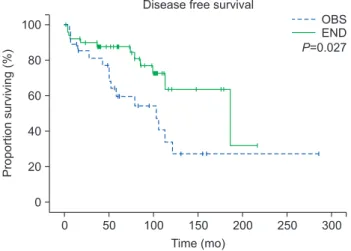
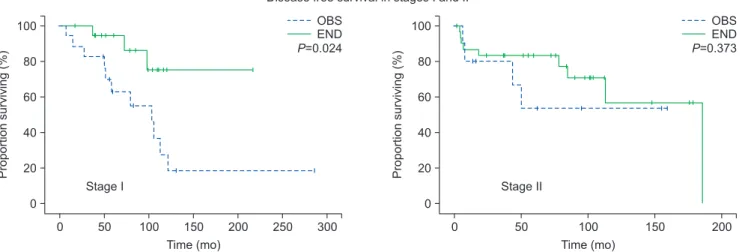
The END group showed a statistically significant benefit in disease-free survival (P=0.027; Fig. 1), especially in stage I patients (P=0.024).(Fig. 2) However, there was no statistical- ly significant difference in regional recurrence-free survival or cancer-specific survival between OBS and END groups.
(Fig. 3, 4)
4. Occult metastasis
Occult cervical nodal metastases were found in 13 cases (13/79, 16.5%), including neck recurrence in 3 cases of the OBS group (3/27, 11.1%) and pathologically positive metas- tases in 10 cases of the END group (10/52, 19.2%). In uni- variable analysis, occult metastasis was related to higher odds of cancer-specific death (odds ratio [OR]=6.25, P<0.01).
5. Factors of overall recurrence
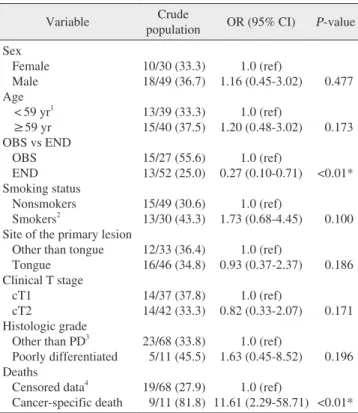
To determine the factors related to overall recurrence, we performed univariable and multivariable analyses. In uni- variable analyses, the END group was correlated with lower overall recurrence (OR=0.27, P=0.006).(Table 2) Cancer-spe- cific death was related to higher odds of overall recurrence and END was applied to patients with suspicion of neck node
metastasis despite negative results.
In the OBS group, occult cervical metastasis was defined as a neck recurrence during follow-up, without failure at the primary site8,9. Cervical metastases in patients with recur- rent primary tumor were not considered occult metastases because the nodal spread may have occurred after the initial treatment8,9. In the END group, occult disease was defined as the presence of microscopic disease on the histopathologic examination of neck dissection specimens8,9.
Survival curves were plotted using the Kaplan-Meier method and compared using the log-rank test. Chi-squared test or Fisher exact test was used for categorical data analysis.
Univariable analyses were performed to find factors affecting recurrence. For multivariable analyses to find independently related factors of recurrence and survival, the Cox propor- tional hazard model was used. Differences were considered significant for P-value <0.05. All statistical analyses were performed with PASW Statistics software version 18.0 (IBM Co., Armonk, NY, USA).
III. Results
1. Characteristics of the study population
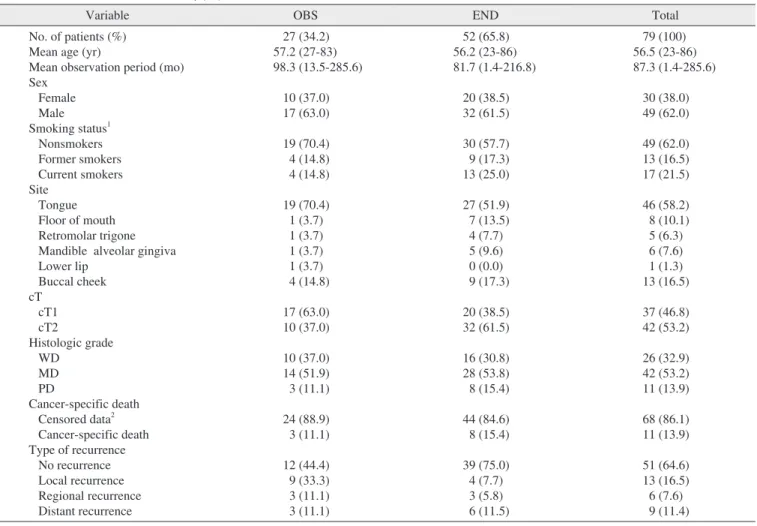
The patients were divided into two groups: OBS (n=27, 34.2%) and END (n=52, 65.8%). The median age of the entire group was 59 years. The OBS period varied from 1.4 months to 285.6 months with a mean of 87.3 months. Re- garding the site of primary lesion, 46 (58.2%) were from tongue, 13 (16.5%) from buccal cheek, 8 (10.1%) from floor of mouth, 6 (7.6%) from mandibular alveolar gingiva, 5 (6.3%) from retromolar trigone, and 1 (1.3%) was from max- illary alveolar gingiva. The stages were cT1 and cT2 in 17 patients (63.0%) and 10 patients (37.0%) in the OBS group, respectively, and 20 patients (38.5%) and 32 patients (61.5%) in the END group. In total, there were 37 patients (46.8%) with cT1 stage and 42 patients (53.2%) with cT2 stage. The characteristics of the study population are shown in Table 1.
2. Characteristics of nodal metastasis
Characteristics of nodal metastasis were investigated in the END group. Forty-two cases (42/52, 80.8%) were patho- logically confirmed as negative for neck node metastasis (pN0). Among the remaining 10 cases (10/52, 19.2%), 8 (15.4%) were pN1, and 2 (3.8%) were pN2. Forty-one pa-
0 50 100 150 200 250
80 60 40 20 0
Proportionsurviving(%)
Time (mo)
300
100 OBS
END P=0.027 Disease free survival
Fig. 1. Disease-free survival. There was a statistically significant difference between observation (OBS) and elective neck dissec- tion (END) groups (P=0.027).
Dong Wook Kim et al: Elective neck dissection versus observation in early stage oral squamous cell carcinoma: recurrence and survival. J Korean Assoc Oral Maxillofac Surg 2016
IV. Discussion
A therapeutic neck dissection is obviously necessary when clinically invaded nodes are present10. The presence of re- gional neck metastases is widely accepted as a major determi- nant of prognosis in patients with OSCC11,12. If the probabil- ity of neck metastases is high, a neck dissection will decrease the risk of regional recurrence. However, if the probability of neck metastases is low, neck dissection constitutes over- treatment, where the morbidity of the neck procedure only decreases quality of life while increasing functional deficits.
(OR=11.61, P<0.01).(Table 2) In multivariable analysis, poor histologic grade was independently related to overall recur- rence (OR=9.65, P<0.01).(Table 3)
6. Factors of cancer-specific death
In a multivariable analysis, advanced age (OR=6.3, P=0.022), higher clinical T stage (OR=15.2, P=0.01), and poorly differentiated histologic grade (OR=6.6, P=0.025) were independently related to cancer-specific death.(Table 4)
0 50 100 150 200 250
80 60 40 20 0
Proportionsurviving(%)
Time (mo)
300
100 OBS
END P=0.024
Disease free survival in stages I and II
0 50 100 150
80 60 40 20 0
Proportionsurviving(%)
Time (mo)
200
100 OBS
END P=0.373
Stage I Stage II
Fig. 2. Disease-free survival in stage I and II patients. In stage I patients, there was a significant difference between observation (OBS) and elective neck dissection (END) groups (stage I, P=0.024; stage II, P=0.373). Statistical analysis by Kaplan-Meier survival estimates and log- rank test.
Dong Wook Kim et al: Elective neck dissection versus observation in early stage oral squamous cell carcinoma: recurrence and survival. J Korean Assoc Oral Maxillofac Surg 2016
0 50 100 150 200 250
80 60 40 20 0
Proportionsurviving(%)
Time (mo)
300 100
OBS END P=0.990 Regional recurrence free survival
Fig. 3. Regional recurrence-free survival. No significant difference between observation (OBS) and elective neck dissection (END) groups (P=0.990). Statistical analysis by Kaplan-Meier survival es- timates and log-rank test.
Dong Wook Kim et al: Elective neck dissection versus observation in early stage oral squamous cell carcinoma: recurrence and survival. J Korean Assoc Oral Maxillofac Surg 2016
0 50 100 150 200 250
80 60 40 20 0
Proportionsurviving(%)
Time (mo)
300
100 OBS
END P=0.990 Cancer specific survival
Fig. 4. Cancer-specific survival. No significant difference between observation (OBS) and elective neck dissection (END) groups (P=0.990). Statistical analysis by Kaplan-Meier survival estimates and log-rank test.
Dong Wook Kim et al: Elective neck dissection versus observation in early stage oral squamous cell carcinoma: recurrence and survival. J Korean Assoc Oral Maxillofac Surg 2016
common site of recurrence, seem congruent with results from previous studies9.
An interesting result of our study is that the END group was related to lower recurrence, but did not seem related to better survival. Of course, we should carefully interpret these results since this study was a retrospective analysis and not a double-blind prospective randomized control trial, so a selec- tion bias (i.e., predilection of END for advanced T stages) may have influenced the results. Most studies have focused on the rate of occult metastasis and related factors to demon- strate the necessity of END. Our results tentatively suggest that END may lower the rate of recurrence, but not necessar- ily improve survival, and that the characteristics of the tumor itself, such as clinical T stage and poor histologic grade, may be important for survival. These results may be helpful when determining the necessity of END for early stage OSCC.
Previous studies have suggested other factors that influence final outcome and survival of cancer treatment. Eicher et al.15 While the problem could be solved if it were possible to pre-
dict the risk of neck metastases, such prediction has been dif- ficult to introduce and apply in clinical practice. Finally, there is little published guidance about management of the N0 neck in OSCC13.
Patients with cT1N0 and cT2N0 OSCC have been reported to have occult metastases in 13% to 33% and 37% to 53% of cases, respectively, at the time of diagnosis14. In this study, the overall occult cervical nodal metastatic rate was 16.5%
(13/79). The rates for cT1N0 and cT2N0 in this study were 8.1% (3/37) and 23.8% (10/42), respectively. Though the occult metastasis rate is relatively low in our study, the ten- dency toward comparably higher incidence of occult metasta- sis in T2 compared to T1, as well as ipsilateral neck being the
Table 2. Univariable analysis of overall recurrence
Variable Crude
population OR (95% CI) P-value Sex
Female Male Age < 59 yr1 ≥59 yr OBS vs END OBS END Smoking status Nonsmokers Smokers2
Site of the primary lesion Other than tongue Tongue
Clinical T stage cT1
cT2
Histologic grade Other than PD3 Poorly differentiated Deaths
Censored data4 Cancer-specific death
10/30 (33.3) 18/49 (36.7) 13/39 (33.3) 15/40 (37.5) 15/27 (55.6) 13/52 (25.0) 15/49 (30.6) 13/30 (43.3) 12/33 (36.4) 16/46 (34.8) 14/37 (37.8) 14/42 (33.3) 23/68 (33.8) 5/11 (45.5) 19/68 (27.9) 9/11 (81.8)
1.0 (ref) 1.16 (0.45-3.02)
1.0 (ref) 1.20 (0.48-3.02)
1.0 (ref) 0.27 (0.10-0.71)
1.0 (ref) 1.73 (0.68-4.45)
1.0 (ref) 0.93 (0.37-2.37)
1.0 (ref) 0.82 (0.33-2.07)
1.0 (ref) 1.63 (0.45-8.52)
1.0 (ref) 11.61 (2.29-58.71)
0.477
0.173
<0.01*
0.100
0.186
0.171
0.196
<0.01*
(OBS: observation group, END: elective neck dissection group, cT: clinical T stage, PD: poorly differentiated, OR: odds ratio, CI:
confidence interval, ref: reference)
*P<0.05.
1Median age of the subjects was 59 years.
2Smokers: includes former smokers for binary analyses.
3Other than PD: includes well-differentiated, moderately differentiated, and poorly differentiated types. There were no undifferentiated types among the subjects.
4Censored data refers to the subjects who were alive until the last follow up, plus the death of the subjects not related to oral squamous cell carcinoma or its complications.
Statistical analysis by chi-square test and Fischer’s exact test.
Dong Wook Kim et al: Elective neck dissection versus observation in early stage oral squamous cell carcinoma: recurrence and survival. J Korean Assoc Oral Maxillofac Surg 2016
Table 4. Multivariable analysis of cancer-specific death Variable Crude population OR (95% CI) P-value Age
< 59 yr1 ≥59 yr Clinical T stage cT1
cT2
Histologic grade2 WD
MD PD
3/39 (7.7) 8/40 (20.0) 1/37 (2.7) 10/42 (23.8)
2/26 (7.7) 4/42 (9.5) 5/11 (45.5)
1.0 (ref) 5.0 (1.83-13.73)
1.0 (ref) 3.4 (1.36-8.47)
1.0 (ref) 1.85 (0.61-5.57) 5.48 (1.54-19.51)
0.002*
0.009*
0.274 0.009*
(cT: clinical T stage, WD: well differentiated, MD: moderately differentiated, PD: poorly differentiated, OR: odds ratio, CI:
confidence interval, ref: reference)
*P<0.05.
1Median age of the subjects was 59 years.
2There was no undifferentiated type among the subjects.
Statistical analysis by Cox proportional hazard model.
Dong Wook Kim et al: Elective neck dissection versus observation in early stage oral squamous cell carcinoma: recurrence and survival. J Korean Assoc Oral Maxillofac Surg 2016
Table 3. Multivariable analysis of overall recurrence
Histologic grade Crude population OR (95% CI) P-value WD
MD PD
8/26 (30.8) 15/42 (35.7) 5/11 (45.5)
1.0 (ref) 1.50 (0.61-3.71)
9.65 (2.30-40.60) 0.378 0.006*
(WD: well differentiated, MD: moderately differentiated, PD: poorly differentiated, OR: odds ratio, CI: confidence interval, ref: reference)
*P<0.05.
Statistical analysis by Cox proportional hazard model.
Dong Wook Kim et al: Elective neck dissection versus observation in early stage oral squamous cell carcinoma: recurrence and survival. J Korean Assoc Oral Maxillofac Surg 2016
Jung Hwan Lim, http://orcid.org/0000-0001-6076-7252 Jung-Hyun Park, http://orcid.org/0000-0002-5297-5059 Woong Nam, http://orcid.org/0000-0003-0146-3624 Hyung Jun Kim, http://orcid.org/0000-0002-3364-9995 In-Ho Cha, http://orcid.org/0000-0001-8259-2190
References
1. Byers RM, El-Naggar AK, Lee YY, Rao B, Fornage B, Terry NH, et al. Can we detect or predict the presence of occult nodal metasta- ses in patients with squamous carcinoma of the oral tongue? Head Neck 1998;20:138-44.
2. Kurokawa H, Yamashita Y, Takeda S, Zhang M, Fukuyama H, Takahashi T. Risk factors for late cervical lymph node metastases in patients with stage I or II carcinoma of the tongue. Head Neck 2002;24:731-6.
3. Pimenta Amaral TM, Da Silva Freire AR, Carvalho AL, Pinto CA, Kowalski LP. Predictive factors of occult metastasis and prognosis of clinical stages I and II squamous cell carcinoma of the tongue and floor of the mouth. Oral Oncol 2004;40:780-6.
4. Werning JW, Heard D, Pagano C, Khuder S. Elective manage- ment of the clinically negative neck by otolaryngologists in pa- tients with oral tongue cancer. Arch Otolaryngol Head Neck Surg 2003;129:83-8.
5. Yuen AP, Ho CM, Chow TL, Tang LC, Cheung WY, Ng RW, et al.
Prospective randomized study of selective neck dissection versus observation for N0 neck of early tongue carcinoma. Head Neck 2009;31:765-72.
6. Fakih AR, Rao RS, Borges AM, Patel AR. Elective versus thera- peutic neck dissection in early carcinoma of the oral tongue. Am J Surg 1989;158:309-13.
7. Vandenbrouck C, Sancho-Garnier H, Chassagne D, Saravane D, Cachin Y, Micheau C. Elective versus therapeutic radical neck dissection in epidermoid carcinoma of the oral cavity: results of a randomized clinical trial. Cancer 1980;46:386-90.
8. Keski-Säntti H, Atula T, Törnwall J, Koivunen P, Mäkitie A. Elec- tive neck treatment versus observation in patients with T1/T2 N0 squamous cell carcinoma of oral tongue. Oral Oncol 2006;42:96- 101.
9. Liu TR, Chen FJ, Yang AK, Zhang GP, Song M, Liu WW, et al.
Elective neck dissection in clinical stage I squamous cell carcinoma of the tongue: does it improve regional control or survival time?
Oral Oncol 2011;47:136-41.
10. Lubek J, El-Hakim M, Salama AR, Liu X, Ord RA. Gingival car- cinoma: retrospective analysis of 72 patients and indications for elective neck dissection. Br J Oral Maxillofac Surg 2011;49:182-5.
11. Feng Z, Li JN, Li CZ, Guo CB. Elective neck dissection versus observation for cN0 neck of squamous cell carcinoma primarily located in the maxillary gingiva and alveolar ridge: a retrospective study of 129 cases. Oral Surg Oral Med Oral Pathol Oral Radiol 2013;116:556-61.
12. Argiris A, Karamouzis MV, Raben D, Ferris RL. Head and neck cancer. Lancet 2008;371:1695-709.
13. Kowalski LP, Sanabria A. Elective neck dissection in oral carci- noma: a critical review of the evidence. Acta Otorhinolaryngol Ital 2007;27:113-7.
14. Fasunla AJ, Greene BH, Timmesfeld N, Wiegand S, Werner JA, Sesterhenn AM. A meta-analysis of the randomized controlled tri- als on elective neck dissection versus therapeutic neck dissection in oral cavity cancers with clinically node-negative neck. Oral Oncol 2011;47:320-4.
15. Eicher SA, Overholt SM, el-Naggar AK, Byers RM, Weber RS.
Lower gingival carcinoma. Clinical and pathologic determi- nants of regional metastases. Arch Otolaryngol Head Neck Surg
recommended END for patients with moderately or poorly differentiated SCC, radiological or histological signs of bony invasion, and tumors in the mandibular symphyseal region16. Ogura et al.17 examined mandibular bony invasion using den- tal CT and found it unfavorable as a prognostic indicator of 5-year survival.
Feng et al.11 reported that the follow-up compliance of patient populations was the vital factor in adopting the OBS strategy for the cN0 neck. They stated that early detection of regional recurrence led to a 100% cervical salvage rate irrespective of T stage, the salvage rate otherwise dropping as remarkably low as <30.0%11. They concluded that END should be recommended as first-line management for all in- termediate and advanced stage patients, with the exception of patients with stage T1 tumors, who have a low risk of nodal metastasis and for whom OBS may be an acceptable alterna- tive to END if the patients strictly comply with a cancer sur- veillance protocol11.
V. Conclusion
For better survival of early OSCC patients without clinical- ly evident neck node metastasis, characteristics of the tumor itself, such as advanced T stage and poor histologic grade, may be equally or more important than the treatment modali- ty of the neck. The follow-up compliance of the patients must be guaranteed to adopt the OBS strategy for the cN0 neck.
Conflict of Interest
No potential conflict of interest relevant to this article was reported.
Acknowledgements
Authorship and Contributions: Study concepts and design (Ba-Da Lee, In-Ho Cha); data acquisition (Woong Nam, Hyung Jun Kim, In-Ho Cha); data analysis and interpretation (Jung Hwan Lim, Dong Wook Kim); statistical analysis (Ba- Da Lee, Dong Wook Kim); manuscript preparation and edit- ing (Jung-Hyun Park, Dong Wook Kim); manuscript review (Woong Nam, Hyung Jun Kim, In-Ho Cha).
ORCID
Dong Wook Kim, http://orcid.org/0000-0001-6167-6475 Ba-Da Lee, http://orcid.org/0000-0002-5953-9524
1996;122:634-8.
16. Overholt SM, Eicher SA, Wolf P, Weber RS. Prognostic factors affecting outcome in lower gingival carcinoma. Laryngoscope 1996;106:1335-9.
17. Ogura I, Kurabayashi T, Amagasa T, Okada N, Sasaki T. Mandibu- lar bone invasion by gingival carcinoma on dental CT images as an indicator of cervical lymph node metastasis. Dentomaxillofac Radiol 2002;31:339-43.