Regeneration from Storage Root Disk Culture of Purple Sweet Potato
Hyejeong Park and Hyeonyong Park*
Department of Biology, Chosun University, Gwangju 501-759, Korea
Abstract - Sweet potato has low regeneration capacity, which is a serious obstacle for the fruitful production of transgenic plants. Simple and rapid regeneration method from storage root explants of purple sweet potato (Ipomoea batatas L.) was investigated. The embryogenic callus was observed from 4 cultivars and its highest rate was induced at 1 μM 2,4-D after 5 weeks of culture. Result revealed that a low concentration of 2,4-D and low light intensity was important factors for embryogenic callus formation. After subculture on medium with 5 μM ABA for 4 days, subsequently, occurred the regeneration of shoots within 4 weeks when these embryogenic callus was transferred onto the MS hormone free medium.
Regenerated shoots were developed into platelets, and grown normal plants in the greenhouse. We developed a simple and quickly protocol to regenerate plantlets in storage root explants of purple sweet potato. This regeneration system will facilitate tissue culture and gene transfer research of purple sweet potato.
Key words - Ipomoea batatas, Embryogenic callus formation, Somatic embryogenesis, Plant Regeneration
*Corresponding author. E-mail : [email protected]
ⓒ 2015 by The Plant Resources Society of Korea
Introduction
Sweet potato (Ipomoea batatas (L.) Lam.) is widely used important crop in tropical, subtropical and warm temperate region (Liu and Cantliffe, 1984). Recently, purple sweet potato is well known because of its role in health care (Lila, 2004). Some purple sweet potato (PSP) cultivars accumulate a high content of anthocyanin pigments in the storage root, which was been regarded as a source of stable anthocyanins of natural food colorants. The major anthocyanins in these storage roots are acylated with aromatic acids (Odake et al., 1992). Anthocyanins have been reported in the various effects such as antioxidant effects (Boo et al., 2012; Shih et al., 2007), anti-inflammatory effects, and anti-tumor properties through the stalling of the growth of pre-malignant cells (Shih et al., 2005). Anthocyanins also help to prevent obesity, hyperglycemia (Tsuda et al., 2003) and asthma (Park et al., 2007). Therefore, anthocyanin from purple sweet potato is expected to be a high quality natural food colorant which may aid in the prevention of lifestyle-related diseases. A male sterility, incompatibility and the hexaploid nature of sweet potato have resulted in very limited improvement of this plant by classical breeding methods (Martin, 1970; Sihachakr
et al., 1997; Srisuwan et al., 2006). Therefore, biotechnology has been developed to complement and supplement the classical methods in breeding programs for efficient improve- ment of this crop. Despite the economic importance of sweet potato, biotechnological applications are still scant attention.
Only little work has been achieved, particularly the exploitation of somaclonal variation (Sihachakr et al., 1997), somatic hybridization (Belarmino et al., 1996) and genetic transformation (Otani et al., 2003). Plant genetic transformation and gene cloning are becoming important tools in crop improvement.
However, development of an efficient and reproducible tissue culture method is the first step in utilizing the power and potential of this new technology. Some protocol in vitro researches for regeneration and transformation have been reported that it is a very recalcitrant species. Sweet potato has low regeneration ability, which is a serious obstacle to produce the transgenic plants. However, these procedures have been very genotype-dependant, and often difficult to reproduce.
Therefore, to develop transgenic plants, it is essential to have reliable methods for efficient production of plants in tissue culture. The objectives of the present study were to establish the conditions whereby a sufficient number of embryogenic callus formation could be isolated routinely for using in regeneration system, and to determine optimum conditions
Original Research Article
(speed and efficient) for regeneration of plants.
Materials and Methods
Plant material and explant preparation
The storage roots of purple sweet potato (Ipomoea batatas L.) cultivar such as ‘Jami’, ‘Sinjami’, Borami’ and ‘Muan 5’
were used in this study. The cultivars were collected from the National Institute of Crop Science Bioenergy Crop Research Center, Jeollanamdo, Korea. Each storage root was randomly selected, scrubbed clean under running tap-water, sterilized with 70% ethanol for 1.5 min, and submerged in 2% sodium hypochlorite solution for 5 min. Then the sterilized materials were rinsed 3 times with sterile distilled water. The bleached skins (0.2~0.3 ㎝ layer) were peeled off under aseptic conditions, and then the remaining part was made into explants whose size was 0.5 × 0.5 × 0.1 ㎝ including cambium part.
Callus cultures
For induction of callus, the basal medium was used whereas the MS medium (Murashige and Skoog, 1962) was adjusted to pH 5.8 with HCl and NaOH before autoclaving at 121℃
for 15 min, and solidified with Phytagel (0.3% m/v). Storage explants were cultured on MS medium supplemented with 0 ~ 100 μM 2,4-dichlorophenoxyacetic acid (2,4-D) and 0~50 μM 6-benzyl amino purine (BA). About 10 ㎖ medium was used to divide in 60 × 10 ㎜ petri dish. Four to five sterile explants are inoculated on the medium. Total 20 explants were tested per condition and the cultures were kept in a growth chamber at 27 ± 2℃ in the dark. After four weeks we counted callus as percentage greater than 8 ㎜ in diameter.
Somatic embryogenesis under light condition
Toward somatic embryogenesis, explants were placed explants on MS medium supplemented with 0.5 μM 2,4-D, 1 μM 2,4-D, 1 μM 2,4-D and 5 μM BA same as callus culture. Cultures were incubated in growth chamber at 27 ± 2℃ under 24 photoperiod (luminosity of 0 or 3000 lux).
Regeneration
Four-week-old embryogenic calli induced from MS medium supplemented with 0.5 μM 2,4-D/ 1 μM 2,4-D/ 1 μM 2,4-D
and 5 μM BA were transferred to MS medium supplemented with 3, 5 μM ABA and maintained in dark. Four days later, the embryogenic calli were transferred onto MS medium supplemented with 0, 3, 6 μM GA
3for shoot induction and cultured at 27 ± 2℃ under 24 photoperiod (luminosity of 0~
3000 lux). The regeneration potential was calculated as the number of primordia formed per callus. Regenerated plantlets were transferred onto growth regulator-free MS medium and cultured by 6 weeks without subculture. Regenerated plantlets, with well-established root system, were washed to remove agar and then transferred to soil. After 3~4 weeks acclimatiza- tion had been completed and plantlets were transferred to large pots for further growth in the greenhouse.
Results and Discussion
Callus induction
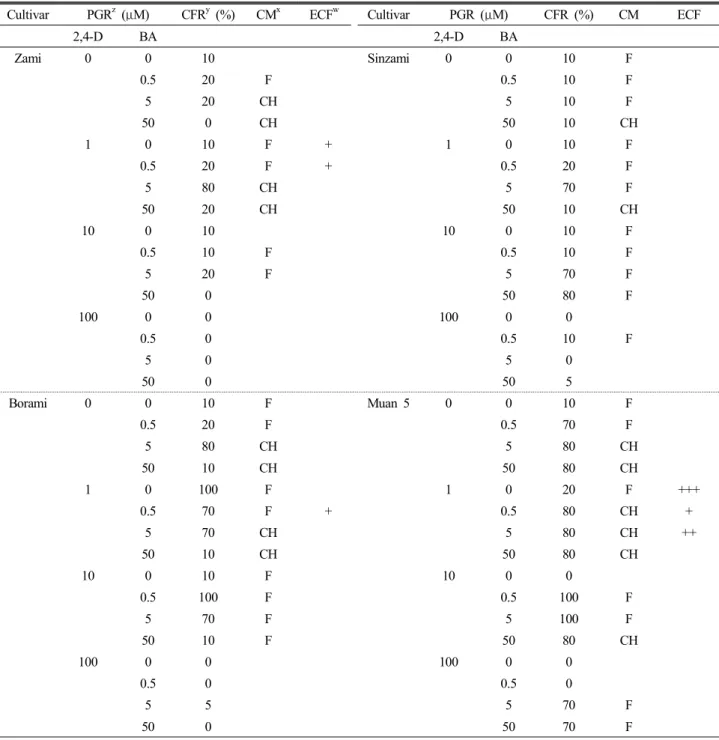
For callus induction, storage root explants were cultured on MS medium supplemented with various combination of 2,4-D and BA (Table 1). Callus initiation from explants of four cultivars was observed at the cutting edge of the explants within a week, and then, developed roughly into friable callus (1~10 μM 2,4-D/1~10 μM 2,4-D and 0.5 μM BA) and compact hard (CH) callus (5 μM BA/ 1 μM 2,4-D and 5 μM BA).
Result showed that the callus forming rates varied from 0~100% with the dependent on the cultivar and combination of growth regulators. Borami and Muan 5 were suitable in callus formation regardless of 2,4-D, BA alone and ratio of 2,4-D to BA. Through this experiment, we know that purple sweet potato needs a balance of growth regulator level, especially the ratio of 2,4-D to BA, for regulating its state of callus growth (Lee et al., 1994). One the other hand, of the various growth regulator screened, only low 2,4-D additional condition gave an embryogenic response except for Sinzami.
However high 2,4-D condition and combination with BA was suppressed formation of embryogenic callus. To induce embryogenic callus, the capacity of the 2,4-D has been reported previously (Al-Mazrooei et al., 1997; Jarret et al., 1984).
Embryogenic callus formation rates under the light condition
Results of callus induction and embryogenic callus
demonstrated that low concentration of 2,4-D and BA were
Table 1. Effect of 2,4-D and BA on callus induction from purple sweet potato
Cultivar PGR
z(μM) CFR
y(%) CM
xECF
wCultivar PGR (μM) CFR (%) CM ECF
2,4-D BA 2,4-D BA
Zami 0 0 10 Sinzami 0 0 10 F
0.5 20 F 0.5 10 F
5 20 CH 5 10 F
50 0 CH 50 10 CH
1 0 10 F + 1 0 10 F
0.5 20 F + 0.5 20 F
5 80 CH 5 70 F
50 20 CH 50 10 CH
10 0 10 10 0 10 F
0.5 10 F 0.5 10 F
5 20 F 5 70 F
50 0 50 80 F
100 0 0 100 0 0
0.5 0 0.5 10 F
5 0 5 0
50 0 50 5
Borami 0 0 10 F Muan 5 0 0 10 F
0.5 20 F 0.5 70 F
5 80 CH 5 80 CH
50 10 CH 50 80 CH
1 0 100 F 1 0 20 F +++
0.5 70 F + 0.5 80 CH +
5 70 CH 5 80 CH ++
50 10 CH 50 80 CH
10 0 10 F 10 0 0
0.5 100 F 0.5 100 F
5 70 F 5 100 F
50 10 F 50 80 CH
100 0 0 100 0 0
0.5 0 0.5 0
5 5 5 70 F
50 0 50 70 F
z
PGR; Plant Growth Regulator,
yCFR; Callus Formation Rates (%),
xCM; Callus Morphology (F, friable; CH, compact and hard),
wECF;
Embryogenic Callus Formation. The data recorded after 4 weeks of culture in the dark.
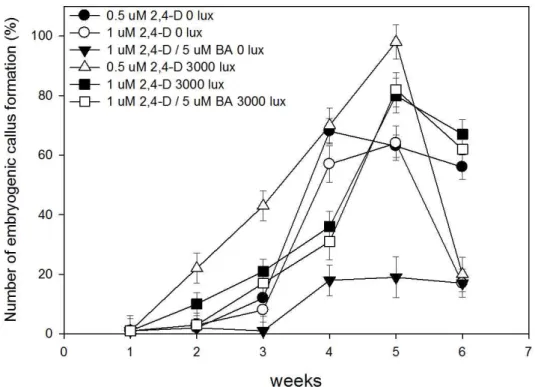
considered the important factors in purple sweet potato. So, we conducted more specific tests in embryogenic callus formation about 2,4-D concentration and light intensity (Fig. 1).
The initiation of embryogenic callus was observed after 2 weeks of culture. In dark condition, the formation frequency was peaked at the culture period between 4 to 5 weeks. After that,
the frequency gradually was decreased. In light condition
(3000 lux), the frequency of embryogenic callus formation
was improved and the best was observed in between in 5 to 6
weeks. Embryogenic callus could classify into 2 types. One
was friable with a whitish color and translucent. It was globular-
shaped embryogenic callus with < 2 ㎜ in diameter. This one
Fig. 1. Effect of light intensity and culture period on the induction of embryogenic callus formation from purple sweet potato.
Counted embryogenic callus (over 1 ㎜ in diameter). Each value represents the average of 4 determinations.
was formed on the medium supplemented with 0.5 μM 2,4-D (Fig. 2A). This embryogenic callus appeared from the cambium region. The other type was similar to the first type except for firmness and 3~6 ㎜ in diameter size at treated 1 μM 2,4-D and 5 μM BA. However, the embryogenic callus formation was the highest in 0.5 μM 2,4-D supplemented condition.
And this frequency was decreased by 5 μM BA addition (Fig. 1). From the results of this experiment, we can make a conclusion that the formation of embryogenic callus is needed to be tested 2,4-D concentration and light intensity (Table 2). When embryogenic callus was subcultured at same condition, it turned to non-embryogenic callus and lost their embryogenic callus formation ability. So, we need an alternative method of regeneration.
Plant Regeneration
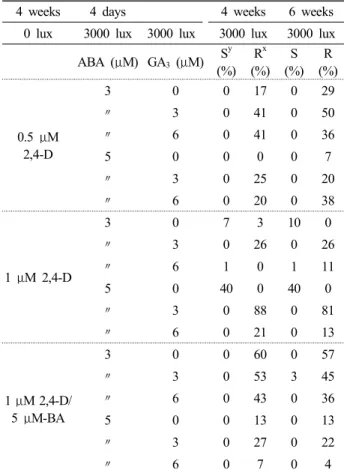
Among the embryogenic callus of the three cultivars, only Muan 5 produced a regenerated plantlets (Table 2). The induced each embryogenic callus was subcultured on MS medium supplemented with 3 or 5 μM ABA addition media for 4 days. Subsequently, they are transferred to 0~6 μM GA
3adding MS medium for 4 days. And they were cultured in
light condition, then calli were developed globular embryos and turned green. But, neither it induced in 1 μM 2,4-D and 5 μM BA. And finally they regenerated 2 shoots per explants (Fig. 2B) (total average is 40 percent). Such embryogenic calli grew into plantlets with normal roots and shoots within 6 weeks when transferred onto the MS hormone free medium (Fig. 2C). The highest frequency (over 2 shoots per explant) of shoot regeneration occurred in the genotype Muan 5 cultured on MS medium containing 5 μM ABA for 4 days and then transferred to MS medium. Addition of GA
3in the second medium reduced the frequency of shoot regeneration.
When after 4 weeks of culture, these embryogenic calli
transferred on MS medium containing 5 μM ABA, showed
few roots and more shoots formation. The shoot regeneration
of embryogenic callus (from 1 μM 2,4-D) firstly grown on 5
μM ABA and transplanted on 0 μM GA
3, 3 μM GA
3, and 6 μ
M GA
3was 40 %, 0, and 0 %, respectively. According to the
analysis of variance the variability of a number of regenerants
was significantly influenced by both ABA and GA
3. A 4-day
preculture in light improved the rate of regeneration. This
regeneration frequency peaked at about 6 weeks after subculture
on regeneration medium. After 6 weeks of culture, this
Fig. 2. Plant regeneration from storage root disk culture of Ipomoea batatas cv. “Muan 5”. A, Embryogenic callus after 2 weeks of culture on MS medium containing 1 μM 2,4-D; B, Develeopment of shoot in MS medium, after 4 weeks of culture; C, Normal plantlet formation after 50 and 60 days culture, respectively; D, Purple sweet potato developed from somatic embryos growing in the soil.
embryogenic calli were subcultured at regeneration medium, there wasn’t regeneration. After that, the regeneration frequency gradually decreased, as some of the embryogenic callus became non-embryogenic. Several factors are important for successful regeneration in purple sweet potato. Firstly, the addition of ABA is critical importance for achieving a high frequency of plant regeneration. Secondly, the size of embryogenic callus, which were transferred to ABA, is also important to obtain a high regeneration frequency. Chee and Cantliffe (1989) reported that the percentage of somatic embryo formation was decreased as the size of the cell-aggregates. Thirdly, the developmental stage of the embryogenic callus was critical, as 4 weeks embryogenic callus was the most regenerative.
Delaying the subculture at regeneration medium diminished
the regeneration ability of the embryogenic callus. Rooted plantlets from which the agar-based medium had been removed under running water, were individually transferred to the solid. Well-established plants were shifted to the field.
The regeneration frequency in sweet potato is often genotype dependent, ranging from 0 to 85% in tested cultivars. So far only a small number of genotypes have been regenerated, based on information gathered from the related publications.
Many factors have been examined to improve the frequency
of plant regeneration in sweet potato. Different reports have
shown that many factors affect plant regeneration frequency
sweet potato: genotype, development stage of callus in the
explants, and hormonal composition of the medium. In our
study, the age of embryogenic callus, ABA addition, and
Table 2. Organogenesis from embryogenic callus derived from storage root disk of purple sweet potato (Muan 5)
z4 weeks 4 days 4 weeks 6 weeks
0 lux 3000 lux 3000 lux 3000 lux 3000 lux ABA (μM) GA
3(μM) S
y(%) R
x(%)
S (%)
R (%)
0.5 μM 2,4-D
3 0 0 17 0 29
〃 3 0 41 0 50
〃 6 0 41 0 36
5 0 0 0 0 7
〃 3 0 25 0 20
〃 6 0 20 0 38
1 μM 2,4-D
3 0 7 3 10 0
〃 3 0 26 0 26
〃 6 1 0 1 11
5 0 40 0 40 0
〃 3 0 88 0 81
〃 6 0 21 0 13
1 μM 2,4-D/
5 μM-BA
3 0 0 60 0 57
〃 3 0 53 3 45
〃 6 0 43 0 36
5 0 0 13 0 13
〃 3 0 27 0 22
〃 6 0 7 0 4
z
After 4 days of culture on a medium containing ABA, the embryogenic callus was transferred to a medium containing MS only, 3 or 6 μM GA
3supplemented. Each value represents the average of 4 determinations.
y