Plantlet Regeneration via Somatic Embryogenesis from Hypocotyls of Common Buckwheat (Fagopyrum esculentum Moench.)
Soo-Jeong Kwon*, Myong-Hae Han*, Yoon-Sun Huh**, Swapan Kumar Roy*, Chul-Won Lee*, and Sun-Hee Woo*
†
*Dept. of Crop Science, Chungbuk National University, Cheongju 361-763, Korea
**Horticultural Research Division, Chungcheongbuk-do Agricultural Research and Extension Services, Cheongwon 363-882, Korea
331
†
Corresponding author: (Phone) +82-43-261-2515 (E-mail) [email protected]
<Received 13 September, 2013; Accepted 29 October, 2013>
한작지(Korean J. Crop Sci.), 58(4): 331~335(2013) DOI : http://dx.doi.org/10.7740/kjcs.2013.58.4.331
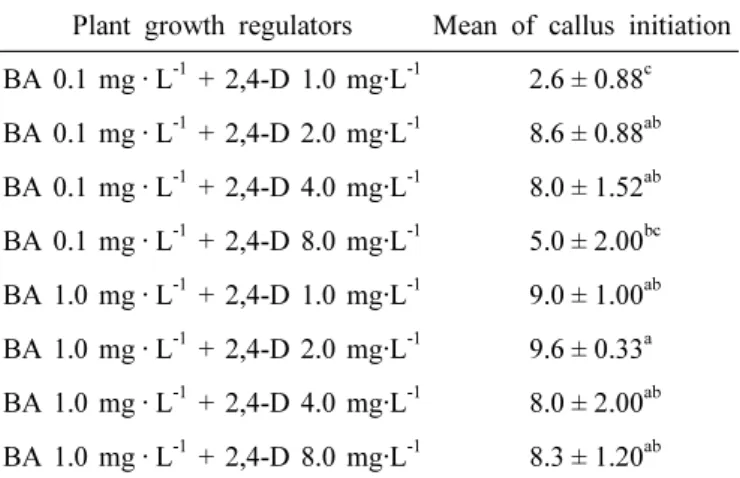
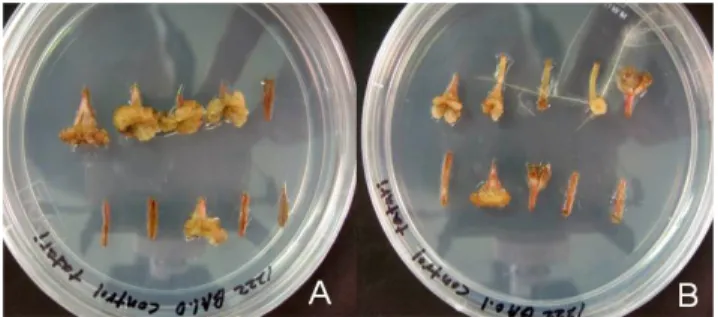
ABSTRACT Buckwheat sprout is used as vegetable, and also flour for making noodles, and so on. Currently, information about tissue culture in buckwheat is limited and restricted to micro-propagation. We carried out somatic embryogenesis and plant regeneration using hypocotyl segments as explant of the cultivated buckwheat species, Fagopyrum esculentum which differs from existing studies in the growth regulator combin- ations used. Maximum callus regeneration was induced on MS medium containing 2,4-dichlorophenoxyacetic acid (2,4-D) 2.0 mg · L
-1, benzyladenine (BA) 1.0 mg · L
-1 and 3% sucrose.
Friable callus was transferred to solidified MS media containing BA (1.0 mg · L
-1) with various concentrations of 2,4-dichloro- phenoxyacetic acid for the induction of embryogenesis. The optimum concentrations of growth regulators (for regeneration of plantlet) were indole-3-acetic acid (2.0 mg · L
-1), Kinetin (1.0 mg · L
-1), BA (1.0 mg · L
-1). Only 2,4-D did not show any significant effect on callus induction or embryogenesis.
Regeneration of embryonic callus varied from 5% to 20%.
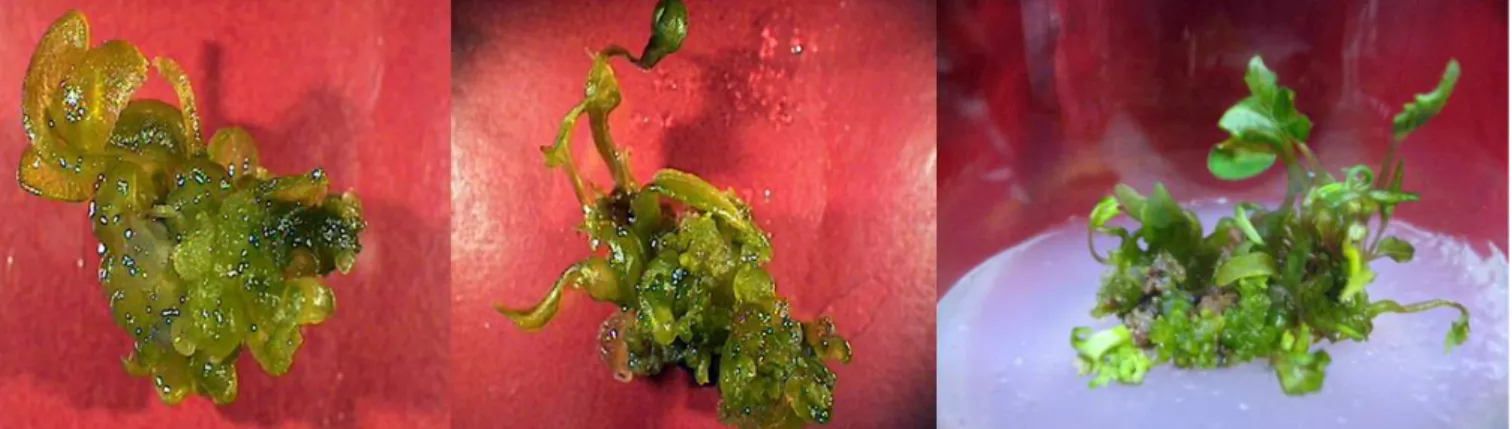
Whole plants were obtained at high frequencies when the embryogenic calli with somatic embryos and organized shoot primordia were transferred to MS media with 3% sucrose. The main objective of this research was to develop an efficient protocol for plant regeneration for common buckwheat, and to apply in future for genetic transformation.
Keywords : common buckwheat, Fagopyrum esculentum, hypocotyl, somatic embryogenesis
Buckwheat , Fagopyrum esculentum Moench, is a cereal grain species of the Polygonaceae family. Buckwheat is gaining all-inclusive importance as a panorama of food crop due to its highly nutritive value. Buckwheat is pseudo- cereal crops, which are good source for essential amino
acid like lysine, and also has excellent protein quality in terms of essential amino acid composition. It is a multipur- pose crop with a variety of utilization such as food, feed, medicine and manure (Dutta et al., 2010; Han et al., 2011).
It already has been proven that Buckwheat is widely adapted in China, Japan, Korea, Canada and some hilly region in the world. The crop matures in a relatively short period of time (70 to 80 days) and makes an excellent rotation with cereal grains. The regeneration of buckwheat plants via organogenesis or somatic embryogenesis from cotyledon explants has been previously reported (Neskovic et al., 1987). Now a day, there is a growing interest in common buckwheat biotechnology because in vitro techniques can provide the means for obtaining somaclones, induced variants, and genetically transformed plants, which can be used both in breeding and in biotechnological production of bioactive compounds. Somatic embryos have also proved to be excellent material for genetic transformation studies due to their competency in expressing incorporated DNA.
The regeneration system is the prime importance for genetic transformation (Farzana et al., 2008). However, the procedure and efficiency of buckwheat plant regeneration was complicated and even not easily available to the scientists yet. A simple and efficient method for the regeneration of autonomous plants from tissue culture is essential to establish a genetic transformation protocol for F. esculentum. Buckwheat has remained a crop with low seed set due to certain characteristics which prevent the application of conventional breeding methods (Kreft, 1983).
The main obstacles in buckwheat breeding include its very