Clinical Presentation of Endometrioid Epithelial Ovarian Cancer with Concurrent Endometriosis:
A Multicenter Retrospective Study
Myong Cheol Lim
1, Kyoung-Chul Chun
2, So-Jin Shin
3, In Ho Lee
4, Kyung Taek Lim
4, Chi Heum Cho
3, Sang-Yoon Park
1, and Joo-Hyun Nam
2Abstract
Background: Endometrioid epithelial ovarian cancer (EEOC) is frequently diagnosed in conjunction with endometriosis and is suggested to arise during the process of endometriosis. This study evaluates the clinical manifestations, including endometriosis-related symptoms and their relationships according to the coexis- tence of endometriosis.
Methods: Using medical records, a retrospective analysis was conducted on 221 patients treated for EEOC at four tertiary educational hospitals between 2000 and 2008. The initial presenting symptoms, particularly those related to endometriosis, were examined in relation to the coexistence of endometriosis or other clinical variables.
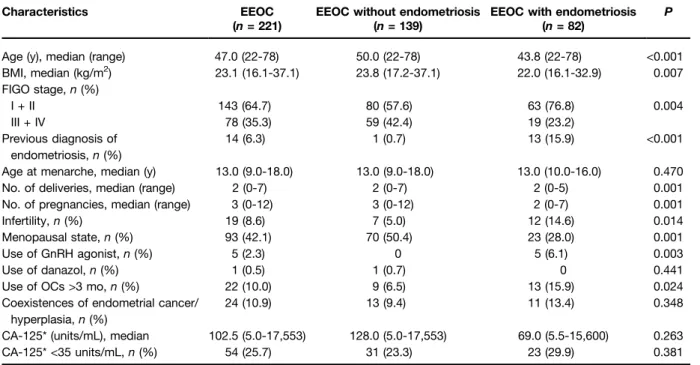
Results: Endometriosis was identified in 82 (37.1%) of the 221 patients with EEOC. The most common symptoms were pelvic pain followed by gastrointestinal symptoms, palpable mass, abdominal distension, vaginal bleeding, and newly developed or exacerbated dysmenorrhea (18.1%) and dyspareunia (13.6%). No- tably, dysmenorrhea and dyspareunia were frequently observed in patients with endometriosis. Among 210 patients identified with pretreatment serum CA-125, 54 (25.7%) displayed normal CA-125 levels (<35 units/
mL) and 23.3% and 29.9% of patients without and with endometriosis had normal CA-125 levels, respectively (P = 0.381). Additionally, 32.6% of the patients with early-stage EEOC displayed normal CA-125 levels.
Conclusions: In this large series of patients with EEOC, the main presenting symptoms were pelvic pain followed by gastrointestinal symptoms, palpable mass, abdominal distension, vaginal bleeding, and newly developed or exacerbated dysmenorrhea and dyspareunia. Dyspareunia and dysmenorrhea were more frequently detected in patients with endometriosis. Normal CA-125 levels cannot be applied as a marker to exclude EEOC, particularly at the early stages. Cancer Epidemiol Biomarkers Prev; 19(2); 398–
404. ©2010 AACR.
Introduction
Ovarian carcinoma is the leading cause of death from gynecologic malignancies. Annually, new diagnoses and mortalities from ovarian cancer are estimated at 21,650 and 15,520, respectively, in the United States alone (1).
Although considerable research efforts have been direct- ed toward improving treatment outcomes and survival in patients with ovarian cancer, effective screening tools with satisfactory sensitivity and false-positive rates have not been developed (2). The identification of acceptable screening tools to achieve a minimum positive predictive value of 10% and a sensitivity of 99.6% for screening the general population of postmenopausal women is a signif- icant challenge (2, 3).
Ovarian cancer has diverse clinical and surgical mani- festations based on the corresponding histology (4-8). En- dometrioid epithelial ovarian cancer (EEOC) and ovarian clear cell carcinoma (OCCC) have some shared as well as some distinct risk factors related to endometriosis, and therefore, separate consideration of these ovarian cancers is suggested (9). The symptoms of ovarian cancer, such as abdominal swelling or pain, are generally vague (10).
Logically, we can assume that endometriosis-related symptoms are more frequent in ovarian cancer–related endometriosis such as EEOC or OCCC. In an earlier study, we reported a high incidence of endometriosis- related symptoms in patients with OCCC (11).
Authors' Affiliations:
1Center for Uterine Cancer, Research Institute and Hospital, National Cancer Center, Goyang, Gyeonggi, Korea;
2