ABSTRACT
Objective: To evaluate survival impact of low anterior resection (LAR) in patients with epithelial ovarian cancer (EOC) grossly confined to the pelvis.
Methods: We retrospectively reviewed 397 patients who underwent primary staging surgery for treatment of 2014 International Federation of Gynecology and Obstetrics (FIGO) stage II–IIIA EOC: 116 (29.2%) IIA, 212 (53.4%) IIB, and 69 (17.4%) IIIA. Patients with grossly enlarged retroperitoneal lymph nodes positive for metastatic carcinoma were excluded. Of 92 patients (23.2%) with gross tumors at the rectosigmoid colon, 68 (73.9%) underwent tumorectomy and 24 (26.1%), LAR for rectosigmoid lesions. Survival outcomes between patients who underwent tumorectomy and LAR were compared using Kaplan-Meier curves.
Results: During the median follow-up of 55 months (range, 1–260), 141 (35.5%) recurrences and 81 (20.4%) deaths occurred. Age (52.8 vs. 54.5 years, p=0.552), optimal debulking (98.5% vs. 95.0%, p=0.405), histologic type (serous, 52.9% vs. 50.0%, p=0.804), FIGO stage (p=0.057), and platinum-based adjuvant chemotherapy ≥6 cycles (85.3% vs. 79.2%, p=0.485) were not different between groups. No significant difference in 5-year progression-free survival (PFS; 57.9% vs. 62.5%, p=0.767) and overall survival (OS; 84.7% vs. 63.8%, p=0.087), respectively, was noted between groups. Postoperative ileus was more frequent in patients subjected to LAR than those who were not (4/24 [16.7%] vs. 11/373 [2.9%], p=0.001). The 5-year PFS (60.3% vs. 57.9%, p=0.523) and OS (81.8% vs. 87.7%, p=0.912) between patients who underwent tumorectomy and those who did not were also similar.
Conclusion: Survival benefit of LAR did not appear to be significant in EOC patients with grossly pelvis-confined tumors.
Keywords: Colectomy; Epithelial Ovarian Cancer; Progression-Free Survival
Original Article
Received: Nov 2, 2017 Revised: Feb 23, 2018 Accepted: Mar 29, 2018 Correspondence to Jeong-Yeol Park
Department of Obstetrics and Gynecology, University of Ulsan College of Medicine, Asan Medical Center, 88 Olympic-ro 43-gil, Songpa-gu, Seoul 05505, Korea.
E-mail: [email protected]
*Current affiliation: Division of Gynecologic Oncology, Princess Margaret Cancer Centre, University Health Network, University of Toronto, Toronto, Canada.
Copyright © 2018. Asian Society of Gynecologic Oncology, Korean Society of Gynecologic Oncology
This is an Open Access article distributed under the terms of the Creative Commons Attribution Non-Commercial License (https://
creativecommons.org/licenses/by-nc/4.0/) which permits unrestricted non-commercial use, distribution, and reproduction in any medium, provided the original work is properly cited.
ORCID iDs Miseon Kim
https://orcid.org/0000-0002-5118-9275 Dong Hoon Suh
https://orcid.org/0000-0002-4312-966X Jeong-Yeol Park
https://orcid.org/0000-0003-2475-7123 E Sun Paik
https://orcid.org/0000-0002-6172-5860 Seungmee Lee
https://orcid.org/0000-0003-1405-2656 Kyung Jin Eoh
https://orcid.org/0000-0002-1684-2267
Miseon Kim ,1 Dong Hoon Suh ,1 Jeong-Yeol Park ,2 E Sun Paik ,3 Seungmee Lee ,4 Kyung Jin Eoh ,5 Joo-Hyun Nam ,2 Yoo-Young Lee ,3,*
Jae-Weon Kim ,4 Sunghoon Kim 5
1Department of Obstetrics and Gynecology, Seoul National University Bundang Hospital, Seongnam, Korea
2 Department of Obstetrics and Gynecology, University of Ulsan College of Medicine, Asan Medical Center, Seoul, Korea
3 Department of Obstetrics and Gynecology, Samsung Medical Center, Sungkyunkwan University School of Medicine, Seoul, Korea
4Department of Obstetrics and Gynecology, Seoul National University Hospital, Seoul, Korea
5Department of Obstetrics and Gynecology, Yonsei University College of Medicine, Seoul, Korea
Survival impact of low anterior resection in patients with epithelial ovarian
cancer grossly confined to the pelvic
cavity: a Korean multicenter study
Joo-Hyun Nam
https://orcid.org/0000-0002-8440-3370 Yoo-Young Lee
https://orcid.org/0000-0002-6951-4558 Jae-Weon Kim
https://orcid.org/0000-0003-1835-9436 Sunghoon Kim
https://orcid.org/0000-0002-1645-7473 Conflict of Interest
No potential conflict of interest relevant to this article was reported.
Author Contributions
Conceptualization: S.D.H., P.J.Y.; Data curation: K.M., P.J.Y., P.E.S., L.S., E.K.J.; Formal analysis: K.M., S.D.H., P.J.Y.; Resources: S.D.H., P.J.Y., N.J.H., L.Y.Y., K.J.W., K.S.; Supervision:
P.J.Y.; Writing - original draft: K.M., S.D.H.;
Writing - review & editing: K.M., S.D.H., P.J.Y., P.E.S., L.S., E.K.J., N.J.H., L.Y.Y., K.J.W., K.S.
INTRODUCTION
Optimal debulking surgery is the most important factor for improving survival outcomes in patients with advanced or recurrent epithelial ovarian cancer (EOC) [1]. Extensive intraperitoneal seeding to the neighboring pelvic viscera often results in the need for rectosigmoid resection to achieve optimal debulking. The technique of low anterior resection (LAR) of pelvic tumor, adjacent rectosigmoid colon, and pelvic peritoneum with primary anastomosis has already been described by many surgeons, with acceptable associated morbidity in advanced or recurrent EOC [2,3].
Unlike in advanced or recurrent EOC, the salutary value of these practices in early-stage EOC confined to the pelvis is still questionable. A number of surgeons performed LAR for all rectosigmoid lesions without exception and irrespective of invasion depth or size of tumor. Although patients without gross residual tumor after LAR can have better prognosis, increased operation-related morbidity after LAR has also been reported in several studies [4-7]. Disruption of the anastomosis leading to clinical anastomotic leak is among the most troublesome complications after LAR. Anastomotic leak is associated with considerable morbidity, including impaired long-term functional outcome, and increased mortality.
Several studies have found that prolonged operating time and blood-product transfusion were important factors associated with anastomotic leak. Thus, if the tumor infiltrating up to the serosa and subserosa of the rectosigmoid colon can be removed by only tumorectomy without gross residual tumor, the surgeons can possibly avoid unnecessary LAR in early-stage EOC.
However, the oncologic safety of omitting LAR without compromising survival outcomes in early-stage EOC must be first established before the current practice patterns can be changed.
Until now, to the best of our knowledge, no studies have investigated the survival impact and safety of LAR in patients with early-stage EOC. Therefore, with this multicenter retrospective study, we aimed to evaluate the survival outcomes in patients with EOC grossly confined to the pelvis according to the methods of bowel surgery (tumorectomy vs. LAR). In addition, the survival outcomes between the patients who did not undergo any bowel surgery and those who underwent tumorectomy were compared to evaluate the prognostic implication of the resectional base after tumorectomy. The incidences of operation-related morbidity between patients who underwent LAR and those who did not were also compared.
MATERIALS AND METHODS
1. Patient cohort
The cohort under study was retrospectively recruited from 5 independent institutions. The study protocol was revised and accepted by each institutional ethics committees. We reviewed the medical records of 397 patients who underwent primary staging surgery for EOC between March 1990 and September 2015. All eligible patients were diagnosed as International Federation of Gynecology and Obstetrics (FIGO) stage IIA to IIIA by gynecologic pathologists of each institutions after staging surgery. Patients with grossly enlarged retroperitoneal lymph nodes proven positive for metastatic carcinoma were excluded.
Staging surgery included peritoneal washing cytology, total hysterectomy, bilateral salpingo- oophorectomy, pelvic lymph node dissection, paraaortic lymph node dissection, and infra/supracolic omentectomy. Additional biopsy for suspicious lesions according to the
surgeons' discretion was allowed. Tumorectomy for rectosigmoid lesions was performed by gynecologic oncologists or colorectal surgeons with each institution's policy. LAR was routinely performed by colorectal surgeons in each institution as follows: 1) The superior rectal vessel was ligated above the extent of the pelvic disease after the retrorectal space was developed; 2) The rectosigmoid colon was divided below the peritoneal reflection and approximately 7 cm above the anal verge; 3) The rectosigmoid colon was resected with a gastrointestinal anastomotic stapler in most patients; 4) End-to-end anastomosis (EEA) was performed with an EEA stapler. Unlike in the routine procedure, the inferior mesenteric artery was not sacrificed, except when mobilization of the distal bowel was necessary to allow tension-free anastomosis.
Information on intraoperative gross rectosigmoid lesions and residual tumors were retrospectively obtained from medical records. Optimal debulking surgery was defined as residual tumor ≤1.0 cm. Progression-free survival (PFS) was defined as the length of time from the date of primary staging surgery to the date of cancer recurrence or death from any cause. Women who were still alive without cancer recurrence at the time of the analysis were censored at the time of their last follow-up. Overall survival (OS) was defined as the length of time from the date of primary staging surgery to the date of death from any cause. Women who were still alive with/without the disease at the time of the analysis were censored at the time of their last follow-up. Operation-related morbidity, including ileus, bowel leakage, fever lasting 3 days postoperative, and wound dehiscence, was also evaluated in the study cohort.
Aside from analysis in the whole study cohort (n=397), the same analysis was repeated in the cohort of patients who had rectosigmoid lesions infiltrating up to the muscle and mucosa, as recorded in the final pathologic reports were excluded to minimize the impact of the invasion depth of rectosigmoid lesions to survival outcomes (n=387).
2. Statistical analysis
Chi-squared test, Fisher's exact test, and Mann-Whitney U test were used to evaluate the dichotomous variables. Survival outcomes were compared using the Kaplan-Meier curves with log-rank test. Statistical analyses were performed using Statistical Package for the Social Sciences Version 22.0 (IBM Inc., Chicago, IL, USA). A p-value <0.05 was considered significant.
RESULTS
1. Patient characteristics
A total of 397 patients were eligible for our study cohort. Patient characteristics are
summarized in Table 1. The median age was 51 years (range, 17–88), and the median follow-up period was 55 months (range, 1–260). Colonoscopy was performed in 200 (50.4%) patients before surgery. Ninety-two (23.2%) patients had gross rectosigmoid lesions that did not have intraoperative evidence of invasion up to the muscle or mucosa according to the surgeon's judgment. Of these patients, 24 (26.1%) received LAR, and the other 68 (73.9%) received only tumorectomy without bowel resection. In our cohort, all patients with rectosigmoid lesions underwent bowel surgery to avoid residual tumors, tumorectomy, or LAR, while no patients without rectosigmoid lesions underwent any bowel surgery. Optimal debulking with residual tumor less than 1.0 cm was achieved in 335 patients (84.4%). Unfortunately, the residual tumors of 52 (13.1%) patients were not described in their operation records. After surgery, a large portion of the population was confirmed as FIGO stage IIB (212, 53.4%). A total of 335 patients (84.4%) received appropriate platinum-based adjuvant chemotherapy for 6 or more
cycles. A total of 141 patients (35.5%) had cancer recurrence, and 81 (20.4%) died at time of analysis. Five-year PFS rates were 64.9%, 60.8%, and 47.0% in FIGO stage IIA, IIB, and IIIA, respectively (p=0.136). Meanwhile, 5-year OS rates were 84.3%, 80.3%, and 80.6% in each stage (p=0.423) (Fig. 1).
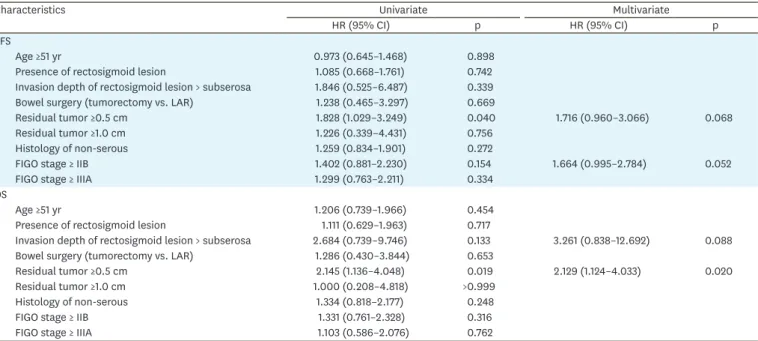
The logistic regression analysis for independent risk factors of survival outcomes was performed and its results were presented in Table 2. In multivariate analysis, the disease stage was not associated with PFS (FIGO ≥IIB, hazard ratio [HR]=1.402; 95% confidence interval [CI]=0.881–2.230; p=0.052) in this study population. Residual tumor ≥0.5 cm was a sole independent risk factor for OS (HR=2.129; 95% CI=1.124–4.033; p=0.020).
2. Tumorectomy vs. LAR
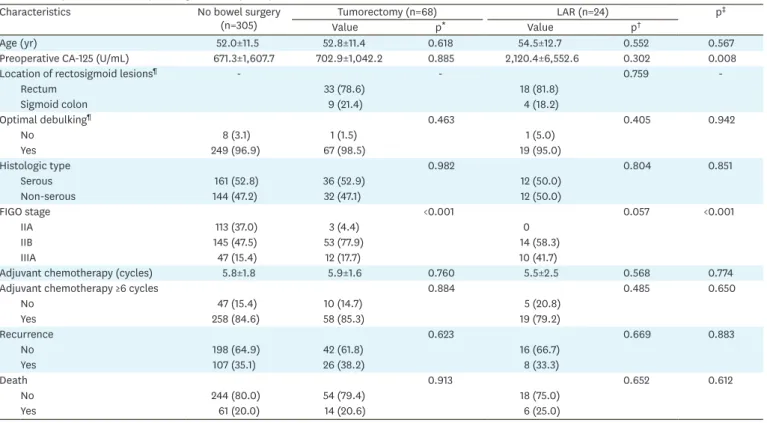
Comparison of clinicopathologic characteristics according to the type of bowel surgery (no bowel surgery [n=305], tumorectomy [n=68], and LAR [n=24]) is shown in Table 3. Optimal debulking was achieved in almost all patients who underwent tumorectomy and LAR (67 Table 1. Patient characteristics (n=397)
Characteristics Value
Age (yr) 51 (17–88)
Follow-up period (mo) 55 (1–260)
Preoperative CA-125 (U/mL) 161.0 (3.1–31,600.0)
Preoperative colonoscopy
No 197 (49.6)
Yes 200 (50.4)
Rectosigmoid lesions
Absent 305 (76.8)
Present 92 (23.2)
Rectum 51
Sigmoid colon 13
Unknown* 28
Bowel surgery
No 305 (76.8)
Tumorectomy 68 (17.1)
LAR 24 (6.1)
Optimal debulking
No 10 (2.5)
Yes 335 (84.4)
Unknown* 52 (13.1)
Histologic type
Serous 209 (52.6)
Non-serous 188 (47.4)
FIGO stage
IIA 116 (29.2)
IIB 212 (53.4)
IIIA 69 (17.4)
Adjuvant chemotherapy (cycles) 6 (0–20)
Adjuvant chemotherapy ≥6 cycles
No 62 (15.6)
Yes 335 (84.4)
Recurrence
No 256 (64.5)
Yes 141 (35.5)
Death
No 316 (79.6)
Yes 81 (20.4)
Values are presented as number (%) or median (range).
CA-125, cancer antigen-125; FIGO, International Federation of Gynecology and Obstetrics; LAR, Low anterior resection.
*Without descriptions on operation records.
[98.5%] vs. 19 [95.0%], p=0.405). One patient (4.2%) who underwent LAR had residual tumor >1.0 cm after surgery. Non-serous histologic type was similarly detected between patients who underwent tumorectomy and LAR (32 [47.1%] vs. 12 [50.0%], p=0.804). Almost all patients who underwent tumorectomy were diagnosed as FIGO stage IIB after surgery (53, 77.9%). FIGO stage IIIA was more frequent in patients who underwent LAR than in those who underwent tumorectomy (10 [41.7%] vs. 12 [17.7%], p=0.057) due to retroperitoneal lymph node metastasis or microscopic extra-pelvic peritoneal involvement. However, the frequency was not significantly different. Platinum-based adjuvant chemotherapy for 6 or more cycles was performed in almost all patients in both groups (58 [85.3%] vs. 19 [79.2%], p=0.485). The cohort excluding the patients who had rectosigmoid lesions infiltrating up
Time (mo) 0.2
0 100 150
Time (mo)
Stage IIA Stage IIA
Stage IIB Stage IIB
Stage IIIA
p=0.136 p=0.423
Stage IIIA 0.2
0 100 150
PFS 0.4
0.6 0.8 1.0
300
200 250
50
A
OS
0.4 0.6 0.8 1.0
300
200 250
50
B
Fig. 1. (A) The 5-year PFS (64.9%, 60.8%, and 47.0%; p=0.136) and (B) 5-year OS (84.3%, 80.3%, and 80.6%; p=0.423) in the whole study population (n=397) (solid line: FIGO stage IIA; dotted line: FIGO stage IIB; and dot-and-dash line: FIGO stage IIIA).
FIGO, International Federation of Gynecology and Obstetrics; OS, overall survival; PFS, progression-free survival.
Table 2. Univariate and multivariate analysis for independent risk factors of survival outcomes (n=397)
Characteristics Univariate Multivariate
HR (95% CI) p HR (95% CI) p
PFS
Age ≥51 yr 0.973 (0.645–1.468) 0.898
Presence of rectosigmoid lesion 1.085 (0.668–1.761) 0.742
Invasion depth of rectosigmoid lesion > subserosa 1.846 (0.525–6.487) 0.339
Bowel surgery (tumorectomy vs. LAR) 1.238 (0.465–3.297) 0.669
Residual tumor ≥0.5 cm 1.828 (1.029–3.249) 0.040 1.716 (0.960–3.066) 0.068
Residual tumor ≥1.0 cm 1.226 (0.339–4.431) 0.756
Histology of non-serous 1.259 (0.834–1.901) 0.272
FIGO stage ≥ IIB 1.402 (0.881–2.230) 0.154 1.664 (0.995–2.784) 0.052
FIGO stage ≥ IIIA 1.299 (0.763–2.211) 0.334
OS
Age ≥51 yr 1.206 (0.739–1.966) 0.454
Presence of rectosigmoid lesion 1.111 (0.629–1.963) 0.717
Invasion depth of rectosigmoid lesion > subserosa 2.684 (0.739–9.746) 0.133 3.261 (0.838–12.692) 0.088
Bowel surgery (tumorectomy vs. LAR) 1.286 (0.430–3.844) 0.653
Residual tumor ≥0.5 cm 2.145 (1.136–4.048) 0.019 2.129 (1.124–4.033) 0.020
Residual tumor ≥1.0 cm 1.000 (0.208–4.818) >0.999
Histology of non-serous 1.334 (0.818–2.177) 0.248
FIGO stage ≥ IIB 1.331 (0.761–2.328) 0.316
FIGO stage ≥ IIIA 1.103 (0.586–2.076) 0.762
CI, confidence interval; FIGO, International Federation of Gynecology and Obstetrics; HR, hazard ratio; LAR, low anterior resection; OS, overall survival; PFS, progression-free survival.
to the muscle and mucosa is described in Supplementary Table 1. FIGO stage between the patients treated with tumorectomy and LAR was significantly different (FIGO stage IIB, 12 [17.9%] vs. 8 [53.3%], p=0.004).
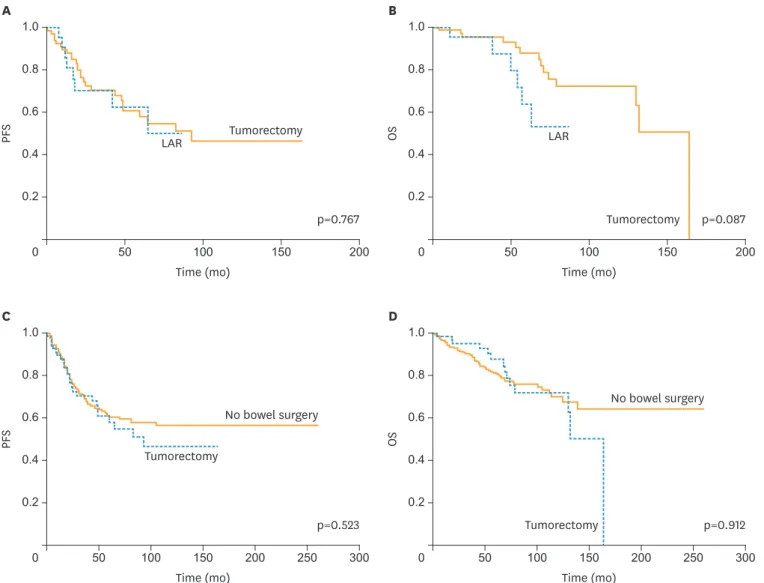
Survival outcomes in patients who received bowel surgery for rectosigmoid lesions are presented in Fig. 2. The 5-year PFS was similar between patients who underwent tumorectomy and those who underwent LAR (57.9% vs. 62.5%, p=0.767). The 5-year OS of patients who underwent tumorectomy was superior to those treated with LAR; however, it was not significantly different (84.7% vs. 63.8%, p=0.087). These survival outcome findings coincided with those of the cohort in which patients who had rectosigmoid lesions infiltrating up to the muscle and mucosa were excluded (Supplementary Fig. 1; 5-year PFS, 58.9% vs. 60.2%, p=0.994; 5-year OS, 90.1% vs. 66.7%, p=0.147).
3. No bowel surgery vs. tumorectomy
The rates of the optimal debulking (249 [96.9%] vs. 67 [98.5%], p=0.463) and non-serous histology (144 [47.2%] vs. 32 [47.1%], p=0.982) were not different between patients who did not undergo bowel surgery and who underwent tumorectomy. FIGO stage IIB was less frequent in patients who did not undergo any bowel surgery, compared to those of tumorectomy (145 [47.5%] vs. 53 [77.9%], p<0.001). In addition, adjuvant chemotherapy for 6 or more cycles was equally administered in both groups (258 [84.6%] vs. 58 [85.3%], p=0.884). Except for FIGO staging, no significant difference was noted in both groups after patients who had rectosigmoid lesions infiltrating up to the muscle and mucosa were excluded (Supplementary Table 1).
Table 3. Comparisons of clinicopathologic factors (n=397)
Characteristics No bowel surgery
(n=305) Tumorectomy (n=68) LAR (n=24) p‡
Value p* Value p†
Age (yr) 52.0±11.5 52.8±11.4 0.618 54.5±12.7 0.552 0.567
Preoperative CA-125 (U/mL) 671.3±1,607.7 702.9±1,042.2 0.885 2,120.4±6,552.6 0.302 0.008
Location of rectosigmoid lesions¶ - - 0.759 -
Rectum 33 (78.6) 18 (81.8)
Sigmoid colon 9 (21.4) 4 (18.2)
Optimal debulking¶ 0.463 0.405 0.942
No 8 (3.1) 1 (1.5) 1 (5.0)
Yes 249 (96.9) 67 (98.5) 19 (95.0)
Histologic type 0.982 0.804 0.851
Serous 161 (52.8) 36 (52.9) 12 (50.0)
Non-serous 144 (47.2) 32 (47.1) 12 (50.0)
FIGO stage <0.001 0.057 <0.001
IIA 113 (37.0) 3 (4.4) 0
IIB 145 (47.5) 53 (77.9) 14 (58.3)
IIIA 47 (15.4) 12 (17.7) 10 (41.7)
Adjuvant chemotherapy (cycles) 5.8±1.8 5.9±1.6 0.760 5.5±2.5 0.568 0.774
Adjuvant chemotherapy ≥6 cycles 0.884 0.485 0.650
No 47 (15.4) 10 (14.7) 5 (20.8)
Yes 258 (84.6) 58 (85.3) 19 (79.2)
Recurrence 0.623 0.669 0.883
No 198 (64.9) 42 (61.8) 16 (66.7)
Yes 107 (35.1) 26 (38.2) 8 (33.3)
Death 0.913 0.652 0.612
No 244 (80.0) 54 (79.4) 18 (75.0)
Yes 61 (20.0) 14 (20.6) 6 (25.0)
Values are presented as number (%) or mean±standard deviations.
CA-125, Cancer antigen-125; FIGO, International Federation of Gynecology and Obstetrics; LAR, Low anterior resection.
*No bowel surgery vs. tumorectomy; †Tumorectomy vs. LAR; ‡Among 3 groups; ¶In patients with available data.
Survival outcomes in patients treated without bowel surgery and with tumorectomy are presented in Fig. 2. The 5-year PFS (60.3% vs. 57.9%, p=0.523) and 5-year OS (81.8% vs.
87.7%, p=0.912) in patients who underwent tumorectomy were not inferior to those of the patients who had no rectosigmoid lesions primarily. These survival outcome findings coincided with those of the cohort in which patients who had rectosigmoid lesions infiltrating up to the muscle and mucosa were excluded (Supplementary Fig. 1; 5-year PFS, 60.3% vs. 58.9%, p=0.632; 5-year OS, 81.2% vs. 90.1%, p=0.929).
4. Operation-related morbidity in patients treated with LAR
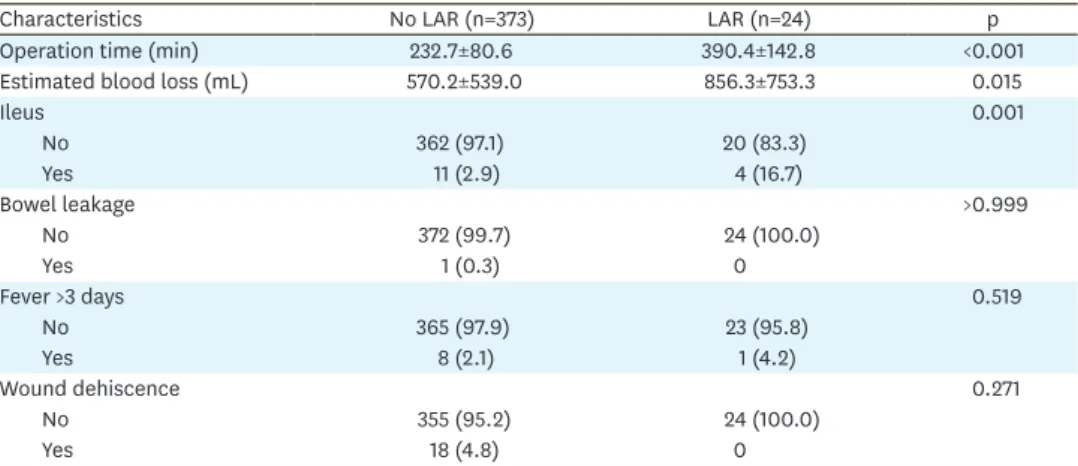
Operation-related outcomes and morbidity were presented in Table 4. Operation time was longer in patients with LAR than those without LAR (390.4±142.8 minutes vs. 232.7±80.6 minutes; p<0.001). In addition, more intraoperative blood loss was estimated in patients with LAR (856.3±753.3 mL vs. 570.2±539.0 mL; p=0.015). Postoperative ileus was more common in patients who underwent LAR than those who did not (4 [16.7%] vs. 11 [2.9%], p=0.001). However, the incidences of bowel leakage, fever lasting more than 3 days
Time (mo) 0.2
0 100 150
Time (mo)
Tumorectomy Tumorectomy
p=0.767 p=0.087
LAR LAR
0.2
0 100 150
PFS 0.4
0.6 0.8 1.0
200 50
A
OS
0.4 0.6 0.8 1.0
200 50
B
Tumorectomy Tumorectomy
No bowel surgery No bowel surgery
Time (mo) 0.2
0 100 150
Time (mo)
p=0.523 p=0.912
0.2
0 100 150
PFS 0.4
0.6 0.8 1.0
300
200 250
50
C
OS
0.4 0.6 0.8 1.0
300
200 250
50
D
Fig. 2. (A) The 5-year PFS (57.9% vs. 62.5%, p=0.767) and (B) 5-year OS (84.7% vs. 63.8%, p=0.087) in patients who had rectosigmoid lesions (solid line:
tumorectomy group [n=68]; dotted line: LAR group [n=24]). (C) The 5-year PFS (60.3% vs. 57.9%, p=0.523) and (B) 5-year OS (81.8% vs. 87.7%, p=0.912) in patients who did not receive LAR (solid line: no bowel surgery group [n=305]; dotted line: tumorectomy group [n=68]).
LAR, low anterior resection; OS, overall survival; PFS, progression-free survival.
postoperative, and wound dehiscence associated to LAR were not different. LAR-related morbidity in the cohort excluding the patients who had rectosigmoid lesions infiltrating up to the muscle and mucosa is described in Supplementary Table 2. Postoperative ileus was also frequently diagnosed in patients treated with LAR (3 [20.0%] vs. 12 [3.0%], p=0.001).
DISCUSSION
Our findings suggested that the survival outcomes depending on the procedure type for the extirpation of rectosigmoid lesions, i.e., tumorectomy vs. LAR, were not statistically different. Although retroperitoneal lymph node micro-metastasis was frequent in patients who underwent LAR, our findings are meaningful when considering that no gross seeding tumor existed above the pelvic brim in all patients. Notably, the survival outcomes in patients with rectosigmoid lesions who underwent tumorectomy only were not inferior to those in patients who had no rectosigmoid lesions primarily. Furthermore, optimal debulking was similarly achieved between patients who underwent tumorectomy and those who underwent LAR (67 [98.5%] vs. 19 [95.0%], p=0.405). These results imply that the tumors on the rectosigmoid colon are relatively well-controlled without bowel resection. In this study, the increased operation-related morbidity following LAR, such as ileus, could also in no way be negligible (4 [16.7%] vs. 11 [2.9%], p=0.001).
The effect of the procedure type for bowel resection on survival outcomes in patients diagnosed with advanced EOC (FIGO stage III–IV) had been proven in several researches.
Most studies suggested that rectosigmoid resection might help improve the survival outcomes in patients with advanced EOC with acceptable complication rate [7-13]. However, Jaeger et al. [14] demonstrated that bowel resection could not improve the poor prognosis of bowel involvement in 194 patients with FIGO stage III disease. In their study, patients without bowel involvement and no residual tumor after surgery showed a significantly better survival rate than other patients irrespective of the resection status. However, all previous studies that evaluated the survival impact of bowel resection were based on advanced-stage EOC. FIGO stage II consists of a small and heterogeneous group, making up less than 10% of all EOC;
therefore, many issues in therapeutic management remain unresolved. We hope that our findings could help surgeons regarding the prognostic implication of the resectional base after tumorectomy for tumors on the rectosigmoid colon.
Table 4. Operation-related outcomes and morbidity (n=397)
Characteristics No LAR (n=373) LAR (n=24) p
Operation time (min) 232.7±80.6 390.4±142.8 <0.001
Estimated blood loss (mL) 570.2±539.0 856.3±753.3 0.015
Ileus 0.001
No 362 (97.1) 20 (83.3)
Yes 11 (2.9) 4 (16.7)
Bowel leakage >0.999
No 372 (99.7) 24 (100.0)
Yes 1 (0.3) 0
Fever >3 days 0.519
No 365 (97.9) 23 (95.8)
Yes 8 (2.1) 1 (4.2)
Wound dehiscence 0.271
No 355 (95.2) 24 (100.0)
Yes 18 (4.8) 0
LAR, low anterior resection.
The major site of bowel resection is the rectosigmoid (48%–55%), followed by the rest of the colon (18%–20%) and the small bowel (6%–27%), depending on the studies [9,15,16].
As the most important prognostic factor for operation-related morbidity, the extent of bowel resection can also affect optimal debulking. Kim et al. [17] on comparing the efficacy between LAR and Hartmann's operation in advanced or recurrent EOC, suggested that LAR may be the optimal procedure for bowel surgery in these patients and may improve postoperative quality of life. Surgical and survival outcomes between LAR and Hartmann's operation did not differ. Similarly, Plotti et al. [18] compared the safety and efficacy of partial rectosigmoid resection (PRR) to those of Hartmann's operation in advanced EOC through a case-control study. In their study, the optimal debulking rate and 5-year OS was not statistically different between the 2 groups. However, in Hartmann's operation group, they observed 4 cases of rectovaginal fistula compared with only 2 cases in PRR. In addition, adjuvant chemotherapy lasted 24 (19–28) days and 18 (15–24) days in Hartmann's operation and PRR groups (p=0.05), respectively. To the best of our knowledge, our study is the first to report the impact of tumorectomy without bowel resection for affected rectosigmoid lesions in EOC survival outcomes and operation-related morbidity. In the present study, the survival outcomes in patients treated with tumorectomy were not inferior to those of the patients with LAR, if optimal debulking could be guaranteed. However, evidence for the safety of the tumorectomy or serosectomy on rectosigmoid colon is lacking, and a global guideline has yet to be established. Therefore, our results should be cautiously applied in clinical practice.
Our study also has several limitations due to its retrospective nature. First, the sample size of the LAR group is relatively small compared with that of the control. Second, we could not fully obtain information about intraoperative characteristics of rectosigmoid lesions due to limited description. Recently, the National Comprehensive Cancer Network recommended that for ovarian cancer, surgeons should describe the initial disease intimately, including that in the pelvis, mid-abdomen, and upper abdomen [19]. Finally, we did not analyze the impact of neoadjuvant chemotherapy (NAC) to LAR performance or survival outcomes. Philip et al.
[20] reported that NAC resulted in decreased bowel resection, which is necessary to achieve optimal debulking in advance EOC. Before NAC, at least 84 patients (87%) would have required bowel resection to obtain optimal debulking without residual tumor. After interval debulking surgery, only 47 patients (49%) required bowel resection, which corresponds to a decrease of 38% (p<0.001).
In the present study, the survival benefit of LAR was not significant in EOC patients with grossly pelvis-confined tumors. Furthermore, postoperative ileus was frequently detected in patients treated with LAR. If rectosigmoid lesions can be resected without residual tumors via tumorectomy, then LAR seems to be not mandatory to improve prognosis in patients with grossly pelvis-confined EOC. Further large prospective studies are necessary to establish standard methods and the safety of tumorectomy or serosectomy to eliminate rectosigmoid lesions.
SUPPLEMENTARY MATERIALS
Supplementary Table 1
Comparisons of clinicopathologic factors (n=387) Click here to view
Supplementary Table 2
Operation-related outcomes and morbidity (n=387) Click here to view
Supplementary Fig. 1
(A) The 5-year PFS (58.9% vs. 60.2%, p=0.994) and (B) 5-year OS (90.1% vs. 66.7%, p=0.147) in patients who had rectosigmoid lesions (solid line: tumorectomy group [n=67]; dotted line:
LAR group [n=15]). (C) The 5-year PFS (60.3% vs. 58.9%, p=0.632) and (B) 5-year OS (81.2%
vs. 90.1%, p=0.929) in patients who did not receive LAR (solid line: no bowel surgery group [n=305]; dotted line: tumorectomy group [n=67]).
Click here to view
REFERENCES
1. Chang SJ, Hodeib M, Chang J, Bristow RE. Survival impact of complete cytoreduction to no gross residual disease for advanced-stage ovarian cancer: a meta-analysis. Gynecol Oncol 2013;130:493-8.
PUBMED | CROSSREF
2. Estes JM, Leath CA 3rd, Straughn JM Jr, Rocconi RP, Kirby TO, Huh WK, et al. Bowel resection at the time of primary debulking for epithelial ovarian carcinoma: outcomes in patients treated with platinum and taxane-based chemotherapy. J Am Coll Surg 2006;203:527-32.
PUBMED | CROSSREF
3. Obermair A, Hagenauer S, Tamandl D, Clayton R, Nicklin J, Perrin L, et al. Safety and efficacy of low anterior en bloc resection as part of cytoreductive surgery for patients with ovarian cancer. Gynecol Oncol 2001;83:115-20.
PUBMED | CROSSREF
4. Matthiessen P. Risk factors for anastomotic leakage after anterior resection of the rectum. Colorectal Dis 2006;8:366.
PUBMED | CROSSREF
5. Mäkelä JT, Kiviniemi H, Laitinen S. Risk factors for anastomotic leakage after left-sided colorectal resection with rectal anastomosis. Dis Colon Rectum 2003;46:653-60.
PUBMED | CROSSREF
6. Richardson DL, Mariani A, Cliby WA. Risk factors for anastomotic leak after recto-sigmoid resection for ovarian cancer. Gynecol Oncol 2006;103:667-72.
PUBMED | CROSSREF
7. Bidzinski M, Derlatka P, Kubik P, Ziolkowska-Seta I, Dańska-Bidzinska A, Gmyrek L, et al. The evaluation of intra- and postoperative complications related to debulking surgery with bowel resection in patients with FIGO stage III-IV ovarian cancer. Int J Gynecol Cancer 2007;17:993-7.
PUBMED | CROSSREF
8. Aletti GD, Podratz KC, Jones MB, Cliby WA. Role of rectosigmoidectomy and stripping of pelvic peritoneum in outcomes of patients with advanced ovarian cancer. J Am Coll Surg 2006;203:521-6.
PUBMED | CROSSREF
9. Salani R, Zahurak ML, Santillan A, Giuntoli RL 2nd, Bristow RE. Survival impact of multiple bowel resections in patients undergoing primary cytoreductive surgery for advanced ovarian cancer: a case- control study. Gynecol Oncol 2007;107:495-9.
PUBMED | CROSSREF
10. Peiretti M, Bristow R, Zapardiel I, Gerardi M, Zanagnolo V, Biffi R, et al. Rectosigmoid resection at the time of primary cytoreduction for advanced ovarian cancer. A multi-center analysis of surgical and oncological outcomes. Gynecol Oncol 2012;126:220-3.
PUBMED | CROSSREF
11. Derlatka P, Sienko J, Grabowska-Derlatka L, Palczewski P, Danska-Bidzinska A, Bidzinski M, et al. Results of optimal debulking surgery with bowel resection in patients with advanced ovarian cancer. World J Surg Oncol 2016;14:58.
PUBMED | CROSSREF
12. Park JY, Seo SS, Kang S, Lee KB, Lim SY, Choi HS, et al. The benefits of low anterior en bloc resection as part of cytoreductive surgery for advanced primary and recurrent epithelial ovarian cancer patients outweigh morbidity concerns. Gynecol Oncol 2006;103:977-84.
PUBMED | CROSSREF
13. Mourton SM, Temple LK, Abu-Rustum NR, Gemignani ML, Sonoda Y, Bochner BH, et al. Morbidity of rectosigmoid resection and primary anastomosis in patients undergoing primary cytoreductive surgery for advanced epithelial ovarian cancer. Gynecol Oncol 2005;99:608-14.
PUBMED | CROSSREF
14. Jaeger W, Ackermann S, Kessler H, Katalinic A, Lang N. The effect of bowel resection on survival in advanced epithelial ovarian cancer. Gynecol Oncol 2001;83:286-91.
PUBMED | CROSSREF
15. Eisenkop SM, Spirtos NM. Procedures required to accomplish complete cytoreduction of ovarian cancer:
is there a correlation with “biological aggressiveness” and survival? Gynecol Oncol 2001;82:435-41.
PUBMED | CROSSREF
16. Eisenhauer EL, Abu-Rustum NR, Sonoda Y, Levine DA, Poynor EA, Aghajanian C, et al. The addition of extensive upper abdominal surgery to achieve optimal cytoreduction improves survival in patients with stages IIIC-IV epithelial ovarian cancer. Gynecol Oncol 2006;103:1083-90.
PUBMED | CROSSREF
17. Kim HS, Kim EN, Jeong SY, Chung HH, Kim YB, Kim JW, et al. Comparison of the efficacy of low anterior resection with primary anastomosis and Hartmann's procedure in advanced primary or recurrent epithelial ovarian cancer. Eur J Obstet Gynecol Reprod Biol 2011;156:194-8.
PUBMED | CROSSREF
18. Plotti F, Montera R, Aloisi A, Scaletta G, Capriglione S, Luvero D, et al. Total rectosigmoidectomy versus partial rectal resection in primary debulking surgery for advanced ovarian cancer. Eur J Surg Oncol 2016;42:383-90.
PUBMED | CROSSREF
19. National Comprehensive Cancer Network (US). NCCN Clinical Practice Guidelines in Oncology. Ovarian cancer including fallopian tube cancer and primary peritoneal cancer, version 1. 2016 [Internet]. Fort Washington, PA: National Comprehensive Cancer Network; 2016 [cited 2017 Feb 24]. Available from:
http://wwwnccnorg/professionals/physician_gls/pdf/ovarianpdf.
20. Philip CA, Pelissier A, Bonneau C, Hequet D, Rouzier R, Pouget N. Impact of neoadjuvant chemotherapy on the rate of bowel resection in advanced epithelial ovarian cancer. Anticancer Res 2016;36:4865-71.
PUBMED | CROSSREF