• 검색 결과가 없습니다.

Congenital mitral valve stenosis in a Chinchilla cat

N/A
N/A
Protected

Academic year: 2021

Share "Congenital mitral valve stenosis in a Chinchilla cat"

Copied!
4
0
0

로드 중.... (전체 텍스트 보기)

전체 글

(1)

pISSN 2466-1384 eISSN 2466-1392 大韓獸醫學會誌 (2016) 第 56 卷 第 3 號 Korean J Vet Res(2016) 56(3) : 197~200 http://dx.doi.org/10.14405/kjvr.2016.56.3.197

197

<Case Report>

Congenital mitral valve stenosis in a Chinchilla cat

Ta-Li Lu

1

, Yong-Wei Hung

1

, Ran Choi

2

, Changbaig Hyun

2,

*

1

Cardiospecial Veterinary Hospital, Taipei 10662, Taiwan

2

Section of Small Animal Internal Medicine, College of Veterinary Medicine, Kangwon National University, Chuncheon 24341, Korea

(Received: April 13, 2016; Revised: June 8, 2016; Accepted: July 6, 2016)

Abstract: A one-year-old, 3.25 kg intact male Chinchilla cat presented with acute right hind limb paralysis. Diagnostic imaging studies found cardiomegaly with interstitial lung pattern, abnormal mitral valve leaflets without maximum opening at the end of the ventricular diastole and during atrial systole and severe mitral inflow obstruction. Based on these findings and its young age, the case was diagnosed as congenital mitral valve stenosis. Treatment was directed to stabilize clinical conditions related to heart failure, to prevent further formation of thrombus and to relieve pain associated with thromboembolism. After one month of therapy, hind limb motor function was fully recovered.

Keywords: cats, flat E-F slope, inflow jet, mitral stenosis, pulmonary hypertension

Congenital mitral valve stenosis (MS) in cats is a rare heart disease characterized by a narrowed mitral valve orifice and progressive left atrial (LA) dilation due to increased pressure gradient across the mitral valvular annulus [1, 2]. Acquired MS has been also reported in cats with bacterial myocarditis [8], although this type is always associated with rheumatic fever in humans [2, 5].

A one-year-old, 3.25 kg intact male Chinchilla cat was pre- sented with acute right hind limb paralysis. According to the owner’s statement, the cat was anorexic and depressed from last few days before the presentation. On the day of admis- sion, the cat was responsive and had no deep pain in right hind limb. In this side of limb, the femoral pulse was faint.

The respiration and heart rates were 42 breaths/min and 200 beats/min, respectively. Systolic blood pressure measured by Doppler method was 146 mmHg. Cardiac auscultation revealed III-IV/VI left apical diastolic murmur. Electrocardiogram found P pulmonale (0.3 mV) and QT prolongation (230 msec). Full complete blood counts and serum biochemistry tests revealed no particular abnormalities except leukocytosis (23,400 counts/

µL). Thoracic radiographs revealed a cardiomegaly (vertebral heart scale 9.0) with bi-atrial dilation (Valentine heart), along with unstructured interstitial lung pattern (Fig. 1). Two- dimensional echocardiography taken at right parasternal long- axis view of the four chambers at the end of ventricular dias- tole (Fig. 2A) and during atrial systole (Fig. 2B) revealed that the mitral valve leaflets were not maximally opened. A left apical view of the heart at the end of ventricular diastole also

revealed the mitral valve leaflets were not maximally opened (Fig. 2D). The color Doppler imaging taken at right paraster- nal long-axis view of the four chambers at the end of ventric- ular diastole found a diastolic jet from LA to left ventricle (LV).

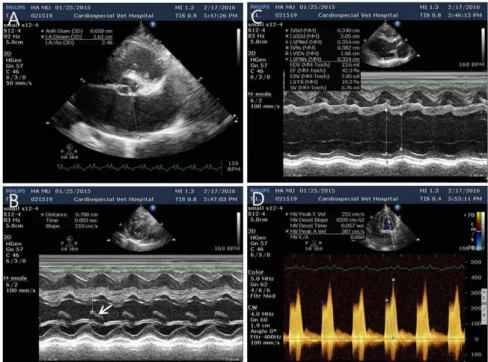
A right parasternal view of the aorta (Ao) and LA revealed severely enlarged LA (LA/Ao ratio 2.48; Fig. 3A). The left auricle projected cranially from the body of the LA, indicat- ing the left auricle was also enlarged (Fig. 3A). M-mode echocardiography revealed slow early diastolic closure of the mitral valve indicated by remarkably reduced E-F slope (mid- diastolic closure velocity) and thickened mitral valve (Fig.

*Corresponding author

Tel: +82-33-250-8681, Fax: +82-33-259-5627 E-mail: [email protected]

Fig. 1. The thoracic radiography of this case. (A) Ventrodosal

view of thoracic radiograph revealed a cardiomegaly with bi-

atrial dilation (Valentine heart). (B) Right lateral of thoracic radio-

graph revealed a cardiomegaly (vertebral heart scale 9.0) with

unstructured interstitial lung pattern.

(2)

198 Ta-Li Lu, Yong-Wei Hung, Ran Choi, Changbaig Hyun

Fig. 2. The echocardiography of this case. (A and B) Two-dimensional echocardiography taken at right parasternal long-axis view of the four chambers at the end of ventricular diastole (A) and during atrial systole (B) revealed that the mitral valve leaflets were not maximally open. (C) The color Doppler imaging taken at right parasternal long-axis view of the four chambers at the end of ventricular diastole found a diastolic jet from left atrial (LA) to left ventricle (LV). (D) A left apical view of the heart at the end of ventricular diastole also revealed the mitral valve leaflets were not maximally open.

Fig. 3. The echocardiography of this case. (A) A right parasternal view of the aorta (Ao) and LA revealed severely enlarged LA (LA/

Ao ratio 2.48). The left auricle projected cranially from the body of the LA, indicating the left auricle was also enlarged. (B) M-mode

echocardiography revealed slow early diastolic closure of the mitral valve indicated by remarkably reduced E-F slope, thickened mitral

valve and anterior movement of posterior mitral valve leaflet in early diastole. (C) The M-mode echocardiography revealed that mark-

edly increased LV end-diastolic diameter (2.05 cm) and the end-systolic diameter (1.66 cm). The %fraction shortening (19.3%) and

ejection fraction (42.3%) were also markedly reduced. (D) The continuous wave Doppler tracing at mitral annulus of left apical 4

chamber view found the peak velocity in early diastole (T-wave to P-wave on electrocardiogram) and atrial systole (P-wave to QRS

complex) were 2.55 m/sec and 3.87 m/sec, respectively, indicating severe MS.

(3)

Mitral stenosis in cat 199

3B). Another M-mode finding was the anterior movement of posterior mitral valve leaflet in early diastole (Fig. 3B). The M-mode echocardiography revealed that markedly increased LV end-diastolic diameter (2.05 cm, normal = 1.2 cm) and the end-systolic diameter (1.66 cm, normal = 0.6 cm) (Fig. 3C). The

%fraction shortening (19.3%) and ejection fraction (42.3%) were also markedly reduced, although the wall thicknesses were normal (Fig. 3C). The continuous wave Doppler trac- ing at mitral annulus of left apical 4 chamber view found the peak velocity in early diastole (T-wave to P-wave on electro- cardiogram) and atrial systole (P-wave to QRS complex) were 2.55 m/sec and 3.87 m/sec, respectively, indicating severe MS (Fig. 3D). Mild pulmonary hypertension (PHT) was also indi- cated by high tricuspid regurgitation jet velocity of 3.18 m/

sec. Based on these findings and young age, the case was diagnosed as congenital MS.

Initial treatment was directed to stabilize clinical condition related to heart failure using furosemide (0.5 mg/kg, q12h, orally [PO]; Sanofi-Aventis, USA) and pimobendan (0.3 mg/

kg, q12h, PO; BI, Germany) and to prevent further throm- boembolism using clopidogrel (18.75 mg/kg, q24h, PO; Sanofi- Aventis). Buprenorphine (0.03 mg/kg, q6–8h, subcutaneously;

Reckitt Benckiser, UK) was also given for pain relieve in this cat. To improve anorexic condition, forced feeding with a prescription diet (Recovery; Royal Canine, USA) was requested to the owner. After 2 days of treatment, clinical condition of this cat was stabilized, although the cat was still anorexic.

Respiration rate was ~20–30 breaths/min at resting. Deep pain sensation was recovered on right hind limb, although the right hind limb was still immobile. The cat was treated with the same medication. The function of right hind limb regained after 1 month of treatment. The cat is still alive and is being administered with the same medication, except pain relief.

Partial obstruction of blood flow from the LA to LV in diastole is characterized feature of MS in cats [1, 3, 6], caus- ing pulmonary edema by the increased resistance of blood flow and subsequent increase in LA pressure along with increase in pulmonary capillary pressures [2]. Marked LA dilation can also facilitate the formation of thrombus in the LA and sys- temic circulation [8]. In this cat, the right hind limb paralysis might be caused by the markedly enlarged LA from severe mitral inflow obstruction. Tachypnea in this cat might be caused by mild pulmonary edema and pain associated with arterial thromboembolism on the right hind limb. Reflex pul- monary vasoconstriction by lower cardiac output in this cat might lead to PHT, evidenced by moderately increased veloc- ity of tricuspid regurgitation jet. PHT is common complica- tion in humans with mitral stenosis [2]. It has been also reported in dogs with MS [7]. Since the cause of PHT was increased pulmonary venous pressure by LA pressure over- load, the PHT might not be severe, unless there is no concur- rent right sided heart failure. No dog or cat with isolated MS has been reported with severe PHT, to date.

The cat presented with clinical signs (e.g., acute hind limb paralysis) consistent with hypertrophic cardiomyopathy (HCM).

In addition, the thoracic radiography showing cardiomegaly with marked bi-atrial dilation along with mild diffuse pulmo- nary infiltration, more convincingly suggested HCM in this cat. However, the echocardiograms in this cat were surpris- ing and demonstrated that there were two combined prob- lems (i.e., MS and PHT) without any evidence of HCM.

Restricted leaflet motion and a turbulent inflow jet at mitral annulus in diastole were diagnostic findings of MS on the 2- D echocardiograms. The severity of the MS is generally determined by mitral valve orifice area and mean pressure gradient between LA and LV in human [2]. Severe MS can be defined by mitral valve orifice area < 1.0 cm

2

and > 10 mmHg mean gradient in human [2]. However, the guideline for determining the severity of MS has yet been established in cats. Instead of a normal pressure gradient that peaks at approximately 2 mmHg, the pressure gradient in this cat was 25 to 60 mmHg, suggesting very severe stenosis. The E/E’

ratio in this cat was 25, suggesting the LA pressure is higher than 20 mmHg. When the LA pressure increases to 20 mmHg, pulmonary edema starts to develop and progresses rap- idly with increasing LA pressure. The progressively increased LA pressure might lead to PHT in this cat.

The M-mode echocardiogram in human with rheumatic mitral stenosis generally shows prolongation of the ejection fraction slope indicated by decreased (flat) E-F slope [2, 5].

In addition, the leaflet thickening and anterior motion of the posterior mitral leaflet on the M-mode echocardiography are diagnostic for rheumatic MS in human [2, 5]. Although rheu- matic MS has never been reported in cats, the diagnostic fea- tures of MS on the M-mode echocardiography are similar [1, 3]. In this cat, those features were clearly demonstrated and suggested congenital MS. One feline study found that HCM can cause acquired MS [10]. However, there was no thickening of ventricular septal and free wall in this cat, indi- cating the HCM was unlikely.

Therapeutic options for MS in human are directed to man- age rheumatic fever and heart failure with antibiotics and car- diac medication and to restore mitral valve function by either surgical mitral valve replacement or mitral valvuloplasty with balloon dilation [2]. Percutaneous balloon mitral valvulo- plasty has been successfully applied in dogs and humans with good success rates [5, 7]. Acute mitral regurgitation is the most common complication after balloon mitral valvuloplasty [2].

However, the balloon mitral valvuloplasty has not been attempted in this cat, due to technical difficulty. Instead, treatment in this cat was directed to stabilize clinical condi- tion related to heart failure, to prevent further formation of thrombus and to relieve pain associated with thromboembo- lism. Although thrombolytic therapy was not done in this cat, the hind limb function was regained with anti-coagulant ther- apy with pain control. The acute heart failure was manage- able by the conventional cardiac medication including diuretics.

Recent feline studies found that pimobendan was beneficial

for reducing mortality and improving clinical sings associ-

ated with heart failure [4, 9]. In this case, administration of

(4)

200 Ta-Li Lu, Yong-Wei Hung, Ran Choi, Changbaig Hyun

pimobendan was beneficial to control clinical signs associated with heart failure.

In conclusion, this case was described a rare case of con- genital MS complicated with PHT. The cat was successfully treated with conventional cardiac medication along with anti- coagulant therapy.

References

1. Campbell FE, Thomas WP. Congenital supravalvular mitral stenosis in 14 cats. J Vet Cardiol 2012, 14, 281-292.

2. Carabello BA. Modern management of mitral stenosis.

Circulation 2005, 112, 432-437.

3. Fine DM, Tobias AH, Jacob KA. Supravalvular mitral stenosis in a cat. J Am Anim Hosp Assoc 2002, 38, 403- 406.

4. Gordon SG, Saunders AB, Roland RM, Winter RL, Drourr L, Achen SE, Hariu CD, Fries RC, Boggess MM, Miller MW. Effect of oral administration of pimobendan in cats with heart failure. J Am Vet Med Assoc 2012, 241, 89- 94.

5. Kang DH, Park SW, Song JK, Kim HS, Hong MK, Kim

JJ, Park SJ. Long-term clinical and echocardiographic outcome of percutaneous mitral valvuloplasty: randomized comparison of Inoue and double balloon techniques. J Am Coll Cardiol 2000, 35, 169-175.

6. Kuijpers NW, Szatmári V. Mitral valve dysplasia in a cat causing reversible left ventricular hypertrophy and dynamic outflow tract obstruction. Tijdschr Diergeneeskd 2011, 136, 326-331.

7. Lehmkuhl LB, Ware WA, Bonagura JD. Mitral stenosis in 15 dogs. J Vet Intern Med 1994, 8, 2-17.

8. Matsuu A, Kanda T, Sugiyama A, Murase T, Hikasa Y.

Mitral stenosis with bacterial myocarditis in a cat. J Vet Med Sci 2007, 69, 1171-1174.

9. Reina-Doreste Y, Stern JA, Keene BW, Tou SP, Atkins CE, DeFrancesco TC, Ames MK, Hodge TE, Meurs KM.

Case-control study of the effects of pimobendan on survival time in cats with hypertrophic cardiomyopathy and congestive heart failure. J Am Vet Med Assoc 2014, 245, 534-539.

10. Takemura N, Nakagawa K, Machida N, Washizu M,

Amasaki H, Hirose H. Acquired mitral stenosis in a cat

with hypertrophic cardiomyopathy. J Vet Med Sci 2003, 65,

1265-1267.

수치

Fig. 1. The thoracic radiography of this case. (A) Ventrodosal view of thoracic radiograph revealed a cardiomegaly with  bi-atrial dilation (Valentine heart)
Fig. 3. The echocardiography of this case. (A) A right parasternal view of the aorta (Ao) and LA revealed severely enlarged LA (LA/

참조

관련 문서

Development of Design Information Template for Nuclear Power Plants for Electromagnetic Pulse ( EMP ) Effect Analysis. Minyi Kim, Hosun Ryu, Songhae Ye, and

A and E, In control group, a small amount of new bone was observed at the margin of bone defect (40×); B and F, In experimental group 1, a large amount of new bone was formed

Frequency of conidial germination (A) and appressorium formation (B) of Colletotrichum orbiculare and callose formation of plant cells (C) at the

A) Clinical view of the recession defects B) Tunnel preparation with VISTA C) Deepithelialization using a high-speed handpiece at the hard palate. D)

Two matrices A=[a jk ] and B=[b jk ] are equal, written A=B, if and only if they have the same size and the corresponding entries are equal, that is, a 11 =b 11 , a 12 =b 12 ,

A hoop and a cylinder of equal mass roll down a ramp with height h. Which has greatest KE at bottom?. A) Hoop B)

§ In Figure 13.6(b), we see the analog signal sampled at periodic intervals and held over the sampling interval by a device called a zero-order sample and hold (Z.O.H) that

1 John Owen, Justification by Faith Alone, in The Works of John Owen, ed. John Bolt, trans. Scott Clark, &#34;Do This and Live: Christ's Active Obedience as the