Effects of Angelica sinensis Root on Longitudinal Bone Growth Rate in Adolescent Female Rats
Donghun Lee
#, Hocheol Kim
*Kyung Hee University, College of Korean Medicine, Department of Herbal Pharmacology
ABSTRACT
Objectives : This study aimed to investigate the effects of Angelicae sinensis Radix on longitudinal bone growth rate in rats. We have screened traditional medicinal herbs to develop the longitudinal bone growth stimulator by well- established rat model. A. sinensis was identified as one of the effective herbs in the screening process.
Methods : Adolescent female rats were administered A. sinensis at doses of 30 ㎎/㎏ and 300 ㎎/㎏ for 10 consecutive days. To observe the rate of longitudinal bone growth, tetracycline was injected intraperitoneally on day 8 to stain a fluorescent band on the anew formed bone. To elucidate the mode of action, we observed insulin-like growth factor-1 (IGF-1) and bone morphogenetic protein-2 (BMP-2) expression after A. sinensis administration in growth plate.
Results : In the 300 ㎎/㎏ A. sinensis group, the length between the proximal endpoint of the tetracycline label and the division line between growth plate and bone was significantly increased compared with vehicle-treated control group. Height of the proximal tibial growth plate was higher in the A. sinensis group compared with control group.
A. sinensis also upregulated the expressions of IGF-1 and BMP-2 in the proliferative zone and hypertrophic zone of the proximal tibial growth plate.
Conclusions : A. sinensis increases longitudinal bone growth rate in rats. According to immunohistochemistry, A.
sinensis increases local IGF-1 and BMP-2 expressions in the growth plate which can be considered as direct stimulation of GH on the local growth plate.
1)
Key words : Angelica sinensis, longitudinal bone growth, IGF-1
I. Introduction
Short stature is defined as the height that is –2.0 standard deviations below the average height for a given age and gender
1). Children with short stature might have a behavioral and psychosocial disorders including social immature, lower self-esteem, social immaturity, or being teased
2-5). People with shorter height tend to have a lower health-related quality of life
6)and higher morbidity of cardiovascular diseases, probably because of small diameter of blood vessels
7,8).
Only about 20% of all short children have certain disorders including growth hormone (GH) deficiency, but the remaining 80% have short stature without
determined reason, so-called idiopathic short stature (ISS)
1). In case of GH deficiency, mean increase in final height due to GH therapy is about 30 cm compared to predicted adult height
9,10). In case of ISS, mean increase in final height attributable to GH therapy is just 3.5–7.5 ㎝ (4-7 years)
11,13-16). High cost of treatment, estimated 10,000-20,000 dollars/㎝
1,15), injection pain, and limitations of use that it can only be used for short stature patients are also considered controversial
17,18).
We have screened traditional medicinal herbs to develop the longitudinal bone growth stimulator by well-established rat model which can evaluate the bone growth rate with tetracycline
19). The root of
*Corresponding author : Hocheol Kim, Kyung Hee University, College of Korean Medicine, Department of Herbal Pharmacology, Seoul, 130-701, Republic of Korea.
·Tel:+82-2-961-0419 ·E-mail : [email protected]
#First author : Donghun Lee, Kyung Hee University, College of Korean Medicine, Department of Herbal Pharmacology, Seoul, 130-701, Republic of Korea.
·Tel:+82-2-961-0419 ·E-mail : [email protected]
·Received:17 November 2016 ·Revised:5 January 2017 ·Accepted:15 January 2017
Angelica sinensis (Oliv.) Diels (Apiaceae) was identified as one of the effective herbs in the screening process.
A. sinensis is widely used to tonify blood, alleviate pain and regulate menstruation. A. sinensis was reported to have anti-inflammatory, anticoagulative, hepatoprotective and neuroprotecitve effects
20). A.
sinensis contains ferulic acid, butylphathlide, butylidenephthalide, Z-ligustilide, linoleic acid known to be responsible for its varied biological activities
21). Aqueous extract of A. sinensis has been reported to stimulate proliferation of osteoprecursor cells
22).
To evaluate the effects of A. sinensis on longitudinal bone growth rate, tetracycline labeling was performed to stain anew formed bone in the growth plate. We have also analyzed the effects of A. sinensis on zonal height in growth plate of proximal tibia. Height growth is the consequence of proliferation and hypertrophy of chondrocytes in the growth plates caused by direct stimulation of GH or circulating insulin-like growth factor-1 (IGF-1)
23,24). To elucidate the mode of action whereby A. sinensis exerts its growth-stimulating effect, we evaluated the IGF-1, and bone morphogenetic protein-2 (BMP-2) expression after A. sinensis administration in growth plate.
Ⅱ. Materials and Methods
1. Material
The dried root of A. sinensis was purchased from Yaksudang in Seoul, Korea. A. sinensis was imported from China. A. sinensis was identified Dr Hocheol Kim, Department of Herbal Pharmacology, Kyung Hee University, where the voucher specimen (#HP114) was deposited.
2. Sample Preparation
The dried root of A. sinensis was extracted in a reflux apparatus (30% aqueous ethanol, 3 h at 90℃) and lyophilized after concentration under reduced pressure.
The yield was 46.8%.
3. Animals
Female 25-day-old Sprague–Dawley rats were used (Samtako Inc, Korea). This study was performed in accordance with the guidelines of the Institutional Animal Care and Use Committee of Kyung Hee University (KHUASP[SE]-13-028). All rats were housed under controlled conditions (22 ± 1℃, 12 h of light starting
at 07:00) in an isolated ventilated chamber with food and water available ad libitum .
4. Treatment
After 7 days of acclimatization, rats were randomly divided into four groups: control, recombinant human GH (rhGH) 20 ㎍/㎏. A. sinensis 30 ㎎/㎏ and A. sinensis 300 ㎎/㎏, which are equivalent to 150 mg/day and 1.5 g /day for 30 kg children. Vehicle, A. sinensis 30 ㎎/㎏
or 300 ㎎/㎏ were orally administered twice daily (8:00 am; 8:00 pm) and rhGH 20 ㎍/㎏ (Eutropin, LG, Korea) was subcutaneously injected once daily (8:00 am) for 10 consecutive days. On the 11
thday, rats were killed for analysis.
5. Longitudinal Bone Growth Rate
Tetracycline hydrochloride 20 ㎎/㎏ was injected intraperitoneally 72 h prior to sacrifice (Sigma Aldrich, USA). Tibias were dissected, fixed in 4% paraformaldehyde and underwent decalcification by immersion in 50 mM ethylenediaminetetraacetic acid solution (Sigma Aldrich).
After dehydration by immersion in 30% sucrose, tibias were cut at sagittal sections of the proximal part with thickness of 40 ㎛ using a cryostat (CM3050S, Leica Microsystems, Germany). Bone growth rate per day was assessed by measuring length between the proximal endpoint of the tetracycline label and the division line between growth plate and dividing the distance into three. Fluorescent band was observed with a fluorescent microscope (BX50, Olympus, Japan) and the length was blind measured with Image J software (NIH, USA) by three different researchers to avoid the possible distinction among individuals.
6. Growth Plate Height
Cresyl violet (CV) staining of the chondrocytes was used to measure the height of growth plate (Sigma Aldrich). Overall growth plate height was measured at three different locations by using Image J software.
7. Immunohistochemistry
For detecting IGF-1 and BMP-2 expression in the
growth plate, dehydrated sections of tibia were prepared
as described above and reacted with rabbit IGF-1 antibody
and goat BMP-2 primary antibody diluted 1/200 overnight
(Santa Cruz, USA). After washing, sections were reacted
with biotinylated rabbit antibody diluted 1/200 (Jackson
Immunoresearch Laboratories), incubated with avidin-
biotin complex reagent diluted 1/100 (Vectastain ABC Kit, Vector Laboratories, USA) for 1 h and developed with 0.05% 3,3-diaminobenzidine solution (Sigma Aldrich) containing hydrogen peroxide.
8. Statistics
Statistical analyses were performed using GraphPad Prism 6 software (GraphPad Software, USA). Differences with p <0.05 between groups were considered statistically significant. All results were expressed as mean values
± SD.
Ⅲ. Results
1. Effect on Longitudinal Bone Growth Rate
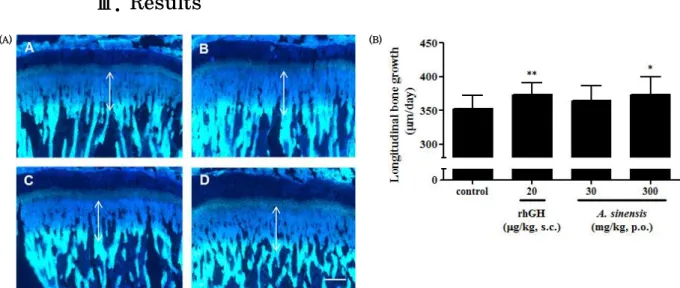
To evaluate the effect of A. sinensis on longitudinal bone growth rate, tetracycline was used as an intra- vital marker to label the anew formed bone of proximal tibia. The double-headed arrow indicates the length of bone growth in proximal tibial growth plate during 72 h period (Figure 1A). The distance was significantly increased by oral administration of A. sinensis at doses of 30 or 300 ㎎/㎏ compared with the control group.
Longitudinal bone growth rate in the control group was 352.8 ± 19.4 ㎛/day, and in rhGH treated group was 373.6
± 17.2 ㎛/day. Oral administrated A. sinensis 30 and 300
㎎/㎏ significantly increased the longitudinal bone growth rate by 364.7 ± 22.3 and 373.9 ± 25.5 ㎛/day.
(A) (B)
Figure 1. (A) Representative fluorescence photomicrographs of sagittal sections of proximal tibial growth plate in rats. The double- headed arrow shows the length between the proximal endpoint of the tetracycline label and the division line between growth plate and bone which indicates the length of bone growth in proximal tibial growth plate during 72 h period. a: vehicle treated control group, b:
rhGH 20 ㎍/㎏ (s.c.) treated group, c: A. sinensis 30 ㎎/㎏ (p.o.) treated group, d: A. sinensis 300 ㎎/㎏ (p.o.) treated group. The scale bar is 200 ㎛ (B) Effects of A. sinensis on longitudinal bone growth rate in proximal tibial growth plate. Each value is the mean ±SD.
2. Effect on Growth Plate Height
Height of growth plate was measured by CV staining.
Typical images of stained sections are shown in Figure 2.
The overall height of growth plate was 497.4 ± 20.8
㎛ in the control group and in rhGH treated group was
531.3 ± 27.7 ㎛. Oral administration of A. sinensis increased growth plate height exhibiting 510.9 ± 25.2 ㎛ at dose of 300 ㎎/㎏ but the difference was not statistically significant compared with the control group.
(A) (B)
photomicrographs of cresyl violet-stained chondrocytes of the proximal tibial growth plate in rats. a: vehicle treated control group, b:
rhGH 200 ㎍/㎏ (s.c.) treated group, c: A. sinensis 30 ㎎/㎏ (p.o.) treated group, d: A. sinensis 300 ㎎/㎏ (p.o.) treated group. The scale bar is 200 ㎛. (B) Effects of A. sinensis on overall height of proximal tibial growth plate. Each value is the mean ±SD.
3. Effects on IGF-1 and BMP-2 Expression
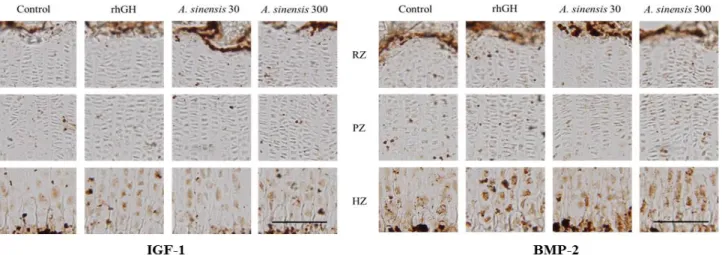
Protein expressions of IGF-1 and BMP-2 were assessed with antigenspecific immunohistochemistry in the proximal tibial growth plate. IGF-1 expression was higher in hypertrophic zones than in resting and proliferative zones.
Administration of A. sinensis or rhGH remarkably increased the IGF-1 expression intensity in the proliferative and hypertrophic zone compared with control. BMP-2 was more highly expressed in the hypertrophic zones and markedly increased by administration of A. sinensis or rhGH particularly.
Figure 5. Immunohistochemical localization of insulin-like growth factor-1 and bone morphogenetic protein-2 on the proximal tibial growth plate in rats, control: vehicle treated control group, rhGH: rhGH 200 μg/kg (s.c.) treated group, A. sinensis 30: A. sinensis 30 mg/kg (p.o.) treated group, A. sinensis 300: A. sinensis 300 mg/kg (p.o.) treated group, RZ: resting zone, PZ: proliferative zone, HZ:
hypertrophic zone. The scale bar is 100 μm.