제4차 산업혁명과 지능형 정부 운용전략에 대한 연구
-블록체인 기술의 전자정부 도입방안 측면에서-
이상윤*ㆍ윤홍주**
A Study on the 4th Industrial Revolution and Intelligent Government Operating Strategy
-In Terms of Block Chain Introduction Plans of Electronic Government-Sang-Yun Lee
*ㆍHong-Joo Yoon
**요 약
제4차 산업혁명시대의 지능형 전자정부와 같은 바람직한 미래형 전자정부의 구현에 있어, 블록체인 기술의 전자정부 도입 방안 측면에서 제4차 산업혁명과 지능형 정부 운용전략으로서 전자투표, 전자계약, 주민등록·전자문서 등의 관리, 부동산 등기 분야 의 네 가지 측면에서 심도있는 고찰을 수행하고 바람직한 전략을 제안하였다. 제4차 산업혁명시대는 정보 혹은 데이터의 공유, 개방, 소통, 공개를 특징으로 클라우드 컴퓨팅 체제에 정보 혹은 데이터를 집중하고 빅데이터를 분석하여 사물인터넷을 통해 정보를 수집하고 언제 어디서나 모바일 등의 스마트기기로 정보통신기술을 활용하여 인간의 행복을 증진시키는 것을 목 적으로 한다. 따라서 이를 위해서는 그 중심이 되는 정보 혹은 데이터에 대한 신뢰는 매우 중요하며 정보 혹은 데이터가 위변 조되지 않고 참여자 모두가 투명하게 공유하는 것이 중요하다. 즉 그런 점에서 보안성을 강화하여 신뢰성을 높일 수 있는 블 록체인 기술의 도입 또는 활용이야말로 필수적인데 여기서는 관련 선행연구를 검토하고 제4차 산업혁명과 지능형 정부 측면 에 대한 논의를 진행한 뒤 전자투표, 전자계약, 주민등록·전자문서 등의 관리, 부동산 등기 분야에서 제4차 산업혁명과 전자정 부 운용전략을 제시하였다.
ABSTRACT
In terms of realizing the future e-government such as intelligent government, this paper attempts to provide an earnest and insightful reflection and suggests desirable strategies with regard to the four different crucial elements including electronic voting, electronic contract, resident registration/electronic document management, and real-estate registration as an operating strategy of intelligent government and the fourth industrial revolution regarding. The 4th industrial revolution is aimed at concentrating information or data characterized with sharing, opening, communicating and releasing in cloud computing system, analyzing big data, collecting information, and flourishing people’s well-being by information and communications technology with utilizing the smart devices. Therefore, reliability of the pivotal information or data is critical and it is important for the participants being transparently shared, without the data or information being forged. In this respect, introduction or application of block chain technology is essential. This paper will review preceding studies, discuss the aspect of the 4th industrial revolution and intelligent government, then suggest operating strategies in the field of electronic voting, electronic contract, management of resident registration and electronic document and real-estate registration.
키워드
The 4th Industrial Revolution, Intelligent Government, Block Chain Technology, E-Government 제4차 산업혁명, 지능형 정부, 블록체인 기술, 전자 정부
* 부경대학교 공간정보시스템공학과([email protected])
** 교신저자 : 부경대학교 공간정보시스템공학과 ㆍ접 수 일 : 2018. 12. 04
ㆍ수정완료일 : 2019. 01. 09 ㆍ게재확정일 : 2019. 02. 15
ㆍReceived : Dec. 04, 2018, Revised : Jan. 09, 2019, Accepted : Feb. 15, 2019 ㆍCorresponding Author : Hong-Joo Yoon
Dept. of Spatial Information Engineering, Pukyoung National University Email : [email protected]
http://dx.doi.org/10.13067/JKIECS.2019.14.1.1
Ⅰ. Introduction
With regard to establishing intelligent government, the materialization of e-government which introduces and applies block chain technology is no longer a thing of the future but that of the present. block chain is one of the distinguishing technologies in the 4th industrial revolution which records and manages data through the chain of the blocks, where the authority to manage or record the data independently without presence of a central system.
Since the 4th industrial revolution which may be characterized by data’s opening, releasing, sharing, and communicating, the importance of security is increasingly being emphasized due to its nature of being open to the public. Strengthening the security on released data is crucial in order to prevent the data from being tampered or used for crimes.
Therefore, it is possible to say that block chain is an essential element in terms of enhancing the security technology for establishment of the future e-government in the 4th industrial revolution due to the openness of such data.
The establishment of future e-government has been often discussed by so-called realization of an intelligent government. Not only does the establishment of intelligent government that utilizes other characteristics of the 4th industrial revolution which are mobile, artificial intelligence, and the internet of things which in turn increases the chances of perfection of government 3.0 that emphasizes releasing, opening, communicating and sharing data but also the establishment is essential for the Korean government to obtain competitiveness to realize platform e-government utilizing big data and cloud computing.
This section will deal with the related discussion in terms of block chain introduction plans of e-government as operating strategies of intelligence government in the 4th industrial revolution.
Therefore, the review of the preceding studies will be performed followed by related discussions of electronic voting, electronic contract, resident registration/electronic document management, and real-estate registration.
Finally, the e-government operating strategies for desirable realization of future e-government which introduces and utilizes block chain technology in terms of establishing intelligent government in the 4th industrial revolution based on the suggested contents.
Ⅱ. The 4th Industrial Revolution and Block Chain Electronic Government
2.1 Related Research
In relation to the fourth industrial revolution, the preceding studies of electronic government approaches in terms of cloud computing, big data, artificial intelligence, and internet of things.
Although a number of preceding studies about electronic government can be found, the researches about information communication technology and electronics directly related to the fourth industrial revolution haven not adequately followed, which requires prudence due to the uncertain nature of the fourth industrial revolution.
Nevertheless, the recent research of S. Lee and H. Yoon(2012a) seeks establishing relative future competitive advantages of electronic government of Korea with cloud computing technology[1]. In addition, S. Lee and H. Yoon(2012b)[2] performed researches on big data electronic government and national informatization with utilization of public data. S. Lee and M. Chung(2016)[3] demonstrates exploratory researches of establishment of electronic government platform to provide customized public services in terms of administration process and improvement in administration information system.
S. Lee and H. Yoon(2016a)[4] suggests big data
administrative space information system and S. Lee and H. Yoon(2016b)[5] provides aspect of utilization of administration space information as metadata. S.
Lee and H. Yoon(2016c)[6] emphasizes importance of establishment of developed big data administrative space information system. S.
Lee(2017)[7] is a study in terms of electronic voting system in relation to electronic government. S.
Lee(2013)[8] is a study in terms of spatial information system, and S. Lee and M.
Chung(2014)[9] is a study of platform electronic government materialization. Lastly, S. Lee and H.
Yoon(2015)[10] is a study of governance risk management and S. Lee(2017)[11] is a study of electronic government and national informatization.
2.2 The Fourth Industrial Revolution and Intelligent Government.
The pursuit of e-government in South Korea is a result of over fifty years of research and development. It has also accumulated a large number of data in terms of administration and obtained its potential as a world-class competitor.
With the combination of digital data and artificial intelligence, it is now seeking a development potential in the areas of rationality in administration, improvement in science, and customized service sector according to region, social class, and circumstance.
In addition, as the recent appearance of Alphogo(Google) and Watson(IBM) which surpasses preexisting notion and realms to the level where an AI understands the desires and emotions of human, desirable future of e-government is now approaching ever closer to the development of information communication technology in the 4th industrial revolution. E-government in the future will outrun preexisting online-centered service provisions and consult the people and government officials’ convenience by utilizing data and artificial
intelligence in the openness of information and data, or so-called autonomously operating government, and it is desirable for the government to delve itself to achieve development to the point where the people are able feel and utilize e-government whenever and wherever by providing customized services including the ones directly pertinent to their daily lives.
However, due to the characteristic of the 4th industrial revolution that highlights openness, maintaining and protecting the security on personal and public information related to national security are essential and introduction block chain technology for administrative data and administration information is critical, as an essential element of establishing smart government. As a technology that enables a network where individuals are directly connected to one another or P2P(Peer-to-Peer), block chain does not require administrators nor central servers. Also, the blocks containing the ledgers of transactions between individuals are connected through a long online chain wherein various transactions can be conducted, and the transaction information forming a block will be transmitted to all of the network participants to be verified. Once the verification procedure has been completed, the block is then registered to the existing block chain hence it is difficult for individuals to manipulate data since the data that is consistent with more than a half of that of the users are verified.
If anyone attempts to manipulate the ledger, the
computation capacity must be higher than a half of
the users, which is practically impossible since the
benefit from the manipulation is less than the cost
of the manipulation. In terms of establishing an
e-government with an application of block chain
technology with reinforced security and in regard
to enhancement in e-democracy, adopting electronic
voting that utilizes block chain can improve
credibility of the voting practices. In the field of
real-estate registration, it enables verification of electronic documents which are impossible to forge or falsify because the administration data are combined and utilized based on block chain. In other words, it enables non-repudiation and prevention of double closing and paperless electronic real-estate contract and safer legal seals.
In terms of management of electronic documents and electronic contracts, enhanced security by adopting block chain technology enables advance warning, which further improves the system’s integrity among government officials by forecast and prevention of corruption and errors in administration with simultaneous comprehensive analysis using big data in administration data and information in administrative process in addition to boosting credibility of e-government.
Therefore, materialization of desirable future e-government, such as intelligent government, is one of the essential assignments for government innovation. The followings will further contemplate the operating strategies of intelligent government in terms of introduction of block chain to electronic government in the upcoming fourth industrial revolution such as electronic voting, electronic contract, management, resident registration and electronic documents, and real-estate registration.
Ⅲ. The 4th Industrial Revolution
and Intelligent Government Operating Strategies
3.1 Electronic Government and Electronic Voting
One of the biggest reasons that electronic government is unable to execute a full-scale electronic voting is credibility. Although election practices are some of the most desirable means of emphasizing a representation of an electronic democracy in an electronic government it has not been able to fully realized as of yet. Although
related information communication technologies have been developed, electronic voting has not been fully implemented among actual election sites due to lacking a more complete security technology for the problems of voting by proxy and the central system. However, block chain technology which appeared during the fourth industrial revolution recently has received attention as a key tool to solve credibility and security issues in electronic voting. It has been customary in paper ballot and existing electronic voting that the management authority or the central system is to be trusted in terms of the voting process and results.
Nonetheless, introduction of block chain technology allowed the voting results to be trusted by verifying the results without the central manager.
Namely, when using block chain, forging voting records is fundamentally impossible because all of the qualified voters themselves can verify the voting process and results. In addition, illegal voting is made impossible as well because the voters who participate in voting can inspect thoroughly if the voting results have been counted according to the actual regulation.
Consequently, the degree of completion of representative democracy will be enhanced and the citizens or public at large promote empathy and credibility on decision making and decision topics through improved voting rate among the people as a whole. Therefore, it is an utmost priority to introduce block chain technology in materializing a desirable and intelligent government.
3.2 Electronic Government and Electronic Contract
At present, the ministry of Land, Infrastructure,
and Transport of Korea is currently operating
electronic contract system. The electronic contract
for real estate from the government is identical to
existing real-estate transaction process and is
characterized by switching from filling out paper
based contracts to that of using electronic devices such as computers, tablets, PCs, and smartphones.
It is no longer necessary to visit Community Service Center because a fixed date and a real transaction are automatically given by self-verification through the official electronic signature of an individual in the overall transaction process. However, aforementioned problem of electronic contract system regarding the real-estate transaction prepared and operated by the government is that it relies on an official electronic signature by individuals for security aspect. Since the system is not applied with up-to-date block chain technology, the credibility on its security is not yet reliable, therefore it is necessary to proactively adopt block chain technology. In other words, it is critical to adopt block chain technology to enhance the system’s stability prior to adoption of the electronic contract system in order to activate real-estate transaction and land register which already has been implemented among developed countries.
3.3 Electronic Government and Real-estate Registration
As previously mentioned, the real-estate electronic contract system that utilizes block chain definitely has more potential for practical application and therefore it needs to be adopted expeditiously.
In more practical terms, since real-estate transaction itself contains sensitive personal information promptly adopting block chain technology resulting in an enhancement of its security and heightened recognition and accessibility of real-estate information. In preexisting real-estate transactions, the related parties consist of land registry office, buyers, sellers, their real-estate agents or managers, legal staffs or lawyers for delegation, loan providers such as bank and loan research analysist. Similarly stated, a wide variety of expenses occur on the sellers and buyers in
addition to the other time consumption criteria on many unnecessary previously mandatory procedures.
If block chain technology that is enhanced with mutual security among the participants is adopted and applied for the transaction procedures, the expense and time requirement will be reduced.
Moreover, unnecessary delays due to multitude of procedures in many different processes can be prevented on top of saving time and expenses which previously occurred among the related parties in the transaction. With regard to the real-estate registration which occurs frequently among daily lives of the people, introducing block chain technology improves satisfaction and convenience of the people in terms of administrative service of the government and thus bring about numerous positive effects.
3.4 Management of Electronic Government and Resident Registration·Electronic Document
As mentioned earlier, adopting and utilizing
block chain technology in terms of real-estate
registration can improve effectiveness and
efficiency in administration, and the same applies to
resident information registration. Characterized by
decentralization and aiming sharing in networking,
block chain technology is superior to preexisting
technologies at preventing forging with enhanced
security. The main purpose of resident registration
is to expedite management of identity and improve
administration efficiency of the government. In the
networking system which is applied with block
chain technology, the relevant authorities of
government can share history of personal identity
in real time. In other words, it allows
identity-related tasks to be expedited as in an
instance in social welfare. As such it will no
longer be necessary to request identity verification
among government authorities such as Community
Service Centers and Ministry of Health and
Welfare, which is possible thanks to block chain having been sharing identity information. Therefore, unlike current system under which electronic documents are being managed by central system of local government or authorities to provide the service, if block chain technology is applied on electronic document such as resident registration, different local governments and authorities will be able to share electronic document in real-time and save time in sharing and reviewing documents when in their interaction due to information provided from local governments and authorities being recorded in real-time for that specific purpose.
Consequently, taking the initiative in adopting block chain technology with regard to resident registration and electronic document management as operating strategies of intelligent government and fourth industrial revolution is extremely essential.
Table. 1. The Fourth Industrial Revolution and E-Government Strategy
D ivision Strategy
Electronic Voting
-Im proving electronic dem ocracy by provide the voters rights to participate in block chain established for voting.
-M aterialized for voting details to encrypted and for voting results to be opened
Electronic Contract
-M utually agreed contents of the contract being encrypted and distributively saved in block chain
-D ecoding of the contract available with a personal key retained only by the contract parties
Real-estate Registration
-Swift m aterialization of electronic contract system in real-estate w hich has been adopted with block chain technology with enhanced reliability
-Saving tim e and cost am ong m ultiple participants in transaction and participation of those who desire to open real-estate registration participating in block chain Resident
Registration, Electronic Docum ent M anagem ent
-Block chain saving tim e and cost needed to share and review the docum ents for cooperation purposes as sim ultaneously sharing am ong departm ents and local governm ent
-The entire inform ation being encrypted and decoding for those w ho have an access to brow se
Ⅳ. Discussion
Hitherto block chain technology is contemplated in terms of adoption of electronic government as an operating strategy of intelligent government and fourth industrial revolution for electronic voting, electronic contract, resident registration/electronic document management, and real-estate registration(table 1). In relation to this, the following is the suggestion, advantages, plan and operating strategy in terms of Materialization of electronic government adopting block chain technology.
The benefits of the plans and operating strategies suggested are as follows: Firstly, block chain technology applied in electronic voting would improve reliability which in turn would result in an enhancement in electronic democracy as well as representative democracy. To enhance reliability of encrypted voting contents, it is desirable to disclose the voting result to all participants in real time.
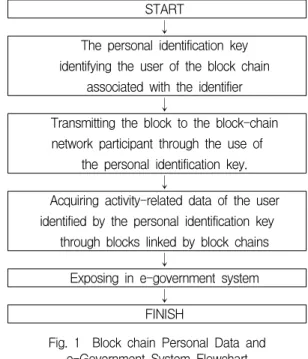
START
↓
The personal identification key identifying the user of the block chain
associated with the identifier
↓
Transmitting the block to the block-chain network participant through the use of
the personal identification key.
↓
Acquiring activity-related data of the user identified by the personal identification key
through blocks linked by block chains
↓
Exposing in e-government system
↓ FINISH
Fig. 1 Block chain Personal Data and e-Government System Flowchart
with Operation Algorithm
Secondly, With a benefit of enhanced security by encoding the contents of the contracts and storing them in block chain, it is necessary to make further improvement in security and reliability of electronic contract in which only participants themselves are allowed access with their respective personal keys to decode the content. Thirdly, one of the advantages of the plans and operating strategies suggested in the field of real estate registration are as follows: It is critical to materialize electronic contract system with block chain technology adopted in the field of real-estate as transactions in real-estate fields containing sensitive information between individuals.
Furthermore, the policy would not only prevent unnecessary delays in multiple phases of it implementation but would also reduce the cost required for the parties involved in the transactions, which would in turn encourage further interested parties who wish to access real-estate registration or other legal registry in order to participate in block chain. The fourth merit of the strategies suggested are as follows: block chain allows local governments and relevant departments to save time and cost by sharing electronic documents simultaneously. In order to realize the objective, all of the pertinent information needs to be encrypted and only the permitted is allowed to decode it.
Therefore, Figure 1 shows the process of personal data processing in four aspects of electronic voting, electronic contracts, management of resident registration and electronic documents, and real estate registration in order to improve understanding of the implementation of e-government applying the above-mentioned block chain technology. Also, figure 1 shows a schematic overview of the e-government system that has been filed and reviewed as a present patent proposed by the present study.
Ⅴ. Conclusion
The advantage of block chain to electronic
government is its better security because block
chain itself is characterized by distributed ledgers
which in itself serve as a potent deterrence against
forging and falsification. Also, in terms of
reliability, all of the participants are allowed to
have an access to information which is separately
saved. Moreover, the absence of a central
organization results in efficiency and no further
cost is required in the central processing. This
paper considers various venues of desirable
introduction and strategies of block chain in the
fourth industrial revolution in terms of benefits
gained on electronic government as described. In
other words, the aforementioned points including
electronic voting, electronic contract, resident
registration, electronic document management and
real-estate registration are considered and provided
with desirable strategies to materialize intelligent
government in the fourth industrial revolution. The
fourth industrial revolution which is characterized
by sharing, opening, communicating, and improving
happiness of the people by concentrating data in
cloud computing system and using internet of
things, and smart devices to collect and analyze big
data. In order to achieve the goals, it is important
for all of the participants to transparently share the
information or data so that they would not be
susceptible for forging and falsification which
would jeopardize user credibility. Adopting and
applying block chain technology is crucial especially
in terms of enhancing security which would yield
user credibility. In this paper, an examination on
relevant preceding researches and a discussion on
intelligent government in the fourth industrial
revolution have been made followed by various
feasible operating strategies on electronic voting,
electronic contract, resident registration, electronic
document management and real-estate registration.
Also, this paper confirmed a schematic flowchart of the current patent pending e-government system.
References
[1] S. Lee and H. Yoon, “The Study on Development of Technology for Electronic Government of S. Korea with Cloud Computing analysed by the Application of Scenario Planning,” J. of the Korea Institute of Electronic Communication Sciences, vol. 7, no. 6, 2012, pp. 1245-1258.
[2] S. Lee and H. Yoon, “The Study on Strategy of National Information for Electronic Government of S. Korea with Public Data analysed by the Application of Scenario Planning,” J. of the Korea Institute of Electronic Communication Sciences, vol.
7, no. 6, 2012, pp. 1259-1273.
[3] S. Lee and M. Chung, “An Exploratory Study on Construction of Electronic Government as Platform with Customized Public Services: to Improve Administrative Aspects of Administrative Processes and Information Systems," J. of Digital Convergence, vol. 14, no. 1, 2016, pp. 1-11.
[4] S. Lee and H. Yoon, “A Study on Smart Eco-city and Ubiquitous Administrative Spatial Informatization : In terms of Water Pollution and Disaster Prevention of Busan Ecodeltacity,”
J. of the Korea Institute of Electronic Communication Sciences, vol. 11, no. 9, 2016, pp. 827-839.
[5] S. Lee and H. Yoon, “A Study on the Administrative Spatial Informatization and Ubiquitous Smart City: Focus on Busan Centum City,” J. of the Korea Institute of Electronic Communication Sciences, vol. 11, no. 4, 2016, pp.
351-364.
[6] S. Lee and H. Yoon, “A Study on the Ferry Sewol Disaster Cause and Marine Disaster Prevention Informatization with Big Data : In terms of ICT Administrative Spatial Informatization and Maritime Disaster Prevention System development,” J. of the Korea Institute of Electronic Communication Sciences, vol.
11, no. 6, 2016, pp. 567-579.
[7] S. Lee, “The study of Internet Electronic Voting of S. Korea with Spatial Information System
analysed by the Application of Scenario Planning," J. of Korea Technology Innovation Society, vol. 15, no. 3, 2012, pp. 604-626.
[8] S. Lee, “A Study on Technology Policy with Spatial Information System of S. Korea Analysed by the Application of Scenario Planning,” J. of Korea Technology Innovation Society, vol. 16, no. 1, 2013, pp. 130-155.
[9] S. Lee and M. Chung, “A Study on ‘Platform’
e-Government for Reducing the digital divide in a Multicultural Society of S. Korea,” J. of Digital Convergence, vol. 12, no. 1, 2014, pp. 1-12.
[10] S. Lee and H. Yoon, “A Study on System for Policy Promotion of Korean Nuclear Power:
Risk Governance with Additional Construction of Nuclear Power Plants,” J. of the Korea Institute of Electronic Communication Sciences, vol. 10, no.
1, 2015, pp. 81-94.
[11] S. Lee, “A Study on Policy of National Informatization with Electronic Government of S.
Korea : Governance Strategy for Government by the Application of ‘scenario planning’,” J. of the Korean Association For Regional Information Society, vol. 20, no. 1, 2017, pp. 21-55.
저자 소개
이상윤(Sang-Yun Lee)
2002년 부산대학교 조선해양공학 과 졸업(공학사)
2009년 부산대학교 대학원 정치 외교학과 졸업(정치학석사) 2011년 부산대학교 대학원 공학박사(STS)수료 2013년 한국행정학회 학술정보이사
2014년 부산대학교 대학원 공공정책학 박사 2014년 ~ 한국전자통신학회 총무이사
2013년 ~ 2014년 부경대학교 공간정보연구소 소장 2015년 ~ 현재 부경대학교 행정공간정보화연구소 부연구소장
2015년 한국이민정책학회 학술정보이사 2016년 (사)한국생태공학회 부회장
※ 관심분야 : 정보기술정책, 전자정부, 행정공간정
보화, 이민다문화와 사이버안보, 빅데이터 디지털
정책
윤홍주(Hong-Joo Yoon)