344
Copyright © 2019 The Korean Society of Fisheries and Aquatic Science pISSN:0374-8111, eISSN:2287-8815
서 론
굴은연간국내의전체패류생산량중
77.54%
를차지할정도 로주요양식자원으로알려져있다(MOF, 2017).
굴은일반적 으로11
월부터4
월까지는생식으로많이소비되며, 5
월부터8
월사이에는주로냉동품,
건제품및통조림등으로가공되어수 출되고있다(Kim et al., 2002).
대부분의굴은탈각후생식용 생굴또는냉동굴로유통되는비중이높다.
하지만굴탈각장은FDA (food drug administration)
나EU (European union)
등록 공장을제외하고는관련법규나전처리가공공장관리규정이 미흡한위생관리의사각지대에놓여있다(Kang et al., 2016).
생식용굴의특성상작업자의수작업에의해탈각하여 제조
되며 날것으로 섭취하기 때문에생산단계에서 오염될수 있 는위해요소들로인해인체에해를끼칠수있다
(Sobsey and Jaykus, 1991; Kang et al., 2017).
국내식중독은다양한경로에의해발생되고있으며그원인 은대부분명확히규명되지않고있다
(Kim et al., 2005).
이에 식품의생산,
유통및조리등에관련된식품취급자들의경우 장갑착용을권장하고있으나(Lee et al., 2009),
장시간장갑사 용및교체없이지속적인작업을할경우발생할수있는미생 물증식에대한연구는부족한실정이다(Park et al., 2010).
생식 용굴의위생과관련된연구는국내외에서다양하게수행되어 왔지만(Choi et al., 1998; Jeong et al., 2004; Lee, 2006; Vugia et al., 2013; Baker, 2016; Kang et al., 2016; Kwon et al., 2017;
참굴(Crassostrea gigas) 탈각 공정에서 작업자 장갑에 의해 발생하는 미생물학적 위해요소 분석
강민균·박슬기·강동민·이도하·조두민·이장원·이재화·신일식
1·김영목*
부경대학교 식품공학과 ∙ 1강릉원주대학교 해양식품공학과
Analysis of Microbiological Hazards From Working Gloves Used in the Processing of Shucked Pacific Oyster Crassostrea gigas
Min-Gyun Kang, Seul-Ki Park, Dong-Min Kang, Do-Ha Lee, Du-Min Jo, Jang-Won Lee, Jae-Hwa Lee, Il-Shik Shin1 and Young-Mog Kim*
Department of Food Science and Technology, Pukyong National University, Busan 48513, Korea
1Department of Marine Food Science and Technology, Gangneung-Wonju National University, Gangneung 25457, Korea
This study assessed the microbiological hazards of gloves worn during the shell shucking process of the oyster Crassostrea gigas , and we suggest an in situ method for minimizing microbial contamination. The study consisted of two groups, one in which the working gloves were periodically replaced (PRG) with new gloves, and another in which the gloves were not replaced (NRG). In the PRG group, gloves were replaced every 2 h during 8 h of process- ing. Food pathogenic bacteria Escherichia coli , Salmonella species, and Listeria monocytogenes were not found in any samples, including gloves and shucked oysters. However, Staphylococcus aureus (SA) was detected in some samples, and the contamination levels were correlated with the working time and the regular replacement of gloves.
SA was not detected on gloves or oysters of the PRG group. However, it was detected in the range of <15 CFU/15 cm
2to 2.9 ×10² CFU/15 cm
2on gloves after 6 h of continuous work, and from <15 CFU/15 cm
2to 2.23 ×10² CFU/15 cm
2on oysters after 8 h. These results indicate that the SA contamination in shucked oysters originated from the work- ing gloves, and that replacement of working gloves every 2-4 h will minimize SA contamination in oyster products.
Key words: Working glove, Microbial hazard, Oyster, Processing process
*Corresponding author: Tel: +82. 51. 629. 5832 Fax: +82. 51. 629. 5824 E-mail address: [email protected]
This is an Open Access article distributed under the terms of the Creative Commons Attribution Non-Commercial Licens (http://creativecommons.org/licenses/by-nc/3.0/) which permits unrestricted non-commercial use, distribution, and reproduction in any medium, provided the original work is properly cited.
Received 9 July 2019; Revised 30 July 2019; Accepted 19 August 2019
저자 직위: 강민균(대학원생), 박슬기(대학원생), 강동민(대학원생), 조두민(
대학원생), 이장원(대학원생), 이재화(대학원생), 신일식(교수), 김영목(교수) https://doi.org/10.5657/KFAS.2019.0344
Korean J Fish Aquat Sci 52(4), 344-348, August 2019
Kang et al., 2017; Mok et al., 2018)
기존의연구들은각가공 공정중일부의공정에서미생물학적및이화학적위해요소에 대한것이며실제현장에적용할수있는방안에대한연구는부 족하다.
특히,
공정중작업자장갑에의한미생물오염도분석 및관리방안에대한연구는매우미미하다.
이에,
본연구에서 는생식용굴탈각공정의위생방안마련을위한기초연구자 료를확보하고자작업자장갑에대한미생물학적위해요소를 분석하였으며위생과작업자안전을위해사용되는작업자장 갑에의한생식용굴의오염실태를분석하고이에대한방안을 제시하고자한다.
재료 및 방법
시료 채취
탈각굴시료및작업자장갑시료의채취는경상남도 통영 시의
1
곳의업체에서진행하였다.
총작업자20
명의장갑을2
개의실험군으로나누어2
시간마다8
시간동안채취하였다.
1
개의실험군은2
시간마다사용한장갑을멸균된시료채취팩
(Whirl-Pak® bags; Nasco, Fort Atkinson, WI, USA)
을이 용하여채취하였고,
나머지1
개의실험군은장갑교체없이사 용중인장갑의표면을pipette swab plus (3M Microbiology, St. Paul., MN, USA)
를사용하여시료를채취하였다(APHA, 2001).
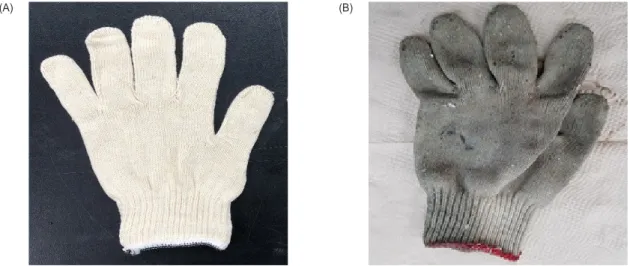
본연구에사용된장갑은면으로구성된면장갑(cotton glove)
를이용하였다(Fig. 1).
모든시료는냉장온도(4°C
이하)
에서보관및운반하여12
시간이내에실험을진행하였다. 일반세균수, 대장균군, 대장균 및 식중독 세균 분석
일반세균수
(viable cell count, VCC),
대장균군(total coli- form, TC)
및대장균(Escherichia coli, EC)
의분석은식품공전(MFDS, 2018)
의일반시험법중미생물시험법에준하여실험을진행하였다
.
채취한탈각굴시료25 g
에0.1 M phosphate buffer saline (PBS, pH 7.2) 225 mL
로10
배희석한후120
초 간stomacher (Bag Mixer 400VW, Interscience, Saint Nom, France)
를이용하여균질화하였다.
VCC
는시료균질액1 mL
를취하여9 mL PBS (phosphate buffer saline)
에단계별로희석하였다.
각단계희석액을pet- rifilm
TMaerobic count plate (3M Microbiology products, St.
Paul, MN, USA)
에분주하여접종한후, 35±1°C
에48±2
시 간동안배양한후생성된집락수를계수하였다. TC
및EC
는VCC
와같은방법으로시료균질액을희석한후각단계희석액을
petrifilm
TMcoliform count plate (3M Microbiology prod- ucts, St. Paul, MN, USA)
와petrifilm
TME. Coli count plate (3M Microbiology products, St. Paul, MN, USA)
에각각분 주하여 접종한 후TC
는35±1°C
에24±2
시간 동안, EC
는35±1°C
에24-48
시간동안배양하였다. TC
는적색또는보라 색의집락수를계수하였고, EC
는푸른집락주위에기포를형 성한집락수를계수하였다.
또한
,
주요식중독원인균중황색포도상구균(Staphylococ- cus aureus, SA)
살모넬라 속(Salmonella sp., SAL)
및리스 테리아모노사이토제네스(Listeria monocytogenes, LM)
총3
종에대한분석을진행하였으며식중독세균분석은식품공전(MFDS, 2018)
의미생물시험법에준하여실험을진행하였다.
결과 및 고찰
장갑 교체에 따른 탈각 굴의 미생물 및 식중독 세균 분석
굴탈각공정중작업자장갑을
2
시간간격으로새장갑으로 주기적으로교체하는공정(PRG)
과장갑을교체하지않고연속적으로사용하는공정
(NRG)
에서채취한탈각굴시료에대한Fig. 1. Before (A) and after (B) using gloves used to oyster Crassostrea gigas shell shucking process.
(A) (B)
VCC, TC,
및EC
오염도에대한분석결과와식중독세균(SA, SAL
및LM)
분석결과를Table 1
에나타내었다.
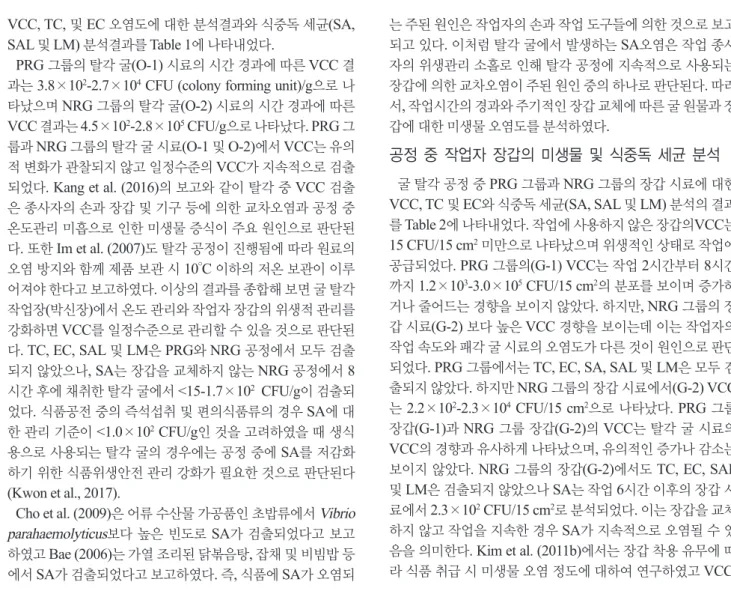
PRG
그룹의탈각굴(O-1)
시료의시간경과에따른VCC
결 과는3.8×10
2-2.7×10
4CFU (colony forming unit)/g
으로나 타났으며NRG
그룹의탈각굴(O-2)
시료의시간경과에따른VCC
결과는4.5×10
2-2.8×10
5CFU/g
으로나타났다. PRG
그 룹과NRG
그룹의탈각굴시료(O-1
및O-2)
에서VCC
는유의 적변화가관찰되지않고일정수준의VCC
가지속적으로검출 되었다. Kang et al. (2016)
의보고와같이탈각중VCC
검출 은종사자의손과장갑및기구등에의한교차오염과공정중 온도관리미흡으로인한미생물증식이주요원인으로판단된 다.
또한Im et al. (2007)
도탈각공정이진행됨에따라원료의오염방지와함께제품보관시
10°C
이하의저온보관이이루어져야한다고보고하였다
.
이상의결과를종합해보면굴탈각 작업장(
박신장)
에서온도관리와작업자장갑의위생적관리를 강화하면VCC
를일정수준으로관리할수있을것으로판단된 다. TC, EC, SAL
및LM
은PRG
와NRG
공정에서모두검출 되지않았으나, SA
는장갑을교체하지않는NRG
공정에서8
시간후에채취한탈각굴에서<15-1.7×10
2CFU/g
이검출되 었다.
식품공전중의즉석섭취및편의식품류의경우SA
에대 한관리기준이<1.0×10
2CFU/g
인것을고려하였을때생식 용으로사용되는탈각굴의경우에는공정중에SA
를저감화 하기위한식품위생안전관리강화가필요한것으로판단된다(Kwon et al., 2017).
Cho et al. (2009)
은어류수산물가공품인초밥류에서Vibrio parahaemolyticus
보다높은빈도로SA
가검출되었다고보고 하였고Bae (2006)
는가열조리된닭볶음탕,
잡채및비빔밥등 에서SA
가검출되었다고보고하였다.
즉,
식품에SA
가오염되는주된원인은작업자의손과작업도구들에의한것으로보고 되고있다
.
이처럼탈각굴에서발생하는SA
오염은작업종사 자의위생관리소홀로인해탈각공정에지속적으로사용되는 장갑에의한교차오염이주된원인중의하나로판단된다.
따라 서,
작업시간의경과와주기적인장갑교체에따른굴원물과장 갑에대한미생물오염도를분석하였다.
공정 중 작업자 장갑의 미생물 및 식중독 세균 분석
굴탈각공정중PRG
그룹과NRG
그룹의장갑시료에대한VCC, TC
및EC
와식중독세균(SA, SAL
및LM)
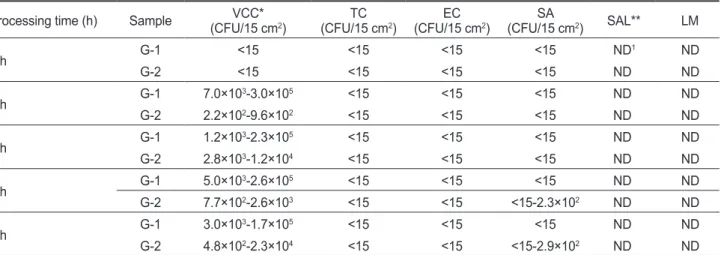
분석의결과 를Table 2
에나타내었다.
작업에사용하지않은장갑의VCC
는15 CFU/15 cm
2미만으로나타났으며위생적인상태로작업에공급되었다
. PRG
그룹의(G-1) VCC
는작업2
시간부터8
시간 까지1.2×10
3-3.0×10
5CFU/15 cm
2의분포를보이며증가하 거나줄어드는경향을보이지않았다.
하지만, NRG
그룹의장 갑시료(G-2)
보다높은VCC
경향을보이는데이는작업자의 작업속도와패각굴시료의오염도가다른것이원인으로판단 되었다. PRG
그룹에서는TC, EC, SA, SAL
및LM
은모두검 출되지않았다.
하지만NRG
그룹의장갑시료에서(G-2) VCC
는2.2×10
2-2.3×10
4CFU/15 cm
2으로나타났다. PRG
그룹 장갑(G-1)
과NRG
그룹장갑(G-2)
의VCC
는탈각굴시료의VCC
의경향과유사하게나타났으며,
유의적인증가나감소는 보이지않았다. NRG
그룹의장갑(G-2)
에서도TC, EC, SAL
및LM
은검출되지않았으나SA
는작업6
시간이후의장갑시 료에서2.3×10
2CFU/15 cm
2로분석되었다.
이는장갑을교체 하지않고작업을지속한경우SA
가지속적으로오염될수있 음을의미한다. Kim et al. (2011b)
에서는장갑착용유무에따 라식품취급시미생물오염정도에대하여연구하였고VCC,
Table 1. Microbial analysis of raw oysters Crassostrea gigas according to the periodically replaced or not replaced gloves
Processing time (h) Sample VCC*
(CFU/g) TC
(CFU/g) EC
(CFU/g) SA
(CFU/g) SAL** LM
0 h O-1 2.5×10³-2.7×10⁴ <15 <15 <15 ND1 ND
O-2 4.5×10²-2.1×10⁴ <15 <15 <15 ND ND
2 h O-1 6.8×10²-2.0×10⁴ <15 <15 <15 ND ND
O-2 7.4×10²-2.0×10⁴ <15 <15 <15 ND ND
4 h O-1 1.4×10³-3.6×10³ <15 <15 <15 ND ND
O-2 7.9×10²-3.5×10³ <15 <15 <15 ND ND
6 h O-1 3.8×10²-3.5×10³ <15 <15 <15 ND ND
O-2 2.2×10³-2.2×10⁴ <15 <15 <15 ND ND
8 h O-1 1.2×10³-6.2×10³ <15 <15 <15 ND ND
O-2 1.2×10³-2.8×10⁵ <15 <15 <15-1.7×10² ND ND
O-1 means raw oyster processed by using periodically replaced gloves and O-2 means raw oyster processed by using not replaced gloves during oyster shell shucking process. 1ND, not determined. *VCC, viable cell counts; TC, Total coliform group; EC, Escherichia coli; SA, Staphylococcus aureus; SAL, Salmonella sp.; LM, Listeria monocytogenes. **The presences of Salmonella sp., and L. monocytogenes were determined by the enrichment culture methods.
TC, EC, SA
및SAL
에대하여분석하였다.
결과적으로맨손으 로식품을취급할경우장갑을사용한경우보다모든실험결과 에서미생물오염도가높게분석되었으며,
이를통해장갑을사 용하여식품을취급하는것이중요한위생적요인으로판단된 다.
하지만,
본결과에서나타나듯이위생적으로관리가되지않 은장갑을지속적으로사용할경우장갑을통해서원료에교차 오염을일으킬수있으며작업자장갑시료로부터SAL
및LM
과같은위해도가높은주요식중독균은검출되지않았지만상 대적으로저위해도인SA
는지속적으로검출되었다.
이러한결 과는굴탈각공정의작업자장갑에의한탈각굴에서SA
오염 을저감화하기위해서는보다적극적인위생적관리방안이필 요하다는것을의미한다(Kwon et al., 2017; Jeong et al., 2018;
Kim et al., 2018).
굴 탈각 공정 중 SA 오염 저감화를 위한 현장적용 방안
Table 2
에나타난것처럼작업용장갑을교체하지않고지속적으로사용할경우작업시간이경과함에따라
SA
가지속적으 로검출되며이로인해생식용굴에교차오염을일으킬수있다.
특히, SA
의경우에는작업6
시간이후장갑에서<15-2.3×10
2CFU/15cm
2으로검출되어굴탈각공정중에오염된장갑사용 에의한교차오염이발생할수있는것으로판단되어굴탈각공 정중에SA
를포함한미생물오염저감화노력이필요하다고 판단된다.
작업자손과장갑에의한미생물오염과저감화에대 하여단체급식소에서식중독저감화를위해작업자의손과장 갑에대한미생물위해분석(Park et al., 2010)
과세척방법에 따른조리종사자손과장갑의미생물저감효과(Jeong, 2008)
등이보고되었다.
또한,
딸기의생산단계에서사용되는장갑의 경우미생물오염이지속적으로발생하며이를관리하기위한 방안으로세척과교체등의방법을제시하고있다(Kim et al.,
2017).
또한,
포장돈육가공공정중작업자장갑과돈육의교차 오염도를연구한결과에서면으로구성된장갑이polyethylene
소재장갑에비해미생물교차오염율이높으며이는면장갑의 높은흡수성과관련이있음이보고되어있다(Kim et al., 2011a).
굴탈각공정중에사용되는장갑은면소재의장갑으로
poly-
ethylene
장갑으로교체할경우오염도가낮아질수있을것으로예상된다
.
하지만장갑의교체는위생뿐아니라작업자의안 전또한고려되어야하므로polyethylene
등으로코팅된면장 갑등의현장적용이검증되어야할것으로판단된다.
기존의선행연구결과와마찬가지로본연구결과에서도굴 탈각공정중작업자장갑의관리는매우중요한위생관리요소 로판단된다
.
즉,
굴탈각공정에종사하는종업원의위생교육 과가공공정에사용되는기구및설비의주기적인세척및소 독등의식품위생안전관리를강화한다면안전한탈각굴(
생굴)
을생산할수있을것으로판단된다.
본연구에서는굴탈각공 정중작업자장갑에의한교차오염에대한미생물학적위해요 소를분석하였고굴탈각작업자의장갑을교체하지않았을시 작업6
시간이후부터SA
가검출되고있으며생식용으로판매 되는탈각굴의경우작업자장갑을2
시간또는4
시간마다장 갑을교체하면미생물학적오염을감소시킬수있으며특히지 속적으로검출되는SA
에대한오염도감소시킬수있을것으 로분석된다.
사 사
이논문은
2019
년도식품의약품안전처에서시행한용역연구개발과제의연구개발비지원
(18162MFDS543)
에의해수행되 었으며이에감사드립니다.
Table 2. Microbial analysis of working gloves according to the periodically replaced or not replaced gloves
Processing time (h) Sample VCC*
(CFU/15 cm2) TC
(CFU/15 cm2) EC
(CFU/15 cm2) SA
(CFU/15 cm2) SAL** LM
0 h G-1 <15 <15 <15 <15 ND1 ND
G-2 <15 <15 <15 <15 ND ND
2 h G-1 7.0×10³-3.0×10⁵ <15 <15 <15 ND ND
G-2 2.2×10²-9.6×10² <15 <15 <15 ND ND
4 h G-1 1.2×10³-2.3×10⁵ <15 <15 <15 ND ND
G-2 2.8×10³-1.2×10⁴ <15 <15 <15 ND ND
6 h G-1 5.0×10³-2.6×10⁵ <15 <15 <15 ND ND
G-2 7.7×10²-2.6×10³ <15 <15 <15-2.3×10² ND ND
8 h G-1 3.0×10³-1.7×10⁵ <15 <15 <15 ND ND
G-2 4.8×10²-2.3×10⁴ <15 <15 <15-2.9×10² ND ND
G-1 means periodically replaced gloves at every 2 h and G-2 means not replaced gloves during oyster shell shucking process. 1ND, not de- termined. *VCC, viable cell counts; TC, Total coliform group; EC, Escherichia coli; SA, Staphylococcus aureus; SAL, Salmonella sp.; LM, Listeria monocytogenes. **The presences of Salmonella sp., and L. monocytogenes were determined by the enrichment culture methods.
References
APHA (American Public Health Association). 2001. Compen- dium of methods for the microbiological examination of foods (4th Ed), American public health association, Wash- ington DC, U.S.A., 26-35.
Baker IL. 2016. Public Perceptions and Pesticides - A case study of the Willapa Bay oyster bed spraying permit of 2015. MS Thesis, University of Washington, Washington DC, U.S.A.
Bae HJ. 2006. Analysis of contamination of bacteria from raw materials, utensils and workers’ hands to prepared foods in foodservice operations. Korean Soc Food Sci Nutr 35, 655- 660. https://doi.org/10.3746/jkfn.2006.35.5.655.
Cho SK, Moon BY and Park JH. 2009. Microbial contamination analysis to assess the safety of marketplace sushi. Korean J Food Scl Technol 41, 334-338.
Choi JD, Jeong WG and Kim PH. 1998. Bacteriological study of sea water and oyster in Charan Bay, Korea. Korean J Fish Aquat Sci 31, 429-436.
Im MN, Lee SJ and Lee KG. 2007. Quantitative risk assess- ment modeling for Staphylococcus aureus in sushi. Food Eng Prog 11, 77-83.
Jeong IG, Park JH, Yoo HD and Choi JD. 2004. Sanitary survey of the sea water and oyster in the south coastal designated area. J Ins Mar Indust 17, 29-37.
Jeong MC, Kang MG, Jang YM, Lee DH, Park SK, Shin IS and Kim YM. 2018. Hazard analysis of food safety in processing process of simple-processed fishery products. Korean J Fish Aquat Sci 51, 518-523.
Jeong BH. 2008. Reduction effect of bacterial populations by education of employee's in restaurant for hygiene and wash- ing method. MS Thesis. Gyeongsang National University, Jinju, Korea.
Kang KT, Kim MJ, Park SY, Choi JD, Heu MS and Kim JS.
2016. Risk assessment of oyster Crassostrea gigas process- ing site for HACCP system model. Korean J Fish Aquat Sci 49, 533-540.
Kang KT, Park SY, Choi JD, Kim MJ, Heu MS and Kim JS.
2017. Safety monitoring of a processing plant for prepar- ing raw oyster Crassostrea gigas for consumption. Korean J Fish Aquat Sci 50, 120-129.
Kim HJ, Lee DS, Lee JM, Kim YM and Shin IS. 2018. Bacte- riological hazard analysis in minimally processed shellfish products purchased from Korean seafood retail outlets. Ko- rean J Fish Aquat Sci 51, 121-126. https://doi.org/10.5657/
KFAS.2018.0121.
Kim JG, Park JY and Kim JS. 2011a. A comparison of microbial load on bare and gloved hands among food handlers. J Env Hlth Sci 37, 298-305.
Kim JS, Yeum DM, Kang HG, Kim IS, Kong CS, Lee TG and Heu MS. 2002. Fundamentals and application for canned foods. Hyoil Publishing Co., Seoul, Korea, 59-329.
Kim SA, Lee JE, Kim GU, Kim SH and Shim WB. 2017. Micro- bial monitoring and exploring ways to prevent or minimize microbial contamination at the production and distribution stages of fresh strawberries. J Food Hyg Saf 32, 485-492.
Kim SH, Sin YM, Lee MJ, Shin PK, Kim MG, Cho JS, Lee CH, Lee YJ and Chae KR. 2005. Isolation of major foodborne pathogenic bacteria from ready-to-eat seafoods and its re- duction strategy. J Life Sci 15, 941-947.
Kim SJ, Park MS, Bahk GK, Rahman S, Park JH and Oh DH.
2011b. Transfer rate of cross contamination of Listeria
monocytogenes between pork meat and worker's hands dur-
ing pork meat processing. J Food Hyg Saf 26, 330-335.Kwon KO, Ryu DG, Jeong MC, Kang EH, Shin IS and Kim YM. 2017. Microbiological and physicochemical hazard analysis in processing process of simple-processed shellfish products. Korean J Fish Aquat Sci 50, 352-358.
Lee H. 2006. Microbiological population of Vibrio parahaemo-
lyticus in oyster wholesale seafood markets. J Food Hyg Saf
21, 238-243.Lee HW, Yoon YH, Seo EK, Kim KY, Shim WB, Kil JK and Chung DH. 2009. Microbiological hazard analysis for ag- ricultural products processing center of tomato and recom- mendations to introduce good agricultural practices (GAP) system. Kor J Food Sci Technol 41, 210-214.
MFDS (Ministry of Food and Drug Safety). 2018. Korean food standards codex. Retrieved from http://www.foodsafe- tykorea.go.kr/foodcode/01_01.jsp on Jan 17, 2018.
MOF (Ministry of Oceans and Fisheries). 2017. Statistical year- book of fisheries production. Retrieved from http://www.
mof.go.kr/statPortal/cate/statView.do on Feb 18, 2018.
Mok JS, Shim KB, Kwon JY and Kim PH. 2018. Bacterial quality evaluation on the shellfish-producing area along the south coast of Korea and suitability for the consumption of shellfish products therein. Fish Aquatic Sci 21: 36.
Park JY, Kim JS and Kim JG. 2010. A study on the hand wash- ing awareness and practices of food-service employees and the load of index microorganisms on the hands. J Env Hlth Sci 36, 95-107.
Sobsey MD and Jaykus LA. 1991. Human enteric viruses and depuration of bivalve molluscs. In: Otwell WS, Rodrick GE and Martin R (Eds), Molluscan shellfish deprivation. CRC Press, Boca Raton, Florida, U.S.A., 71-114.
Vugia DJ, Farzaneh T, Anna EN, Michael H and Patricia MG.
2013. Impact of 2003 state regulation on raw oyster-associ- ated Vibrio vulnificus illnesses and deaths. California U.S.A.
Emerg Infect Dis 19, 1276-1280.