서해안 3배체 굴 (
Crassostrea gigas
) 의 계절별 체성분,
아미노산, 지방산 및 글리코겐 함량 변화
황인준, 한종철
1, 허영백
1, 임현정
국립수산과학원 서해수산연구소, 1국립수산과학원 남동해수산연구소
Seasonal variation in the body composition, amino acid, fatty acid
and glycogen contents of triploid Pacific oyster, Crassostrea gigas
in western coastal waters of Korea
In Joon Hwang, Jong Chul Han
1, Young Baek Hur
1and Hyun Jeong Lim
West Sea Fisheries Research Institute, NIFS, Incheon 22383, Korea
1Southeast Sea Fisheries Research Institute, NIFS, Gyoengsangnamdo 53085, Korea
ABSTRACT
We examined the seasonal variation of the proximate, amino acid, fatty acid composition and glycogen contents of triploid Pacific oyster cultured in western coastal waters of Korea in 2015. The specimens were collected in February, May, August and November from off-bottom farming site. The lipid content was the highest in winter season (February, 2.10 ± 0.06 %), the protein content was the highest in autumn season (November, 9.09 ± 0.04%) while the moisture and ash content was the highest in summer season (August, 86.00 ± 0.12% and 2.67 ± 0.03%, respectively). The total amino acid contents was the highest in winter season (1,011.5 mg / 100 g), decreased gradually and was the lowest in summer season (486.7 mg / 100 g). The total amino acid composition was dominated by taurine, aspartic acid, glutamic acid, glycine and alanine. In the fatty acid composition, the two fatty acids, eicosapentaenoic acid and docosahexaenoic acid, which comprised that as much as 50% of the total fatty acid contents, were dominated during all season. The glycogen content was the highest in summer season (1.26 ± 0.03 g / 100 g) although it was stable during the other season with the range of 0.69 ± 0.04-0.86 ± 0.01 g / 100 g. Taken together, these results suggest that triploid pacific oysters have high commercial value not only in winter season but in summer season because they do not spawn and have high contents of glycogen comparing with those of diploid oyster in this period.
Key words: Amino acid, Fatty acid, Glycogen, Oyster, Triploid
서 론
굴 (Crassostrea gigas) 은 2015년 기준 세계 총생산량이 약 600 만톤으로 집계되고 있으며, 우리나라의 굴 생산량은 265,432 톤으로 중국에 이어 세계 2위의 생산량을 나타내고 있다 (수산정보포탈, http://www.fips.go.kr: FAO, 2015). 국 내에서 생산되는 종은 굴 C. gigas, 벗굴 Ostrea denselamellosa, 강굴 C. rivularis 등이 있으며 양식생산량 의 대부분을 차지하는 종은 굴로서 남해 연안에서는 주로 수하 식 양식으로 생산되는 반면 서해안에서는 포장끈식, 간이수하 식, 바닥식 그리고 수평망식 등 다양한 양식 방법으로 생산되 고 있다 (Hur et al., 2008). 서해안의 굴 양식방법 중 수평망 식 굴 양식은 2008년에 도입된 기술로서, 덩이굴이 아닌 개체 별로 분리된 종패를 양성망에 넣고 철근으로 제작된 지지대 위 에 수평으로 적재하여 생산하는 방법이다 (Lim et al., 2011). 서해안은 조수간만의 차가 큰 특징으로 인해 매일 공기 중에 노출되어 남해안 굴에 비해 성장은 느리지만, 고유의 식감과Received: December 12, 2016; Revised: December 22, 2016; Accepted: December 30, 2016
Corresponding author : Hyun Jeong Lim Tel: +82 (32) 745-0720, e-mail: [email protected] 1225-3480/24637
This is an Open Access article distributed under the terms of the Creative Commons Attribution Non-Commercial License with permits unrestricted non-commercial use, distribution, and reproducibility in any medium, provided the original work is properly cited.
풍미로 인해 서해안 굴 소비는 점진적으로 증가할 것으로 전망 되고 있다. 또한 서해안의 수평망식 양식으로 생산되는 굴은 굴을 대상으로 불임처리된 3배체 (triploid) 종패를 이용하고 있다 (Beaumont et al., 1991). 굴을 대상으로 한 3배체 생산 은 난모세포의 극체 (polar body) 방출을 억제하거나 일반 2 배체와 4배체를 교배하여 생산하는 방법 등이 있다 (Stanley
et al., 1981; Beaumont et al., 1991). 특히 3배체 굴은 불
임의 특징으로 인하여 산란기동안 산란에 소요되는 에너지를 체성장에 사용함으로써 일반 2배체 굴에 비해 빠른 성장과 함 께 육질이 우수한 것으로 알려져 있다 (Allen and Downing, 1986; Nell et al., 1994: Jeung et al., 2016).
일반적으로 굴은 성숙과 함께 체내에 저장되어 있는 에너지 를 산란기인 5-8월까지 소비하고 이후 체내에 다시 저장하는 것으로 알려져 있으며 (Delaporte et al., 2006; Malet et
al., 2006), 국내 굴 소비 역시 산란기 이후 10월에서 이듬해
2-3월에 집중되어 있다 (Kim et al., 2009; Kim et al., 2014). 굴의 성숙 연주기 또는 계절 변화와 관련하여 조직 내 생화학적 조성 변화에 관한 연구는 많이 이루어져 있으나 (Urrutia et al., 2001; Saucedo et al., 2002; Ngo et al., 2006; Li et al., 2006; Dridi et al., 2007; Kim et al., 2014), 일반 2배체에 관한 연구들이 대부분이며 3배체 굴에 관한 연구는 거의 없는 실정이다. 이에 본 연구는 우리나라 서 해안에서 수평망식 양식으로 생산되고 있는 3배체 굴의 일반 성분, 아미노산 조성, 글리코겐 함량의 계절변화를 조사하여 기존의 일반 2배체 굴을 대상으로 한 연구와의 비교를 통해 3 배체 굴의 영양학적 기초자료를 제시하고자 하였다.
재료 및 방법
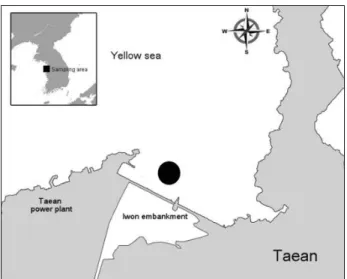
1. 시료 3배체 굴은 충남 태안군 이원면 갯벌참굴 시범어장 (Fig. 1) 에서 수평망식으로 양성 중인 개체들을 계절별 (2015년 2월, 5월, 8월, 11월) 로 30개체씩 채집하였다. 채취된 시료는 냉장 상태로 실험실로 운반되어 크기 (각고, 각장, 각폭: mm) 와 중 량 (전중량, 육중량: g) 을 계측한 뒤 condition index를 분석 하였다. 크기는 버어니어캘리퍼스 (cd-20CPX, Mitutoyo Corp., Japan) 로, 중량은 전자저울 (HH320, Ohaus Corp., USA) 로 소수점 둘째자리까지 측정하였으며, 연체부지수 (fatness) 는 전중량에 대한 육중량의 백분율로 산출하였고 condition index (CI) 는 Lawrence and Geoffrey (1982) 의 방법에 따라 측정하였다. 연질부 및 패각의 건조 중량은 Lutz et al. (1980) 의 방법을 준용하여 80℃ dry oven (MOV-2125, Sanyo, Japan) 에서 48-72시간 동안 일정한 중량이 될 때까지 건조시킨 후 측정하였다.Condition index (CI) = 연체부 건조중량 (g) × 100 / 패각 건조중량 (g) 2. 일반성분 분석 수분은 상압가열건조법, 조단백질은 semimicro-Kjeldhal 분해법, 조지방은 Soxhlet법 그리고 조회분은 건식회화법으로 측정하였다 (AOAC, 1995). 3. 유리아미노산 분석 유리아미노산 분석을 위한 시료 전처리는 시료에 20% trichloroacetic acid (TCA) 를 동량 가하여 교반 (10분) 및 원심분리 (3,000 rpm, 10분) 를 실시한 다음 상층액 중 일부를 분액 깔대기에 취한 후, 에테르 (ester) 로 TCA 제거 공정을 4 회 반복하고 농축하여 제조하였다. 전처리한 시료는 Lithium citrate buffer (pH 2.2) 로 정용한 다음 아미노산 자동 분석 기 (Biochrom 20, Pharmacia Biotech., England) 로 정량 분석하였다.
4. 지방산 분석
지방산은 Bligh and Dyer (1959) 의 방법에 따라 시료의 총 지방질을 추출하고, AOCS Official Method (AOCS, 1990) 에 따라 검화 및 methyl ester화 시킨 다음, iso-octane을 첨가해 지방산을 분리시켜 Supeleowax-320 capillary column (Supeco Japan Ltd., Japan) 이 장착된 GC (GC-17A, Shimadzu Co., Japan) 로 분석하였다. 각 지 방산은 표준물질과 retention time 비교 및 equivalent chain length법으로 동정하였다.
Fig. 1. Sampling station of triploid Pacific oyster cultured in
5. 글리코겐 분석
글리코겐 함량은 시료 0.5 g에 30% KOH 5 mL를 첨가하 여 95 ℃에서 20분간 중탕 후 Na2SO4 포화용액 0.5 mL와 ethanol 5 mL를 첨가하여 95℃에서 다시 15분간 중탕한 후 원심분리 (1,259 g, 10 min) 하였다. 원심분리된 침전물에 2 mL의 deionized water와 2.5 mL의 ethanol을 첨가하고 원 심분리 (1,259 g, 10 min) 후, 5 M 농도의 HCl 2 mL을 첨 가하여 재용해시킨 다음 0.5 M 농도의 NaOH 용액으로 중화 하여 50 mL로 정용하여 시료액으로 사용하였다. 시료용액 5 mL에 0.2% anthron-sulfate solution을 10 mL 첨가하고 95℃에서 10분간 중탕 후 냉각하여 분광광도계 (UV mini-1240, Shimadzu, Tokyo, Japan)를 이용하여 620 nm 에서 흡광도를 측정하였다 (Click and Engin, 2005). 글리코 겐 함량은 glucose를 표준물질로 작성한 정량 곡선에 따라 측 정하였으며, 글리코겐 전환계수 0.9를 곱하여 계산하였다. 6. 통계분석
분석결과는 모두 평균 ± 표준오차로 나타내었으며, SPSS
10.1K (Michigan Avenue, Chicago, IL, USA) 를 사용하여 ANOVA test 실시 후 95 % 신뢰수준에서 Tukey’s test로 평균간 유의성을 검정하였다.
결 과
1. 연체부지수 및 condition index의 계절변화 채집된 3배체 굴의 계절별 (2월, 5월, 8월, 11월) 각장, 각 고, 전중, 육중을 조사한 결과 (Fig. 2) 각장, 각고, 전중은 계 절별로 뚜렷한 차이를 보이지 않았다. 각고는 115.49 ± 2.30-120.93 ± 2.24 mm, 각장은 64.11 ± 1.34-66.72 ± 1.47 mm 그리고 전중은 137.94 ± 4.67-151.56 ± 6.35 g의 범위를 나타냈다. 육중량은 2월에 14.93 ± 1.29 g을 보인 후 8월까지 점진적으로 감소하여 13.10 ± 0.88 g의 최소값을 보 인 후, 11월에는 19.50 ± 1.17 g으로 앞선 시기에 비해 유의 한 최대값을 나타냈다 (P < 0.05). 이들 개체들의 육질부 건중량, 연체부지수 및 CI의 계절변 화에서는 11월에 모두 최고값을 나타냈다 (Fig. 3). 육질부 건 MonthFeb. May Aug. Nov.
S he ll he ig ht ( m m ) 0 20 40 60 80 100 120 140 Month
Feb. May Aug. Nov.
S he ll le ng th ( m m ) 0 20 40 60 80 Month
Feb. May Aug. Nov.
T otal w ei ght ( g) 0 20 40 60 80 100 120 140 160 Month
Feb. May Aug. Nov.
Bo dy w ei gh t ( g) 0 5 10 15 20 25 a a a b
Fig. 2. Seasonal variation of shell height, shell length, total weight and body weight of triploid oyster. Values are
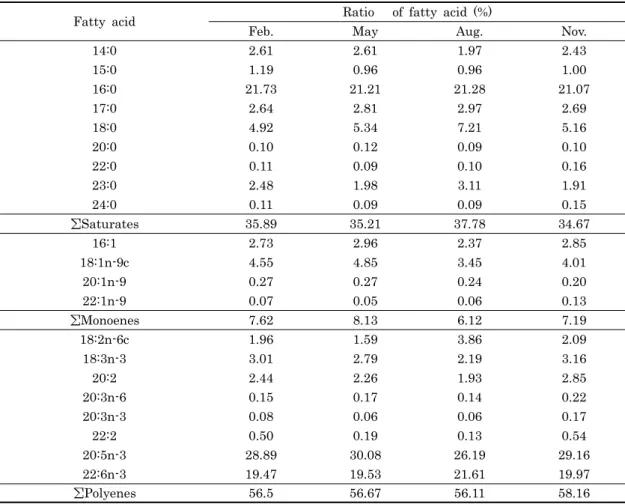
중량은 2월에 2.30 ± 0.25 g을 보인 후 8월까지 점진적으로 감 소하다가 11월에 3.75 ± 0.29 g으로 앞선 시기에 비해 유의한 최대값을 나타냈다 (P < 0.05). 또한 연체부지수와 CI의 계절변 화에 있어서도 이와 유사하게 8월에 각각 최소값 (8.99 ± 0.44, 1.76 ± 0.15) 을 보였고, 11월에 앞선 시기에 비해 유의한 최대 값 (14.13 ± 0.75, 4.44 ± 0.25) 을 나타냈다 (P < 0.05) 2. 일반성분 변화 계절별 3배체 굴의 체성분 변화를 조사한 결과 (Table 1), 수분은 2월에 82.43 ± 0.34 %를 나타냈고 이후 8월까지 지속 적으로 증가하여 86.00 ± 0.12 %로 최대값을 나타냈다 (P < 0.05). 이후 11월에는 80.73 ± 0.35%로 다른 시기에 비해 유 이한 최저값을 나타냈다 (80.73 ± 0.35 %, P < 0.05). 조단백 질 비율은 겨울철에 봄, 여름보다 다소 높은 경향을 나타내었 다. 조지방은 2월에 2.10 ± 0.06 %로 최대값 (P < 0.05) 을 보인 후 8월까지 지속적으로 감소하여 1.25 ± 0.03 %의 최소 값 (P < 0.05) 을 나타낸 후 11월에 다시 증가하였다 (1.98 ± 0.02 %). 조단백질은 2월에 8.87 ± 0.02%를 나타낸 후 8월까 지 지속적으로 감소하여 8.03 ± 0.05 %의 최소값 (P < 0.05) 을 보였으며, 11월에는 9.09 ± 0.04%로 다른 시기에 비해 유 의한 최대값을 나타냈다 (9.09 ± 0.04 %, P < 0.05). 조회분 은 2월에 2.37 ± 0.03 %를 나타낸 후 8월까지 지속적으로 증 가하여 유의한 최대값인 2.67 ± 0.03 % (P < 0.05) 를 나타낸 이후 11월에는 2.32 ± 0.04 %로 감소하였다. 3. 지방산 변화 3배체 굴의 주요 지방산은 20:5 (n-3), 16:0, 22:6 (n-3), 18:0, 18:1 (n-9) 등이 분석되었으며, 그 구성 비율은 폴리엔 산 (polyunsaturats), 포화산 (saturates) 및 모노엔산 (monoenes)의 순으로 확인되었다 (Table 2). 계절 변화에 따 른 지방산 함량은 다른 시기에 비해 폴리엔산은 11월 (58.16 %) 에, 포화산은 8월 (37.78 %) 에 가장 높았으며 모노엔산은 8월 (6.12 %) 에 가장 낮게 나타났다. 또한 n-3계열의 고도불 포화지방산인 20:5 (n-3) 는 5월 (30.08 %) 에 가장 높았고 8 월 (26.19 %) 에 가장 낮은 값을 나타냈다. 22:6 (n-3) 는 다 른 시기에는 뚜렷한 차이가 없었으나 8월에 21.61 %로 가장 높은 값을 나타냈다. 4. 유리아미노산 조성 및 글리코겐 변화
3배체 굴의 주요 아미노산은 taurine, glutamic acid,
Month
Feb. May Aug. Nov.
M e at d ry w eig h t (g) 0 1 2 3 4 5 Month
Feb. May Aug. Nov.
Fa tn es s 0 2 4 6 8 10 12 14 16 Month
Feb. May Aug. Nov.
Condi tion index 0 1 2 3 4 5 6 a a a b a a a b a a b c
Fig. 3. Seasonal variation of meat dry weight, fatness, condition index of triploid oyster. Values are the mean ± SE. Different
superscripts are significant differences by Tukey test (P < 0.05).
Month Moisture (%) Lipid (%) Protein (%) Ash (%)
Feb. 82.43 ± 0.34a 2.10 ± 0.06a 8.87 ± 0.02a 2.37 ± 0.03a
May 83.17 ± 0.19a 1.73 ± 0.03b 8.58 ± 0.04b 2.57 ± 0.03b
Aug. 86.00 ± 0.12b 1.25 ± 0.03c 8.03 ± 0.05c 2.67 ± 0.03b
Nov. 80.73 ± 0.35c 1.98 ± 0.02a 9.09 ± 0.04d 2.32 ± 0.04a
Table 1. Seasonal variation of the proximate composition of triploid oyster. Values are the mean ± SE. Different superscripts are
aspartic acid, glycine, alanine 등으로 분석되었다 (Table 3). 이 중, taurine이 가장 높은 비율로 나타났으며, 8월에 324.3 mg/100 g으로 최저함량을 보였고 2월에 465.5 mg / 100 g의
최고함량을 나타내었다. Glutamic acid도 8월에 32.7 mg / 100 g의 최저함량과 2월에 142.1 mg / 100 g의 최고함량을 나 타냈다. Aspartic acid, proline, glycine 등의 조성변화 역시 8 월에 최저함량을 나타냈고 2월에 최고함량을 나타냈다. 3배체 굴의 글리코겐 농도는 계절별로 0.69 ± 0.04-1.26 ± 0.03 g /100 g의 범위를 보였으며, 유리아미노산 조성 변화와 는 반대경향인 2월에 가장 낮은 값을 보인 후 8월에 최고값을 나타냈다 (Fig. 4).
고 찰
본 연구에 사용된 3배체 굴의 육중량은 13.10 ± 0.88-19.50 ± 1.17 g의 범위를 보여 기존의 일반 2배체의 육중량에 비해 높은 수치를 확인할 수 있었다. 또한 3배체 굴의 육중량이 여 름철 (8월) 에 가장 낮고 가을철 (11월) 에 가장 높은 결과로 인해 육질부 건조중량, 연체부지수 및 CI의 변화도 육중량 변 화와 유사한 경향을 나타냈다. 일반 2배체를 대상으로 한 기존 의 연구에 의하면 통영, 고성, 사천 그리고 여수 해역에서 생산Fatty acid Ratio of fatty acid (%)
Feb. May Aug. Nov.
14:0 2.61 2.61 1.97 2.43 15:0 1.19 0.96 0.96 1.00 16:0 21.73 21.21 21.28 21.07 17:0 2.64 2.81 2.97 2.69 18:0 4.92 5.34 7.21 5.16 20:0 0.10 0.12 0.09 0.10 22:0 0.11 0.09 0.10 0.16 23:0 2.48 1.98 3.11 1.91 24:0 0.11 0.09 0.09 0.15 ∑Saturates 35.89 35.21 37.78 34.67 16:1 2.73 2.96 2.37 2.85 18:1n-9c 4.55 4.85 3.45 4.01 20:1n-9 0.27 0.27 0.24 0.20 22:1n-9 0.07 0.05 0.06 0.13 ∑Monoenes 7.62 8.13 6.12 7.19 18:2n-6c 1.96 1.59 3.86 2.09 18:3n-3 3.01 2.79 2.19 3.16 20:2 2.44 2.26 1.93 2.85 20:3n-6 0.15 0.17 0.14 0.22 20:3n-3 0.08 0.06 0.06 0.17 22:2 0.50 0.19 0.13 0.54 20:5n-3 28.89 30.08 26.19 29.16 22:6n-3 19.47 19.53 21.61 19.97 ∑Polyenes 56.5 56.67 56.11 58.16
Table 2. Seasonal variation of the total fatty acid composition of triploid oyster
Month
Feb. May Aug. Nov.
Gl ycogen c o nt e nt ( g/ 10 0 g) 0.0 0.2 0.4 0.6 0.8 1.0 1.2 1.4 1.6 a b c b
Fig. 4. Seasonal variation of glycogen contents of triploid
된 11월 굴의 육중량은 5.9-9.1 g의 범위를 나타낸다고 보고 되어 있다 (Lee et al., 2012). 또한 거제만과 자란만에서 생산 된 굴의 연중 육중량은 5.86-10.26 g의 범위를 보였으며, 하절 기인 7월에 최소값을 나타낸 후 다시 증가하여 거제만에서는 10월, 자란만에서는 이듬해 2월에 최대값을 나타냈으며 비만 도 역시 이와 유사한 경향을 나타냈다 (Kim et al., 2014). 계절변화에 따른 3배체 굴의 일반성분의 변화에서는 수분과 회분의 비율은 여름철에 가장 높았으며, 가을철에 가장 낮은 것으로 확인되었다. 지방과 단백질의 비율은 이와 반대 경향으 로 여름철에 가장 낮았으며, 지방의 비율은 겨울철 그리고 단 백질은 가을철에 가장 높은 것으로 확인되었다. 일반적으로 단 백질은 굴의 성숙 과정에서 에너지로 작용하며 특히 산란기에 증가하는 것으로 보고되어 있으며, 지방은 생식세포 발달과 산 란에 기여하기 때문에 여름철에 급격히 감소한다고 알려져 있 다 (Barber and Blake, 1981; Jeong et al., 1999; Dridi et
al., 2007). 이는 굴의 산란기로 알려진 5월-9월 사이에 거제
Amino acid Month
Feb. May Aug. Nov.
1 Phosphoserine 0.0 0.0 0.0 0.0
2 Taurine 465.5 333.0 324.3 360.0
3 Phospho ethanol amine 0.0 0.0 0.0 0.0
4 Urea 0.0 0.0 0.0 0.0 5 Aspartic acid 73.5 40.8 23.9 52.4 6 Hydroxy proline 2.6 0.4 0.0 0.0 7 Threonine 0.0 3.1 3.1 4.7 8 Serine 19.5 16.1 15.3 8.4 9 Glutamic acid 142.1 43.9 32.7 55.2 10 Sarcosine 0.0 0.0 0.0 0.0
11 A-amino adipic acid 1.4 0.8 1.4 1.4
12 Proline 90.7 3.4 1.9 14.0 13 Glycine 73.9 18.4 12.0 21.3 14 Alanine 65.9 23.0 28.8 27.1 15 Cituline 0.0 0.0 0.0 0.0 16 a-amino-n-butyric acid 0.0 1.0 0.9 1.2 17 Valine 2.0 3.7 4.0 3.2 18 Cystine 0.0 0.0 0.0 0.0 19 Methionine 0.7 1.7 1.5 1.1 20 Cystathionine 0.0 0.0 0.0 0.0 21 Isoleucine 1.3 1.5 1.7 1.4 22 Leucine 2.4 2.4 2.5 2.0 23 Tyrosine 1.3 1.5 1.5 1.3 24 Phenylalanine 1.0 1.7 1.8 1.2 25 ß-alanine 25.8 4.2 1.6 3.3 26 ß-aninoisobutyricacid 1.6 0.2 0.5 0.1 27 γ-amino-n-butyricacid 4.8 1.1 0.1 0.2 28 Ethanol amine 0.0 1.1 0.6 0.0 29 Hydroxyllysine 0.0 0.0 0.0 0.0 30 Ornithine 4.7 3.4 1.6 1.7 31 Lysine 6.4 6.5 6.6 5.2 32 1-methylhistidine 0.0 0.0 0.0 0.0 33 Histidine 0.7 1.0 1.9 1.3 34 3-methylhistidine 0.0 0.0 0.0 0.0 35 Anserine 0.0 0.0 0.0 0.0 36 Carnosine 0.0 0.0 0.0 0.0 37 Arginine 23.7 13.6 16.5 18.2
만, 자란만, 가막만 및 아일랜드의 Cork Harbour에서의 2배 체 굴에서 모두 단백질 비율이 높게 유지된 결과에서도 보고되 어 있다 (Linehan et al., 1999; Kim et al., 2009; Kim et
al., 2014). 그러나 3배체 굴의 경우 오히려 여름철에 단백질 비율이 최소값을 나타냈는데, 이는 3배체 처리에 따른 불임으 로 인해 산란하지 않는 특성에 기인한 것으로 생각된다. 또한 Jeung et al., (2016) 에 의하면 3배체 굴의 번식 특성 연구에 서 산란은 하지 않았으나 일부 개체에서 생식세포의 분열과 증 식이 확인된 결과로 미루어보아 생식세포 발달에 따른 물질대 사의 변화가 있을 것으로 생각되며 추후 연구를 통해 구명해야 할 부분이다. 일반적으로 해산동물에는 탄소수 20미만의 n-3계열 고도 불 포화지방산이 다량 함유되는 것이 특징이며, 이매패류의 경우 DHA (22:6 n-3) 와 EPA (20:5 n-3) 의 조성비가 높은 특징을 나타낸다 (Jeong et al., 1999). 본 연구결과 3배체 굴에서도 EPA와 DHA가 주요 지방산으로 분석되어 식품영양학적 가치 가 우수함을 확인할 수 있었다. 또한 계절별 변화 양상에서 EPA는 여름에 최소값을 나타냈으나 DHA는 최대값을 나타냈 다. 기존의 2배체 굴을 대상으로 한 지방산 조성 변화에서는 EPA와 DHA 모두 산란기인 여름철에 최소값을, 성숙기인 봄철 에 최대값을 나타냈으며 이는 생식세포 발달에 따른 세포막의 구조와 기능에 DHA가 작용하는 것으로 알려져 있다 (Dirdi et al., 2007). 8월에 3배체 굴의 DHA 함량이 높게 유지되는 결 과 역시 상기에서 밝힌 바와 같이 불임처리에 따른 생식세포 활 성 억제에 의한 것으로 판단된다. 그러나 EPA의 계절변화에서 는 2배체에서의 계절변화와 유사한 경향을 나타냈다. 수산물의 맛에 관여하는 주요 유리아미노산으로는 aspartic acid, glutamic acid, proline, glycine, alanine 등이 보고되 어 있다 (Park et al., 2000). 본 연구에서 3배체 굴의 계절별 유리아미노산 분석 결과 aspartic acid와 glutamic acid 모두 5월에 다소 감소하여 8월에 최저치를 나타낸 후, 다시 11월에 서 2월까지 크게 증가하였다. 특히 감칠맛과 단맛을 좌우하는 glutamic acid의 함량은 2월에 142.1 mg /100 g으로 8월 시 료의 함량 32.7 mg /100 g에 비해 4.3배 증가하는 것으로 분 석되었다. 따라서 3배체 굴의 경우, 여름철 산란을 하지 않는 특징으로 수확은 가능하지만 관능적인 측면에서는 겨울철 수 확한 굴이 더욱 상품가치가 높을 것으로 판단된다. 또한 식품 에서 쓴맛에 관련되어 있는 아미노산인 histidine 함량도 8월 에 가장 높고 2월에 가장 낮아 2월에 생산된 3배체 굴이 관능 적으로 더 우수한 것으로 생각된다. 글리코겐은 다수의 패류종에서 배우자 형성과정에서의 대사 와 에너지 공급에 중요한 역할을 하는 것으로 보고되어 있으 며, 산란기 동안에는 체내의 글리코겐이 소비되고 산란기 이후 다시 체내에 축적되는 것으로 알려져 있다 (Ruiz et al.,
1992; Mathieu and Lubet, 1993; Dridi et al., 2007). 본 연구결과, 3배체 굴의 글리코겐 함량은 여름철인 8월에 최고값 을 나타냈으며 이는 일반 2배체와 달리 3배체 굴은 산란을 하 지 않는 특성으로 인해 산란기에 성숙에 소요되는 에너지를 최 소화하여 글리코겐 함량이 높게 유지되는 것으로 판단된다 (Kim et al., 2014). 한편 굴의 영양성분은 서식처 환경과 관 련하여 글리코겐 축적이 서식처의 클로로필-α함량과 상관성 이 높은 것으로 알려져 있다 (Heude-Berthelin, 2000; Heude-Berthelin et al., 2001). 본 연구에 사용된 3배체 굴 양식어장의 월별 클로로필-α함량, 식물플랑크톤 종 조성 및 생체량 연구 결과 9월에 최대값을 나타냈으나 이는 담수 유입 에 따른 것으로 보고되어 있다 (Kim et al., 2014). 또한 9월 을 제외한 시기 중 클로로필-α함량, 식물플랑크톤 종 조성 및 생체량이 가장 높은 시기는 4월로 나타났으며 9월 이후에는 급감하였다. 따라서 3배체 굴은 봄철부터 여름철까지 충분한 먹이 섭취와 함께 산란하지 않음으로 인해 체내 글리코겐 축적 이 매우 활발히 진행되고 9월 이후 급감하는 먹이로 인해 축적 된 글리코겐이 일부 분해하여 에너지원으로 사용하는 것으로 생각된다. 이상의 결과를 종합해 보면 우리나라 서해안의 수평망식 양 식장에서 생산된 3배체 굴은 불임처리에 따른 특성으로 산란 기인 여름철에도 높은 DHA와 글리코겐을 함유하고 있어 2배 체와 달리 겨울철뿐만 아니라 여름철에도 영양학적으로 우수 한 것으로 확인되었다.
요 약
본 연구는 2015년 우리나라 서해안에서 양식된 3배체 굴 의 일반성분, 지방산, 아미노산 조성 및 글리코겐 함량의 계절 적 변화를 조사하였다. 지방 함량은 겨울철에 가장 높았으며 (2월, 2.10 ± 0.06 %), 단백질 함량은 가을철에 (11월, 9.09 ± 0.04 %) 에서 가장 높았고 수분과 회분은 여름철 (8월, 86.00 ± 0.12 % 및 2.67 ± 0.03 %) 에 가장 높았다. 총아미노산 함 량은 겨울철 (1,011.5 mg/100 g) 에 가장 높았고, 점차적으로 감소하여 여름철에 가장 낮았다 (486.7 mg/100 g). 아미노산 조성은 taurine, aspartic acid, glutamic acid, glycine 및 alanine 등이 주요 아미노산으로 분석되었다. 지방산 조성에 서 전체 지방산 함량의 50 % 이상을 차지하는 지방산은 EPA 와 DHA로 확인되었다. 글리코겐 함유량은 여름철에 가장 높 았으며 (1.26 ± 0.03 g /100 g), 다른 시기에는 0.69 ± 0.04-0.86 ± 0.01 g /100 g의 범위로 일정한 함량을 보였다. 이상의 결과를 종합해 볼 때, 3배체 굴은 불임처리를 통해 산 란을 하지 않아 여름철에 글리코겐 함량이 높아 겨울철뿐만 아 니라 여름철에도 상업적 가치가 높은 것으로 확인되었다.사 사
본 연구는 국립수산과학원의 지원 (R2016014)에 의해 수 행되었습니다.
REFERENCES
Allen, Jr S.K. and Downing, S.L. (1986) Performance of triploid Pacific oysters, Crassostrea gigas (Thunberg). Ⅰ. Survival, growth glycogen content and sexual maturation in yearlings. Journal of Experimental
Marine Biology and Ecology, 102: 197-208.
AOAC. (1995) Official method of analysis of AOAC international. 16th Association of Official Analytical
Chemistry, Washington D.C. U.S.A, pp. 69-74.
Barber, B.J. and Blake, N.J. (1981) Energy storage and utilization in relation to gametogenesis in Argopecten
irradians concentricus. Journal of Experimental Marine Biology and Ecology, 52: 121-134.
Beaumont, A.R. and Fairbrother, J.E. (1991) Ploidy manipulation in molluscan shellfish: a review.
Journal of Shellfish Research, 10: 1-18.
Cicik, B. and Engin, K. (2005) The effects of cadmium on levels of glucose in serum and glycogen reserves in the liver and muscle tissues of Cyprinus carpio.
Turkish Journal of Veterinary Animal Science, 29:
113-117.
Dealporte, M., Soudant, P., Lambert, C., Moal, J., Pouvreau, S., and Samain, J.F. (2006) Impact of food availability on energy storage and defense related hemocyte parameters of the Pacific oyster Crassostrea
gigas during an experimental reproductive cycle. Aquaculture, 254: 571-582.
Dridi, S., Romdhane, M.S., and Elcafsi, M. (2007) Seasonal variation on weight and biochemical composition of the Pacific oyster, Crassostrea gigas in relation to the gametogenic cycle and environmental conditions of the Bizert lagoon, Tunisia. Aquaculture, 263: 238-248.
Heude-Berthelin, C. (2000) Study of glycogen metabolism in the oyster Crassostrea gigas: consequences on reproduction and summer mortalities. PhD thesis, Caen University, France. 156 p.
Heude-Berthelin, C., Laisney, J., Espinosa, J., Martin, O., Hernandez, G., and Mathieu, M., (2001) Storage and reproductive strategy in Crassostrea gigas from two different growing areas (Normandy and the Atlantic coast, France). Invertebrate Reproduction
and Development, 40: 79–86.
Hur, Y.B., Min, K.S., Kim, T.E., Lee, S.J., and Hur, S.B. (2008) Larvae growth and biochemical composition change of the Pacific oyster, Crassostrea gigas, larvae during artificial seed production. Journal of
Aquaculture, 21: 203-212.
Jeong, B.Y., Moon, S.K., Jeoung, W.G., and Lee, J.S. (1999) Changes in proximate compositions of the
oysters (Crassostrea gigas) cultured with Korea and Japanese spats. Journal of Korean Fisheries Society, 32: 563-567.
Jeung, H.D., Keshavmurthy, S., Lim, H.J., Kim, S.K., and Choi, K.S. (2016) Quantification of reproductive effort of the triploid Pacific oyster, Crassostrea gigas raised in intertidal rack and bag oyster culture system off the west coast of Korea during spawning season. Aquaculture, 464: 374-380
Kim, C.W., Kim, E.O., Heong, H.D., Jung, C.G., Park, M.W., and Son, S.G. (2009) Variation of body composition and survival rate according to spawning of Pacific oyster (Crassostrea gigas) in Gamak bay.
Journal of Korean Fisheries Society, 42: 481-486.
Kim, M.A., Shim, K.B., Park, J.S., Oh, E.G., Shin, S.B., Park, K., and Lim, C.W. (2014) Seasonal variation in the proximate composition, pH and glycogen content of oysters Crassostrea gigas collected in Geoje and Jaran Bay in Korea. Korean Journal of Fisheries
and Aquatic Sciences, 47: 713-718.
Lawrence, D.R. and Geoffrey, I.S. (1982) The determination and use of condition index of oysters.
Estuaries Research Federation, 5(1): 23-27.
Lee, Y.M., Lee, S.J., Kim, S.G., Hwang, Y.S., Jeong, B.Y., and Oh, K.S. (2012) Food component characteristics of cultured and wild oysters
Crassostrea gigas and Ostrea denselamellos in Korea. Korean Journal of Fisheries and Aquatic Sciences,
45: 586-593.
Li, Q., Liu, W., Shirasu, K., Chen, W., and Jiang, S. (2006) Reproductive cycle and biochemical composition of the Zhe oyster Crassostrea plicatula Gmelin in an eastern coastal bay of China.
Aquaculture, 261: 752-759.
Lim, H.J., Lee, T.S., Cho, P.G., Back, S.H., Byun, S.G., and Choi, E.H. (2011) The production efficiency of cupped oyster, Crassostrea gigas spat according to clutch and growth comparing diploid and triploid oysters in off-bottom culture for tidal flat utilization.
Korean Journal of Fisheries and Aquatic Sciences,
44: 259-266.
Linehan, L.G., O’Connor, T.P., and Burnell, G. (1999) Seasonal variation in the chemical composition and fatty acid profile of Pacific oysters (Crassostrea
gigas). Food Chemistry, 64: 211-214.
Lutz, R.A., Incze, L.S., Porter, B., and Stotz, J.K. (1980) Seasonal variation in the condition of raft-cultured mussels (Mytilus edulis L.). Proceedings of World
Mariculture Society, 11: 262-268.
Mallet, A.L., Carver, C.E., and Landry, T. (2006) Impact of suspended and off-bottom Eastern oyster culture on the benthic environment in eastern Canada.
Aquaculture, 255: 362-373.
Mathieu, M., and Lubet, P. (1993) Storage tissue metabolism and reproduction in marine bivalves – a brief review. Invertebrate Reproduction and
Development, 23: 123-129.
Nell, J.A., Cox, E., Smith, I.R., and Maguire, G.B. (1994) Studies on triploid oysters in Australia. Ⅰ. The
farming potential of triploid Sydney rock oysters
Saccostrea commercialis (Iredale and Roughley). Aquaculture, 126: 243-255.
Ngo, T.T., Kang, S.G., Kang, D.H., Sorgeloos, P., and Choi, K.S. (2006) Effect of culture depth on the proximate composition and reproduction of the Pacific oyster, Crassostrea gigas from Gosung Bay, Korea. Aquaculture. 253: 712-720.
Park, H.Y., Cho, Y.J., Oh, K.S., Koo, J.G., and Lee, N.G. (2000) Applied seafood processing. Suhyup Pub Co, Seoul, Korea, 39-42.
Ruiz, C., Abad, M., Sedano, F., Garcia-Martin, L.O., and Sanchez Lopez, J.L. (1992) Influence of seasonal environmental changes on the gamete production and biochemical composition of Crassostrea gigas in suspended culture in E1 Grive, Galicia, Spain.
Journal of Experimental Marine Biology and Ecology,
155: 249-262.
Saucedo, P., Racotta, I., Villarreal, H., and Monteforte, M. (2002) Seasonal changes in the histological and biochemical profile of the gonad, digestive gland and muscle of the calafia mother-of-pearl oyster, Pinctada
mazatlania associated with gametogenesis. Journal of Shellfish Research, 21: 127-135.
Stanley, J.G., Allen, Jr S.K., and Hidu, H. (1981) Polyploid induced in the American oyster, Crassostrea
virginica with cytochalasin B. Aquaculture, 23: 1-10.
Urrutia, G.X., Navarro, J.M., Clasing, E., and Stead, R.A. (2001) The effects of environment factors on the biochemical composition of the bivalve Tagelus
dombell (Lamarck, 1818) from the intertidal flat of
Coihuin, Puerto Montt. Chile. Journal of Shellfish