굴,
Crassostrea gigas
부착기 유생의 부착에 미치는 신경전달물질종의 영향허영백, 조규태, 변순규, 문태석
국립수산과학원 남동해수산연구소The Effect of Neuroactive Compounds on Settlement of Pacific Oyster, Crassostrea gigas Pediveliger Larvae
Youngbaek Hur, Qtae Jo, Soongyu Byun and Tesek Mun
Southeast Sea Fisheries Research Institute, NFRDI, Tongyeong 650-943, KoreaABSTRACT
We determined the effects of neuroactive compounds known as synthetic larval settlement inducers on the settlement of the Pacific oyster C. gigas pediveliger on the larval collector. Six types of the inducers, serotonin (5-HT), γ-amino butyric acid (GABA), L-3,4-dihydroxyphenylalanine (L-DOPA), norepinephrine, epinephrine and methyl bromide (MB) were tested. All the chemicals induced larval settlement, MB being the most effective with settlement rate of 42.7 ± 2.7%, followed by GABA (35.4 ± 2.0%), 5-HT (29.1 ± 2.2%), L-DOPA (19.2 ± 2.1%), epinephrine (15.2 ± 0.9%), and norepinephrine (11.0 ± 1.2%). The chemicals γ-amino butyric acid and methyl bromide were also better in terms of settled density on the collector with their respective density of 1.97 ± 1.42 and 2.37 ± 1.86 ind/cm
2, reminiscent of being most effective candidates for a larval settlement inducer in the oyster hatchery.
Keywords : Neuroactive compounds, Induce settlement, Settlement rate, Larvae, Crassostera gigas, Oyster
서 론
굴, Crassostrea gigas은 우리나라에서 매우 중요한 양식 대상 종으로 연간 양식에 필요한 종묘는 약 1,800만연 이상이 소요되고, 이 중 대부분은 천연종묘생산에 의존하고 있지만, 최근 인공종묘생산기술이 개발됨에 따라 연간 약 10-15% 정 도를 인공종묘로 대체하고 있다. 그러나 인공종묘는 천연종묘 에 비해 생산단가가 매우 높다. 따라서 단위면적당 생산량을 높여 생산단가를 낮추는 것은 매우 중요한 일이다. 대부분의 인공종묘 생산과정에서 생산단가에 가장 큰 영향을 미치는 중
요한 요인 중의 하나는 낮은 채묘율이다. 미국의 버어지니아 굴, Crassostrea virginica 인공종묘배양장의 경우 평균 채묘 율이 22.2% 수준으로 보고 (Henderson, 1983; Nosho and Chew, 1991; Greene and Grizzle, 2005; Grant et al., 2013) 되고 있고, 우리나라도 현장탐문 결과 비슷한 수준으로 추정되었다. 문제는 채묘 시 대부분의 부착기 유생이 투입된 채묘기질에 부착하지 않고 주로 채묘조의 벽면 및 바닥에 대량 부착하여 실질적 채묘효율을 떨어뜨리는 요인으로 작용하는 것인데, 투입된 부착기질에 효율적으로 부착을 유도할 수 있다 면 인공종묘의 생산량을 증대시킬 수 있는 하나의 방편이 된다 (Yu et al., 2008).
굴을 포함한 대부분의 해양 고착성 무척추동물들은 일정기 간 부유유생기를 거친 후 성패형태의 치패가 되기 전에 일련의 부착과 변태 과정을 거치는데, 부착과 변태 성공률에 따라 이 후 생존에 큰 영향을 미치고, 특히 인공종묘생산과정에서 채묘 율에 많은 영향을 미친다. 지금까지 해양무척추 동물 부착기 유생의 부착과 변태를 유발하는 기작을 밝히기 위해 다양한 연 구가 진행되었는데, 부착기질 표면의 특성 (Faimali et al., 2004), 미생물막 (Maki et al., 1989; Weiner et al., 1989;
Received: November 12, 2014; Revised: December 20, 2014; Accepted: December 24, 2014
Corresponding author : Youngbaek Hur
Tel: +82 (55) 640-4730 e-mail: [email protected] 1225-3480/24546
This is an Open Access article distributed under the terms of the Creative Commons Attribution Non-Commercial License with permits unrestricted non-commercial use, distribution, and reproducibility in any medium, provided the original work is properly cited.
Leitz and Wagner, 1993; Keough and Raimondi, 1996), 페르몬효과 (Hadfield, 1978; Jensen et al., 1990;
Zimmer-Faust and Tamburri, 1994; Andrews et al., 2001; Zhao and Qian, 2002), 특정 먹이생물 종 (Hadfield, 1978; Todd, 1985), 부착기 유생의 밀도와 건강 (Min et al., 1995; Hur et al., 2008; Min et al., 1999), 수온과 염분 (Jeon et al., 2012) 등이 영향을 주는데, 이러한 결과를 종합 하여 부착과 변태를 유발하는 요인은 서식환경에서 발인되는 자연적인 요인과 부착기 유생 자체의 생리적인 변화에 따른 생 체 내 특이적인 화학물질이 상호 복합적으로 작용하는 것으로 알려졌다 (Crip, 1984, Morse, 1990; Pawlik, 1992;
Tamburri et al., 1992; Qian, 1999; Hadfield and Paul, 2001; Yu et al., 2008; Ganesan et al., 2010).
이러한 결과로부터 최근 생물학적인 요인들에서 발원된 특 이한 화학물질 즉 신경계에 직접 생화학적으로 작용하는 각종 신경전달물질 (Coon et al., 1985; Bonar et al., 1990;
Johnson et al., 1991; Rodriguez et al., 1993; Martinez et al., 1999; Walch et al., 1999; Doroudi and Southgate, 2002) 이 부착과 변태를 효과적으로 유발할 수 있음이 입증됨 에 따라 적당한 약학적인 화합물인 신경전달물질종을 사용하 면 이매패류 인공종묘생산과정에서 부착기 유생의 부착율을 높이는 효과가 있는 것으로 보고되고 있다 (Walch et al., 1999). 그러나 이와 같은 연구결과는 대부분 부착기 유생이 수 용된 해수에 직접적으로 처리하여 부착과 변태를 유발시킨 연 구 결과이다. 이는 우리나라와 같이 연승수하식 양식에 이용되 는 종묘를 생산하는 경우는 상기 언급된 연구자들의 연구결과 를 적용하는데 문제점이 있다.
우리나라 수하식 굴 양식에 이용되는 종묘는 굴 또는 가리비 패각을 간격 없이 60-80개 조립하여 자연 또는 인공적인 방법 으로 채묘 후 하나하나 다시 분리하여 지역에 따라 20-30개의 패각을 25-30 cm 간격으로 재조립하여 수하 양성한다. 이 과 정에서 각각의 패각 채묘기에 40-60 마리 정도의 치패가 부착 된 경우 가장 좋은 채묘로 조립 시 패각 하나만 이용하면 된다.
그러나 그 이하일 경우는 패각을 2-3개씩 포개어 조립하게 되 는데, 이 경우 시간과 노동력 손실을 유발하고, 그 이상 부착하 게 되면 양성 시 성장둔화 및 수지상 성장현상 등으로 수율를 저하시키는 문제점을 유발할 뿐만 아니라, 인공채묘의 경우 막 대한 유생의 허실을 유발한다. 따라서 고른 부착과 채묘율 제 고는 굴 인공종묘생산과정에서 매우 중요하다.
이에 본 연구는 굴 인공종묘생산 시 고른 부착과 채묘율 제 고를 위한 다양한 신경전달물질종의 효과를 조사하기 위해 지 금까지 해양무척추동물 부착기 유생의 부착과 변태 유도에 효 과가 입증된 6종의 신경전달물질종을 직접 채묘기질인 패각에 처리하여 부착유인 효과의 유무를 검정하고자 실시하였다.
재료 및 방법
1. 유생사육
실험에 이용한 굴 부착기 유생을 얻기 위해 사용된 굴 어미 는 남동해수산연구소 남해양식연구센터 패류중간육성장에서 관리하던 만 1년생으로 평균 각장 63.7 ± 6.4 cm 크기의 자연 성숙된 개체를 이용하였다. 채란 발생된 유생은 수온 26 ± 1℃, 염분 32 ± 2로 조절된 수용적 10 톤 콘크리트 수조에서 먹이생물로 Isochrysis galbana, Cheatoceros gracilis, Pavlova lutheri, Phaeodactylum tricornutum, Nannochloris oculata, Tetraselmis tetrathele를 각각 30%
: 20% : 20% : 10% :10% :10%의 비율로 혼합하여 일일 3회 공급하면서 14일 동안 사육하였다. 부착기 유생은 망목 230 μm인 걸름망을 이용하여 선별된 평균 각장 331.2 ± 13.8 μm, 각고 349.3 ± 13.8 μm 크기의 유생을 부착실험에 이용하였 다.
2. 유생의 신경전달물질 분석
분석에 이용한 신경전달물질은 도파민과 세로토닌 계열로 검정 곡선을 얻기 위한 표준시약은 3,4-Dihydroxyphenylacetic acid, DOPA (Sigma, USA), Dopamine, DA (Sigam, USA), 5-Hydroxyindoleacetic acid, 5-HIAA (Sigma, USA) 및 5-Hydroxytryptamine, 5-HT (Sigma, USA) 을 사용하였 다. 각 표준물질의 검정곡성을 구하기 위해 DOPA와 DA 표준 시약은 10 mg을 취하여 20 mL 용량의 test tube에 취한 후 HCL로 용해시켜 5 mg/mL 농도로 만든 표준원액을 다시 HCL용액 (0.01N HCL + 1 mg/mL EDTA·2Na) 으로 희석 하여 10.0, 45.0, 75.0 및 100.0 μg/mL 농도가 되도록 만든 후 HPLC (Water, USA)-ECD (EiCom, Japan), Column:
EiComPak SC-50DS (size 3.0 × 150 mm), flow rate: 0.5 mL/min. 조건에 주입하여 얻은 농도별 피크면적으로 회귀곡 선을 작성하여 검정곡선을 얻었고, 5-HIAA와 5-HT의 표준시 약은 무수 CH3COOH용액에 용해하여 표준원액을 제조한 후 다시 초산나트륨 용액 (0.02M CH3COOH + 10μM EDTA·2Na) 으로 희석하여 동일한 방법으로 검정곡선을 구하 였다. 유생의 성장단계별 분석용 시료는 성장단계별로 평균 각 장 120, 180, 250 μm 및 부착기 유생으로 구분하여 거름망 을 이용 유생을 수거한 후 다시 여과해수로 수회 세척한 다음 최종적으로 증류수로 세척한 후 동결 건조하여 시료로 이용하 였다. 각각의 시료는 1.0 g을 취한 후 20 mL 용량의 test tube에 3차 증류수 10 mL와 혼합 마쇄 후 원심 분리하여 상 등액 200 μL를 취한 후 BHBA 500 pg, 0.1 M EDTA·2Na 100 μL, 1.5 M T3 Buffer (ph 8.6) 0.5 mL, 알루미나 10
mg을 혼합하여 10 Min. vortex 후 1,000 g, 4℃에서 1분간 원심분리 후 다시 증류수로 3회 세척 후 1,000 g, 4℃에서 1 분간 재 원심분리 후 최종적으로 초산나트륨용액으로 희석하 여 HPLC로 분석하였다.
3. 부착유인 효과
실험에 이용한 신경전달물질은 serotonine (5-HT, sigma USA), gamma amino butyric acid (GABA, sigma USA), L-3,4-dihydroxyphenylalanine (L-DOPA, sigma USA), norepineprien (norEPI, sigma USA), epineprien (EPI, sigma USA), methyl bromide (MB, yakuri Japan) 6종을 이용하였다. 부착유인 시험은 동일한 부착면적을 얻기 위해 굴 패각을 3.0 cm × 3.0 cm 크기로 절단하여 가운데 직경 3.0 mm 구멍을 뚫은 다음, 생물부착층 등 이물질을 제거하기 위 하여 pH 2의 염산 수용액에 10분간 침지한 후 담수로 수회 세 척한 다음 자연광 조건에서 24시간 건조 후 직경 5.0 mm, 길 이 1.0 cm 크기의 플라스틱 간극제를 패각과 패각 사이에 넣 고 10개씩 코팅철사에 조립하여 채묘연을 만든 다음 각각의 신경전달물질을 0.02 μm UF필터로 여과한 여과해수에 0.1 M 농도로 희석한 후 조립된 채묘연을 2시간 동안 침지하여 처 리물질들이 굴 패각 내로 충분히 침투되도록 하였다. 이 후 1 시간 동안 실온에서 건조 후 각각을 25.0℃ 여과해수를 채운 수용적 1.5 L 원형용기에 3연씩(총 30 패각) 3반복으로 설치 한 다음 1 L의 여과해수를 채운 후 선별된 부착기 유생을 1 마리/mL (1,000 마리) 밀도로 투입하였다. 그리고 부착기 유 생의 고른 분포를 유도하기 위하여 미세하게 공기를 공급하였 고, 빛에 의한 영향을 줄이기 위해 빛을 차단하여 조도를 200 Lux 이하로 유지하면서 48시간 동안 부착을 유도하였다. 부착 실험 기간 동안 먹이공급은 I. galbana와 C. gracilis를 동일 비율로 혼합하여 1일 2회 3 × 10⁴ cells/mL 공급하였고, 환수 는 하지 않았다. 최종 부착률 조사는 48시간 동안 실험 용기에 서 채묘 후 수용적 200 L 사각 FRP 수조로 채묘기 만 옮겨 수온 25℃에서 채묘 시 공급된 동일 먹이를 공급하면서 2주간 (부착치패가 명확히 관찰되는 시기) 유수 사육을 실시한 후 각 부착기질 당 부착마리수를 육안으로 개수 후 아래 식으로 계산 하였다. 대조구는 처리하지 않은 부착기질을 활용하여 동일한 방법으로 채묘 관리 후 비교하였다.
Setting rate (%) =
No. of attached spats
× 100 1,000
(No. of attached spats; sum (n = 30) of number of each substrate attached spats)
한편, 채묘기질 당 부착마리수의 분포변화를 조사하기 위하 여 채묘기질당 부착빈도를 조사하였다. 기질당 부착빈도는 전 체 90개 채묘기 (30개 x 3 시험구) 를 모집단으로 각각의 채묘 기별 부착마리수를 채묘기질 면적으로 나누어 cm2 당 부착밀 도 및 부착빈도를 조사하였다.
4. 통계처리
각 채묘 실험구간의 부착율과 부착밀도에 대한 유의차 유무 는 One-way ANOVA-test 를 실시한 후, Duncan’s test로 평균간의 유의성 (P < 0.05) 을 검정하였고, 부착밀도의 분포 를 조사하기 위하여 빈도분석을 실시하였다. 모든 분석은 SPSS 통계 프로그램을 사용하여 분석하였다.
결 과
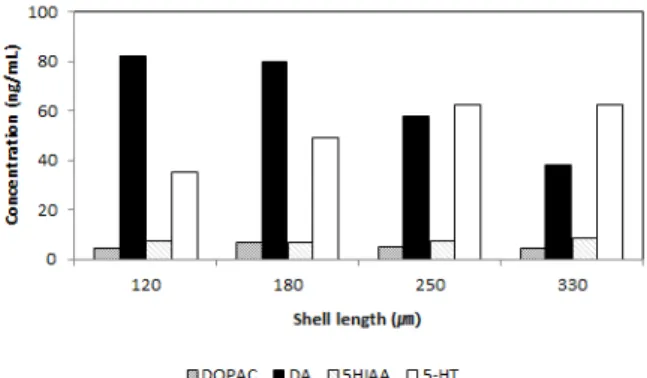
굴 유생의 성장에 따라 아민계 호르몬과 serotonine 계 호 르몬의 변화가 관찰되었고, 유생이 성장함에 따라 아민성 호르 몬인 3,4-dihydroxyphenylacetic acid (DOPAC) 및 dopamine (DA) 함량은 각각 초기 각정기 유생인 평균 각장 120 μm크기의 유생에서는 4.65 ng/mL와 85.28 ng/mL에 서 점점 감소하여 부착기 유생에서는 각각 4.99 ng/mL와 38.11 ng/mL로 DA의 전구체인 DOPAC 농도는 큰 변화가 없었지만, DA 농도는 46.3% 감소하였다. 반면에 세로토닌계 호르몬인 5HIAA와 5-HT 농도는 각각 120 μm 크기의 초 기 각정기 유생에서는 4.51 ng/mL와 35.06 ng/mL에서 점점 증가하여 부착기 유생에서는 각각 8.73 ng/mL와 62.68 ng/mL으로 증가하였다 (Fig. 1).
한편, 신경전달물질, serotonin (5-HT), γ-aminobutyric Acid (GABA), L-3,4-dihydroxyphenylalanine (L-DOPA), norepinephrine (NorEPI), epinephrine (EPI) 및 methyl bromide (MB) 6종을 패각부착기질에 직접 처리한 후 굴 부 Fig. 1. Concentrate variation of DOPAC, DA, 5HIAA and
5-HT at the larvae, Crassostrea gigas size.
착기 유생을 대상으로 부착유인 효과를 조사한 결과 전체 투입 유생에 대한 평균 부착률은 각각 29.1 ± 2.2%, 35.4 ± 2.0%, 19.2 ± 2.1%, 11.0 ± 1.2%, 15.2 ± 0.9% 및 42.7 ± 2.7%로 MB로 처리한 채묘구에서 유의적으로 가장 높은 결과를 보였 고, 반대로 NorEPI 처리구에서 가장 낮은 부착률을 보였다 (P < 0.05). 전체적으로 L-DOPA, NorEPI, EPI 처리구는 무처리구 (23.4 ± 2.1%) 에 비해 유의적으로 낮은 부착률을 보여 부착기 유생을 부착 유도하는 효과가 없는 것으로 나타났 다. 그러나 GABA와 MB로 처리한 시험구에서는 무처리구에 비해 유의적으로 높은 부착률을 보여 부착유인에 효과가 있는
것으로 나타났다 (Fig. 2). 채묘기질 cm2당 부착밀도와 부착빈 도 변화는 Table 1와 Fig. 3에서 보는 것과 같다. 굴 패각 채 묘기질 cm2당 부착밀도는 평균 채묘율 결과와 비슷한 경향으 로 GABA와 MB 처리구에서 각각 1.97 ± 1.42 및 2.37 ± 1.86 마리/cm2로 유의적으로 가장 높은 부착밀도를 보였고, NorEPI와 EPI 처리구에서는 각각 0.61 ± 0.44, 0.84 ± 0.55 마리/cm2으로 가장 낮은 부착밀도를 보였다 (P < 0.05). 한 편, cm2당 부착마리수의 범위는 5-HT 4.33마리, GABA 10.50마리, L-DOPA 4.50마리, NorEPI 2.17마리, MB 8.83 마리, EPI 2.50마리 그리고 대조구에서 3.50마리로 GABA 처리구에서 가장 넓은 부착밀도 범위를 보였고, NorEPI 처리 구에서 가장 좁은 부착밀도 범위를 보였다. 처리구별로 비교적 양호한 부착빈도 분포를 보인 구는 5-HT, GABA 및 MB구로 빈도분포의 중앙 부착마리수는 각각 1.59 마리/cm2, 1.79 마 리/cm2, 1.76 마리/cm2로 나타나 대조구 1.20 마리/cm2에 비 해 비교적 양호한 부착분포를 보였다. 그러나 L-DOPA, NorEPI, EPI는 각각 중앙값이 0.94 마리/cm2, 0.53 마리 /cm2, 0.75 마리/cm2로 대조구에 비해 저조한 채묘효율을 보 였다.
고 찰
굴, C. gigas 인공종묘 생산 과정에서 설치된 부착기질에 부 착기 유생의 부착을 신속하고 정확하게 유도하여 부착과 변태 Fig 2. Mean setting rate of pediveliger larvae, Crassostrea
gigas for 6 Neuroactive compounds (Values with different superscripts on the bars are statistical different at P < 0.05; F value = 98.922, P value = 0.000).
Neuroactive compounds
Mean (N = 90)
Std.
Deviation
Std.
Error
95% Confidence Interval for Mean
Min. Max.
Lower Bound
Upper Bound
Control 1.41b 0.88 0.09 1.22 1.59 0.17 3.67
5-HT 1.64bc 0.80 0.08 1.47 1.81 0.33 4.67
GABA 1.97cd 1.43 0.15 1.67 2.27 0.00 10.50
L-DOPA 1.07ab 0.75 0.08 0.91 1.22 0.00 4.50
NorEPI 0.61a 0.44 0.05 0.52 0.70 0.00 2.17
MB 2.37d 1.86 0.20 1.98 2.76 0.17 9.00
EPI 0.84a 0.55 0.06 0.72 0.96 0.00 2.50
ANOVA Sum of
Squares df Mean
Square F Sig.
Between Groups 213.592 6 35.599 31.210 0.000
Within Groups 710.616 623 1.141
Total 924.208 629
※ Values with different superscripts are statistical different at P < 0.05.
Table 1. Descriptive and ANOVA table of the settlement density Crassostera gigas spats per centimeter squares on the effects of the six neuroactive compounds
율을 높이는 것은 전체 종묘생산량에 결정적인 영향을 미치기 때문에 매우 중요한데, 이와 같은 이유는 부착기 유생의 부착 이 지연되면 성장과 변태가 억제되어 궁극적으로 폐사로 이어 지기 때문이다 (Faimali et al.,2004; Najiah et al., 2008).
따라서 인공종묘 생산과정에서 채묘 시 부착과 변태율를 높이 게 되면, 종묘생산량을 증대시키는 효과가 있다 ((Li et al., 2006). 특히 채묘 시 대부분의 부착기 유생이 투입된 채묘기질 에 부착하지 않고 수조 벽면, 바닥과 같이 기질 외에 부착하여 대량의 유생 허실이 발생하여 채묘효율을 떨어뜨리는 주요 요
인으로 작용하고 있는데, 상대적으로 투입된 부착기질에 효율 적으로 부착을 유도할 수 있다면 인공종묘의 생산량을 증대시 킬 수 있다 (Yu et al., 2008). 이러한 점을 감안하여 본 연구 는 지금까지 굴을 포함한 이매패류와 전복과 같은 복족류의 부 착기 유생에 처리를 하면 부착을 유도하는데 효과가 있는 것으 로 밝혀진 약물학적 화합물인 serotonin, γ-aminobutyric acid, L-3,4-dihydroxyphenylalanine, epinephrine, norepinephrine 및 methyl bromide (bromomethane) 과 같은 신경전달물질종 (Coon et al., 1985; Bonar et al., Fig. 3. Histogram of the attachment density frequency on the six neuroactive compounds of Crassostera
gigas spats per centimeter squares (cm2).
1990; Coon et al. 1990a,b; Fang et al., 2001; Kang et al., 2004; García-Lavandeira et al., 2005; Gao and Liu, 2006; Yang et al., 2008; Walch et al., 1999; Yang et al., 2011; Sánchez-Lazo et al., 2012; Teh et al., 2012;
Mesías-Gansbiller et al., 2013; Yang et al., 2013) 을 채 묘기질에 직접처리 후 채묘를 했을 때 채묘기 자체가 부착을 유인하는데 효과가 있는지를 조사하고자 실시하였는데 실험 결과는 앞서 보고된 결과와 많은 차이를 보였다. 이와 같은 차 이는 대부분의 앞선 연구자들은 이와 같은 신경전달물질종을 부착기 유생에 직접 현탁식으로 일정농도와 처리시간별 등으 로 처리하여 부착과 변태 유도효과를 실험하고 보고하였는데, 본 연구에서는 이들 신경전달물질종을 일정기간 채묘기질 (굴 패각) 에 침적시켜 채묘기질 자체가 부착을 유인하는지를 실험 한 점에 차이를 두고 있다. 실험결과 6종류의 실험대상 신경전 달물질종 중 γ-aminobutyric acid와 methyl bromide 처리 구에서 대조구에 비해 유의적으로 높은 채묘율과 단위 cm2 당 부착밀도가 높게 나타났지만, epinephrine, norepinephrine 및 L-3,4-dihydroxyphenylalanine 처리구에서는 대조구에 비해 유의적으로 낮은 결과를 보였는데, 이와 같은 결과는 Beiras and Widdows (1995), Coon 등 (1985, 1986), Walch 등 (1999) 과 Fang 등 (2001) 이 이들 물질은 굴, C.
gigas 유생의 부착을 유도하는데 효과적이라고 보고한 것과 대조적인 결과를 보였다. 지금까지 연구결과 카테콜아민 경로 가 몇몇 해산 무척추동물 유생의 부착과 변태를 조절하는 것으 로 밝혀진 이 후 (Coon et al., 1985; Okano et al., 1996;
Murthy et al., 2009; Sánchez-Lazo et al., 2012) 몇몇 상 업적 인공종묘배양장에서 부착과 변태율을 높이기 위해 이들 약품의 사용가능성을 제시하고 있는 점을 감안하면 본 연구결 과는 매우 대조적이다. 이렇게 대조적인 차이를 보인 이유는 실험과정에서 발생한 것으로 추정된다. 즉 이 3종의 카테콜아 민계열의 화합물은 공기중에 노출되면 매우 빠르게 산화되는 특징이 있는데, 본 실험과정에서 부착기질에 이들 약품을 침적 시킨 후 공기중 노출 건조과정에서 일부 산화되어 약효가 저해 된 것으로 추정된다. Serotonin (5-HT) 또한 복족류 (Couper and Leise, 1996; Leise et al., 2001; Pawlik, 1990) 와 진 주조개류인 Pinctada maxima (Zhao et al., 2003), Pinctada fucata martensii (Yu et al., 2008), Pteria penguin (Wassnig and Southgate, 2012) 그리고 홍합, Mytilus coruscus (Yang et al., 2013) 유생의 부착과 변태 를 유도하지만, 전복류인 Haliotis rufescens (Morse et al., 1979) 와 굴, C. gigas (Coon et al., 1985) 유생의 변태는 유도하지 못하는 것으로 알려져 있는데, 본 실험에서도 세로토 닌을 침지한 처리구의 평균 채묘율과 부착밀도는 각각 29.1%
와 1.64 마리/cm2으로 대조구인 무처리구에 비해 각각 6.3%
와 0.23 마리/cm2으로 약간 높게 나타났지만, 유의적인 차이 는 없었다. 이는 Coon 등 (1985) 의 결과와 비슷한 경향을 보 여주고 있다. 한편, 중추신경계 (CNS) 에서 억제신경전달 물 질로 가장 풍부하게 관찰되는 것이 γ-aminobutyric acid, GABA (Schousboe and Waagepetersen, 2010) 인데, 연체 동물의 신경전달물질로도 잘 알려져 있다 (Osborne, 1971).
지금까지 GABA는 백합류 (García-Lavandeira et al., 2005) Aulacomya maoriana (Alfaro et al., 2011), 전복 류 Haliotis rufescens (Baloun and Morse, 1984), H.
diversicolor supertexta (Li et al., 2006), 진주조개류 Pinctada maxima (Zhao et al., 2003), P. margaritifera (Doroudi and Southgate, 2002), 백합류인 Venerupis pullastra (García-Lavandeira et al., 2005) 와 넓적굴, Ostrea edulis (García-Lavandeira et al., 2005) 유생의 부 착과 변태를 유도하는 것으로 보고되고 있다. 유생의 부착과 변태를 유도하는 GABA의 약리적인 작용은 GABA 민감세포 에서 이온의 과분극으로 이온의 이동에 따른 변태유도 (Baloun and Morse, 1984) 와 유생의 섬모운동을 억제하여 운동성을 잃게 함으로서 부착이 유도되는 것으로 추정하고 있 는데 (Barlow, 1990), 대체적으로 부착과 변태 유도 효과가 매우 좋아 상업적인 굴 인공종묘배양장에서 사용하면 좋을 것 으로 보고되고 있다 (Mesías-Gansbiller et al., 2013). 본 실 험에서도 평균 채묘율과 cm2당 부착밀도가 유의적인 차이는 없었지만, methyl bromide의 42.7% 2.34 마리/cm2보다는 낮은 35.4%와 1.97 마리/cm2를 보여 6종의 신경전달물질 중 비교적 양호한 결과를 보여 충분히 굴 인공종묘배양장에서 패 각에 집접처리하는 부착유인 물질로 활용 가능할 것으로 판단 된다. 한편, 본 연구에서 6종류의 신경전달물질 중 가장 양호 한 결과를 보인 화합물은 methyl bromide (bromomethane) 였는데, methyl bromide는 휘발성 유기브로민 화합물로 주로 곡물의 훈증소독제로 많이 이용되는데, 해수 중에서는 산호말 을 포함한 석회조류, 녹조류 및 갈조류 등에서 방출되고 대기 중으로 휘발 분산되는데, 성게류 및 둥근전복, H. discus등 일 부 해산 무척추동물 유생의 부착과 변태를 유도 (Taniguchi et al., 1994; Kang et al., 2004) 하는 것으로 보고되고 있지 만, 직접적으로 굴, C. gigas 부착기 유생을 대상으로 실험한 결과는 없다. 성게와 둥근전복 부착기 유생의 경우 700-1000 ppm으로 처리했을 때 90-100% 부착이 유도된다고 했지만, 본 실험의 내용과 달라 그 결과를 비교하기는 어렵지만, 결론 적으로 채묘기질을 적절한 농도 (0.1 M) 로 처리된 methyl bromide 해수용액에 침지 등의 방법으로 처리하면 저렴하고 간편하게 대량 처리할 수 있으므로 상업적 굴 인공종묘배양장 에서 채묘율을 개선하는데 매우 효과적으로 적용될 수 있을 것 으로 판단된다. 이상의 결과를 종합하면, 카테콜아민계열의 화
합물과 모노아민 계열인 세로토닌은 채묘시 채묘기질에 직접 처리하여 채묘율을 개선시키는데는 효과가 없는 것으로 보였 는데, 이는 처리방법적인 면에서 재검토가 있어야 할 것으로 보인다. 그러나 γ-aminobutyric acid, GABA와 methyl bromide (bromomethane) 은 본 실험에서 매우 효과적인 결 과를 보였다. 따라서 향후 상업적 인공종묘배양장 등에서 실질 적으로 이용 가능한 대량처리 방법 및 효과에 대해서 보다 심 도있는 연구가 진행되어야 할 것이다.
요 약
굴 부착기 유생의 부착 유인 효과를 조사하기 위하여 6종류 (serotonin, γ-amino butyric acid, L-3,4-dihydroxyphenylalanine, norepinephrine, epinephrine, methyl bromide) 의 신경전달물질을 채묘기질
에 직접 처리하여 굴 부착기 유생의 부착 유인 효과를 조사하 였다. 조사결과 평균 채묘율는 각각 29.1 ± 2.2%, 35.4 ± 2.0%, 19.2 ± 2.1%, 11.0 ± 1.2%, 15.2 ± 0.9% 및 42.7 ± 2.7%로 MB 처리구에서 가장 높은 결과를 보였고, norepinephrine 처리구에서 유의적으로 가장 낮은 결과를 보 였다 (P < 0.05). 채묘기질 cm2당 부착밀도와 부착빈도는 γ -amino butyric acid와 methyl bromide 처리구에서 각각 1.97 ± 1.42 및 2.37 ± 1.86 마리/cm2로 가장 높은 부착밀도 를 보였다 (P < 0.05). 본 실험결과 굴 인공종묘배양장 등에 서 부착기 유생의 부착요율을 높이는데, γ-amino butyric acid와 methyl bromide를 이용하면 효과적일 것으로 보인다.
감사의 글
본 연구는 국립수산과학원 수산시험연구사업비 (RP-2014-AQ-130) 지원에 의해 수행된 연구결과입니다.
REFERENCES
Alfaro, A.C., Young, T., Ganesan, A.M. (2011) Regulatory effects of mussel (Aulacomya maoriana Iredale 1915) larval settlement by neuroactive compounds, amino acids and bacterial biofilms. Aquaculture, 322–
323: 158–168.
Andrews, W.R., Targett, N.M. and Epifanio, C.E. (2001) Isolation and characterization of the metamorphic inducer of the common mud crab, Panopeus herbstii.
Journal of Experimental Marine Biology and Ecology, 261: 121–134.
Baloun, A.J., Morse, D.E. (1984) Ionic control of settlement and metamorphosis in larval Haliotis rufescens (Gastropoda). Biology Bulletin, 167: 124–138.
Barlow, L.A. (1990) Electrophysiological and behavioral responses of larvae of the red abalone (Haliotis rufescens) to settlement-inducing substances. Bulletin of Marine Science, 46: 537–554.
Beiras, R., Widdows, J. (1995) Induction of metamorphosis in larvae of the oyster Crassostrea gigas using neuroactive compounds. Marine Biology, 123: 327–334.
Bonar, D.B., Coon, S.L., Walch, M., Weiner, R.M. and Fitt, W. (1990) Control of oyster settlement and metamorphosis by endogenous and exogenous chemical cues. Bulletin of marine Science, 46: 484–
498.
Coon, S.L., Bonar, D.B. and Weiner, R.M. (1985).
Induction of settlement and metamorphosis of the Pacific oyster, Crassostrea gigas (Thunberg), by L-DOPA and catecholamines. Journal of Experimental Marine Biology and Ecology, 94: 211–
221
Coon, S.L., Bonar, D.B., Weiner, R.M. (1986) Chemical production of clutchless oyster spat using epinephrine and norepinephrine. Aquaculture, 58: 255 –262.
Coon, S.L., Fitt, W.K., Bonar, D.B. (1990a). Competence and delay of metamorphosis in the Pacific oyster Crassostrea gigas. Marine Biology, 106(3): 379–387.
Coon, S.L., Walch, M., Fitt, W.K., Weiner, R.M., Bonar, D.B. (1990b) Ammonia induces settlement behavior in oyster larvae. The Biological Bulletin, 179(3): 297–
303.
Couper, J.M., Leise, E.M. (1996) Serotonin injections induce metamorphosis in larvae of the gastropod mollusc Ilyanassa obsoleta. Biology Bulletin, 191: 178 –186.
Crisp, D.J. (1984) Overview of research on marine invertebrate larvae. In: Grant, P.T. and Mackie, A.M.
Eds., Chemoreception in Marine Organisms, vol. 1.
177–265. Academic Press, London.
Doroudi, M.S. and Southgate, P.C. (2002) The effect of chemical cues on settlement behaviour of blacklip pearl oyster (Pinctada margaritifera) larvae.
Aquaculture, 209: 117–124.
Faimali, M., Garaventa, F., Terlizzi, A., Chiantore, M.
and Cattaneo-Vietti, R. (2004) The interplay of substrate nature and biofilm formation in regulating Balanus amphitrite Darwin, 1854 larval settlement.
Journal of Experimental Marine Biology and Ecology, 306: 37–50.
Fang, Q., Lin, B.S., Fang, Y.Q. (2001) Induction of larval settlement and metamorphosis of two oysters Crassostrea gigas and Ostrea cucullata by some chemicals. Journal of Oceanography Taiwan Strait, 20(1): 20–26.
Ganesan. A.M., Alfaro A.C., Brooks J.D. and Higgins C.M. (2010) The role of bacterial biofilms and exudates on the settlement of mussel (Perna canaliculus) larvae. Aquaculture, 306: 388-392.
Gao, R.C., Liu, W.B. (2006) Induction of larval
settlement and metamorphosis of Coelomactra antiquata using some chemicals. Journal of Fisheries China, 30(5): 597–602.
García-Lavandeira, M., Silva, A., Abad, M., Pazos, A.J., Sánchez, J.L., Pérez-Parallé, M.L. (2005) Effects of GABA and epinephrine on the settlement and metamorphosis of the larvae of four species of bivalve molluscs. Journal of Experimental Marine Biology and Ecology, 316: 149–156.
Grant, M.N., Meritt, D.W., Kimmel, D.G. (2013) Chemical induction of settlement behavior in larvae of the eastern oyster Crassostrea virginica (Gmelin).
Aquaculture, 402-403: 84-91.
Greene, J.K., Grizzle, R.E., 2005. Oyster (Crassostrea virginica Gmelin) restoration studies in the Great Bay estuary, New Hampshire. Final Report for NOAA Award Number NA03NOS4200060..
Hadfield, M.G., 1978. Metamorphosis in marine molluscan larvae: an analysis of stimulus and response. In: Chia, F.S. and Rice, M.E. Eds, Settlement and Metamorphosis of Marine Invertebrate Larvae. 165–175. Elsevier, New York.
Hadfield, M.G. and Paul, V.J. (2001). Natural chemical cues for settlement and metamorphosis of marine-invertebrate larvae. In: McClintock, J.B., Baker, B.J. (Eds.), Marine Chemical Ecology. 431–
461. CRC press, New York.
Henderson, B.A. (1983) Handling and Remote Setting Techniques for the Pacific oyster larvae, Crassostrea gigas. Master’s thesis, Department of Fisheries and Wildlife, 37. Oregon State University. OR
Hur, Y.B., Min, K.S., Kim, T.E., Lee, S.J. and Hur, S.B.
(2008) Larvae growth and biochemical composition change of the Pacific oyster Crassostrea gigas, larvae during artificial seed production. Journal of aquaculture, 21: 203-212.
Jeon, C.Y., Hur Y.B. and Cho, K.C. (2013). The Effect of Water Temperature and Salinity on Settlement of Pacific Oyster, Crassostrea gigas Pediveliger Larvae.
Korean Journal of Malacology, 28: 21-28.
Jensen, R.A., Morse, D.E., Petty, R.L. and Hooker, N.
(1990) Artificial induction of larval metamorphosis by free fatty acids. Marine Ecological Progress of Service, 67: 55–71.
Johnson, C.R., Muir, D.G. and Reysenbach, A.L. (1991) Characteristic bacteria associated with surfaces of coralline algae: a hypothesis for bacterial induction of marine invertebrate larvae. Marine Ecological Progress of Service, 74: 281–294.
Kang, K.H., Kim, B.H., Kim, J.M. 2004. Induction of larval settlement and metamorphosis of the abalone, Haliotis discus hannai larvae using bromomethane and potassium chloride. Aquaculture, 230: 249–259.
Keough, M.J. and Raimondi, P.T. (1996) Responses of settling invertebrate larvae to bioorganic films:
Effects of large-scale variation in films. Journal of Experimental Marine Biology and Ecology, 207: 59–
78.
Leise, E.M., Thavaradhara, K., Durham, N.R., Turner, B.E. (2001) Serotonin and nitric oxide regulate metamorphosis in the marine snail Ilyanassa obsoleta. American Zoologist, 41: 258–267.
Leitz, T. and Wagner, T. (1993) The marine bacterium Alteromonas espejiana induces metamorphosis of the hydroid Hydractinia echinate. Marine Biology, 115:
173–178.
Li, H.F., Lin, W., Zhang, G., Cai, Z.H., Cai, G.P., Chang, Y.Q., Xing, K.Z. (2006) Enhancement of larval settlement and metamorphosis through biological and chemical cues in the abalone Haliotis diversicolor suertexta. Aquaculture, 258(1–4): 416–423.
Maki, J.S., Rittschof, D., Schmidt, A.R., Snyder, A.G.
and Mitchell, R. (1989) Factors controlling attachment of bryozoan larvae: a comparison of bacterial films and unfilmed surfaces. Biological Bulletin, 177: 295–302.
Martinez, G., Aguilera, C. and Campos, E.O. (1999) Induction of settlement and metamorphosis of the scallop Argopecten purpuratus Lamarck by excess K+
and epinephrine: energetic costs. Journal of Shellfish Research, 18: 41–46.
Mesías-Gansbiller, C., Silva, A., Maneiro, V., Pazos, A., Sánchez, J.L., pérez-Parallé, M.L. (2013) Effects of chemical cues on larval settlement of the flat oyster (Ostrea edulis L.): A hatchery approach. Aquaculture, 376-379: 85-89.
Min, K.S., Chang, Y.J., Park, D.W., Jung, C.G., Kim, D.H. and Kim, G.H. (1995) Studies on rearing conditions for mass seedling production in Pacific oyster larvae, Crassostrea gigas (Thunberg). Bulletin of National Fisheries Research and Development Agency, 49: 91-111.
Min. S.K., Kim, T.I., Hur, S.B., Hur, Y.B., Chun, C.Y.
and Kim, D.H. (1999) Growth and survival of the artificial and natural seeding in the Pacific oyster, Crassostrea gigas (Thunberg). Bulletin of National Fisheries Research and Development Agency, 57:
43-53.
Morse, D.E., Hooker, N., Duncan, H., Jensen, L. (1979) γ-Aminobutyric acid, a neurotransmitter, induces planktonic abalone larvae to settle and begin metamorphosis. Science, 204: 407–410.
Morse, D.E. (1990) Recent progress in larval settlement and metamorphosis: closing the gaps between molecular biology and ecology. Bulletin of marine Science, 46: 465–483.
Murthy, P.S., Venugopalan, V.P., Nair, K.V.K., Subramoniam, T. (2009) Larval settlement and surfaces: implications in development of antifouling strategies. In: Flemming, H.C., Murthy, P.S., Venkatesan, R., Cooksey, K. (Eds.), Marine and Industrial Biofouling. Springer, Berlin, pp. 233–263 Najiah, M., Nadirah, M., Lee, K.L., Lee, S.W., Wendy,
W., Ruhil, H.H., Nurul, F.A. (2008) Bacteria flora and heavy metals in cultivated oysters Crassostrea iredalei of Setiu Wetland, East Coast Penincular Malaysia.
Veterinary Research Communications, 32: 377–381.
Nosho, T.Y., Chew, K.K. (1991) Remote setting and nursery culture for shellfish growers. Washington Sea Grant Workshop Record (68 pp.).
Okano, K., Shimizu, K., Satuito, C.G., Fusetani, N.
(1996) Visualization of cement exocytosis in the cypris cement gland of the barnacle Megabalanus rosa. Journal of Experimental Biology, 199: 2131–
2137.
Osborne, N.N. (1971) Occurrence of GABA and taurine in the nervous systems of the dogfish and some invertebrates. Comparative and General Pharmacology, 2: 433–438.
Pawlik, J.R. (1990) Natural and artificial induction of metamorphosis of Phragmatopoma lapidosa californica (Polychaeta: Sabellariidae), with a critical look at the effects of bioactive compounds on marine invertebrate larvae. Bulletin of Marine Science, 46:
512–536.
Pawlik, J.R. (1992) Chemical ecology of the settlement of benthic marine invertebrate. Oceanogr. Marine Annual Review, 30: 273–335.
Qian, P.Y. (1999) Larval settlement of polychaetes.
Hydrobiologia, 402: 239–253.
Rodriguez, S.R., Ojeda, F.P. and Inestrosa, N.C. (1993) Settlement of benthic marine invertebrates. Marine Ecological Progress of Service, 97: 193– 207.
Sánchez-Lazo, C., Martínez-Pita, I., Young, T., Alfaro, A.C. (2012) Induction of settlement in larvae of the mussel Mytilus galloprovincialis using neuroactive compounds. Aquaculture, 344–349: 210–215.
Schousboe, A., Waagepetersen, H.S. (2010) Serotonin (5-hydroxytrytamine; 5-HT): receptors. In: Squire, L.R. (Ed.), Encyclopedia of Neuroscience 4:
Neurotransmitters and Receptors. Science Press, Beijing, pp. 168–172.
Tamburri, M.N., Zimmer-Faust, R.K. and Tamplin, M.L.
(1992) Natural sources and properties of chemical inducers mediating settlement of oyster larvae: a re-examination. Biological Bulletin, 183: 327–338.
Taniguchi, K., Kurata, K., Maruzoi, T., Suzuki, M., (1994) Dibromomethane, a chemical inducer of larval settlement and metamorphosis of the sea urchin, Strongylocentrotus nudus. Fish. Sci., 60: 795– 796.
Teh, C.P., Zulfigar, Y., Tan, S.H. (2012) Epinephrine and l-DOPA promote larval settlement and metamorphosis of the tropical oyster, Crassostrea iredalei (Faustino, 1932): An oyster hatchery perspective. Aquaculture, 338–341: 260–263.
Todd, C.D. (1985) Settlement-timing hypothesis: reply to
Grant and Williamson. Marine Ecological Progress of Services, 23: 197–202.
Yang, J.L., Satuito, C.G., Bao, W.Y., Kitamura, H.
(2008) Induction of metamorphosis of pediveliger larvae of the mussel Mytilus galloprovincialis Lamarck, 1819 using neuroactive compounds, KCl, NH4Cl and organic solvents. Biofouling, 24: 461–470.
Yang, J.L., Li, Y.F., Satuito, C.G., Bao, W.Y., Kitamura, H. (2011) Larval metamorphosis of the mussel Mytilus galloprovincialis Lamarck, 1819 in response to neurotransmitter blockers and tetraethylammonium. Biofouling, 27: 193–199.
Yang, J.L., Li, S.H., Li, Y.F., Liu, Z.W., Liang, X., Bao, W.Y., Li, J.L. (2013) Effects of neuroactive compounds, ions and organic solvents on larval metamorphosis of the mussel Mytilus coruscus.
Aquaculture, 396-399: 106-112.
Yu, X., He, W., Gu, J.D., He, M. and Yan, Y. (2008) The effect of chemical cues on settlement of pearl oyster Pinctada fucata martensii (Dunker) larvae.
Aquaculture, 277: 83-91.
Walch, M., Weiner, R.M., Colwell, R.R. and Coon, S.L.
(1999) Use of l-DOPA and soluble bacterial products to improve set of Crassostrea virginica (Gmelin, 1791) and C. gigas (Thunberg, 1793). Journal of Shellfish Research, 18: 133–138.
Wassnig, M., Southgate, P.C. (2012) Effects of settlement cues on behaviour and substrate attachment of hatchery reared winged pearl oyster (Pteria penguin) larvae. Aquaculture, 344–349: 216–222.
Weiner, R.M., Walch, M., Labare, M.P., Bonar, D.B. and Colwell, R.R. (1989) Effect of biofilms of the marine bacterium Alteromonas colwelliana (LST) on set of the oysters Crassostrea gigas (Thunberg, 1793) and C. virginica (Gmelin, 1791). Journal of Shellfish Research, 8: 117–123.
Zhao, B. and Qian, P.Y. (2002) Larval settlement and metamorphosis in the slipper limpet Crepidula onyx (Sowerby) in response to conspecific cues and the cues from biofilm. Journal of Experimental Marine Biology and Ecology, 269: 39–51.
Zhao, B., Zhang, S., Qian, P.Y. (2003) Larval settlement of the silver- or goldlip pearl oyster Pinctada maxima (Jameson) in response to natural biofilms and chemical cues. Aquaculture, 220: 883–901.
Zimmer-Faust, R.K. and Tamburri, M.N. (1994) Chemical identity and ecological implications of a waterborne, larval settlement cue. Limnology and Oceanography, 39: 1075–1087.