673
Copyright © 2018 The Korean Society of Fisheries and Aquatic Science pISSN:0374-8111, eISSN:2287-8815
서 론
패류를매개로인체에해를끼치는미생물에는병원성비브 리오와같이해양에서유래하는것도있지만많은종의세균이 나바이러스는육상온혈동물의분변에서유래한다
(Todd and Campbell, 2002). Escherichia coli
는사람이나동물의장내분 포된정상세균총으로자연계에서널리분포하고있으며,
대부 분대장균은병원성이없는것으로알려져있으나일부의특이 혈청형은유아에게설사를일으킬뿐아니라성인에게도급성 위장염을일으키며동물에서도다양한소화기질병과설사증 상을유발하는것으로알려져있다(Song et al., 2004).
특히굴(Crassostrea gigas)
의경우는가열조리하지않고날것으로섭 취하는경우가많기때문에생산단계에서오염되는여러가지식품위생위험요소로인해인체에직접적인위해를미칠수있 다
(Sobsey and Jaykus, 1991).
페니실린발견이후다양한종류 의항생제는사람과동물의치료,
질병예방및성장촉진등의목 적으로사용되고있다.
어류양식장의경우,
양식어의질병예방 및치료를위하여항생제를사료에첨가하거나약용함으로써 소기의목적을달성하고있다(Son et al., 2003).
식용동물에서 치료및예방목적뿐만아니라사료효율의증대를위해사용하 는사료첨가제는식용동물과식품에서항생제내성유전자를 유도하여항생제내성균을출현하게하였으며결국에는사람에 서세균성질병치료에사용되는항생제에대한내성균주의출 현을가져왔다(Angulo et al., 2000; Donabedian et al., 2003).
항생제내성은항생제를사용하기때문에발생한다
.
항생제에 노출된미생물이자기복제과정에서내성을갖는형질을선택용남광도 해역의 굴(Crassostrea gigas) 및 육상오염원에서 분리한 대장균 (Escherichia coli)의 항생제 내성
권순재·정연중·윤현진·목종수
1·권지영*
국립수산과학원 남동해수산연구소, 1국립수산과학원 식품위생가공과
Antimicrobial Resistance in Escherichia coli Isolated from Oyster
Crassostrea gigas and Inland Pollution Sources in the Yongnam-Gwang- do Area, Korea
Soon Jae Kwon, Yeoun Joong Jung, Hyun Jin Yoon , Jong Soo Mok
1
and Ji Young Kwon*Southeast Sea Fisheries Research Institute, National Institute of Fisheries Science, Tongyeong 53085, Korea
1Food Safety and Processing Research Division, National Institute of Fisheries Science, Busan 40683, Korea
We isolated and characterized Escherichia coli ( E. coli ) from oyster Crassostrea gigas and inland pollution sources on Yongnam-Gwangdo island and neighboring areas on the southern coast of Korea in 2014-2015. A total of 222 strains of E. coli were isolated from 132 oysters and 88 samples from inland pollution sources. These 222 isolates were tested for their susceptibility to 24 antimicrobial agents, and 221 isolates were found resistant to the tested antibiotics.
Of these 99.5% and 70.7% of the isolates showed very high resistance to rifampin and cephalothin respectively, fol- lowed by tobramycin (23.4%), streptomycin (20.2%), tetracycline (19.4%), cefepime (18.9%), ceftazidime (18.9%) and nalidixic acid (16.7%). The resistance rate of E. coli isolated from oysters was higher than that from inland pol- lution sources. In addition, multiple resistance to at least four antibiotics were present in 73.2% and 26.5% of E. coli isolates from oysters and inland pollution source samples, respectively.
Key words: Oyster, Antimicrobial resistance, Inland pollution source, Escherichia coli
*Corresponding author: Tel: +82. 55. 640. 4760 Fax: +82. 55. 641. 2036 E-mail address: [email protected]
This is an Open Access article distributed under the terms of the Creative Commons Attribution Non-Commercial Licens (http://creativecommons.org/licenses/by-nc/3.0/) which permits unrestricted non-commercial use, distribution, and reproduction in any medium, provided the original work is properly cited.
Received 20 November 2018 Revised 5 December 2018; Accepted 20 December 2018 저자 직위: 권순재(인턴연구원), 정연중(해양수산연구사), 윤현진(인턴연구 원), 목종수(해양수산연구관), 권지영(해양수산연구사)
https://doi.org/10.5657/KFAS.2018.0673
Korean J Fish Aquat Sci 51(6), 673-681, December 2018
하게되고
,
이렇게생겨난저항성유전자를다른미생물에게전 달해이들도유사한구조나내성을갖게하는것이다.
또한여 러항생제가유사한구조나성분을공유하기때문에미생물이 하나의항생제에내성을갖게되면동시에다른여러항생제에 도내성을갖게되기도된다.
항생제사용이항생제내성을일으 키는가장큰원인이므로미생물이항생제내성을갖게되는것 은막을수없는자연현상이지만,
문제는항생제의오·
남용이 과정을가속화하고있다는데있다(Watts et al., 2017).
특히항 생제를투여한축산동물이나사람의분변으로부터내성균이자 연환경으로방출되기도하는데,
사람이나동물에게투여한항 생제가완전히분해나대사되지않고섭취된항생제의경우약70%
정도가성분이변하지않은상태로배설된다는보고도있 다(Kummerer, 2009).
자연계에유출된항생제는자연계에존 재하는미생물의내성을증가시켜돌연변이성항생제내성을 유발시키는원인으로작용할수있다(Witte, 2000).
세균에서의항생제내성은이러한내성균에감염된사람이나 동물의치료를어렵게하기때문에중요하며
,
특히여러가지항 생제에내성을갖는다제내성균의출현및증가로인해항생제 내성문제는전세계적으로중대한공중보건학적위협이되고 있다(Souli et al., 2008).
경상남도의진해만서부에위치하고 있는용남광도해역은북쪽은고성군거류면과동해면서쪽과 남쪽은통영시광도면과용남면,
동쪽은거제시사등면과접하 고있다. 2015
년동해역의양식어업권은총91
건중굴양식업 이49
건으로약54%
를차지하고있었으며배수유역내에는가 축및가금류의총사육수는약40
만마리로그중닭이213,113
마리가사육되고있었다(NIFS, 2017).
또한,
대단위아파트등 의인구밀집지역이조성되어있어육상유래의항생제내성문제 가높을것으로판단된다.
따라서본연구에서는용남광도해역의굴양식장및해상으 로유입되는하천에서대장균을분리하고
,
분리된대장균의항 생제내성패턴을조사함으로써항생제내성균및육상오염원 관리를위한기초자료를제공하고자하였다.
재료 및 방법
시료 채취 및 운반
시료로사용된굴은
2014
년1
월부터2015
년12
월까지매월1
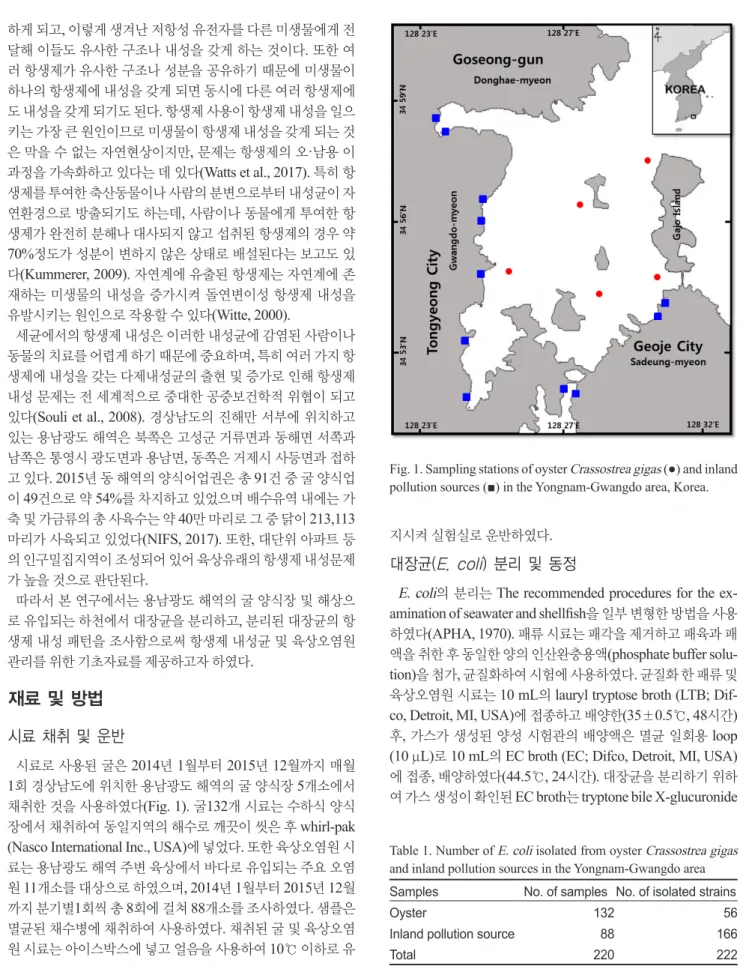
회경상남도에위치한용남광도해역의굴양식장5
개소에서 채취한것을사용하였다(Fig. 1).
굴132
개시료는수하식양식 장에서채취하여동일지역의해수로깨끗이씻은후whirl-pak (Nasco International Inc., USA)
에넣었다.
또한육상오염원시 료는용남광도해역주변육상에서바다로유입되는주요오염 원11
개소를대상으로하였으며, 2014
년1
월부터2015
년12
월 까지분기별1
회씩총8
회에걸쳐88
개소를조사하였다.
샘플은 멸균된채수병에채취하여사용하였다.
채취된굴및육상오염 원시료는아이스박스에넣고얼음을사용하여10℃
이하로유지시켜실험실로운반하였다
. 대장균(E. coli) 분리 및 동정
E. coli
의분리는The recommended procedures for the ex- amination of seawater and shellfish
을일부변형한방법을사용하였다
(APHA, 1970).
패류시료는패각을제거하고패육과패액을취한후동일한양의인산완충용액
(phosphate buffer solu- tion)
을첨가,
균질화하여시험에사용하였다.
균질화한패류및 육상오염원시료는10 mL
의lauryl tryptose broth (LTB; Dif- co, Detroit, MI, USA)
에접종하고배양한(35±0.5℃, 48
시간)
후
,
가스가생성된양성시험관의배양액은멸균일회용loop
(10 μL)
로10 mL
의EC broth (EC; Difco, Detroit, MI, USA)
에접종,
배양하였다(44.5℃, 24
시간).
대장균을분리하기위하 여가스생성이확인된EC broth
는tryptone bile X-glucuronide
Table 1. Number of E. coli isolated from oyster Crassostrea gigas and inland pollution sources in the Yongnam-Gwangdo area Samples No. of samples No. of isolated strains
Oyster 132 56
Inland pollution source 88 166
Total 220 222
Fig. 1. Sampling stations of oyster Crassostrea gigas (●) and inland pollution sources (■) in the Yongnam-Gwangdo area, Korea.
agar (TBX; Oxoid, Basingstoke, UK)
평판에streak
하여배양(44±1℃
에서22±2
시간)
후, E. coli
로추정되는청색또는청 녹색의집락을선택하여VITEK system (Biomerieux, Marcy, France)
으로확인,
동정하였다.
항생제 내성 시험
E. coli
의항생제내성확인에는Acar and Goldstein (1991)
의 디스크확산법을이용하였다.
분리,
동정된E. coli
는muller hin- ton broth (MHB; BBL, NJ, USA)
에접종하여35℃
에서18-24
시간배양한후,
균배양액의농도를densicheck plus (Biom- erieux, Marcy, France)
로0.5
가되도록희석하여조정하였다.
두께4 mm
의muller hinton II agar (MHA; BBL, NJ, USA)
평판에희석된균액을도말하고 흡수가되도록5
분간 방치한 후15
분이내에항생제디스크(Sensi-disc, BBL, NJ, USA)
를 평판에고착시켰다.
항생제디스크는amikacin (30 μg; AN), amoxicillin/ clavulanic acid (30 μg; AmC), ampicillin (10 μg;
AM), aztreonam (30 μg; ATM), cefamandole (30 μg; MA),
cefazolin (30 μg; CZ), cefepime (30 μg; FEP), cefotaxime (30 μg; CTX), cefotetan (30 μg; CTT), cefoxitin (30 μg; FOX), ceftazidime (30 μg; CAZ), cephalothin (30 μg; CF), chloram- phenicol (30 μg; C), ciprofloxacin (5 μg; CIP) gentamicin (10 μg; GM), imipenem (10 μg; IPM), nalidixic acid (30 μg; NA), piperacillin (100 μg; PIP), rifampin (5 μg; RA), streptomycin (10 μg; S), tetracycline (30 μg; TE), tobramycin (10 μg; NN), trimethoprim (5 μg; TMP), trimethoprim/ sulfamethoxazole (1.25/ 23.75 μg; SXT)
등24
종을사용하였다.
항생제디스크를 고착시킨muller hinton II Agar
평판은35℃
에서16-18
시간배 양한후,
증식저해대(inhibition zone)
의크기를측정하여항생 제내성유무를판별하였다.
결과 및 고찰
대장균의 항생제 내성
2014
년1
월부터2015
년12
월까지용남광도해역의굴에서Table 2. Antimicrobial resistance of E. coli isolated in the Yongnam-Gwangdo area
Antimicrobial agents Concentration
per disk (μg) Diffusion zone
breakpoint (mm) No. of resistance isolates (%) Escherichia coli (n=222)
Amikacin (AN) 30 <14 31 (13.9)
Amoxicillin/Clavulanic acid (AMC) 20/10 <13 6 (2.7)
Ampicillin (AM) 10 <13 10 (4.5)
Aztreonam (ATM) 30 <10 5 (2.5)
Cefamandole (MA) 30 <14 17 (7.7)
Cefazolin (CZ) 30 <14 12 (5.4)
Cefepime (FEP) 30 <14 42 (18.9)
Cefotetan (CTT) 30 <12 1 (0.4)
Cefotaxine (CTX) 30 <14 7 (3.2)
Ceftazidime (CAZ) 30 <14 42 (18.9)
Cephalothin (CF) 30 <14 157 (70.7)
Cefoxitin (FOX) 30 <14 6 (2.7)
Chloramphenico (C) 30 <12 15 (6.8)
Ciprofloxacin (CIP) 5 <15 11 (5.0)
Gentamicin (GM) 10 <12 14 (6.3)
Imipenem (IPM) 10 <13 0 (0.0)
Nalidixic acid (NA) 30 <13 37 (16.7)
Piperacillin (PIP) 10 <17 32 (14.4)
Rifampin (RA) 5 <17 221 (99.5)
Streptomycin (S) 10 <11 45 (20.2)
Tetracycline (TE) 19 <14 43 (19.4)
Trimethoprim/ Sulfamethoxazole (SXT) 23.75/1.25 <10 16 (7.2)
Tobramycin (NN) 10 <12 52 (23.4)
Trimethoprim (TMP) 5 <10 18 (8.1)
E. coli
는56
균주,
배수유역의 주요육상오염원(
하천10
개소,
생활하수1
개소)
에서는166
균주가분리되었으며(Table 1),
굴 과육상오염원에서분리한E. coli 222
균주를대상으로24
종 의항생제에대한내성률을조사한결과(Table 2),
내성률은ri- fampin (99.5%)
에서가장높았고그다음으로는cephalothin (70.7%), tobramycin (23.4%), streptomycin (20.2%), tetracy- cline (19.4%), cefepime (18.9%), ceftazidime (18.9%), nali- dixic acid (16.7%), piperacillin (14.4%), amikacin (13.9%)
순이었다.
이외trimethoprim, cefamandole, trimethoprim/
sulfamethoxazole, chloramphenicol, gentamicin, cefazolin.
ciprofloxacin, ampicillin, cefoxitin, amoxicillin/ clavulanic acid, cefoxitim, aztreonam, cefotetan
에대한내성률은10%
이 하로낮았으며, imipenem
에대한내성은확인되지않았다.
이 전의연구결과, 2011
년부터2012
년까지남해안3
개지역(
고흥,
여수,
남해)
의패류에서분리한E. coli
의내성률은tetracycline (29.9%), streptomycin (25.5%), ampicillin (18.6%)
순으로높았고
(Park et al., 2013), 2013
년남해안에위치한한산거제만 과자란만사량도해역의주변육상오염원(
거제시,
통영시,
고 성군소재하천및마을하수)
에서분리한E. coli
는tetracycline
(10.6%)
에대한내성률이가장높았으며다른항생제들의내성률은
5%
이하이거나 내성을나타내지 않았다(Park et al., 2018).
그러나2013
년부터2015
년까지서해안의패류에서분 리한E. coli
는ampicillin (37.2%), cephalothin (21.7%), ce- fazolin (19.9%)
순으로높은내성률을나타내었으며(Jo et al., 2016)
남해안과는달리tetracycline
계항생제에대한내성률 은4%
수준이었고cephem
계항생제에대한내성이높게나타났다
. 2014
년과2015
년에용남광도해역에서채취한굴과오염원시료를대상으로한본연구결과에서
E. coli
의내성률은ansamycin
계항생제인rifampin
과cephem
계항생제인cepha- lothin
에서아주높게나타났는데,
이러한결과는축·
수산용항 생제로가장많이판매되고있는tetracycline
계와penicillin
계 항생제(MFDS, 2018)
에대한내성률이높았던2014
년이전결 Table 3. Antimicrobial resistance of E. coli isolated from oyster Crassostrea gigas and inland pollution sources in Yongnam-Gwangdo areaAntimicrobial agents Concentration per
disk (μg) Diffusion zone breakpoint (mm)
No. of resistance isolates (%)
Oyster Inland pollution source E. coli (n=56) E. coli (n=166)
Amikacin (AN) 30 <14 2 (3.6) 8 (4.8)
Amoxicillin/Clavulanic acid (AMC) 20/10 <13 1 (1.8) 5 (3.0)
Ampicillin (AM) 10 <13 8 (14.3) 23 (13.9)
Aztreonam (ATM) 30 <10 0 (0.0) 5 (3.0)
Cefamandole (MA) 30 <14 0 (0.0) 17 (10.2)
Cefazolin (CZ) 30 <14 0 (0.0) 5 (3.0)
Cefepime (FEP) 30 <14 40 (71.4) 2 (1.2)
Cefotetan (CTT) 30 <12 1 (1.8) 0 (0.0)
Cefotaxine (CTX) 30 <14 0 (0.0) 7 (4.2)
Ceftazidime (CAZ) 30 <14 40 (71.4) 2 (1.2)
Cephalothin (CF) 30 <14 41 (73.2) 116 (69.9)
Cefoxitin (FOX) 30 <14 0 (0.0) 6 (3.6)
Chloramphenico (C) 30 <12 6 (10.7) 9 (5.4)
Ciprofloxacin (CIP) 5 <15 1 (1.8) 10 (6.0)
Gentamicin (GM) 10 <12 2 (3.6) 12 (7.2)
Imipenem (IPM) 10 <13 0 (0.0) 0 (0.0)
Nalidixic acid (NA) 30 <13 7 (12.5) 30 (18.1)
Piperacillin (PIP) 10 <17 6 (10.7) 26 (15.7)
Rifampin (RA) 5 <17 56 (100.0) 165 (99.4)
Streptomycin (S) 10 <11 8 (14.3) 37 (22.3)
Tetracycline (TE) 19 <14 12 (21.4) 31 (18.7)
Trimethoprim/ Sulfamethoxazole (SXT) 23.75/1.25 <10 4 (7.1) 12 (7.2)
Tobramycin (NN) 10 <12 40 (71.4) 12 (7.2)
Trimethoprim (TMP) 5 <10 6 (10.7) 12 (7.2)
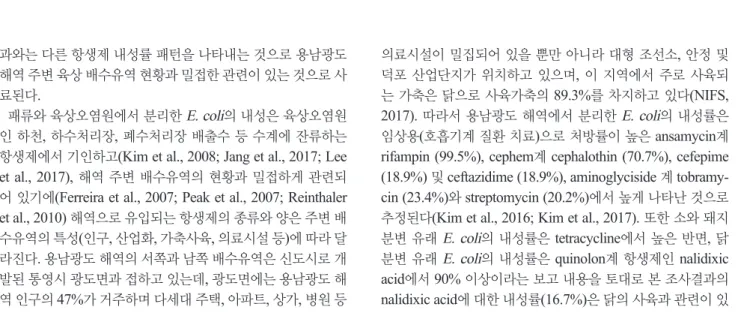
과와는다른항생제내성률패턴을나타내는것으로용남광도 해역주변육상배수유역현황과밀접한관련이있는것으로사 료된다
.
패류와육상오염원에서분리한
E. coli
의내성은육상오염원 인하천,
하수처리장,
폐수처리장배출수등수계에잔류하는 항생제에서기인하고(Kim et al., 2008; Jang et al., 2017; Lee
et al., 2017),
해역주변배수유역의현황과밀접하게 관련되어있기에
(Ferreira et al., 2007; Peak et al., 2007; Reinthaler et al., 2010)
해역으로유입되는항생제의종류와양은주변배 수유역의특성(
인구,
산업화,
가축사육,
의료시설등)
에따라달 라진다.
용남광도해역의서쪽과남쪽배수유역은신도시로개 발된통영시광도면과접하고있는데,
광도면에는용남광도해 역인구의47%
가거주하며다세대주택,
아파트,
상가,
병원등의료시설이밀집되어있을뿐만아니라대형조선소
,
안정및 덕포 산업단지가위치하고있으며,
이지역에서주로사육되 는가축은닭으로사육가축의89.3%
를차지하고있다(NIFS, 2017).
따라서용남광도해역에서분리한E. coli
의내성률은 임상용(
호흡기계질환치료)
으로처방률이높은ansamycin
계rifampin (99.5%), cephem
계cephalothin (70.7%), cefepime (18.9%)
및ceftazidime (18.9%), aminoglyciside
계tobramy- cin (23.4%)
와streptomycin (20.2%)
에서높게나타난것으로 추정된다(Kim et al., 2016; Kim et al., 2017).
또한소와돼지 분변유래E. coli
의 내성률은tetracycline
에서높은반면,
닭 분변유래E. coli
의내성률은quinolon
계항생제인nalidixic
acid
에서90%
이상이라는보고내용을토대로본조사결과의nalidixic acid
에대한내성률(16.7%)
은닭의사육과관련이있Table 4. Multiple antimicrobial resistance of E. coli isolated from oyster Crassostrea gigas in Yongnam-Gwangdo Area
No. of antimicrobials Resistance patterns No. of isolated strains Total (%)
1 RA 5 8.9
2
AM, RA 1
12.5
CF, RA 3
CTT, RA 1
RA, TE 1
TMP, RA 1
3
AMC, AN, RA 1
5.4
CF, AN, RA 1
CF, TMP, RA 1
4 FEP, NN, CAZ, RA 4
GM, S, TMP, RA 1 8.9
5 CF, FEP, NN, CAZ, RA 20 35.7
6
AM, CF, FEP, NN, CAZ, RA 3
8.9
CF, FEP, NN, CAZ, RA, C 1
CF, GM, FEP, NN, CAZ, RA 1
7 CF, FEP, NA, NN, CAZ, RA, TE 2
CF, S, FEP, NN, CAZ, RA, TE 2 7.1
8 CF, S, FEP, NN, CAZ, RA, C, TE 1 1.8
9 AM, CF, S, FEP, PIP, NN, CAZ, RA, TE 1 1.8
10 AM, CF, S, FEP, PIP, NN, CAZ, RA, C, TE 1 1.8
11
AM, CF, AN, FEP, NA, PIP, TMP, NN, CAZ, RA, SXT 1
5.4 AM, CF, FEP, NA, PIP, TMP, NN, CAZ, RA, TE, SXT 1
AM, CF, S, FEP, NA, PIP, NN, CAZ, RA, C, TE 1
12 AM, CF, S, FEP, NA, PIP, TMP, NN, CAZ, RA, TE, SXT 1 1.8
56 100
AN, Amikacin; AMC, Amoxicillin/Clavulanic acid; AM, Ampicillin; ATM, Aztreonam; MA, Cefamandole; CZ, Cefazolin; FEP, Cefepime;
CTX, Cefotaxime; CTT, Cefotetan; FOX, Cefoxitin; CAZ, Ceftazidime; CF, Cephalothin; C, Chloramphenicol; CIP, Ciprofloxacin; GM, Gentamicin; IPM, Imipenem; NA, Nalidixic acid; PIP, Piperacillin; RA, Rifampin; S, Streptomycin; TE, Tetracycline; NN, Tobramycin;
TMP, Trimethoprim; SXT, Trimethoprim/Sulfamethoxazole.
Table 5. Multiple antimicrobial resistance of E. coli isolated from inland pollution source in Yongnam-Gwangdo Area No. of
antimicrobials Resistance patterns No. of isolated
strains Total (%)
0 1 0.6
1 RA 25 15.1
2
AN, RA 3
39.2
CF, RA 50
MM, RA 1
NA, RA 5
RA, C 2
RA, FOX 2
RA, TE 2
3
AN, NA, RA 1
18.7
CF, MA, RA 8
CF, NN, RA 1
CF, RA, TE 7
CF, S, RA 12
S, AN, RA 2
4
AM, CF, PIP, RA 2
9.6
AM, CF, S, RA 1
CF, GM, RA, FOX 1
CF, NA, RA, CIP 2
CF, NA, RA, TE 1
CF, PIP, RA, TE 1
CF, RA, C, TE 1
CF, S, NN, RA 1
CF, S, RA, TE 3
CF, RA, TE, CIP 1
GM, S, RA, TE 1
S, AN, NA, RA 1
5
AN, CF, GM, PIP, RA 1
3.0
AM, CF, NA, PIP, RA 1
AM, CF, PIP, RA, C 1
CF, S, AN, AMC, RA 1
CF, S, MA, RA, TE 1
6
AM, CF, NA, PIP, RA, TE 1
3.0
AM, CF, S, PIP, RA, FOX 1
CF, S, AN, PIP, RA, TE 1
CF, S, MA, RA, C, TE 1
CZ, CF, S, AM, RA, FOX 1
AN, Amikacin; AMC, Amoxicillin/Clavulanic acid; AM, Ampicillin; ATM, Aztreonam; MA, Cefamandole; CZ, Cefazolin; FEP, Cefepime;
CTX, Cefotaxime; CTT, Cefotetan; FOX, Cefoxitin; CAZ, Ceftazidime; CF, Cephalothin; C, Chloramphenicol; CIP, Ciprofloxacin; GM, Gentamicin; IPM, Imipenem; NA, Nalidixic acid; PIP, Piperacillin; RA, Rifampin; S, Streptomycin; TE, Tetracycline; NN, Tobramycin;
TMP, Trimethoprim; SXT, Trimethoprim/Sulfamethoxazole.
을것으로사료되며
,
향후조사지점별E. coli
내성률확인및비 교등추가연구가필요하리라생각된다.
대장균의 항생제 내성 비교
패류와육상오염원에서분리한
E. coli
의항생제별내성의경 향은Table 3
에나타내었다.
굴에서분리한E. coli
는24
종의항 생제중18
종에대한내성이확인되었으며,
내성률은rifampin (100%), cephalothin (73.2%), cefepime (71.4%), ceftazidime (71.4%), tobramycin (71.4%)
순이었고,
이들외에는20%
이하 의내성률을나타내었다. 22
종의항생제에서내성을나타낸육 상오염원분리균주의내성률은rifampin (99.4%), cephalothin
(69.9%)
에서높았고나머지항생제들의내성률은20%
이하였다
.
항생제별내성률은육상오염원시료보다굴에서높게나타 나는경향을보였는데,
이러한결과는이동성이없는패류의특 성에의한것으로(Grimes, 1991; Feldhusen, 2000)
육상오염 원에서유입되는항생제가여과·
섭이과정중에축적되기때문 인것으로사료된다.
그리고육상오염원시료에서는굴에서내 성이확인되지 않았던aztreonam (5%), cefamandole (17%), cefazolin (5%), cefotaxime (7%), cefoxitin (6%)
에서내성을나타내는
E. coli
가확인되었는데,
이들은특정오염원에서만분리되는균주인것으로추정되며명확한원인을확인하기위
해서는육상오염원지점별로오염의발원지와주변환경에대한 보다정밀한추적조사가수행되어야할것으로판단된다
대장균의 다제내성 양상
용남광도해역의굴에서분리된
E. coli 56
균주에대한항생제 내성패턴은Table 4
에나타내었다.
분리된모든균주는시험에 사용된24
종의항생제중최소1
종에서12
종에대하여내성을 나타내었고,
내성을나타내지않는균주는없었다.
내성을나타 내는56
균주중에서4
종이상의항생제에내성을나타내는다 제내성균(multiple antimicrobial resistance bacteria, MARB)
은41
균주(73.2%)
로 확인되었으며,
내성률이 높았던5
종(ri- fampin, cephalothin, cefepime, ceftazidime, tobramycin)
의항생제에내성을갖는균주가가장많았다
(35.7%).
용남광도해역의굴에서분리한
E. coli
의다제내성균검출률또한개별항생제에대한내성률과마찬가지로남해안과서해안의패류에서 분리한
E. coli
의다제내성률(14.2%, 15.9%)
보다높았고(Park et al., 2013; Jo et al., 2016),
항생제의사용이빈번한어류양식 장의양식어류에서분리된다제내성균검출률(62.5%)
보다높 게나타났다(Son et al., 2009) .
이러한결과는앞서언급한바 와같이용남광도해역주변배수유역오염원의특성과관련이 있을것으로사료되며,
이외에도지역사회의항생제사용량의 Table 5. ContinuedNo. of
antimicrobials Resistance patterns No. of isolated
strains Total (%)
7
AM, GM, S, NA, RA, TE, CIP 1
1.8
AM, S, PIP, TMP, RA, TE, SXT 1
GM, PIP, TMP, MA, RA, TE, CIP 1
8 AM, CZ, CF, PIP, MA, RA, TE, CTX 1
AM, CZ, CF, PIP, TMP, RA, TE, SXT 1 1.2
9 AM, CZ, CF, NA, PIP, ATM, MA, RA, CTX 1 0.6
10 AM, CF, NA, PIP, TMP, NN, RA, C, TE, SXT 1
S, PIP, ATM, NN, MA, RA, TE, CTX, CIP, SXT 1 1.2
11
AM, CZ, CF, GM, NA, PIP, ATM, MA, RA, CTX, CIP 1
3.0
AM, CZ, CF, S, AMC, NA, PIP, TMP, MA, RA, SXT 3
CF, GM, S, NA, PIP, TMP, NN, MA, RA, C, STX 1
13 AM, CF, GM, S, NA, PIP, TMP, NN, RA, C, TE, CIP, SXT 1
AM, CZ, CF, GM, S, NA, PIP, NN, MA, RA, TE, CTX, CIP 1 1.2
14 AM, CZ, CF, GM, FEP, NA, PIP, TMP, ATM, NN, MA, RA, CTX, SXT 1
AM, CZ, CF, GM, S, PIP, TMP, NN, MA, CAZ, RA, TE, FOX, SXT 1 1.2
17 AM, CZ, CF, GM, FEP, NA, PIP, TMP, ATM, NN, MA, CAZ, RA, TE, CTX, CIP, SXT 1 0.6
Total 166 100
AN, Amikacin; AMC, Amoxicillin/Clavulanic acid; AM, Ampicillin; ATM, Aztreonam; MA, Cefamandole; CZ, Cefazolin; FEP, Cefepime;
CTX, Cefotaxime; CTT, Cefotetan; FOX, Cefoxitin; CAZ, Ceftazidime; CF, Cephalothin; C, Chloramphenicol; CIP, Ciprofloxacin; GM, Gentamicin; IPM, Imipenem; NA, Nalidixic acid; PIP, Piperacillin; RA, Rifampin; S, Streptomycin; TE, Tetracycline; NN, Tobramycin;
TMP, Trimethoprim; SXT, Trimethoprim/Sulfamethoxazole.
증가및다변화등다양한원인들에서기인하는것으로추정된 다
.
그리고가축유래E. coli
의내성및다제내성률조사결과,
연 도별내성률추이는다소차이가있으나,
소와돼지에서분리한E. coli
의내성률은전반적으로감소추세를나타내었고닭에서는증가추세를나타내었다
.
닭의분변및도축장의닭도체에서 분리한E. coli
의다제내성률은각각84.7%-90.1%
및69.4%- 87.0%
로소의분변(17.0%-31.9%)
과도체(15.2%-38.2%),
돼 지의 분변(64.6%-87.4%)
과 도체(52.3%-78.6%)
에서 분리한균주보다높은것으로나타나
(MFDS, 2018)
용남광도해역의패류와육상오염원에서분리한
E. coli
의항생제내성패턴은 배수유역에서주로사육되는가축용항생제와도무관하지않 을것으로사료된다.
육상오염원에서분리된
E. coli (166
균주)
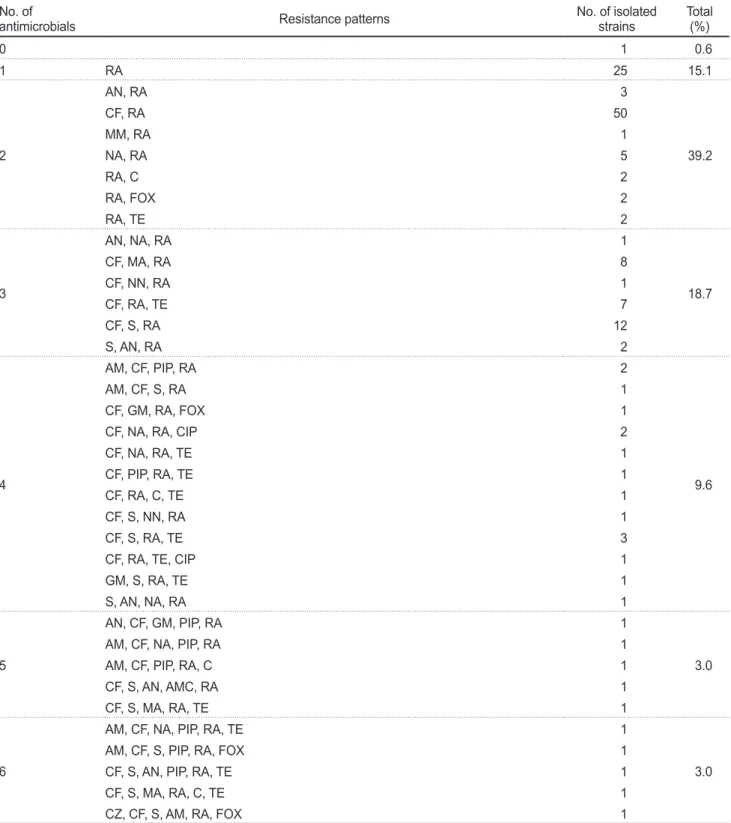
의다제내성(Table 5)
은개별로도내성률이높았던항생제인rifampin
과cephalo- thin
에내성을나타내는균주가30% (50
균주)
로가장많았고,
다제내성균의검출률은26.5% (44
균주)
로패류보다낮았는데,
이는일정기간항생제등이축적·
잔류하는패류와달리하천,
생활하수,
하수처리장방출수등과같은육상오염원은수계로 유동·
확산되기때문인것으로추정되며,
육상오염원에유입되 거나잔류하는 항생물질은본류와지류,
강우량(
풍수기,
갈수 기등),
조사시기(
농번기등),
폐수·
하수처리공법등환경조건 에영향을받으므로(Kim et al., 2008)
육상오염원에잔류항생 제종류와내성패턴은패류보다다양한경향을나타내는것으 로사료된다.
연안해역에정착
·
서식하는패류를비롯한수산물은다양한 육상오염원을통해해역으로유입되는항생제에노출되고,
지 속적인항생제의환경노출에따라수산물에서내성균및다제 내성균의검출률및출현가능성또한점차높아지고있다.
따라 서내성균과다제내성균의출현을최소화하고안전한수산물 을생산하기위해서는항생제의적절한사용과국가차원의적 극적인항생제관리와더불어육상오염원에서의항생제내성 률확인및항생제저감연구등이지속추진되어야할것이다.
사 사
이논문은
2018
년국립수산과학원수산과학연구사업수출패류생산해역및수산물위생조사
(R2018056)
의지원으로수행된연구이며연구비지원에감사드립니다
.
References
Acar JF and Goldstein FW. 1991. Disk susceptibility testing. In:
Antibiotics in Laboratory Medicine, Lorian V, ed. Williams
& wilkins, Baltimore, M.D., U.S.A., 17-52.
Angulo FJ, Johnson KR and Tauxe RV. 2000. Origins and con- sequences of antimicrobial-resistant nontyphoidal salmonel-
la: implications for the use of fluoroquinolones in food ani-
mals. Mocrob Drug Resist 6, 77- 83. http://doi.org/10.1089/mdr.2000.6.77.
APHA (American Public Health Association). 1970. Recom- mended procedures for the examination of seawater and shellfish. 4th Ed. American Public Health Association, Washington D.C., U.S.A., 1-47.
Donabedian SM, Thal LA and Hershberger E. 2003. Molecular characterization of gentamicin-resistant Enterococci in the United States: evidence of spread from animals to humans through food. J Clin Microbiol 41, 1109-1113. http://doi.
org/10.1128/JCM.41.3.1109-1113.2003.
Feldhusen F. 2000. The role of seafood in bacterial foodborne disease. Microbes Infect 2, 1651-1660.
Ferreira M, Vaz-Moreira I, Gonzalez-Pajuelo M, Nunes OC and Mannaia CM. 2007. Antimicirobial resistance patterns in Enterobacteriaceae isolated from an urban wastewater treatment plant. FEMS Microbiol Ecol 60, 166-176. https://
doi.org/10.1111/j.1574-6941.2006.00268.x.
Grimes DJ. 1991. Ecology of estuarine bacteria capable of caus- ing human disease: A review. Estuaries 14, 345-360. https://
doi.org/10.2307/1352260.
Jang YJ, Yoo YJ, Sul WJ, Cha CJ, Rhee OJ and Chae JC. 2017.
Effect of antibiotic resistant factors in effluent of wastewater treatment plant on stream. Korean J Microbiol 53, 316-319.
https://doi.org/10.7845/kjm.2017.7083.
Jo MR, Park YS, Park KBW, Kwon JY, Yu HS, Song KC, Lee HJ, Oh EG, Kim JH, Lee TS and Kim PH. 2016. Antimi- crobial resistance in Escherichia coli isolated from shellfish farms on the west coast of Korea. Korean J Fish Aquat Sci 49, 13-19. https://dx.doi.org/10.5657/ KFAS.2016.0013.
Kim JA, Park JH, Kim BY and Kim DS. 2017. The Trend of Acute Respiratory Tract Infections and Antibiotic Pre- scription Rates in Outpatient Settings using Health Insur- ance Data. Korean J Clin Pharm 27, 186-194. https://doi.
org/10.24304/kjcp.2017.27.3.186.
Kim JH, Park CK, Kim MY and Ahn SG. 2008. Contamination of Veterinary Antibiotics and Antimicrobials in Han River Basin. J Korean Soc Environ Anal 11, 109-118.
Kim YA, Park YS, Youk TM, Lee SS and Son YJ. 2016. A Study on the Use of Antibiotics in Korea and the Resistance of Major pathogens to Antibiotics. NHIS Ilsan hospital Report 2016-20-001, 1-116.
Kummerer K. 2009. Antibiotics in the aquatic environment- A review-Park I. Chemosphere 75, 417-434. https://doi.
org/10.1016/j.chemosphere.2008.11.086.
Lee HJ, Kim HY, Kim KY, Yang DS, Lee IJ, Lim YK, Kim JH and Oh JE. 2017. Characteristic Occurrence and Dis- tributions of Pharmaceuticals in the Nakdong River. J Ko- rean Soc Environ Eng 39, 403-411. https://doi.org/10.4491/
KSEE.2017.39.7.403.
MFDS (Minstry of Food and Drug Safety). 2018. Antimicrobial resistance monitoring. Retrieved from http://www.mfds.
go.kr/m_231/view.do?seq=33040 on Jul 10, 2018.
NIFS (National Institute of Fisheries Science). 2017. Report of sanitary survey of shellfish growing area in Yongnam- Gwangdo, 2014-2016. NIFS, Busan, Korea.
Park KBW, Kim SH, Ham IT, Ryu AR, Kwon JY, Kim JH, Yu HS, Lee HJ and Mok JS. 2018. Antimicrobial resistance patterns of Escherichia coli isolated from discharged water from inland pollution sources in the Hansan-Heojeman and Jaranman-Saryangdo area of Korea. Korean J Fish Aquat Sci 51, 1-7. https://doi.org/10.5657/KAFS.2018.0001.
Park KBW, Park JY, Jo MR, Yu HS, Lee HJ, Kim JH, Oh EG, Shin SB, Kim YK and Lee TS. 2013. Antimicrobial resis- tance in Escherichia coli isolated from shellfish farms in the southern coast of Korea. Korean J Fish Aquat Sci 46, 528- 533. http://do.doi.org/10.5657/KFAS.2013.0528.
Peak N, Knapp CW, Yang RK, Hanfelt MM, Smith MS, Aga DS and Graham DW. 2007. Abundance of six tetracycline resistance genes in wastewater lagoons at cattle feedlots with different antibiotic use stategies. Environ Microbiol 9, 143-151. http://doi.org/10.1111/j.1462-2920.2006.01123.x.
Reinthaler FF, Ferierl G, Galler H, Haas D, Leitner E, Mascher F, Melkes A, Posch J, Winter I, Zarfel G and Marth E.
2010. ESBL-producing E. coli in Austrian sewage sludge.
Water Res 44, 1981-1985. https://doi.org/10.1016/j.wa- tres.2009.11.052.
Sobsey MD and Jaykus LA. 1991. Human enteric viruses and depravation of bivalve molluscs. In: Molluscan shellfish depravation. Otwell WS, Rodrick GE and Martin RE, eds.
CRC Press, Boca Raton, F.L., U.S.A., 71-114.
Son JC, Park SW and Min KJ. 2003. Environmental and an- timicrobial characteristics of Vibro spp. isolated from fish, shellfish and brackish water samples in Gyeonbuk western coast. Kor J Environ Health 29, 94-102.
Son KT, Oh EG, Park KBW, Kwon JY, Lee HJ, Lee TS and Kim J.H. 2009. Antimicrobial susceptibility of Escherichia
coli isolated from fish farms on the southern coast of Korea.
Korean J Fish Aquat Sci 42, 322-328.
Song SW, Jung SC, Kim SI, Jung ME, Kim KH, Lee JY, Lim SK, Lee YJ, Cho NI, Park JM and Park YH. 2004. Sur- veilance of antimicrobial susceptibility of bacteria isolated from slaughterhouse in Korea, 2003. 1. Antimicrobial sus- ceptibility of E. coli isolated from carcasses in slaughter house. Korean J Vet Public Health 25, 215-221.
Souli M, Galani I and Giamarellou H. 2008. Emergence of ex- tensively drug-resistant and pandrug-resistant Gram-nega- tive bacilli in Europe. Euro Surveill 13, 19045.
Todd KE and Campbell AR. 2002. Growing area 1508 sanitary survey report. Marlborough Public Health Unit, Marlbor- ough, New Zealand.
Watts JEM, Schreier HJ, Lanska L and Hale MS.2017. The Rise Tide of Antimicribial Resistance in Aquaculture: Source, Sinks and Solutions. Mar Drugs 15, 1-16. https://doi.
org/10.3390/md15060158.
Witte W. 2000. Selective pressure by antibiotic use in live- stock. Int J Antinicrob Agents 16, S19-S24. https://doi.
org/10.1016/S0924-8579(00)00301-0.