• 검색 결과가 없습니다.

Effect of Sr Substitution for RE on Microstructure and Tensile Properties in Mg-Al-RE Casting Alloys

N/A
N/A
Protected

Academic year: 2021

Share "Effect of Sr Substitution for RE on Microstructure and Tensile Properties in Mg-Al-RE Casting Alloys"

Copied!
4
0
0

로드 중.... (전체 텍스트 보기)

전체 글

(1)

− 284 − 한국주조공학회지 제31권 제5호 (2011. 10)

Effect of Sr Substitution for RE on Microstructure and Tensile Properties in Mg-Al-RE Casting Alloys

Joong-Hwan Jun

Advanced Fusion Process R&D Group, Korea Institute of Industrial Technology, Incheon 406-840, Korea

Abstract

본 연구는 Mg-Al 합금에 첨가된 희토류 금속(rare earth metal, RE)과 스트론튬(Sr)이 상온 및 고온 기계적 특성에 미치는 영향을 비교하고, 그 결과를 미세조직의 변화와 연관지어 분석하는 것이 목적이다. 이를 위해 4종의 Mg-6%Al-(3-X)%RE-

X%Sr 합금(X = 0~3)을 마련하여 RE를 Sr으로 대체하면서 상온 및 고온 인장 특성, 크립 저항성을 평가하였다. RE가 Sr으

로 대체됨에 따라, 층상구조의(α + Al

4

Sr)상이 α 덴드라이트 사이에 생성되면서 침상의 Al

4

RE상이 점차 소멸하였으며 Mg-

6%Al-3%Sr 합금에서는(α + Al

4

Sr) 과 블록형태의 Mg-Al-Sr상이 관찰되었다. Sr 함량이 증가할수록 항복강도와 크립저항성 은 지속적으로 향상되는 경향을 나타내었다.

Key words : Mg-Al-RE alloy, Sr, Tensile properties, Creep resistance.

(Received August 22, 2011 ; Accepted September 26, 2011)

1. Introduction

Magnesium (Mg) and its alloys have gained an increasing attention due to their low density (~1.8 g/cm

3

), high specific solidity, good machinability and damping capacity [1-2].

However, relatively inferior tensile strength and creep resistance of Mg alloys at elevated temperatures in comparison with competitive Al alloys, have limited their further utilization as weight-saving structural material in automotive and aerospace applications. Consequently, principal researches for widespread use of the Mg alloys have focused on the improvement in mechanical properties at elevated temperatures [3-6].

It is well established that rare earth metals (RE) and Strontium (Sr) are very beneficial in improving high tempera- ture strength and creep resistance of the Mg alloys by an in- troduction of Al-RE, Al-Sr and/or Mg-Al-Sr compounds possessing high thermal stabilities [7-9]. In spite of numerous works on RE and/or Sr-containing Mg-Al based alloys [7-12], however, efficiencies of RE and Sr elements in mechanical properties at room and elevated temperatures have not been comparatively investigated. In this study, we report on the changes in microstructures and tensile properties at room and elevated temperatures with Sr content in Mg-6%Al-(3- X)%RE-X%Sr (X = 0~3) permanent mold casting alloys.

2. Experimental

Four Mg-6%Al based alloys containing 3%RE, 2%RE-

1%Sr, 1%RE-2%Sr and 3%Sr (in weight), respectively, were prepared by melting 99.9%Mg, 99.9%Al, 99.0%RE (Ce-rich misch metal, ~55% of Ce, ~22% of La, ~18% of Nd and ~5%

of Pr) and 99.0%Sr under a (SF

6

+ CO

2

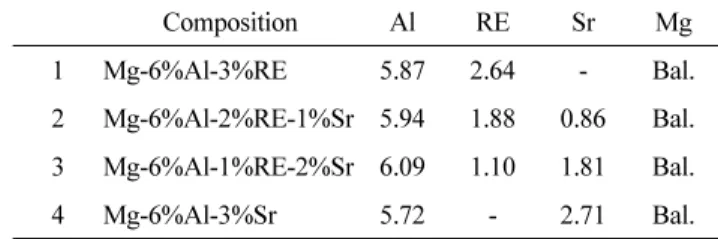
) covering gas and casting into a metallic mould. From the ingots, various speci- mens for optical microscopy (OM), scanning electron micros- copy (SEM), X-ray diffractometry (XRD), tensile and creep tests were prepared by machining. Chemical compositions of experimental alloys determined by means of ICP, are listed in Table 1.

Tensile tests were conducted at room temperature and 175

o

C with a constant initial strain rate of 6.7 × 10

−4

s

−1

with an Instron-type tensile testing machine. ASTM subsize specimens with a gauge length of 25 mm were employed. Tensile creep tests were also performed on 100 MPa at 175

o

C. Microstructural examinations were carried out by means of XRD (Rigaku CN- 2200) with Cu-K α radiation, OM (Olympus CK-40M) and SEM (FEI Sirion FESEM) equipped with energy dispersive X-ray spectrometer (EDAX) system. Samples for OM and SEM observations were mechanically polished and chemically

E-mail : [email protected]

(44)

Table 1. Chemical compositions of experimental alloys (in weight).

Composition Al RE Sr Mg

1 Mg-6%Al-3%RE 5.87 2.64 - Bal.

2 Mg-6%Al-2%RE-1%Sr 5.94 1.88 0.86 Bal.

3 Mg-6%Al-1%RE-2%Sr 6.09 1.10 1.81 Bal.

4 Mg-6%Al-3%Sr 5.72 - 2.71 Bal.

(2)

Effect of Sr Substitution for RE on Microstructure and Tensile Properties in Mg-Al-RE Casting Alloys - Joong-Hwan Jun 285

etched with a solution of 5 mL acetic acid + 6 g picric acid + 10 mL H

2

O + 100 mL ethanol.

3. Results and Discussion 3.1 Microstructures

Optical microstructures for Mg-6%Al-(3-X)%RE-X%Sr alloys are represented in Fig. 1. As reported in a previous work [10], the microstructure of Mg-6%Al-3%RE alloy is distinctively characterized by random distribution of clusters of needle-like Al

4

RE intermetallic compounds within α (Mg) grains and small amount of β (Mg

17

Al

12

) phase with fine particular morphology.

It is well known that the Mg-Al binary alloy shows inferior

high temperature strength and creep resistance because the β phase with 437

o

C of low melting temperature is easily softened and coarsened at elevated temperature above 120

o

C [13].

Dominance of Al

4

RE compounds in the Mg-6%Al-3%RE alloy (Fig. 1(a)) may well be attributed to the higher chemical interaction of Al and RE elements and higher forming temperature of Al

4

RE than β phase, which results in the early consumption of Al atoms before formation of β phase during solidification. It is noted in Fig. 1 that with increasing Sr content, dendritic morphology of α grains becomes obvious and the amount of eutectic phase at the interdendritic region increases gradually.

Secondary electron images for the Mg-6%Al-(3-X)%RE-

(45)

Fig. 2. Secondary electron images of Mg-6%Al-(3-X)%RE-X%Sr alloys : (a), (b) Mg-6%Al-3%RE, (c), (d) Mg-6%Al-1%RE-2%Sr and (e), (f) Mg-6%Al-3%Sr.

Fig. 1. Optical microstructures of Mg-6%Al-(3-X)%RE-X%Sr alloys : (a) Mg-6%Al-3%RE, (b) Mg-6%Al-2%RE-1%Sr, (c) Mg-6%Al-1%RE-

2%Sr and (d) Mg-6%Al-3%Sr.

(3)

− 286 Journal of the Korea Foundry Society Vol. 31, No. 5, 2011

X%Sr alloys are given in Fig. 2. Fig. 2(a) and (b) clearly represents the various sizes of needle-shaped Al

4

RE phase within the grains. By the substitution of Sr for RE, eutectic Al

4

Sr precipitates with lamellar morphology are formed in the interdendritic regions. The Al

4

RE is still visible, but its volume fraction and size become reduced as observed in the Mg-6%Al- 1%RE-2%Sr alloy (Fig. 2(c) and (d)). The Mg-6%Al-3%Sr alloy shows dendritic grains and interdendritic eutectic phases consisting of bulky compounds and lamellar Al

4

Sr phase with more continuous manner (Fig. 3(e) and (f)). EDS analyses revealed that bulky phase is Mg

13

Al

3

Sr ternary compound as reported by Jing et al. [8]. In a previous study [14], it has been reported that the type of Sr-related compound in the Mg-Al-Sr based alloys depends on the ratio of Sr/Al concentrations.

When the Sr/Al ratio in the alloy is lower than 0.3, only Al

4

Sr can form in the microstructure while the Sr/Al ratio is higher than 0.3, the Mg-Al-Sr ternary phase will appear besides Al

4

Sr phase. Thus, the existence of Mg-Al-Sr ternary phase in the Mg-6%Al-3%Sr alloy with Sr/Al ratio of 0.5 is well consistent with the previous results.

XRD patterns in the Mg-6%Al-(3-X)%RE-X%Sr alloys are shown in Fig. 3. Several peaks corresponding to α , Al

4

Ce and β phases appear in the Mg-6%Al-3%RE alloy, demonstrating that this alloy contains small amount of β phase in combination with α and Al

4

RE as seen in the optical and SEM micro- structures (Fig. 1(a), Fig. 2(a), (b)). With the increase in Sr content, Al

4

Sr peaks are additionally introduced whereas the Al

4

Ce peaks become gradually decayed due to the decreased RE content. It is noted that the β peaks are not visible in the Sr-containing alloys.

3.2 Tensile properties

Fig. 4 represents the changes in yield strength (YS), ultimate tensile strength (UTS) and elongation at RT and 175

o

C with Sr content in the Mg-6%Al-(3-X)%RE-X%Sr alloys. At RT, YS increases continuously with increasing Sr content, whereas UTS and elongation to failure become lower. At 175

o

C, however, YS and UTS are improved simultaneously in the alloys with higher amounts of Sr, even though the elongation is still deteriorated slightly.

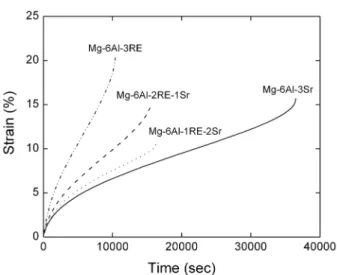
Creep curves and minimum creep rates of the Mg-6%Al-(3- X)%RE-X%Sr alloys tested at 175

o

C under 100 MPa are given in Figs. 5 and 6, respectively. The Sr substitution for RE leads to the abrupt decrease in minimum creep rates from 14.49 × 10

4

s

1

(Mg-6%Al-3%RE) to 0.27 × 10

4

s

1

(Mg-6%Al-3%Sr). The

~50 times lower minimum creep rate of the Mg-6%Al-3%Sr alloy than the Mg-6%Al-3%RE alloy indicates that Sr is more beneficial in creep resistance of the Mg-Al based alloys than RE. After considering that the principal strengthening phases of Al

4

RE and Al

4

Sr would possess practically same level of thermal stability resulting from their similar melting tempera- tures over 1000

o

C [14], the improvement in tensile strength and

(46)

Fig. 4. Tensile properties at RT and 175

o

C for Mg-6%Al-(3-X)%RE- X%Sr alloys.

Fig. 3. XRD patterns of Mg-6%Al-(3-X)%RE-X%Sr alloys : (a)

Mg-6%Al-3%RE, (b) Mg-6%Al-2%RE-1%Sr, (c) Mg-6%Al-

1%RE-2%Sr and (d) Mg-6%Al-3%Sr.

(4)

Effect of Sr Substitution for RE on Microstructure and Tensile Properties in Mg-Al-RE Casting Alloys - Joong-Hwan Jun 287

creep resistance by substituting RE with Sr may well be related to the formation of interdendritic eutectic structure consisting of Al

4

Sr and Mg-Al-Sr intermetallics. The higher the Sr content, volume fraction and continuity of the interdendritic phases become increased, yielding grain boundary strengthening and re- stricting grain boundary migration effectively during creep test.

4. Summary

Microstructures and tensile properties at ambient and elevated temperatures were studied by substituting RE for Sr in Mg- 6%Al-(3-X)%RE-X%Sr alloys (X = 0~3). With increasing Sr content, Al

4

Sr phase with lamellar morphology was newly

introduced at interdendritic regions, with a gradual extinction of needle-shaped Al

4

RE. The Mg-6%Al-3%Sr alloy shows dendritic grains and interdendritic eutectic phases containing bulky Mg-Al-Sr and lamellar Al

4

Sr with more continuous manner. The substitution of Sr for RE provided higher YS, UTS and creep resistance at 175

o

C, which indicates that Sr would be more beneficial in tensile properties and creep resistance at elevated temperature than RE for the Mg-Al based casting alloys.

References

[1] B. L. Mordike and T. Ebert : Mater. Sci. Eng. A, “Magnesium:

Properties-applications-potential”, 302 (2001) 37-45

[2] H. Friedrich and S. Schumann : J. Mater. Proc. Tech., “Research for a “new age of magnesium” in the automotive industry”, 117 (2001) 276-281

[3] A. Luo : Int. Mater. Rev., “Recent magnesium alloy develop- ment for elevated temperature applications”, 49 (2004) 13-30 [4] B. L. Mordike : Mater. Sci. Eng. A, “Creep-resistant magnesium

alloys”, 324 (2002) 103-112

[5] A. Srinivasan, J. Swaminathan, M. K. Gunjan, U. T. S. Pillai and B. C. Pai : Mater. Sci. Eng. A, “Effect of intermetallic phases on the creep behavior of AZ91 magnesium alloy”, 527 (2010) 1395-1403

[6] M. O. Pekguleryuz and A. A. Kaya : Adv. Eng. Mater., “Creep resistant magnesium alloys for powertrain applications”, 5 (2003) 866-878

[7] F. Khomamizadeh, B. Nami and S. Khoshkhooei : Metall.

Mater. Trans. A, “Effect of rare-earth element additions on high temperature mechanical properties of AZ91 magnesium alloy”, 36 (2005) 3489-3494

[8] B. Jing, S. Yangshan, X. Shan, X. Feng and Z. Tianbai : Mater.

Sci. Eng. A, “Microstructure and tensile creep behavior of Mg- 4Al based magnesium alloys with alkaline-earth elements Sr and Ca additions”, 419 (2006) 181-188

[9] M. Kunst, A. Fischersworring-Bunk, G. L’esperance, P.

Plamondon and U. Glatzel : Mater. Sci. Eng. A, “Microstructure and dislocation analysis after creep deformation of die-cast Mg- Al-Sr (AJ) alloy”, 510-511 (2009) 387-392

[10] Y. Lu, Q. Wang, X. Zeng, W. Ding, C. Zhai and Y. Zhu : Mater.

Sci. Eng. A, “Effects of rare earths on the microstructure, properties and fracture behavior of Mg-Al alloys”, 278 (1999) 66-76

[11] S. M. Zhu, M. A. Gibson, J. F. Nie, M. A. Easton and T. B.

Abbott : Scripta Mater., “Microstructural analysis of the creep resistance of die-cast Mg-4Al-2RE alloy”, 58 (2008) 477-480 [12] T. Sato and M. V. Kral “ Mater. Sci. Eng. A, “Microstructural

evolution of Mg-Al-Ca-Sr alloy during creep”, 298 (2008) 369- 376

[13] G. Pettersen, H. Westengen, R. Hoier and O. Lohne : Mater. Sci.

Eng. A, “Microstructure of a pressure die cast magnesium- 4wt.% aluminum alloy modified with rare earth additions”, 207 (1996) 115-120

[14] H. Okamoto : ASM International, Phase Diagrams for Binary Alloys, (2000) 28

[15] H. Okamoto : ASM International, Phase Diagrams for Binary Alloys, (2000) 44

(47) Fig. 5. Creep curves of Mg-6%Al-(3-X)%RE-X%Sr alloys obtained

at 175

o

C under 100 MPa.

Fig. 6. Comparison of minimum creep rates for Mg-6%Al-(3-X)

%RE-X%Sr alloys measured at 175

o

C under 100 MPa : (a)

Mg-6%Al-3%RE, (b) Mg-6%Al-2%RE-1%Sr, (c) Mg-6%Al-

1%RE-2%Sr and (d) Mg-6%Al-3%Sr.

수치

Table 1.  Chemical compositions of experimental alloys (in weight).
Fig. 2.  Secondary electron images of Mg-6%Al-(3-X)%RE-X%Sr alloys : (a), (b) Mg-6%Al-3%RE, (c), (d) Mg-6%Al-1%RE-2%Sr and (e), (f) Mg-6%Al-3%Sr.
Fig. 4.  Tensile properties at RT and 175 o C for Mg-6%Al-(3-X)%RE- Mg-6%Al-(3-X)%RE-X%Sr alloys.
Fig. 6.  Comparison of minimum creep rates for Mg-6%Al-(3-X)

참조

관련 문서

주조합금에서의 인장특 성은 Mn과 Sr을 동시에 첨가한 경우 가장 우수한 것으로 나 타났으며, 이것은 Mn의 긍정적인 효과, 즉 침상 Al 5 FeSi 상의 감소와 더불어

At room temperature and 100 ℃, the workpieces showed similar behaviors in microstructural evolution and tensile properties depending on forging passes, while the increase

SEM micrograph of AlFeSi compound formed at the interface between cast iron insert and Cu-added Al alloy fabricated by compound casting method...

The microstructure, mechanical properties and cor- rosion resistance of the as-cast Mg-Zn-Ca-Sr alloys were characterized by using optical microscopy, scanning

The effects of Zn and Mg amounts on the solidification characteristics, microstructure, thermal conductivity and tensile strength of Al-Zn-Mg-Fe alloys were investigated

Refinement of microstructure and precipitation of thermally stable secondary phases are important goal for the design of heat-resis- tant Mg alloy.. In this study, the effect of

이러한 Al 다이캐 스팅 부품에 적용되고 있는 Al 소재로는 대부분 Al-Si 합금계 가 사용되고 있으나, Al-Si 합금계는 인장강도 수준이 300MPa 이하이기 때문에 300MPa

The microstructural and mechanical properties were analyzed by OM, XRD, SEM, and tensile tests. The addition of Ca to the Mg-11Li-3Zn-1Sn-0.4Mn alloy resulted in the formation of