Al-Zn-Mg-Cu 합금의 주조성 및 인장특성에 미치는 Mg 및 Cu 첨가량의 영향
김기태†·임영석·김정민 *
한국생산기술연구원 주조기술센터, *한밭대학교 신소재공학부
Effects of Mg and Cu Amounts on the Casting Characteristics and Tensile Property of Al-Zn-Mg-Cu Alloys
Ki-Tae Kim†, Young-Suk Lim, and Jeong-Min Kim*
Foundry Technology Center, Korea Institute of Industrial Technology, Incheon 406-800, Korea
*Dept. of Applied Materials Eng., Hanbat National University, Daejeon 305-719, Korea
Abstract
The effects of Mg and Cu amounts on the casting characteristics and tensile property of Al-Zn-Mg-Cu alloys were investigated for the development of high strength aluminium alloys for gravity mold casting. Increase of copper amounts in Al-6%Zn-3%Mg- y%Cu alloys resulted in reduction of the fluidity of these alloys and had little effects on the tensile property of these alloys. Increase of magnesium amounts from 1.0wt% to 3.3wt% in Al-6%Zn-x%Mg-0.5%Cu alloys resulted in reduction of the elongation of these alloys from 12% to 3% and increase of the tensile strength of these alloys from 340MPa to 450MPa, but had little effects on the fluidity of these alloys.
Key words : Aluminum alloy, Mold casting, Mold filling, Fluidity, High strength.
(Received January 13, 2012 ; Accepted February 22, 2012)
1. 서 론
세계적으로 환경오염 문제가 대두되면서 자동차 산업분야에서 는 자동차의 평균연비 및 자동차 배기가스 규제 강화에 대비 한 연비개선이 절실히 요구되고 있어, 이에 대한 대책으로 자 동차 경량화를 위한 알루미늄 등의 경량소재를 이용한 자동차 부품 적용이 크게 늘어나고 있다. 이에 따라서 경량소재의 한 계를 극복할 수 있는 고강도, 고연성, 고열전도도 등의 고기능 알루미늄 소재 및 부품제조기술이 요구되고 있다. 주조, 단조 및 압연 등의 공정에 의하여 제조되는 알루미늄 부품 중에서 다이캐스팅 및 금형주조 등의 주조공정에 의하여 제조되는 알 루미늄 주조 부품 생산량은 전체 알루미늄 부품 생산량의 약 80%에 이르고 있다. 주조용 알루미늄 합금으로는 Al-Cu, Al- Si, Al-Mg 및 Al-Zn 합금계 등이 있으나 Al-Cu 합금계를 제 외하고는 인장강도가 300MPa 수준이기 때문에 300MPa 이상
의 고강도를 요구하는 알루미늄 자동차 부품설계 및 적용에 한계를 갖고 있다. 최근 고강도 다이캐스팅 및 주조용 알루미 늄 합금 소재에 대한 관심이 높아지면서 세계 유수의 알루미 늄 제조업체에서는 인장강도 300MPa 이상의 다이캐스팅 및 주조용 Al-Zn 합금에 대한 연구개발이 이루어지고 있다[1-3].
Al-Zn 합금계는 대부분 압출, 압연 등의 소성가공용 합금소재 로서 사용되고 있으며, 석출강화 열처리 후 600MPa 수준의 높은 인장강도를 나타내고 있다. 그러나 주조용 Al-Zn 합금계 는 300MPa 정도의 인장강도를 나타내지만 주조성이 열악하여 주조용 합금소재로 사용하는 데에 한계성을 갖고 있기 때문에 주조 크랙 방지 및 유동성 향상 등 주조성 향상을 위한 합금 조성 개량, 주조속도 조절, 냉각속도 조절 및 결정립 미세화 등과 같은 여러 연구결과가 보고되었다[4-9]. 그러나 Al-Zn- Mg-Cu 합금을 주조하였을 때에 Mg 및 Cu 첨가에 따른 주 조성이나 인장 특성의 영향과 관련된 보고는 거의 없다. 따라
†Corresponding author: Ki-Tae Kim
[Tel: +82-32-850-0422, E-mail : [email protected]]
서, 본 연구에서는 500MPa급 주조용 고강도 Al-Zn-Mg-Cu 합금개발을 목적으로 Al-Zn-Mg-Cu 합금을 중력 금형주조하여 Mg 및 Cu 첨가량이 유동성 및 금형 충전성 등의 주조성에 미치는 영향을 조사하였으며, 또한 Mg 및 Cu 첨가량이 Al- Zn-Mg-Cu 합금의 인장강도 및 연신율 등의 인장특성에 미치 는 영향도 조사하였다.
2. 실험 방법
Al, Zn 및 Mg 등의 순금속(99.9%)과 Al-50%Fe, Al-20%Cu 및 Al-10%Ti 등의 모합금을 흑연 도가니를 사용하여 전기로 에서 용해하였으며, 용탕의 유동성 확보와 과열에 따른 산화를 최소화하기 위하여 용탕온도를 730oC~750oC로 유지하였다. 다 음에 환원성 플럭스(flux)를 용탕 표면에 산포하고 교반하여 용 탕 내 산화물을 제거하였으며, Ar 가스를 사용하여 용탕의 탈 수소처리를 수행하였다. 용해가 완료된 용탕으로부터 채취한 시 험편들의 화학조성을 분광 분석기를 이용하여 분석한 결과를 Table 1에 나타내었다. Mg 및 Cu 첨가량이 Al-Zn-Mg-Cu 합금의 주조성 및 인장특성에 미치는 영향을 조사하기 위하여 Zn은 약 6wt%로 고정하였고, Mg은 1~3wt% 범위, Cu는 0~2wt% 범위로 합금조성을 조절하였다. 그리고 Al-Zn-Mg-Cu
합금의 유동성 및 금형 충전성 등의 주조성과 인장특성을 조 사하기 위하여 나선형 금형 및 계단형 금형에 합금을 주조하 여 Fig. 1 및 Fig. 2와 같은 나선형 시험편과 계단형 시험편을 얻었다. 나선형 시험편의 크기는 폭 12 mm, 두께 5 mm, 최대 길이 780 mm이며, 계단형 시험편의 크기는 폭 100 mm, 높이 25 mm, 각각의 계단 두께는 3, 6, 9 및 12 mm이며 일정한 주조조건에 따라서 주조하였다. 주조조건은 용탕 온도 730oC, 금형 온도 200oC로 하여 시험편을 주조하였다. 주조된 계단형 시험편은 480oC에서 30분 용체화 처리한 후에 120oC에서 24 시간 시효 처리하였다. 합금의 유동성은 나선형 시험편의 최대 유동거리로 평가하였으며, 합금의 금형 충전성은 계단형 시험편 의 3, 6, 9 및 12 mm 각각의 두께별 충전율로 평가하였다.
또한 시험편의 인장시험은 3, 6, 9 및 12 mm 각각의 두께별 계단형 시험편을 주조 및 가공하여 ASTM B 557M 규격에 따라 수행하였고, 시험편의 미세조직은 SEM, EDX 및 XRD 등을 이용하여 분석하였다.
3. 결과 및 고찰 3.1 금형 충전성
Fig. 3은 Al-6%Zn-x%Mg-y%Cu 합금에서의 Mg 및 Cu
Table 1. Chemical compositions of Al-6%Zn-x%Mg-y%Cu alloys (wt%)
alloys Cu Mg Zn Zr Ti Fe Al
Al-6%Zn-3%Mg-y%Cu
alloy 1 0.001 3.45 6.49 0.08 0.06 0.33 bal.
alloy 2 0.50 3.31 6.28 0.08 0.07 0.38 bal.
alloy 3 1.07 3.34 6.32 0.11 0.06 0.43 bal.
alloy 4 1.97 2.93 6.04 0.10 0.05 0.33 bal.
Al-6%Zn-x%Mg-0.5%Cu
alloy 5 0.38 1.03 5.82 0.11 0.22 0.28 bal.
alloy 6 0.44 2.08 5.96 0.04 0.22 0.37 bal.
alloy 7 0.50 3.31 6.28 0.08 0.07 0.38 bal.
Fig. 1. Spiral mold specimen for evaluation of the fluidity of Al- 6%Zn-x%Mg-y%Cu alloys.
Fig. 2. Step mold specimen for evaluation of the mold filling and tensile properties of Al-6%Zn-x%Mg-y%Cu alloys.
첨가량이 3, 6, 9 및 12 mm 두께의 계단형 시험편 금형 충 전성에 미치는 영향을 나타낸 것이다. Al-6%Zn-x%Mg-y%Cu 합금에서 Zn은 약 6wt%로 고정하였고, Mg은 1~3wt% 범위, Cu는 0~2wt% 범위로 합금조성을 조절하였다. Mg 및 Cu 첨가 량에 관계없이 Al-6%Zn-x%Mg-y%Cu 합금은 3, 6, 9 및 12 mm 두께의 계단형 시험편에서 모두 충전되어 금형 충전율은 100%가 되었다. 즉, Al-6%Zn-x%Mg-y%Cu 합금의 3, 6, 9 및 12 mm 두께의 계단형 시험편 금형 충전성은 Mg 및 Cu 첨가량에 따라서 차이가 없는 것을 알 수 있다.
3.2 유동성
Fig. 4 및 Fig. 5는 각각 Al-6%Zn-x%Mg-y%Cu 합금에서 Mg 및 Cu 첨가량이 유동성에 미치는 영향을 나타낸 것이다.
먼저 Fig. 4에서 Zn 첨가량이 약 6%이고 Cu 첨가량은 약 0.5%이며 Mg 첨가량을 1~3%로 변화시킨 Al-6%Zn-x%Mg- 0.5%Cu 합금은 Mg 첨가량에 따라서 유동성의 변화 없이 780 mm의 최대 유동장을 나타내고 있다.
Fig. 5에서 Zn 첨가량이 약 6%이고 Mg 첨가량은 약 3.0%이며 Cu 첨가량을 0~2.0%로 변화시킨 Al-6%Zn-3%Mg- y%Cu 합금의 유동성은 Cu 첨가량 증가에 따라서 저하된 것
을 알 수 있다. 즉, Al-6%Zn-x%Mg-y%Cu 합금에서 Mg은 유동성에 영향을 미치지 않았으나 Cu는 첨가량 증가에 따라서 유동성을 저하시킨 것으로 요약할 수 있다. 알루미늄의 유동성 Fig. 3. Variation of the mold filling of Al-6%Zn-x%Mg-y%Cu alloys
with Mg and Cu contents.
Fig. 4. Variation of the spiral length of Al-6%Zn-x%Mg-0.5%Cu alloys with Mg contents.
Fig. 5. Variation of the spiral length of Al-6%Zn-3%Mg-y%Cu alloys with Cu contents.
은 합금원소의 종류 및 첨가량에 따라서 변화하는 것으로 알 려져 있는데, Cu, Ti, Fe 등은 첨가량 증가에 따라서 알루미 늄의 유동성을 저하시키지만 Si, Mg 등은 첨가량 증가에 따라 서 알루미늄의 유동성을 향상시키는 것으로 보고되어 있다[10].
따라서 본 연구에서의 Al-6%Zn-3%Mg-y%Cu 합금의 유동성 도 Cu 첨가량 증가에 따라서 저하된 것으로 판단된다.
3.3 인장 특성
Fig. 6은 Zn 첨가량이 약 6%이고 Mg 첨가량은 약 3.0%이
며 Cu 첨가량을 0~2.0%로 변화시킨 Al-6%Zn-3%Mg-y%Cu 합금에서 Cu 첨가량이 인장 특성에 미치는 영향을 나타낸 것 이다. Al-6%Zn-3%Mg-y%Cu 합금의 인장강도, 항복강도 및 연신율 등의 인장특성은 Cu 첨가량에 따라서 큰 변화가 없으 며, 단지 계단형 시험편의 두께에 따라서 인장강도는 380~500 MPa, 항복강도는 300~400MPa, 연신율은 1~3% 범위를 나타 내었다. Cu는 Al-Zn-Mg 합금에 첨가되어 석출상의 석출속도 를 증가시키고 일부 MgZn2 석출상을 CuMgAl2 석출상으로 변화시키며, 또한 응력부식을 감소시키는 효과가 있는 것으로 Fig. 7. Variation of the tensile properties of Al-6%Zn-x%Mg-0.5%Cu
alloys with Mg contents.
Fig. 6. Variation of the tensile properties of Al-6%Zn-3%Mg-y%Cu alloys with Cu contents.
알려져 있다[11]. 본 연구에서의 Al-6%Zn-3%Mg-y%Cu 합금 에 첨가된 Cu는 인장특성에 미치는 영향이 적은 것으로 판단 된다.
Fig. 7은 Zn 첨가량이 약 6%이고 Cu 첨가량은 약 0.5%이 며 Mg 첨가량을 1~3%로 변화시킨 Al-6%Zn-x%Mg-0.5%Cu 합금에서 Mg 첨가량이 인장 특성에 미치는 영향을 나타낸 것 이다. Mg 첨가량에 따라서 Al-6%Zn-x%Mg-0.5%Cu 합금의 인장강도 및 항복강도는 점차 증가하였다. Mg 첨가량이 약 1%인 합금의 연신율은 계단형 시험편의 두께에 따라서 8~15%
의 범위를 나타내었으나, Mg 첨가량이 약 2% 및 3%인 합금 은 약 3%의 연신율을 나타내었다. Mg은 Al-Zn 합금에 첨가
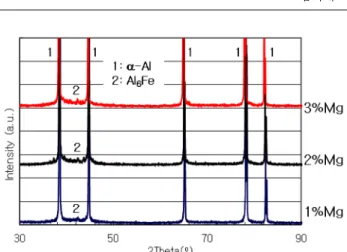
되어 MgZn2 석출상의 석출에 따라서 인장강도를 증가시키지만 MgZn2 석출상의 결정입계 편석으로 인하여 연신율 저하 및 응 력부식성을 증가시키는 것으로 알려져 있다[12]. Fig. 8은 Al- 6%Zn-x%Mg-0.5%Cu 합금의 미세조직을 XRD를 이용하여 분 석한 결과를 나타낸 것으로서 α-Al 및 Al6Fe상이 나타났다.
또한 Fig. 9는 Al-6%Zn-x%Mg-0.5%Cu 합금의 미세조직을 SEM으로 관찰한 것으로서 합금의 결정입계에 화합물이 정출되 어 있는 것을 볼 수 있다. Table 2는 이 결정립계 화합물을 EDX를 이용하여 분석한 결과를 나타낸 것으로서, Cu와 Si이 미량 함유된 Al6Fe(Fe: 5.9~10.9at%, Si: 1.4~2.0at%, Cu: 1.6~
2.8at%, Al: balance)인 것으로 분석되었으며 합금 응고시의 정 출상인 것으로 판단된다. Al-6%Zn-x%Mg-0.5%Cu 합금에서 Mg 첨가량 증가에 따라서 연신율이 감소된 것은 XRD 및 EDX 분석에서 나타나지는 않았으나 Mg 첨가량 증가에 따라서 MgZn2 석출상의 양이 증가하였기 때문인 것으로 추정되며, 또 한 XRD 및 EDX 분석에서 나타난 기지내 Mg 고용량 증가 에 따른 Fe 고용량 감소로 결정립계에 정출된 Al6Fe의 양이 증가하였기 때문인 것으로 판단된다. 이상의 결과로 부터 Al- 6%Zn-x%Mg-0.5%Cu 합금에서 Mg 첨가량 증가에 따라서 합 금의 인장강도는 증가하였으나, 연신율은 감소하였다.
4. 결 론
500MPa급 주조용 고강도 Al-Zn-Mg-Cu 합금개발을 목적으 로 Al-Zn-Mg-Cu 합금을 중력 금형주조하여 Mg 및 Cu 첨가 량이 유동성 및 금형 충전성 등의 주조성에 미치는 영향을 조 사하였으며, 또한 Mg 및 Cu 첨가량이 Al-Zn-Mg-Cu 합금의 인장강도 및 연신율 등의 인장특성에 미치는 영향도 조사한 결과 다음과 같은 결론을 얻었다.
1) Al-6%Zn-3%Mg-y%Cu 합금에서 Cu를 0~2wt% 범 Fig. 8. XRD analysis results of Al-6%Zn-x%Mg-0.5%Cu alloys.
Table 2. EDX analysis result of grain boundary precipitates on Al- 6%Zn-x%Mg- 0.5%Cu alloys
elements Fe Si Cu Al
at% 5.9~10.9 1.4~2.0 1.6~2.8 bal.
Fig. 9. SEM microstructure of Al-6%Zn-x%Mg-0.5%Cu alloys and : (a) 1%Mg (b) 2%Mg (c) 3%Mg.
위로 하여 첨가량을 증가시킨 결과, 합금의 유동성은 약간 저하되었으나 합금의 인장강도, 항복강도 및 연신율 등의 인장특성에는 큰 영향을 미치지 않았다.
2) Al-6%Zn-x%Mg-0.5%Cu 합금에서 Mg을 1~3wt% 범위 로 하여 첨가량을 증가시킨 결과, 합금의 유동성에는 별 영향 을 미치지 않았으나 합금의 인장강도는 약 340MPa에서 약 450MP로 증가하였으나 연신율은 약 12%에서 약 3%로 감소 하였다.
3) Mg 및 Cu의 합금원소 첨가량 조절에 따라서 중력금형주 조에 의한 인장강도 500MPa급 Al-6%Zn-x%Mg-y%Cu 합금을 얻을 수 있었다.
감사의 글
본 연구는 지식경제부 국가플랫폼기술개발사업의 지원으로 수 행되었습니다.
참고문헌
[1] L. Jen, Y. Xinyan and Z. Wenping : PCT Patent, “High strength, high stress corrosion cracking resistant and castable Al-Zn-Mg- Cu-Zr alloy for shape cast products” WO 2008/036760 (2008) [2] J. Dong, J. Z. Cui, F. X. Yu, Z. H. Zhao and Y. B. Zhuo : J.
Mater. Proc. Tech., “A new way to cast high-alloyed Al-Zn-Mg- Cu-Zr for super-high strength and toughness” 171 (2007) 399- 404
[3] K. T. Kim, J. H. Yang and Y. S. Lim : J. KFS, “Effects of Zn Amounts on the Castability and Tensile Properties of Al-Zn-
Mg-Cu Alloys for Die Casting” 30 (2010) 137-141
[4] D. Jie, C. Jianzhong, D. Wenjiang : J. Crystal Growth,
“Theoretical discussion of the effect of a low-frequency electromagnetic vibrating field on the as-cast microstructures of DC Al-Zn-Mg-Cu-Zr ingots” 295 (2006) 179-187 [5] J. Dong, J. Cui, X. Zeng and W. Ding : Mater. Letters, “Effect
of low-frequency electromagnetic field on microstructures and macrosegregation of φ270 mm DC ingots of Al-Zn-Mg- Cu-Zr alloy” 59 (2005) 1502-1506
[6] S. Geoffrey K : US Patent, “Method for grain refinement of high strength aluminum casting alloys” 6,645,321 (2003) [7] Z. Yubo, C. Jianzhong, Z. Zhihao, Z. Haitao, and Q. Ke :
Mater. Sci. Eng. A, “Effect of low frequency electromagnetic field on casting crack during DC casting superhigh strength aluminum alloys ingots” 406 (2005) 286-292
[8] B. Zhang, J. Cui and G. Lu : Mater. Sci. Eng. A, “Effect of low-frequency electromagnetic field on microstructures and macrosegregation of continuous casting 7075 aluminum alloy” 355 (2003) 325-330
[9] R. K. Paramatmuni, K. M. Chang, B. S. Kang and X. Liu : Mater. Sci. Eng. A, “Evaluation of cracking resistance of DC casting high strength aluminum ingots” 379 (2004) 293-301 [10] E. Gebhardt, M. Becker and S. Dorner : Aluminium, “Effect of
alloying additions on the viscosity of aluminum” 31 (1955) 315- 321
[11] G. T. Hahn and A. R. Rosenfield : Met. Trans. A, “Metallurgical factors affecting fracture toughness of aluminum alloys” 6A (1975) 653-670
[12] M. O. Speidel : Trans. AIME, “Stress corrosion cracking of aluminum alloys” 6A (1975) 631-651