J Korean Soc Pediatr Nephrol 2014;18:64-70 DOI: http://dx.doi.org/10.3339/jkspn.2014.18.2.64
Copyright © 2014 The Korean Society of Pediatric Nephrology
ISSN 1226-5292 (print) ISSN 2234-4209 (online)소아복막투석환자에서 CKD-MBD와 중증 부갑상샘 기능항진증에서 비타민 D 치료
울산대학교 의과대학 서울아산병원 어린이병원 소아청소년과 강은구ᆞ이주훈ᆞ박영서
Chronic Kidney Disease-mineral Bone Disorder and Active Vitamin D Analogs for Treating Severe Hyperparathyroidism in Children Receiving Chronic Peritoneal Dialysis
Purpose: The aims of this study were to assess the clinical and laboratory profiles of chronic kidney disease-mineral bone disorder (CKD-MBD) and to assess the effects of treatment of active vitamin D analogs on severe hyperparathyroidism (SHPT) in pediatric patients on chronic peritoneal dialysis.
Methods: This is a retrospective study included 53 patients who had been under- going dialysis for more than 1 year, between January 2003 and December 2012.
Results: Even after treatment with phosphate binders and active vitamin D analogs, the mean±standard deviation of the percentage of time during peritoneal dialysis that the patients’ serum concentrations of phosphorus, corrected total calcium, and parathyroid hormone (PTH) fell within the Kidney Disease Outcomes Quality Initiative recommended ranges was 25.06±17.47%, 53.30±23.03%, and 11.52±
9.51%, respectively. Clinical symptoms or radiological signs of CKD-MBD were observed in 10 patients (18.9%). There were significant differences in percentage of time that the serum intact PTH concentration was outside of the recommended range between patients with and without symptoms or signs of CKD-MBD (below recommended range, 11.74±7.37% vs. 40.77±25.39%, P<0.001; above the recommended range, 63.79±27.86% vs. 37.09±27.76%, P=0.022). Of the 25 patients with SHPT, high-dose alfacalcidol treatment was required in 13 patients that controlled SHPT in 7 of these patients, without marked complications.
Conclusion: Despite our efforts to manage CKD-MBD, patients’ met the recom- mended ranges from relevant guidelines at a low frequency. The treatment of high-dose active vitamin D analogs was required in about half of the patients with SHPT and effective in about half of them.
Key words: CKD-MBD, Peritoneal dialysis, Active vitamin D
Eun Gu Kang, M.D.,
Joo Hoon Lee, M.D., and Young Seo Park, M.D.
Department of Pediatrics, Asan Medical Center Children's Hospital, University of Ulsan College of Medicine, Seoul, Korea
Corresponding Author:Young Seo Park, M.D.
Department of Pediatrics, Asan Medical Center Children's Hospital, Ulsan University College of Medicine, Seoul, Korea
Tel: +82-2-3010-3386, Fax: +82-2-473-3725 E-mail: [email protected]
Received: 5 September 2014 Revised: 23 September 2014 Accepted: 1 October 2014
*The authors have no conflict of interests per- taining to this article to declare.
This is an open-access article distributed under the terms of the Creative Commons Attribu- tion Non-Commercial License (http:// crea- tivecom mons.org/licenses/bync/3.0/) which permits unrestricted non-commercial use, distribution, and reproduction in any medium, provided the original work is properly cited.
Introduction
Many studies have indicated that chronic kidney disease-mineral bone disorder (CKD-MBD), which is a systemic disorder of mineral and bone metabolism that occurs in association with chronic kidney disease, is associated with an increased risk of musculoskeletal morbidities, cardiovascular events, and mortality [1-4].
Current guidelines for the management of CKD-MBD place emphasis on the control of serum levels of parathy- roid hormone (PTH) and mineral electrolytes by using several types of phosphate binders and active vitamin D analogues [4-6]. Although abnormalities in serum phosphorus and calcium concentrations improved after the introduction of guidelines on mineral metabolism, such abnormalities remain common in CKD-MBD pa- tients receiving dialysis [2, 7, 8].
Skeletal deformities and growth retardation can easily develop in infants and young children that are receiving chronic peritoneal dialysis. Malnutrition, metabolic acidosis, end-organ growth hormone resistance, and mineral disturbances are risk factors for these abnor- malities. However, even after correction of these factors, the growth rate does not normalize in the majority of patients and secondary hyperparathyroidism contri- butes to persistent growth failure [7]. Secondary hyper- parathyroidism is also associated with an increased prevalence of bone pain, fracture and extraskeletal calcification [9]. Treatment of secondary hyperparathy- roidism includes maintaining the serum levels of calcium and phosphorus within normal ranges by dietary mani- pulation, phosphate binders, vitamin D analogues, cal- cimimetics, or parathyroidectomy. The most effective doses of active vitamin D analogues and calcimimetics are not clearly identified. Some studies showed that large doses over a long time are required and others that such treatments are less likely to achieve the targets in patients with severe hyperparathyroidism [10, 11].
The aims of this study were to assess the clinical and laboratory profiles of CKD-MBD with reference to the Kidney Disease Outcomes Quality Initiative (KDOQI) guidelines and to review the treatment of active vitamin D analogues on severe hyperparathyroidism in pediatric
patients who underwent peritoneal dialysis for more than 1 year.
Materials and methods
1. Patients
Patients who underwent chronic peritoneal dialysis for more than 1 year at Asan Medical Center Children’
s Hospital between January 2003 and December 2012 were included. Data were collected by retrospective review of medical records and included the basic characteristics, medical history, and medications of the patients, as well as their biochemical results during the follow-up.
2. Variables of interest and methods of measurement
The percentage of time throughout the follow-up that the biochemical results were within, below, and above the range recommended by the KDOQI guidelines was calculated for each patient. The target serum concentra- tions of phosphorus were 4.5-6.5 mg/dL for children aged 1-5 years, 3.6-5.8 mg/dL for children aged 6-12 years, and 2.3-4.5 mg/dL for adolescents aged over 12 years. The target serum concentrations of corrected total calcium were 9.4-10.8 mg/dL for children aged 1-5 years, 9.4-10.3 mg/dL for children aged 6-12 years, and 8.8-10.2 mg/dL for adolescents aged over 12 years [5].
Total calcium concentration was corrected for serum albumin using the following equation: Total calcium con- centration=calcium concentration+0.8 (4.0-albumin con- centration), if the albumin concentration is <4.0 g/dL.
Vitamin D status was assessed according to the mean 25(OH) vitamin D concentration in each year. According to the KDOQI guidelines, vitamin D deficiency was defined as a 25(OH) vitamin D concentration of ≤15 ng/
mL, severe vitamin D deficiency as <5 ng/mL, vitamin D insufficiency as 16-30 ng/mL, and vitamin D sufficiency as >30 ng/mL. The target concentration of intact PTH was 200-300 pg/mL and severe hyperparathyroidism
was defined as an intact PTH concentration of >1,000 pg/mL, according to the KDOQI guidelines.
Both calcitriol and alfacalcidol are widely used as active vitamin D analogues, having been shown to be effective in suppressing PTH. Alfacalcidol has been more frequently prescribed in our center. There is no consensus regarding the optimal dosage of active vitamin D analogues; we defined high-dose active vitamin D treatment as a dosage of alfacalcidol greater than 0.05 mcg/kg/QOD and usual dose as a dosage of alfacalcidol less than 0.05 mcg/kg/QOD. Control of severe hyperparathyroidism was defined as maintaining a serum concentration of intact PTH less than 300 pg/mL.
Routine biochemical variables, such as calcium, pho- sphorus, alkaline phosphatase, albumin, and total CO2 levels, were measured by standard automated methods.
The serum intact PTH concentration was measured by an immunoradiometric assay. Serum 25(OH) vitamin D and 1,25(OH)2 vitamin D concentrations were measured by radioimmunoassays.
3. Statistical analyses
Descriptive statistics of continuous variables are pre- sented as the mean and standard deviation for normally distributed parameters or as the median (range) for skewed parameters. Categorical variables are presented as frequencies. Subgroups were compared using the t-test for continuous variables and the chi-square test for categorical variables with a P value of <0.05 considered significant. Associations between the intact PTH serum concentration and other variables were tested by linear regression analysis with a P value of <0.05 considered significant. All statistical analyses were performed using IBM SPSS software, version 21 (IBM, Armonk, NY, USA).
Results
1. Patient characteristics
Between January 2003 and December 2012, 53 patients (35 boys and18 girls) underwent peritoneal dialysis in
our center and were included in this study. The age at initiation of peritoneal dialysis was 1-17 years (median, 10 years) and the duration of peritoneal dialysis was 12- 132 months (median, 33 months). Twenty-five patients (47.2%) received a kidney transplant and the median duration from initiation of peritoneal dialysis to kidney transplantation was 31 months (range, 14-112 months).
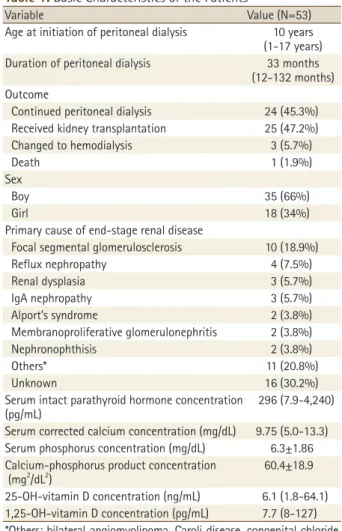
The most common primary cause of end-stage renal disease was focal segmental glomerulosclerosis (18.9%) (Table 1).
2. Biochemical outcomes and vitamin D status
To maintain serum concentrations of calcium, pho-Table 1. Basic Characteristics of the Patients
Variable Value (N=53)
Age at initiation of peritoneal dialysis 10 years (1-17 years) Duration of peritoneal dialysis 33 months
(12-132 months) Outcome
Continued peritoneal dialysis 24 (45.3%) Received kidney transplantation 25 (47.2%)
Changed to hemodialysis 3 (5.7%)
Death 1 (1.9%)
Sex
Boy 35 (66%)
Girl 18 (34%)
Primary cause of end-stage renal disease
Focal segmental glomerulosclerosis 10 (18.9%)
Reflux nephropathy 4 (7.5%)
Renal dysplasia 3 (5.7%)
IgA nephropathy 3 (5.7%)
Alport’s syndrome 2 (3.8%)
Membranoproliferative glomerulonephritis 2 (3.8%)
Nephronophthisis 2 (3.8%)
Others* 11 (20.8%)
Unknown 16 (30.2%)
Serum intact parathyroid hormone concentration
(pg/mL) 296 (7.9-4,240)
Serum corrected calcium concentration (mg/dL) 9.75 (5.0-13.3) Serum phosphorus concentration (mg/dL) 6.3±1.86 Calcium-phosphorus product concentration
(mg2/dL2) 60.4±18.9
25-OH-vitamin D concentration (ng/mL) 6.1 (1.8-64.1) 1,25-OH-vitamin D concentration (pg/mL) 7.7 (8-127)
*Others: bilateral angiomyolipoma, Caroli disease, congenital chloride diarrhea, Fechtner syndrome, Henoch-Schonlein nephritis, hyperuri- cemic nephropathy, infantile nephrotic syndrome, Joubert syndrome, lupus nephritis, primary oxalosis, and posterior urethral valve syndrome.
Mean±standard deviation for normally distributed parameters and median (range) for skewed parameters.
sphorus, and PTH within the recommended ranges, pa- tients were treated with calcium-containing phosphate binders (calcium carbonate or calcium acetate), calcium- free phosphate binders (sevelamer hydrochloride or lanthanum carbonate), and active vitamin D analogues (alfacalcidol) for 75.33±3.14%, 23.30±24.00%, and 58.69
±25.82% of the time they were receiving peritoneal dialysis, respectively. The type of phosphate binder (cal- cium-containing or calcium-free) was determined by the serum calcium concentration. Despite the treatment with these medications, the mean±standard deviation of the percentage of time during peritoneal dialysis that the patients’ serum concentrations of phosphorus, cor- rected total calcium, and PTH were within the recom- mended ranges was 25.06±17.47%, 53.30±23.03%, and 11.52±9.51%, respectively.
There were no significant differences between boys and girls in relation to the percentage of time during peritoneal dialysis that the biochemical results were within the recommended ranges. Peritoneal dialysis for a longer amount of time was associated with patients showing hypercalcemia for a higher percentage of time (r=0.439, P=0.001), but was not associated with the percentage of time that patients exhibited hyperpara- thyroidism or hyperphosphatemia.
At 1 year after peritoneal dialysis initiation, 6 (17.1%) of the 38 patients in whom the 25(OH) vitamin D concen- tration had been measured at least once had a mean 25(OH) vitamin D concentration of greater than 30 ng/mL. At 2 years after peritoneal dialysis initiation, 1 patient (2.9%) had vitamin D sufficiency. At 3 years after peritoneal dialysis initiation, no patients had vitamin D sufficiency.
An increased serum PTH concentration was signifi- cantly associated with a decreased serum corrected total calcium concentration and an increased serum phosphorus concentration, but was not significantly associated with decreased serum concentrations of 25(OH) vitamin D or 1,25(OH)2 vitamin D.
3. Clinical symptoms and/or radiological signs of CKD-MBD
Clinical symptoms or radiological signs of CKD-MBD were observed in 10 patients (18.9%). Bone pain or osteopenia was observed in 4 patients, skeletal defor- mities in 2 patients, tissue calcification in 2 patients, rickets in 1 patient, and a fracture in 1 patient. Three patients developed these symptoms or signs prior to the initiation of peritoneal dialysis. There were signifi- cant differences between patients without and with symptoms or signs of CKD-MBD in terms of the per- centage of time during peritoneal dialysis that the intact PTH concentration was below the guideline (40.77±
25.39% vs.11.74±7.37%, P<0.001) and above the guideline (37.09±27.76% vs. 63.79±27.86%, P=0.022). The percen- tage of time during peritoneal dialysis that the other biochemical results were outside the recommended guidelines did not significantly differ between these two groups of patients. Clinical symptoms or radiological signs of CKD-MBD were associated with severe hyper- parathyroidism (P=0.002) (Table 2).
4. Treatment of high dose active vitamin D analogues on severe hyperparathyroidism
Of the 25 patients (47.2%) who showed severe hyper- parathyroidism more than once during the follow-up, severe hyperparathyroidism was controlled in 12 patients by treatment with alfacalcidol at a dosage of less than 0.05 mcg/kg/QOD. Among the 13 patients who were treated with alfacalcidol at a dosage of greater than 0.05 mcg/kg/QOD, severe hyperparathyroidism was control- led by using high dose alfacalcidol alone in 5 patients and by using high dose alfacacidol plus cinacalcet (dose;
25-50 mg daily) in 2 patients. In these patients, the mean duration of high dose alfacalcidol treatment was 5.5±4.4 months (maximum, 12.3 months) and the mean dose of alfacalcidol was 0.109±0.032 mcg/kg/QOD (maximum, 0.158 mcg/kg/QOD).
Six patients had persistent severe hyperparathyroidism despite high dose alfacalcidol treatment. In 2 of these patients, severe hyperparathyroidism was controlled
after kidney transplantation or parathyroidectomy.
Another 2 patients in whom the intact PTH concentration has recently increased continue to receive a high dose of alfacalcidol. The other 2 patients persistently had an intact PTH concentration of greater than 1000 pg/mL despite the treatment with a combination of high dose alfacalcidol, cinacalcet (dose; 50 mg daily) and parathy- roidectomy.
During high dose alfacalcidol treatment, 4 patients experienced hypercalcemia and 10 patients experienced hyperphosphatemia, but this phenomenon was nor- malized after alfacalcidol treatment was discontinued or the dosage was reduced. After high dose active vitamin D treatment, the serum 1,25 (OH)2 vitamin D concentra- tion remained below the normal range. Although none of the patients in this study underwent a bone biopsy, no patients showed biochemical features consistent with adynamic bone such as persistent hypercalcemia, low serum PTH or alkaline phosphatase level.
Discussion
This study shows that CKD-MBD remains a significant problem in children receiving chronic peritoneal dialysis, despite efforts to meet the KDOQI guidelines. Most studies concerning CKD-MBD reported cross-sectional data in
adult patients receiving dialysis and there are few studies of pediatric patients. This study was a retrospective study that assessed CKD-MBD by determining the percentage of time during chronic peritoneal dialysis that mineral electrolytes were imbalanced in pediatric patients.
Although most patients received phosphate binders and active vitamin D analogues, the percentage of time during peritoneal dialysis that serum phosphorus, calcium, and intact PTH concentrations were within the recommended ranges was low. The median percentage of time during peritoneal dialysis that patients exhibited hyperphosphatemia was 73% and the serum phosphorus concentration was above the recom mended range throug hout the entire follow-up period in 4 patients.
The median percentage of time during peritoneal dialysis that patients exhibited hyperparathyroidism was 37%
and 3 patients had persistent hyperparathyroidism throughout the entire follow-up period. The International Pediatric Peritoneal Dialysis Network (IPPN) study showed a similar result that the KDOQI guidelines were achieved in a relatively low percentage of patients [12]. There was a limitation to assess whether enough doses of phosphate binders were administered because the doses of pho- sphate binders were not collected in this study. The compliance and dietary restrictionof the patients should also be considered.
Vitamin D insufficiency and deficiency were common Table 2. Comparison of Patients with and without Symptoms or Signs of Chronic Kidney Disease-mineral Bone Disorderin Terms of the Percentage of Time During Peritoneal Dialysis that Biochemical Results were within, Below, and Above the Range Recommended by the Kidney Disease Outcomes Quality Initiative (KDOQI) Guidelines
Clinical symptoms or radiological signs of
chronic kidney disease-mineral bone disorder P value
Yes (N=7) No (N=43)
PTH % of time below the guideline 11.74±7.37 40.77±25.39 <0.001
% of time within the guideline 24.47±21.92 22.13±16.71 0.744
% of time above the guideline 63.79±27.86 37.09±27.76 0.022
Phosphorus % of time below the guideline 7.85±14.44 5.57±9.31 0.583
% of time within the guideline 18.97±22.74 25.80±17.54 0.364
% of time above the guideline 73.18±26.62 68.63±21.22 0.614
Calcium % of time below the guideline 17.08±21.54 16.75±18.05 0.965
% of time within the guideline 49.30±29.26 56.64±25.35 0.490
% of time above the guideline 33.62±28.11 26.61±24.20 0.490
Ca*P % of time below the guideline 32.34±23.16 47.22±21.61 0.103
SHPT Yes 7 (14%) 15 (30%) 0.002
No 0 (0%) 28 (56%)
Abbreviations: SHPT, severe hyperparathyroidism; PTH, parathyroid hormone; Ca*P, Calcium-phosphorus product.
and the proportion of patients who showed vitamin D insufficiency or deficiency increased with the duration of peritoneal dialysis. In pediatric patients treated with dialysis, the prevalence of vitamin D insufficiency and deficiency was reportedly 83-98%. Many studies sugg- ested that suboptimal serum vitamin D levels were associated with higher serum PTH levels, contributed to the development of secondary hyperparathyroidism, and were associated with increased risks of cardiovascular events and death [13-15].
Approximately 19% of patients showed clinical symp- toms or radiological signs of CKB-MBD and these were associated with severe hyperparathyroidism. Information about the growth of patients was not collected in this study, although growth failure is a common feature of pediatric patients with CKD-MBD. In the IPPN registry, the prevalence of clinical symptoms or radiological signs of bone disease was 15%, and the height of below the third percentile was 39% of children [12]. Among young Dutch adults who received dialysis before the age of 14 years, 61% had severe growth retardation, 36.8% had clinical symptoms of bone disease, and 17.8% had dis- abilities owing to bone disease [16].
In the current study, about half of patients who showed severe hyperparathyroidism required higher than usual doses of alfacalcidol. Among these, 7 patients had a decreased serum intact PTH concentration and achi- eved the KDOQI target intact PTH concentration by taking an increased dose of alfacalcidol with or without cinacalcet. In a recent meta-analysis, receiving vitamin D therapies in the form of alfacalcidol, calcitriol, or ana- logues was significantly associated with reduced risks of all-cause mortality and cardiovascular mortality. The effect of 1,25 (OH)2 vitamin D concentration on the reduced risk of mortality is not only owing to the alle- viation of hyperparathyroidism but also to PTH-inde- pendent biological activity [17]. It is uncertain whether the benefits of active vitamin D analogues are reduced when they are prescribed at high doses or whether such high doses are insufficient in patients with severe hyperparathyroidism [18, 19]. Adynamic bone disease is a side-effect of intermittent treatment with active vitamin D analogues [20]. Although none of the patients in this
study underwent a bone biopsy, no patient showed biochemical features consistent with adynamic bone disease. The percentage of time during dialysis that patients exhibited hypercalcemia was not higher in patients that were treated with high doses of alfacalcidol than in patients that were treated with lower doses of alfacalcidol. Furthermore, during high-dose alfacalcidol treatment, the serum 1,25 (OH)2 vitamin D concentration remained below the normal range.
In conclusion, despite our efforts to manage CKD-MBD in pediatric patients receiving dialysis, the proportions of time that patients met the relevant guidelines were low. In addition, severe hyperparathyoroidism, which was associated with clinical symptoms and radiological signs of CKD-MBD, was observed in half of patients.
High dose of active vitamin D analogues was required in 13 patients with severe hyperparathyroidism and controlled severe hyperparathyroidism was observed in 7 patients without marked complications.
한글요약
목적: 본 연구는 만성복막투석환자에서 만성 신부전 무 기질 골 장애의 목표 달성 정도의 평가와 중증 부갑상선기 능항진증에서 비타민 D 치료에 대해 검토하였다.
방법: 본 연구는 2003년 1월부터 2012년 12월까지 1년 이상 복막투석을 시행한 53명의 환자를대상으로 한 후향 적 연구이다.
결과: 인산염 결합제제와 비타민 D 치료에도 불구하고 투석기간 중 인, 칼슘, PTH가 KDOQI의 목표치 내에 있었 던 비율의 평균±표준편차 값은 각각 25.06±17.47%, 53.30
±23.03%, 11.52±9.51%이었다. 10명(18.9%)의 환자에서 CKD-MBD의 임상적 증상 혹은 영상의학적 징후가 있었 고, 이는 증상 혹은 징후가 없었던 군과 비교하여 PTH가 목표치보다 높았던 시간의 비율이 길고(63.79±27.86% vs.
37.09±27.76%, P=0.022) PTH가 목표치보다 낮았던 시간 의 비율이 짧은 것(11.74±7.37% vs 40.77±25.39%, P<0.001) 과 유의한 상관관계가 있었다. 중증 부갑상선기능항진증이 있었던 25명의 환자 중 고용량비타민 D 치료를 받은 환자 는 13명이었고 이 중 7명의 환자가 특별한 합병증 없이 부 갑상선기능항진증이 조절되었다.
결론: 만성복막투석에서 CKD-MBD를 조절하기 위한
노력에도 불구하고 칼슘, 인, 비타민 D, PTH가 목표치를 만족하는 기간의 비율은 낮은편이다. 중증 부갑상선기능항 진증 환자의 반 정도에서 고용량 비타민 D 치료가 필요하 였고 이 중 50% 정도에서 효과가 있었다.
References
1) Tangri N, Wagner M, Griffith JL, Miskulin DC, Hodsman A, Ansell D, et al. Effect of bone mineral guideline target achievement on mortality in incident dialysis patients: an analysis of the United Kingdom Renal Registry. Am J Kidney Dis 2011;57:
415-21.
2) Tentori F, Blayney MJ, Albert JM, Gillespie BW, Kerr PG, Bommer J, et al. Mortality risk for dialysis patients with different levels of serum calcium, phosphorus, and PTH: the Dialysis Outcomes and Practice Patterns Study (DOPPS). Am J Kidney Dis 2008;
52:519-30.
3) Palmer SC, Hayen A, Macaskill P, Pellegrini F, Craig JC, Elder GJ, et al. Serum levels of phosphorus, parathyroid hormone, and calcium and risks of death and cardiovascular disease in individuals with chronic kidney disease: a systematic review and meta-analysis. Jama 2011;305:1119-27.
4) KDIGO clinical practice guideline for the diagnosis, evaluation, prevention, and treatment of Chronic Kidney Disease-Mineral and Bone Disorder (CKD-MBD). Kidney Int Suppl 2009:S1-130.
5) K/DOQI clinical practice guidelines for bone metabolism and disease in children with chronic kidney disease. Am J Kidney Dis 2005:S1-122.
6) Klaus G, Watson A, Edefonti A, Fischbach M, Ronnholm K, Schaefer F, et al. Prevention and treatment of renal osteo- dystrophy in children on chronic renal failure: European guide- lines. Pediatr Nephrol 2006;21:151-9.
7) Wesseling-Perry K, Salusky IB. Chronic kidney disease: mineral and bone disorder in children. Semin Nephrol 2013;33:169-79.
8) Fouque D, Roth H, Pelletier S, London GM, Hannedouche T, Jean G, et al. Control of mineral metabolism and bone disease in haemodialysis patients: which optimal targets? Nephrol Dial Transplant 2013;28:360-7.
9) Shroff RC, Donald AE, Hiorns MP, Watson A, Feather S, Milford D, et al. Mineral metabolism and vascular damage in children on dialysis. J Am Soc Nephrol 2007;18:2996-3003.
10) Frazao JM, Elangovan L, Maung HM, Chesney RW, Acchiardo SR, Bower JD, et al. Intermittent doxercalciferol (1alpha- hydroxyvitamin D(2)) therapy for secondary hyperparathy- roidism. Am J Kidney Dis 2000;36:550-61.
11) Messa P, Macario F, Yaqoob M, Bouman K, Braun J, von Al- bertini B, et al. The OPTIMA study: assessing a new cinacalcet (Sensipar/Mimpara) treatment algorithm for secondary hy- perparathyroidism. Clin J Am Soc Nephrol 2008;3:36-45.
12) Borzych D, Rees L, Ha IS, Chua A, Valles PG, Lipka M, et al.
The bone and mineral disorder of children undergoing chronic peritoneal dialysis. Kidney Int 2010;78:1295-304.
13) Wesseling-Perry K, Pereira RC, Sahney S, Gales B, Wang HJ, Elashoff R, et al. Calcitriol and doxercalciferol are equivalent in controlling bone turnover, suppressing parathyroid hormone, and increasing fibroblast growth factor-23 in secondary hyperparathyroidism. Kidney Int 2011;79:112-9.
14) Cho HY, Hyun HS, Kang HG, Ha IS, Cheong HI. Prevalence of 25(OH) vitamin D insufficiency and deficiency in pediatric patients on chronic dialysis. Perit Dial Int 2013;33:398-404.
15) Gonzalez EA, Sachdeva A, Oliver DA, Martin KJ. Vitamin D insufficiency and deficiency in chronic kidney disease. A single center observational study. Am J Nephrol 2004;24:503-10.
16) Groothoff JW, Offringa M, Van Eck-Smit BL, Gruppen MP, Van De Kar NJ, Wolff ED, et al. Severe bone disease and low bone mineral density after juvenile renal failure. Kidney Int 2003;63:266-75.
17) Duranton F, Rodriguez-Ortiz ME, Duny Y, Rodriguez M, Daures JP, Argiles A. Vitamin D treatment and mortality in chronic kidney disease: a systematic review and meta-analysis. Am J Nephrol 2013;37:239-48.
18) Naves-Diaz M, Alvarez-Hernandez D, Passlick-Deetjen J, Guinsburg A, Marelli C, Rodriguez-Puyol D, et al. Oral active vitamin D is associated with improved survival in hemodialysis patients. Kidney Int 2008;74:1070-8.
19) Shinaberger CS, Kopple JD, Kovesdy CP, McAllister CJ, van Wyck D, Greenland S, et al. Ratio of paricalcitol dosage to serum parathyroid hormone level and survival in main- tenance hemodialysis patients. Clin J Am Soc Nephrol 2008;
3:1769-76.
20) Goodman WG, Ramirez JA, Belin TR, Chon Y, Gales B, Segre GV, et al. Development of adynamic bone in patients with secondary hyperparathyroidism after intermittent calcitriol therapy. Kidney Int 1994;46:1160-6.