Print ISSN: 2288-4637 / Online ISSN 2288-4645 doi:10.13106/jafeb.2021.vol8.no5.0785
Factors Affecting the Liquidity of Firms After Mergers and Acquisitions: A Case Study of Commercial Banks in Vietnam
Thi Nguyet Dung NGUYEN
1, Thanh Cong HA
2, Manh Cuong NGUYEN
3Received: January 30, 2021 Revised: April 05, 2021 Accepted: April 15, 2021
Abstract
The purpose of the research is to assess the factors affecting the liquidity of the commercial banks that are conducting mergers and acquisitions activities in Vietnam during the 2008–2018 period. This study employs samples based on 2-component data sets with cross- section and time-series data collected from the annual report of the State Bank and the audited acquisitions financial statements of nine commercial banks engaged in mergers and acquisitions activities. To carry out the research objectives, the authors conducted quantitative analysis through the Pooled OLS, REM, FEM and GMM models. The results shown that: (i) bank liquidity is positively affected by liquidity lagged, the return on equity (ROE) and economic growth; negatively affected by bank size, non-performing loan, short-run loan to deposit ratio; (ii) there is not enough evidence to conclude about the relationship between net profit margin, equity-to-assets ratio and inflation rate to bank liquidity; (iii) notably, we found evidence that, after the mergers and acquisitions, the liquidity of Vietnamese commercial banks decreased. The findings of this study suggest that bank managers take a more comprehensive view of the results of mergers and acquisitions and implications for banks to improve liquidity in the post-merger and acquisitions conditions.
Keywords: Bank, Liquidity, Mergers, Acquisitions JEL Classification Code: G21, G33, G34
monitoring system is too loose, which made the financial system unable to withstand financial shocks. Moreover, the problem of bank liquidity and capital that had not been given adequate attention before was one of the basic causes of this crisis. Meanwhile, bank liquidity is considered an important indicator, not only affecting operational efficiency and cash flow balancing capacity, but also the value and success of the bank (Tahir et al., 2020). Therefore, the liquidity of commercial banks has now received great attention from policymakers, administrators and researchers. The fact is that commercial banks have received a lot of support from governments and central banks, but there are still quite a lot of banks in the world facing many financial risks due to liquidity problems.
In Vietnam, in order to meet the increasingly diverse demand and increasingly fierce competition of international economic integration, the government has been restructuring the banking system through mergers and acquisitions.
This restructuring aims to eliminate weak banks and improve the performance of banks after the mergers and acquisitions. Liquidity of the banking system is considered a very necessary issue, which not only helps the financial market to develop stably and sustainably, but also helps
1
First Author and Corresponding Author. Vice Dean, Faculty of Business Management, Hanoi University of Industry, Viet Nam [Postal Address: 198 Cau Dien Street, North Tu Liem District, Ha Noi, 10000, Viet Nam] Email: [email protected]
2
Head of Basic Economics, Faculty of Business Management, Hanoi University of Industry, Viet Nam.
Email: [email protected]
3
Head of Investment Economics, Faculty of Business Management, Hanoi University of Industry, Viet Nam.
Email: [email protected]
© Copyright: The Author(s)
This is an Open Access article distributed under the terms of the Creative Commons Attribution Non-Commercial License (https://creativecommons.org/licenses/by-nc/4.0/) which permits unrestricted non-commercial use, distribution, and reproduction in any medium, provided the original work is properly cited.
1. Introduction
Since the global financial crisis of 2007–2009, bank
managers and researchers have pointed out various reasons
for this crisis. According to the International Monetary Fund
(IMF), it is the risk-taking activity of financial institutions
during this period, most of the assets of many financial
institutions in the world invest in subprime credit items
or risky financial instruments while the global financial
the economy operate smoothly. However, after the mergers and acquisitions, the liquidity of Vietnamese commercial banks all dropped sharply right after the time of mergers and acquisitions. In the following years, the liquidity tended to increase, but was not as high as the liquidity before the mergers and acquisitions.
Therefore, this study is conducted to supplement empirical evidence on factors affecting the liquidity of Vietnamese commercial banks that have carried out merger and acquisition activities during 2008–2018, as an important basis for bank managers to propose solutions to improve liquidity in the following mergers and acquisitions. At the same time, the research results are an important basis for bank managers to propose solutions to improve liquidity in the conditions after mergers and acquisitions. If previous research only mentioned factors affecting bank liquidity through internal factors, in this study, the authors considered and analyzed macro factors. In particular, the merger and acquisition dummy variables are added to the research model. In addition, the authors used the GMM model in analyzing panel data to solve endogenous problems and autocorrelation.
The authors structure the article into five sections. Section 1 is the introduction, the significance of research problem, research gaps and research objectives. Section 2 presents a brief literature review. Section 3 spells out the research methodology to be applied. Section 4 presents and discusses the results. Section 5 offers conclusions and suggestions for further research.
2. Literature Review
2.1. Liquidity of Commercial Banks
According to the Basel Committee on Banking Supervision, liquidity is the ability to meet the demand of using usable capital for business activities at all times such as payment of deposits, loans, payments, and capital transactions. According to Duttweiler (2009), liquidity is a qualitative representation of a bank’s financial strength.
Liquidity consists of two aspects: natural liquidity and artificial liquidity. Natural liquidity is a cash flows derived from assets and liabilities for a specified period of time, such as cash inflows from customers, customers repay bank loans, and revenue from providing service level. Artificial liquidity is created from converting assets into cash before the maturity date. According to Rose (2002), liquidity is met by cash flows such as customers depositing money, issuing short-term valuable papers, and borrowing in the interbank money market (this cash flows are called liquidity supply from the capital source); selling securities, paying from customers, etc. (these flows are called liquidity supply from assets). Hence, liquidity represents the ability to perform
all maturity payment tasks. To measure the liquidity of commercial banks, scientists often use the indicators LIQ
1, LIQ
2, LIQ
3as follows:
LIQ = Liquidated assets Total assets
1
(1)
The LIQ
1ratio reflects the proportion of liquid assets on the total short-run mobilized capital of the bank. The higher this indicator, the better the liquidity of the bank and vice versa. Where, liquid assets include cash and transferable assets. More specifically, liquid assets include cash, deposits at central banks and other banks, trading securities and available-for-sale investment securities. The LIQ
1indicator was used by Aspachs et al. (2005); Rychtárik (2009); Praet and Herzberg (2008); Demirguc-Kunt and Huizinga (1999);
Anamika and Anil (2016).
LIQ = Liquidated assets Short-run mobilized capital
2
(2)
The ratio of LIQ
2reflects how much proportion of the liquid assets on of short-run mobilized capital of the bank.
Similar to LIQ
1indicator, the higher this indicator, the better the liquidity of the bank and vice versa. In particular, short-term mobilized capital sources include debt sources maintained over a period of less than 12 months, such as government debts and central banks, deposits at other banks, customer deposits, for less than 12 months. The LIQ
2indicator has been used by Moore (2010) and Praet and Herzberg (2008).
LIQ = Loans
Total assets
3
(3)
The ratio of LIQ
3reflects in the total assets of the bank, how much proportions of the loan. The higher the ratio, the lower the liquidity of the bank. The LIQ
3indicator has been used by Demirguc-Kunt and Huizinga (1999) and Athanasoglou et al. (2006).
2.2. Factors Affecting the Liquidity of Commercial Banks
2.2.1. Intrinsic Factors of Commercial Banks
Bank size (SIZE) is considered by many researchers to
be an important factor and has a negative impact on bank
liquidity (Kiyotaki & Moore, 1997; Holmstrom & Tirole,
1998; Kashyap et al., 2002; Vodová, 2011; Anamika & Anil,
2016). Their results show that small-scaled commercial
banks often have disadvantages in accessing capital markets,
so they tend to have in reserve plenty of liquidity assets.
In contrast, large-scaled commercial banks often maintain low liquidity because they believe in the central bank’s support if a financial shock impacts them. Different from the above arguments, some study shown that small-sized commercial banks often focus on credit activities, liquidity assets often have a very low rate in the total asset accounts item so their liquidity is often worse than that of big banks (Berger & Bouwman, 2009). Other studies argue that a nonlinear relationship exists between bank size and bank liquidity (Dinger, 2009; Bonner & Eijffinger, 2015; Deléchat et al., 2014). Thus, the effect of bank size (SIZE) on bank liquidity is not specifically expected.
As regards non-performing loan (NPL), some researchers believe that bad debts (overdue debts over 90 days, or unpaid interests over 90 days, or late payment of interest and principal raises doubt about the solvency of the loan) has a significant impact on commercial banks. In particular, high bad debt ratio can affect credit supply, reducing confidence of customers, which led to massive withdrawals due to customers’ concerns about the bank’s liquidity, resulting in large-scale liquidity demand. Therefore, previous studies by Barr et al. (1994); Bloem and Gorter (2001); Lucchetta (2007); Vong and Chan (2009); Sabri et al. (2020) show a negative relationship between bad debt ratio and bank liquidity. However, research by Vodová (2011) suggests that there is a positive relationship between bank liquidity and non-performing loan. Thus, the impact of NPL ratio on bank liquidity is not specifically expected.
About the return-on-equity (ROE), many studies found the negative impact of ROE on bank liquidity has a negative impact of ROE on bank liquidity (Aspachs et al., 2005;
Lucchetta, 2007; Vodová, 2011). When banks increase lending to customers, or invest in assets that are considered highly profitable, ROE will increase, but these items are considered as low liquid assets. Other studies have found a positive impact of ROE on bank liquidity (Bourke, 1989;
Bunda & Desquilbet, 2008; Bonfim & Kim, 2008; Angela
& Alina, 2015; Anamika & Anil, 2016; Ayoush et al., 2020).
Thus, the effect of the return-on-equity (ROE) on bank liquidity is not specifically expected.
As regards net profit margin (NIM), according to Baltensperger (1980) and Santomero (1984), the level of bank liquidity depends on the level of holding liquid assets to prevent risks, thus increasing the opportunity cost of holding this asset, the bank’s profits will accordingly decrease.
Empirical result research by Valla and Saes-Escorbiac (2006) also confirmed the findings of Baltensperger (1980) and Santomero (1984). Thus, net profit margin (NIM) is expected to have a negative impact on bank liquidity.
The ratio of equity-to-total assets (ETA) is one of the indicators showing the capital adequacy and financial safety of a bank. This low ratio proves that the bank uses high financial leverage, which contains a lot of risks and
can make bank liquidity decrease. Bunda and Desquilbet (2008); Vodová (2011); Bonfim and Kim (2008); Aspachs et al. (2005); John and Caterina (2019); Sabri et al. (2020) also show the positive effects of the ratio of equity-to- total assets on bank liquidity. Thus, the ratio of equity- to-total assets (ETA) is expected to have a positive impact on bank liquidity.
The higher ratio of loans to short-run capital mobilization (LSC) proves that the bank lends much higher than the mobilized capital. Therefore, when banks have difficulties in liquidity, it will be difficult to mobilize cheap capital sources if they lend too much, making liquidity decrease.
On the contrary, if this ratio is low, it indicates that the bank lends less than the mobilized capital or may have other sources such as borrowing on the interbank market, issuing valuable papers, lower than deposits increasing the bank’s liquidity (Golin, 2001). Previous studies such as Aspachs et al. (2005); Bonfim and Kim (2008), Golin (2001) all showed a negative relation between the ratio of loans to short-run capital mobilized from bank liquidity. Thus, the ratio of loans to short-run capital mobilization (LSC) is expected to have a negative impact on bank liquidity.
2.2.2. Macro Factors
As regards economic growth (GDP), banks can change the status of assets to adapt to the risk fluctuations arising from the fluctuations of the economic environment. Specifically, in a state of economic recession, inefficient economic operations, and risky lending operations, commercial banks will tend to hold more liquid assets. On the contrary, in the context of good economic growth, banks will tend to reduce the liquidity reserve to lend, while capital mobilization from the economy may decline due to the subjects expected to earn billions. The return on investment is higher than bank deposits. This relation was found by Aspachs et al. (2005), Valla and Saes-Escorbiac (2006), Chung-Hua Shen et al.
(2009), Dinger (2009), Deléchat et al. (2014), Anamika and Anil, (2016). Thus, economic growth is expected to have a negative impact on bank liquidity.
As regards the inflation rate (INF), inflation represents the purchasing power of money and interferes with the ability of the financial sector to allocate resources effectively.
Specifically, when inflation rises, leading to a shift of the economy’s resources from lenders to borrowers as borrowers can pay debts with lower value currencies, and this will divert the bank’s resources by reducing the liquidity reserve for lending, the level of liquidity will tend to decrease, this relationship was also found in the research of Bunda and Desquilbet (2008), Vodová (2011). Thus, inflation rate is expected to have a negative relation on bank liquidity.
Regarding the merger and acquisition operations (DMA),
according to Michael (2010), the nature of the merger
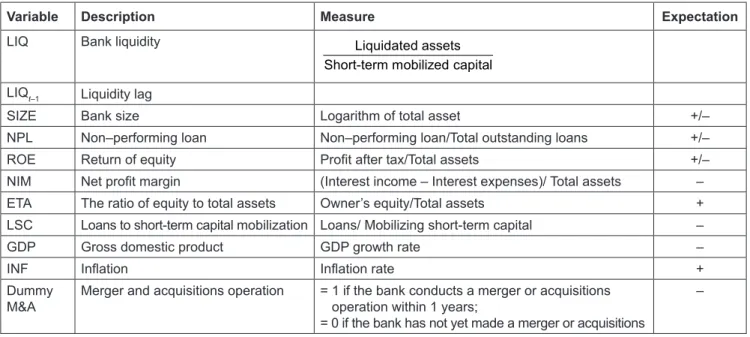
Table 1: Measure Variables in the Model
Variable Description Measure Expectation
LIQ Bank liquidity Liquidated assets
Short-term mobilized capital LIQ
t–1Liquidity lag
SIZE Bank size Logarithm of total asset +/–
NPL Non–performing loan Non–performing loan/Total outstanding loans +/–
ROE Return of equity Profit after tax/Total assets +/–
NIM Net profit margin (Interest income – Interest expenses)/ Total assets –
ETA The ratio of equity to total assets Owner’s equity/Total assets +
LSC Loans to short-term capital mobilization Loans/ Mobilizing short-term capital –
GDP Gross domestic product GDP growth rate –
INF Inflation Inflation rate +
Dummy
M&A Merger and acquisitions operation = 1 if the bank conducts a merger or acquisitions operation within 1 years;
= 0 if the bank has not yet made a merger or acquisitions
– and acquisitions activities are the conversion of business
ownership with the aim of concentrating capital and expanding the size of bank. Therefore, after the mergers and acquisitions, the size of the bank increases, which in turn will make the bank liquidity decrease. On the other hand, after the mergers and, acquisitions, banks mainly promote lending activities, or invest in other assets for the purpose of profitability rather than the purpose of improving liquidity. Therefore, the merger and acquisition activities are expected to have a negative relation with bank liquidity (Al-Hroot et al., 2020).
3. Research Methods and Materials
To carry out the research objectives, the authors mainly use quantitative research methods with secondary data sources from the annual reports of the State Bank and the audited acquisitions financial statements of nine commercial banks have activities of merger and acquisitions, the specific steps are as follows:
Overview of research and development of research models: The authors review the domestic and foreign research works and identify research gaps. Based on the research of Kashyap et al. (2002), Aspachs et al. (2005), the authors set up a research model in accordance with the research objectives.
LIQ LIQ SIZE NPL ROE
NIM ETA
i t i t it it it
it it
,
=
,+ + +
+ +
β
−β β β
β β
1 1 2 3 4
5 6
++ +
+ + +
β β
β β ε
7 8
9 10
LSC GDP
INF DMA
it it
it it it