pISSN 1738-6640 eISSN 2234-4020 http://dx.doi.org/10.6114/jkood.2017.30.1.074
Original Article / 원저
황련해독탕이 비염 개선에 미치는 효과:
기초실험 연구 문헌 분석
손미주
1*
·정의민1
·김윤희2
·이동효3
·김성하1
1한국한의학연구원 임상연구부
2한국한의학연구원 한의약융합연구부
3우석대학교 한의과대학 안이비인후피부과학 교실
Therapeutic effect of the traditional herbal formula, Hwanglyeonhaedok-tang, on rhinitis: A Review of the experimental study
Mi-Ju Son
1*·Ui-Min Jerng
1·Yun-Hee Kim
2·Dong-Hyo Lee
3·Sung-Ha Kim
11
Clinical Research Division, Korea Institute of Oriental Medicine
2
KM Convergence Research Division, Korea Institute of Oriental Medicine
3
Dept. of Ophthalmology & Otolaryngology & Dermatology, College of Korean Medicine, Woo-Suk University
Abstract
Objectives : This study aimed to assess the scientific evidence for the use of Hwanglyeonhaedok-tang, a traditional herbal formula, in the treatment of rhinitis, and prepare the basis for the investigational new drug application by analyzing the experimental studies.
Methods : Ten electronic databases were searched up to December, 2016 without language limitation.
Experimental studies on the anti-inflammatory and anti-allergic effects of Hwanglyeonhaedok-tang against rhinitis were included. We extracted data about study design, characteristics of intervention, outcomes, and pharmacological effects from the included studies and summarized them.
Results : Eight hundred and thirty-three potentially relevant studies were identified, of which 18 experimental studies met our inclusion criteria.
Of 18 included studies, 5 had conducted cell viability test, and all studies had reported that Hwanglyeonhaedok-tang was non-cytotoxic.
ⓒ 2017 the Society of Korean Medicine Ophthalmology & Otolaryngology & Dermatology
This is an Open Access journal distributed under the terms of the Creative Commons Attribution Non-Commercial License (http://creativecommons.org/license/by-nc/3.0/) which permits unrestricted non-commercial use, distribution, and reproduction in any medium, provided the original work is properly cited.
Ⅰ. 서 론
비염은 콧물, 코막힘, 재채기 및 소양감 중 한 가지 이상의 증상을 동반하는 비점막의 염증성 질환으로, 전 인구의 40% 정도에서 발견되는 흔한 질환이다
1)
. 비염은 한방 의료기관에서 근골격계 질환을 제외하고 진료실인원이 가장 높은 질환군으로, 국민건강보험공 단에서 발표한 2014년 질병소분류별 다빈도 상병급여 현황에 따르면 한방 의료기관에 내원하여 진료받은 실인원 기준 J00_급성 비인두감염은 14위, J30_혈관 운동성 알레르기성 비염은 22위, J31_만성 비염, 비인 두염 및 인두염은 25위, J06_다발성 및 상세불명 부 위의 급성 상기도감염은 47위로, 연평균 총 75만명 정도가 비염 치료를 목적으로 한방 의료기관을 내원 하는 것으로 확인되었다2)
.비염은 한의학에서 鼻鼽, 鼻齆, 鼻噴, 鼻臭의 범주 에 속하며, 치료로는 內外治法을 병용하는데, 급성기 의 경우에는 九味羌活湯, 通竅湯, 麗澤通氣湯, 細辛膏 등을, 만성기에는 芎竅散, 細辛散 등을 활용한다
3)
. 한 의 임상현장에서는 한약과 침 뿐만 아니라, 한의 외용 요법을 광범위하게 활용하고 있으며, 비염 치료에 많 이 활용되는 한의 외용요법에는 분무제, 점비액 등이있다. 방 등
4)
의 연구에서 국소 한약 외용제는 알레르 기 비염의 주요 증상 점수를 개선시키는 것으로 나타 났으며, 辛夷, 黃芩, 黃連, 黃芪가 외용 치료 한약제로 다용되었음을 확인할 수 있었다.황련해독탕(黃連解毒湯, Hwanglyeonhaedok-tang) 은 葛洪의 肘後備急方
5)
에 처음 수록된 처방으로 三焦 熱盛으로 인한 大熱煩憂, 口燥咽乾, 錯語不眠, 吐血, 衄血, 發斑하는 증상과, 외과의 癰腫疔毒에 舌紅苔黃 하고 脈數有力한 증상을 치료하는데 사용되는 처방이 다6)
.황련해독탕은 선행연구에서 항염증
7)
, 항알레르기7)
, 해열8)
효능이 있는 것으로 밝혀진 바 있으며, 황련해 독탕의 주 구성약제인 황금, 황련은 알레르기 비염의 비강 내 외용 치료 한약제로 다용되고 있어 비염 치 료에 내복 및 외용제로 활용할 수 있을 것으로 추측 된다.황련해독탕의 항염증, 해열 효능에 대한 문헌 고찰 은 이미 수행된 바 있으나
9)
, 비염 특이적 비임상연구 (non-clinical trial)에 대한 문헌 고찰은 진행되지 못 하였다. 이에 본 연구에서는 황련해독탕이 비염 치료 제로서의 가능성이 있는지 확인하고자 황련해독탕의 비임상 효능 연구를 분석하고자 한다.Hwanglyeonhaedok-tang exhibits anti-inflammatory effect by regulating the inflammation-related cytokines including nitric oxide(NO), prostaglandin E
2(PGE
2), interleukin-6(IL-6), and tumor necrosis factor-α(TNF-α) in vitro and in vivo.
Hwanglyeonhaedok-tang exhibits anti-allergic effect by suppressing eosinophil, and histamine levels.
Hwanglyeonhaedok-tang helps in the recovery of nasal mucous membrane by supressing goblet cells, heat shock protein 70, and substance P.
Conclusions : This study suggests that Hwanglyeonhaedok-tang has the potential to be developed as therapeutic agent for rhinitis. Further experimental and clinical studies needed to be performed to prove the safety and efficacy.
Key words : herbal medicine; Hwanglyeonhaedok-tang; rhinitis; anti-inflammatory; anti-allergy
Corresponding author : Son, Mi Ju, KMD. Clinical Research Division, Korea Institute of Oriental Medicine, 1672, Yuseongdae-ro, Yuseong-gu, Daejeon, Republic of Korea (34054)
(Tel: 042-868-9446, E-mail: [email protected]) Recieved 2017/1/6 Revised 2017/2/7 Accepted 2017/2/14
Ⅱ. 연구대상 및 방법
1. 논문 검색
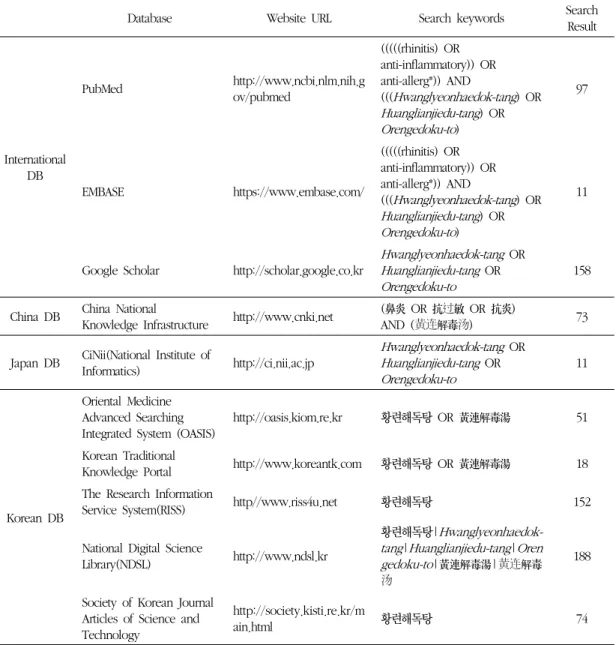
검색은 출판년도와 언어에 제한을 두지 않고 국 내·외 학술검색 데이터베이스를 이용하여 수행하였 다. 검색어는 ‘황련해독탕’, ‘Hwanglyeonhaedok-tang’,
Database Website URL Search keywords Search
Result
International DB
PubMed http://www.ncbi.nlm.nih.g
ov/pubmed
(((((rhinitis) OR anti-inflammatory)) OR anti-allerg*)) AND
((( Hwanglyeonhaedok-tang ) OR Huanglianjiedu-tang ) OR Orengedoku-to )
97
EMBASE https://www.embase.com/
(((((rhinitis) OR anti-inflammatory)) OR anti-allerg*)) AND
((( Hwanglyeonhaedok-tang ) OR Huanglianjiedu-tang ) OR Orengedoku-to )
11
Google Scholar http://scholar.google.co.kr
Hwanglyeonhaedok-tang OR Huanglianjiedu-tang OR Orengedoku-to
158
China DB China National
Knowledge Infrastructure http://www.cnki.net (鼻炎 OR 抗过敏 OR 抗炎)
AND (黄连解毒汤) 73
Japan DB CiNii(National Institute of
Informatics) http://ci.nii.ac.jp
Hwanglyeonhaedok-tang OR Huanglianjiedu-tang OR Orengedoku-to
11
Korean DB
Oriental Medicine Advanced Searching Integrated System (OASIS)
http://oasis.kiom.re.kr 황련해독탕 OR 黃連解毒湯 51
Korean Traditional
Knowledge Portal http://www.koreantk.com 황련해독탕 OR 黃連解毒湯 18
The Research Information
Service System(RISS) http//www.riss4u.net 황련해독탕 152
National Digital Science
Library(NDSL) http://www.ndsl.kr
황련해독탕| Hwanglyeonhaedok- tang | Huanglianjiedu-tang | Oren gedoku-to |黃連解毒湯|黄连解毒 汤
188
Society of Korean Journal Articles of Science and Technology
http://society.kisti.re.kr/m
ain.html 황련해독탕 74
Table 1. Electronic Bibliographic Databases
‘Huanglianjiedu-tang’, ‘Orengedoku-to’, ‘黃連解毒 湯’, ‘黄连解毒汤’과 ‘비염’, ‘항염증’, ‘항알레르기’,
‘rhinitis’, ‘anti-allergic’, ‘anti-inflammatory’, ‘鼻炎’,
‘抗过敏’, ‘抗炎’을 데이터베이스의 특성에 맞게 활용하 였다. 검색에 활용된 데이터베이스, 검색어 및 검색결 과는 Table 1과 같다.
2. 문헌 선정 및 자료 추출
황련해독탕은 가감 또는 합방여부, 제형 및 투여경 로에 상관없이 모든 종류의 황련해독탕을 수집하였다.
비염은 알레르기비염, 호산구 증다성 비알레르기 비 염, 혈관운동성 비염, 만성 비부비동염 등 모든 종류 의 비염을 분석 대상으로 삼았으며, 비염의 주요 증상 개선지표인 항염증, 항알레르기 효과를 검색 대상에 포함하였다. 분석 대상은 비임상연구, 즉 실험연구 (experimental study)로 in vitro, in vivo, ex vivo를 모두 포함하였다. 비염으로 대상 질환을 명확히 정하 지 않은 연구일지라도, 염증, 면역 반응 결과가 비염 과 연관될 수 있다고 판단될 경우는 포함하였으며, 분 석 부위가 명확히 비염과 관계없는 연구는 배제하였 다. 문헌 선정은 2인의 저자가 각각 독립적으로 수행 하였다.
3. 자료 분석
자료 분석은 각 논문에서 시행한 실험 방법 및 유 효성 결과를 위주로 분석하였다.
Ⅲ. 결 과
1. 연구 동향
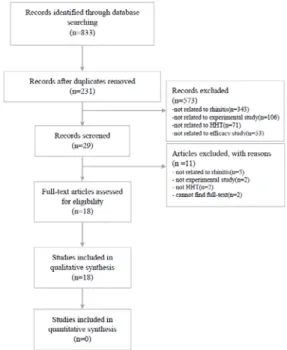
국내외 데이터베이스에서 검색된 총 833편의 문헌 중, 231편을 중복 제거하고, 제목과 초록으로 본 연구 주제와 관련 없는 문헌 573편을 배제한 후, 남은 29 편의 문헌에 대해 Full-text 검색을 실시하였다. 이 중 황련해독탕이 아닌, 황련해독탕의 개별 성분에 대한 연구 2편과, 문헌고찰 2편, 그리고 비염과 관련되어 있지 않은 황련해독탕의 항염증 효능에 관한 연구 5 편, 원문을 확보하지 못한 학위논문 1건과 학술대회 발표 1편을 배제하고, 최종적으로 18편의 논문을 대 상으로 분석을 실시하였다(Fig. 1).
Fig. 1. PRISMA flow diagram
분석에 포함된 총 18편의 연구
10-27)
는 모두 한국, 중 국, 일본에서 수행된 연구로, 이 중 한국에서 발표된 논문이 11편11-17,21,23,26,27)
으로 가장 많았으며, 중국이 5편
10,18,19,24,25)
, 일본이 2편20,22)
으로 그 뒤를 이었다.18편의 논문
10-27)
중 총 5편18-20,22,24)
이 SCI(E) 급 저널 에 실렸는데, 중국에서 발표한 5편10,18,19,24,25)
의 논문 중 3편
18,19,24)
이, 일본에서 발표된 총 논문 2편20,22)
이 이에 해당한다. 황련해독탕은 열수추출물이 실험 재 료로 많이 사용되었으나, 3편11,13,17)
의 연구에서는 황 련해독탕 약침액을 주요 중재법으로 활용하였다.2. 황련해독탕의 세포독성 시험 결과
세포독성 실험(cell viability test)은 총 5편
14,15,17,24,26)
의 연구에서 진행되었는데, 그 중 3편14,17,24)
은 Raw 264.7 세포주를 이용하였으며, 이 외에 사람 비점막 섬유아세포(human nasal mucosal fibroblast)
15)
와 RBL-2H3 세포주26)
에서 세포독성(cytotoxicity)을 평가하였다. 황련해독탕은 5편 모두에서 세포 독성이관찰되지 않았다.
3. 황련해독탕의 항염증 효능
황련해독탕의 항염증 효능을 밝히기 위한 실험연구 는 총 16편
10-25)
으로, 그 중 in vitro 연구는 10건11,14-20,23,24)
in vivo 연구는 11건10-13,18,19,21-25)
이었다.in vitro 연구는 대식세포주인 Raw 264.7 세포주를 이용한 연구가 8건
11,14,16-19,23,24)
으로 대부분을 차지하 였으며, 이외에도 사람 비점막 섬유아세포
15)
, J774.1 대식세포주20)
, rat peritoneal 세포주24)
를 이용한 연구 가 각 한 건씩 있었다. 11건10-13,18,19,21-25)
의 in vivo 연 구 중, 9건
10-13,18,19,21,23,25)
은 mouse를 사용하였으며, 4 건13,18,22,24)
은 rat을 이용하였다. in vitro 연구에서는 9건
11,14,16-20,23,24)
이 lipopolysacharaide(LPS)를 염증유 발물질로 사용하였으며, 그 외에 interleukin-1β(IL-1 β)15)
, A2318724)
이 염증유발물질로 이용되었다.mouse는 ICR mouse를 이용한 연구가 5건
12,13,18,21,25)
으로 가장 많은 비율을 차지하였으며, BALB/c mouse 1건
11)
, kunming mouse 2건10,19)
, 정체를 알 수 없는 mouse 1건23)
이 실험에 이용되었고, rat은 3 건13,18,24)
의 연구에서 spraque-dawley rat이, 1건22)
의 연구에서 wister rat이 사용되었다. in vivo 연구에서 는 총 3건12,21,23)
에서 LPS가 염증유발물질로 사용되었 으며, carrageenan 3건13,19,24)
, acetic acid 3건13,22,25)
, 그리고 xylene10)
,ovalbumin11)
, dextran13)
, arachidonic acid18)
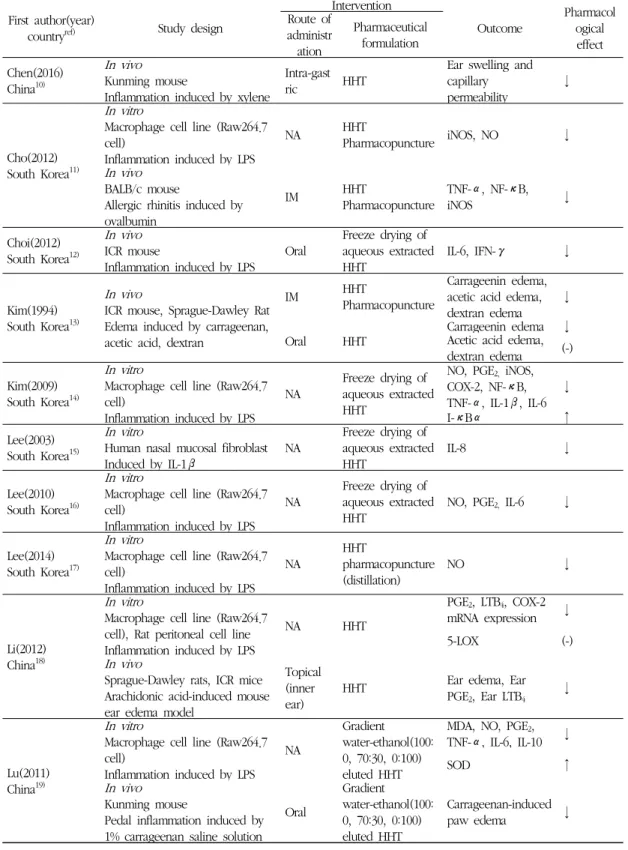
이 염증유발물질로 사용되었다.황련해독탕은 in vitro 연구에서 염증 관련 인자인 nitric oxide(NO), inducible nitric oxide synthesis (iNOS), IL-1β, interleukin-6(IL-6), interleukin-8 (IL-8), tumor necrosis factor-α(TNF-α), nuclear factor-κ B(NF-κB), cyclooxygenase-2(COX-2), prostaglandin E2(PGE
2
), prostaglandinD2(
PGD2)
, leukotrieneB4
(LTB
4
), interferon-γ(IFN-γ), malondialdehyde (MDA), interleukin-10(IL-10), 5-hydroxyeicosa- tetraenoic acid(5-HETE), 12-hydroxy-5,8,10- heptadecatrienoicacid(12-HHT), 11-hydroxyeico-satetraenoicacid(11-HETE)의 수치를 유의하게 낮추 는 것으로 확인되었다. 또한 IL-1β/IL-6, COX-2 messenger ribonucleic acid(mRNA) 발현도 억제하는 것으로 나타났다. In vivo 연구에서는 NO, PGE
2
, IL-6, TNF-α 외에도 염증 산물로 발생되는 edema를 억제하 는데 유의한 효과를 가지고 있는 것으로 나타났다. 특히 NO 및 PGE2
는 총 8편의 in vitro, in vivo 연구에서 연 구 디자인과 상관없이 낮추는 것으로 나타나 황련해독탕 이 염증을 억제하는 기전에 NO 및 PGE2
조절과 밀접한 연관이 있을 것으로 파악해 볼 수 있다(Table 2).4. 항알레르기 효능
총 3편
11,26,27)
의 논문이 황련해독탕의 항알레르기 효능에 대해 분석하였으며, 3편의 논문 중 in vitro 연구는 1편26)
, in vivo 연구는 2편11,27)
이었다. In vitro 연구는 호염기성 백혈구 세포주인 RBL-2H3 cell을 이용하였으며, in vivo 연구는 BALB/c mouse 와 wister rat을 이용하였다. 알레르기 유발물질로는 ovalbumin, phorbol 12-myristate(PMA), A23187, anti-dinitrophenyl immunoglobulin E(anti-DNP IgE)이 사용되었다. RBL-2H3 세포주에서 알레르기 관련 인자인 eosinophil, histamine을 감소시켰으며, 그 외에도 β-hexosaminidase, IL-4, TNF-α를 억제 하고, COX-1, COX-2 mRNA의 발현을 감소시켰다 (Table 3).5. 비점막 손상 완화 효능
Cho 등
11)
은 황련해독탕 약침이 비강점막 손상에 미치는 영향을 알아보기 위해, ovalbumin으로 알레 르기가 유발된 BALB/c mouse의 비점막 염증 관련 인자인 goblet cell, heat shock protein 70(HSP70), peroxisome proliferator-activated receptor gamma(PPAR-γ), substance P가 감소한 것을 확인 할 수 있었다. 황련해독탕 약침은 비점막 회복에 긍정 적인 영향을 미침을 확인할 수 있었다(Table 4).First author(year)
country
ref)Study design
Intervention
Outcome
Pharmacol ogical effect Route of
administr ation
Pharmaceutical formulation Chen(2016)
China
10)In vivo Kunming mouse
Inflammation induced by xylene
Intra-gast
ric HHT
Ear swelling and capillary permeability
↓
Cho(2012) South Korea
11)In vitro
Macrophage cell line (Raw264.7 cell)
Inflammation induced by LPS
NA HHT
Pharmacopuncture iNOS, NO ↓
In vivo BALB/c mouse
Allergic rhinitis induced by ovalbumin
IM HHT
Pharmacopuncture
TNF-α, NF-κB,
iNOS ↓
Choi(2012) South Korea
12)In vivo ICR mouse
Inflammation induced by LPS
Oral
Freeze drying of aqueous extracted HHT
IL-6, IFN-γ ↓
Kim(1994) South Korea
13)In vivo
ICR mouse, Sprague-Dawley Rat Edema induced by carrageenan, acetic acid, dextran
IM HHT
Pharmacopuncture
Carrageenin edema, acetic acid edema, dextran edema
↓
Oral HHT
Carrageenin edema ↓ Acetic acid edema, dextran edema (-) Kim(2009)
South Korea
14)In vitro
Macrophage cell line (Raw264.7 cell)
Inflammation induced by LPS NA
Freeze drying of aqueous extracted HHT
NO, PGE
2,iNOS, COX-2, NF-κB, TNF-α, IL-1β, IL-6
↓
I-κBα ↑
Lee(2003) South Korea
15)In vitro
Human nasal mucosal fibroblast Induced by IL-1β
NA
Freeze drying of aqueous extracted HHT
IL-8 ↓
Lee(2010) South Korea
16)In vitro
Macrophage cell line (Raw264.7 cell)
Inflammation induced by LPS NA
Freeze drying of aqueous extracted HHT
NO, PGE
2,IL-6 ↓
Lee(2014) South Korea
17)In vitro
Macrophage cell line (Raw264.7 cell)
Inflammation induced by LPS NA
HHT
pharmacopuncture (distillation)
NO ↓
Li(2012) China
18)In vitro
Macrophage cell line (Raw264.7 cell), Rat peritoneal cell line Inflammation induced by LPS
NA HHT
PGE
2, LTB
4, COX-2 mRNA expression ↓
5-LOX (-)
In vivo
Sprague-Dawley rats, ICR mice Arachidonic acid-induced mouse ear edema model
Topical (inner ear)
HHT Ear edema, Ear
PGE
2, Ear LTB
4↓
Lu(2011) China
19)In vitro
Macrophage cell line (Raw264.7 cell)
Inflammation induced by LPS NA
Gradient water-ethanol(100:
0, 70:30, 0:100) eluted HHT
MDA, NO, PGE
2, TNF-α, IL-6, IL-10 ↓
SOD ↑
In vivo Kunming mouse
Pedal inflammation induced by 1% carrageenan saline solution
Oral
Gradient water-ethanol(100:
0, 70:30, 0:100) eluted HHT
Carrageenan-induced
paw edema ↓
Table 2. Summary of the Anti-inflammatory Effect of Hwanglyeonhaedok-tang
First author(year)
country
ref)Study design
Intervention
Outcome
Pharmacol ogical effect Route of
administr ation
Pharmaceutical formulation
Lu(2011) China
19)In vitro
Macrophage cell line (Raw264.7 cell)
Inflammation induced by LPS NA
Gradient water-ethanol(100:
0, 70:30, 0:100) eluted HHT
MDA, NO, PGE
2, TNF-α, IL-6, IL-10 ↓
SOD ↑
In vivo Kunming mouse
Pedal inflammation induced by 1% carrageenan saline solution
Oral
Gradient water-ethanol(100:
0, 70:30, 0:100) eluted HHT
Carrageenan-induced
paw edema ↓
Oshima(2013) Japan
20)In vitro
Murine macrophage-like cell line(J774.1)
Inflammation induced by LPS NA
Freeze drying of aqueous extracted HHT
PGE
2↓
Park(2007) South Korea
21)In vivo ICR Mouse
Inflammation induced by LPS intra-cerebroventricular injection
Oral
Freeze drying of aqueous extracted HHT
IL-6, TNF-α ↓
Wang(1997) Japan
22)In vivo Wistar rat
Inflammation(edema) induced by acetic acid
Oral HHT(Tsumura)
IL-8 ↓
Serum SOD (-)
Yang(2011) South Korea
23)In vitro
Macrophage cell line (Raw264.7 cell)
Inflammation induced by LPS
NA Aqueous extracted HHT
NO, TNF-α, IL-6, IL-1β/IL-6 mRNA expression
↓ IL-1β, TNF-α mRNA expression (-) In vivo
Mouse
Inflammation induced by LPS intra-abdominal injection
Oral Aqueous extracted HHT
Serum IL-1β ↓
Serum TNF-α, IL-6 (-)
Zeng(2009) China
24)In vitro
Macrophage cell line (Raw264.7 cell), Inflammation induced by LPS
NA
Freeze drying of aqueous extracted HHT
NO ↓
In vitro
Rat peritoneal cell line
Inflammation induced by A23187 NA
Freeze drying of aqueous extracted HHT
LTB
4, 5-HETE ↓ PGE
2, PGD
2,
12-HHT, 11-HETE (-) In vivo
Spraque-Dawley rats Inflammation induced by carrageenan
Oral
Freeze drying of aqueous extracted HHT
NO, LTB
4, Leukocyte accumulation, exudate volume in the rat air pouches
↓
PGE
2, 12-HHT, Arachidonicacid (-) Qin(1994)
China
25)In vivo ICR mouse
Edema induced by acetic acid
Intra-gast
ric HHT Acetic acid edema ↓
Abbreviations: COX-2: cyclooxygenase-2, FHHT: fermented
Hwanglyeonhaedok-tang
, HHT:Hwanglyeonhaedok-tang
, I-κBα: I-kappa B alpha, IFN-γ: interferon-γ, IL-1β: interleukin-1β, IL-6: interleukin-6, IL-8: interleukin-8, IL-10: interleukin-10, IM: intra-muscular, iNOS: inducible nitric oxide synthesis, NF-κB: nuclear factor-κB, LPS: lipopolysacharaide, LTB4: LeukotrieneB4, MDA:malondialdehyde, NA: not applicable, NO: nitricoxide, PGE2: prostaglandin E2, SOD: superoxidedismutase, TNF-α: tumor necrosis factor-α, 5-LOX: 5-lipoxigenase, 5-HETE: 5-hydroxyeicosatetraenoic acid, PGD2:prostaglandin D2,
12-HHT:12-hydroxy-5,8,10-heptadecatrienoicacid, 11-HETE:11-hydroxyeicosatetraenoicacid
Ⅳ. 고 찰
본 연구는 황련해독탕이 비염 치료제로서의 가능성 이 있는지 확인하기 위해 비임상 효능 연구 동향을 파악하였다.
국내외 데이터베이스에서 검색된 총 833편의 논문 중 분석에 포함된 18편의 연구는 모두 한국, 중국, 일 본에서 수행되었다. 한국에서 발표한 논문은 11편으 로 가장 많았는데, 이는 한중일 3국 중 황련해독탕의 항염증, 항알레르기 효과에 대한 관심도가 한국이 가
First author (year) country
ref)Study design
Intervention
Outcome
Pharmacol ogical
effect Route of
administration
Pharmaceutical formulation
Baek(2008) South Korea
26)In vitro
Rat basophilic leukemia cell line(RBL-2H3 cell) Allergy induced by PMA, A23187
NA
Freeze drying of aqueous extracted HHT
β
-hexosaminidase, IL-4, TNF-α, COX-1/COX-2 mRNA expression
↓
Cho(2012) South Korea
11)In vivo BALB/c mouse Allergic rhinitis Allergy induced by ovalbumin
IM HHT
Pharmacopuncture Eosinophil ↓
Yoon(1997) South Korea
27)In vivo
BALB/c mouse, Wister rat
IgE mediated anaphylaxis activated by anti-DNP IgE
IC/IP/Oral
Freeze drying of aqueous extracted modified HHT
Passive cutaneous anaphylaxis, histamine
↓
Abbreviations: anti-DNP IgE: anti-dinitrophenyl immunoglobulin E, COX-1: cyclooxygenase-1, COX-2: cyclooxygenase-2, HHT:
Hwanglyeonhaedok-tang
, IC: intracutaneous, IL-4: interleukin-4, IM: intramuscular, IP: intraperitoneal, NA: not applicable, TNF-α: tumor necrosis factor-αTable 3. Summary of the Anti-allergic Effect of Hwanglyeonhaedok-tang
First author(year)
country
ref)Study design
Intervention
Outcome Pharmacologica l effect Route of
administration
Pharmaceutical formulation
Cho(2012) South Korea
11)In vivo BALB/c mouse Allergic rhinitis induced by ovalbumin
IM HHT
Pharmacopuncture
Goblet cell, HSP70, PPAR- γ, Substance P
↓
Abbreviations: IM: intra-muscular, HSP70: heat shock protein 70, PPAR-γ: peroxisome proliferator-activated receptor gamma
Table 4. Summary of the Effect of the Hwanglyeonhaedok-tang on the Protection of Nasal Mucosal Lesions
장 높다고 해석할 수 있다. 그러나 본 연구에서 포함 된 지역 데이터베이스가 한국이 5개, 중국 1개, 일본 1개로 한국 데이터베이스의 숫자가 많아 본 결과에 비뚤림 위험의 가능성이 있어 해석에 주의를 요한다.
연구에 사용된 황련해독탕은 대부분 동결건조한 열 수추출물을 분석 대상으로 삼았으나, 한국에서 발표 된 3편의 연구에서는 황련해독탕 약침액을 분석대상 으로 삼았다. 이는 황련해독탕 약침이 임상현장에서 많이 쓰이고 있는 한국의 현실이 반영된 것으로 해석 된다.
총 5편의 연구에서 세포 독성 실험이 진행되었는 데, RBL-2H3 세포주, Raw 264.7 세포주, 비점막 섬 유아세포주에서 황련해독탕 농도 최소 10㎍/㎖에서 최대 4㎎/㎖에서 세포독성이 발견되지 않았다. 이전 연구에서 황련해독탕은 반묘
28)
, 니코틴29)
, 에탄올30)
중독 등에 해독작용이 있는 것으로도 밝혀졌는데, 위 의 사실을 미루어 보아 황련해독탕은 독성이 적고 안 전한 약인 것으로 판단된다.황련해독탕의 항염증 효과에 대해 분석한 10편의 in vitro 연구에서는 LPS로 염증을 유도시킨 대식세 포주인 Raw264.7 cell과 J774.1 cell에서 황련해독탕 을 투여한 후, 염증 관련 cytokine 및 mRNA expression을 확인하였는데, 황련해독탕은 iNOS, NO, TNF-α, IL-1β, IL-6, IL-10, NF-κB, COX-2, LTB
4
, PGE2
를 LPS 처리한 대조군에 비해 유의하게 감소시키고, I-kappa B alpha(I-κBα) 수치를 유의 미하게 증가시켰음을 확인할 수 있었다.대식세포는 초기 염증 반응에 관여하는 대표적인 면역세포로서 염증 반응 시 탐식 작용을 통해 이물질 을 억제하며, pro-inflammatory cytokine인 IL-1β, IL-6, IL-8, IL-12, TNF-α 등을 분비하여 염증 반응 을 활성화 시킨다
31)
. 또한 대식세포는 iNOS를 포함하 고 있고, 염증 반응이 있을 때 iNOS를 발현하여 NO 를 생산하는데32)
, NO는 체내 방어, 신호전달, 혈관확 장 등의 다양한 기능을 가지며, 염증 발생 시 혈관투 과성, 부종 등의 염증반응을 촉진시키고, 많은 염증 및 감염성 질환을 매개하여 조직을 손상시키는 등 유 해한 작용을 한다33)
.또한 염증 반응에서 NF-κB는 iNOS와 COX-2의 발현에 관여하는 것으로 알려진 대표적인 전사조절인 자로
34)
, 평소에는 I-κBα 결합하여 불활성화된 상태 로 존재하다가 염증반응이 활성화되면 iNOS 발현 증 가를 통해 염증 반응의 가속화에 의한 조직 손상을 유도한다35)
. COX-2는 염증반응 시 활성화되어 PGE2
를 증가시키는데 관여하는 효소이며, PGE
2
는 발열과 통증작용에 관여한다36)
.본 연구 결과로 미루어보아, 황련해독탕은 염증 초 기 단계의 비특이적 면역 반응 체계에 관여하여 대식 세포의 활성을 조절하고 pro-inflammatory cytokine 의 분비를 억제하며, NF-κB의 억제단백질 중의 하 나인 I-κBα의 인산화를 억제하여 NF-κB가 발현을 억제하며, 그러한 결과로 iNOS 및 COX-2의 발현 또 는 활성이 억제되어 NO 및 TNF-α, IL-1β, IL-6 등 의 cytokine 분비가 감소되며, PGE
2
의 생성을 억제시 키는 효과가 있는 것으로 파악된다.황련해독탕의 항염증 효과에 대해 분석한 11편의 in vivo 연구에서는 염증 관련 cytokine 외에 부종 감 소 효과를 확인하였는데, 황련해독탕은 염증 반응 시 발생하는 조직의 부종을 LPS 처리한 대조군에 비해 효과적으로 감소시키는 것으로 나타났다. 초기 염증 반응 시 혈관삼투압 증가에 따라 발생하는 조직의 부 종을 효과적으로 감소시키는데, 이는 in vitro 결과에 서처럼 pro-inflammatory cytokine과 LTB
4
와 같은 chemokine 조절을 통해 가능한 것으로 추측된다.비염의 항알레르기 효과를 분석한 3편의 연구는 ovalbumin, anti-DNP IgE 또는 BALB/c mouse와 mast cell line으로 간주되는 RBL-2H3 세포
37)
를 이 용하여 알레르기 반응에 핵심적인 인자인 eosinophil, histamine과 비만세포에서 분비되는 cytokine을 분석 하였다.호산구, 호염구 및 비만세포는 즉시형 과민반응과 알레르기 질환의 작동세포로 histamine으로 대표되는 vasoactive amine에 의해 활성화된다. 그 중 비만세 포는 염증 및 알레르기 반응 시 TNF-α, IL-4, IL-5, IL-6, IL-8, IL-13 등의 cytokine을 만들어내며, 그 중 IL-4는 알레르기 반응의 핵심적인 요소인 Immunoglobulin E(IgE) 생성에 관여하여 염증 반응 및 알레르기 질환의 발생에 중요한 역할을 담당한다
38)
.알레르기 반응과 밀접하게 연관되어 있는 호산구와 비만세포의 활성을 감소시킨다면 알레르기 염증 반응 을 감소시킬 수 있을 것이며, 황련해독탕은 histamine
억제를 통해 비만세포의 활성을 감소시키고, IL-4의 생성과 호산구 활성을 감소시켜 항알레르기 효과가 있는 것으로 생각된다.
Cho 등
12)
의 연구결과에서 황련해독탕 약침은 비강 내 점액분비세포인 goblet cell을 감소시켰으며, 점막 상피 손상 시 합성되는 HSP70 및 비강 점막의 소양 감 및 재채기 반응에 관여하는 substance P를 감소시 켰다. 이는 황련해독탕 약침이 비강 점막 재생에 유효 한 작용을 하는 것으로 판단된다.비염은 비염을 일으키는 원인에 따라 알레르기 비 염과 비알레르기 비염으로 나뉘며, 임상적인 양상에 따라 급성비염, 만성비염, 위축성 비염 등으로 나뉜다
39)
. 비염은 이처럼 다양하게 분류되고 있으나 비점막 의 염증성 반응이라는 점에서는 공통적이며, 비염 치 료를 위해서는 비점막의 염증 반응을 억제시키는 것 이 중요하다.이상의 연구결과를 종합하면 황련해독탕은 항염증, 항알레르기 효과가 있어 비염으로 인한 비강 내의 염 증 반응 개선에 유효한 역할을 할 수 있을 것으로 보 이며, 비강내 점액 분비를 감소시키고, 비강 점막의 소양감과 재채기를 완화시키는데 중요한 역할을 할 것으로 생각된다. 또한 황련해독탕은 알레르기 비염 에서 histamine을 조절하여 알레르기 반응으로 나타 나는 비강내 염증 발생을 억제시킬 수 있을 것으로 판단된다.
Ⅴ. 결 론
황련해독탕이 비염의 효능에 관한 비임상 실험 연 구를 분석한 결과 다음과 같다.
1. 황련해독탕은 세포독성 실험을 수행한 5편의 연구 에서 세포독성은 발견되지 않았다.
2. 황련해독탕은 NO, PGE
2
, IL-6, TNF-α와 같은 전염증인자를 조절하여 항염증작용이 있는 것으로 나타났다.3. 황련해독탕은 호산구, IL-4, histamine 발현을 억 제시켜 항알레르기 작용이 있는 것으로 나타났다.
4. 황련해독탕은 비점막 염증 관련 인자인 goblet cell, HSP70을 억제하여 비강 내 점액 분비를 감 소시키고, 비점막 회복에 도움을 주는 것으로 나타 났다.
연구비 지원 기관 한국한의학연구원(K17790)
감사의 글
본 연구는 한국한의학연구원 주요사업 ‘한의 비염 외용 치료제의 효능 및 안전성 근거 확보(K17790)’
의 지원을 받아 수행되었습니다.
References
1. Small P, Frenkiel S, Becker A, Boisvert P, Bouchard J, Carr S, et al. Rhinitis: A Practical and Comprehensive Approach to Assessment and Therapy. J Otolaryngol.
2007;36(S1):S5-S27.
2. Benefits by Frequency of Disease (2014_Korean Medicine Total) [Internet].
National health insurance service. 2014.
Available from: http://kosis.kr/statHtml/statHtml.
do?orgId=350&tblId=DT_35001_A81211&conn_pa th=I2.
3. Chae B. Eye, ear, nose, throat diseases in east Asian medicine. Seoul:Jipmoondang. 2004:
256-66.
4. Bang MR, Kim JH, Min SY. A literature
study of topical application of Chinese herbal medicine for allergic rhinitis. J Pediatr Korean Med. 2016;30(3):52-60.
5. Hong G. Zhouhoubeijifang(Handbook of Prescriptions for Emergencies). Shanghai:
Renmin weisheng chuban she. 1996:34-7.
6. Lee S. Bangjehak(Formula study). Seoul:
Younglimsa. 1996:112-3.
7. Chen Y, Xian Y, Lai Z, Loo S, Chan WY, Lin ZX. Anti-inflammatory and anti-allergic effects and underlying mechanisms of Huang-Lian-Jie-Du extract: Implication for atopic dermatitis treatment. J Ethnopharmacol.
2016;185:41-52.
8. Liu S, Wang N, Chen P, Li X, Liu C. Effect of Huanglianjiedu Tang on fever in rats induced by 2, 4-dinitrophenol. J Tradit Chin Med. 2013;33(4):492-9.
9. Kim JH, Shin HK. Analysis of Biological Experiments on the Anti-inflammatory and Antipyretic Effects of Hwangryeonhaedok-tang. J Korean Med. 2012;33(4):26-36.
10. Chen G, Li M, Xie S, Dou D. Anti- inflammatory material basis of Huanglian Jiedu Tang and Its fractions. Chinese Journal of Experimental Traditional Medicine Formulae. 2016;22(1):98-102.
11. Cho J, Kim YJ, Kim E, Lee S, Kim K. The effects of Hwanryunhaedok-tang pharmacopuncture by the anti-inflammatory action of supresssion of iNOS production on mice with allergic rhinitis. The Journal of Korean Acupuncture & Moxibustion Society.
2012;29(1):89-101.
12. Choi YY, Kim MH, Lee TH, Yang WM.
Evaluation of efficacy evaluation of
Hwangryunhaedok-tang and Gungangbuja- tang on lipopolysaccharide (LPS)-induced inflammation mouse model. Herbal Formula Science. 2012;20(2):83-92.
13. Kim KH, Kim SS. Study on analgesic, anti-inflammatory and antipyretic effects of aqua-acupuncture and administration per orally of Whangryounhaedogtang and Onsungouhyoulbang. J Korean Med.
1994;15(1):9-15.
14. Kim DH, Jahr PS, Jung JY, Kim SC, Byun SH. Anti-inflammatory Effects of the Aqueous Extract of Hwangnyeonhaedok-tang in LPS-activated Macrophage Cells. Kor J Herbology. 2009;24(4):39-47.
15. Lee I, Kim H, Lee E, Kim E, Ryu J. Effect of Hwang-Ryeon-Hae-Dok-Tang on the Release of IL-8 in Human Nasal Mucosal Fibroblast. J Korean Med Ophtahlmol Otolaryngol Dermatol. 2003;16(3):68-81.
16. Lee JA, Ha HK, Jung DY, Lee HY, Lee JK, Huang DS, et al. Comparative study of 25 herbal formulas on anti-inflammatory effect.
The Journal of Oriental Obstetrics and Gynecology. 2010;23(3):101-11.
17. Lee JH, Kim MJ, Lee JW, Kim MR, Lee IH, Kim EJ. Comparison of the Ingredient Quantities, and Antioxidant and Anti- inflammatory Activities of Hwangryunhaedok Decoction Pharmacopuncture by Preparation Type. The Journal of Korean Acupuncture &
Moxibustion Society. 2014;31(4):45-55.
18. Li L, Zeng H, Shan L, Yuan X, Li Y, Liu R, et al. The different inhibitory effects of Huang-Lian-Jie-Du-Tang on cyclooxygenase 2 and 5-lipoxygenase. J Ethnopharmacol. 2012;
143(2):732-9.
19. Lu J, Wang JS, Kong LY. Anti-inflammatory effects of Huang-Lian-Jie-Du decoction, its two fractions and four typical compounds. J Ethnopharmacol. 2011;134(3):911-8.
20. Oshima N, Narukawa Y, Hada N, Kiuchi F.
Quantitative analysis of anti-inflammatory activity of orengedokuto: importance of combination of flavonoids in inhibition of PGE
2
production in mouse macrophage-like cell line J774.1. J Nat Med. 2013;67(2):281-8.21. Park SH, Kwon YU, Lee TH. Effects of Hwangryunhaedok-Tang and Geongangbuja- Tang on the change of interleukin-6 and TNF-alpha level induced by LPS I.C.V.
injection in mice. The Korean Journal of oriental medical prescription. 2007;15(1):
185-97.
22. Wang LM, Yamamoto T, Wang XX, Yang L, Koike Y, Shiba K, et al. Effects of oren-gedoku-to and unsei-in, Chinese traditional medicines, on interleukin-8 and superoxide dismutase in rats. J Pharm Pharmacol. 1997;49(1):102-4.
23. Yang HJ, Joo HA, Baek SC, Park JS, Hong SH. Anti-inflammatory effects of Hwangnyeonhaedok-tang and fermented Hwangnyeonhaedok-tang. J Korean Med Ophtahlmol Otolaryngol Dermatol. 2011;24 (2):1-15.
24. Zeng H, Liu X, Dou S, Xu W, Li N, Liu X, et al. Huang‐Lian‐Jie‐Du‐Tang exerts anti‐
inflammatory effects in rats through inhibition of nitric oxide production and eicosanoid biosynthesis via the lipoxygenase pathway. J Pharm Pharmacol. 2009;61(12):
1699-707.
25. Qin X, Wu J. Huanglian jiedu tang zhen tong kang yan zuoyong de shiyan yanjiu.
Pharmacology and Clinics of Chinese Materia Medica. 1994;6:9-10.
26. Baek SI, Bae JH, Kim JY, Sim SH, Kang KH, Lee SY, et al. Anti-allergic Inflammatory Effects of Hwangyounhaedog-tang on PMA Plus A23187-stimulated RBL-2H3 Cells.
Korean J Oriental Physiology & Pathology.
2008;22(3):600-6.
27. Yoon SC, Song BK, Kim HK, Lee EJ.
Inhibition of immunoglobulin E-mediated anaphylaxis by modified Hwanglyunhaedok- tang. J of Oriental Chr Dis. 1997;3(1):66-77.
28. Kim SM, Seo BI, Choi HS. The Effect of Hwangryunhaedoktang on the Toxicity of Dried Mylabris phalerata Extract. Kor J Herbology. 2010;25(2):41-54.
29. Hong EJ, Min SY, Kim JH. The Effect of Hwangryunhaedok-tang and its Major Component Coptidis Rhizoma, Berberine on Nicotine Addiction in Rats. J Korean Oriental Med. 2008;29(4):55-67.
30. Yoon JH, Kim SM, Leem MH, Park JH. A histological study of the effects of CCL4 and ethanol on the liver and kidneys of rats after preadministration of Hwanryunhaedoktang. Korean J Orient Int. 2001;22(1):5-11.
31. Murphy K. Janeway's Imunobiology. New York:Garland Science. 2012:37-74.
32. Nussler AK, Billiar TR. Inflammation, immunoregulation, and inducible nitric oxide synthase. J Leukoc biol. 1993;54(2):171-8.
33. Kobayashi Y. The regulatory role of nitric oxide in proinflammatory cytokine expression
during the induction and resolution of inflammation. J Leukoc biol. 2010;88(6):
1157-62.
34. Lee AK, Sung SH, Kim YC, Kim SG.
Inhibition of lipopolysaccharide-inducible nitric oxide synthase, TNF-alpha and COX-2 expression by sauchinone effects on I-kappaB alpha phosphorylation, C/EBP and AP-1 activation. Br J pharmacol. 2003;139(1):11-20.
35. Baeuerle PA. IkappaB-NF-kappaB structures:
at the interface of inflammation control. Cell.
1998;95(6):729-31.
36. Doan T, Melvold R, Viselli S, Saltenbaugh C.
Lippincott's illustrated reviews: Immunology.
2nd ed. Seoul:Bioscience publisher. 2014:
283-91.
37. Passante E, Frankish N. The RBL-2H3 cell line: its provenance and suitability as a model for the mast cell. Inflamm Res. 2009;58 (11):737-45.
38. Abbas AK, Lichtman AH, Pillai S. Cellular and Molecular Immunology. 6th ed.
Seoul:ePublic. 2008:451-71.
39. Noh KT. Otorhinolaryngology Head and Neck Surgery. 3rd ed. Seoul:Ilchokak. 2006:204.