국소한약외용제의 알레르기성 비염 치료 효과에 대한 문헌 고찰
방미란․김장현․민상연
동국대학교 한의과대학 소아과교실
Abstract
A Literature Study of Topical Application of Chinese Herbal Medicine for Allergic Rhinitis
Bang Mi Ran․Kim Jang Hyun․Min Sang Yeon Department of Pediatrics, College of Oriental Medicine, Dongguk University
Objectives
The purpose of this study is to analyze studies about the effects of topical application of Chinese herbal medicine for allergic rhinitis within randomized controlled trials (RCT).
Methods
The search database includes KJTK (Korean Traditional Knowledge Portal), OASIS (Oriental Medicine Advanced Searching Integrated system), CNKI (China National Knowledge Infrastructure), PubMed, and EMBASE. We used the following key search terms: “allergic rhinitis”, “traditional Chinese medicine”, “traditional Korean medicine”,
“Chinese herbal medicine”, “randomized controlled trial”, “clinical study”, “nasal spray”, and “nasal drop”
Results
Five studies were selected for analysis. Three studies used nasal spray of Chinese herbal medicine and two studies used nasal drops of Chinese herbal medicine for the intervention. Frequently used herbs were Magnoliae Flos (辛夷), Scutellariae Radix (黃芩), Coptidis Rhizoma (黃連), and Astragali Radix (黃芪). For the outcome measures, studies used symptom score, questionnaire of Quality of Life, nasal airway resistance, or laboratory studies. From all 5 studies, it has been shown that topical application of Chinese herbal medicine was effective for improving symptoms of allergic rhinitis. Two out of five studies showed statistical difference between study group and control group.
Conclusions
This study shows that topical application of Chinese herbal medicine can improve symptoms of allergic rhinitis.
Well-designed RCT studies with low risk of bias and studies with outcome measures for assessing the immunomodulatory effects are necessary to confirm these findings.
Key words : Allergic rhinitis, Herbal medicine, Randomized controlled trial
Received: July 22, 2016 ∙ Revised: August 13, 2016 ∙ Accepted: August 16, 2016 Corresponding Author: Min Sang Yeon
Department of Korean Pediatrics, Dongguk University International Hospital, Siksa-dong, Ilsandong-gu, Goyang-si, Gyeonggi-do, 410-773, Republic of Korea Tel: +82-31-961-9072, Fax: +82-31-961-9009
E-mail: [email protected]
ⓒ The Association of Pediatrics of Korean Medicine. All rights reserved. This is an open-access article distributed under the tenus of the Creative Commons Attribution Non-Commercial License (http://creativecommons.org/licenses/by-nc/3.0/), which permits unrestricted non-commercial use, distribution, and reproduction in any medium, provided the original work is properly cited.
ISSN 1226-8038(Print), 2287-9463(Online), http://dx.doi.org/10.7778/jpkm.2016.30.3.052
Ⅰ. Introduction
알레르기성 비염은 아토피 질환 중 가장 흔한 질환 으로 모세혈관의 확장으로 발생한 부종에 의해 코막힘, 콧물, 재채기의 3대 증상을 특징으로 하며 가려움, 결 막의 충혈, 작열감 등을 동반한다. 소아청소년에서 흔 히 발생하는 질환으로 호발 연령은 천식이나 아토피 피부염에 비해 늦어 학동기와 청소년기에 흔히 발생한 다1-2). 알레르기성 비염의 유병률은 매년 증가하고 있 으며 알레르기성 비염으로 인한 증상은 수면이나 학교 생활을 방해하고 삶의 질을 저해하여 국내뿐 아니라 전세계적으로 사회적, 경제적 부담을 주고 있다3-4).
알레르기성 비염의 약물 치료로는 항히스타민제, 비 강 스테로이드, 혈관 수축제, 항콜린제, Leukotriene modifiers가 있으나5) 이러한 약물 치료는 두통, 어지럼 증, 진전, 불면증 등의 원치 않는 부작용을 일으킬 수 있다. 따라서 보완 대체 의학 치료 중 특히 한약이 중국 과 대만을 중심으로 알레르기성 비염의 치료에 많이 이용되고 있다6-7).
최근 알레르기성 비염에 대한 한약과 침구 치료 효 과에 대한 연구 동향8-9)은 발표되고 있으나 국소한약외 용제에 관한 문헌 고찰은 찾기 힘들어 본 연구에서 조 사하게 되었다. 外治療法으로는 침구 치료 이외에 穴 位貼敷療法, 분무제, 점비액 등의 치료가 있는데 穴位 貼敷療法에 관한 체계적 고찰 연구10)는 발표된 적이 있어 본 연구에서는 한약코분무제와 한약점비액을 중 심으로 알레르기성 비염에 관한 무작위배정 비교임상 시험연구 (Randomized controlled trial)들을 조사, 분석 하였다.
Ⅱ. Methods
1. Search Strategy
검색은 2016년 5월 26일에 하였으며 출판 년도의 제한은 두지 않고 검색날짜 이전의 관련 연구 들을 포함 하였다. 한국전통지식포탈 (Korean Traditional Knowledge Portal, KJTK), 전통의학정보포탈 (Oriental Medicine Advanced Searching Integrated system, OASIS), CNKI (China National Knowledge Infrastructure), PubMed, EMBASE의 데이터베이스에서 검색을 하였다. 검색어 는 “allergic rhinitis”, “traditional Chinese medicine”,
“traditional Korean medicine”, “Chinese herbal medicine”,
“randomized controlled trial”, “clinical study”, “nasal spray”,
“nasal drop”의 검색어를 이용하였다.
2. Study Selection 1) Types of Studies
알레르기성 비염에 대한 국소한약외용제의 효과를 평가한 모든 무작위배정 비교임상시험연구 (Randomized controlled trial)를 포함하였다. 관찰연구, 동물 실험, 고 찰 연구들은 제외 되었다.
2) Types of Participants
알레르기성 비염을 진단 받은 환자를 대상으로 하 였으며 성별과 연령에는 제한을 두지 않았다.
3) Types of Interventions
국소한약외용제 즉, 한약코분무제 또는 한약점비액 을 주요 중재로 사용한 연구를 대상으로 하였으며 침 구치료, 경구 복용 한약치료, 穴位貼敷療法은 제외하 였다.
4) Types of Control Groups
국소한약외용제와 비교될 비교중재로는 위약, 기존 의 약물 치료, 무 처치, 다른 한약 처방 혹은 한의학적 중재법을 포함하였다.
5) Types of Outcome Measures
평가 척도로 알레르기성 비염의 주요 증상 점수를 반드시 포함하도록 하였다. 알레르기성 비염의 주요 증상으로는 재채기, 콧물, 소양감, 코막힘을 포함하도 록 하였다.
3. Data Extraction
본 연구에서는 연구의 일반적 특성, 연구 대상자 수, 연구 대상자, 임상연구 대상 질환, 중재법, 비교중재법, 중재 기간, 결과 측정 지표, 해당 연구의 결과의 항목들 을 자료에서 추출하였다.
4. Risk of Bias Assessment
선정된 문헌을 대상으로 비뚤림 위험을 평가하였다.
비뚤림 위험 평가는 Cochrane Collaboration의 ‘Risk of
Bias’ 도구를 이용하였다. ‘Risk of Bias’ 방법에서는 선 택 비뚤림, 실행 비뚤림, 결과 확인 비뚤림, 탈락 비뚤 림, 보고 비뚤림의 다섯 가지의 비뚤림을 순서 생성, 배정순서 은닉, 참여자, 연구자 눈가림, 결과 평가자 눈 가림, 불완전한 결과보고, 선택적 결과처리, 선택적 결 과 보고, 기타 잠재적 편견의 7개 영역으로 구분하여 평가한다. 평가자는 각 영역의 비뚤림 위험에 대한 세 부 기준에 따라 ‘높음’, ‘모호함’, ‘낮음’이라 평가하게 된다.
5. Data Analysis
본 연구의 결과는 연구간의 이질성이 높아 통계적인 합성을 할 수 없다고 판단하여 정성적 합성법 (Qualititative Synthesis)을 통해 기술적으로 제시하였으며 메타분석 은 수행하지 않았다.
Ⅲ. Results
1. Results of the Search
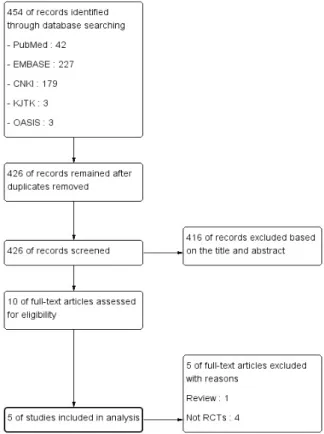
PubMed에서 42개의 연구가 검색되었으며, EMBASE 에서는 227개, CNKI에서는 179개, KJTK에서 3개, OASIS에서 3개의 문헌이 검색되었다. 이 중 중복된 논 문 28개를 제외하였으며 제목과 초록을 살펴 본 후 10 개가 선택되었으며 전문을 검토한 후 1개의 Review 논 문과 RCT 연구가 아닌 4개의 논문이 제외되었다. 최종 적으로 본 고찰 연구의 포함 기준에 부합하는 연구는 5개였다11-5) (Fig. 1).
2. Included Studies
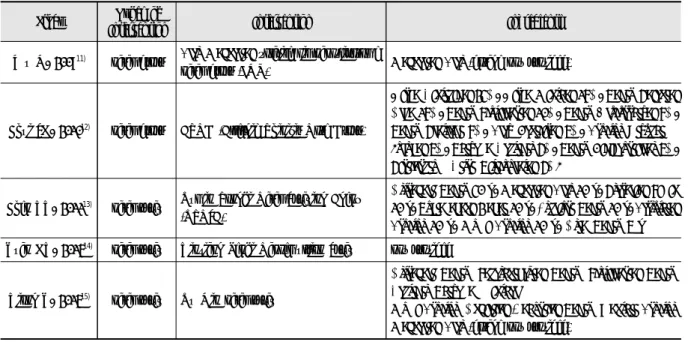
총 5개의 RCT 연구를 분석하였으며 포함된 연구들 은 모두 중국에서 이루어졌으며 1개12)는 영문, 4개는 중국어로 출판되었다11,13-5). 5개의 RCT 연구 중 cross-over 연구는 1개12) 였다.
3. Participants
연구 대상자 수는 최소 35명에서 최대 191명으로 다 양하였다. 연구 당 포함된 평균 대상자 수는 약 121명이 었다. 5개의 연구 중 소아청소년만을 연구 대상으로 한 것은 2개였다11,14). 알레르기성 비염에 대한 진단 기준이 명확하게 나온 것은 5개의 연구 중 4개가 있었다11,13-5).
4. Interventions
2개의 연구11-2)는 한약점비액이 주요 중재였으며, 3 개의 연구13-5)는 한약코분무제가 주요 중재였다. 4개 연
구11-3,15)는 시험군에서 한약점비액과 한약코분무제와
같은 국소한약외용제만을 단독으로 사용하였으며, 1개 연구14)는 국소한약외용제와 비운동 (nasal exercise)요법 을 병행하였다. Chui의 연구12)에서는 대조군으로 place- bo를 사용하였으며, Chen의 연구13)에서는 대조군으로 Beconase라는 비강 스테로이드 분무제를 사용하였다.
Xiong15)는 대조군으로 Biyankang tablet (鼻炎康片)이 라는 경구 한약을 사용하였으며 Wu11)는 대조군으로 Zyrtec라는 항히스타민제를 사용하였다. Yuan14)의 연 구에서는 대조군으로 Budesonide nasal spray라는 비강 스테로이드 분무제를 사용하였다. 1개의 cross over연구
12)를 제외하고 4개의 연구11,13-5)에서의 중재기간을 살 펴보면 최소 2주, 최대 4주로 평균 22.5일이었다. 포함 된 연구들의 특성은 (Table 1)에서 정리하였다. 5개의 연구에서 사용된 국소한약외용제의 약물 구성은 (Table 2)에서 정리하였다. 사용 약재들의 빈도를 분석하였을 때 2회 이상 사용된 약물은 辛荑, 黃芩, 黃連, 黃芪가 있었다. 본초학적인 분류에서는 發散風寒藥, 淸熱燥濕 藥, 補氣藥이 사용되었다.
Fig. 1. Flow diagram of searching and article selection
Study Types of
Intervention Intervention Ingredients
Wu M, 200911) nasal drops Flos Magnoliae volatile oil nano-liposome
nasal drops (FMO) Magnoliae Flos (dosage not provided)
Chui SH, 201012) nasal drops ARND (Allergic Rhinitis Nose Drops)
Herba Centipedae 23%, Herba Menthae 16%, Radix Paeoniae Alba 16%, Radix Scutellariae 10%, Radix Glycyrrhizae 6%, Radix Platcodi 6%, Floz Lonicerae 5%, Fructus Zizyphi Jujubae 5%, Rhizoma Coptidis 4%, Radix Ledebouriellas 5%, Pericarpium Citri Reticuulatae 4%.
Chen XX, 201113) nasal spray Qumin Tongbi Nasal Spraying Agent (QTNSA)
Astragali Radix 30 g, Magnoliae Flos 10 g, Psoraleae Semen 10 g, Rubia akane Nakai 10 g, Bupleuri Radix 10 g, Forsythiae Fructus 10 g, Mume Fructus 10 g, Asia Radix 5 g Yuan HX, 201514) nasal spray Xinxiang Penbi Nanoemulsion Spray not provided
Xiong Y, 201515) nasal spray Qu Min nasal spray
Astragali Radix, Saposhnikoviae Radix, Scutellariae Radix, Coptidis Rhizoma, menthol
Mume Fructus, Angelicae Dahuricae Radix, Xanthii Fructus, Magnoliae Flos (dosage not provided)
Table 2. Intervention and Ingredients of the Included Studies
Study Method Participants Intervention Treatment
period
Study/
placebo sample sizes
Wu M, 200911) RCT
1) Study group
Number: 97, male/female: 59/38 Age range: mean 5.50
2) Control group
Number: 94, male/female: 56/38 Age range: mean 5.89
1) Study group: FMO twice daily for 10 days (1 drop each time) per course → total two courses
2) Control group: Zyrtec tablet (Cetirizine) 5mg once daily for 10 days per course → total two courses
20 days 97/94
Chui SH, 201012)
RCT (cross-ov
er)
female: range 14-71 (mean 35 years) male: range 8-76 (mean 41 years)
1) Group A: ARND (2 weeks) → washout (3 weeks) → placebo (2 weeks)
2) Group B: placebo (2 weeks) → washout (3 weeks) → ARND (2 weeks)
7 weeks Group A (20) / Group B (15)
Chen XX, 201113) RCT
1) Study group
Number: 57, male/female: 36/21 Age range: 18-53 (mean 27.43) 2) Control group
Number: 46, male/female: 30/16 Age range: 17-61 (mean 30.78)
1) Study group: QTNSA twice daily for 1 week (one course) → total two courses 2) Control group: Beconase twice daily for 1
week (one course) → total two courses
2 weeks 57/46
Yuan HX, 201514) RCT
1) Study group
Number: 120, male/female: 62/58 Age range: mean 10.26 2) Control group
Number: 60, male/female: 39/21 Age range: mean 11.05
1) Study group: Xinxiang Penbi Nanoemulsion (50 μL) twice daily for 4weeks + Nasal exercises
2) Control group: Budesonide nasal spray (64 μL) twice daily for 4 weeks + Nasal exercises
4 weeks 120/60
Xiong Y, 201515) RCT
1) Study group Number: 70
Age range: range 17-63 (mean 43.5) 2) Control group
Number: 30
Age range: range 16-62 (mean 42.6)
1) Study group: Qu Min nasal spray (for 28 days) (dosage not provided)
2) Control group: Biyankang 3 tablets three times a day for 28 days
28 days 70/30
RCT: Randomized controlled trial, FMO: Flos Magnoliae volatile oil nano-liposome nasal drops, ARND: Allergic Rhinitis Nose Drops, QTNSA:
Qumin Tongbi Nasal Spraying Agent
Table 1. The Characteristics of the Included Studies
5. Risk of Bias in Included Studies
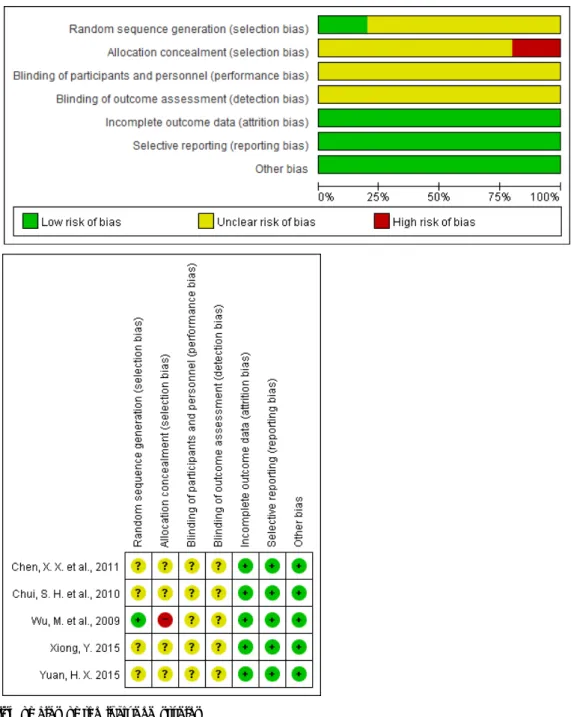
5개의 연구 중 무작위 배정순서 생성에서 ‘낮음’이 라 평가 한 연구는 난수표를 이용하였던 연구로 1개11) 뿐이었다. 나머지 연구에서는 무작위 배정순서 방법에 대한 구체적인 언급이 없었다. 배정순서 은폐에서는 난수가 기재된 표를 이용한 1개의 연구11)를 제외한 나 머지 연구는 ‘모호함’이라 평가 하였다. 연구 참여자, 연구자에 대한 눈가림에서는 5개의 연구 모두에서 해 당 결과를 다루지 않아서 ‘모호함’이라 평가 하였다. 불 충분한 결과자료, 선택적 보고, 그 외 비뚤림 영역에서 는 5개의 연구 모두 ‘낮음’이라 평가하였다 (Fig. 2).
6. Effects of Topical Application of Chinese Herbal Medicine
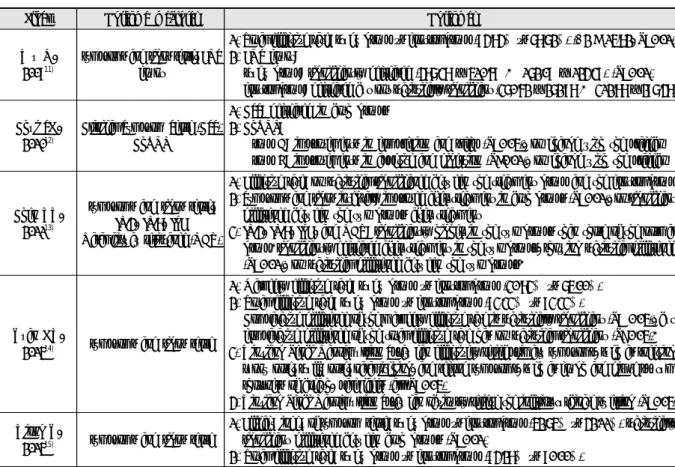
연구에 사용된 평가 척도와 결과는 (Table 3)에 정리 하였다. 5개의 연구 모두 symptom score를 평가척도로 사용하였다. Chui의 연구12)에서는 알레르기성 비염의 증상과 삶의 질을 평가하였으며, Chen13)은 알레르기성 비염의 증상 및 하비갑개의 종창 정도를 보는 징후, IL-4, IL-8, IgE와 같은 혈청검사, 비강기도저항을 평가 하였다. Xiong15)은 알레르기성 비염의 증상을 평가하였 으며 Wu의 연구11)에서는 알레르기성 비염의 증상 및 하 비갑개의 종창 정도를 보는 징후, EOS (eosinophil) 수치
Fig. 2. Risk of bias of the included studies
의 변화를 평가하였다. Yuan14)는 알레르기성 비염의 증 상 및 하비갑개의 종창 정도를 보는 징후를 평가하였다.
대조군에 비해 시험군에서 국소한약외용제가 통계 적으로 유의하게 알레르기성 비염 증상 및 징후 점수 개선에 효과가 있었던 연구는 Xiong의 연구15), Wu의 연구11) 2개 였다. 나머지 3개 연구12-4)에서 국소한약외 용제는 치료 전 보다 치료 후 증상 및 징후 점수가 유의 하게 개선 되기는 하였으나 대조군에 비해 통계적으로 유의한 차이가 없었다.
삶의 질도 평가한 Chui의 연구12)에서 국소한약외용 제인 Allergic Rhinitis Nose Drops (ARND)를 먼저 처치 한 Group A에서 치료 후 안색과 수면 영역에서의 삶의 질 점수가 개선되었으나 (p < 0.05) placebo에 비해 차이 가 있지는 않았다. Placebo 후 ARND를 처치한 Group B에서는 식욕과 소화, 즐거움 영역에서의 삶의 질 점수 가 개선되었으나 (p < 0.05) placebo에 비해 차이가 없었 다. EOS를 추가로 평가 지표로 사용한 Wu의 연구11)결 과를 보면 EOS가 국소한약외용제인 Flos Magnoliae vol- atile oil nano-liposome nasal drops (FMO) 치료 후 유의하 게 감소하였으며 그 차이는 대조군에 비해 통계적으로
유의하였다. IL-4, IL-8, IgE와 비강기도저항을 추가로 평가한 Chen의 연구13)에서는 국소한약외용제인 Qumin Tongbi Nasal Spraying Agent (QTNSA) 치료 후 해당 지 표들이 모두 유의하게 감소 하였으나 대조군에 비해 통 계적으로 유의한 차이가 없었다.
Ⅳ. Discussion
알레르기성 비염은 대표적인 제 I형 알레르기 질환 으로 비점막 염증세포에 대한 IgE 매개반응으로 발생 하며 3대 증상으로는 재채기, 맑은 콧물, 코막힘이 있 다. 알레르기성 비염을 일으키는 주요 원인은 꽃가루, 집먼지 진드기, 애완동물 해충 등이 있다16). 알레르기 성 비염의 유병률은 통계청 자료17)에 따르면 2014년 14.8%로 2001년 2.7%, 2007년 12% 였던 것과 비교하 여 증가하는 추세에 있다.
알레르기성 비염의 약물 치료에는 corticosteroid 분 무제, 항히스타민제, cromolyn sodium, 항콜린제, 류코 트리엔 수용체 길항제 등이 있으며 이에 반응하지 않
Study Outcome measures Outcomes
Wu M, 200911)
symptoms and signs score, EOS count
1) Total effective rate: study group vs control group (94.84% vs 78.72%) (χ2 = 15.82, P<0.01) 2) EOS count:
study group: significantly decreased (487.38 ± 510.69 → 172.09 ± 124.39) (P<0.01) control group: decreased but not statistically significant (370.62 ± 272.98 → 312.88 ± 297.48)
Chui SH, 201012)
Clinical Symptom Score (CSS) ChQOL
1) CSS: decreased in both groups 2) ChQOL:
Group A: improvements in complexion and sleep (P<0.05), no change with the placebo Group B: improvements in appetite and digestion (P=0.01), no change with the placebo
Chen XX, 201113)
symptoms and signs score, IL-4, IL-8, IgE Nasal airway resistance (NAR)
1) Effective rate: no statistical significance between the treatment group and the control group 2) Symptoms and signs integrals: improved after treatment in both groups (P<0.01), no significant
difference between the two groups after treatment
3) IL-4, IL-8, IgE, and NAR: significantly higher in the two groups than those of the normal group. significantly decreased after treatment in the two groups, showing statistical difference (P<0.01), no statistical difference between the two groups.
Yuan HX,
201514) symptoms and signs score
1) Markedly effective rate: study group vs control group (30.83% vs 75.00%) 2) Total effective rate: study group vs control group (93.33% vs 93.33%)
Comparative difference of the markedly effective rate is statistically significant (P< 0.05), but comparative difference of the total effective rate has no statistical significant (P>0.05).
3) Xinxiang Penbi Nanoemulsion Spray can effectively relief primary symptoms, such as sneezing runny nose, stuffy nose, nasal itching, and second symptoms, such as cough and dilute sputum shortness of breath, pale faces (all P<0.05)
4) Xinxiang Penbi Nanoemulsion Spray can obviously relieve the inferior turbinate swelling (P<0.05)
Xiong Y,
201515) symptoms and signs score
1) Efficacy index of symptom score: study group vs control group (52.75% vs 42.11%) statistically significant difference between both groups (P<0.01)
2) Total effective rate: study group vs control group (94.28% vs 90.00%) EOS: Eosinophil, ChQOL: Chinese Quality of Life Instrument
Table 3. Outcome Measures and Outcomes of the Included Studies
을 경우 면역요법이 고려된다5,18). 그러나 기존의 약물 치료는 두통, 어지럼증, 진전, 불면증 등의 부작용이 있 으며 면역요법은 중등도의 환자에게 사용하는 치료법 으로 증상 및 삶의 질 개선에 효과적이지만 고비용이 라는 단점이 있다18). 이러한 이유로 알레르기성 비염의 치료로 한의학적 치료가 중국, 대만에서는 활발히 이 용되고 있으며6-7) 치료의 편리성 측면에서 한약코분무 제, 한약점비액에 대한 개발도 이루어지고 있다11-5,19). 이에 본 연구에서는 한약코분무제와 한약점비액을 중 심으로 알레르기성 비염에 관한 무작위배정 비교임상 시험연구 (Randomized controlled trial)들을 조사, 분석 하였다.
알레르기성 비염의 국소한약외용제에 관한 RCT연 구들을 KJTK, OASIS, CNKI, PubMed, EMBASE의 데 이터베이스에서 검색하여 분석한 결과 국소한약외용 제가 알레르기성 비염의 주된 증상인 재채기, 콧물, 소 양감, 코막힘의 증상을 개선할 수 있다는 것을 보여준 다. 그러나 증상 개선의 기전에 대하여 EOS와 IL-4, IL-8, IgE의 감소와 같은 면역학적인 조절과 관련 될 것이라는 것을 보여준 연구는 2개만이 있었으며 근거 가 불충분하였다. 국소한약외용제가 알레르기성 비염 의 증상 개선에 효과가 있다는 본 연구의 결론은 포함 된 연구들이 선택 비뚤림, 실행 비뚤림의 위험이 모호 하거나 높았다는 점을 참고하여 받아들여져야 한다.
알레르기성 비염의 外治法에 대한 고찰 연구로 중 국에서 발표된 문헌19)이 있는데 여기서는 外治法 중 貼 敷療法이 가장 주요한 치료 방법이라 하였으며 다음으 로 침구치료, 국소한약외용제가 주요한 치료법이라 하 였다. 貼敷療法에 많이 쓰이는 한약은 細辛, 白芥子, 甘遂, 玄胡索 이었으며 국소한약외용제에 많이 쓰이는 한약은 蒼耳子, 辛荑, 黃芪, 白芷였다. 본 고찰에서 분 석한 연구들에서도 국소한약외용제의 구성 약물로 辛 荑, 黃芪, 細辛, 蒼耳子, 白芷가 사용되었다. Yuan의 연 구14)에서 사용된 한약코분무제의 약물 구성은 명시되 지 않았으나 細辛과 辛荑를 바탕으로 하였다는 것을 제시하였다. 최근 細辛은 hemeoxygenase-1 (HO-1)의 유도와 nuclear factor (NF)-κB의 억제를 통해 항염증 효 과가 있다는 연구20)가 발표되었다. 辛荑의 성분 중 하 나인 lignan은 platelet-activating factor (PAF), cytosolic phospholipase A2, hexosaminidase, lipoxygenase와 같은 염증 매개 물질을 저해하는 효과가 있다21). 본 고찰 연 구에서 각 연구에 사용된 약재들의 빈도를 분석하였을 때 2회 이상 사용된 약물은 辛荑, 黃芩, 黃連, 黃芪가
있었다. 이 약물들은 공통적으로 항염증 효과가 있다.
黃芩은 Kim의 연구22)에 따르면 黃芩 유래 flavonoid 계 열인 bacalin, baicalein 및 wogonin이 Th1과 Th2 사이토 카인을 조절할 수 있는 효과를 보인다 하였으며, 黃連 은 LPS에 의해 유발된 Macrophage의 IL-1α, IL-5, IL-6, IL-12p40과 같은 각종 cytokine 생성을 억제한다는 보 고가 있었다23). 黃芪는 IL-2, IFNr 및 IL-10의 유전자 발현을 유도하여 항염증 효과가 있음을 시사하는 보고 가 있었다24). 한의학적으로 辛荑는 散風寒, 通鼻竅의 효능이 있으며, 鼻淵頭痛, 鼻流濁涕 등의 증상에 要藥 이 된다. 黃芩과 黃連은 淸熱燥濕, 瀉火解毒의 효능이 있으며, 黃芪는 補中益氣, 利水消腫, 托毒生肌의 효능 이 있다.
Wu의 연구11)에서는 辛荑 단일 약물의 방향유를 점 비액으로 사용하였다. 국내에 보고된 국소한약외용제 로는 通竅湯 증류추출액의 분무제25)가 있었고, 黃連, 辛荑, 川芎, 細辛, 麻黃, 柹蔕의 증류추출액에 유칼립 투스, 라벤더 에센셜 오일을 추가한 분무제26) 그리고 細辛膏27)가 있었으나 RCT 연구가 아니거나 동물 실험 으로 본 고찰 연구에서는 제외되었다. 알레르기성 비 염의 한의학및 보완대체의학적 치료에 대한 국내 임상 연구를 분석한 보고28)에서는 경구 약물 치료법으로는 加味通竅湯, 加味補中益氣湯, 小靑龍湯, 荊芥連翹湯 加味, 加味防風通聖散 등의 순서로 다용되었다고 한 다. 현재까지는 국내에서는 알레르기성 비염의 국소한 약외용제에 대한 연구가 다양하지 않으며 RCT 연구도 찾기 어려웠다.
본 연구의 한계점은 포함된 연구들이 5개로 연구의 수가 부족했다는 점과 연구간 이질성이 높아 메타분석 을 수행하지 못하여 결과에 대한 통계적인 합성을 하 지 못했다는 것이 있다. 각 연구마다 주요 중재법인 국 소한약외용제의 약물 구성에도 차이가 있었다. 또한 선택 비뚤림과 실행 비뚤림이 모호하거나 높은 연구들 이었으며 증상점수 외에 국소한약외용제의 효과를 밝 힐 만한 기전에 대한 평가 척도가 부족하였다. 그러나 본 고찰 연구의 결과는 기존에 발표된 RCT 연구들의 성향과 문제점을 파악하여 향후 진행될 알레르기성 비 염에 대한 연구 설계에 기반이 될 것으로 생각한다.
알레르기성 비염에 대한 국소한약외용제의 치료효 과를 확신시하기 위해서는 향후 무작위 배정순서나 배 정순서 은폐에 적절한 방법을 선택하여 비뚤림 위험이 낮은 잘 설계된 RCT 연구들이 진행되어야 할 것이다.
또한 결과 지표로 증상 점수뿐 아니라 염증매개물질과
관련된 혈청검사를 통해 면역조절기전을 함께 밝히는 연구가 수행되어야 할 것이다.
Ⅴ. Conclusion
본 연구는 KJTK, OASIS, CNKI, PubMed, EMBASE 의 데이터베이스에서 국소한약외용제의 알레르기성 비염 치료 효과에 관한 RCT 연구들을 검색하여 정리, 분석하였다. 본 연구에서 얻어진 결론은 다음과 같다.
최종 5개의 RCT 연구에서 사용된 치료법으로는 한 약점비액이 2편, 한약코분무제가 3편 있었으며 평균 치료기간은 22.5일 이었다.
국소한약외용제에 주로 사용된 약물은 辛荑, 黃芩, 黃連, 黃芪가 있었다. 본초학적인 분류에서는 주로 發 散風寒藥, 淸熱燥濕藥, 補氣藥이 사용되었다.
각 연구의 평가척도로는 알레르기성 비염의 주요 증상 점수 외에, 삶의 질 점수, 비강기도저항, EOS 수 치, IL-4, IL-8, IgE와 같은 혈청검사가 이용되었다.
국소한약외용제는 치료 후 알레르기성 비염의 주요 증상 점수를 개선시켰으며 대조군에 비해 통계적으로 유의한 차이가 있었던 연구는 2편 이었다.
본 연구 결과를 확고히 하기 위해서는 향후 비뚤림 위험이 낮은 연구 설계가 필요하며, 결과 지표로 증상 점수와 함께 면역조절인자를 포함하는 RCT 연구가 이 루어져야 할 것이다.
References
1. Hong CE. Textbook of pediatrics. 10th ed. Seoul: Miraen Publising co. 2012:1144-50.
2. Kim KB, Kim DG, Kim YH, Kim JH, Min SY, Park EJ, Baek JH, Yu SA, Lee SY, Lee JY, Lee HJ, Chang GT, Chai JW, Han YJ, Han JK. Pediatrics of Korean medicine. First Volume. Seoul: Eui Seong Dang Publishing co. 2015:359-60.
3. Schatz M. A survey of the burden of allergic rhinitis in the USA. Allergy. 2007;62Suppl85:9-16.
4. Ozdoganoglu T, Songu M, Inancli HM. Quality of life in allergic rhinitis. Ther Adv Respir Dis. 2012;6(1):25-39.
5. Pawankar R, Bunnag C, Khaltaev N, Bousquet J. Allergic rhinitis and its impact on asthma in Asia pacific and
the ARIA update 2008. World Allergy Organ J.
2012;5(Suppl 3):S212-7.
6. Huang TP, Liu PH, Lien AS, Yang SL, Chang HH, Yen HR. A nationwide population-based study of tradi- tional Chinese medicine usage in children in Taiwan.
Complement Ther Med. 2014;22(3):500-10.
7. Li XM. Complementary and alternative medicine in pediatric allergic disorders. Curr Opin Allergy Clin Immunol. 2009;9(2):161-7.
8. Yen HR, Liang KL, Huang TP, Fan JY, Chang TT, Sun MF. Characteristics of traditional Chinese medicine use for children with allergic rhinitis: a nationwide pop- ulation-based study. Int J Pediatr Otorhinolaryngol.
2015;79(4):591-7.
9. Feng S, Han M, Fan Y, Yang G, Liao Z, Liao W, Li H. Acupuncture for the treatment of allergic rhinitis:
a systematic review and meta-analysis. Am J Rhinol Allergy. 2015;29(1):57-62.
10. Wen CY, Liu YF, Zhou L, Zhang HX, Tu SH. A systematic and narrative review of acupuncture point application therapies in the treatment of allergic rhinitis and asthma during dog days. Evid Based Complement Alternat Med: eCAM. 2015;2015:846-51.
11. Wu M, Zhang JY, Zhang X. Clinical observation of Flos Magnoliae Volatile oil nano-liposome nasal drops in treating pediatric allergic rhinitis. Zhongguo Zhong Xi Yi Jie He Za Zhi. 2009;29(8):740-2.
12. Chui SH, Shek SL, Fong MY, Szeto YT, Chan K. A panel study to evaluate quality of life assessments in patients suffering from allergic rhinitis after treatment with a Chinese herbal nasal drop. Phytother Res.
2010;24(4):609-13.
13. Chen XX, Fu JX, Huang J. Clinical study of curing patients with perennial allergic rhinitis by Qumin Tongbi nasal spraying agent. Zhongguo Zhong Xi Yi Jie He Za Zhi. 2011;31(5):643-6.
14. Yuan HX. Clinical rsearch of Xinxiang Penbi Nanoemulsion in the treatment of pediatric allergic rhini- tis: Nanjing University of Chinese medicine. 2015.
15. Xiong Y. Clinical research of Qu Min nasal spray in the treatment of allergic rhinitis. J Practic Tradit Chin Med. 2015;31(04):330-1.
16. Lisa MW, Alkis T. Allergic rhinitis. N Engl J Med.
2015;372(5):456-63.
17. Korean Statistical Information Service [updated 2016.
01. 13.; cited 2016. 06. 17.]. Available from: http://ko- sis.kr/statHtml/statHtml.do?orgId=117&tblId=DT_1 1702_N118&conn_path=I2.
18. Denis K, Stephanie S. Treatment of allergic rhinitis.
Am Fam Physician. 2010;12(81):1440-6.
19. Zhang Hl, Wang Q, Zhang HM. Bibliometric analysis on randomized controlled research literatures about treat- ing allergic rhinitis with external therapy of traditional Chinese medicine. China J Tradit Chin Med Pharm.
2015;30(9):3247-9.
20. Lee JA, Lee MY, Seo CS, Ha H, Lee H, Kim JH, Shin HK. Asiasari sieboldii suppresses inflammatory mediators through the induction of hemeoxygenase-1 expression in RAW264.7 cells. Immunopharmacol Immunotoxicol. 2012;34(1):15-20.
21. Jung KY, Kim DS, Oh SR, Park SH, Lee IS, Lee JJ, Shin DH, Lee HK. Magnone A and B, novel anti-PAF tetrahydrofuran lignans from the flower buds of Magnolia Fargesii. J Nat Prod. 1998;61(6):808-11.
22. Kim YJ, Lee JC, Kim HY, Xie G, Yun YG, Jang SI. Th1 and Th2 cytokine modulation by Baicalin, Baicalein and Wogonin from Scutellaria Radex on the
CD4+ jurkat T Cells. J Orient Physiol Pathol. 2005;
19(4):922-7.
23. Lee JW, Han HS, Lee YJ. Anti-inflammatory effect of Coptidis Rhizoma extract. Korean J Herbology.
2014;29(5):83-90.
24. Shin SW, Lee YS, Park JH, Kwon TK, Seong IS, Kwon YK. Comparison of immunomodualtory effects of wa- ter-extracted Ginseng Radix, Pilose Asia-bell, Astragali Radix, Astractylodes Rhizoma Alba and Dioscoreae Rhizoma. J Orient Physiol Pathol. 2004;18(4):1140-6.
25. Koo JS, Baek JH. A clinical study on the effect of Tongkyu-tang distillate on pediatric allergic rhinitis.
J Korean Orient Pediatr. 2003;17(2):103-14.
26. Kim JE, Hong CH. Survey on effect and satisfaction of Korean medicine distillate nasal spray of patient with chronic rhinitis. J Orient Med Ophthalmol Otolaryngol Dermatol. 2012;25(3):56-64.
27. Kim MA, Kim MB, Ko WS, Yoon HJ. The anti-allergic effect of SESHINGO (SSG). J Orient Med Ophthalmol Otolaryngol Dermatol. 2008;21(3):69-81.
28. Koo EJ, Han JK, Kim YH. Review of clinical studies on Korean medicine and complementary and alternative medicine treatment for allergic rhinitis in the Korean literature. J Korean Orient Pediatr. 2015;29(4):77-89.