천식의 한약치료에 관한 문헌고찰 - 국내 한의학 임상연구를 중심으로
박청수1#·홍미나2,3#·반재진1·정한솔4·최준용1,2,5*
1 : 부산대학교 한의학전문대학원 한의학과, 2 : 부산대학교 한방병원 한의약임상연구센터,
3 : 부산대학교 대학원 한의학과, 4 : 부산대학교 한의학전문대학원 응용의학부, 5 : 부산대학교 한방병원 한방내과
Review on Herbal Medications of Asthma in Domestic Clinical Research on Traditional Korean Medicine
Cheong Su Park
1#, Minna Hong
2,3#, Jae Jin B an
1, Han Sol Jeong
4, Jun Y ong Choi
1,2,5*
1 : Department of Korean Medicine, School of Korean Medicine, Pusan National University, 2 : Clinical Research Center for Korean Medicine, Pusan National University Korean Medicine Hospital,
3 : D epartment of Korean Medicine, The G raduate School, Pusan National University, 4 : Division of Applied Medicine, School of Korean Medicine, Pusan National University, 5 : Department of Internal Medicine, Pusan National University Korean Medicine Hospital
The purpose of this study was to review the herbal medications of asthma through clinical studies in Korea and to be utilized in the treatment of asthma and in other clinical studies. All clinical researches about asthma published up to 13th February 2018 were found in two domestic electric databases, Oriental Medicine Advanced Searching Integrated System(OASIS) and National Discovery for Science Library(NDSL). Twenty-seven articles were selected and of these, there were 14 articles of before and after studies(BAS), 8 of case series(CS), 4 of case reports(CR) and 1 of the randomized controlled trial(RCT). The most frequently used prescription was "Cheongsangboha-tang(淸上補下湯)". There were various TCM patterns, and Tae-Eum-In(太陰人) was the most common Sasang constitution(四象體質). Frequently used evaluations to assess treatment effects were lung function tests such as Forced expiratory volume at one second (FEV1) and Quality of Life Questionnaire for Adult Korean Asthmatics(QLQAKA) questionnaire responses. We have found that herbal medicine treatment can be an effective treatment to improve the symptoms and the quality of life of asthmatic patients. But we consider that large-scale systematically designed clinical researches are needed additionally.
keywords : Herbal medication, Asthma, Traditional Korean Medicine
* Corresponding author
Jun-Yong Choi, Department of Internal Medicine, School of Korean Medicine, Pusan National University. Mulgeum-eup, Yangsan-si, 50612, Korea
·E-mail : [email protected] ·Tel : +82-55-360-5953
·Received : 2018/10/01 ·Revised : 2018/11/13 ·Accepted : 2018/12/05
ⓒ The Society of Pathology in Korean Medicine, The Physiological Society of Korean Medicine pISSN 1738-7698 eISSN 2288-2529 http://dx.doi.org/10.15188/kjopp.2018.12.32.6.361 Available online at https://kmpath.jams.or.kr
# These two authors contributed equally to this work. Hong planned study flow and wrote first draft, Park conducted study and analyzed results.
서 론
천식은 기침, 호흡곤란, 천명음 등의 증상을 호소하는 대표적 인 만성 호흡기 질환 중 하나로 한의학에서는 효천증(哮喘證)의 범 주에 속한다1). 천식은 전 세계적으로 큰 사회적 문제가 되고 있는 질환으로 세계보건기구의 보고에 의하면 3억 명 이상이 이환되어 있고 연간 천식으로 인한 사망도 346,000명 이상으로 추정되고 있 다2). 우리나라의 경우 만 19세 이상 성인에서의 천식 유병률은 1998년 1.1%에서 2016년 2.7%로 증가하는 양상을 보이고 있으며, 연령별로 살펴보았을 때 특히 60세 이상의 고연령군에서 지속적으 로 높다3). 이는 고령화 사회에 진입하고 있는 우리나라의 상황을
고려하면 향후 천식이 지금보다 더 큰 사회적 부담이 될 수 있다는 점을 시사한다. 또한 미세먼지의 노출은 천식의 급성 악화와 병원 방문, 입원 및 사망률을 증가시키고 장기적으로는 폐 기능을 감소 시킬 수 있는데4), 우리나라는 몽골 및 중국 등의 먼지 대기오염 영 향으로 미세먼지 오염이 지속되고 있어4,5) 천식의 발생이 더욱 증 가될 우려가 있다.
천식의 치료방법은 꾸준히 발전하고 있음에도 불구하고 여전히 많은 천식 환자들이 고통을 받고 있으며, 치료 반응에 대한 불만족 또는 부작용의 경험 등으로 인해 한약 치료 등 새로운 치료에 대해 관심을 보이고 있다6,7). 특히 최근 영문 및 중국어로 발표된 천식 의 한약치료에 대한 무작위대조군 연구를 체계적 문헌고찰한 결
과 표준 양약치료에 한약을 추가할 경우 양약 단독치료에 비해 유의한 효과가 있음이 보고되었다8). 그러나 국내 한의계의 천식 치료에 대한 체계적인 문헌고찰은 존재하지 않는 실정이다.
본 연구진은 현재 천식에 대한 한의약 치료의 표준임상진료지 침이 부재한 상황에서 국내 한의계의 천식에 대한 임상 진료의 활 성화 및 추후 임상 연구에 도움이 되고자 국내 임상연구를 통하여 천식의 한약치료에 대해 조사·분석하였다.
연구대상 및 방법
1. 검색 전략
국내 database인 전통의학정보포털(OASIS; http://oasis.kiom.
re.kr) 및 국가과학기술정보센터(NDSL; http://www.ndsl.kr)를 이용하였고, 2018년 2월 13일을 기준으로 발간된 논문 전체를 대상으로 검색하였다. 검색어는 ‘천식’ OR ‘asthma’ OR ‘효천’ OR
‘哮喘’을 이용하였다.
2. 선별 기준
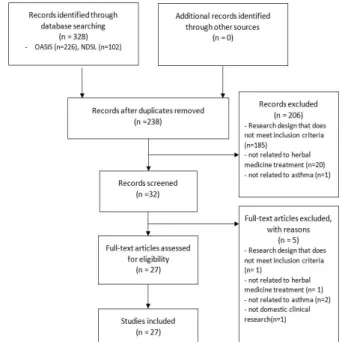
국내에서 진행된 임상연구로서 천식에 대해 한약치료를 시행한 연구를 포함하였으며, 한약치료를 시행하지 않은 연구는 모두 제외 하였다. 검색된 논문의 초록을 검토하고 필요한 경우 전문을 읽어 선정 기준에 맞는 27편의 논문을 최종 선정하였다(Fig. 1).
Fig . 1. Flo w ch a rt of T rial Se le ction P roce ss
3. 자료 정리
조9) 등의 연구에서 사용한 연구 분류 방법을 참고하여 선별된 논문을 단면연구(CrSS;Cross-sectional study), 환자-대조군 연구 (CCS; Case-control study), 전후 비교 연구(BAS;
Before-and-after study), 증례군 연구(CS; Case series), 단일 증례 보고(CR; Case report), 무작위 대조 연구(RCT;
Randomized controlled trial), 비 무작위 대조 연구(NRCT;
Non-randomized controlled trial)로 분류하였다.
결 과
1. 연도별 분포
연도별 분포는 1985년 2편, 1987년 1편, 1989년 1편, 2001년 1편, 2002년 6편, 2003년 5편, 2004년 2편, 2005년 1편, 2006년 1편, 2007년 1편, 2011년 1편, 2013년 2편, 2015년 1편, 2016년 2편이었다(Table 1, Supplement 1).
2. 연구방법 분석
총 27편의 논문 중 전후 비교 연구(BAS)는 14편, 증례군 연구 (CS)는 8편, 단일 증례 보고(CR)는 4편, 무작위 대조군 시험(RCT) 은 1편이었다(Table 1, Supplement 1).
3. 연구대상자 수
20명 이하는 11건, 21명 이상 40명 이하는 13건, 41명 이상 60 명 이하는 1건, 60명 이상은 2건이었다(Table 1, Supplement 1).
4. 치료방법
처방의 형태는 대부분 탕약이거나, 탕약을 원내에서 자체적으 로 엑기스 형태로 가공한 형태22)였으나, 산제(補中益氣湯, 麻黃定 喘湯) 및 환제(喘肺丸)형태도 있었다.
원방에 약간의 약재를 더하거나 뺀 경우도 있었는데, 이러한 경우는 기본 원방에 포함시켜 집계하였다. 또한 합방을 한 경우는 각 처방을 따로 집계하였다. 한 논문에서 여러 처방을 다루거나 순 차적으로 투약한 경우에도 별개의 처방으로 집계하였다. 한 처방에 관한 증례군 연구의 경우, 해당 처방은 1건으로 집계하였다.
淸上補下湯이 9편으로 가장 많았고, 小靑龍湯, 麥門冬湯, 加味 鎭咳湯이 각 4편, 貝母湯, 定喘化痰降氣湯이 각 3편, 麻黃定喘湯 이 2편, 荊防導赤散, 紫菀湯, 生脈散, 補肺湯, 獨活地黃湯, 藿香正 氣散, 補中益氣湯, 越婢加半夏湯, 半夏散及湯, 桔梗湯, 喘肺丸, 天 門冬湯이 각 1편씩이었다(Table 2).
T ab le 2 . Fre q u e n cy o f P re scrip tio n
Freq uency Prescrip tio n nam e
9 C heo ng san gb o ha-tang (淸 上 補 下 湯 ;Q ing shang b uxia-tang ) 4 So cheo ng ryong -tang (小 靑 龍 湯 ;X iaoq ing lon g-tang ),
M aekm und o ng -tang (麥 門 冬 湯 ;M aim en do ng -tang ), Gam ijinhae-tang (加 味 鎭 咳 湯 ;Jiaw eizhenke-tang )
3 Paem o -tan g(貝 母 湯 ;Beim u-tang ),
Jeo ng cheo nhw ad am g ang g i-tang (定 喘 化 痰 降 氣 湯 ;D ing ch uanh uatan jiang q i-tang )
2 M ahw ang jeo ng cheo n-tang (麻 黃 定 喘 湯 ;M ahu ang d ing chuan-tang )
1
H yeo ng b an gd o jeok -san(荊 防 導 赤 散 ;Jing fan gd aochi-san), Jaw an -tang (紫 菀湯 ;Ziw an-tang ), Sang m aek-san(生 脈
散 ;Sheng m ai-san), Bo p ye-tang (補 肺 湯 ;Bufei-tan g),
D o khw aljihw ang -tan g(獨 活 地 黃 湯 ;D uhuo d ihuang -tang ), G w akyang jeo ng g i-san (藿 香 正 氣 散 ;H uo xian gzhen gq i-san),
Bo ju ng ik ki-tang (補 中 益 氣 湯 ;Buzho ng yiq i-tang ), W olb ig ab an ha-tang (越 婢 加 半 夏 湯 ;Yueb ijiab an xia-tang ),
B anh asang eup -tang (半 夏 散 及 湯 ;Banxiasanji-tang ),
G ilg yeo ng -tang (桔 梗 湯 ;Jug eng -tan g),
C heo np ye-hw an(喘 肺 丸 ;C huan fei-w an),
C heon m un do ng -tang (天 門 冬 湯 ;Tian m end o ng -tang )
T ab le 1 . C lin ica l Stu d ie s a b ou t H e rb al M e d icin e fo r A sth m a e xce p t fo r C ase R ep o rt an d C a se Se rie s First
au tho r (Year)
Stud y typ e Sam p le
(Follow -up)
Treatm ent A : treatm ent g roup
B: C on tro l gro up
Treatm ent p erio d (Fo llow -
up )
Evaluatio n Result
H eo
1 0)(200 1) BA S 15 So cheo ng ryo ng -tang ;
X iaoq ing lon g-tang 2w s FV C, FEV1 , PEFR, Q LQ AK A FV C *, FEV1 *, PEFR*, Q LQ A KA (total score*, sym p tom sco re*, activity sco re, em o tio n sco re*, enviro nm ental sco re*)
increased Jun g
1 1 )(200 2) BA S 15
(9) So cheo ng ryo ng -tang ;
X iaoq ing lon g-tang 2w s IL-4 , IL-5, IFN -γ IL-4 in creased ,
IL-5 , IFN -γ d ecreased Jun g
1 2 )(200 2) BA S 36 C heo ng san gb o ha-tang ;
Q ing shan gb uxia-tan g 4w s FV C, FEV1 , PEFR, Q LQ AK A, eo sin op hil co unt, serum Ig E,
IL-4 , IL-5, IFN -γ
FVC , FEV 1*, PEFR*, Q LQ AK A to tal score*, eo sinop hil co unt, IL-5 in creased ,
serum Ig E, IL-4, IFN -γ* d ecreased H w ang
1 3 )(200 2) BA S 15
(10 ) So cheo ng ryo ng -tang ;
X iaoq ing lon g-tang 2w s Eosino p hil cou nts, serum IgE, CD 4 +, C D 8+ , CD 4 +/C D 8+ ,
Q LQ AK A, FEV1
Eo sino ph il co unts, C D 4+ , Q LQ AK A to tal sco re, FEV 1 increased , Serum Ig E, C D 4+ /CD 8 + d ecreased,
CD 8 + is no d ifference H w ang
1 4 )(200 2) BA S 36 C heo ng san gb o ha-tang ;
Q ing shan gb uxia-tan g 4w s FV C, FEV1 , PEFR, Q LQ AK A, eo sin op hil co unt, serum Ig E,
IL-4 , IL-5, IFN -γ
FVC , FEV 1*, PEFR*, Q LQ A KA to tal sco re, eosino p hil co unt, IL-5 increased ,
Serum IgE, IL-4 , IFN -γ* d ecreased H w ang
1 5 )(200 2) BA S 32
(27 ) So cheo ng ryo ng -tang ;
X iaoq ing lon g-tang 8w s FV C, FEV1 , PEFR, Q LQ AK A, eo sin op hil co unt, serum Ig E,
IL-4 , IL-5, IFN -γ
FEV 1, PEFR, Q LQ AK A total score*, eo sin op hil co unt, serum Ig E* increased,
FVC , IL-4 , IL-5*, IFN -γ d ecreased
C ho i
16 )(200 3) BA S 36
(34 )
G am i-p aem o -tang ; Jiaw ei-b eim u-tan g (The o verall p atients w ere d ivid ed into tw o g roup s b y
easiness o f spu tum exp ecto ratio n; no rm al g ro up
and abn orm al g rou p.)
4w s FV C, FEV1 , PEFR, Q LQ AK A, sp utu m exp ecto ratio n
easiness
FV C (O verall Patien t*, N o rm al G ro up , Ab no rm al G ro up *), FEV1 (O verall Patient*, N orm al G roup , A bn orm al G roup *), PEFR(O verall Patient*, N orm al G roup , A bn orm al G roup *), Q LQ AKA to tal sco re(O verall Patient*, N orm al G roup *,
Ab no rm al G ro up *) increased ,
Sp utum expecto ration easiness in ab no rm al gro up * im p ro ved
Jun g
1 7 )(200 3) BA S 36
(34 )
G am i-p aem o -tang ; Jiaw ei-b eim u-tan g (p atients gro up d ivid ed b y severity, using GIN A ; step 2,
step 3 , step 4)
4w s FV C, FEV1 , PEFR, Q LQ AK A, AS T, A LT, BU N , C reatinine
FVC (o verall p atients*, step 2, step 3*, step 4 ), FEV 1(o verall p atients*, step2 , step 3 , step 4), PEFR(overall p atients *, step 2,
step3 , step 4 *) Q LQ AKA to tal sco re(o verall patien ts*, step 2, step3 *, step 4*) increased ,
A LT(o verall p atients), BU N (overall p atients) d ecreased, There w as no sig nificant d ifference in AST, C reatinine.
H w ang
1 8 )(200 3) BA S 36
(24 ) C heo ng san gb o ha-tang ;
Q ing shan gb uxia-tan g 4w s (3m s)
FV C, FEV1 , PEFR, Q LQ AK A, eo sin op hil co unt, serum Ig E,
IL-4 , IL-5, IFN - γ
FVC (4 w s, 3m s), FEV 1(4 w s, 3m s), PEFR(4 w s, 3m s), Q LQ A KA total sco re(4w s, 3m s*), IL-5 (3 m s) increased ,
Eo sino ph il co unts(4w s, 3 m s), serum Ig E(4w s, 3m s), IL-4(4 w s, 3m s), IL-5(4w s), IFN -γ(4 w s, 3 m s) d ecreased
H w ang
1 9 )(200 3) BA S 36
(34 )
G am i-p aem o -tang ; Jiaw ei-b eim u-tan g (The overall patients w ere d ivided into tw o groups by eosino phil counts; N EG and AEG and b y IgE; N IG and AIG)
4w s FV C, FEV1 , PEFR, eo sin op hil co unt, serum Ig E, IL-4, IL-5,
IFN -γ, Q LQ A KA
FVC *, FEV 1*, PEFR*, IL-4 , IL-5 in o verall p atients, Q LQ AK A to tal sco re(o verall p atients*, N EG 2w s*, N EG 4w s, AEG*, A IG *)
increased ,
Eo sino p hil coun t, serum Ig E, IFN -γ d ecreased
H w ang
2 0 )(200 3) BA S 36
C heo ng san gb o ha-tang ; Q ing shan gb uxia-tan g (Patients w ere d ivid ed into tw o gro up s by stero id use o r
no t; IC SG and N ICS G) 4w s
FV C, FEV1 , PEFR, eo sin op hil co unts, serum Ig E, Q LQ AK A, IL-4, IL-5, IFN -γ, num b er of
stero id-using p atients
FV C(N ICS G*, ICSG ), FEV 1(N IC SG *, IC SG ), PEFR(N ICS G*, ICSG ), eo sinop hil co unt(IC SG), serum Ig E(IC SG ), IL-5(IC SG ), Q LQ AK A
to tal sco re(N IC SG *, IC SG*) increased ,
Eo sino ph il coun t(N ICSG ), serum Ig E(N ICS G), IL-4 (N IC SG, IC SG ), IL-5(N ICSG ), IFN -γ(N IC SG*, ICS G), num b er o f stero id -using
p atients d ecreased
C ho i
21 )(200 4) BA S 32
(30 )
G am i-ch eong sang b oha-tang ; Jiaw ei-q ing shang bu xia-tang (Patients w ere d ivid ed into three g rou ps by TC M p attern;
ESG , D SG and C SG )
4w s FV C, FEV1 , PEFR, Q LQ AK A,
FV C(D SG ), FEV1 (ESG*, D SG *. C SG), PEFR(ESG *, D SG *, CSG ), Q LQ A KA to tal sco re(ES G 2w s, ESG 4w s*, D SG 2 w s*, D SG 4w s,
C SG ) increased , FV C (ESG, C SG ) d ecreased
Jun g
2 2 )(200 4) BA S 32
(30 )
G am i-ch eong sang b oha-tang ; Jiaw ei-q ing shang bu xia-tang (Patients g rou ps classified b y
G IN A; step1 , step 2 , step 3, step 4)
4w s FV C, FEV1 , PEFR, Q LQ AK A
FVC (o verall p atients, step 2, step 4), FEV 1(o verall p atients*, step 1, step 2, step 3, step4 *), PEFR(o verall p atients*, step 2 , step3 , step 4 *), Q LQ AKA to tal sco re(o verall patien ts*, step 2,
step 3*, step4 ) increased , FV C (step 1, step 3), PEFR(step 1), Q LQ A KA to tal sco re(step1 ) d ecreased
Jeong
2 3 )(200 5) BA S 30
(27 )
G am i-ch eong sang b oha-tang ; Jiaw ei-q ing shang bu xia-tang (Patients g rou ps classified b y
G IN A ; step 2 , step 3, step 4)
4w s FV C, FEV1 , PEFR, Q LQ AK A
FVC (o verall patien ts, step 3, step 4 ), FEV 1(p atient, step 3, step4 ), PEFR(o verall p atients*, step 2, step 3*, step 4 ), Q LQ AK A total sco re(o verall p atients 2w s*, overall p atients 4w s, step 2 2 w s,
step 3 2w s, step 4 2w s*, step 4 4w s) increased , FVC (step 2), FEV 1(step 2 ), Q LQ AK A total sco re(step 2 4 w s, step 3 4w s*)
d ecreased
Park
2 4 )(201 3) RC T 26
(20 )
A: M ahw angjeongcheon-tang;
M ahuangdingchuan-tang(n=13) B : Placeb o (n= 13 )
(All Tae-Eum -In)
(10 ds) 2w s
1. Safety: Weight, BUN, Creatinine, A ST, ALT, A LP, γ-G TP 2 . Efficacy: FEV 1, FEV1 /FVC , PEF, C AM SO N -Ⅴ , Q LQ AK A
1.Safety: There w as no sign ificant difference b etw een tw o g ro up s in w eig ht, BU N , creatinine, A ST, ALT, ALP, γ-G TP 2. Efficacy: There w as no sig nificant d ifference b etw een tw o g ro up s in FEV 1, FEV1 /FVC , PEF, C AM SO N -Ⅴ , Q LQ AK A total
sco re
d: d ay, w : w eek, m : m o n th , *: p< 0.05, FVC : Forc ed vita l c ap ac ity, FE V1 : Fo rc ed exp irato ry vo lu m e at o n e sec on d , P EF: P eak exp irato ry flo w . P EFR : P eak exp irato ry flo w rate, Q LQ A KA : q u a lity o f life q u estion n aire fo r a d u lt Ko rean asth m atics, G IN A : G lob a l in itiative for a sth m a , VA S: Visu al a n alog u e sca le, BU N : B lo od u rea n itro g en , CA M S O M -Ⅴ : Clin ic al asth m a m ea su rem en t sc ale in o rien ta l m ed icin e-Ⅴ , A ST: A spa rtate am in o tran sfera se, A LT: A lan in e a m in o tra n sferase, A LP : A lka lin e p h osph ata se, γ -G TP : G am m a g lu ta m yl tran sp eptida se, N EG : N orm a l eo sin o ph il G rou p , A E G : A b n orm al eosin o ph il G rou p, N IG : N o rm a l Ig E G rou p, A IG : A bn o rm a l Ig E G ro u p, IC SG : In h a led co rtic osteroid g ro u p , N IC SG : N o n -in h a led co rtic osteroid g ro u p , E SG : E xcess syn d ro m e gro u p . D SG : D eficien c y syn d rom e g ro u p , C SG : C oexisten c e syn d rom e g ro u p
Su p p le m en t 1 . C a se R e p o rt an d C ase Se rie s ab o u t H erb al M e d icin e fo r A sth m a First
auth or (Year)
Study typ e
Sam p le (Follo w - u p)
Treatm ent A: treatm ent gro up
B : Co ntrol g ro up
Treatm ent p erio d
(Fo llo w -up ) Evaluation Result
Lee
3 3)(19 85) C S 60
(45) G am i-m aek do ng -tang ;
Jiaw ei-M aid on g-tang 1 ~m o re
than 4 0d s To tal effective rate of
gen eral sym p tom 6 9% (31 /45) p atients w ere im p roved
Jeung
4 5 )(19 85) C S 47
Gam i-m aekd o ng -tan g; Jiaw ei-M aido ng -tang (n= 15 ) G am ijin hae-tang ; Jiaw eizh enke-tang (n= 13) Ch eong sang b oha-tang ; Q ing shang b uxia-tang (n= 10 ) Jeo ng cheo nhw ad am g ang gi-tang ; D ing chuanhuatanjiang q i-tang (n= 6)
Etc(n=3 )
1~ 40d s To tal effective rate of
gen eral sym p tom 8 5% (40 /47) p atients w ere im p roved
Kilcho n
4 6 )(19 87) C S 38 9 (20 6)
C heo ng sang b o ha-tang ; Q in gsh ang b uxia-tang (n=1 54) G am ijin hae-tang ; Jiaw eizh enke-tang (n= 80)
G am i-m aek do ng -tang ; Jiaw ei-M aid o ng -tan g(n= 60) Jeong ch eonh w adam gang g i-tang , D ing ch uanh uatan jiang q i-tang (n=3 6)
Etc(n= 59)
M o stly
1 ~9 ds To tal effective rate of
gen eral sym p tom 82 % (169 /206 ) p atients w ere im p roved
Rh ee
47 )(19 89) C S 55 4 (35 8)
C heo ng sang b o ha-tang ; Q in gsh ang b uxia-tang (n=1 94) G am ijinhae-tang ; Jiaw eizhenke-tang (n =10 0) Gam i-m aekd o ng -tan g; Jiaw ei-M aido ng -tang (n= 89 )
Jeong ch eonh w adam gang g i-tang ; D ing ch uanh uatan jiang q i-tang (n=4 1)
Etc(n= 29)
M o stly
1 ~9 ds To tal effective rate of
gen eral sym p tom 7 9.9% (2 86/3 58) p atients w ere im p roved
K im
3 5 )(20 02) C S 3
S oyan g-in D o khw aljih w ang -tang ; D uh uod ihuang -tang , So eum -in G w akhyan gjeo ng g i-san; H uo xiang zheng q i-san,
G am ijin hae-tang ; Jiaw eizh enke-tang + Taeu m -in G ag am -b op ye-tan g; Jiaw ei-bu fei-tang
1~3 w s To tal effective rate of
gen eral sym p tom 10 0% (3/3 ) p atients w ere im p roved
W ei
3 7 )(20 06) C R 1 Jaw an-tang ; Ziw an-tang 1d →
S ang m aek-san ; Sheng m ai-san + Cheo nm und o ng -tan g;
Tianm end on g-tang 8d s 9d s G eneral sym pto m im p roved
K im
3 4 )(20 07) C R 1 M ahw ang jeon gchun-tang ; M ahuang d in gchuan -tang
(Taeum -in) 2w s G eneral sym pto m im p roved
Sul
4 8 )(20 11) C S 25 Bo ju ng ik ki-tang ; B uzhon gyiq i-tang V ario us M ainten ance and
recurrence d eg ree
Excellent: 4 8% (n= 12), g oo d : 3 2% (n= 8), fair: 8 % (n= 2), p oo r:
12% (n= 3)
M o re effective in ‘lon ger than 3m s g roup ’ than ‘shorter than
1m ’ o r ‘1m ~ 2m ’ g roup Lee
4 1)(20 13) C R 1 W o lb igab anh a-tang ; Yu ebijiab anxia-tang 2w s→
B anh asang eup -tang ; B anxiasanji-tang 1w 2 2d s Q LQ AKA Q LQ AKA to tal sco re increased Park
4 9 )(20 15) C R 1 G am i-g ilgyeo ng -tan g; Jiaw ei-ju gen g-tang 3w s TV , FVC , FEV 1/FV C,
C hest X -ray TV , FVC , FEV 1/FV C increased , Chest X-ray result becam e norm al H an
4 0 )(20 16) C S 2 C heo np ye-hw an; C huanfei-w an 4 w s, 1 0w s FVC , FEV 1, V AS FV C , FEV 1 increased,
V AS d ecreased
K im
3 6 )(20 16) C S 5 H yeo ng b ang d o jeok-san -g am i; Jing fang d ao chi-san-jiaw ei 3w s FEV 1, PEF, Q LQ A KA
FEV 1*, PEF*, Q LQ AK A(to tal*, sym p tom , activity*, em o tion
sco re) increased , QLQAKA (environm ental sco re)
d ecreased
d : da y, w : w eek, m : m o n th , *: p< 0.05, FV C: Fo rc ed vital ca pa city, FEV 1: Fo rced exp irato ry volu m e a t o n e seco n d , P EF: P ea k exp ira to ry flow . Q LQ A K A : Q u a lity of life q u estio n n a ire for a d u lt Ko rea n asth m atics, V A S: Visu al an a lo g u e sca le, TV: Tid a l volu m e
5. 변증 및 사상체질 분류
총 27편의 논문 중 변증이 기재된 논문은 3편이었고, 사상체질 이 기재된 논문은 3편 있었다(Table 3).
T ab le 3 . T C M P atte rn Id e n tificatio n (辨 證 ) an d Sa sa n g C o n stitu tio n (四 象 體 質 )
C lassificatio n Freq uency
TCM p attern iden tificatio n
(辨 證 )
H eart-k id ney-deficiency (心 腎 兩 虛 ), Ph leg m -d am p ness (痰 濕 ), Phleg m -stag natio n (痰 鬱 ),
External co ntraction of w in d-co ld (外 感 風 寒 ), U pp er excess and low er deficiency (上 實 下 虛 ),
Lung -d eficiency (肺 虛 ), C o ld -p hlegm (寒 痰 )
1
Lung-qi-deficiency+lung-yin-d eficiency(肺 氣 虛 +肺 陰 虛 ) 1 C old w ith end o g enou s heat (寒 包 熱 喘 ) 1 Fo ur
Co nstitutio n (四 象 體 質 )
Lesser yang p erson (少 陽 人 ) 1
Lesser yin perso n (少 陰 人 ) 1
Greater yin p erso n (太 陰 人 ) 3
6. 치료기간
4주간의 치료가 10편(37.04%)으로 가장 많았고, 2주간의 치료 는 5편(18.52%), 3주간의 치료는 2편(7.41%), 9일간의 치료는 1편 (3.70%)이었다(Table 4).
T ab le 4 . T re atm e n t P e rio d
Treatm ent perio d Freq uency Percentag e (% )
9d ays 1 3.70
2w eeks 5 18 .52
3w eeks 2 7.41
22 d ays 1 3.70
4w eeks 10 37 .04
8w eeks 1 3.70
1 0w eek s 1 3.70
V ario us 6 22 .22
to tal 27 1 00.0 0
7. 추적기간
치료 종료 후 추적기간을 따로 언급하지 않은 경우가 25편 (92.60%)으로 대부분이었고, 추적기간이 10일인 논문 1편, 3달인 논문이 1편 있었다(Table 5).
T ab le 5. Fo llo w u p p e rio d
Fo llo w u p p erio d Freq uen cy Percentage (% )
N o ne 2 5 9 2.60
1 0d ays 1 3.7 0
3m o nth s 1 3.7 0
to tal 2 7 100 .00
8. 치료효과의 평가
치료효과를 평가하는 도구로는 FVC, FEV1, PEF, PEFR, TV 등의 폐 기능 검사결과, 제반 증상이 호전되었다고 보고한 비율, QLQAKA, VAS, CAMSOM-Ⅴ 등의 설문지를 통한 환자의 설문 응 답 결과, IL-4, IL-5, IFN-γ, Eosinophil count, Serum IgE 등의 혈청검사결과, Chest X-ray 등의 영상검사결과 및 스테로이드 처 치를 필요로 하는 환자의 수 증감 등이 사용되었다. 치료효과가 아 닌 약제의 안정성 평가를 위해 도입된 검사는 제외하였다. 치료 시 작 2주 후, 치료중단 4주 후 등 여러 차례에 걸쳐 측정이 이루어진 경우 모두 치료 전의 수치와 비교하여 각각의 증감을 표기하였다.
사용된 빈도를 보면 FEV1 및 QLQAKA가 16편으로 가장 많았 고, FVC가 14편, PEFR이 13편, 제반 증상 호전 비율이 8편, Eosinophil count, serum IgE이 7편, IL-4와 IL-5와 IFN-γ가 7 편, FEV1/FVC가 3편, PEF, VAS, CAMSOM-Ⅴ, TV, CD4+, CD8+, CD4+/CD8+, Chest X-ray, 스테로이드 처치를 필요로 하 는 환자의 수가 각 1편씩에서 사용되었다(Table 6).
T ab le 6. Fre q u e n cy of E valu atio n C rite ria
Freq uency Evaluatio n C riteria
16 FEV 1, Q LQ AK A
14 FVC
13 PEFR
8 g eneral sym p to m im p ro vem en t ratio 7 Eo sino ph il co unt, Serum Ig E, IL-4, IL-5, IFN -γ
3 FEV 1/FVC
1 PEF, V AS, C AM SO M -Ⅴ , TV , CD 4 +, C D 8+ , CD 4 +/C D 8+ , Ch est X-ray, num b er of steroid -u sin g p atients
고 찰
기관지 천식에 대한 국내 한약치료의 임상연구동향을 파악하기 위하여 본 연구에서는 OASIS 및 NDSL 검색을 통해 선정된 임상 논문 27편을 분석하였다.
연구 방법을 분석하였을 때 총 27편의 논문 중에 전후 비교 연구(BAS)가 14편으로 가장 많았고, 무작위 대조 연구(RCT)는 1편 뿐 이었는데 이는 통계적으로 유의한 결과의 무작위 대조 연구들은 주로 영어로 출판되는 저널에 투고하여 게재될 가능성이 높기 때문 인 것으로 사료된다25).
천식에 대한 한약 치료 연구 중 가장 빈도가 높게 사용된 처
방은 淸上補下湯이었다. 淸上補下湯은 淸上補下丸을 탕제로 복용 할 수 있도록 용량을 조절한 처방이며20), 淸上補下丸은 《壽世保元》
및 《方藥合編》에 수록된 처방으로 虛勞로 몸이 허약한데 찬 기운 을 받아 기침이 나며 가래가 끓고 숨이 차면서 오래도록 낫지 않는 데 쓴다26)고 하였다. 정 등12)및 황 등20)은 淸上補下湯을 4주간 투 여하여 폐 기능 및 삶의 질에서 유의한 개선을 확인하였고, 특히 황 등20)은 천식의 중등도(severity) 단계 중 2단계 이상에서 사용이 권고되는 저용량 흡입스테로이드를 사용하고 있는 환자군의 스테로 이드 절약효과를 보고하였다. 흡입 스테로이드의 대표적인 국소 부 작용으로 구강 캔디다증, 상기도 자극에 의한 간헐적 기침 등이 있 으며 일부는 폐에서 흡수되어 전신적 부작용이 나타날 수 있는데
27), 천식환자들이 淸上補下湯을 병용함으로써 저용량 흡입스테로이 드로 인한 부작용 발생을 낮출 수 있을 것으로 기대할 수 있다. 정 등22)은 기관지 천식 환자 30명을 대상으로 숙지황, 산약, 산수유를 증량한 加味淸上補下湯엑기스제제를 4주간 투여하였을 때 폐 기능 및 삶의 질에서 유의한 개선을 확인하였고, 최 등21)은 환자들을 실 증군(Excess Syndrome Group; ESG), 허증군(Deficiency Syndrome Group; DSG), 허실착잡군(Coexistence Syndrome Group; CSG)을 나누었을 때 DSG, 즉 허증군에서 보다 효율적인 삶의 질 및 폐 기능의 개선효과가 있었음을 보고하였다. 정 등23)은 加味淸上補下湯 엑기스제제를 중단 4주 후 폐 기능 검사 및 QLQAKA상 유의한 하강 없이 유지됨을 확인하였다.
그 다음으로 小靑龍湯이 천식에서 빈용되었다. 小靑龍湯은
《傷寒論》에 처음 수록된 처방으로, 傷寒表證 때 水飮이 정체되어 오한, 발열이 있으면서 기침을 하고 숨이 찰 때 사용할 수 있다26). 최근 대만에서는 천식을 치료함에 있어 小靑龍湯의 활용하는 빈도 가 높은데, Wang 등28)은 성인 천식에 小靑龍湯이 定喘湯 다음으 로 빈용되는 처방이라고 분석하였으며, Chen 등29)은 소아 천식에 麻杏甘石湯 다음으로 小靑龍湯이 빈용된다고 보고하였다. 중국에서 는 진료지침을 통해서 小靑龍湯의 활용을 권고하고 있는데, 성인 기관지천식에서는 급성 발작기 중 寒哮證에 小靑龍湯을 활용하도 록 하였고30)소아 천식 중의진료지침에서는 천식 발작기 중 寒性哮 喘證인 경우 小靑龍湯을 사용하도록 권고하고 있다31). 실험 연구들 에서도 小靑龍湯이 천식에 효능이 있음이 보고되어 왔는데, 김 등
32)이 小靑龍湯의 효능에 대한 국내외 실험 연구 문헌들을 분석한 연구에 따르면 小靑龍湯이 호산구, 대식세포 등의 염증세포의 침윤 과 생산을 억제하여 기관지 내피세포에 대한 독성을 줄이고, 기관 지 과반응성과 염증성 반응을 억제할 수 있다고 하였다. 또 小靑龍 湯은 interleukin(IL) 발현을 조절함으로써 점액분비를 감소시키며, 기관지 상피세포 또는 대식세포 등에서 분비되는 기관지 수축인자 인 endothelin-1(ET-1)를 감소시켜 기관지 평활근 수축을 억제하 는 등 천식 개선에 관한 효능이 있었음을 보고하였다. 본 연구에 포함된 천식에 대한 小靑龍湯의 임상연구들을 살펴보면 허 등10)이 기관지 천식 환자 15명을 대상으로 2주간 小靑龍湯 전탕액을 투여 하여 폐 기능 및 삶의 질 개선을 확인하였다. 그러나 IL-4, IL-5, IFN-γ등 혈청 내 cytokine의 유의성 있는 변화는 관찰할 수 없었 으며11), 혈액 Eosinophil count, CD4+, CD8+, CD4+/CD8+, IgE 또한 치료 전후 통계적으로 유의한 변화가 없었다13). 황 등15)이 지
속성만성천식 환자를 대상으로 小靑龍湯 전탕액을 2달간 투여하였 을 때 삶의 질에서는 유의한 개선을 보였으나 폐 기능 검사에서는 의미 있는 호전을 보이지 않았으며, 총 호산구 및 IL-4, IFN-γ에서 도 의미 있는 변화는 관찰되지 않았다. 반면 IgE는 小靑龍湯 투여 전에 비하여 투여 8주 후에 통계적으로 의미 있는 상승을 보였고, IL-5는 통계적으로 의미 있는 감소를 보였다. 이를 종합해 보면 기 관지 천식 환자에게 小靑龍湯은 천식 환자의 삶의 질을 개선하는 데에는 유의한 효과가 있음을 알 수 있으나 임상에서 총 호산구, IgE, IL-4, IL-5, IFN-γ등의 혈액학적 지표를 통해 치료 효과를 확 인 할 수는 없었다.
이 외에도 다양한 처방들이 사용되었는데, 이 등33)은 후향적 연구에서 천식 환자를 대상으로 加味麥冬湯을 투여하였을 때 69%
의 환자가 호전됨을 보고하였고, 최 등16)과 정 등17)의 연구에서 貝 母散에 금은화를 가한 처방인 加味貝母湯을 1달간 투여하여 폐기 능검사 및 QLQAKA상 유의한 호전이 있었다고 하였으나 황 등19) 은 호산구수, IgE, 및 IL-4, IL-5, IFN-γ에서는 유의한 변화가 없 었다고 보고하였다.
그 외 사상 체질을 분류하여 처방하는 경우도 있었다. 太陰人 으로 판별한 천식 환자를 대상으로 한 연구로는 麻黃定喘湯을 사 용하여 증상이 호전된 증례 논문이 있었고34), 무작위 대조 연구에 서는 비록 麻黃定喘湯을 2주간 복용한 군이 위약군에 비해 폐 기 능 검사, 천식 중등도 검사(Clinical asthma measurement scale in oriental medicine-Ⅴ;CAMSOM-Ⅴ), 삶의 질에서 유의한 개선 은 없었으나 麻黃定喘湯 복용을 완료 후 10일이 경과한 시점에는 천식 중증도 검사에서 대조군에 비해 유의한 호전을 보였다24). 김 등34)은 각각 少陰人, 少陽人, 太陰人으로 판별된 천식 환자 3명을 대상으로 체질별 적응증에 해당하는 처방을 투여하여 증상이 호전 된 증례를 보고하였다. 반면 少陽人의 脾受寒表寒病에 사용하는 형 방도적산을 체질에 관계없이 5명의 천식 환자에 투여하여 증상이 호전된 보고도 있었다36).
특수 상황의 천식으로서 임신 중 천식이 있는 경우에 한약치 료를 한 증례 보고가 1건 있었다37). 한국 천식 진료지침2)에서는 일반적으로 임산부의 1/3에서 천식이 악화되며, 임신 중에 천식이 급성 악화가 될 경우 태아에게 저산소증이 발생할 수 있고, 천식 이 조절되지 않으면 산모에서는 전자간증, 태아에서는 조산이나 저체중 출산, 주산기 사망 등과 같은 합병증의 위험을 높일 수 있기 때문에 임신 천식 환자에 대한 치료를 적극적으로 권고한 다. 따라서 임신 천식 환자에 대해 한방치료를 시행한 증례 연구 는 향후 한방의료기관에서 임신 천식환자에게 적극적인 치료를 할 수 있는 계기를 마련해주었다고 볼 수 있다. Wei 등37)은 임신 23주된 천식 환자에게 기침, 호흡곤란, 흉통 등의 증상을 완화시 키기 위해 紫苑湯과 生脈散合天門冬湯을 투여하여 증상의 호전을 보였고 태아에도 이상이 없었음을 보고하였다. 紫苑湯과 天門冬飮 은 《東醫寶鑑》 婦人門에 나오는 처방으로 임신 중 風寒으로 오 랫동안 기침이 멎지 않는 데 사용하는 처방으로38) 임신 천식에 응용할 수 있다. 다만 두 처방에 모두 들어있는 상백피는 다량 사용시 자궁수축을 일으키는 한약39)이므로 태반이 완성되는 임신 16주까지는 주의하여 사용해야 할 것으로 보인다.
대부분의 논문에서 천식의 치료 효과를 평가할 때 폐 기능 검 사 및 삶의 질 평가가 빈번하게 사용되었는데 그 중 FEV1을 평가 한 논문이 16편10,12-24,36,40), 천식 환자의 삶의 질을 평가하는 QLQAKA(Quality of life questionnaire for adult Korean asthmatics)를 이용한 논문이 16편이었다10,12-24.36,40,41). 천식을 진 단하고 치료함에 있어 기준이 되는 천식의 국제적 진료지침은 Global Initiative for Asthma(GINA)의 Global Strategy for Asthma Management and Prevention으로 흔히 GINA 가이드라 인으로 불리는데, 2006년 11월에 개정된 진료지침에서는 천식이 조절되는 정도에 따라 ’조절됨(Controlled)’, ‘부분 조절됨(Partly Controlled)’, ‘조절 안됨(Uncontrolled)’의 3단계로 분류하도록 하 였고, 기존에 천식 증상의 중증도(Severity)에 따라 ’간헐성 (Intermittent)’, ‘경증 지속성(Mild persistent)’, ‘중등증 지속성 (Moderate persistent)’, ‘중증지속성(Severe persistent)’의 4단계 로 분류하던 방법을 오직 연구목적일 때만 사용하도록 하였으며, 천식의 치료단계를 5단계로 나누어 천식의 조절에 따라 약제의 종 류 및 양을 각 단계의 권고에 따라 변경하여 사용하도록 하였다42). 이러한 기본 틀은 최근 업데이트된 2018년 GINA 가이드라인까지 유지되고 있다41). 2002년 GINA 가이드라인에 따라 대상자의 천식 을 중등도에 따라 분류한 논문은 3편17,22,23)이었으며 모두 2006년 11월 이전에 게재된 논문이었다. 2006년 11월 이후의 논문 중 천 식을 GINA 가이드라인에 따라 분류한 연구는 없었으나 CAMSOM-V라는 평가도구를 이용해 천식 중등도의 점수 변화로 한약제제의 천식에 대한 유효성을 평가한 논문이 1편 있었다34). 천 식 증상의 조절 상태를 평가하는 방법으로서 ACT(Asthma Control Test), ACQ(Asthma Control Questionnaire) 등의 설문 도구가 개발되었고 그 유용성이 검증되었으며2), 1차 의료기관을 방 문하는 천식 환자를 대상으로 한 대규모 연구에서 환경적 요인과 약물 순응도까지 함께 평가할 수 있는 APGAR (Activities, Persistent, triGgers, Asthma medications, Response to therapy) 평가도구를 활용했을 때 천식 조절 정도와 예후가 개선 됨이 확인되었다44). 그러나 이러한 평가 도구들의 개발로 의료진 뿐 아니라 천식 환자 스스로 자신의 증상을 평가할 수 있고 나아가 증상 및 예후가 개선됨에도 불구하고 천식 조절 상태를 평가하는 도구를 이용한 논문은 전무하였다.
본 연구를 통하여 천식 환자를 대상으로 한약 치료가 증상 및 삶의 질 개선에 유효한 치료수단이 될 수 있음을 확인할 수 있었 다. 그러나 객관적인 평가도구를 사용하지 않은 연구들이 다수 있 어 치료효과에 대한 객관성을 가지기 어렵다는 한계가 있었다. 또 천식의 조절 정도를 평가하는 것이 임상에서 중요한 요소이므로 향 후 임상 연구에서 객관적인 평가 도구들을 활용하여 천식 증상의 조절 상태에 대해 평가하고, 나아가 국내에서 천식 증상 조절 여부 에 따른 한약 치료를 제시할 수 있는 근거를 마련할 수 있도록 체 계적으로 설계된 대규모 임상연구가 추가적으로 필요하다고 사료된 다. 향후 국내 천식 임상연구 및 진료현장에서는 객관적인 폐기능 검사를 적극적으로 활용하고, QLQAKA, ACT, ACQ 등의 체계화된 증상 설문평가지를 이용하여 천식 환자에 대한 객관적이고 적절한 평가가 이루어져야 할 것이다. 특히 천식의 무작위대조군 연구를
수행할 경우 비뚤림을 줄이기 위한 무작위배정의 객관화, 눈가림 (시험자, 평가자, 환자 등), 연구 시험 및 대조군 한약(위약 포함)에 대한 정확한 용량, 질 관리 등이 반드시 필요하다.
결 론
OASIS 및 NDSL에서 검색을 통해 선정된 천식의 한약치료에 대한 임상 연구 27편을 대상으로 고찰하여 저자들은 다음과 같은 결론을 얻었다.
연도별 분포는 1980년대 4편, 2000년대 17편, 2010년대 6편 이었다. 연구방법은 대체로 전후 비교 연구로 진행되었고, 그 외 증례군 연구, 단일 증례 보고, 무작위 대조군 시험이 있었다. 연구 대상자 수는 21명 이상 40명 이하가 가장 많았으며, 20명 이하가 그 다음 순이었다. 치료방법은 대부분 탕약이었으며, 산제 및 환제 도 있었다. 최다빈도 처방은 淸上補下湯이었고 그 다음으로는 小靑 龍湯, 麥門冬湯 등이 사용되었다. 변증의 경우는 다양했고, 사상체 질로는 태음인이 가장 많았다. 치료기간의 경우는 4주가 가장 많았 고, 별도의 추적기간 없이 연구가 종료된 경우가 가장 많았다. 치 료효과의 평가는 폐 기능 검사 결과와 QLQAKA설문지를 통한 환 자의 설문 응답이 가장 많이 사용되었으며, 혈청검사결과도 빈번히 사용되었다.
감사의 글
이 논문은 부산대학교 기본연구지원사업(2년)에 의하여 연구되 었음.
References
1. Faculty council of Korean internal medicine of pulmonary system. internal medicine of pulmonary system. Seoul: Nado; 2011.
2. Korean Guideline for Asthma Seoul: Korean Academy of Asthma, Allergy, and Clinical Immunology & Korean Academy of Allergy and Respiratory Disease; 2015 [cited 2018 May 15]. Available from:
http://www.allergy.or.kr/file/150527_01.pdf.
3. Korea Centers for Disease Control and Prevention. 2016 National Health Statistics. Seoul.
4. Kim SH, Yang HJ, Jang AS, Kim SH, Song WJ, Kim TB, et al. Effects of particulate matter in ambient air on the development and control of asthma. Allergy Asthma Respir Dis. 2015;3(5):313-9.
5. Kim HS, Chung YS, Yoon MB. An analysis on the impact of large-scale transports of dust pollution on air quality in East Asia as observed in central Korea in 2014. Air Qual Atmos Health 2016 Feb;9(1):88-93.
6. Hwang BY, Park MN, Choi HS, Choi CW, Yoo JH, Kang
HM, et al. The Current Status of Complementary-Alternative Medicine for Asthmatics in Korea : Experience in One Tertiary Care Hospital.
Tuberc Respir Dis. 2006;61(4):339-46.
7. Ng TP, Wong ML, Hong CY, Koh KT, Goh LG. The use of complementary and alternative medicine by asthma patients. QJM. 2003;96(10):747-54.
8. Shergis JL, Wu L, Zhang AL, Guo X, Lu C, Xue CC.
Herbal medicine for adults with asthma: A systematic review. J Asthma. 2016;53(6):650-9.
9. Cho JE, Cha HJ, Oh EJ, Kweon HJ, Lee JS, Ahn AL, et al. The Analysis of the Articles Published in Korean Journal of Family Practice. Korean J Fam Pract.
2018;8(1):93-9.
10. Heo TS, Hwang WS, Ju CY, Jung HJ, Rhee HK, Jung SK.
The Effects of Socheongryong-tang on Pulmonary Function and Quality-of-Life in Asthmatic Patients. J Korean Med. 2001;22(4):131-41.
11. Jung SK, Heo TS, Hwang WS, Ju CY, Kim YW, Jung HJ.
The Effects of Sochongryong-tang on Serum IL-4, IL-5, and IFN-γ Asthmatic Patients. J Korean Med.
2002;23(2):70-7.
12. Jung SK, Hwang WS, Ju CY, Lee JS, Cho IH, Jung HJ.
Clinical Effects of Chuongsangboha-tang in Asthmatic Patients. J Korean Med. 2002;23(4):151-60.
13. Hwang WS, Jung HJ, Ju CY, Lee JS, Lee KK, Rhee HK, et al. A Study on Changes in Blood Eosinophil, Serum IgE and T Lympocyte Subpopulation after Sochongryongtang to Asthmatic Patients. J Int Korean Med. 2002;23(1):83-9.
14. Hwang WS, Lee JS, Ju CY, Jung HJ, Rhee HK, Jung SK.
An Analysis of Therapeutic Effects of Chungsangboha-tang in 36 Cases of Asthma Based on Criteria for Differentiating Syndromes of Asthma.
Journal of oriental chronic diseases. 2002;8(1):64-8.
15. Hwang WS, Chung KJ, Ju CY, Hong JP, Lee JS, Jung HJ, et al. The Clinical Effects of Socheongryong-tang in Asthmatic Patients. J Int Korean Med. 2002;23(4):651-60.
16. Choi JY, Hwang WS, Lee JS, Jung HJ, Rhee HK, Jung SK.
The Clinical Effects of Gamipaimo-tang in Asthmatic Patients According to the Easiness of Sputum Expectoration. J Int Korean Med. 2003;24(03):588-96.
17. Jung SK, Hwang WS, Lee JS, Choi JY, Jung H, Rhee HK.
The Clinical Effects of Gamipaimo-tang (Jiaweibeimu-tang) in Asthmatic Patients Based on Severity. J Korean Med. 2003;24(3):155-64.
18. Hwang WS, Lee JS, Choi JY, Jung HJ, Rhee HK, Jung SK.
The Clinical Effects Following Discontinuation of
Chungsangoha-tang(Oingshangbuxia-tang) Treatment in Patients with Controlled Asthma. J Korean Med.
2003;24(3):184-91.
19. Hwang WS, Choi JY, Lee JS, Jung HJ, Rhee HK, Jung SK.
The Effects of Gamipaimo-tang on blood Eosinophil, serum IgE and Cytokines in Asthmatic Patients. J Int Korean Med. 2003;24(04):747-58.
20. Hwang WS, Choi JY, Lee JS, Ju CY, Jung HJ, Rhee HK, et al. The Steroid Sparing Effects of Cheongsangboha-tang in Asthmatic Patients. J Int Korean Med. 2003;24(1):1-10.
21. Choi JY, Lee JS, Jeong SY, Lee KY, Jeong SY, Lee KK, et al. An Analysis of Therapeutic Effects of Gamichuongsangboha-tang in 30 Asthmatics Based on Criteria for Defiency-Excess Differentiating Syndromes of Asthma. J Int Korean Med. 2004;25(03):379-87.
22. Jung SK, Jung HJ, Lee JS, Lee KY, Jeong SY, Rhee HK, et al. The Clinical Effects of Gamichuongsangboha-tang(Jiaweigingshanhbuxia-tang) extract in Asthmatic Patients Based on Severity. J Korean Oriental Med. 2004;25(2):110-8.
23. Jeong SY, Lee JS, Choi JY, Lee KY, Jung HJ, Rhee HK, et al. Clinical effects of AF-365 for maintenance therapy in chronic stages of asthmas. J Int Korean Med. 2005;26(01):001-11.
24. Park SJ, Choi NR, Kim K, Yoo JH, Lee SW, Joo JC.
Clinical Trial of Herbal Medicine Formula Mahwangjeongcheon-tang on Patients with Asthmatic Symptom: A Preliminary Study. J Sasang Constitut Med.
2013;25(4):373-83.
25. Egger M, Smith GD. Bias in location and selection of studies. BMJ (Clinical research ed). 1998;316(7124):61-6.
26. New oriental medicine dictionary compilation committee.
New oriental medicine dictionary. Seoul: Yeogang; 2005.
27. Soo JA. Inhaled Steroids in Asthma Therapy: An Update. Korean J Med. 2011;80(2):129-34.
28. Wang HM, Lin SK, Yeh CH, Lai JN. Prescription pattern of Chinese herbal products for adult-onset asthma in Taiwan: a population-based study. Annals of allergy, asthma & immunology : official publication of the American College of Allergy, Asthma, & Immunology.
2014;112(5):465-70.
29. Chen HY, Lin YH, Thien PF, Chang SC, Chen YC, Lo SS, et al. Identifying core herbal treatments for children with asthma: implication from a chinese herbal medicine database in Taiwan. Evidence-based complementary and alternative medicine : eCAM.
2013;2013:125943.
30. State Administration of Traditional Chinese Medicine of the People’s Republic of China. Chinese medicine diagnosis and treatment programs of 92 diseases with 24 departments (2017 edition). China: China Medical Science Press; 2017.
31. Zhao X, Wang S, Han X, Yan W, Ni G, Li Y. Clinial practice guideline of pediatric asthma in traditional Chinese medicine. J Pediatr TCM. 2008;4(3):4-6.
32. Kim JH, Shin HK. Analysis of Biological Experiment on Socheongryoung-tang(Xiaoqinglong-tang). J Korean Oriental Med. 2013;33(3):54-73.
33. Lee HG, Jeong SG. The clinical study on Gamimaegdongtang applied asthma. J Korean Med.
1985;6(2):49-54.
34. Kim DR, Kim SH, Se YG. A Clinic Study of the Treatment for Asthma in Taeumin with RBBB(Right Bundle Branch Block). J Sasang Constitut Med.
2007;19(3):293-9.
35. Kim JH, Shin DY, Kim HW, Song JM. A Case Study of 3 Asthma Patients-Soeumin, Soyangin, Taeumcin. J Sasang Constitut Med. 2002;14(1):112-7.
36. Kim KT, Jung JH. The Effects of Hyeongbangdojeok-san- gami on Pulmonary Function and Quality of Life in Asthmatic Patients. J Int Korean Med. 2016;37(5):839-46.
37. Wei TS, Yang SJ. The case study on one case of the Asthma during the period of pregnancy. Herbal formula science. 2006;14(1):176-83.
38. Heo J. Donguibogam. Seoul: Bubinmunhwasa; 2007.
39. The Society of Korean Medicine Obstetrics and Gynecology.
Oriental gynecologist's care manual. Seoul: Eui Seong Dang. 2017;853-69.
40. Han SR, Park G, Kwon OY. Two Cases of Asthma Patients Treated with CheonPae-hwan. J Int Korean Med. 2016;37(2):218-24.
41. Lee SH, Sun YC, Lee SY, Park BW, Byun SB, Jeong JY, et al. A Case Report on Asthma Which was Diagnosed as Han-po-youl. Herbal formula science.
2013;21(2):173-80.
42. Cho SH. Update of asthma management guideline : GINA 2006. Korean J Med. 2007;72(3):245-55.
43. Global Initiative for Asthma National Heart Lung and Blood Institute. 2018 GINA Report, Global strategy for asthma management and prevention 2018 [cited 2018
Sept 12]. Available from:
https://ginasthma.org/2018-gina-report-global-strategy-f or-asthma-management-and-prevention/.
44. Yawn BP, Wollan PC, Rank MA, Bertram SL, Juhn Y, Pace W. Use of Asthma APGAR Tools in Primary Care
Practices: A Cluster-Randomized Controlled Trial.
Annals of family medicine. 2018;16(2):100-10.
45. Jeong SG, Lee HG. Clinical observation for Bronchial Asthma. J Int Korean Med. 1985;2(1):53-9.
46. Kilchon YS, Choi SB, Jeong SK, Lee H. Clinical study on wheezing asthma. J Korean Med. 1987;8(2):32.
47. Rhee HK, Jung SK, Kwon H, Oh TH, Hwang EO. Clinical observation for Hyo-chun. J Korean Med. 1989;10(2):78-85.
48. Sul M, Kim D, Kim D, Jang H, Kim J, Jung H, et al.
Usage of Bojungiki-tang to Maintain and Treat Asthmatic Patients. J Int Korean Med.
2011;32(4):497-503.
49. Park JH, Oh DJ, Park SJ. A Case Report of Asthma Patient with Pneumonia Improved by Buteyko Breathing Technique and Korean Medical Treatment. J Korean Med Rehabi. 2015;25(3):103-9.