219
Research Article Weed & Turfgrass Science
Weed & Turfgrass Science was renamed from both formerly Korean Journal of Weed Science from Volume 32 (3), 2012, and formerly Korean Journal of Turfgrass Science from Volume 25 (1), 2011 and Asian Journal of Turfgrass Science from Volume 26 (2), 2012 which were launched by The Korean Society of Weed Science and The Turfgrass Society of Korea founded in 1981 and 1987, respectively.
토양 방선균 유래 Herbicidin의 제초활성
원옥재1·김영태1·김재덕2·최정섭2*·고영관2·박기웅1*
1충남대학교 식물자원학과, 2한국화학연구원 친환경신물질연구센터
Herbicidal Activity of Herbicidin from a Strain of Soil Actinomycete Streptomyces scopuliridis
Ok Jae Won1, Young Tae Kim1, Jae Deok Kim2, Jung Sup Choi2*, Young Kwan Ko2, and Kee Woong Park1*
1Department of Crop Science, Chungnam National University, Daejeon 34134, Korea
2Eco-friendly and New Materials Research Center, Korea Research Institute of Chemical Technology, P.O. Box 107, 141, Gajeong-ro, Yuseong-gu, Daejeon, 34114, Korea
서 론
현재 널리 쓰이고 있는 유기합성 제초제는 인축에 대한 독성 및 토양 잔류로 인한 환경오염에 대한 우려가 있으나 천연물 제초제는 이러한 우려가 적다(Sekizawa and Takematsu, 1982). 미국 및 유럽 등 선진국에서는 유기합성 제초제의 생산 및 사용량을 규제하고 있으며, 경제협력개발기구(OECD) 회원국의 경우 2004년 생산량을 기준으로 2013년 까지 40%
를 축소하는 등 세계적으로 유기합성 제초제의 생산 및 사 용을 줄이는 추세이다(Kim, 2009). 따라서 이러한 유기합
성 제초제의 대안으로 식물, 동물, 미생물에 존재하는 다양 한 2차 대사산물인 천연물을 기원으로 하는 제초제의 개 발이 활발이 이루어지고 있다.
미생물 기원 제초활성 물질은 세균, 곰팡이, 방선균으로 부터 생산되는 2차 대사산물을 근간으로 개발되고 있다. 특 히 이 중 방선균은 균사형태로 생장하는 그램양성 토양 미 생물로 500가지 이상의 속으로 분류되며 다양한 유효성분 을 지니고 있다(Joseph et al., 2012). 대표적으로 Streptomyces 속 방선균으로부터 분리된 항생물질은 전체 항생물질의 45%를 차지하며(Umezawa, 1982), 이들 중 S. griseus에서 분 ABSTRACT. This study was conducted to evaluate the effect of herbicidin, new natural herbicidal substances, derived from soil actinomycetes Streptomyces scopuliridis. Several weed species were subjected to examine the germination inhibition and herbicidal activity at the concentration from 100 to 2,000 ppm. There was no selectivity in germination inhibition and herbicidal activity against crops. Germination of Echinochloa oryzoides, Digitaria ciliaris, Abutilon theophrasti and Amaranthus retroflexus was inhibited completely when 7.81 ppm of extract was treated in petri dish. Pre-emergence application of herbicidin in soil condition showed low inhibition against weeds. However, post application of herbicidin in green house resulted in the necrosis of weeds at the concentration of 2,000 ppm. A. retroflexus was sensitive to herbicidin at the low concentration of 62.5 ppm, whereas E.
oryzoides was tolerant to lower concentration of herbicidin until it became withered at the concentration of 2,000 ppm. In conclusion, herbicidal substances derived from S. scopuliridis herbicidin, which is consisted with herbicidin A and B, have dominant effect on germination and growth inhibition. On the other hand, herbicidin was insufficient to control gramineous weeds. In future, it will be needed to develop the combination of herbicidin with other herbicide or compounds to control gramineous weeds as well.
Key words: Germination, Herbicidin, Streptomyces scopuliridis, Weed control
Received on August 20, 2015; Revised on September 3, 2015; Accepted on September 10, 2015
*Corresponding author: 1Phone) +82-42-821-5726, Fax) +82-42-822-2631; E-mail) [email protected]
2Phone) +82-42-860-7431, Fax) +82-42-861-4913; E-mail) [email protected]
© 2015 The Korean Society of Weed Science and The Turfgrass Society of Korea
This is an Open-Access article distributed under the terms of the Creative Commons Attribution Non-Commercial License (http://cre- ativecommons.org/licenses/by-nc/3.0) which permits unrestricted noncommercial use, distribution, and reproduction in any medium,
리한 streptomycin은 폐결핵 치료제로 개발되어 이용되고 있다(Schatz et al., 1944). 또한 S. hygroscopicus로부터 분리 된 oligopeptide계 제초활성 물질인 bialaphos가 상업화 되 었으며, 그밖에 새로운 미생물 제초제의 개발연구가 현재 까지 활발히 이루어지고 있다(Tachibana and Kaneko, 1986).
오늘날 미생물 분리 및 배양기술을 통하여 자연계에 존재 하는 미생물 중 약 10% 미만이 발견되어 이용되고 있으며 앞으로도 다양한 미생물로부터 신규 물질의 개발이 이루 어질 것으로 예측된다(Iwai and Takahashi, 1992).
방선균이 생산하는 2차 대사산물을 활용한 제초활성 물질 로는 S. saganonensis가 생산하는 herbicidin A와 B가 1976년 에 보고되었으며(Arai et al., 1976), 이외에도 S. galilaeus가 생 산하는 homoalanosine (Fushimi et al., 1989), Kitasatospora phosalacinea가 생산하는 phosalacine (Omura et al., 1984), S.
hygroscopicus가 생산하는 hydantocidin 등이 발견되었다 (Nakajima et al., 1991). 한편 이러한 방선균 유래 물질 중 glufosinate-ammonium은 일본에서 1984년 S. hygroscopicus 로 부터 발견된 후 비선택성 제초제로 개발하여 현재 전세 계적으로 사용되고 있다(Ebert et al., 1990).
국내의 경우 현재까지 미생물, 자생식물, 식물의 정유성 분 등으로부터 천연 제초활성물질 탐색을 위한 연구가 수행 되어왔으나, 아직까지는 상업화는 이루어지지 않고 있다. 대 표적으로 Streptomyces 속에서 유래한 methoxyhygromycin (MHM)은 제초활성 물질로서의 가능성이 있다고 보고되었 으나, 높은 처리농도 등의 문제로 실용화되지 못하였다(Lee et al., 2003).
토양 방선균 유래 대사산물인 KR-001은 herbicidin A와 B가 주성분인 물질로, 2013년 한국화학연구원의 온실 및 포장조건에서 살초력과 작물 선택성 평가를 통해 비선택 성 천연 제초제로서의 가능성이 제시된 바 있다(Lee et al., 2013). Nucleoside 계 제초활성 물질인 herbicidin A와 B는 모두 벼(Oryza sativa)에 대한 약해가 적었으나, 토마토 (Lycopersicon esculentu)와 무(Raphanus sativus)에서 75 ppm 의 herbicidin A와 300 ppm의 herbicidin B에서 80-100%의 생장 저해를 보였다(Arai et al., 1976). 잡초에 대한 약효 시 험결과 화본과잡초 보다 광엽잡초에 민감한 반응을 보여 herbicidin A와 B는 300 ppm에서 피(Echinochloa oryzoides) 의 생육을 각각 50-95%와 80-95% 저해하고, 닭의장풀 (Commelina communis), 쇠비름(Portulaca oleracea), 흰명아 주(Chenopodium album)의 생육은 100% 저해하였다. 한편 전체적인 잡초의 생육 저해 효과는 herbicidin A가 herbicidin B 보다 우수한 것으로 알려졌다.
따라서, 본 연구는 토양 방선균 유래 대사산물 herbicidin 을 이용하여 다양한 잡초와 작물을 대상으로 처리 농도에 따른 발아, 생육저해효과 및 안전성 등을 조사하여 새로운
천연물제초제 개발의 가능성을 확인하고자 수행되었다.
재료 및 방법
시험약제
S. scopuliridis KR-001(수탁번호: KCTC 12156BT)은 한국 화학연구원에서 발굴한 제초활성 방선균으로 16S rRNA 유 전자 비교 조사에서 S. scopuliridis RB72 (T)와 99.7%의 유 사도를 나타냈다. 실험에 사용한 S. scopuliridis herbicidin으 로부터 얻어진 대사산물의 제초활성 물질은 herbicidin A (50%)와 herbicidin B (5%)로 구성되어 있다.
Herbicidin의 잡초에 대한 약효와 작물에 대한 약해 잡초에 대한 약효시험
시험 잡초는 외떡잎식물인 강아지풀(Setaria viridis), 바랭 이(Digitaria cilialis), 피와 쌍떡잎식물인 소리쟁이(Rumex crispus), 어저귀(Abutilon theophrasti), 털비름(Amaranthus retroflexus), 토끼풀(Trifolium repens)을 대상으로 하였다. 발 아시험은 패트리디쉬(60×15 mm)에 여과지(Advavtec No. 2, 55 mm) 2장을 깔고 그 위에 잡초 종자를 각각 20립씩 올 려 놓았다. Herbicidin의 처리농도는 25, 50, 100 ppm을 5 ml 처리한 후 파라필름으로 밀봉하여 3반복으로 실시하였다.
이후 30oC, 12시간 광조건, 25oC, 12시간 암조건의 생장상 에서 1주일간 발아를 유도한 뒤 발아율을 측정하였다. 경 엽처리 효과시험을 위해 유리온실(25-35oC)에서 105구(15×7) 트레이에 수도용(피)과 원예용(그 외 잡초종) 상토를 넣어 준 후 1구에 3-5개의 종자를 파종하였다. 물관리는 트레이 받침을 이용하여 저면관수 하였으며, 2주간 재배 후 평균 2-3엽기에 herbicidin (500, 1,000, 2,000 ppm)에 전착제인 DOS 70 (0.2%)을 혼합하여 100 L ha-1의 양으로 분무기를 이용하여 처리하였다. Herbicidin 처리 2주 후 지상부를 채 취하여 봉투에 넣고 건조오븐에서 72oC, 72시간 동안 건조 하였다. 이후 건물중을 측정하고, 무처리 건물중 대비 처리 구 건물중의 비율인 방제가로 각 잡초에 대한 약효를 평가 하였다.
작물에 대한 약해시험
시험 작물은 외떡잎식물인 밀(Triticum aestivum), 벼 그 리고 쌍떡잎식물인 고추(Capsicum annuum), 배추(Brassica campestris), 상추(Lactuca sativa), 오이(Cucumis sativus)를 대 상으로 하였다. 발아시험 및 경엽처리 효과시험방법은 잡 초에 대한 약효시험의 재배방법과 처리시기, 처리농도, 조 사방법과 동일한 방법으로 수행하였다.
잡초종별 농도반응
패트리디쉬에서의 발아억제효과
시험 잡초는 외떡잎식물인 피, 바랭이와 쌍떡잎식물인 어 저귀, 털비름을 대상으로 하여 패트리디쉬(60×15 mm)에 여 과지(Advavtec No. 2, 55 mm) 2장을 깔고 그 위에 잡초종 자를 각각 20립씩 올려놓았다. Herbicidin 처리농도는 2,000 ppm을 1/2씩 희석하여 총 14개의 농도와 무처리로 패트리디쉬에 herbicidin의 농도별 용액을 각각 5 ml씩 처 리한 후 파라필름으로 밀봉하여 3반복으로 실시하였다. 이 후 광조건 12시간에서 30oC, 암조건 12시간에서 25oC인 생 장상에서 7일간 처리한 후 발아된 종자수를 조사하고 농 도에 따른 무처리 대비 발아율을 구하였다. Herbicidin의 농도 그래프와 GR50(생장의 50%를 저해하는 농도)값은 Sigmaplot의 log-logistic 모델을 이용한 비선형회귀분석을 사용하여 구하였다(Seefeldt et al., 1995).
토양처리에 의한 발아억제효과
시험 잡초는 외떡잎식물인 바랭이와 피, 쌍떡잎식물인 어 저귀와 털비름을 대상으로 하여 유리온실(25-35oC)에서 105 구(15×7) 트레이에 수도용(피)과 원예용(그 외 잡초종) 상토 를 넣어준 후 트레이 1구에 3-5개의 종자를 파종하였다. 실험 은 각각의 육묘 트레이를 처리구로 하여 3반복하였다. 파종 직후 충분한 양의 물을 공급하였으며, 파종 1일 후에 2,000 ppm 을기준으로 1/2로 희석한 7개의 농도를 1,000 L ha-1의 양으 로 토양에 살포하여 무처리와 비교하였다. 처리 2일간 물 을 공급하지 않았으며, 이후 물관리는 트레이받침을 통하 여 저면관수 하였다. 처리 2주 후 지상부를 채취하여 봉투 에 넣고 건조오븐에서 72oC, 72시간 동안 건조시켰다. 이후 건물중을 측정한 후 무처리 건물중 대비 처리구 방제가로 각 잡초에 대한 발아억제 및 생육저해효과를 평가하였다.
경엽처리에 의한 살초효과
시험 잡초는 외떡잎식물인 피, 바랭이와 쌍떡잎식물인 어 저귀, 털비름을 대상으로 하여 유리온실(25-35oC)에서 105 구(15×7) 트레이에 수도용(피)과 원예용(바랭이, 어저귀, 털 비름) 상토를 넣어준 후 1구에 3-5개의 종자를 파종하였으 며, 물관리는 트레이받침을 통한 저면관수로 실시하였다.
실험은 각각의 육묘 트레이를 처리구로 하여 7반복하였다.
2주간 재배 후 평균 2-3엽기에 herbicidin을 처리하였다. 처 리농도는 2,000 ppm을 기준으로 1/2씩 희석하여 총 14개의 농도에 전착제인 Tween 20 (0.2%)을 혼합하여 1,000 L ha-1 의 양으로 분무기를 이용하여 처리하고 무처리와 비교하 였다. 처리 2주후 지상부를 채취하여 봉투에 넣어 건조오 븐에서 72oC, 72시간 동안 건조시켰다. 이후 건물중을 측 정하고 무처리 건물중 대비 처리구 방제가로 살초효과를 평가하였다. 또한 herbicidin의 농도 그래프와 GR50(생장의 50%를 저해하는 농도)값은 Sigmaplot의 log-logistic 모델을 이용한 비선형회귀분석을 사용하여 구하였다(Seefeldt et al., 1995).
결과 및 고찰
KR-001의 잡초에 대한 약효와 작물에 대한 약해 잡초에 대한 약효시험
토양 방선균 유래 제초활성물질의 잡초에 대한 발아억제 및 제초활성을 조사한 결과는 다음과 같다. 발아억제 시험 의 경우 100 ppm 처리에서 외떡잎식물은 모두 발아가 억 제되었으며, 쌍떡잎식물은 토끼풀에서만 무처리 대비 75.0%
의 발아억제를 보였고, 나머지 잡초 초종은 모두 발아가 100% 억제되었다. 최저 농도인 25 ppm에서 피와 강아지풀, 어저귀가 추가로 발아하였으나 최종 80% 내외의 발아억제 Table 1. Effect of pre-emergence and foliar applications on the herbicidal activity of herbicidin in several weed species.
Weed species
Herbicidin (ppm)
25 50 100 500 1,000 2,000
Pre-emergence Post-emergence
--- Herbicidal efficacy (%) ---
Echinochloa oryzoides 90.0±5.1z 100 100 60.3±3.8 79.5±3.4 82.1±2.6
Setaria viridis 78.5±3.4 84.9±12.0 100 53.2±23.5 41.6±7.4 65.7±12.9
Digitaria ciliaris 100 100 100 96.1±1.5 92.2±2.7 92.2±2.2
Abutilon theophrasti 79.8±10.7 100 100 71.7±1.9 74.9±1.9 71.7±2.4
Trifoloum repens 38.9±9.6 42.6±10.3 75.0±8.0 75.0±1.3 73.5±3.8 74.2±12.9
Amaranthus retroflexus 100 100 100 98.3±0.4 97.6±0.9 98.6±0.4
Rumex crispus 100 100 100 79.0±4.6 74.0±1.0 80.0±2.6
zMean± Standard error.
를 보였으며, 토끼풀의 경우 38.9%의 발아억제를 나타냈다.
잡초의 발아억제 정도는 쌍떡잎식물에서 보다 민감한 반 응을 보였다. 제초활성 시험은 2,000 ppm에서 외떡잎식물 인 바랭이와 쌍떡잎식물인 털비름이 각각 92.2%와 98.6%
로 민감한 반응을 보였으며, 그 이외의 잡초종은 70% 이 상의 제초활성을 보였다. 특히 바랭이와 털비름은 500 ppm 에서도 약 95% 이상의 우수한 방제효과를 보였으며, 피 (60.3%)와 강아지풀(53.2%)의 방제효과는 다른 잡초종에 비해 큰 폭으로 감소하였다(Table 1). 이는 100 ppm의 herbicidin A에서 피는 80-90% 생육저해를 보인다는 결과 와 크게 다르게 나타났다(Kim et al., 1996). 이러한 결과는 처리 당시 잡초의 생육차이 및 herbicidin의 유효성분의 차 이 때문으로 여겨진다. 이와 같이 다양한 잡초 초종을 대 상으로 발아 및 살초효과를 검증한 결과 herbicidin은 발아 억제 및 경엽처리를 위한 제초제로의 개발 가능성을 나타냈다.
작물에 대한 약해시험
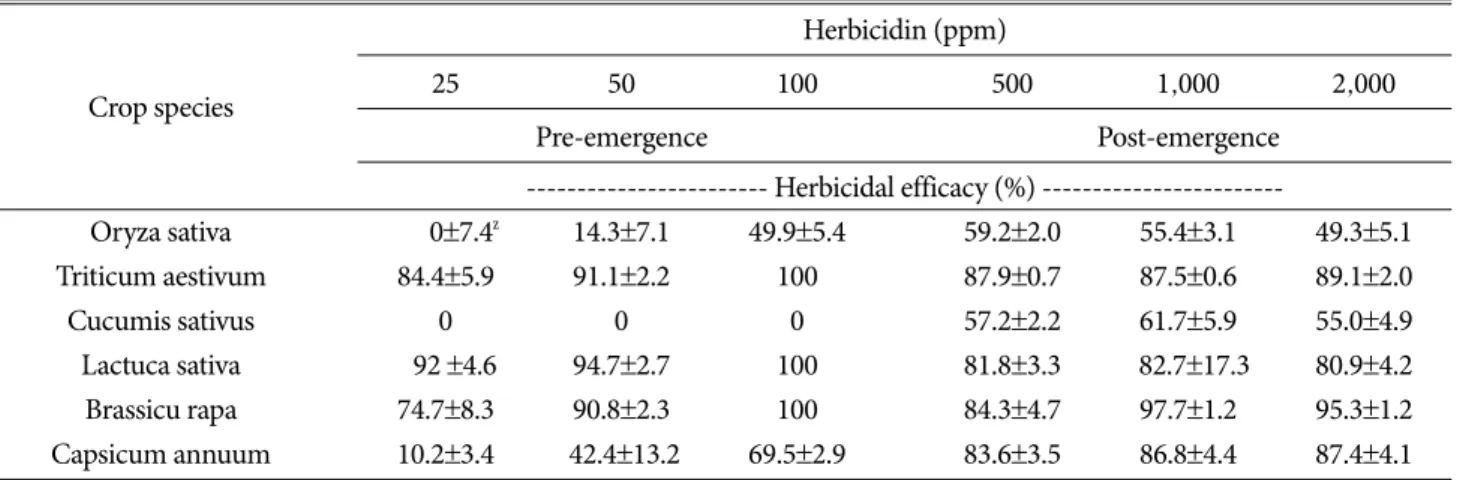
작물에 대한 발아억제 및 생육저해효과에 대한 herbicidin 의 약해시험 결과는 다음과 같다. 100 ppm 농도 처리시 밀, 상추, 배추는 100%의 발아억제를 보였으며, 벼와 고추는 각각 49.9%와 69.5%의 발아억제를 나타냈다. 반면 오이는
발아억제를 나타내지 않았는데, 이는 두꺼운 종피로 인하 여 herbicidin의 흡수가 원활히 이루어지지 않았기 때문이 라 여겨진다. 한편 25 ppm에서 벼, 오이, 고추는 0-10% 수 준의 발아억제를 보였으며, 나머지 작물들은 70-90% 정도 의 발아억제를 나타냈다. 생육에 대한 약해 시험은 2,000 ppm 에서 벼와 오이가 각각 49.3%와 55.0%의 생육저해를 보였 으며, 이외의 작물은 모두 80% 이상의 생육저해를 나타냈 다. 또한 500 ppm의 농도에서도 모든 작물에 대하여 동일 한 정도의 저해효과를 보였다(Table 2). 한편 벼와 오이에 서는 50% 내외로 잡초종들에 비해 낮은 생육저해를 나타 냈지만 실질적인 선택성을 나타내기에는 불충분한 결과를 보였다. 이는 경엽처리 결과 고추와 토마토는 심한 약해를 보이지만 벼는 비교적 저해가 덜하다는 결과와도 일치하 였다(Arai et al., 1976; Lee et al., 2013).
잡초종별 농도반응
패트리디쉬에서의 발아억제효과
Herbicidin의 잡초별 발아 억제 농도를 조사한 결과 피, 바랭이, 어저귀의 경우 7.8 ppm, 털비름의 경우 3.9 ppm까 지 100%의 발아억제를 보였다. GR50값은 단자엽식물인 피 와 바랭이에서 2 ppm 정도로 나타났으며, 쌍자엽식물인 털 Table 2. Effect of pre-emergence and post-emergence applications of herbicidin on several crop species.
Crop species
Herbicidin (ppm)
25 50 100 500 1,000 2,000
Pre-emergence Post-emergence
--- Herbicidal efficacy (%) ---
Oryza sativa 0±7.4z 14.3±7.1 49.9±5.4 59.2±2.0 55.4±3.1 49.3±5.1 Triticum aestivum 84.4±5.9 91.1±2.2 100 87.9±0.7 87.5±0.6 89.1±2.0
Cucumis sativus 0 0 0 57.2±2.2 61.7±5.9 55.0±4.9
Lactuca sativa 92±4.6 94.7±2.7 100 81.8±3.3 82.7±17.3 80.9±4.2 Brassicu rapa 74.7±8.3 90.8±2.3 100 84.3±4.7 97.7±1.2 95.3±1.2 Capsicum annuum 10.2±3.4 42.4±13.2 69.5±2.9 83.6±3.5 86.8±4.4 87.4±4.1
zMean± Standard error.
Table 3. Effect of herbicid with different concentrations on emergence of weeds in greenhouse.
Weed species
Herbicid (ppm)
31 63 125 250 500 1,000 2,000
--- Herbicidal efficacy (%) ---
Echinochloa oryzoides 9.2±6.7z 25.8±9.9 33.8±14.9 28.5±4.3 23.5±9.6 30.4±5.0 28.5±14.5 Digitaria ciliaris 6.1±15.3 06.2±13.9 16.3±6.9 22.4±8.9 26.1±3.4 22.5±12.7 40.6±3.3 Abutilon theophrasti 4.1±9.8 09.2±13.1 55.4±4.3 50.4±7.4 61.0±8.6 58.5±4.6 55.3±5.1 Amaranthus retroflexus 0.1±6.4 06.1±15.3 27.3±16.2 23.0±5.3 58.6±5.7 85.6±7.6 85.6±8.5
zMean± Standard error.
비름과 어저귀의 경우 1 ppm 정도였다. 발아억제 효과는 모든 잡초 초종에서 매우 민감한 반응을 보였고, 쌍떡잎식 물이 보다 더 민감한 발아억제 반응을 나타냈다(Fig. 1).
토양처리에 의한 발아억제효과
Herbicidin의 토양처리에 따른 잡초의 발아 및 생육저해 효과는 외떡잎식물인 바랭이와 피의 경우 2,000 ppm 처리 에서 각각 40%와 28% 이하의 생육저해를 보였으나 그 이 하의 농도에서는 외견상 저해를 보이지 않았다. 반면 쌍떡 잎식물 중 어저귀는 2,000 ppm부터 125 ppm까지 50-60%
사이의 생육저해를 보였고, 털비름은 1,000 ppm까지 85%
내외의 저해를 보이고 500 ppm에서도 58.6%의 저해를 나타 냈다. 이는 토양에 S. scopuliridis의 에틸아세트 분획물을 2,000 ppm의 농도로 처리시 95-100%의 저해를 보였다는 결 과와 다른 양상을 나타냈다(Lee et al., 2013). 한편 본 실험 에서 토양처리시 쌍떡잎식물에서 보다 우수한 생육저해 효 과를 보였으나 모든 잡초 초종에서 완전한 고사가 나타나 지 않고 추후 생육이 회복되어 토양 처리를 통한 적용은 적합하지 않은 것으로 여겨진다.
경엽처리에 의한 살초효과
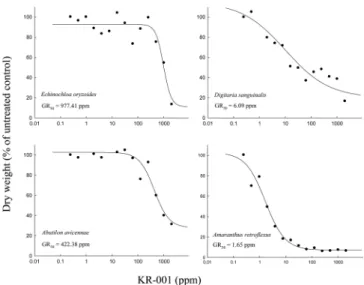
Herbicidin의 경엽 처리 후 1일 이내에 모든 잡초에서 잎 의 끝부분이 꼬이거나 말리는 현상이 관찰되었으며, 어저 귀는 엽에 황변된 반점이 발생하였다. 약제처리 2주 후에 피는 최고농도인 2,000 ppm에서도 완전히 고사하지 않았 으며, 1,000 ppm에서도 역시 경미한 생육저해 현상만을 보 였다. 바랭이와 어저귀는 2,000 ppm에서 고사하였으며, 500 ppm까지도 생육저해를 나타냈다. 털비름은 가장 민감 한 반응을 보여 62.5 ppm에서도 고사하였으며 1 ppm에서
도 육안상 저해되는 모습이 관찰되었다. 이는 S. scopuliridis 의 에틸아세테이트 분획물을 2,000 ppm의 처리시 95-100%
의 생육저해를 보인 결과와 유사하였으며, 1,000 ppm에서 는 완전 방제가 되지 않았다는 내용과도 일치하였다(Lee et al., 2013). 본 실험의 결과를 종합하면 herbicidin을 2,000 ppm 의 농도로 경엽처리 할 경우 많은 종의 잡초를 방제할 수 있을 것으로 보이며 피의 경우도 그보다 높은 농도로 처리 를 하면 방제가 가능할 것으로 사료된다(Fig. 2).
요 약
본 연구를 통해 토양 방선균 유래 제초활성물질을 대상 으로 제초제로서의 적용 가능성 여부를 확인하기 위하여 수행되었다. 잡초에 대한 발아와 경엽처리에 대한 약효시 험 결과, 종자 발아는 100 ppm 수준으로 처리하고 경엽에 는 2,000 ppm 수준으로 처리해야 저해효과를 나타냈다. 작 물에 대한 시험 결과, 오이는 발아억제가 이루어지지 않았 으며 벼는 발아와 생육 모두 50% 내외의 저해를 보였다.
그 외의 모든 시험 작물 초종은 처리 농도에 따른 민감한 반응을 보였다. 즉 토양방선균으로부터 발굴한 천연제초활 성물질은 선택성 제초제로의 개발은 어려워 보이나 비선 택성 제초제로의 개발은 가능할 것으로 보인다. 한편 처리 방법에 따른 농도별 시험 결과, 패트리디쉬에서 실험의 경 우 모든 잡초종이 농도에 민감히 반응하였으며, GR50값은 1-2 ppm 정도를 보였다. 그리고 토양처리 효과에 따른 발 아억제 및 생육저해 효과는 쌍떡잎식물에서 보다 민감한 반응을 보였고, 털비름의 경우 1,000 ppm에서도 85%의 생 육저해를 보였다. 경엽처리에 따른 생육저해 조사시 2,000 ppm 에서 피는 고사하지 않았으나 나머지 초종은 모두 고사하 Fig. 1. Effect of herbicidin at various concentration on
germination of weeds in a growth chamber.
Fig. 2. Effect of various concentrations of herbicidin post application on four weed species.
였고, 특히 털비름은 6.25 ppm의 농도에서도 고사하였다.
경엽처리에 따른 대표적인 반응으로 바랭이는 잎의 꼬임 현상을 나타냈고, 어저귀는 잎이 변색되었다. 토양처리는 그 효과가 경미하고 일정기간 경과후에 재생되어 방제효 과가 부족하였으며, 경엽처리의 경우 피를 제외한 잡초종 등이 2,000 ppm에서 방제가 가능할 것으로 보인다. 또한 모 든 결과를 종합 할 때 화본과잡초 보다 광엽잡초에서 민감 한 발아억제 및 생육저해 효과를 볼 수 있었다. 따라서 토 양 방선균 유래 제초활성 후보물질은 비선택성 경엽처리 제로서의 개발이 상대적으로 유망할것으로 판단되었다. 한 편 화본과 잡초에 대한 저해 효과가 부족함으로 추후 다른 제제와 혼합함으로써 화본과 잡초도 동시에 방제할 수 있 는 기술의 개발이 필요할 것이다.
주요어: Herbicidin, Streptomyces scopuliridis, 발아, 잡초방제
Acknowledgement
We would like to acknowledge the financial support from the R&D Convergence Program of NST (National Research Council of Science & Technology) of Republic of Korea.
References
Arai, M., Haneishi, T., Kitahara, N., Enikita, R. and Kawakubo, K.
1976. Herbicidins A and B, two new antibiotics with herbicidal activity. I. Producing organism and biological activities. J.
antibiot. 29(9):863-869.
Ebert, E., Leist, K.H. and Mayer, D. 1990. Summary of safety evaluation toxicity studies of glufosinate ammonium. Food Chem Toxicol. 28(5):339-49.
Fushimi, S., Nishikawa, S., Mito, N., Ikemoto, M., Sasaki, M., et al.
1989. Studies on a new herbicidal antibiotic, homoalanosine. J.
Antibiot. 42(9):1370-1378.
Iwai, Y. and Takahashi, T. 1992. Seletion of microbial sources of bioactive compounds. Springer, pp. 281-302. In: Omura, S. (Ed.).
The Search for Bioactive Compounds from Microorganisms.
Spring-Verlag New York, USA.
Joseph, B., Sankarganesh, P., Edwin, B.T. and Raj, S.J. 2012.
Endophytic streptomycetes from plants with novel green chemistry. Int. J. Biol. Chem. 6(2):42-52.
Kim, J.C. 2009. Research and development trends of the biological pesticide. Bioin-Special Zine. 10:1-20. (In Korean)
Kim, W.G., Kim, J.P., Kim, C.J. and You, I.D. 1996. A herbicidal nucleoside compound isolated from Streptomyces tubercidicus ME-9189. Kor. J. Appl. Microbiol. Biotechnol. 24(1):82-86. (In Korean)
Lee, B.Y., Kim, J.D., Kim, Y.S., Ko, Y.K., Yon, G.H., et al. 2013.
Identification of Streptomyces scopuliridis KR-001 and its herbicidal characteristics. Weed Turf. Sci. 2(1):38-46. (In Korean)
Lee, H.B., Kim, C.J., Kim, J.S., Hong, K.S. and Cho, K.Y. 2003. A bleaching herbicidal activity of methoxyhygromycin (MHM) produced by an actinomycete strain Streptomyces sp. 8E-12.
Lett. Appl. Microbiol. 36(6):387-91.
Nakajimam, M., Kazuko, I., Takamatsu, Y., Kinoshita, T., Okazaki, T., et al. 1991. Hydantocidin: a new compound with herbicidal activity from Streptomyces hygroscopicus. J. Antibiot.
44(3):293-300.
Omura, S., Murata, M., Hanaki, H., Hinotozawa, K., Oiwa, R., et al.
1984. Phosalacine, a new herbicidal abtibiotic containing phosphinothricin. fermentation, isolation. biological activity and mechanism of action. J. Antibiot. 37(8):829-835.
Schatz, A., Bugie, E. and Waksman, S.A. 1944. Streptomycin, a subastance exhibiting antibiotic activity against gram positive and gram negative bacteria. Exp. Biol. Med. 55:66-69.
Seefeldt, S.S., Jensen, J.E. and Feurst, E.P. 1995. Log-logistic analysis of herbicide dose-response relationships. Weed Tech. 9:218-227.
Sekizawa, Y. and Takematsu, T. 1982. How to discover new antibiotics for herbicidal use. pp 261-268. In: Miyamoto, J. and Kearney, P.C. (Eds.). Natural products: Proceedings of the 5th International Congress of pesticide chemistry. Pergamon press, Kyoto, Japan.
Tachibana, K. and Kaneko, K. 1986. Development of a new herbicide, bialaphos. J. of pestic Sci. 11(2):297-304. (In Japanese) Umezawa, H. 1982. Genetics, biosyntheses, actions & new substances: Proceedings, an International Conference on Trends in Antibiotic Research. Japan Antibiotics Research Association.
Tokyo, Japan.