366
and Safety
Available online at http://www.foodhygiene.or.kr
http://dx.doi.org/10.13103/JFHS.2015.30.4. 366
다종 농약 다성분 분석법을 이용한 농산물 중 hexaconzole 분석
최수정*·황인숙·조태희·이재인·이인숙·육동현·박원희·김무상·김건희1 서울시보건환경연구원 강남농수산물검사소, 1덕성여자대학교 식품영양학과
Analysis of Hexaconazole in Agricultural Products using Multi Class Pesticide Multiresidue Method
Su Jeong Choi*, In Sook Hwang, Tae Hee Cho, Jae In Lee, In Sook Lee, Dong Hyun Yook, Won Hee Park, Moo Sang Kim, and Gun Hee Kim1
Gangnam Agro-marine Products Inspection Center,
Seoul Metropolitan Government Research Institute of Public Health and Environment
1
Department of Food and Nutrition, Duksung Women's University (Received April 20, 2015/Revised June 20, 2015/Accepted October 8, 2015)
ABSTRACT - This work was conducted to apply the multi class pesticide multiresidue method for determining the use of hexaconazole in the agricultural products using GC-NPD. The multi class pesticide multiresidue method results were validated for the assay of hexaconazole by using linearity, accuracy, precision, limit of detection and quan- titation. The linearity in the concentration ranged from 0.025 to 5.0 mg/L (R
2> 0.999). Lettuce recoveries ranged from 89.42% to 94.15% with relative standard deviations below 7.78%, for spiking levels from 0.04 to 4.0 mg/kg. The limit of detection was 0.04 mg/kg, and the limit of quantitation was 0.11 mg/kg. The intra- and inter-day precisions were 2.42~3.49% and 4.90~7.78%, respectively. We suggested that the multi class pesticide multiresidue method for determin- ing hexaconazole was highly accurate and reproducible, and it will be used as a routine analysis in agricultural products.
Key words : Hexaconazole, GC-NPD, Agricultural products
Hexaconzole[(RS)-2-(2,4-dichlorophenyl)-1-(1H-1,2,4- triazol-1-yl)hexan-2-ol] 은 다양한 작물에 곰팡이 병원균을 제어하기 위해 널리 이용되고 있는 1,2,4-triazole기를 가지 고 침투성 살균제이다
1). Triazole 계 농약은 ergosterol bio- synthesis inhibitor (EBI) 계 농약의 한 종류로 침투 이행성, 내우성 농약으로 예방 및 치료효과가 좋아 사용량이 많 다
2). EBI 계 농약은 isoprenoid 생합성 경로에 관여하여 병 원성 미생물의 세포막 ergosterol 생합성을 저해하여 병원 균 증식을 저해한다
3). Triazole 계 잔류농약 분석에 흔히 이 용되는 방법은 ECD (electron capture detector)
4,5)나 NPD (nitrogen phosphorous detector)
6,7)를 이용한 GC 분석과 SIM (selective ion monitoring) 이나 Full scan mode에서의 GC-MS
8,9)분석법이 가장 많이 사용되고 있다.
잔류농약 분석법은 그 분석목적과 1회 검사 당 가능한 농약성분 수에 따라 다성분 분석법(multiresidue analytical method) 과 개별 분석법(individual analytical method)으로 나뉜다. 개별 분석법은 농약의 등록 및 규제를 위해 주로 사용되며 분석의 신뢰성이 요구될 때 이용된다. 농약의 등 록을 위한 분석은 재배중인 작물에 농약을 살포·채취 분 석하여 해당 작물의 농약 잔류 정도를 파악하기 위해 농 약에 가장 적합한 분석방법을 선정하여 분석하게 되므로 분석 감도와 정밀성이 높고, 신뢰도가 보장된다. 다성분 분석법은 주로 잔류농약 모니터링 목적에 적합한 방법으 로 분석 1회 검사 당 수십 가지 이상의 농약성분을 동시 에 분석할 수 있어 분석효율이 매우 높으나 농약 성분마 다 최적의 분석방법을 적용하는 것이 불가능하며 각각의 성분에 대한 정밀도나 신뢰성이 낮은 단점이 있다
10).
식품공전에서 대부분의 triazole계 농약은 GC-NPD를 이 용한 다종 농약 다성분 분석법 제2법을 적용하고 있는데, hexaconzole 은 구조적 유사성에도 불구하고 다성분 분석 법을 사용한다. 다성분 분석법은 고전적인 glass column 정제방법을 사용하여 장시간이 요구되며, 유기용매가 많
*Correspondence to: Su Jeong Choi, Gangnam Agro-marine Pro- ducts Inspection Center, Seoul Metropolitan Government Re- search Institute of Public Health and Environment, Seoul 05699, Korea
Tel: 82-2-3401-6291, Fax: 82-2-3401-6742
E-mail: [email protected]
이 사용되어 경제적이지 못한 단점이 있다. 그에 비해 다 종 농약 다성분 분석법 제2법은 cartridge column을 사용 하여 정제함으로서 짧은 시간 내에 적은 용매로 효율적인 분석이 가능하다.
따라서 본 연구는 대표 농산물에서의 hexaconazole 잔 류량 분석을 위한 다종 농약 다성분 분석법 제 2법 적용 연구를 통해 신속·정확한 시험법을 적용하여, 빠른 사후 처리로 소비자에게 안전한 농산물을 공급하고자 한다.
Materials and Methods
재료
시료는 식품의약품안전처 식품원재료 분류표에 따른 대 표 농산물(상추, 쌀, 배추, 사과, 고추, 감귤)을 서울 대형 마트(2014년 1월~3월)에서 구입하여 사용하였으며, 즉시 잔류농약분석용 식품 전처리 방법
11)에 의하여 전체를 분 쇄기(Blixer 5A Plus, Robot Coupe, USA)로 분쇄하여 폴 리에틸렌 비닐팩에 밀봉 포장하여 냉장(−4
oC) 보관하면서 실험에 사용하였다.
시약 및 장비
표준품 hexaconazole (99.0%)은 Dr. Ehrenstorfer GmbH 사(Augsburg, Germany)에서 구입한 것을 사용하였다. 추
출 및 분석에 사용되는 acetonotrile (J.T.Baker, USA), acetone (Kanto, Japan), hexane (Kanto, Japan), ethyl acetate (Kanto, Japan) 는 잔류농약 분석용을 사용하였고, sodium sulfate anhydrous (Wako, Japan) 은 모두 특급이상의 것을 사용하였고, 정제용 florisil cartridge는 Agilent Technologis (USA) 를 사용하였다.
시료를 여과하기 위해 여과용 필터 5A, 1PS, 0.2 μm nylon syringe filter 는 Whatman사(Brentford, UK) 제품을 사용하였으며, 추출에 사용된 균질기는 Omni Macro ES (Omni international, USA) 이고, 용매를 제거할 때 사용한 감압 농축기는 EYELA NVC-2100 (Eyela Co., Japan)였다.
표준용액의 조제
Hexaconazole 표준품은 acetone에 녹여 100 mg/L로 만 들어 −20
oC 에서 냉동 보관하면서 표준원액으로 사용하였 으며, 분석 시 20% acetone 함유 hexane으로 희석하여 0.025, 0.01, 0.25, 0.5, 1.0, 2.5, 5.0 mg/L 가 되도록 표준용 액을 만들어 검량선을 작성하였다.
기기분석
식품 중 hexaconazole을 분석하기 위하여 GC-NPD (GC- 7890, Agilent, USA) 이용하였고, 칼럼으로는 DB-17 (15 m × 0.32 mm I.d, 0.25 μm film thickness, Agilent, USA)를 사
Table 1. The operation parameters of the GC-NPD for analysis of hexaconazole
Instrument Parameter Conditions
GC
Column DB-1701 (30 m × 0.32 mm I.d, 0.25 μm film thickness)
Temperature
Injector: 210
oC
Oven: 100
oC (2 min) → 10
oC /min → 200
oC (3 min) → 10
oC /min → 260
oC (9 min) Detector: 320
oC
Carrier gas 1.5 mL/min (N
2) Injection volume 1 μL
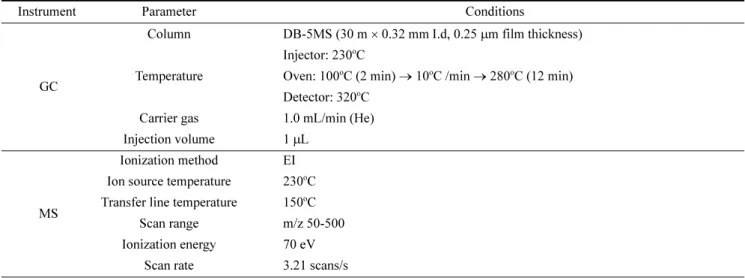
Table 2. The operation parameters of the GC-MS for analysis of hexaconazole
Instrument Parameter Conditions
GC
Column DB-5MS (30 m × 0.32 mm I.d, 0.25 μm film thickness)
Temperature
Injector: 230
oC
Oven: 100
oC (2 min) → 10
oC /min → 280
oC (12 min) Detector: 320
oC
Carrier gas 1.0 mL/min (He) Injection volume 1 μL
MS
Ionization method EI Ion source temperature 230
oC Transfer line temperature 150
oC
Scan range m/z 50-500
Ionization energy 70 eV
Scan rate 3.21 scans/s
용하였다. 검출된 hexaconazole을 확인하기 위하여 GC- MSD (GC-7890, Agilent, USA) 와 DB-5MS (30 m ×0.32 mm I.d, 0.25 μm film thickness, Agilent, USA)를 사용하 였다. 분석조건은 각각 Table 1과 2에 나타냈다.
추출 및 정제
다성분 분석법을 이용한 hexaconazole 분석
시료의 전처리 과정은 식품공전 중 잔류농약분석법 다 성분 분석법
12)을 적용하였다. 분쇄기를 이용해 분쇄한 균 질화된 시료 50 g을 취해 acetone 100 mL를 넣은 후 균질 기로 2분간 균질화한다. 5A 여지를 이용해 부흐너깔때기 로 감압여과하고, 잔류물은 acetone 40 mL로 씻어 위의 여 액과 합한다. 합친 여액을 미리 dichloromethane 50 mL와 포화식염수 50 mL 및 증류수 450 mL를 넣은 1 L 분액깔 때기로 옮긴 후 심하게 흔들어 섞은 후 정치하여 dichloro- methane 층을 취한다. 다시 물층에 dichloromethane 50 mL 를 넣고 위와 같이 2회 반복하여 앞의 dichloromethane층 을 합하고 무수황산나트륨으로 탈수, 여과하고, 40
oC 에서 감압 농축하고 잔사를 dichloromethane 10 mL로 녹인다.
안지름 1.5 cm, 길이 40 cm의 칼럼관에 Flolisil 10 g, 무수 황산나트륨 약 2 g을 차례로 충전한 후 dichloromethane 50 mL 를 가하여 상단에 소량의 dichloromethane이 남을 정 도로 유출시켜 버린다. 여기에 위의 농축액(dichloromethane 용액) 10 mL를 가한 후 약 3 mL/분의 유속으로 흘려 버린 다. 충전제 표면이 노출되기 직전 dichloromethane 100 mL 를 가하여 유출시켜 버리고, etheyl acetate/dichloromethane 혼합액(30/70, v/v) 100 mL로 용출시켜 받은 후 40
oC 이하 의 수욕 중에서 감압하여 건조시키고 acetone 5 mL로 용 해하여 시험용액으로 한다.
다종농약 다성분 분석법을 이용한 hexaconazole 분석 시료의 전처리 과정은 식품공전 중 잔류농약분석법 다 종농약 다성분 분석법 제 2법
13)을 적용하였다. 시료는 분 쇄기를 이용해 분쇄한 균질화된 시료 50 g을 취해(쌀은 물 30 mL 를 넣어 2시간 방치) acetonitrile 100 mL을 넣은 후 Omni Macro Homogenizer 로 3분간 균질화하여, 5A 여지 를 이용해서 부흐너 깔대기로 감압 여과한다. 여액을 NaCl 10-15 g 이 들어있는 분액 깔대기에 넣고 3분간 세게 흔든 뒤 이를 정치하여 acetonitrile층과 물층을 분리시킨 후 상 등액인 acetonitrile층을 10 mL 취해 40
oC 의 수욕상에서 건 조하였다. 미리 florisil cartridge를 20% acetone 함유 hexane 5 mL 로 활성화시킨 후 건조한 시료에 20% acetone 함유 hexane 4 mL 를 넣어 활성화된 cartridge에 용출시켜 시험 관에 받고 다시 20% acetone 함유 hexane 5 mL로 재용해 하여 동일 시험관에 모았다. 이 용출된 액을 40
oC 의 항온 수조에서 증발시키고 20% acetone 함유 hexane 2 mL을
넣어 용해한 후 시험용액으로 하였다.
다종농약 다성분 분석법 유효성 검증
다종농약 다성분 분석법의 유효성은 직선성, 정확성, 정 밀성, 검출한계 및 정량한계로 검증을 하였다. 직선성은 표준용액을 0.025, 0.1, 0.25, 0.5, 1.0, 2.5, 5.0 mg/L 농도 가 되도록 20% acetone 함유 hexane으로 희석한 후 GC- NPD 에 주입하여 얻어진 피크면적으로부터 검량선을 작성 하였다. 정확성과 정밀성은 농약이 검출되지 않은 시료에 최종농도가 검출한계, 검출한계 10배, 검출한계의 100배 농도인 0.04, 0.4, 4.0 mg/kg으로 농약을 첨가한 후 회수율 과 상대표준편차로 측정하였다. 일내 정밀성을 측정하기 위해 위와 같은 농도를 3번 반복하였고, 일간 정밀성은 3 일간 반복해서 상대표준편차로 측정하였다. 검출한계와 정 량한계는 농약이 검출되지 않은 상추에 검출한계와 정량 한계의 농도를 추정한 후, 추정한 검출한계의 1에서 5배 사이의 농도를 첨가하여 전처리 후 검량선에서 농도를 측 정하였다. 측정한 값으로부터 표준편차(s)를 구하고, 검량 선에서 얻은 기울기(m)을 바탕으로 검출한계는 3.3 s/m, 정 량한계는 10 s/m으로 계산하였으며, 실험은 3회 반복하여 평균값을 구하였다.
통계처리
두 분석법간의 차이점은 통계학적인 분석 SPSS statistical package (12.0, SPSS Inc., Chicago, IL, USA) 를 이용하여 대응표본 t검정(paired t-test)을 실시하였다. 유의성 검정은 p 값이 0.05이하인 경우 유의성이 있는 것으로 판정하였다.
Results and Discussion
Hexaconazole 분석조건 확인
Hexaconazole 은 물리화학적 특성은 Table 3과 같다. 분 자량 341.2, 증기압 0.018 mPa (20
oC), 옥탄올/물 분배계 수(Log P
ow) 3.9, 물에 대한 용해도는 20
oC 에서 17 g/L인 중간비극성인 화합물로 분자구조 내에 2개 이상의 질소를 포함하고 있어 GC-NPD를 사용하였고, hexaconazole의 분 석조건을 최적화하기 위해서 phenylsiloxane이 50% 함유 된 DB-17컬럼을 이용하여 오븐온도 조건별로 비교한 후 오븐 온도를 선정하였다.
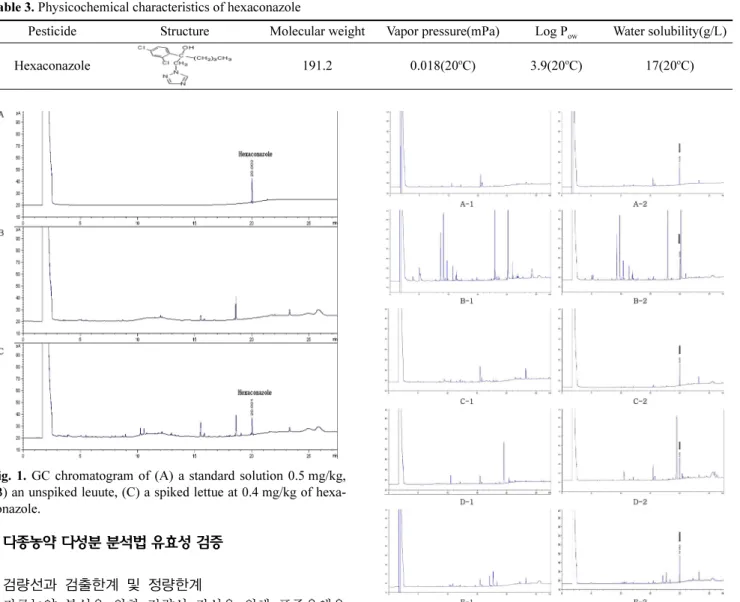
확립된 분석조건에서 얻은 표준물질의 크로마토그램, 표
준 용액을 첨가한 시료의 크로마토그램을 비교하여 hexa-
conazole 피크가 분리되는 지를 확인한 결과 다른 물질과
간섭 없이 분리되었다(Fig. 1). 표준용액의 머무름 시간은
20.004 분이고 상추의 머무름 시간은 20.001분으로 표준용
액의 피크 유지시간과 상추 추출액의 피크 유지시간이 일
치하였다.
다종농약 다성분 분석법 유효성 검증 검량선과 검출한계 및 정량한계
잔류농약 분석을 위한 검량선 작성을 위해 표준용액을 조제한 후 GC-NPD로 분석한 결과 Table 4와 같이 hexa- conazole 의 상관계수(R
2) 는 0.999이상의 우수한 직선성을 나타냈다. 시험법의 검출한계는 0.04 mg/kg, 정량한계는 0.11 mg/kg 였다(Table 4.). 다종농약 다성분 분석법의 희석배 수가 0.4이므로, 시료에서 이를 환산하면 이는 국제식품규 격위원회(Codex)
14)및 국내
15)에서 권장하는 기준인 0.05 mg/
kg 이하의 정량한계에도 적합하였다.
선택성
Hexaconazole 의 선택성은 상추, 쌀, 배추, 사과, 고추, 감 귤 무처리 시료의 크로마토그램과 6가지 시료에 표준 용 액을 첨가하여 실험한 크로마토그램을 서로 비교함으로써
평가하였다. Fig. 1~2와 같이 대표 시료 중 hexaconazole 과 같은 머무름 시간을 갖는 어떤 방해물질도 검출되지 않고 선택적으로 분리되었다.
정확성과 정밀성
회수율에 따른 정확성과 정밀성을 살펴본 결과는 Table 5 와 같다. 상추 시료에 첨가한 표준품의 회수율은 89% 이 상이었으며, 일내 정밀성의 상대표준편차(RSD)는 2.42- 3.49% 범위를 나타냈고, 동일한 농도에서 동일 실험방법 Table 3. Physicochemical characteristics of hexaconazole
Pesticide Structure Molecular weight Vapor pressure(mPa) Log P
owWater solubility(g/L)
Hexaconazole 191.2 0.018(20
oC) 3.9(20
oC) 17(20
oC)
Fig. 1. GC chromatogram of (A) a standard solution 0.5 mg/kg, (B) an unspiked leuute, (C) a spiked lettue at 0.4 mg/kg of hexa- conazole.
Table 4. Linear equations, correlation coefficients, LODs and LOQs of hexaconazole
1)Pesticide Linear equation Correlation coefficient (R
2) LOD
2)(mg/kg) LOQ
2)(mg/kg)
Hexaconazole y = 80.58012x − 0.942331 0.9994 0.04 0.11
1)
Instrument linearity range: 0.025~5.0 mg/L
2)
Mean value from 3 measurements
Fig. 2. GC chromatogram corresponding to rice (A), korean cab-
bage (B), apple (C), pepper (D), mandarin (E), control (1), spiked
at 2.0 mg/kg (2).
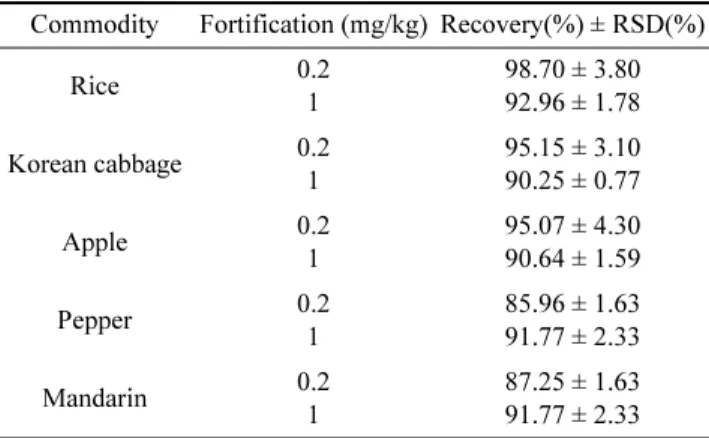
으로 3일 반복 시험한 일간 정밀성의 상대표준편차는 4.90- 7.78% 의 농도 범위를 나타내어(Table 6), 0.04-4.0 mg/kg에 서는 정밀성은 모두 상대표준편차 8% 이하의 결과를 보 였다. Table 7은 다양한 시료에서의 회수율을 나타낸 결과 로, 0.2, 1.0 mg/kg 농도로 첨가된 시료의 회수율은 모두 86% 이상의 회수율을 보였으며, 전체적인 상대표준편차는 4.3% 이하로 나타났다. 각국 및 국제기구 등에서 연구수행 에 활용된 분석방법에 대한 적합성은 회수율과 상대표준 편차 등의 범위를 이용하여 판단하고 있는데, 국내는 회 수율 70~120% 및 상대표준편차 20%이하
15), 유럽연합에서 제시한 회수율은 70~120%와 상대표준편차 20%이하
15), 국 제식품규격위원회는 회수율 60~120%와 상대표준편차 15~30% 이하 규정하고 있는데
14), 다종농약 다성분 분석법 으로 제시한 회수율은 최소 86%이상과 정밀성 7.78%이 하의 변이계수를 나타내어 국내 및 국제적 기준을 만족하 였다.
다성분 분석법과 다종농약 다성분 분석법 비교
두 방법 간 비교실험은 회수율로 하였고, 농약이 검출 되지 않은 상추에 0.04, 0.4, 4.0 mg/kg가 되도록 농약을 첨가하여 분석하였다. 농약의 각 첨가농도에 따른 단성분 의 회수율은 82.62~93.22%, 상대표준편차는 0.82~3.40%였 고, 다성분 분석법의 회수율은 89.42~93.78%, 상대표준편 차는 2.42~3.49%였다(Table 4). 두 분석법의 회수율 최소 82% 이상과 정밀성 3.5%이하의 변이계수를 나타내어 국내 및 국제적 기준을 만족하였고, 대응표본 t검정(paired t-test) 을 이용하여 검증한 결과, 0.04, 0.4 mg/kg 농도에서 p-value 0.856, 0.063 으로 두 분석법 간의 유의적인 차이는 없었고, 고농도인 4.0 mg/kg에서는 다성분 분석법의 회수율이 낮 았으며, p-value 0.032로 두 방법 간의 유의적인 차이가 있 었다. 이 결과들을 통해 다종농약 다성분 분석법은 기존 의 다성분 분석법을 이용한 결과와 비슷한 추출 효율을 보였다고 판단된다.
Table 5. Comparison of intra-day (n = 3) accuracy and precision of hexaconazole between multiresidue method and multi class pesti- cide multiresidue method in lettuce
Fortification (mg/kg)
Recovery(%) ± RSD(%)
p-value Multiresidue
method
Multi class pesticide multiresidue method 0.04 93.22 ± 1.80 93.78 ± 3.49 0.856
0.4 87.22 ± 0.82 93.61 ± 2.42 0.063 4.0 82.62 ± 3.40 89.42 ± 2.58 0.032 Table 6. Inter-day (over a period of 3 consecutive days) accuracy and precision of multi class pesticide multiresidue method in let- tuce (n = 3)
Fortification (mg/kg) Inter-day (3days) Recovery(%) ± RSD(%)
0.04 94.15 ± 4.90
0.4 93.95 ± 4.93
4.0 90.03 ± 7.78
Table 7. Recovery and precision of hexaconazole of multi class pesticide multiresidue method in agricultural products (n = 3)
Commodity Fortification (mg/kg) Recovery(%) ± RSD(%)
Rice 0.2
1
98.70 ± 3.80 92.96 ± 1.78 Korean cabbage 0.2
1
95.15 ± 3.10 90.25 ± 0.77
Apple 0.2
1
95.07 ± 4.30 90.64 ± 1.59
Pepper 0.2
1
85.96 ± 1.63 91.77 ± 2.33
Mandarin 0.2
1
87.25 ± 1.63 91.77 ± 2.33
Table 8. Comparison of average residues of pesticide between individual residue method and multi class pesticide multiresidue method in leafy vegetables (n = 3)
Commodity
Mean ± SD(mg/kg)
p-value Multiresidue
method
Multi class pesticide multiresidue method Beat leaves 1.465 ± 0.053 1.547 ± 0.070 0.133 Mustard green 0.609 ± 0.013 0.621 ± 0.013 0.394
Fig. 3. Total ion chromatogram (TIC) in mustard green by GC-MS
under EI mode (A) and EI mass spectrum of hexaconazole (B).
두 전처리 방법간의 농약 잔류량 비교
실제 hexaconazole이 검출된 시료에서 다성분 분석법과 다종농약 다성분 분석법의 차이를 대응표준 t검정(paired t-test) 을 이용하여 검증한 결과, 농산물 중 잔류량은 Table 8 과 같다. 95% 신뢰수준(α = 0.05)에서 두 분석법 간의 농 약 잔류량을 비교한 결과 p-value는 비트잎 0.133, 겨자채 0.394 로 두 분석법간의 유의적인 차이는 없었다.
분석법의 재확인
다종농약 다성분 분석법으로 검출된 시료의 정성적 확 인을 위하여 GC/MS를 이용하였다. Hexaconazole이 검출 된 시료의 정성확인을 위해 GC-MS의 분자량 범위를 50~
500 m/z 로 scan mode에서 214 m/z, 83 m/z, 175 m/z을 확 인하였고, 위의 조건으로 분석한 결과 hexaconazole의 머 무름 시간은 17.02분이었다(Fig. 3). Hexaconazole 무처리 시료에서 대상 성분들의 peak가 관찰되지 않았으며, 인위 적으로 첨가 시료에서는 동일한 머무름 시간대에 정확하 게 hexaconazole을 확인할 수 있었다.
국문요약
농산물 중 hexaconazole 분석을 위해, GC-NPD를 이용 하여 다종농약 다성분 분석법을 적용하고자 본 연구를 수 행하였다. Hexaconazole의 다종농약 다성분 분석법 유효 성 검증은 직선성, 정확성, 정밀성, 검출한계 및 정량한계 로 하였다. 0.025~5.0 mg/L의 농도에서 검량선의 상관계수 (R
2) 는 0.999이상의 우수한 직선성을 보였다. 상추에 0.04~
4.0 mg/kg 을 첨가한 농약의 회수율은 89.42~94.15%였고, RSD 는 7.78%이하의 재현성을 나타냈다. 검출한계는 0.04 mg/kg 였고, 정량한계는 0.11 mg/kg였다. 일간 및 일내 정 밀도는 각각 2.42~3.49%와 4.90~7.78%였다.
본 연구결과에서 다종농약 다성분 분석법을 이용한 hexa- conazole 분석은 매우 정확하고, 높은 재현성을 보여, 농 산물 중 hexaconazole 분석에 적용할 수 있을 것으로 판 단된다.
References