http://dx.doi.org/10.7585/kjps.2014.18.4.269
Open Access
269
동시 다성분 분석법에 의한 농산물 중 Diflubenzuron 분석
박선희*·한창호·김애경·신재민·이재규·박영혜·김지민·황래홍·장민수 송미옥·박주성·윤은선·김무상·정 권
서울시보건환경연구원 강남농수산물검사소
Analysis of Diflubenzuron in Agricultural Commodities by Multiresidue Method
Sun-hee Park *, Chang-ho Han, Ae-kyung Kim, Jae-min Shin, Jae-kyoo Lee, Young-hae Park, Ji-min Kim, Lae-hong Hwang, Min-su Chang, Mi-ok Song, Ju-sung Park, Eun-sun Yun, Mu-sang Kim and Kweon Jung Gangnam Agro-Fishery Products Inspection Center, Seoul Metropolitan Government Research Institute of Public
Health and Environment, Seoul 138-701, Korea
(Received on August 21, 2014. Revised on August 27, 2014. Accepted on October 8, 2014)
Abstract The multiclass pesticide multiresidue method for the simultaneous determination of diflubenzuron in agricultural products was conducted by using HPLC-UVD. The method was validated through the guidelines of linearity, specificity, limit of detection (LOD), limit of quantification (LOQ), accuracy and precision with pesticide-free spinach, Korean cabbage, eggplant, squash, sweet pepper, cucumber, Korean melon. The calibration curve of diflubenzuron was linear over the concentration range of 0.05-5 mg/kg with correlation coefficient of above 0.99999. The limit of detection and quantification was 0.008 and 0.02 mg/kg. Mean recoveries of diflubenzuron for each sample were 77.5-105.6%. Relative standard deviation (RSD) in recoveries were all less than 20%. The intra-day and inter-day precision (RSD) were 0.4-1.9% and 0.7-1.9%, respectively. The result of validation indicated that this method was accurate and rapid assay.
Key words multiclass pesticide multiresidue method, agricultural products, diflubenzuron, HPLC
서 론
농약이라 함은 농작물을 해하는 균, 선충, 바이러스, 잡초 등의 방제에 사용되는 살균제, 살충제, 제초제, 기피제, 유인 제, 전착제 등과 농작물의 생리기능을 증진하거나 억제하는 데 사용되는 약제를 말한다(농약관리법). 농약의 대부분은 탄소, 수소, 산소, 질소, 인, 나트륨, 염소, 유황, 마그네슘 등 과 같은 원소로 구성된 유기합성물질로써 자체의 물리화학 적 특성에 따라 분해되는 것도 있지만 상당수가 농산물 및 토양에 잔류하게 된다. 농약은 이러한 잔류특성으로 인해 만성독성을 야기하는 것으로 알려져 있으며 토양, 식품 및 음료 등에서 검출되고 있다(Pyysalo, H.,1983; Woodwell,
G. M.,1967; Kanazawa, J., 1981; Edwards, C. A., 1971).
이에 잔류농약에 대한 관리 및 규제가 강화됨은 물론 식품 및 농산물 중 잔류농약수준을 검사, 평가하여 안전성 확보 를 위한 체계적이고 정밀한 잔류농약 분석방법이 요구되고 있다.
본 연구의 분석대상 농약인 diflubenzuron (1-(4-chloro- phenyl)-3-(2,6-difluorobenzoyl)urea)은 benzoylurea계 살충 제로 일본에서는 1981년부터 산림방제와 모기나 파리의 방 제에 이용되고 있다(K. Wellinga et al.,1973). 현재 국내에 서는 액상수화제인 에버린(한국삼공), 수화제인 디밀린(신젠 타), 초심(동방아그로), indoxacarb와의 합제인 수화제 특명 (한국삼공), imidacloprid와의 합제인 수화제 신속타(아리스 타), etofenprox와의 합제인 유현탁제 옥타브(농협케미컬), lambda-cyhalothrin과의 합제인 수화제 라이플(인바이오)등 이 판매되고 있다(Korea Crop Protection Association,
*Corresponding author
Tel: +82-2-2640-6601, Fax: +82-2-2640-6604 E-mail: [email protected]
ORIGINAL ARTICLES / RESIDUE
2014). 적용 대상으로 감귤, 사과, 배, 복숭아, 고추, 옥수수, 자두, 장미, 딸기, 배추, 오이, 수박, 파, 참외, 양송이, 느타 리버섯 등의 나방류 및 파리의 방제에 사용되고 있다.
세계 각국은 농산물 및 식품에 대한 잔류농약의 안전성을 평가하기 위하여 잔류허용기준(maximum residue limit, MRL) 을 설정하여 규제할 뿐만 아니라 자국 및 농산물 중 잔류농약을 분석하고 그 실태를 조사하고 있다. FDA의 잔 류농약 모니터링 프로그램은 해마다 자국 식품 뿐만 아니라 수입 식품과 사료 및 영·유아식품에 대해서 실시하고 있고 국내 및 수입 시료에 대한 잔류 농약 검출 빈도와 검출된 농약의 잔류 농도 범위를 조사하였다. 이 보고서에 따르면 2011 년 영유아식 10건에서 diflubenzuron이 검출되었고 그 범위는 0.0002~0.004 ppm이라 보고되어 있다.
EU 에서는 27개국의 회원국과 EFTA 2개국(Norway, Iceland) 에서 잔류 농약 모니터링을 수행하여 적합률 및 부 적합률을 보고하고 있다. 이에 따르면 diflubenzuron이 2011 년 과일, 견과류 14643건 중 59건, 채소류 14982건 중 21건 이 검출되었으며, 2010년 과일, 견과류 14076건 중 53건, 채소류 14314건 중 16건이 검출되었다. 그리고 2008년 과 일, 채소류 28461건 중 120건이 검출되었고 2007년 과일, 채소류 26997건에서 112건의 diflubenzuron이 검출되었다.
우리나라 국립 농산물 품질관리원의 최근 diflubenzuron 검출 현황과 안전성 조사 결과를 살펴보면 2009년 271건, 2010 년 157건, 2011년 201건, 2012년 195건이 채소류에서 검출되었다. 검출된 채소 품목을 살펴보면 부추, 열무, 고추, 시금치, 미나리, 양송이버섯, 깻잎 등 우리나라 국민들의 식 탁에 자주 올라오는 소비량이 많은 것들이다. 최근 소비자 들은 생활 수준의 향상과 더불어 식품의 선택기준이 가격, 품질뿐만 아니라, 안전성 및 위생성에 중점을 두고 있으며 특히, 이렇게 소비량이 많은 농산물의 경우 소비자들의 잔 류농약에 대한 불안감을 해소시키기 위해서 정확하고 신속 한 잔류농약 분석법이 요구되어 지고 있다.
Diflubenzuron 은 현재 식품공전에 diflubenzuron, triflu- muron, hexaflumuron 등 8종의 농약을 분석할 수 있는 다성 분 분석법(식품공전 일반시험법 4.1.3.28)으로 분석하도록 되어 있다. 그러나 실제 도매시장 경매 농산물을 포함한 유 통 농산물의 안전성 검사는 유통 및 소비가 빠르게 이루어 지는 농산물의 특성상 가장 많은 종류의 농약(280여종)을 신속히 검사할 수 있는 다종농약다성분 분석법(multiclass pesticide multiresidue methods) 제2법(식품공전 일반시험법 4.1.2.2) 이 주로 이용되며, 다른 다성분 분석법이나 단성분 분석법은 필요시에만 실시되는 경우가 많다. 따라서 본 연 구는 국내외에서 빈번히 검출되고 있는 diflubenzuron이 다 종농약다성분 분석법 제2법에 의해 분석 가능한지를 검증하 여 상시 검사대상에 추가함으로써 소비자들에게 신뢰하고 안심할 수 있는 농산물 공급에 기여하고자 하였다.
재료 및 방법
대표 농산물 선정
본 연구에서 사용한 농산물 시료는 diflubenzuron에 대한 잔류허용기준과 채소류 유형을 고려하여 시금치, 엇갈이배 추, 가지, 애호박, 청피망, 오이, 참외 등 총 7종을 선정하였 고, 각각의 분석시료는 서울 시중에 유통 중인 채소류를 수 거하여 그 중 잔류농약이 검출되지 않은 것을 사용하였다.
시약 및 기구
Diflubenzuron의 분자량은 310.7 (C
14H
9ClF
2N
2O
2) 이고 무 색 결정으로 녹는점이 210-230
oC 이다. 물에 대한 용해도는 25
oC, PH 7일 때 0.08 mg/L 수준을 나타내며 n-hexane 0.063 g/L, toluene 0.29 g/L, dichloromethane 1.8 g/L, methanol 1.1 g/L 의 용해도를 나타내어 물에는 잘 녹지 않으나 다양 한 유기용매에 잘 녹는다. Diflubenzuron의 화학적 구조식 은 Fig. 1과 같다.
Diflubenzuron 표준품은 Dr. Ehrenstorfer Gmbh (Augsburg, Germany) 에서 구입하였고, 추출 및 분석을 위한 유기용매 acetonitrile, methanol은 HPLC 등급으로 J. T. Baker (Phillipsburg, NJ, USA) 제품을 사용하였다. dichlorome- thane은 Kanto (Tokyo, Japan), sodium chloride는 Junsei Chemical Co. (Japan) 에서 구입하여 사용하였다. 증류수는 초순수 조제기(ELGA, 18.2 Mohm·cm, Buck, UK)로 만들 어 사용하였다. NH
2Cartridge 는 Agilent Technology (USA), shark skin filter 는 Whatman (Middlesex, UK), 0.45 µm nylon syringe filter는 Pall Life science (USA) 제품을 사용 하였다. 시료는 Blixer 5 Plus (Robot Coupe, Jackson, MS, USA) 를 이용하여 분쇄하였으며, Omni Macro Homogenizer 로 균질화하였다.
표준용액 조제
Diflubenzuron 표준품을 정밀히 달아 100 mL 용량플라스
크에 취하고 methanol로 표시선까지 채워 용해시켜 200
mg/kg 의 표준원액을 조제하고, methanol로 희석하여 10
mg/kg가 되게 한 후 이 용액을 다시 methanol을 이용하여
단계적으로 희석하여 0.05, 0.1, 0.3, 0.5, 1, 2, 5 mg/kg의 표
Fig. 1. Chemical structure of diflubenzuron.
준용액을 준비하였다. 표준원액과 표준용액은 모두 -20
oC 에 보관하며 실험에 사용하였다.
시료의 전처리
시료는 식품공전 중 다종농약다성분 분석법 제2법(Ministry of Food and Drug Safety, 2013) 과 Lee 등의 동시다성분 분 석법으로 실험하였다(Lee, Y. D., 2012). 시료는 분쇄기를 이용하여 분쇄한 시료 50 g을 취해 acetonitrile 100 mL를 넣은 후 Omni Macro Homogenizer로 3,800 rpm, 2분간 균 질화하여 shark skin filter를 이용하여 염화나트륨 10-15 g 이 있는 150 mL 분리병에 담고 마개(teflon-lined)를 막은 후 1분간 세게 흔들어 섞었다. 용매 추출액을 충분히 정치 하여 acetonitrile층과 물층으로 분리시켰다. 상층액(acetoni- trile 층) 10 mL를 취하여 40
oC 이하의 수욕상에서 건고하였 다. 미리 NH
2cartridge 에 1% methanol을 함유한 dichloro- methane 5 mL 를 초당 2-3방울 정도의 속도로 유출하여 버 려 활성화 시킨다. 건고한 시료에 1% methanol을 함유한 dichloromethane 2 mL 를 넣어 녹인 액을 cartridge상단에 넣 어 초당 1-2방울 정도의 속도로 용출시켜 시험관에 받는다.
다시 1% methanol 을 함유한 dichloromethane 5 mL로 재 용해하여 용매에 젖어있는 cartridge에 용출시켜 동일 시험 관에 모았다. 동일 시험관에 모은 용출액은 40
oC 이하의 항
온수조에서 낮은 유속으로 공기를 통과시키며 용매를 날려 보낸 후 acetonitrile에 녹여 2 mL로 한 후 nylon syringe filter 0.45 µm로 여과하여 시험용액으로 하였다.
분석기기 및 조건
Diflubenzuron 을 분석하기 위하여 기기는 자외부흡광광도 검출기(Ultraviolet Detector, UVD)가 장착된 HPLC system (1100 GPC system, Agilent Technology, USA)을 이용하였다.
HPLC-UVD 를 이용한 역상 액체 크로마토그래피에 의한 분석조건은 컬럼은 C
18(ZOBAX SB-C18, 5.0 µm, 4.6 × 150 mm, Agilent)을 사용하였으며, 이동상으로는 distilled water와 methanol을 사용하여 초기에 distilled water를 70%
의 조성으로 시작하여 20분에 acetonitrile을 100% 되도록 기울기 조건으로 하고 유속을 1 mL/min 하여 diflubenzuron 을 분리하였다. 자외부흡광광도검출기 측정파장은 254 nm 로 하였다. HPLC-UVD를 통해 분석한 diflubenzuron의 정 성적 신뢰성 확인을 위해 LC-MSD를 이용하였으며, 분석조 건은 Table 1과 같다.
직선성 및 특이성
직선성은 표준 검량선의 회귀방정식으로부터 얻은 상관계 수(Correlation coefficient, R
2) 값으로 확인하였다. 표준검량 Table 1. HPLC and MSD operating conditions for diflubenzuron
LC
Instrument HPLC 1100 GPC system (Agilent Technology, USA) Detector Ultraviolet Detector (UVD), 254 µm Column ZOBAX SB-C18 (5.0 µm, 4.6 × 150 mm, Agilent)
Mobile Phase
Time (min) Distilled water (%) Acetonitrile (%)
0 70 30
5 50 50
10 20 80
17 5 95
20 0 100
22 0 100
24 70 30
Flow rate 1 mL/min
Injection volume 10 µL
MSD
MS detection APCI
Drying gas flow 6.0 L/min
Drying gas temperature 350
oC
Nebulizer pressure 50 psig
Vaporizer temperature 325
oC
Capillary voltage 4000 V
Corona current 4.0 A
Scan mode
m/z range 50-500
Cycle time 0.95 (sec/cycle)
선은 diflubenzuron 표준원액을 methanol로 단계적으로 희 석하여 0.05, 0.1, 0.3, 0.5, 1, 2, 5 mg/kg 농도가 되도록 만 든 7개의 표준용액을 10 µL씩 HPLC-UVD에 주입하여 크 로마토그램의 peak 면적을 기준으로 작성하였다.
특이성은 표준용액과 무처리 시료, 표준용액을 첨가한 회 수율 시료의 크로마토그램의 머무름 시간을 비교함으로써 분리능과 선택성으로 평가하였다.
검출한계와 정량한계
검출한계와 정량한계를 추정하기 위하여 Agilent Chems- tation Software를 사용하였다. 여러 농도의 diflubenzuron 표준용액을 이용하여 신호 대 잡음비가 3이 되는 농도를 추 정하였다. 추정한 농도의 1에서 10배 사이의 diflubenzuron 표준용액을 만들어 농약이 검출되지 않은 시료에 첨가하여 앞서 기술한 분석방법으로 분석하여 peak 면적을 기준으로 검량선을 만들었다. 검량선으로부터 얻은 기울기(S)와 반응 의 표준편차(R)를 바탕으로 검출한계와 정량한계를 구하였 으며, 실험은 5회 반복하였다. 반복 실험한 5개의 검량선의 기울기의 평균을 기울기(S)로 이용하며, 5개의 검량선의 y 절편들의 표준편차를 표준편차(R)로 사용하여 아래의 식에 대입하여 구하였다.
검출한계(LOD) = 3.3 × (R/S) 정량한계(LOQ) = 10 × (R/S)
정확성과 정밀성
정확성은 농약이 포함되지 않은 시료 7건(시금치, 엇갈이 배추, 가지, 애호박, 청피망, 오이, 참외)을 분쇄하고 균질화
Fig. 2. Calibration curve of diflubenzuron (R
2> 0.99999).
Table 2. Recoveries of diflubenzuron in agricultural products Agriculture
products
Fortification (mg/kg)
Recovery
a)(%) ± SD RSD
b)(%)
LOQ (mg/kg)
LOD (mg/kg)
MRL (mg/kg) Spinach
1 100.7 ± 12.1 12.0
0.02 0.008 2.0
0.2 105.6 ± 6.5 6.2
0.05 994.5 ± 10.4 11.0
Korean cabbage
1 983.7 ± 2.1 2.6
0.02 0.008 2.0
0.2 982.0 ± 2.7 3.3
0.05 979.5 ± 9.8 12.3
Eggplant
1 101.1 ± 1.9 1.9
0.02 0.008 1.0
0.2 989.7 ± 9.9 11.0
0.05 995.2 ± 6.1 6.4
Squash
1 996.8 ± 1.7 1.7
0.02 0.008 0.3
0.2 100.2 ± 19.5 19.4
0.05 989.2 ± 4.5 5.0
Sweet pepper
1 979.6 ± 10.2 12.8
0.02 0.008 1.0
0.2 984.3 ± 6.1 7.2
0.05 982.6 ± 7.4 9.0
Cucumber
1 989.8 ± 2.8 3.1
0.02 0.008 1.0
0.2 987.1 ± 2.1 2.4
0.05 977.5 ± 7.8 10.0
Korean melon
1 998.3 ± 3.1 3.1
0.02 0.008 1.0
0.2 986.5 ± 5.9 6.8
0.05 985.3 ± 3.7 4.3
a)Mean values of triplicate measurement
b)RSD (Relative Standard Deviation, %) = (Standard Deviation / Average Recovery)
×
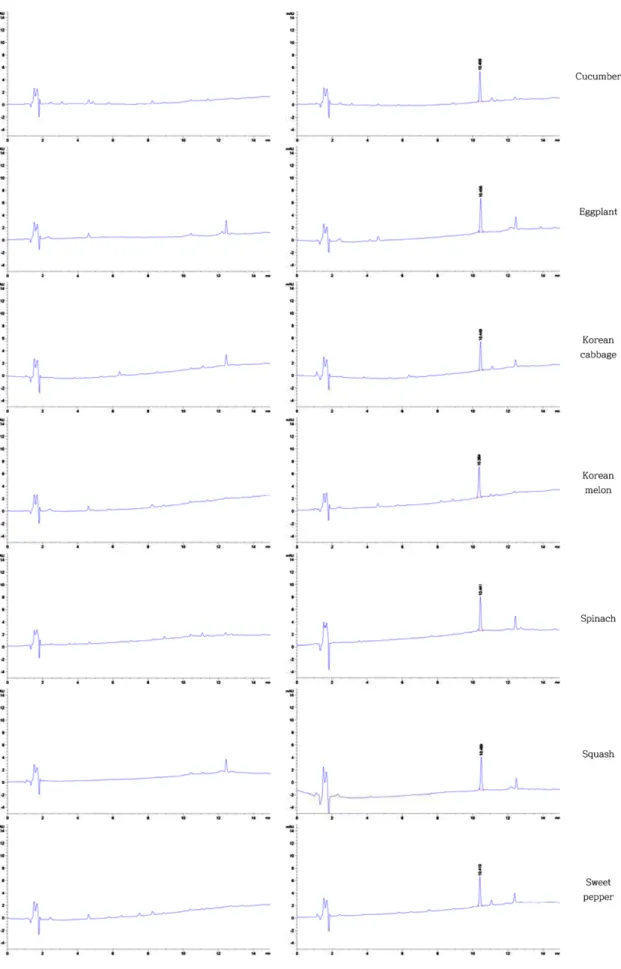
100Fig. 3. HPLC-UVD chromatograms of each sample matrices. The lefts are blank, and the rights are diflubenzuron (1 mg/kg) in
spiked.
하여 시료 50 g에 최종농도가 0.05, 0.2, 1 mg/kg가 되도록 diflubenzuron 첨가한 후, 3농도별 3회 반복하여 앞서 기술 한 분석방법으로 분석하여 회수율(Recovery)과 상대표준편 차(Relative Standard Deviation, RSD)로 측정하였다.
정밀성은 Intra-day 정밀성과 Inter-day 정밀성을 측정하여 평가하였다. Diflubenzuron 표준용액을 0.05, 0.2, 1 mg/kg 에 해당하는 농도 범위에서 하루에 실험을 5회 반복하여 Intra-day 정밀성을 구하였고, 동일 실험을 3일간 반복하여
Inter-day 정밀성을 구하여 상대표준편차(RSD)를 이용하여 나타내었다.
결과 및 고찰
직선성 및 특이성
Diflubenzuron 표준용액 0.05-5 mg/kg 범위에서 7개 농도
를 HPLC-UVD에 주입해서 얻은 표준검량선의 1차 회귀방
Fig. 4. LC-UVD chromatogram (a), DAD spectrum (b), LC-MSD chromatogram (c), and LC-MSD mass spectrum (d) of diflubenzuron.
정식(linear regression equation)은 Y = 28.45819X − 0.219677 이고 상관계수(Correlation coefficient, R
2) 값이 0.99999로서 고도의 상관성을 띈 직선성을 나타내었다(Fig. 2). 또한 시 료의 매트릭스 중 diflubenzuron과 같은 머무름 시간을 갖는 어떤 방해물질도 검출되지 않아 본 시험은 높은 분리능과 선택성을 가짐을 확인 할 수 있었다(Fig. 3).
검출한계와 정량한계
HPLC-UVD 를 이용한 측정값을 토대로 표준편차와 기울 기에 근거하여, 검출한계(Limit of Detection, LOD), 정량한 계(Limit of Quantification, LOQ)를 구한 결과, 검출한계는 0.008 mg/kg 이고, 정량한계는 0.02 mg/kg였다. 식품공전 잔 류농약분석법 실무해설서에 따르면(Lee, 2012) 잔류농약 시 험법은 해당농약의 잔류허용기준(maximum residue limit, MRL) 의 1/2 이하의 농도이거나, 0.05 mg/kg 이하의 정량한 계가 요구되고 있다. 본 연구에 사용된 diflubenzuron의 MRL 이 0.05 mg/kg임을 고려할 때, 정량한계 0.02 mg/kg은 그 기준에 적합하였다.
정확성과 정밀성
Diflubenzuron 의 회수율 실험은 정량한계 0.02 mg/kg를 고려하여, 7가지의 농약이 검출되지 않은 시료에 최종 농도 가 정량한계의 2.5배 농도, 정량한계의 10배 농도, 정량한계 의 50배 농도인 0.05, 0.2, 1 mg/kg이 되도록 표준용액을 첨 가하여 3회 반복하여 분석을 수행하였다. 회수율에 대한 결 과는 Table 2와 같다. 0.05 mg/kg 농도에서의 회수율은 가 지가 가장 높았으며 오이가 가장 낮았고, 0.2 mg/kg 농도에 서는 시금치가 가장 높고 엇갈이배추가 가장 낮았다. 1 mg/
kg 농도에서는 가지가 가장 높고 청피망이 가장 낮은 회수 율을 보였다. 엇갈이 배추, 오이, 참외는 첨가농도가 높을수 록 회수율이 증가하는 경향을 보였으며 그 외, 다른 시료는 첨가농도와 회수율의 상관관계가 없었다. 분석결과 diflu- benzuron 의 평균 회수율은 77.5~105.6% 였으며 상대표준편 차는 20% 미만으로 나타났다. 각국 및 국제기구 등에서 연 구 수행에 활용된 분석법에 대한 적합성은 회수율과 상대표 준편차의 범위를 이용하여 판단하고 있는데, 국내는 잔류농 약 분석법에서 회수율 70-120% 및 상대표준편차 20% 이하, 국제식품규격위원회는 회수율 60-120%와 상대표준편차 15-
30% 이하, 유럽연합에서 제시한 회수율은 70-120%와 상대 표준편차 20% 이하를 규정하고 있다. 본 연구에서는 회수 율 최소 77% 이상과 20% 미만의 상대표준편차를 나타내어 국내 잔류농약분석법 기준 및 국제적 기준을 만족하였다 (Rural Development Administration 2009., European Com- mision 2010., Codex Alimentarius Commission 2003.).
정밀도는 diflubenzuron 표준용액을 0.05, 0.2, 1 mg/kg 세 가지 농도로 희석하여 하루에 5번씩 3일에 걸쳐 측정하였다.
정밀도는 하루에 실험을 5회씩 반복하여 일내 정밀도인 intra-day test에서 0.4-1.9%, 3일간 반복 측정하여 일간 정밀 도인 inter-day test에서 0.7-1.9%를 보여 분석오차 20% 이 하의 국내 잔류농약분석법의 기준과 비교하여 볼 때 매우 만족스런 수준으로 평가되었다(Table 3).
각 농도에서의 정확도와 정밀도를 살펴본 결과 비교적 높 은 정확도와 정밀도를 갖는다는 것을 알 수 있었으며, 본 연 구에서 시행한 다종농약다성분 분석법 제2법이 diflubenzuron 을 분석하는데 적합한 것으로 판단되었다.
Literature cited
Jeon, J. S., M. J. Kwon, S. H. O, H. J. Nam, H. Y. Kim, J. M.
Go and Y. H. Kim (2006) A survey on the pesticide residues on agricultural products on the markets in Incheon area from 2003 to 2005. J. Environmental Agriculture 25:180- 189.
Lee, Y. D. (2012) Handbook for the pesticide residue analytical methods of food code, 3rd ed, National Institution of Food and Drug Safety Evaluation, Cheongwon, Korea.
Kim, Y. S. and H. R. Sohn (2001) Effect of Diflubenzuron on silkgland development of silkworm, Bombyx mori (Lepidoptera: Bombycidae). Korean J. Seric. Sci. 43(2):77- 82.
Wellinga, K., R. Mulder and J. J van Daalen (1973) Synthesis and laboratory evaluation of 1-(2,6-disubstituted benzoyl)- 3-phenylureas, a new class of insecticides. I. 1-(2,5- Dichlorobenzoyl)-3-phenylureas. J. Agric. Food Chem.
21(3):348-354
Wellinga, K., R. Mulder and J. J van Daalen (1973) Synthesis and laboratory evaluation of 1-(2,6-disubstituted benzoyl)- 3-phenylureas, a new class of insecticides. II. Influence of the acyl moiety on insecticidal activity. J Agric. Food Chem.
Table 3. Precision for the determination of diflubenzuron Concentration
(mg/kg)
Intra-day Inter-day
Mean
a)± SD RSD (%) Mean ± SD RSD (%)
1 27.6 ± 0.2 0.7 27.8 ± 0.2 0.7
0.2 95.4 ± 0.1 1.9 95.4 ± 0.1 1.9
0.05 91.2 ± 0.005 0.4 91.2 ± 0.02 1.7
a)Mean area values of quintuplicate measurement