세계화:중국학생과 한국학생들의 해외 유학 경험
Going global: The Study Abroad Experiences of Chinese and Korean Students
엘라 키드*, 김혜균**
우송대학교 솔브리지 국제경영학부*, 우송대학교 뷰티디자인경영학과**
Ella Kidd([email protected])*, Hye-Kyun Kim([email protected])**
요약
본 연구는 정치·경제적 측면에서 일정궤도에 오르고 영어교육을 중시하는 두 나라의 학생 3명을 대상으 로 진행하였다. 본 연구의 참가자들은 한국인 재학생 2명과 중국 유학생 1명이다. 연구의 목적은 이들이 해외에서 경험한 전반적인 언어 학습을 평가하는 것이었다. 본 연구의 참가자들은 비슷한 문화와 언어학습 방식을 공유하지만 제2외국어 준비를 위한 접근방식은 서로 달랐으며, 이와 다르게 그들이 해외에서 공부하 도록 동기를 부여한 내적 요인들은 동일했다. 그리고 교실 상황(평가), 사회적 환경(환경)및 학습전략도 서 로 달랐다. 본 논문의 방법론은 표본 추출 기술을 이용한 전체론적 접근법을 사용하였다. 응답은 사전에 준비된 설문지와 구조화되지 않은 인터뷰에 의해 이루어졌고, 추후에 유도 추론 프로세스에 의해 분석되었 다. 세 가지 즉, 책임, 문화, 의사소통의 충돌로 특정하였다. 이번 연구는 참가자들이 모국에서 영어학습에 대한 사전준비를 철저히 하면 할수록 해외에서의 성공에 큰 기여를 한다는 것을 보여 주었다.
■ 중심어 :∣해외유학∣영어학습경험∣국제적∣유학생∣제2외국어∣
Abstract
This study includes three students’ whose country origin is of a political and economic success, therefore the pursuit to learn English is important. The participants evaluated in this study are two students of Korean descent and one Chinese student. The purpose was to evaluate their overall language learning experiences outside of their home country. While the participants in this study share similar cultures and learning styles their process towards second language readiness is different. The internal factors (readiness) that motivated them to study abroad were synonymous. However, the classroom situations (assessment), social settings (environment), and strategies used were disparate. The methodology of this paper used a holistic approach with a snowball sampling technique. The responses were collected by a prepared questionnaire and unstructured interviews, then later analyzed by the inductive reasoning process. The 3 specific categories identified were despondency, culture and communication conflict. The present study revealed that the participants’ earlier preparation from their home country plays a significant contribution to their success abroad.
■ keyword :∣Study Abroad∣English Practitioners∣International∣International Students∣Second Language∣
* 본 연구는 2018년도 우송대학교 교내 학술연구조성비 지원에 의해 수행되었습니다.
접수일자 : 2018년 06월 11일 수정일자 : 2018년 06월 22일
심사완료일 : 2018년 06월 26일
교신저자 : 김혜균, e-mail : [email protected]
I. Introduction
The catchy phrase “going global” appears to be a tag line for many businesses and education institutions. It is visible in the world around us and it appears that there is no getting away from it. In second or foreign language the term “globalization of English” refers to the rapid spread of English[1]. The spread of English continues to remain a leading force as a second language. But ironically, it is a threat to wipe out cultures and local languages[2].
All things considered, the linguistic evolution of English continues to remain the pinnacle of globalization and technology regardless of the past language decline or death such as Latin, Phoenician, and Sanskrit[3]. Therefore, it is predicted by 2050 half of the world will be proficient in it[4]. For this reason, at least 1.7 million students from nonspeaking English speaking countries where English is not the native language (i.e. Japan, China, and Korea) cross-borders to study. Because of the advanced, innovative technological changes in education (Task-based, CLT) the paradigm of English Language Teaching (ELT) continues to pass on linguistic skills to prepare learners for forthcoming employment. Furthermore, if Korea and China continues to exert political and economic trademarks, ELT practitioners should consider the issues of language, culture, power, and social justice by situating EFL in a broader social context of ELT[5].
The experiences and assessments of Asian students study abroad have been studied in detail and published in various research literatures in higher education[6]. Hence, this study compares three Asian students from two economic global rising countries.
Most research examines students who constitute one single ethnic group within one geographical location.
Furthermore, this study examines and compares three
Asian students from flourishing economic countries with a synonymous desire to learn English.
The overall viewpoint of this paper is to compare the experiences of three participants mentioned in this study and their perceptions of their English medium instruction outside of their home country. However, it is paramount to explain the competitiveness that the English language has over East Asian and Asian countries to increase socio-economic dominance.
Because of the availability of participants’ the population is marginalized to some degree, therefore, this study was conducted using the snowball effect.
The effectiveness of this method has been recognized as significant, especially in marginalized populations[7].
In addition, to generalize the results for larger groups, the study should have involved more participants including males. The student’s duration of study abroad might affect the results of the correlation between the internal and external factors.
Asian students who feel they are better prepared for study outside of their home country showed higher satisfaction. Preparation is an important factor in getting enjoyment of a study abroad programme.
(1) How do a Korean and Chinese student socially adapt outside of their home country?
(2) What are their visual and cognitive perceptions of the foreign language classroom processes outside of their home country?
(3) Do the study abroad experience increase the student’s confidence and speaking level?
Ⅱ. Literature Review
2.1 Developing L2 self and perceptions
Leaving one's home country can be an arduous task, yet it is exciting to view other cultures` way of life. As a matter of fact, there are significant
drawbacks to leaving one's home country to travel abroad. It is indicative that international students feel lonely, homesick, anxious, and depressed. Above all, students with limited English proficiency reported communication as the most challenging, especially when trying to communicate to other English speakers[8].
According to the social cultural theory concept human beings discern the world around them through signs and symbols, based on their interaction with other people. While consciousness and conceptual development are initially seen as an inter-mental phenomenon shared among others but sub sequentially the individual appropriates their own consciousness which becomes an intra-mental phenomenon[9][10].
The concept of the ideal L2 motivational self-system proposed by [11], emphasized the importance of the future images that L2 learners possess with regard to L2 learning and use. Dorneyei explains that L2 learners are likely to be deeply motivated to learn the target language if they have a vivid future image of an ideal L2 self and willing to acquire the L2 speaking image. It is important for students to develop their L2 self which cultivates high-level L2 behavior and motivation[12].
When examining past researchers of Korean culture, [13] investigated that Korean elementary students’ visual style and auditory learning styles influence their creation of ideal L2 self and enhance motivated L2 behavior.
To examine the L2 self-perspective in Chinese culture Zhang investigated 1,667[12]. Chinese students learning styles, imagination, ideal L2 self, and motivated L2 behavior. Her study showed that Chinese students prefer visual learning style in comparison to their auditory and kinesthetic learning style. The finding concluded teachers should assist students in developing and maintaining their ideal L2
self and facilitate their L2 learning motivation by providing visual teaching materials.
Accordingly, experiences are something that we all encounter as humans in our lives. In the classroom, students convene at the same time, however perceive their experiences differently. According to the Gestalt psychology of perceptions, certain phenomena can be viewed as an organized or whole rather than parts[13]. For example to compare the two groups within this paper, Chinese students perception of their language success in an Australian School of Accounting was related to their level of preparedness (internal), [14] In the case of Korea where Korean students studied in a US university, they perceived their level of success was a lack in sufficient amount of American cultural studies and classroom learning environment behaviors (external)[15].
2.2 Classroom Experience
A large percentage of Korean students begin English studies in grammar school with a native teacher, depending on the school size and location some do not interact with a nonnative teacher until their first year in college. As a part of the general education curricula, most universities require students' to take a two-year course of Integrated English (e.g. listening, reading, writing and speaking).
During this time the students are expected to participate and build their communicative abilities through various activities such as debates, presentations, picture description tasks, and informative speech. On the other hand, Asian students reported having trouble with understanding lectures, taking notes, answering questions, and writing essays[16]. Resulting in an indignant attitude, therefore the epistemology and ontology perspectives are important in English Language Teaching (ELT)[17].
In China, English is a required subject for school children. College students are required two years of English in order to earn a bachelor’s degree. The intensity of acquiring the English language is prominent in China because of its expanding trade ties across the world. However, the utility of English is for learning purposes to modernize the country, not culture learning. This attitude is prevalent amongst Chinese citizens and Western ideology is disregarded[18].
2.3 The Transnational Experience
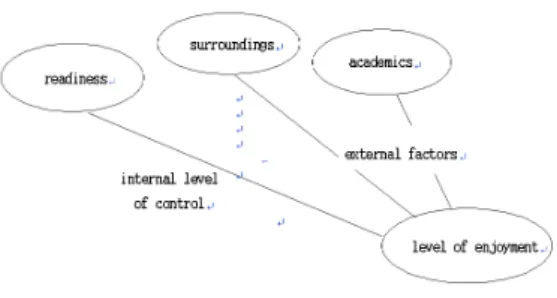
Social learning theory is forecasted on the notion that behavior is predicated on the expectancy and the way a person behaves which in turns rewards the individual to the extent the value the individual places on the reward. The extent of what an individual sees an association between what they do and what will happen to them is the locus of control[19]. The social learning theory is used in this paper as an example to investigate individual overall enjoyment of a study abroad program[20]. The locus of control was used in prior literature in the area of accountability Morris [21], organizational behavior[22] and job satisfaction;
and job performance[22]. For this study, the locus of control is viewed as what the individual can control (readiness). From the view of intrinsic control, the researcher examine the participants’ previous language dies (readiness). The external (surroundings) control factors are surroundings and assessment. Control is felt internally and not imposed externally. For example, an individual whose feelings are internally felt has the ability to take control of situations that are not prearranged. On the other hand, an external control individual may not feel so prepared for unstructured situations. See [Fig. 1]. Many studies have been published on the topic of foreign language anxiety [23] and study abroad[24], and there have
even been a few studies that focus on the relationship experience abroad and language learning anxiety[25].
The teaching criteria is synonymous in Korea and China, however the academic experiences are different. The universities where the participants’
studied are composed of diverse teachers from various geographical regions. The participants’ did report that having a different instructor made a difference in their overall performance. From the view of academics (external control) the participants’ in this study reported different experiences.
On the other hand, the examination of the teacher is not the focus of this study. Furthermore, it is important to mention the teaching styles and questions in the language classroom. Research has been conducted features of the teacher’s questions.
Some researchers such as Allwright & Bailey, 2004;
Fanselow, 1987; Long & Sato, 1983 have revealed that questions used in classrooms are often unlike the questions outside the classroom. Most questions asked by the teacher were display question (i.e., the questions asking for information which the teacher already knows)[26], whereas only one question out of every seven question was a referential question (i.e., the question asking for information which the teacher does not know).
Fig. 1. Relationship of preparation, culture and technical teaching on student satisfaction.
[adapted] from “Chinese students’ study abroad experience, ” by Wang, Q, Taplin, R, Brown, A, 2011, International Journal of Educational Management Vol. 25, 265-277.
[Adapted] with permission.
The overwhelming consensus of findings from studies using social learning theory is that internally controlled persons do better under unstructured situations when they are left to solve problems themselves. In contrast to externally controlled individuals who do well in structured situations when they are told what to do and what to expect.
According to social learning theory, individuals bring locus of control perspectives with them into the new experience of traveling abroad[27].
Ⅲ. Method
The methodology of the paper uses a constructivism philosophy because it deals with reality as a product interacting with experience in the real world. Therefore, the reality is a construct of the human mind and it is subjective. In order for the researcher to delve further into the research questions, a qualitative design was preferred given the number that two students are involved in the study. The research instrument used is relationship of preparation, culture and technical teaching. This study is granted permission by the original producer[28].
There are two types of sampling methods that can be used to recruit participants to a study-random sampling and non-random sampling (sometimes called non-probability). Snowball sampling is a type of non-random (probability) sampling method[29].
Each member of the study was random selected but the known availability of participants who have studied abroad was not easy to identify. Therefore, the snowball sampling method is the only sampling method to obtain a reasonably representative sample.
3.1 Data Collection
In order to complete this study, the individuals selected match the characteristic of interest, in addition to an availability of the samples. Interviews were conducted vis-a-vis between the researcher and the participant in an authentic holistic environment.
The participant's background information is represented in [Table 1]. For the purpose of discretion, the participants are identified with pseudonyms Korean student (Ko1), Korean student (Ko3), and Chinese student (Ch2). Each participant received formal English instruction from their home country prior to studying abroad.
PARTICIPANTS KO1 CH2 KO3
Gender F F F
Time of English study abroad 2 wks 104 wks 32 wks
Total ys of English study 5 10
Student classification Grad Grad Grad
(Ko1)= Korean Student (Ch2)= Chinese Student (Ko3)=Korean Student
Table 1. Participants identification
Interviews 1) Respondent 1
The first subject is of Korean ethnicity who is classified as a senior. Her abroad studies duration was for two weeks. Based on her responses from the questionnaire pertaining to the environment, The subject stated that she had no problems communicating with others inside or outside of the classroom she stated that she liked the food, living conditions, traffic, and weather. The subject stated she did not like the landscape.
The investigator met with the subject in the investigator’s office to discuss her experiences and perceptions about her English studies in Australia.
The subject was made aware that the information provided would be kept anonymous. The subject was also made aware of the purposes of the small informal
interview. The interview lasted approximately 25 to 30 minutes in length.
stated that her previous language studies adequately prepared her for abroad studies.
Respondent 1 stated she liked her classes and made use of all resources available.
2) Respondent 2
The second subject is of Chinese ethnicity who is classified as a senior. The investigator met with her to discuss experiences and perceptions about her English studies in Korea in the investigator’s office.
The subject was made aware that the information provided would be kept anonymous. and the purposes of the small informal interview. The interview lasted approximately 25 to 30 minutes in length. (Ch2) is currently studying in Korea, enrolled in university courses majoring in Beauty Design. Although, she is no longer required to enroll in English courses, the second language criteria apply to her as well. Based on her responses from the questionnaire pertaining to the environment, the subject stated that she had no problems communicating with others inside or outside of the classroom. The subject also stated that she likes the food, living conditions, traffic, and weather but dislikes the landscape. The subject stated that her previous language studies adequately prepared her for abroad studies. The subject stated she liked or enjoyed her classes and made use of all resources available.
3) Respondent 3
The third respondent is of Korean ethnicity who has currently graduated. Her abroad duration studies were for eight months in Malaysia. Different from Ko1 who reported she did not have any problems communicating inside or outside of the classroom.
Ko2 reported that she had no problems
communicating inside of the language classroom;
however communicating outside of the classroom was arduous. Ko2 reported on the questionnaire form that she had no problems with the environment such as traffic, weather, living conditions, food, or landscape.
Similarly to Ch2 who reported having periods of sadness, Ko2 reported the same experience.
Ⅳ. Results
The results of the interview revealed that the landscape is a significant factor in the students overall level of enjoyment. According to Kim (2006), in addition to acquiring a second language, thorough understandings of the target cultures are paramount towards upward amelioration. However, the participants must be willing to embrace an outside culture without bias. In the case of Ko1 and Ch2 the landscape contributed a negative factor in their experience. In order for the learner to accept another culture in regards to upward development, a definition of culture should be provided. “Based on the relations between language and culture, language is the conduit of culture, while culture is the contents of language, it is assumed that the cultural factors that affect Second Language Acquisition (SLA) may be classified into developmental or process factors, structural factors, and pragmatic factors” (Tong, Renfeng, & Weizhong, Retrieved from www.celea.
rg.cn/pastversion/lw/pdf/yangweizhong%20.pdf.
The findings of this study are presented in three categories (communication difficulty, academic challenges, and instructor discourse), with enlarge veneration to the student's experiences and perceptions. First, the communication difficulty respondents experience difficulty communicating in the language classroom ; (2) Second, The second
finding reveals the course difficulty from both respondents as compared to the English courses in their home country; and (3) Lastly, regarding instructor discourse the student revealed a difficult time communicating with the instructor due to their inability to convey in the English language.
4.1 Communication difficulty
According to Ko1 and Ch2 students study abroad for various, mostly for advancement in the second language due to increasing their chances of becoming employable. In China, students acquire English as a mode to better their country. In Korea, students acquire English to earn a degree, make acquaintances with native speakers of English, and for professional needs. Contrary, according to Premkamolnetr (1999), students study abroad to fulfill graduate and post-graduate degree requirements, in order to meet their own personal needs of academic and professional fulfillment.
1) Respondent Ko1:
The respondent was very excited about the study abroad choice. Her previous language study courses helped her to maintain a good academic standing.
However, she felt some discomfort in communication because of her inability to communicate effectively with peers and instructors.
2) Respondent Ch2:
The respondent reported difficulty communicating in English in the classroom. felt as though the English lectures were not synonymous as the lectures in her home country. Respondent reported as extreme difficulty communicating in English, inside of the classroom.
In addition the respondent stated her Korean speaking ability is native like, yet she struggles to have friendly relationships with Korean students.
3) Respondent Ko3
Respondent reported a display of assertiveness to get along with students of other nationalities with no difficulties communicating inside of the classroom;
however she did have some problems communicating outside of the classroom with peers and periods of sadness.
4.2 Academic challenges 1) Respondent Ko1:
The respondent revealed that access to supplementary materials was readily available and textbooks were easier. Respondent revealed that examinations were better in Australia compared to Korea and therefore the course was not difficult to pass.
Respondent Ko1 stated- “It made me stronger and better than before”.
2) Respondent Ch2:
The respondent revealed that supplementary resources were not readily available and textbooks were not reader friendly. Respondent revealed that the examinations were not easy to pass in Korea compared to the exams in China.
Respondent Ch2 stated-“I think studying in Korea is okay”
3) Respondent Ko3
The respondent revealed that supplementary resources were not readily available and textbooks were not reader friendly. Respondent revealed that the examinations were not easy to pass in Korea compared to the exams in China.
4.3 Instructor discourse 1) Respondent Ko1:
The respondent revealed that the lectures taught by
the professors were better in Australia compared to her home country. However, as stated previously respondent felt some intimidation when speaking to the instructor.
2) Respondent Ch2:
The respondent revealed that the lectures taught by the professors were not better in Korea compared to her home country. In this case, Ko1 appears to function at a high social level, without any discomfort or anxiety. On the other hand, Ch2 appear to function at a lower English speaking level, factor such as landscape and sadness are discussed. Moreover, respondent Ch2 felt that the assignments in her home county were better to comprehend.
When I asked the Ko1 student regarding the information she learned during her stay in Australia, she stated, “I learned a lot” and “my previous studies helped”.
Experiences are met with different challenges based on an individual’s epistemology and ontology which is the foundation for their overall perception.
3) Respondent Ko3
Respondent Ko3 reported favorable responses towards the practitioner’s classroom practice.
Respondent reported the practitioner’s ability to communicate in the target language was better than in her home country and there was a substantial amount of academic writing which made the courses were more difficult to pass.
When the researcher asked the Ko3 what was your overall opinion of the teachers teaching methodology?
The respondent stated: “I enjoyed my classes and I was shy to ask questions.”
Ⅴ. Discussion and Conclusion
This study explored three Asian student’s experiences and perceptions of studying abroad in a university setting in relation to their experiences. The findings from the data indicated factors (1) despondency (2) culture conflict and (3) communication difficulty. In the area of exploring new surroundings, the Korean students expressed more social outgoing tendencies than the Chinese student. In the area of academics, all students indicated their previous language courses helped them in their present English class, but students indicated some discomfort with communication which created sadness. The both Korean students expressed more growth in the area of English fluency compared to the Chinese student.
All students expressed dichotomous views when comparing the textbooks and discussions in the host country. The Korean students indicated the textbooks in the host country were reader friendly and assignments better prepared in the host country.
However, the Chinese student expressed the textbooks were not reader friendly and class discussions more arduous in Korea. In addition, when the examiner asked the participants' in a face-to-face interview “Do you feel the need to extend their language courses beyond their study abroad experience”? The Korean students stated, "maybe", however, they felt internally confident in their language abilities. The Chinese student answered
"yes" she felt the need to extend her studies. The overall perceptions of the study abroad classes with the Korean students are favorable, while this was not the case with the Chinese student.
In this study, the Ko1 and Ko3 students’ level of internal and external control was to learn a second language within a structured environment. The Chinese student’s level of external and internal
control was predicated on the conditions of the environment in a structured situation. This is demonstrating that no matter how much a student is prepared internally, the external factors can modify the internal factors in a structured environment.
Korea and China are well-developed countries, but as technological innovations continue to expand in non-western countries; the acquisition of the English language remains a requirement by its students. The function of English both in Korea and China is used in various domains of the society such as education, business, media, and government. However, if students are to acquire a second language in a global setting they should have some prior knowledge of that language to become adaptable to the host country's culture. This study revealed, all students in this report share similar learning styles but their trajectory to readiness regarding language and time allotment shows different emotional levels, thus, the overall level of enjoyment was different. All students studied in a structured environment in three different geographical regions.
In conclusion, the overall scope of this paper was to investigate three students’ personal adjustments and academic achievements outside of their home country.
However, the dissimilar results are an indication that student’s cultural and cognitive background is a factor in determining the overall success of their second language. Therefore, to inculcate culture in second language teaching allows students the ability to develop their second language identity. Society is viewed as a macrocosm, which formulates our culture, whereby language is the conduit that opens up the world of reality. Therefore, the onset of a student's second language learning is affected by the practitioner's approach towards the student's second language success. As been previously studied by Zhang (2015) and Kim (2009).
To conclude, the Chinese and Korean students social adaptations are disparate. The Korean students’
internal preparations were more willing to adapt to their new surroundings in spite of the external views.
However, the Chinese student was not internally prepared to adapt to her new surroundings. The Korean students’ cognitive perceptions of learning the target language (English) outside of their home country were based on the pedagogy of the language teacher. As a result, this increased their confidence in speaking English. On the other hand, the Chinese student cognitive perceptions was also disparate, due to the despondency and unwillingness to adapt socially.
참 고 문 헌
[1] Crystal, English as a Global Language.
Cambridge, Cambridge University, 1997.
[2] C. Gnutzmann and F. Intemann, "Introduction:
The Globalization of English. Language, politics, and the English language classroom," In C.
Gnutzmann, & F. Intemann (Eds.), The globalization of English and the English language classroom 2nd ed, pp.9-24, 2008.
[3] New York Times, Across Culture, English is the word, 2007.
[4] A. Johnson, "The Rise of English: The Language of Globalization in China and the European Union," Macalaster International:
Vol.22, No.12, 2006.
[5] K. Sung, "Developing a Graduate EFL Program Based on Critical Theory and Pedagogy,"
Foreign Language Education, Vol.14, No.3, pp.95-124, 2007.
[6] M. Yang, "What attracts mainland Chinese students to Australian higher education,"
Studies in Learning, Evaluation, Innovation, and Development, Vol.4, No.2, pp.1-12, 2007.
[7] N. Cohen and T. Arieli, "Field research in conflict environments: Methodological challenges and snowball sampling," Journal of Peace Research, Vol.48, No.4, pp.423-435, 2011.
[8] J. Kim, "A Case Study of Korean Graduate Students in a U.S," University: Challenges and Strategies, Foreign Language Education, Vol.13, No.2, pp.205-229, 2006.
[9] L. Schatzman and A. Strauss, "Social class and modes of communication," American Journal of Sociology, Vol.60, pp.329-338, 1955, (Reprinted in A. G. Smith (Ed.), Communication and culture, New York: Holt, pp.442-455, 1966.
[10] R. Mitchell, "Communicative language teaching in practice," London:Centre for Information on Language Teaching, 1988.
[11] Z. Motivation Dornyei, "Language Identity, and the L2 Self," British Library Cataloguing in Publication Data, 2009. Retrieved from http://www.psych.ualberta.ca/, 2005.
[12] Y. K. Kim and T. Y. Kim, "The effect of Korean secondary school students' perceptual learning styles and ideal L2 self on motivated L2 behavior and English proficiency," Korean Journal of English Language and Linguistics, Vol.11, pp.21-42, 2011.
[12] Q. Zhang, "A Study on Chinese Students’
Perceptual Learning Styles, Ideal L2 Self, and Motivated L2 Behavior," etrieved from TEIC201501005.htm. Ahn, K.(2008). Teaching as one has been taught: The impact of teacher socialization on the implementation of English curricular reform. English Teaching, Vol.63, No.3, pp.91-117, 2015.
[13] S. Y. Kim, "Questioning the statbility of foreign lanuage classroom anxiety and
motivation across different classroom contexts,"
Foreign Language Annals, Vol.42, No.1, 2009.
[14] Q. Wang and A. Brown, "Chinese Students’
satisfaction of the study abroad experience,"
International Journal of Educational Management, Vol.2, No.3, pp.265-277, 2011.
[15] J. Kim, "A Case Study of Korean Graduate Students in a U.S," University: Challenges and Strategies, Foreign Language Education, Vol.13, No.2, pp.205-229, 2006.
[16] P. S. Heikinheimo and J. C. Shute, "The Adaptation of foreign students: Student views and institutional implications," Journal of College Student Personnel, Vol.27, No.5, pp.399-406, 1986.
[17] K. Sung, "Developing a Graduate EFL Program Based on Critical Theory and Pedagogy,"
Foreign Language Education, Vol.14, No.3, pp.95-124, 2007.
[18] A. Johnson, "The Rise of English: The Language of Globalization in China and the European Union," Macalaster International, Vol.22, Article 12. 2009.
[19] Q. Wang and A. Brown, "Chinese Students’
satisfaction of the study abroad experience,"
International Journal of Educational Management, Vol.25, No.3, pp.265-277, 2011.
[20] A. D. Kalechstein and S. Nowicki, Jr. "A meta-analytical examination of the relationship between control expectancies and academic achievement: an 11-year follow-up to the Findley and Cooper," Genetic Social, & General Psychology Monographs, Vol.123, pp.27-57, 1997.
[21] P. Morris, "Teaching in Hong Kong:
professionalization, accountability and the state,"
Research Papers in Education, Vol.19, No.1, pp.105-21, 2004.
[22] S. P. Robinson (8thed.), "Prentice-Hall,
Englewood Cliffs, NJ .Organisational" Behavior:
Pearson. 1998.
[22] T. A. Judge and J. E. Bono, "Relationship of core self-evaluations traits-self-esteem, generalized self-efficacy, the locus of control, and emotional stability with job satisfaction and job performance: a meta-analysis,” Journal of Applied Psychology, Vol.86, No.1, pp.80-92, 2001.
[23] E. Horowitz, "Foreign Language Classroom Anxiety," The Modern Language Journal, Vol.70, No.2, pp.125-132, 1986.
[24] D. E. Davidson, "Study abroad :`When`, `how long`, and `What result`?," New data from Russian front, Vol.spring, No.2010, pp.6-26, 2010.
[25] H. W. Allen and C. Herron, "A mixed methodology investigation of the linguistic and affective outcomes of summer study abroad,"
Foreign Language Annals, Vol.36, No.3, 2003.
[26] K. Bailey, "Practical English Language teaching speaking," McGraw-Hill:New york, 2004.
[27] M. McLeod and P. Wainwright, "Researching the study abroad experience," Journal of Studies in International Education, Vol.3, No.1, pp.66-71, 2009.
[28] Q. Wang, R. Taplin, and A. Brown, "Chinese students' satisfaction of the study abroad experience," Internatioal Jornal of Educational Management, Vol.25, pp.265-277, 2011.
[29] Sedgwick, P. Snowball Sampling. Retrieved from https://www.researchgate.net/profile/Philip_Sed gwick/publication/291162231_Snowball_samplin g/links/569e756608ae21a56424b5d4/Snowball-sa mpling.pdf, 2013.
저 자 소 개
엘라 키드(Ella Kidd) 정회원
▪2004년 12월 : Grambling State University(공학사)
▪2011년 2월 : Grambling State University(이학석사)
▪2015년 12월 ~ 현재 : 경희대학 교 영미어문학과(박사수료)
▪2012년 8월 ~ 현재 : 우송대학교 솔브리지 국제경영 학부 조교수
<관심분야> : 읽기 교육, 언어 교육
김 혜 균(Hye-Kyun Kim) 정회원
▪2000년 2월 : 덕성여자대학교 서 양화과(미술학사)
▪2003년 8월 : 덕성여자대학교 미 술학과(미술학석사)
▪2007년 6월 : London College of Fashion(FDA)
▪2013년 8월 : 건국대학교 의류학과(이학박사)
▪2013년 3월 ∼ 현재 : 우송대학교 뷰티디자인경영학 과 조교수
<관심분야> : 미용, 뷰티콘텐츠, 융복합