Dominant Synoptic Patterns Controlling PM
10Spatial Variabilities over the Korean Peninsula
Hyo-Jin Park
1,2, Jieun Wie
1, and Byung-Kwon Moon
1,*
1
Division of Science Education/Institute of Fusion Science, Jeonbuk National University, Jeonju 54896, Korea
2
Gimje Girls’ High School, Gimje 54393, Korea
Abstract: This study examines the controlling role of synoptic disturbances on PM10 spring variability in the Korean Peninsula by using empirical orthogonal function (EOF) and back trajectory analyses. Three leading EOF modes are identified, and a lead-lag analysis suggests that PM10 variabilities be closely related to the synoptic weather systems. The first EOF shows the spatially homogeneous distribution of PM10, which is influenced by travelling anticyclonic disturbance with negative precipitation and descending motion. The second and third modes exhibit the dipole structures of PM10, being associated with propagating cyclones. Furthermore, the back-trajectory analysis suggests that the transport of pollutants by anomalous winds associated with synoptic disturbances also contribute to the altered PM10 concentration.
Hence, a substantial synoptic control should be considered in order to fully understand the PM10 spatiotemporal variability.
Keywords: PM10, synoptic weather systems, trajectory pathway
1. Introduction
Particulate matter (PM), an environmental cause of premature deaths (Zhang et al., 2017), is primarily produced from fossil fuel combustion, and therefore anthropogenic emissions have a strong effect on such air pollutants (Li et al., 2013). The concentration of PM with diameters less than 10 μm (PM
10) is highly dependent on the synoptic system, which determines day-to-day changes in weather (Zhang et al., 2009;
Beaver et al., 2010; Gao et al., 2011; Fortelli et al., 2016). For example, high PM
10events are often caused by stagnant high pressure (anticyclone) systems with subsidence and dry conditions, thus providing favorable conditions for an accumulation of locally emitted pollutants (Kallos et al., 1993; Triantafyllou et al., 2002). Anomalous winds associated with synoptic systems also play an important role in changing PM
10levels by modulating the long-range transport of
pollutants from source regions (Lee et al., 2013; Oh et al., 2015). In contrast, mid-latitude cyclones lead to decreased air-pollution levels because of wet deposition (Pranesha and Kamra, 1997; Choi et al., 2008).
South Korea, located downstream of the East Asia continent, has frequently suffered from heavy PM
10events associated with local emission sources (Park et al., 2004), as well as long-range transport from external sources (Kim et al., 2007; Lee and Kim, 2018). Corresponding to these two effects, Lee et al.
(2011) identified two synoptic weather conditions that favor high PM
10episodes in Seoul: anomalous anticyclones located in the northern regions of the Korean Peninsula with easterly anomalies, and anomalous anticyclones that have moved to southern Korea with upper-level westerlies. Both anticyclones contribute to increases in PM
10of Seoul via accumulation of local emissions, and transboundary influx of pollutants, respectively. Identification of synoptic patterns associated with high-PM
10conditions can provide a promising way for prediction of air quality (Hur et al., 2016), because mid-latitude synoptic system can be easily forecast in advance.
While previous studies have focused on synoptic patterns which may affect PM levels at a particular location (e.g., Seoul, the capital city of South Korea;
*Corresponding author: [email protected]
*Tel: +82-63-270-2824
This is an Open-Access article distributed under the terms of the Creative Commons Attribution Non-Commercial License (http://
creativecommons.org/licenses/by-nc/3.0) which permits unrestricted non-commercial use, distribution, and reproduction in any medium, provided the original work is properly cited.
Lee et al., 2013), little attention has been given to the spatially inhomogeneous distribution of PM in South Korea. There is the possibility that migratory anticyclones and cyclones passing through the Korean Peninsula could affect spatial variation, depending on their pathways.
The present study aimed to analyze the spatial modes of variability in PM
10levels in South Korea and their association with the passage of synoptic weather systems. Three spatial modes of PM
10associated with synoptic atmospheric patterns were identified using an empirical orthogonal function (EOF) analysis.
2. Data and Methods
The PM
10concentrations used in this study were hourly data from 318 monitoring sites over South Korea, collected during five springs (March-April- May) from 2011-2015, provided by the Korea Environment Corporation (downloaded from https://
www.airkorea.or.kr/eng). Using these hourly data, we calculated daily average concentrations of PM
10, and excluded the 44 days when Asian dust was observed, since Asian dust has its own distinct sources and transport routes (Chun et al., 2001; Kim, 2008).
Figure 1a shows the time series of the averaged daily
Fig. 1. (a) Time series of the spatial-mean daily PM10 con- centration (μg m−3) from 318 monitoring sites with 44 Asian dust days highlighted in brown; 15 Asian dust days in 2011, 3 in 2012, 5 in 2013, 6 in 2014, and 15 in 2015. Note that vertical dashed lines divide each year. (b) Spatial distribu- tion of daily mean PM10 concentrations (μg m−3). (c) As in (b) but averaged values over the 0.25o×0.25o grid. (d) Power spectrum for the daily PM10 during springtime. The green line is the mean red noise spectra and dashed upper and lower lines are 10% and 5% significance levels, respectively.
PM
10concentrations together with Asian dust events during the analysis period. The spatial distribution of daily average PM
10levels was highest around the Seoul Metropolitan Area (Fig. 1b), which is most likely attributable to anthropogenic sources (Sharma et al., 2014). In metropolitan cities there were many observation stations located within close proximity to each other, making it difficult to discriminate between and express each value individually. To reduce the resolution, the results were latticed within latitudes 33
oN-39
oN and longitudes 124
oE-131
oE, at a resolution of 0.25
o×0.25
o. The average PM
10concentration of the stations located in each grid was defined as the representative value of the grid (Fig. 1c). We used the re-gridded PM
10concentration data to examine the
relationship between PM
10spatial modes and synoptic disturbances. The day-to-day variability in PM
10was made evident through the power spectrum analysis (Fig. 1d), reflecting the influence of synoptic-scale meteorological conditions.
Moderate Resolution Imaging Spectroradiometer Terra satellite aerosol optical depth (AOD) data (Tanre et al., 1997; Remer et al., 2002) were used to compare the results of the EOF analysis. The horizontal resolution for these data is 1
o×1
o. For the atmospheric data, the National Centers for Environmental Prediction Reanalysis dataset (NCEP2), with a horizontal resolution of 2.5
o×2.5
o, was used for the 1000 hPa temperature, 850 hPa and 500 hPa geopotential heights, 850 hPa U- and V-winds, and 500 hPa vertical velocity (ω)
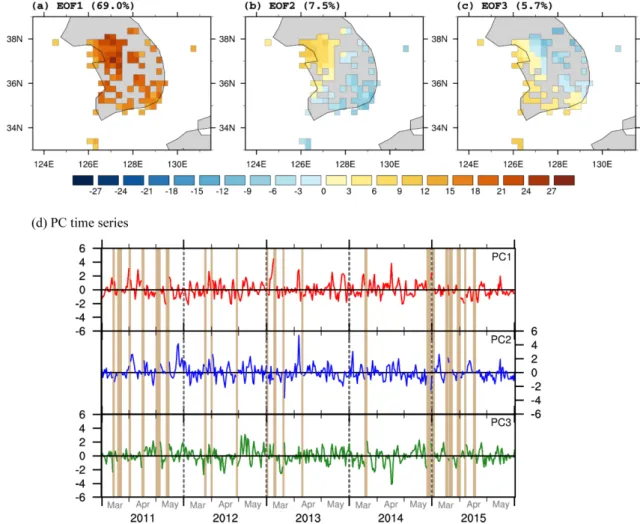
Fig. 2. (a-c). Three leading EOF modes of the daily PM10 concentrations in Korea, and (d) their corresponding PC time series with 44 Asian dust days highlighted in brown.
(Kanamitsu et al., 2002). The precipitation dataset from the Global Precipitation Climatology Project, with a 1
o×1
ohorizontal resolution, was used (Huffman et al., 2001). We also used the National Oceanic and Atmospheric Administration HYSPLIT model (Draxier and Hess, 1998) to identify the transboundary transport of PM
10. Three-day (72 h) back trajectory paths were simulated at altitudes of 1,000 m at 6-h intervals.
3. Results
The Empirical Orthogonal Function (EOF) was applied to determine the spatiotemporal variability of PM
10(Fig. 2). The first mode shows a uniformly positive signal throughout the Korean Peninsula, accounting for 69.0% of total variation. The correlation coefficient between PC1 and the variation in average Korean PM
10concentration (Fig. 1a) was very high (r=0.99), indicating that the first EOF mode (EOF1) may be related to the anomalous high pressure system (e.g., Lee et al., 2011) over the Korean Peninsula. The second EOF mode (EOF2) exhibits a dipole pattern with a positive northwestern region and a negative southeastern region, which accounted for 7.5% of the total variance. In the third mode (EOF3), the dipole structure is also evident in the northeastern and southwestern parts of Korea, which explains 5.7% of the total variation.
Given that these modes, particularly EOF2 and EOF3, may yield non-physical modes due to the orthogonal constraints, it is critical to understand whether the dipoles-type PM
10anomalies in Korea are
related to East Asian large-scale patterns. The regressed satellite retrieval AOD distributions with EOF modes confirmed that Korean PM
10variability extended to the East Asian region. For example, the PC1-regressed AOD shows an increased AOD in the zonally elongated region extending from the Yellow Sea to the East/Japan Sea (Fig. 3a). Similarly, the EOF2 and EOF3 modes of PM
10over Korea (Fig. 2b, c) can be related to AOD variations over the East Asia (Fig. 3b, c, respectively). These AOD results suggest that spatiotemporal variations (Fig. 2) are significant and reflect the synoptic patterns associated with variation in PM
10concentrations over Korea.
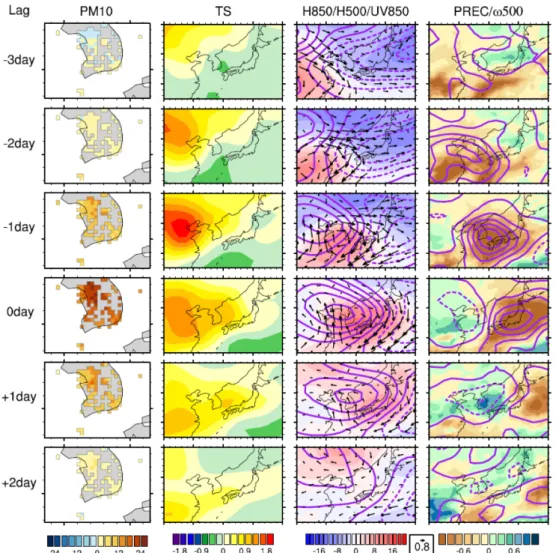
The lead-lag regressed atmospheric patterns with PC1 show that overall positive PM
10anomalies (Fig.
2a) are associated with the high pressure system that passes through the Korean Peninsula (Fig. 4). While PM
10levels were low over the northwestern part of Korea with a lag of -3 day, PM
10concentrations increased as the high pressure anomaly begins to dominate over Korea during the lag period -2 to 0 days, which may lead to PM
10accumulation (Kim et al., 2014). Note that the westward tilting geopotential heights and associated temperature, winds, precipitation and vertical motions are clearly observed at lag 0.
During the lag +1 to +2 days, the center of the high
pressure system moved toward Japan, and southerly
winds prevailed throughout Korea. Simultaneously,
Korea was influenced by positive precipitation and
upward motion, causing decreasing concentrations in
PM
10. Moreover, southerly winds could also contribute
to lowering PM
10by transporting particle-poor ocean
Fig. 3. Linear regression maps of AOD against PC1, (b) PC2, and (c) PC3 from Fig. 2. The black dots represent statistical sig- nificance at the 90% confidence level.air masses to Korea. Lag +2 days displayed weak high pressure and wind speed over the peninsula.
Figure 5 shows the PC2-regressed evolution of atmospheric synoptic disturbances. The positive PM
10anomaly appears over most of Korea with a lag of -3 days, except in the southeastern region. Subsequently, the dipole PM
10pattern develops up to zero lag with anomalous easterly winds and convection activities around Korea, which may have caused negative anomalies from Japan to eastern China (Fig. 3b). It should be noted that these anomalous synoptic
patterns can be related to the mid-latitude cyclone that formed in southern China with a lag of -2 days and travelled across the East China Sea. The warm sector between the cold and warm fronts was also consistently propagated eastward (second column in Fig. 4). The dipole pattern shows local positive PM
10anomalies around the Seoul metropolitan area, even under increased precipitation, which may indicate the significant role of local emission of pollutants (e.g., Kim and Kim, 2000; Park et al., 2004). At present, however, it remains unclear which factors lead to
Fig. 4. Linear lead-lag regression maps of atmospheric anomaly variables against PC1. The leftmost column shows PM10. The second row shows the surface temperature (TS) with contour interval of 0.3 K. The third panel shows the 500 hPa (contour;H500) and 850 hPa (shading; H850) geopotential heights and the 850 hPa wind field (vector; UV850). The contour intervals of the 500 hPa and 850 hPa geopotential heights are 4 hPa and 2 hPa, respectively. The right most column shows precipitation (shading; PREC) and vertical velocity (contour; ù500) with contour intervals of 0.2 mm d–1 and 0.01 Pa s–1, respectively.
positive PM
10anomalies around the Seoul metropolitan area.
In the case of PC3, the PM
10levels decreased in the northeastern regions of Korea, while increasing in the southwestern areas during the 3 to 1 day lag period and eventually led to a dipole PM
10pattern at lag 0 day. Simultaneously, the Korean Peninsula experienced a predominantly descending motion anomaly, which was associated with the high pressure system. This suppressed convection generally favors accumulation of air pollutants, thus causing the positive PM
10concentration in Korea at lag 1 and 2 days. Negative anomalies in northeastern areas may also be attributed to anomalous northerly winds of the western flank of
cyclones, which tends to dilute pollution due to the influence of relatively clean air masses from the Siberian region (Fig. 7i).
We used the HYSPLIT model to identify air parcel
trajectories associated with each EOF mode. In the
first mode, the trajectories were analyzed for Seoul,
Busan and Gwangju. Fig. 7a-c show the frequencies
of passage of air parcels that arrived at those cities on
the 29 days when PC1 exceeded +1.5σ. These days
exhibited positive PM
10anomalies in most areas of
Korea (Fig. 3a) because these air parcels mainly
originated in China (Fig. 7a-c), where pollution levels
are high (Fig. 7i). Therefore, the transboundary transport
of PM
10particles from China may play a significant
Fig. 5. Same as Fig. 4, except for lead-lag regressed patterns against PC2.role in elevating PM
10concentrations across the Korean Peninsula (Oh et al., 2015). A similar transport from the Gobi Desert in Mongolia appeared for trajectories arriving at Seoul in EOF2 (Fig. 7d), where PM
10levels exhibited positive anomalies.
However, in this case, the trajectories were more diverse and confined around the Seoul metropolitan area, which indicates the potential impact of local emission, as previously discussed. In contrast, the trajectories arriving at Busan (Fig. 7e) broadly extend to the East/Japan Sea, where the air is clean (Fig. 7i), which in turn decreased the PM
10levels there (Fig. 5).
Similarly, high frequencies of back trajectories at Gwangju were related to polluted continental air
masses in the third mode (Fig. 7g, i), while the source region to Gangreung was largely related to clean air flows from northern Korea and the East/Japan Sea.
These results clearly indicate that PM
10concentrations in Korea were strongly influenced by background source regions, as well as local emissions (Lee et al., 2011). Furthermore, EOF mode analysis suggests that synoptic weather system can influence the air parcels trajectory to the Korean Peninsula, thus leading to altered PM
10concentrations.
4. Summary
In this study, we used the daily average PM
10 Fig. 6. Same as Fig. 4, except for lead-lag regressed patterns against PC3.concentrations in the spring of 2011-2015 in Korea to identify the three leading modes, and then we analyzed their associated time evolution of meteorological fields (surface temperature, 850 and 500 hPa geopotential heights, 850 hPa winds, 500 hPa vertical velocity and precipitation). The EOF1 exhibited spatially homogeneous mode with 69.0% of explained variance. The EOF2 and EOF3, which explained 7.5 and 5.7% of variance respectively, were characterized by dipole patterns of
PM
10. These distinct spatial structures reflect the influences of different synoptic meteorological patterns, which were described by the lead-lag regression between PC time series and meteorological fields.
The EOF1 showed that the positive PM
10anomalies
throughout Korea were formed as a high pressure
system propagated eastward (Fig. 4). The associated
downward motion and dryness favor the accumulation
of pollutants, thus increasing PM
10concentrations. It
Fig. 7. Air parcel passage frequencies from back trajectories arriving at (a-c) Seoul (37.57oN, 126.97oE), Busan (35.18oN, 129.07oE), and Gwangju (35.16oN, 126.85oE) on 29 days when PC1 time series exceeded +1.5σ respectively. (d-e) As (a-c), but trajectories from Seoul and Busan for PC2 (30 days). (g-h) Trajectories from Gwangju and Gangreung for PC3 (27 days). (f) Locations of four cities. (i) Annual mean AOD in East Asia.should be noted that the regression analysis is linear;
therefore, Fig. 4 also demonstrates that mid-latitude cyclones passing through the Korean Peninsula can create negative PM
10levels across the Korean Peninsula due to enhanced wet deposition.
Similar synoptic controls of daily PM
10air pollution were also observed in the second and third modes.
The EOF2 exhibited a dipole PM
10anomaly pattern between northwestern and southeastern regions of Korea (Fig. 2b). The lead-lag regression revealed that this dipole structure coexisted with the transient cyclone that passed over the south sea of Korea (Fig.
5). Subsequently, precipitation increased in Korea, with anomalous southeasterly winds, causing a reduction in PM
10levels in this region. However, the Seoul metropolitan area (i.e., northwestern region of Korea) experienced enhanced levels of PM
10pollution. Since population and transportation densities are concentrated in the Seoul Metropolitan Area, the accumulation of local pollution may play a significant role in enhancing PM
10levels (Fig. 7d) and producing the dipole anomaly distribution. This spatially inhomogeneous distribution of PM
10requires further investigation. The EOF3 illustrated that positive PM
10values are observed in the southwestern part of Korea, which experiences anticyclonic conditions with downward motions (Fig. 6). In contrast, the northeastern region of Korea is located along the western flank of an anomalous cyclone, where northerly winds are dominant, bringing particle-depleted cold air masses from the Siberian area (Fig. 7h), thereby leading to a decrease in PM
10concentration.
We also investigated the trajectories of air parcels to relate PM
10changes associated with EOF modes to transport pathways to four cities in Korea. The results demonstrated that positive PM
10anomalies coincide with the polluted air parcels originating from industrial areas in China (Fig. 7a-c, g), and partly from the Gobi Desert (Fig. 7d), indicating the long-range transport of pollutants. As previously discussed, the analyses of trajectories also confirmed that air parcels originating in particle-depleted oceans tend to disperse pollutants (Fig. 7e, h).
Our study focused on the effect of synoptic disturbances on PM
10variability, using unprecedented spatial and temporal scales, in the Korean Peninsula.
This differs from previous studies that have analyzed shorter periods and only limited regions (e.g., Lee et al., 2011; Lee et al., 2013; Oh et al., 2015). The EOF analysis allowed us to identify the region-wide variability in PM
10and, furthermore, back trajectory analysis revealed the significant role of transport pathways in controlling pollution levels, although the accumulation of local pollutants can still not be ruled out. Finally, our main findings of dominant synoptic patterns controlling PM
10spatial variabilities in Korea and associated pathways of transport of parcels of air tend to be seasonally dependent. Moreover, one would expect large interannual variability in PM
10due to teleconnections (e.g., Wie and Moon, 2017; Kim et al., 2019), as well as in transport pathways. These issues need further investigation.
Acknowledgment
This work was supported by the National Research Foundation of Korea (NRF) grant funded by the Korean government (MSIT) (No. 2019R1A2C1008549).
H.J.P. and J.W. were also supported by the Korea Ministry of Environment (MOE) as “Climate Change Correspondence Program.”
References
Beaver, S., Palazoglu, A., Singh, A., Soong, S.T., and Tanrikulu, S., 2010, Identification of weather patterns impacting 24-h average fine particulate matter pollution.
Atmospheric Environment, 44, 1761-1771.
Choi, Y.S., Ho, C.H., Kim, J., Gong, D.Y., and Park, R.J., 2008, The impact of aerosols on the summer rainfall frequency in China. Journal of Applied Meteorology and Climatology, 47, 1802-1813.
Chun, Y.S., Boo, K.O., Kim, J., Park, S.U., and Lee, M., 2001, Synopsis, transport, and physical characteristics of Asian dust in Korea. Journal of Geophysical Research- Atmospheres, 106, 18461-18469.
Draxier, R.R. and Hess, G.D., 1998, An overview of the HYSPLIT_4 modelling system for trajectories, dispersion and deposition. Australian Meteorological Magazine, 47,
295-308.
Fortelli, A., Scafetta, N., and Mazzarella, A., 2016, Influence of of synoptic and local atmospheric patterns on PM10 air pollution levels: A model application to Naples (Italy). Atmospheric Environment, 143, 218-228.
Gao, Y., Liu, X., Zhao, C., and Zhang, M., 2011, Emission controls versus meteorological conditions in determining aerosol concentrations in Beijing during the 2008 Olympic Games. Atmospheric Chemistry and Physics, 11, 12437-12451.
Huffman, G.J., Adler, R.F., Morrissey, M.M., Bolvin, D.T., Curtis, S., Joyce, R., McGavock, B., and Susskind, J., 2001, Global precipitation at one-degree daily resolution from multisatellite observations. Journal of Hydro- meteorology, 2, 36-50.
Hur, S.K., Oh, H.R., Ho, C.H., Kim, J., Song, C.K., Chang, L.S., and Lee, J.B., 2016, Evaluating the predictability of PM10 grades in Seoul, Korea using a neural network model based on synoptic patterns.
Environmental Pollution, 218, 1324-1333.
Kallos, G., Kassomenos, P., and Pielke, R.A., 1993, Synoptic and mesoscale weather conditions during air- pollution episodes in Athens, Greece. Boundary-Layer Meteorology, 62, 163-184.
Kanamitsu, M., Ebisuzaki, W., Woollen, J., Yang, S.K., Hnilo, J.J., Fiorino, M., and Potter, G.L., 2002, NCEP- DOE AMIP-II Reanalysis (R-2). Bulletin of the American Meteorological Society, 83, 1631-1643.
Kim, D.Y. and Kim, J.W., 2000, Development of a speciated, hourly, and gridded air pollutants emission modeling system-a case study on the precursors of photochemical smog in the Seoul metropolitan area, Korea. Journal of the Air & Waste Management Association, 50, 340-347.
Kim, H.S., Jong-Bae, H., Philip, K.H., Holsen, T.M., and Yi, S.M., 2007, Characteristics of the major chemical constituents of PM2.5 and smog events in Seoul, Korea in 2003 and 2004. Atmospheric Environment, 41, 6762- 6770.
Kim, J., 2008, Transport routes and source regions of Asian dust observed in Korea during the past 40 years (1965-2004). Atmospheric Environment, 42, 4778-4789.
Kim, Y., Kim, S.W., Yoon, S.C., Kim, M.H., and Park, K.H., 2014, Aerosol properties and associated regional meteorology during winter pollution event at Gosan climate observatory, Korea. Atmospheric Environment, 85, 9-17.
Kim, J.H., Kim, M.K., Ho, C.H., Park, R.J., Kim, M.J., Lim, J., Kim, S.J., Song, C.K., 2019, Possible link between Arctic sea ice and January PM10 concentrations in South Korea. Atmosphere, 10, 619. doi:10.3390/
atmos10100619.
Lee, J. and Kim, K.Y., 2018, Analysis of source regions
and meteorological factors for the variability of spring PM10 concentrations in Seoul, Korea. Atmospheric Environment, 175, 199-209.
Lee, S., Ho, C.H., and Choi, Y.S., 2011, High-PM10
concentration episodes in Seoul, Korea: Background sources and related meteorological conditions. Atmospheric Environment, 45, 7240-7247.
Lee, S., Ho, C.H., Lee, Y.G., Choi, H.J., and Song, C.K., 2013, Influence of transboundary air pollutants from China on the high-PM10 episode in Seoul, Korea for the period October 16-20, 2008. Atmospheric Environment, 77, 430-439.
Li, X.H., He, K.B., Li, C.C., Yang, F.M., Zhao, Q., Ma, Y.L., Cheng, Y., Ouyang, W.J., and Chen, G.C., 2013, PM2.5 mass, chemical composition, and light extinction before and during the 2008 Beijing Olympics. Journal of Geophysical Research-Atmospheres, 118, 12158- 12167.
Oh, H.R., Ho, C.H., Kim, J., Chen, D.L., Lee, S., Choi, Y.S., Chang, L.S., and Song, C.K., 2015, Long-range transport of air pollutants originating in China: A possible major cause of multi-day high-PM10 episodes during cold season in Seoul, Korea. Atmospheric Environment, 109, 23-30.
Park, E.S., Guttorp, P., and Kim, H., 2004, Locating major PM10 source areas in Seoul using multivariate receptor modeling. Environmental and Ecological Statistics, 11, 9-19.
Pranesha, T.S. and Kamra, A.K., 1997, Scavenging of aerosol particles by large water drops: 3. Washout coefficients, half-lives, and rainfall depths. Journal of Geophysical Research-Atmospheres, 102, 23947-23953.
Remer, L.A., Tanre, D., Kaufman, Y.J., Ichoku, C., Mattoo, S., Levy, R., Chu, D.A., Holben, B., Dubovik, O., Smirnov, A., Martins, J.V., Li, R.R., and Ahmad, Z., 2002, Validation of MODIS aerosol retrieval over ocean. Geophysical Research Letters, 29, doi:10.1029/
2001GL013204.
Sharma, A.P., Kim, K.H., Ahn, J.W., Shon, Z.H., Sohn, J.R., Lee, J.H., Ma, C.J., and Brown, R.J.C., 2014, Ambient particulate matter (PM10) concentrations in major urban areas of Korea during 1996-2010.
Atmospheric Pollution Research, 5, 161-169.
Tanre, D., Kaufman, Y.J., Herman, M., and Mattoo, S., 1997, Remote sensing of aerosol properties over oceans using the MODIS/EOS spectral radiances. Journal of Geophysical Research-Atmospheres, 102, 16971-16988.
Triantafyllou, A.G., Kiros, E.S., and Evagelopoulos, V.G., 2002, Respirable particulate matter at an urban and nearby industrial location: Concentrations and variability and synoptic weather conditions during high pollution episodes. Journal of the Air & Waste Management Association, 52, 287-296.
Wie, J. and Moon, B.K., 2017, ENSO-related PM10 variability on the Korean Peninsula. Atmospheric Environment, 167, 426-433.
Zhang, Q., Jiang, X.J., Tong, D., Davis, S.J., Zhao, H.Y., Geng, G.N., Feng, T., Zheng, B., Lu, Z.F., Streets, D.G., Ni, R.J., Brauer, M., van Donkelaar, A., Martin, R.V., Huo, H., Liu, Z., Pan, D., Kan, H.D., Yan, Y.Y., Lin, J.T., He, K.B., and Guan, D.B., 2017, Transboundary health impacts of transported global air pollution and
international trade. Nature, 543, 705-709.
Zhang, X.Y., Wang, Y.Q., Lin, W.L., Zhang, Y.M., Zhang, X.C., Gong, S., Zhao, P., Yang, Y.Q., Wang, J.Z., Hou, Q., Zhang, X.L., Che, H.Z., Guo, J.P., and Li, Y., 2009, Changes of atmospheric composition and optical properties over Beijing 2008 Olympic monitoring campaign. Bulletin of the American Meteorological Society, 90, 1633-1652.
Manuscript received: October 22, 2019 Revised manuscript received: October 26, 2019 Manuscript accepted: October 28, 2019