Assessment of Bioremediation Potential of
Cellulosimicrobium sp. for Treatment of Multiple Heavy Metals
Tushar Bhati, Rahul Gupta, Nisha Yadav, Ruhi Singh, Antra Fuloria, Aafrin Waziri, Sayan Chatterjee, and Ram Singh Purty*
University School of Biotechnology, Guru Gobind Singh Indraprastha University, Sec-16C, Dwarka, New Delhi, India
Received: August 16, 2018 / Revised: November 4, 2018 / Accepted: November 7, 2018
Introduction
Heavy metals are naturally occurring metalloid hav- ing density more than 5 g/cm3 [1, 2]. High level of heavy metal accumulation, increased bioavailability, and their ever increasing percentage in the atmosphere are major problem to environment. Although they are present nat- urally in environment but their presence as contami- nants in environment is mainly due to anthropogenic activities such as mining, tanneries, use of chemical fer- tilizers, etc [3]. Some heavy metals such as Hg, Ag, Cd, and Pb are toxic even at low concentration and does not have any functional roles (as a metal ions) in organisms [4, 5]. They can alter the enzyme specificity, damage the
cell membrane, disrupt cellular function, and destroy the DNA structure. Metal ions interfere with osmotic balance, oxidative phosphorylation process of microor- ganisms, and cellular DNA destruction [6, 7].
Heavy metals have adverse effect on human health such as Pd metal ion disturb the biological functions of cell by replacing other bivalent metal cations such as Ca2+, Mg2+, and Fe2+.High Pd concentration leads to increase in concentration of reactive oxygen species and decrease in concentration of antioxidants. High concen- tration of cadmium binds to cysteine-rich proteins like metallothionein, forming a cysteine-metallothionein complex which is responsible for hepatotoxicity and deposition in kidney leads to nephrotoxicity [8]. Arsenic inside the cell undergoes series of biotransformation reactions and gets converted in methylated inorganic arsenic. It is highly toxic and responsible for the induc- tion of the arsenic carcinogenesis [9]. Chromium exists In the present study, we have studied the bioremediating capability of bacterial strain against six heavy metals. The strain was isolated from river Yamuna, New Delhi which is a very rich repository of bioremedi- ating flora and fauna. The strain was found to be Gram positive as indicated by Gram staining. The strain was characterized using 16s rRNA gene sequencing and the BlastN result showed its close resemblance with the Cellulosimicrobium sp. As each treatment has its own toxicity eliciting expression of different fac- tors, we observed varied growth characteristics of the bacterial isolate and its protein content in response to different heavy metals. The assessment of its bioremediation capability showed that the strain Cellulo- simicrobium sp. has potential to consume or sequester the six heavy metals in this study in the following order iron > lead > zinc > cooper > nickel > cadmium. Thus, the strain Cellulosimicrobium sp. isolated in the present study can be a good model system to understand the molecular mechanism behind its bioreme- diating capabilities under multiple stress conditions.
Keywords: Cellulosimicrobium sp, bioremediation, multiple heavy metals tolerant, Yamuna river
*Corresponding author
Tel: +91-11-25302311, Fax: +91-11-25302304 E-mail: [email protected]
© 2019, The Korean Society for Microbiology and Biotechnology
in various oxidation states. Cr (VI) is more dangerous than Cr (III), as Cr (VI) can enter the cells more easily than that of Cr (III). Due to mutagenic properties, the International Agency for the Research on Cancer catego- rizes Cr (VI) as a group 1 human carcinogen [10].
Various techniques are being developed for removal of heavy metals from environment but none of them are a panacea for remediating contaminated soils and often more than one technique may be required to optimize clean-up efforts. Reverse osmosis, ion exchange, mem- brane technology, filtration, evaporation, and chemical precipitation are conventional techniques developed for removal of heavy metals from environment, but these techniques are inefficient and highly expensive. Most of the above-mentioned techniques are not useful if the concentration of heavy metal is below 100 mg/l [11].
Most of the metal salts are soluble in water so can’t be readily separated by this conventional techniques [12].
These physical and chemical conventional methods become less cost effective and mostly ineffective if the concentration of heavy metals is very low. So there is a need for development of innovative treatment tech- niques for remediation of toxic heavy metals from soil and wastewater [13]. Biological methods like phytoex- traction, biosorption, bioaccumulation, phytoremidation and phytostabilization may be most effective alternative to physico-chemical methods for removal of heavy met- als [14].
Bioremediation is a biological process that uses the liv- ing organisms such as bacteria and fungus, to degrade the organic waste present in the environment to a non toxic or at least less toxic form under the controlled con- ditions. This method is effective when surrounding envi- ronment conditions promote microbial growth and optimal activity. Optimization and control of bioremedi- ation processes are quite complex. In order to be effective bioremediation process, there must be manipulation of the different environment parameters which promote the microbial growth, activity, and ultimately lead to increased rate of degradation. The rate of bioremedia- tion is influenced by different factors such as the avail- ability of contaminants to the microbial population, bacterial degeneration ability, environmental factors such as temperature, pH, the presence of aerobic or anaerobic environment, and nutrients. In the past, sev- eral bacteria strains have been reported for their ability
for bioremediation [15]. Bacteria can be used for biore- mediation for one metal or mixture of heavy metals.
Usually, strains which are resistant to multiple heavy metals have great advantage over the former one, as need for single type of condition only, less time consum- ing, cost effective as well as less laborious. So isolation of bacteria resistant to multiple heavy metals becomes very important.
Therefore, in order to isolate bacteria resistant to mul- tiple heavy metals it is evident to search for sites which have multiple heavy metals as a pollutant. The Yamuna with the catchment area in Delhi serves as a major site for drainage of the most of the chemical and biological wastes of the city. The concentration of heavy metals, namely, Pb, Fe, Cd, Ni, Cu and Co in various effluents originating from different industries has been reported to exceed the maximum permissible limits for drinking in Yamuna water [16]. So, it is expected that there will be a good probability of finding multiple heavy metal resistant strains in its water sample. Therefore, in the present study water sample collected from the Yamuna was used for isolation of multiple heavy metal resistant bacteria. The isolated bacterial strain can later be used as a model species to study the molecular mechanism behind its bioremediating capabilities as well as multi- ple heavy metal tolerance through transcriptome studies [17].
Materials and Methods
Chemicals and reagents
Stock solutions of 1 M were prepared in sterile deion- ised water separately for each heavy metal under study using the laboratory grade chemicals. For working solu- tion preparation, the stock solution was diluted using sterile deionised water. The metal salts viz. cadmium chloride (CdCl2· H2O) and nickel sulfate (NiSO4· 6H2O) were purchased from Fischer Scientific, ferric sulfate (Fe2(SO4)3· 7H2O) from S.D. fine chemicals, Cupric sul- fate (CuSO4· 5H2O), lead acetate (Pb (C2H3O2)2· 3H2O) and zinc sulfate (ZnSO4· 7H2O) from SRL. All other chemicals and reagents used in this research work were purchased from SRL unless stated otherwise.
Study area and collection of water samples
Water samples were collected from the banks of the
Yamuna River, near Monastery market, New Delhi, India (28.6726oN, 77.2313oE), in pre-sterilized bottles and stored at 4℃ in the laboratory until further analy- ses. Working stock of the water sample was prepared by serial dilution from 10-1 to 10-8 with sterile deionised water.
Screening of multiple heavy metal resistant bacteria In order to obtain isolated bacterial colonies, primary screening for multiple heavy metal resistant microbial cultures was carried out with the serial diluted water sample ranging from 10-1 to 10-8. Around 100 µl of the each water sample was spread plated on the LB agar plates supplemented with 1 mM of each heavy metals (CdCl2· H2O, NiSO4· 6H2O, Fe2(SO4)3· 7H2O, Pb (C2H3O2)2· 3H2O, CuSO4· 5H2O and ZnSO4· 7H2O). For control experiment, water sample without dilution was spread plated on the LB agar plate supplemented with 1 mM of each heavy metal. The plates were incubated overnight at 37℃ to obtain the isolated colonies. Multi- ple heavy metal tolerance of the bacterial isolates was analyzed by streak plating on the LB agar plate supple- mented with 1 mM of either CdCl2· H2O or NiSO4· 6H2O or Fe2(SO4)3· 7H2O or Pb (C2H3O2)2· 3H2O or CuSO4· 5H2O or ZnSO4· 7H2O, respectively.
Molecular characterization
Molecular identification has been carried out using bacterial 16S rRNA gene sequencing [18]. In order to perform the 16S rRNA gene sequencing, the isolates obtained from 10-8 serial diluted sample were streaked on a LB agar plate supplemented with 1 mM of each heavy metal (Cd, Fe, Ni, Pb, Cu and Zn) were deposited and sequenced at CSIR-National Chemical Laboratory, Pune, India. The chromosomal nucleic acid was extracted using the QIAamp DNA Mini Kit (Cat.No.
51304, Qiagen).
Phylogenetic analysis
The 16S rRNA gene sequence obtained after sequenc- ing was compared with the other sequences available in GenBank database using BLASTN program [19]. Acces- sion numbers of all the hits was tabulated and their sequences were retrieved from the database for further analyses. Downloaded sequences were used as tem- plates for multiple sequence alignment using MEGA 6
software using MUSCLE algorithm [20]. Phylogenetic and molecular evolutionary genetic analysis of the sequences was conducted based on Neighbor-Joining method. The final figure of the alignment was visualized using Jalview [21].
Gram staining
To categorize the isolated multiple heavy metal resis- tant bacteria as Gram positive or negative, Gram stain- ing was carried out following the standard protocol [22].
Determination of growth curves
To study the effect of different heavy metals of 1 mM concentration on the bacterial growth, growth curves analysis was performed. A loop full of freshly grown bac- teria was inoculated in 100 ml of LB broth (control) or LB broth supplemented with 1 mM of either CdCl2· H2O or NiSO4· 6H2O or Fe2(SO4)3· 7H2O or Pb (C2H3O2)2· 3H2O or CuSO4· 5H2O or ZnSO4· 7H2O, respectively.
Both control and experimental sets were incubated at 37℃ and the absorbance was measured after every 2 h interval at 600 nm.
Effect of different heavy metals on protein content Bacterial isolate was grown in LB broth supplemented with 1 mM of either CdCl2· H2O or NiSO4· 6H2O or Fe2(SO4)3· 7H2O or Pb (C2H3O2)2· 3H2O or CuSO4· 5H2O or ZnSO4· 7H2O, respectively. LB broth without any heavy metal was maintained as control. Both control and experimental sets were incubated at 37℃. In order to extract protein from equal number of cells, the growth of bacteria was stopped when the absorbance at 600 nm reached at 0.6 OD. Bacterial cells were harvested by cen- trifugation at 12,000 rpm for 5 min at 4℃. Using sonica- tion method, bacterial cells were lysed in lysis buffer (50 mM Tris pH-8, 10% glycerol, 0.1% Triton X 100). The supernatant obtained after centrifugation was used for protein estimation by Lowry’s method [23].
Effect of different concentration of heavy metals on growth
In order to determine the level of tolerance, bacterial isolates was streaked on LB agar plates supplemented with different concentration of either CdCl2· H2O or NiSO4· 6H2O or Fe2(SO4)3· 7H2O or Pb (C2H3O2)2· 3H2O or CuSO4 or ZnSO4· 7H2O, respectively. LB agar plate
supplemented with 1 mM of each heavy metal was maintained as control. The response on growth was observed after incubating the plates overnight at 37℃.
Bioremediation assay
To conduct the bioremediation assay, LB broths were supplemented with 1 mM of either CdCl2· H2O or NiSO4· 6H2O or Fe2(SO4)3· 7H2O or Pb (C2H3O2)2· 3H2O or CuSO4 or ZnSO4· 7H2O, was taken as initial concen- tration. The LB broth is then inoculated with the bacte- rial isolates and incubated overnight at 37℃. After 24 h of growth, the culture was centrifuged and the LB broth obtained were sent to FICCI Research and Analysis Centre, New Delhi, for inductively coupled plasma mass spectrometry (ICP-MS) to determine the final concentra- tion of heavy metals. Percentage bioremediation/accu- mulation was calculated using the following formula:
Bioremediation (%) =
Results
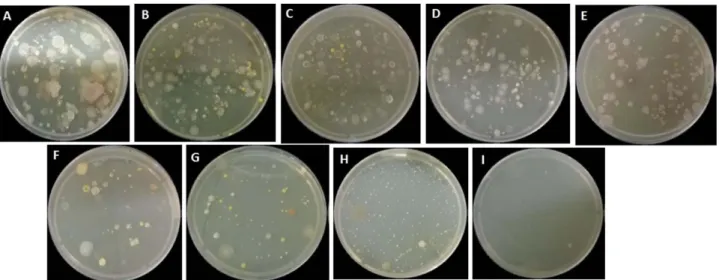
Isolation of multiple heavy metal resistant bacteria Primary screening for multiple heavy metal resistant bacteria resulted in three isolated colonies when plated with 10-8 serial diluted water sample. All the three colo- nies showed resistant to multiple heavy metals as they
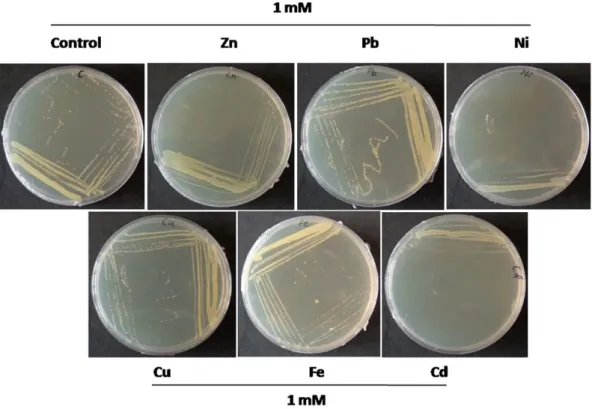
grew well in LB agar plate supplemented with 1 mM of each heavy metal (Fig. 1). The bacterial isolates showed growth on all the heavy metal supplemented LB agar plates when their multiple heavy metal tolerance capa- bility was analyzed (Fig. 2).
Characterization of bacterial isolates
In order to identify the isolates, all the three colonies obtained from 10-8 serial diluted water samples were molecular characterized using 16S rRNA gene sequenc- ing. The 16S rRNA gene sequence obtained was submit- ted to GenBank with the accession number MH685192.
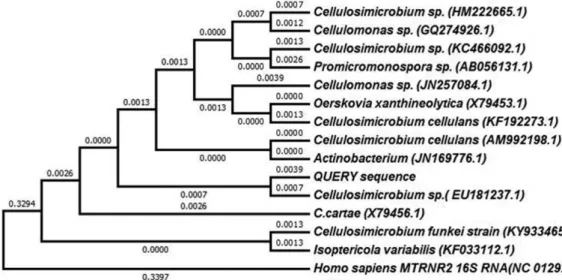
The sequence was later used for BLASTN analysis which showed that all the three colonies were same and identified as Cellulosimicrobium sp. (Table 1). There- fore, for further analysis out of the three isolates, only one was considered. The sequence of all the BLAST hits that showed 99% identity were retrieved and used for multiple sequence alignment using MEGA 6. Multiple sequence alignment showed similarities with the all sequences of different species obtained from the BLAST hits (Fig. S1). Phylogenetic tree analysis showed that the bacterial isolates is closely related to Cellulosimicro- bium sp. (Fig. 3). Gram staining showed the bacterial strain to be gram positive bacteria (Fig. S2).
Growth analysis
The growth curve of Cellulosimicrobium sp. was Initial conc. Final conc.–
Initial conc.
--- 100×
Fig. 1. (A-I) Spread plates showing primary screening of multiple heavy metal resistant microbial cultures on LB agar plates supplemented with 1 mM of each heavy metals (Cd, Ni, Fe, Pb, Cu and Zn). (A) Control: Without diluted water samples, (B) 10-1, (C) 10-2, (D) 10-3, (E) 10-4, (F) 10-5, (G) 10-6, (H) 10-7 and (I) 10-8 serial diluted water sample.
observed under both the conditions, i.e., control and in presence of 1 mM concentration of different heavy met- als (Fig. 4). In control, the strain entered the log phase after 4 h of lag phase where it remained for 10 h. The cell
entered stationary phase after 14 h of incubation and remained for 20 h after that it entered the declined phase. The pattern of the growth in control, zinc and lead stress was similar, though the cells in 1 mM stress Fig. 2. Isolated bacterial strain showing multiple heavy metal tolerance when streak plated on LB agar plates supplemented with different concentration of either CdCl2·H2O or NiSO4·6H2O or Fe2(SO4)3·7H2O or Pb (C2H3O2)2·3H2O or CuSO4·5H2O or ZnSO4·7H2O, respectively.
Table 1. Table showing various hits obtained after BLASTN analysis.
Accession number Strain E value Query cover (%) Identify (%)
HM2226651 Cellulosimicrobium sp. strain 0707K4-3 0 98 99
GQ274926.1 Cellulosimicrobium sp. strain TUT 1242 0 98 99
KC466092.1 Cellulosimicrobium sp. strain H2 0 99 99
AB056131.1 Ptomicromonospora sp. strain IFO 16225 0 97 99
JN257084.1 Cellulosimicrobium sp. strain Aq2 0 98 99
X79453.1 Oerskovia xanthineolytica 0 98 99
KF192273.1 Cellulosimicrobium sp. strain KSKE-13 0 96 99
AM992198.1 Cellulosimicrobium cellulans 0 98 99
JN169776.1 Actinoacterium 0 98 99
X79456.1 C. Cartae MSD 0 97 99
KF033112.1 Isoptericola variabilis strain KSR05 0 97 99
EU181237.1 Cellulosimicrobium sp. strain 120-1 0 98 99
KY933465.1 Cellulosimicrobium funkei strain IHB B 0 98 99
grew a little slower in comparison to control. In 1mM iron stress, the growth was much better than that of con- trol. The cell entered the log phase only after 3 h of incu- bation and remained for 11 h. The cells entered stationary phase after 14 h of incubation and decline phase was seen after 40 h of incubation. The growth rate of bacteria was slower for copper, nickel and cadmium treated culture (Fig. 4). In the present study, growth of Cellulosimicrobium sp. was observed to be much slower in cadmium and nickel indicating that 1 mM concentra- tion of these two metals is more toxic compared to other heavy metals tested.
Effect of different heavy metal stress on protein content To study the effect of different heavy metals on the
total protein content, supernatant obtained after sonica- tion was estimated for each of the six different metal- treated cells and calculated using the BSA standard curve. The protein content in the iron-treated culture was found to be maximum followed by control (Fig. 5).
Protein content decreased or increased upon heavy metal stress treatment. In comparison to control, it was around 77.27, 16.27, 4.34, and 0.8% decreased under cadmium, nickel, copper and zinc stress, respectively.
Upon iron and lead stress treatment, 19.58, and 1.66%
increase in protein content was noted (Fig. 5).
Effect of different concentration of heavy metals on growth
To study the tolerance level, the isolated Cellulosimi- Fig. 3. Neighbor-joining evolutionary tree showing relationship of 16S rRNA gene (Accession No. MH685192) with other sequences used in Multiple Sequence Alignment analysis.
Fig. 4. Growth curve of Cellulosimicrobium sp. under 1 mM concentration of different heavy metals.
Fig. 5. Protein content of Cellulosimicrobium sp. under 1 mM concentration of different heavy metals.
crobium sp. strain was grown on LB agar plates supple- mented with different heavy metals of varying concentration. The growth of the Cellulosimicrobium sp.
was higher on LB agar plate supplemented with iron, where it grew till 7 mM concentration and least was observed for cadmium, where its growth was observed till 2 mM (Fig. S3A; S3F). The bacterial strain tolerated up to 6 mM concentration in lead, 5 mM in zinc and cop- per and 3 mM in nickel supplemented LB agar plates (Fig. S3B−S3E).
Bioremediation assay
The bioremediation capability of Cellulosimicrobium sp. was studied with the aid of inductive plasma cou- pling mass spectrometer. It was observed that isolated strain can sequestered/consumed maximum of 70.26%
iron and least 7.65% for cadmium (Table 2). The bacte- rial strain has shown the bioremediation capability of sequestering 24.12%, 22.82%, 21.21% and 18.98% of lead, zinc, copper, and nickel from medium, respectively.
Discussion
Heavy metals are non-essential metals which are not required by the cell and are toxic to organism even at very low concentration. Higher concentration of both non-essential and essential metals are toxic to the cells, they can block the normal function of the cell, and also damage the DNA leading to the cell death [6]. However, few species have the mechanism to grow and survive under extreme environment conditions. In order to iso- late microbes with multiple heavy metal tolerant capa- bility, it is important to choose the sites or locations that allows or promote the growth of strains of our interest.
Therefore, in the present study, we have isolated the
bacterial strain from the river Yamuna, New Delhi, India. In the recent papers, it has been shown that the river Yamuna in contaminated with different heavy metals due to dumping of industrial waste and various other human activities [16, 24, 25]. Thus, bacterial strain isolated from such environment, i.e., Yamuna River, may possess the mechanism of heavy metal toler- ance.
As expected the growth was observed when the bacte- rial isolates was grown in LB agar plates supplemented with 1 mM of different heavy metals. Gram staining showed that the bacteria isolated to be Gram positive.
Further, upon molecular characterization using 16s rRNA gene sequencing, BLASTN and phylogenetic tree analysis, the isolated bacteria was found to be genus Cellulosimicrobium. It is known that the genus Cellu- losimicrobium is a Gram-positive, yellow-pigmented, non-motile and rod-shaped or coccoid bacterial strain [26, 27]. Cellulosimicrobium sp. which was isolated from the Yamuna in the present study, was earlier reported from soil [28], tannery waste water [25, 29] and in radio- active wastewater [30]. In one of the study Cellulosimi- crobium sp. was also isolated from the patient with acute renal failure [31]. Recent studies have also shown that this may cause bacteremia in bone marrow of trans- plant patients [32].
Growth rate of Cellulosimicrobium sp. when exposed to various treatments cannot be compared as each treat- ment has its own toxicity and the strain response will also be different. However, under control conditions the strain has very short lag phage of 3−4 h followed by 8−
10 h of log phase. In the present study, stationary phase remained for 20 h followed by decline phase. In the ear- lier reports it has been noted that growth rate varies with the treatments and amongst species [33−35].
Under stress condition it is well know that microbes or plants tries to express genes that codes for the proteins involves in providing tolerance against the adverse con- ditions. In the present study, under different heavy metal stress the protein content varied with maximum during iron stress and least under cadmium and nickel.
The protein content observed can be correlated with the growth rate of Cellulosimicrobium sp. indicating that the strain tried to express various transporters or enzymes for its survival. Most of the earlier studies are limited to adaptability of the Cellulosimicrobium sp. in Table 2. Bioremediation capability of Cellulosimicrobium sp.
S No. Metals
Initial concentration
(ppm)
Final concentration
(ppm)
Accumulation (%)
1 Cadmium 98 90.50 7.65
2 Iron 27.95 8.31 70.26
3 Lead 31.84 24.16 24.12
4 Nickel 54 43.75 18.98
5 Copper 27.15 21.39 21.21
6 Zinc 16.12 12.44 22.82
chromium and thorium contaminated environment [25, 30]. Various heavy metals can alleviate or suppress the microbial activity under the mixture conditions. Some may have a synergistic and some may have an antago- nistic effect on the overall growth and sustainability of the organism [36−38]. The present study showed that the bacteria strain is found to be resistant towards mul- tiple heavy metals which include lead, iron, copper, zinc, nickel and cadmium. This may be due to fact that the bacteria may have high potential as chemisorptions sites [39, 40].
In the present study, the bioremediation capability showed that the strain Cellulosimicrobium sp. has capa- bility to consume or sequester iron more than cadmium.
The bioremediation capability is more for iron > lead >
zinc > cooper > nickel > cadmium. Recently, Cellulo- simicrobium sp. has been reported for utilizing benzo(a)pyrene (BaP) the sole carbon and energy source under nitrate-reducing conditions [34], potential of reducing toxic Cr(VI) to non-toxic Cr(III) [25] and reme- diation of thorium (IV) [30]. Thus, the bacterial strain Cellulosimicrobium sp. isolated in the present study can serve as a model system for understanding the molecu- lar mechanism of heavy metal tolerance in microbes using transcriptome profiling [17, 41].
Acknowledgments
This investigation has been carried out under the Faculty Research Grant Scheme awarded to RSP (Grant No. GGSIPU/DRC/FRGS/2018/
26[1114]L) from GGS Indraprastha University, New Delhi, India. We also thank GGS Indraprastha University, New Delhi for all the labora- tory space and encouragement.
Conflict of Interest
The authors have no financial conflicts of interest to declare.
References
1. Gadd GM. 1992. Metals and microorganisms: A problem of defi- nition. FEMS Microbiol. Lett. 100: 197-203.
2. Nies DH. 1999. Microbial heavy-metal resistance. Appl. Microbiol.
Biotechnol. 51: 730-750.
3. Trevors JT, Oddie KM, Belliveau BH. 1985. Metal resistance in bac- teria. FEMS Microbiol. Lett. 32: 39-54.
4. Bhattacharyya S, Chatterjee S, Basu S. 2008. Mercury pollution:
The problem still persists. Everyman’s Sci. 42: 279-286.
5. Lima e Silva AAD, Carvalho MA, de Souza SA, Dias PMT, Silva Filho RGD, Saramago CS, et al. 2012. Heavy metal tolerance (Cr, Ag and Hg) in bacteria isolated from sewage. Braz. J. Microbiol. 43: 1620- 1631.
6. Bruins MR, Kapil S, Oehme FW. 2000. Microbial resistance to met- als in the environment. Ecotoxicol. Environ. Saf. 45: 198-207.
7. Valko M, Morris H, Cronin M. 2005. Metals, toxicity and oxidative stress. Curr. Med. Chem. 12: 1161-1208.
8. Jaishankar M, Tseten T, Anbalagan N, Mathew BB, Beeregowda KN. 2014. Toxicity, mechanism and health effects of some heavy metals. Interdiscip. Toxicol. 7: 60-72.
9. Singh N, Kumar D, Sahu AP. 2007. Arsenic in the environment:
effects on human health and possible prevention. J. Environ. Biol.
28: 359-365.
10. Hopkins J. 1991. IARC Monographs on the evaluation of carcino- genic risks to humans: Volume 49. Chromium, nickel and weld- ing. Food Chem. Toxicol. 29: 647-648.
11. Ahluwalia SS, Goyal D. 2007. Microbial and plant derived bio- mass for removal of heavy metals from wastewater. Bioresour.
Technol. 98: 2243-2257.
12. Hussein H, Farag S, Moawad H. 2003. Isolation and characteriza- tion of Pseudomonas resistant to heavy metals contaminants.
Arab. J. Biotechnol. 7: 13-22.
13. Waisberg M, Joseph P, Hale B, Beyersmann D. 2003. Molecular and cellular mechanisms of cadmium carcinogenesis. Toxicology 192: 95-117.
14. Kapoor A, Viraraghavan T. 1995. Fungal biosorption—an alterna- tive treatment option for heavy metal bearing wastewaters: a review. Bioresour. Technol. 53: 195-206.
15. Kang CH, Kwon YJ, So JS. 2016. Bioremediation of heavy metals by using bacterial mixtures. Ecol. Eng. 89: 64-69.
16. Sehgal M, Garg A, Suresh R, Dagar P. 2012. Heavy metal contami- nation in the Delhi segment of Yamuna basin. Environ. Monit.
Assess. 184: 1181-1196.
17. Volpicella M, Leoni C, Manzari C, Chiara M, Picardi E, Piancone E, et al. 2017. Transcriptomic analysis of nickel exposure in Sphingo- bium sp. ba1 cells using RNA-seq. Sci. Rep. 7: 8262.
18. Clarridge JE. 2004. Impact of 16S rRNA gene sequence analysis for identification of bacteria on clinical microbiology and infec- tious diseases. Clin. Microbiol. Rev. 17: 840-862.
19. Altschul SF, Gish W, Miller W, Myers EW, Lipman DJ. 1990. Basic local alignment search tool. J. Mol. Biol. 215: 403-410.
20. Tamura K, Stecher G, Peterson D, Filipski A, Kumar S. 2013.
MEGA6: Molecular Evolutionary Genetics Analysis Version 6.0.
Mol. Biol. Evol. 30: 2725-2729.
21. Waterhouse AM, Procter JB, Martin DMA, Clamp M, Barton GJ.
2009. Jalview Version 2 - a multiple sequence alignment editor and analysis workbench. Bioinformatics 25: 1189-1191.
22. Smith AC, Hussey MA. 2005. Gram stain protocols. In: ACM Micro- belibrary - Laboratory protocols. American Society for Microbiol- ogy, Washington, USA, http://www.microbelibrary.org
23. Lowry OH, Rosebrough NJ, Farr AL, Randel JR. l951. Protein esti- mation with folin phenol reagent. J. Biol. Chem. 193: 265-275.
24. Kaushik A, Kansal A, Kumari S, Kaushik CP. 2009. Heavy metal contamination of river Yamuna, Haryana, India: assessment by metal enrichment factor of the sediments. J. Hazard. Mater. 164:
265-270.
25. Bharagava RN, Mishra S. 2018. Hexavalent chromium reduction potential of Cellulosimicrobium sp. isolated from common efflu- ent treatment plant of tannery industries. Ecotoxicol. Environ. Saf.
147: 102-109.
26. Schumann P, Weiss N, Stackebrandt E. 2001. Reclassification of Cellulomonas cellulans (Stackebrandt and Keddie 1986) as Cellu- losimicrobium cellulans gen. nov., comb. nov. Int. J. Syst. Evol.
Microbiol. 51: 1007-1010.
27. Scott JR, Zähner D. 2006. Pili with strong attachments: Gram- positive bacteria do it differently. Mol. Microbiol. 62: 320-330.
28. Yoon JH, Kang SJ, Schumann P, Oh TK. 2007. Cellulosimicrobium terreum sp. nov., isolated from soil. Int. J. Syst. Evol. Microbiol. 57:
2493-2497.
29. Chandra R, Bharagava RN, Kapley A, Purohit HJ. 2011. Bacterial diversity, organic pollutants and their metabolites in two aera- tion lagoons of common effluent treatment plant (CETP) during the degradation and detoxification of tannery wastewater. Biore- sour. Technol. 102: 2333-2341.
30. Elwakeel KZ, El-Sadik HA, Abdel-Razek AS, Beheary MS. 2012.
Environmental remediation of thorium (IV) from aqueous medium onto Cellulosimicrobium cellulans isolated from radioac- tive wastewater. Desalination Water Treat. 46: 1-9.
31. Delport J, Wakabayashi AT, Anantha RV, Lannigan R, John M, McCormick JK. 2014. Cellulosmicrobium cellulans isolated from a patient with acute renal failure. JMM Case Rep. 1.
32. Gonzales Zamora JA, Camps N. 2018. Bacteremia caused by Cel- lulosimicrobium in a bone marrow transplant patient: A case
report and literature review. IDCases 11: 64-66.
33. Youssef AS, Beltagy EA, El-Shenawy MA, El-Assar SA. 2012. Pro- duction of k-carrageenase by Cellulosimicrobium cellulans iso- lated from Egyptian Mediterranean coast. Afr. J. Microbiol. Res. 6:
6618-6628.
34. Rizvi F, Kanwal W, Faisal M. 2016. Chromate-reducing profile of bacterial strains isolated from industrial effluents. Pol. J. Environ.
Stud. 25: 2121-2128.
35. Qin W, Fan F, Zhu Y, Huang X, Ding A, Liu X, et al. 2018. Anaerobic biodegradation of benzo(a)pyrene by a novel Cellulosimicrobium cellulans CWS2 isolated from polycyclic aromatic hydrocarbon- contaminated soil. Braz. J. Microbiol. 49: 258-268.
36. Vijver MG, Elliott EG, Peijnenburg WJGM, de Snoo GR. 2011.
Response predictions for organisms water-exposed to metal mixtures: a meta-analysis. Environ. Toxicol. Chem. 30: 1482-1487.
37. Cabrero A, Fernandez S, Mirada F, Garcia J. 1998. Effects of copper and zinc on the activated sludge bacteria growth kinetics. Water Res. 32: 1355-1362.
38. Rial D, Vázquez JA, Murado MA. 2011. Effects of three heavy met- als on the bacteria growth kinetics: a bivariate model for toxico- logical assessment. Appl. Microbiol. Biotechnol. 90: 1095-1109.
39. Tunali S, Cabuk A, Akar T. 2006. Removal of lead and copper ions from aqueous solutions by bacterial strain isolated from soil.
Chem. Eng. J. 115: 203-211.
40. Gupta K, Chatterjee C, Gupta B. 2012. Isolation and characteriza- tion of heavy metal tolerant Gram-positive bacteria with biore- medial properties from municipal waste rich soil of Kestopur canal (Kolkata), West Bengal, India. Biologia. 67: 827-836.
41. Zhang Y, Chen S, Hao X, Su JQ, Xue X, Yan Y, et al. 2016. Transcrip- tomic analysis reveals adaptive responses of an Enterobacteria- ceae Strain LSJC7 to arsenic exposure. Front. Microbiol. 7: 636.